CELT WORKSHOP Getting Published: Exploring the Issues and Dispelling the Myths Professor Simon Haslett Centre for Excellence in Learning and Teaching Canolfan dros Ragoriaeth mewn Dysgu ac Addysgu Email:  [email_address] Website:  http://celt.newport.ac.uk
Attention! Welcome to the  Getting Published  workshop. Please come in and help yourself to tea or coffee. Please sit at a table where there are at least some people who you have never met or don’t know that well , but don’t worry I’m sure they won’t bite! No more than six people to a table please.
A bit about the facilitator Since 1990 Simon has published: Over 120 academic articles, mostly peer-reviewed journal articles. Over 50 articles in the popular press (newspapers, magazines, blogs, etc). Over 50 conference papers. Seven edited books (three as sole editor). Two sole authored books. Served as editor on four academic peer-reviewed journals and professional magazines (e.g. for learned society).
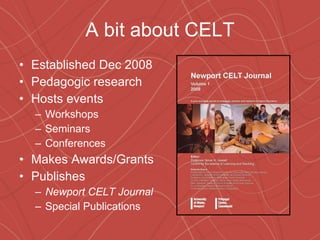
A bit about CELT Established Dec 2008 Pedagogic research Hosts events Workshops Seminars Conferences Makes Awards/Grants Publishes Newport CELT Journal Special Publications
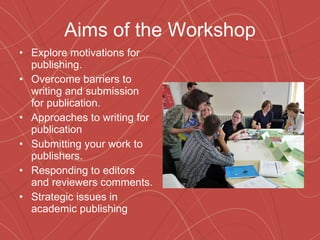
Aims of the Workshop Explore motivations for publishing. Overcome barriers to writing and submission for publication. Approaches to writing for publication Submitting your work to publishers. Responding to editors and reviewers comments. Strategic issues in academic publishing
Why are you here? What are your motivations for wanting to write and publish your work? In your table groups, take it in turns to tell each other and discuss your main motivation for wanting to get published. Someone write each one down in the centre column of on the flipchart paper to report back. 10-15 minutes
What are you bringing with you? Turn to someone you don’t know, or don’t know very well, introduce yourself and  tell them about a piece of writing that you have written  and are proud of, published or not (5 mins each). List up to three positive writing tips  each (things that helped you) on a  white  post-it that you are happy to share; stick them onto the groups flipchart down the left-hand side. In your pairs, after around 10 minutes,  agree two top tips to share with the rest of the group  and discuss. Should take around 15-20 minutes altogether.
So  why  are you here? What are the barriers that are preventing you writing and/or publishing your work? In groups of three, discuss the main barriers to writing and getting published. Write each one down on a yellow post-it note and stick to the right side of the flipchart paper. 10-15 minutes
Mid-Plenary Session In your table groups, stick your flipchart paper on the wall/window, whiteboard, etc. Wander around the room and look at what other groups have written in terms of: Motivation Tips Barriers Could you use this to inform your approach to writing and publication?
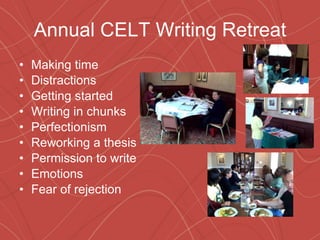
Annual CELT Writing Retreat Making time Distractions Getting started Writing in chunks Perfectionism Reworking a thesis Permission to write Emotions Fear of rejection
Submitting for Publication Who is your audience? Types of publications? Choosing a journal to submit to. Preparing your manuscript. What not to do. Possible outcomes Dealing with and overcoming rejection Responding to reviewers comments
Making your name known Collaborate with your supervisor (or a colleague) Become active in your academic community Present at conferences Journal editors actively look out for good papers Prepare effective conference posters Network: talk to journal editors (who are other academics) Write working papers Practice in writing academic papers Useful feedback Does not count as prior publication if revised Create your own website
Audience Local, national, international? Researchers, practitioners, teachers, general public? Type of Publication Journal article (watch out for special issues) Magazine article Review article Book review – good way of starting Research note (short report or work in progress) Working paper – mainly for conferences Book or chapter in book (often through invitation)
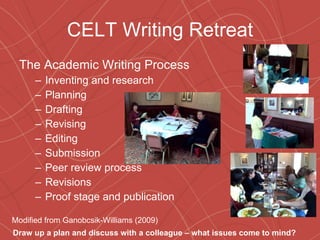
CELT Writing Retreat The Academic Writing Process Inventing and research Planning Drafting Revising Editing Submission Peer review process Revisions Proof stage and publication Modified from Ganobcsik-Williams (2009) Draw up a plan and discuss with a colleague – what issues come to mind?
Choosing the Right Journal Research the journals in your field Library and websites Conference stands Talk to peers  Familiarise yourself with aims and scope of journals Choose the most suitable journal(s) for your article Good to have a fall back or two Should it be an Open Access journal?  http://www.youtube.com/watch?v=7mRFRe4DxdM Type of journal (pro’s and con’s) Multidisciplinary (often for a general subject readership) Niche (need to be hot on specifics) Do you Write an article for a specific journal? (I prefer this from the start) Find a journal for your article? (if I haven’t chosen a journal yet)
Assessing the Best Journal for Your Article What is the readership and usage? Prestige in your field Who is the editor and who are on the editorial board? Who is likely to review your paper – can you suggest reviewers? Is  Who publishes in the journal?  Is it published by a major publisher or association?  Local/national/international? Is it peer reviewed How long will this take? Is it on the Institute of Scientific Information (ISI) Citation Database? How often is it cited? Is it available online and in print?
Writing for Your Chosen Journal Check the aims and scope Look at previous papers to get a feel for what is accepted – has it got a history in a topic area? Contact the editor – maybe? What does my research contribute to the field? Make your research relevant to the wider world; you need to be explicit about its widest context. Ask a colleague to read paper prior to submission – maybe? Except where English needs to be checked/improved.
Preparing the Manuscript Read the guidelines carefully – many submit through an online gateway now. Comply with minimum and maximum limits  Expand any acronyms Especially if the audience is international or interdisciplinary Write an abstract that conveys the content, results and main conclusions (add keywords) Check spelling and grammar Double spaced and single sided (usually required).
Manuscript Preparation Cont’d. Ensure references cited in text appear in bibliography – and vice versa Not too many self-references if reviewed anonymously (add them after review) Figures, tables and photographs Check they are ALL present Resolution and file type is important e.g. TIFFs Observe conventions e.g. maps should have scale bars and north arrow Place in a separate file Make sure they are all numbered and referred to Consider/suggest how they will appear in the journal Ensure you have the correct copyright clearance Some journals now accept audio and video clips
What not to do Don’t try to boil down your whole PhD/Masters thesis into one article Don’t put the article on your website first Don’t send your article to more than one journal at once Don’t plagiarise, including self-plagiarism Don’t repeat the same article with just small changes Don’t wait for a decision before you start your next article.
Possible outcomes Accept as submitted – very rare Accept with minor revisions Accept with major revisions – with or without second peer-review stage. Higher Education Quarterly  receives c. 90 papers/year and accepts 30%, but 30% of those are never resubmitted after revision. Reject – common Studies in Higher Education  rejects 350 of the 400 papers it receives every year!
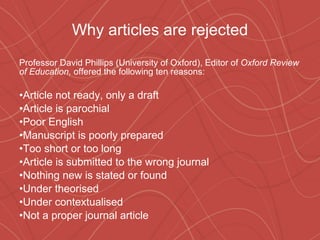
Why articles are rejected Professor David Phillips (University of Oxford), Editor of  Oxford Review of Education,  offered the following ten reasons: Article not ready, only a draft Article is parochial Poor English Manuscript is poorly prepared  Too short or too long Article is submitted to the wrong journal Nothing new is stated or found Under theorised Under contextualised Not a proper journal article
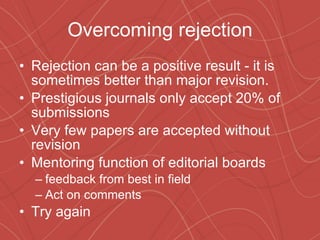
Overcoming rejection Rejection can be a positive result - it is sometimes better than major revision. Prestigious journals only accept 20% of submissions Very few papers are accepted without revision Mentoring function of editorial boards feedback from best in field  Act on comments  Try again
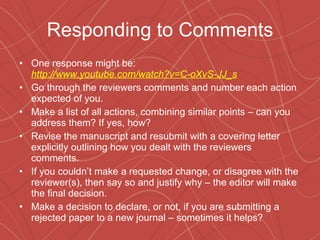
Responding to Comments One response might be:  http://www.youtube.com/watch?v=C-oXvS-JJ_s Go through the reviewers comments and number each action expected of you. Make a list of all actions, combining similar points – can you address them? If yes, how? Revise the manuscript and resubmit with a covering letter explicitly outlining how you dealt with the reviewers comments. If you couldn’t make a requested change, or disagree with the reviewer(s), then say so and justify why – the editor will make the final decision. Make a decision to declare, or not, if you are submitting a rejected paper to a new journal – sometimes it helps?
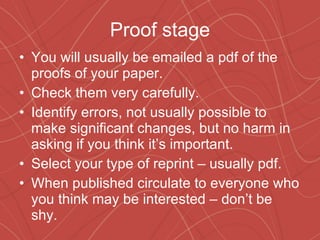
Proof stage You will usually be emailed a pdf of the proofs of your paper. Check them very carefully. Identify errors, not usually possible to make significant changes, but no harm in asking if you think it’s important. Select your type of reprint – usually pdf. When published circulate to everyone who you think may be interested – don’t be shy.
Strategic Issues Some issues that may influence you: Research Excellence Framework (REF) High impact, ISI-listed journals Research Degree Awarding Powers (RDAPs) Learned/professional society journals Institutional/Departmental Strategy E.g. Research-informed teaching To assist in gaining external funding Prioritisation and personal goals E.g. always wanted to publish in a particular journal
What’s your next move? In pairs, discuss what might be your next step on the road to writing and getting published? For example: Will you collaborate or go it alone? Do you have any strategic priorities? Do you need further support or advice? Draw up a personal action plan with targets and a timescale for achieving them; what will you do if you don’t meet them?
Useful Resources HEA-ICS, 2007.  Writing for Publication .  http://www.ics.heacademy.ac.uk/events/displayevent.php?id=187  [accessed 28 th  June 2010]. Taylor and Francis Ltd, 2004.  Getting published in academic publications: Tips to Help you Publish Successfully.  At  www.lancs.ac.uk/celt/celtweb/files/ gettingpublished _js.ppt  [accessed 28th June 2010]. Vitae, 2010.  Publishing your research .  http://www.vitae.ac.uk/researchers/1298/Publishing-your-research.html  [accessed 28th June 2010].

Getting Published Workshop

  • 1.
    CELT WORKSHOP GettingPublished: Exploring the Issues and Dispelling the Myths Professor Simon Haslett Centre for Excellence in Learning and Teaching Canolfan dros Ragoriaeth mewn Dysgu ac Addysgu Email: [email_address] Website: http://celt.newport.ac.uk
  • 2.
    Attention! Welcome tothe Getting Published workshop. Please come in and help yourself to tea or coffee. Please sit at a table where there are at least some people who you have never met or don’t know that well , but don’t worry I’m sure they won’t bite! No more than six people to a table please.
  • 3.
    A bit aboutthe facilitator Since 1990 Simon has published: Over 120 academic articles, mostly peer-reviewed journal articles. Over 50 articles in the popular press (newspapers, magazines, blogs, etc). Over 50 conference papers. Seven edited books (three as sole editor). Two sole authored books. Served as editor on four academic peer-reviewed journals and professional magazines (e.g. for learned society).
  • 4.
    A bit aboutCELT Established Dec 2008 Pedagogic research Hosts events Workshops Seminars Conferences Makes Awards/Grants Publishes Newport CELT Journal Special Publications
  • 5.
    Aims of theWorkshop Explore motivations for publishing. Overcome barriers to writing and submission for publication. Approaches to writing for publication Submitting your work to publishers. Responding to editors and reviewers comments. Strategic issues in academic publishing
  • 6.
    Why are youhere? What are your motivations for wanting to write and publish your work? In your table groups, take it in turns to tell each other and discuss your main motivation for wanting to get published. Someone write each one down in the centre column of on the flipchart paper to report back. 10-15 minutes
  • 7.
    What are youbringing with you? Turn to someone you don’t know, or don’t know very well, introduce yourself and tell them about a piece of writing that you have written and are proud of, published or not (5 mins each). List up to three positive writing tips each (things that helped you) on a white post-it that you are happy to share; stick them onto the groups flipchart down the left-hand side. In your pairs, after around 10 minutes, agree two top tips to share with the rest of the group and discuss. Should take around 15-20 minutes altogether.
  • 8.
    So why are you here? What are the barriers that are preventing you writing and/or publishing your work? In groups of three, discuss the main barriers to writing and getting published. Write each one down on a yellow post-it note and stick to the right side of the flipchart paper. 10-15 minutes
  • 9.
    Mid-Plenary Session Inyour table groups, stick your flipchart paper on the wall/window, whiteboard, etc. Wander around the room and look at what other groups have written in terms of: Motivation Tips Barriers Could you use this to inform your approach to writing and publication?
  • 10.
    Annual CELT WritingRetreat Making time Distractions Getting started Writing in chunks Perfectionism Reworking a thesis Permission to write Emotions Fear of rejection
  • 11.
    Submitting for PublicationWho is your audience? Types of publications? Choosing a journal to submit to. Preparing your manuscript. What not to do. Possible outcomes Dealing with and overcoming rejection Responding to reviewers comments
  • 12.
    Making your nameknown Collaborate with your supervisor (or a colleague) Become active in your academic community Present at conferences Journal editors actively look out for good papers Prepare effective conference posters Network: talk to journal editors (who are other academics) Write working papers Practice in writing academic papers Useful feedback Does not count as prior publication if revised Create your own website
  • 13.
    Audience Local, national,international? Researchers, practitioners, teachers, general public? Type of Publication Journal article (watch out for special issues) Magazine article Review article Book review – good way of starting Research note (short report or work in progress) Working paper – mainly for conferences Book or chapter in book (often through invitation)
  • 14.
    CELT Writing RetreatThe Academic Writing Process Inventing and research Planning Drafting Revising Editing Submission Peer review process Revisions Proof stage and publication Modified from Ganobcsik-Williams (2009) Draw up a plan and discuss with a colleague – what issues come to mind?
  • 15.
    Choosing the RightJournal Research the journals in your field Library and websites Conference stands Talk to peers Familiarise yourself with aims and scope of journals Choose the most suitable journal(s) for your article Good to have a fall back or two Should it be an Open Access journal? http://www.youtube.com/watch?v=7mRFRe4DxdM Type of journal (pro’s and con’s) Multidisciplinary (often for a general subject readership) Niche (need to be hot on specifics) Do you Write an article for a specific journal? (I prefer this from the start) Find a journal for your article? (if I haven’t chosen a journal yet)
  • 16.
    Assessing the BestJournal for Your Article What is the readership and usage? Prestige in your field Who is the editor and who are on the editorial board? Who is likely to review your paper – can you suggest reviewers? Is Who publishes in the journal? Is it published by a major publisher or association? Local/national/international? Is it peer reviewed How long will this take? Is it on the Institute of Scientific Information (ISI) Citation Database? How often is it cited? Is it available online and in print?
  • 17.
    Writing for YourChosen Journal Check the aims and scope Look at previous papers to get a feel for what is accepted – has it got a history in a topic area? Contact the editor – maybe? What does my research contribute to the field? Make your research relevant to the wider world; you need to be explicit about its widest context. Ask a colleague to read paper prior to submission – maybe? Except where English needs to be checked/improved.
  • 18.
    Preparing the ManuscriptRead the guidelines carefully – many submit through an online gateway now. Comply with minimum and maximum limits Expand any acronyms Especially if the audience is international or interdisciplinary Write an abstract that conveys the content, results and main conclusions (add keywords) Check spelling and grammar Double spaced and single sided (usually required).
  • 19.
    Manuscript Preparation Cont’d.Ensure references cited in text appear in bibliography – and vice versa Not too many self-references if reviewed anonymously (add them after review) Figures, tables and photographs Check they are ALL present Resolution and file type is important e.g. TIFFs Observe conventions e.g. maps should have scale bars and north arrow Place in a separate file Make sure they are all numbered and referred to Consider/suggest how they will appear in the journal Ensure you have the correct copyright clearance Some journals now accept audio and video clips
  • 20.
    What not todo Don’t try to boil down your whole PhD/Masters thesis into one article Don’t put the article on your website first Don’t send your article to more than one journal at once Don’t plagiarise, including self-plagiarism Don’t repeat the same article with just small changes Don’t wait for a decision before you start your next article.
  • 21.
    Possible outcomes Acceptas submitted – very rare Accept with minor revisions Accept with major revisions – with or without second peer-review stage. Higher Education Quarterly receives c. 90 papers/year and accepts 30%, but 30% of those are never resubmitted after revision. Reject – common Studies in Higher Education rejects 350 of the 400 papers it receives every year!
  • 22.
    Why articles arerejected Professor David Phillips (University of Oxford), Editor of Oxford Review of Education, offered the following ten reasons: Article not ready, only a draft Article is parochial Poor English Manuscript is poorly prepared Too short or too long Article is submitted to the wrong journal Nothing new is stated or found Under theorised Under contextualised Not a proper journal article
  • 23.
    Overcoming rejection Rejectioncan be a positive result - it is sometimes better than major revision. Prestigious journals only accept 20% of submissions Very few papers are accepted without revision Mentoring function of editorial boards feedback from best in field Act on comments Try again
  • 24.
    Responding to CommentsOne response might be: http://www.youtube.com/watch?v=C-oXvS-JJ_s Go through the reviewers comments and number each action expected of you. Make a list of all actions, combining similar points – can you address them? If yes, how? Revise the manuscript and resubmit with a covering letter explicitly outlining how you dealt with the reviewers comments. If you couldn’t make a requested change, or disagree with the reviewer(s), then say so and justify why – the editor will make the final decision. Make a decision to declare, or not, if you are submitting a rejected paper to a new journal – sometimes it helps?
  • 25.
    Proof stage Youwill usually be emailed a pdf of the proofs of your paper. Check them very carefully. Identify errors, not usually possible to make significant changes, but no harm in asking if you think it’s important. Select your type of reprint – usually pdf. When published circulate to everyone who you think may be interested – don’t be shy.
  • 26.
    Strategic Issues Someissues that may influence you: Research Excellence Framework (REF) High impact, ISI-listed journals Research Degree Awarding Powers (RDAPs) Learned/professional society journals Institutional/Departmental Strategy E.g. Research-informed teaching To assist in gaining external funding Prioritisation and personal goals E.g. always wanted to publish in a particular journal
  • 27.
    What’s your nextmove? In pairs, discuss what might be your next step on the road to writing and getting published? For example: Will you collaborate or go it alone? Do you have any strategic priorities? Do you need further support or advice? Draw up a personal action plan with targets and a timescale for achieving them; what will you do if you don’t meet them?
  • 28.
    Useful Resources HEA-ICS,2007. Writing for Publication . http://www.ics.heacademy.ac.uk/events/displayevent.php?id=187 [accessed 28 th June 2010]. Taylor and Francis Ltd, 2004. Getting published in academic publications: Tips to Help you Publish Successfully. At www.lancs.ac.uk/celt/celtweb/files/ gettingpublished _js.ppt [accessed 28th June 2010]. Vitae, 2010. Publishing your research . http://www.vitae.ac.uk/researchers/1298/Publishing-your-research.html [accessed 28th June 2010].