Research
methods
YEAR 3
Research Topic
Try to pick a topic that you find interesting. This will ensure the research process is as engaging
and fun as possible.
Ask yourself: What am I curious about? What questions do I have? What topic would I like to
learn more about? [If you’re still not sure, think of 3 things that interest you, even if you don’t
think they relate to your class. You might be surprised at the connections you can make!]
Even while you’re writing, your topic may change slightly. In many ways, writing is a way of
thinking through your topic. As you write—and think—you may decide to refine your topic to
better reflect the content of your research paper
Research Introduction
An introduction provides an overview of your topic and any background information that
your readers need to know in order to understand the context.
Most of your introduction should be taken up with background information, but this
doesn’t mean that you should fill your opening section with overly general statements.
AIMS
This is a high level statement summarizing the main goal of the report.
The conclusions should be clear and be able to link with the objectives.
The following phrases will help you recognize the aims
• the research aims to…
• the aim of the study was…
•The research study was…
•The study plans to…
OBJECTIVES
• Should be practicaly oriented. Show specific to achieve the major goal/aim
• They help to evaluate the research aim
• helps to evaluate the research aim
• Break down into actionable tasks
• Objectives have to be “SMART’
To notice objectives the following phrases;
 To assess…
 To corelate…
 To observe….
 To find out…
 To quantify….
 To find out..
RESEARCH QUESTIONS
These are specific questions your research wants to answer.
They drive pieces through and connects the whole report.
Aims are used to develop questions.
Questions can be asked similar to the objectives discussed previously.
HYPOTHESIS
A hypothesis is a concept or idea that is tested through research and experiments. In
other words, it is a tentative prediction about the outcome of a study that can be tested
by research. It is developed before the data is collected based on the existing body of
knowledge in a particular area of study. Data is then collected, analyzed, and used to
support or negate the hypothesis, arriving at a definite conclusion at the end of the
research.
Thus basically, you make a prediction about the outcome at the start of the study and
conduct experiments to test whether this prediction is true and to what extent.
LITERATURE REVIEW
This is a survey of previously published and current literature that identifies the most
significant and relevant information in order to provide a deeper understanding and
overview of the topic. The goal is to present a baseline understanding of current
knowledge on the topic and identify any gaps in the research.
IMPORTANCE OF LITERATURE REVIEW
1.It can help you find new and interesting theories for your research project
2.It can help you show that you possess sound knowledge and wisdom with respect to your field of research
3.It summarizes and synthesizes the previous research studies. The summary is a recap of the important points in the research while the
synthesis is a reinterpretation, reorganization, or reshuffling of the old data.
4.It can help you connect the work of different authors to your research study
5.It can help you show the importance of your research by assessing the gaps and deficiencies in previous studies
6.It can help you present your ideas in the right order by focusing on less number of mistakes.
7.It can help you narrow your research topic according to the scope of your research.
8.The methodologies, statistical tools, and techniques can help you find methods and techniques for the present research. By analyzing
the past research, you can also predict the outcome of the tests and studies.
9.The significance of a literature review is that it helps strengthen the views of your readers with the help of citations and references from
other established sources.
The five key steps to writing a literature
review
•Search for relevant literature.
•Evaluate and select sources.
•Identify debates, themes, and gaps.
•Outline your structure.
•Write it.
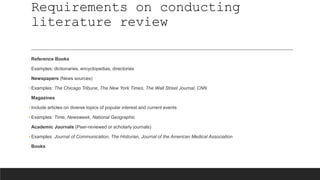
Requirements on conducting
literature review
Reference Books
Examples: dictionaries, encyclopedias, directories
Newspapers (News sources)
• Examples: The Chicago Tribune, The New York Times, The Wall Street Journal, CNN
Magazines
• Include articles on diverse topics of popular interest and current events
• Examples: Time, Newsweek, National Geographic
Academic Journals (Peer-reviewed or scholarly journals)
• Examples: Journal of Communication, The Historian, Journal of the American Medical Association
Books
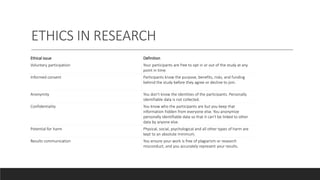
ETHICS IN RESEARCH
Ethical issue Definition
Voluntary participation Your participants are free to opt in or out of the study at any
point in time.
Informed consent Participants know the purpose, benefits, risks, and funding
behind the study before they agree or decline to join.
Anonymity You don’t know the identities of the participants. Personally
identifiable data is not collected.
Confidentiality You know who the participants are but you keep that
information hidden from everyone else. You anonymize
personally identifiable data so that it can’t be linked to other
data by anyone else.
Potential for harm Physical, social, psychological and all other types of harm are
kept to an absolute minimum.
Results communication You ensure your work is free of plagiarism or research
misconduct, and you accurately represent your results.
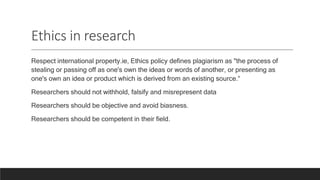
Ethics in research
Respect international property.ie, Ethics policy defines plagiarism as "the process of
stealing or passing off as one's own the ideas or words of another, or presenting as
one's own an idea or product which is derived from an existing source.“
Researchers should not withhold, falsify and misrepresent data
Researchers should be objective and avoid biasness.
Researchers should be competent in their field.
Title Lorem Ipsum
LOREM IPSUM DOLOR SIT AMET,
CONSECTETUER ADIPISCING ELIT.
NUNC VIVERRA IMPERDIET ENIM.
FUSCE EST. VIVAMUS A TELLUS.
PELLENTESQUE HABITANT MORBI
TRISTIQUE SENECTUS ET NETUS.

RSM2.pptx

  • 1.
  • 2.
    Research Topic Try topick a topic that you find interesting. This will ensure the research process is as engaging and fun as possible. Ask yourself: What am I curious about? What questions do I have? What topic would I like to learn more about? [If you’re still not sure, think of 3 things that interest you, even if you don’t think they relate to your class. You might be surprised at the connections you can make!] Even while you’re writing, your topic may change slightly. In many ways, writing is a way of thinking through your topic. As you write—and think—you may decide to refine your topic to better reflect the content of your research paper
  • 3.
    Research Introduction An introductionprovides an overview of your topic and any background information that your readers need to know in order to understand the context. Most of your introduction should be taken up with background information, but this doesn’t mean that you should fill your opening section with overly general statements.
  • 4.
    AIMS This is ahigh level statement summarizing the main goal of the report. The conclusions should be clear and be able to link with the objectives. The following phrases will help you recognize the aims • the research aims to… • the aim of the study was… •The research study was… •The study plans to…
  • 5.
    OBJECTIVES • Should bepracticaly oriented. Show specific to achieve the major goal/aim • They help to evaluate the research aim • helps to evaluate the research aim • Break down into actionable tasks • Objectives have to be “SMART’ To notice objectives the following phrases;  To assess…  To corelate…  To observe….  To find out…  To quantify….  To find out..
  • 6.
    RESEARCH QUESTIONS These arespecific questions your research wants to answer. They drive pieces through and connects the whole report. Aims are used to develop questions. Questions can be asked similar to the objectives discussed previously.
  • 7.
    HYPOTHESIS A hypothesis isa concept or idea that is tested through research and experiments. In other words, it is a tentative prediction about the outcome of a study that can be tested by research. It is developed before the data is collected based on the existing body of knowledge in a particular area of study. Data is then collected, analyzed, and used to support or negate the hypothesis, arriving at a definite conclusion at the end of the research. Thus basically, you make a prediction about the outcome at the start of the study and conduct experiments to test whether this prediction is true and to what extent.
  • 8.
    LITERATURE REVIEW This isa survey of previously published and current literature that identifies the most significant and relevant information in order to provide a deeper understanding and overview of the topic. The goal is to present a baseline understanding of current knowledge on the topic and identify any gaps in the research.
  • 9.
    IMPORTANCE OF LITERATUREREVIEW 1.It can help you find new and interesting theories for your research project 2.It can help you show that you possess sound knowledge and wisdom with respect to your field of research 3.It summarizes and synthesizes the previous research studies. The summary is a recap of the important points in the research while the synthesis is a reinterpretation, reorganization, or reshuffling of the old data. 4.It can help you connect the work of different authors to your research study 5.It can help you show the importance of your research by assessing the gaps and deficiencies in previous studies 6.It can help you present your ideas in the right order by focusing on less number of mistakes. 7.It can help you narrow your research topic according to the scope of your research. 8.The methodologies, statistical tools, and techniques can help you find methods and techniques for the present research. By analyzing the past research, you can also predict the outcome of the tests and studies. 9.The significance of a literature review is that it helps strengthen the views of your readers with the help of citations and references from other established sources.
  • 10.
    The five keysteps to writing a literature review •Search for relevant literature. •Evaluate and select sources. •Identify debates, themes, and gaps. •Outline your structure. •Write it.
  • 11.
    Requirements on conducting literaturereview Reference Books Examples: dictionaries, encyclopedias, directories Newspapers (News sources) • Examples: The Chicago Tribune, The New York Times, The Wall Street Journal, CNN Magazines • Include articles on diverse topics of popular interest and current events • Examples: Time, Newsweek, National Geographic Academic Journals (Peer-reviewed or scholarly journals) • Examples: Journal of Communication, The Historian, Journal of the American Medical Association Books
  • 12.
    ETHICS IN RESEARCH Ethicalissue Definition Voluntary participation Your participants are free to opt in or out of the study at any point in time. Informed consent Participants know the purpose, benefits, risks, and funding behind the study before they agree or decline to join. Anonymity You don’t know the identities of the participants. Personally identifiable data is not collected. Confidentiality You know who the participants are but you keep that information hidden from everyone else. You anonymize personally identifiable data so that it can’t be linked to other data by anyone else. Potential for harm Physical, social, psychological and all other types of harm are kept to an absolute minimum. Results communication You ensure your work is free of plagiarism or research misconduct, and you accurately represent your results.
  • 13.
    Ethics in research Respectinternational property.ie, Ethics policy defines plagiarism as "the process of stealing or passing off as one's own the ideas or words of another, or presenting as one's own an idea or product which is derived from an existing source.“ Researchers should not withhold, falsify and misrepresent data Researchers should be objective and avoid biasness. Researchers should be competent in their field.
  • 15.
    Title Lorem Ipsum LOREMIPSUM DOLOR SIT AMET, CONSECTETUER ADIPISCING ELIT. NUNC VIVERRA IMPERDIET ENIM. FUSCE EST. VIVAMUS A TELLUS. PELLENTESQUE HABITANT MORBI TRISTIQUE SENECTUS ET NETUS.