Writing for Broadcast
 Identify how writing for TV & radio differs from
other types of writing
 Explain the most important factors when
writing for TV & radio
 Identify how attribution and quotations are
different in TV & radio than print news
 Identify tips for preparing copy of a radio story
Lecture Objectives
 What are the techniques to improve your
accuracy?
 What are sources you can use to gather
information?
Writing for Radio – Let’s Discuss
 Read the template for writing and formatting
a radio script
 Be ready to discuss these questions:
 What style of writing do you use for radio?
 What are the guidelines for writing informally?
 How is attribution for radio different than for news
stories? How is it similar?
 What is one tip about transitions?
Attributes & Writing Structure
 Tell who said something before telling what was said
 Title precedes name on first reference (Professor
Jennifer Reeve says…) & use last name thereafter
(Reeve says…)
 Senator Broom of Hunstville will introduce a new rural
development bill…
 County horticultural agent Judy Drake says…
 Use action verbs (Avoid “there is” because weak verb)
Writing Techniques
 Introduce direct quotes
 In her words…
 The secretary put it this way…
 In the words of the secretary…
 He ends by saying…
 Reeves used these words…
 Write out symbols (dollars instead of $ or percent
instead of %)
 For decimals, write out word “point”
Writing Techniques
What is the rule for using abbreviations in
radio and television stories?
Let’s Discuss
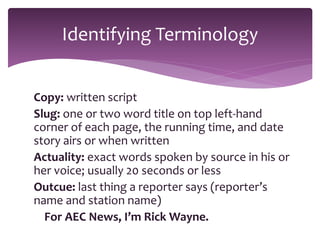
Copy: written script
Slug: one or two word title on top left-hand
corner of each page, the running time, and date
story airs or when written
Actuality: exact words spoken by source in his or
her voice; usually 20 seconds or less
Outcue: last thing a reporter says (reporter’s
name and station name)
For AEC News, I’m Rick Wayne.
Identifying Terminology
 Rewrite this story for radio (10 points)
 60 seconds or close to 200 words
 Select the most important points for radio broadcast
 Show me you did your reading:
 Use attribution for radio news as recommended
 Use transitions
 Follow rule for using abbreviations, numbers,
In-Class Activity
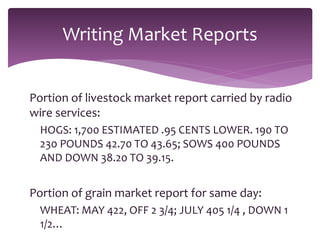
Portion of livestock market report carried by radio
wire services:
HOGS: 1,700 ESTIMATED .95 CENTS LOWER. 190 TO
230 POUNDS 42.70 TO 43.65; SOWS 400 POUNDS
AND DOWN 38.20 TO 39.15.
Portion of grain market report for same day:
WHEAT: MAY 422, OFF 2 3/4; JULY 405 1/4 , DOWN 1
1/2…
Writing Market Reports
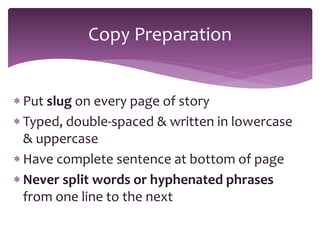
 Put slug on every page of story
 Typed, double-spaced & written in lowercase
& uppercase
 Have complete sentence at bottom of page
 Never split words or hyphenated phrases
from one line to the next
Copy Preparation
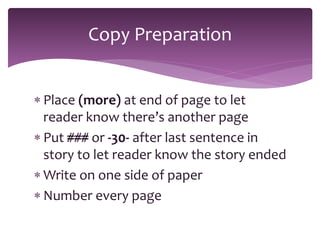
 Place (more) at end of page to let
reader know there’s another page
 Put ### or -30- after last sentence in
story to let reader know the story ended
 Write on one side of paper
 Number every page
Copy Preparation

Broadcast writing

  • 1.
  • 2.
     Identify howwriting for TV & radio differs from other types of writing  Explain the most important factors when writing for TV & radio  Identify how attribution and quotations are different in TV & radio than print news  Identify tips for preparing copy of a radio story Lecture Objectives
  • 3.
     What arethe techniques to improve your accuracy?  What are sources you can use to gather information? Writing for Radio – Let’s Discuss
  • 4.
     Read thetemplate for writing and formatting a radio script  Be ready to discuss these questions:  What style of writing do you use for radio?  What are the guidelines for writing informally?  How is attribution for radio different than for news stories? How is it similar?  What is one tip about transitions? Attributes & Writing Structure
  • 5.
     Tell whosaid something before telling what was said  Title precedes name on first reference (Professor Jennifer Reeve says…) & use last name thereafter (Reeve says…)  Senator Broom of Hunstville will introduce a new rural development bill…  County horticultural agent Judy Drake says…  Use action verbs (Avoid “there is” because weak verb) Writing Techniques
  • 6.
     Introduce directquotes  In her words…  The secretary put it this way…  In the words of the secretary…  He ends by saying…  Reeves used these words…  Write out symbols (dollars instead of $ or percent instead of %)  For decimals, write out word “point” Writing Techniques
  • 7.
    What is therule for using abbreviations in radio and television stories? Let’s Discuss
  • 8.
    Copy: written script Slug:one or two word title on top left-hand corner of each page, the running time, and date story airs or when written Actuality: exact words spoken by source in his or her voice; usually 20 seconds or less Outcue: last thing a reporter says (reporter’s name and station name) For AEC News, I’m Rick Wayne. Identifying Terminology
  • 9.
     Rewrite thisstory for radio (10 points)  60 seconds or close to 200 words  Select the most important points for radio broadcast  Show me you did your reading:  Use attribution for radio news as recommended  Use transitions  Follow rule for using abbreviations, numbers, In-Class Activity
  • 10.
    Portion of livestockmarket report carried by radio wire services: HOGS: 1,700 ESTIMATED .95 CENTS LOWER. 190 TO 230 POUNDS 42.70 TO 43.65; SOWS 400 POUNDS AND DOWN 38.20 TO 39.15. Portion of grain market report for same day: WHEAT: MAY 422, OFF 2 3/4; JULY 405 1/4 , DOWN 1 1/2… Writing Market Reports
  • 11.
     Put slugon every page of story  Typed, double-spaced & written in lowercase & uppercase  Have complete sentence at bottom of page  Never split words or hyphenated phrases from one line to the next Copy Preparation
  • 12.
     Place (more)at end of page to let reader know there’s another page  Put ### or -30- after last sentence in story to let reader know the story ended  Write on one side of paper  Number every page Copy Preparation

Editor's Notes

  • #5 Write good leads Use present tense whenever possible Sense of immediacy but don’t strain to use present tense if it doesn’t fit story naturally Short sentences of 20 words or less Subject-verb-object order preferred Use person’s complete name in first reference, then person’s last name thereafter
  • #11 Broadcasters presenting such daily reports know that the 42.70 and 43.65 refer to dollars and cents per 100 pounds. Part of the time they will say it that way even though it is not written. Likewise, farmers and other listeners interested in hog prices know what is meant. The situation is similar for grain and other commodities. In the case of grain, reporters know the figures are in terms of dollars, cents and fractions of cents per bushel. Listeners following the grain futures market know the above quotations mean wheat for May delivery is $4.22 per bushel and the price is down two and three-fourth cents from the day before. Other commodity prices may be quoted on the basis of pounds, I 00 pounds, tons, cases, barrels or 1,000 board feet.