UNIT 10
Y
SCRIPTWRITING AND NEWSCASTING
News is information about current
events. This may be provided
through many different media: word
of mouth, printing, postal systems,
broadcasting, electronic
communication, or through the
testimony of observers and witnesses
to events.
The information may be in respect of the reader’s
interest in specific fields. The best ingredient is
that it should be of some education value for
readers. The readers ought to be of the progress of
the country and making in the specific fields. The
countrymen have the right to know as to how
strangers their country is. It is for the readers of
the country. A news is tomorrows history done up
in to-days meal package. It enables the people to
make up their minds as what to think and how to
act.
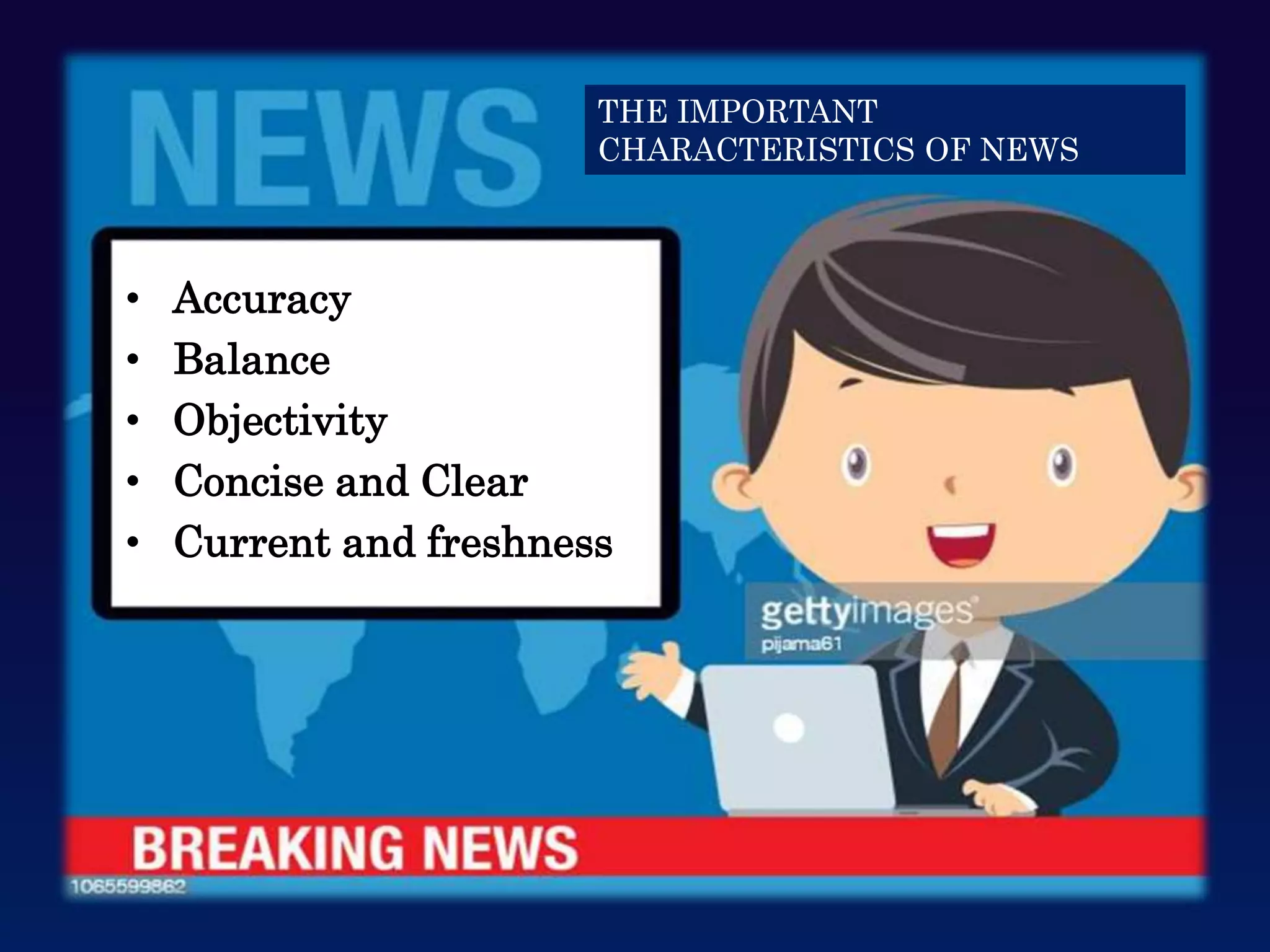
• Accuracy
• Balance
• Objectivity
• Concise and Clear
• Current and freshness
THE IMPORTANT
CHARACTERISTICS OF NEWS
Elements of News
• Immediacy or Timeliness
• Proximity
• Consequences
• Prominence
• Drama
• Oddity
• Conflict
• Sex
• Progress
You can read in detail the article
about news different sources . But
here I would like to tell you, we
usually get most of your news about
what is going on in the world today
from the newspaper or radio or
television or magazine or talking to
people.
Source of News
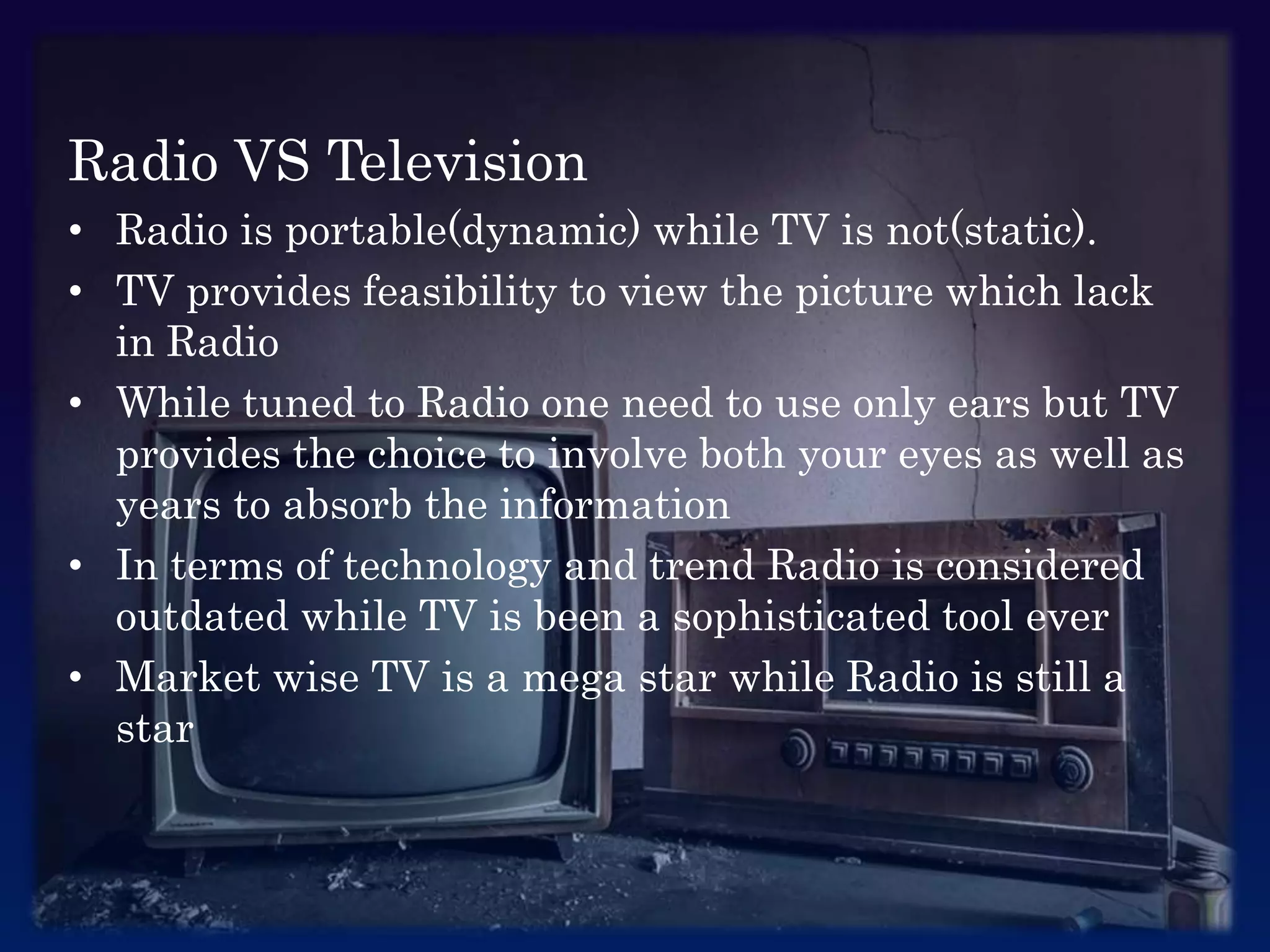
Radio VS Television
• Radio is portable(dynamic) while TV is not(static).
• TV provides feasibility to view the picture which lack
in Radio
• While tuned to Radio one need to use only ears but TV
provides the choice to involve both your eyes as well as
years to absorb the information
• In terms of technology and trend Radio is considered
outdated while TV is been a sophisticated tool ever
• Market wise TV is a mega star while Radio is still a
star
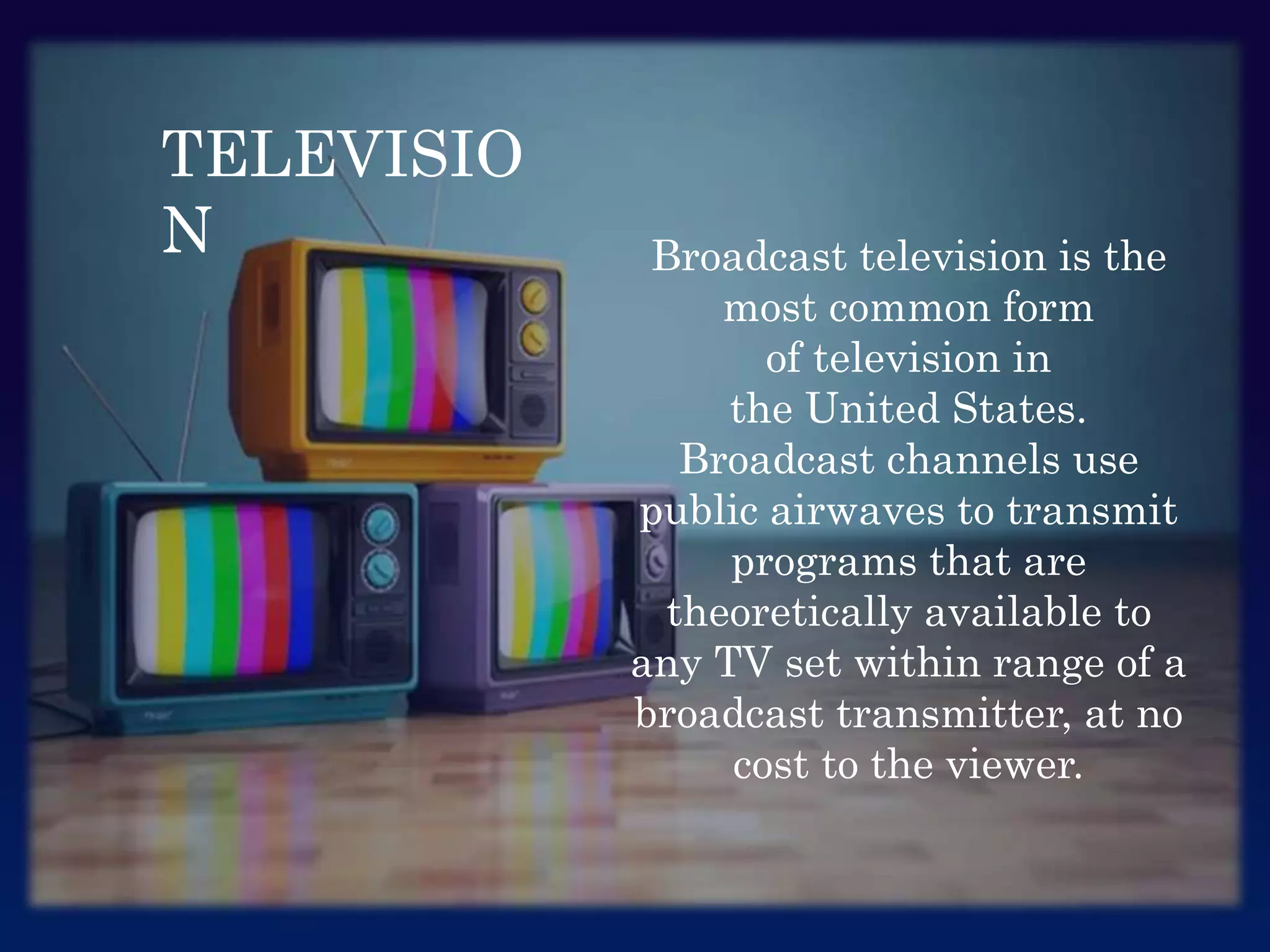
Broadcast television is the
most common form
of television in
the United States.
Broadcast channels use
public airwaves to transmit
programs that are
theoretically available to
any TV set within range of a
broadcast transmitter, at no
cost to the viewer.
TELEVISIO
N
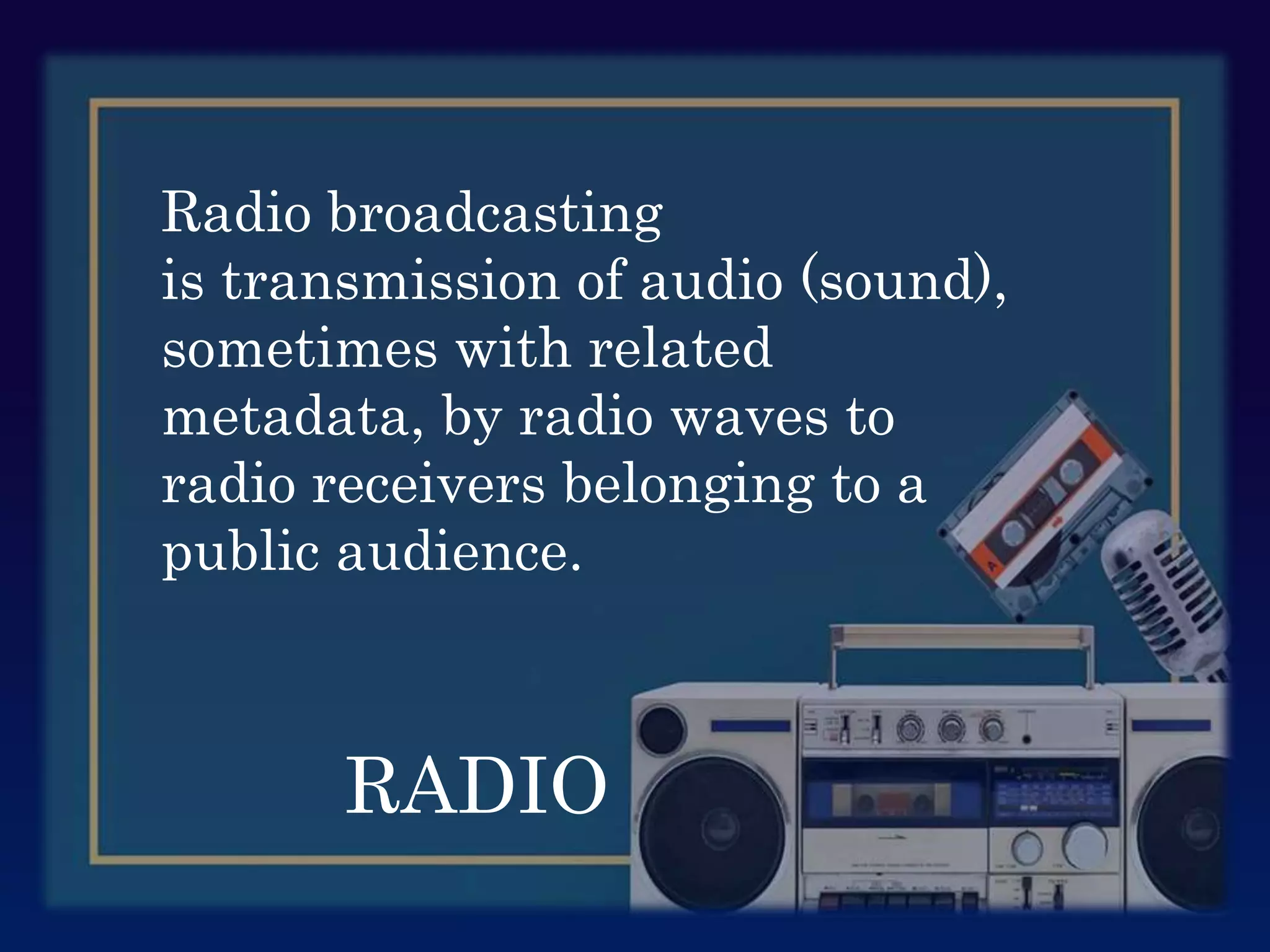
Radio broadcasting
is transmission of audio (sound),
sometimes with related
metadata, by radio waves to
radio receivers belonging to a
public audience.
RADIO
Broadcasting is a form of communication
and speech that is subject to numerous
government regulations. As soon as radio
began to develop in the early part of the 20th
century, the federal government realized the
great potential for broadcasting as a
communications medium. The government
also recognized a need to place various
controls on this rapidly growing industry.
Radio Act of 1927 (US)
RA No. 3846 (PH)
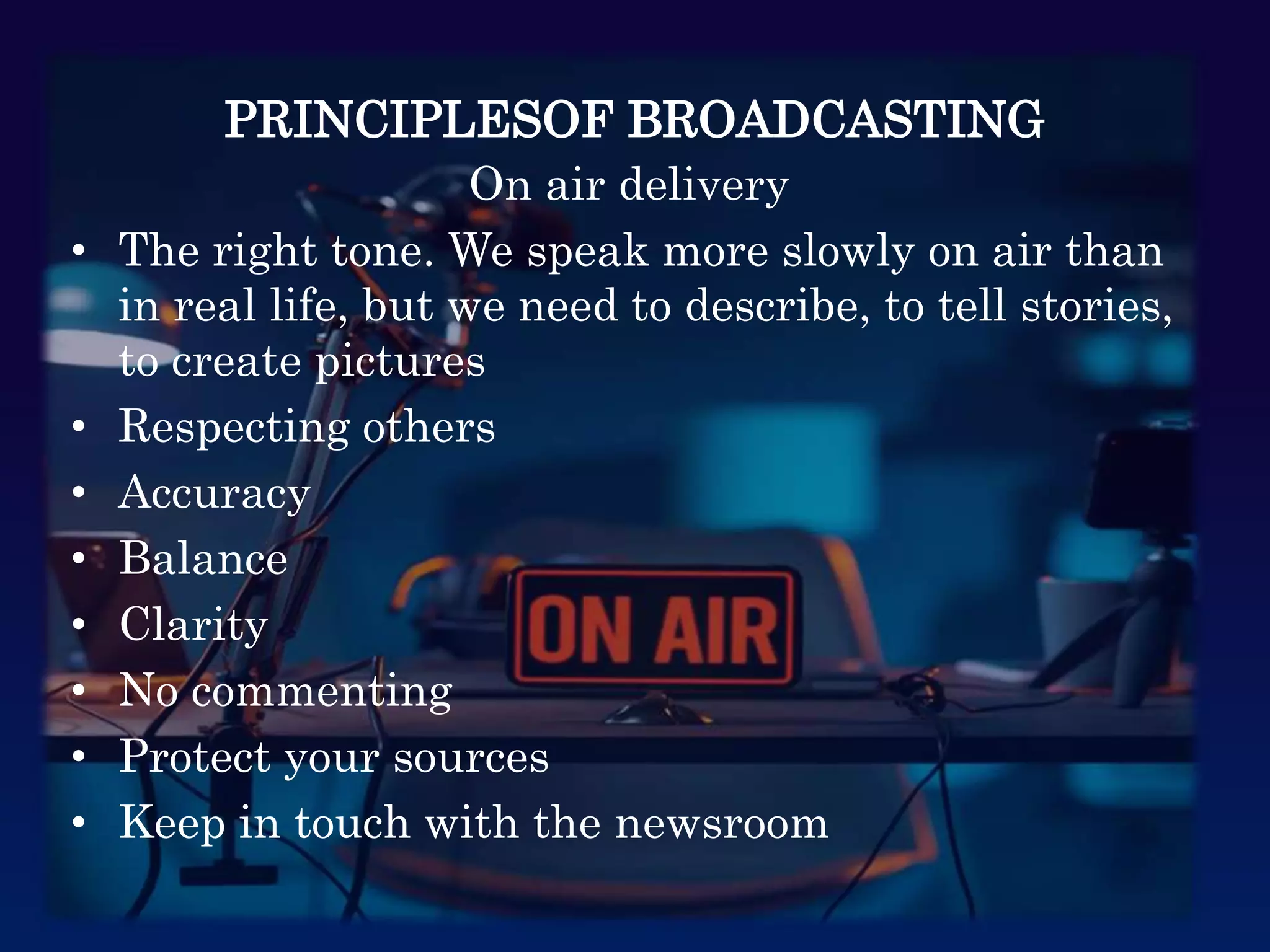
On air delivery
• The right tone. We speak more slowly on air than
in real life, but we need to describe, to tell stories,
to create pictures
• Respecting others
• Accuracy
• Balance
• Clarity
• No commenting
• Protect your sources
• Keep in touch with the newsroom
PRINCIPLESOF BROADCASTING
HOW TO
WRITE A
SCRIPT?
WRITING FOR THE EYE AND EAR
Writing for radio and television is different from
writing for print for several reasons. First, you have
less space and time to present news information.
Therefore, you must prioritize and summarize the
information carefully. Second, your listeners cannot
reread sentences they did not understand the first
time; they have to understand the information in a
broadcast story as they hear it or see it. As a result,
you have to keep your writing simple and clear. And
third, you are writing for “the ear.” In print news
stories, you are writing for “the eye”; the story must
read well to your eye.
• The writing style should be conversational. Write the way you
talk.
• Each sentence should be brief and contain only one idea. We do
not always talk in long sentences. Shorter sentences are better
in broadcast news writing. Each sentence should focus on one
particular idea.
• Be simple and direct. If you give your audience too much
information, your audience cannot take it in. Choose words
that are familiar to everyone.
• Read the story out loud. The most important attribute for
writing for “the ear” is to read the story aloud. This will give
you a feeling for timing, transitions, information flow, and
conversation style. Your audience will hear your television or
radio news story, so the story has to be appealing to the ear.
TELEVISION AND RADIO
NEWS WRITING STRUCTURE
• Be brief.
• Use correct grammar.
• Put the important information first.
• Write good leads.
• Use contractions.
• Use simple subject-verb-object sentence structures.
• Use the active voice and active verbs.
• For radio news stories, write with visual imagery.
TELEVISION
AND RADIO
NEWS WRITING
TECHNIQUES
• Use a person’s complete name (first and last name) in the first
reference, then the person’s last name thereafter.
• Use phonetic spellings for unfamiliar words and words that are
difficult to pronounce.
• Omit obscure names and places if they are not meaningful to
the story.
• Titles precede names; therefore, avoid appositives.
• In age reference, precede the name with the age.
• Avoid writing direct quotations into a news script, if at all
possible. Instead, let people say things in their own words
during soundbites. A soundbite is the exact words spoken by
someone in his or her own recorded voice.
• The attribution should come before a quotation, not
after it. In contrast to writing for print media, the
attribution of paraphrased quotations in broadcast
stories should be at the beginning of the sentence,
before the paraphrase.
• Avoid most all abbreviations, even on second
reference, unless it is a well-known abbreviation.
• Avoid symbols when you write.
• Use correct punctuation. Do not use semicolons. Use
double dash marks for longer pauses than commas.
Use underlines for emphasis.
• Use numbers correctly. Spell out numerals through 11. (This is
different from Associated Press Style for print stories, which
spells out one through nine, and starts using numerals for 10
and above.) Use numerals for 12 through 999. Use hyphenated
combinations for numerals and words above 999. (Examples:
33-thousand; 214-million.) Round off numbers unless the exact
number is significant. (Example: Use “a little more than 34
million dollars,” not “34-million, 200-thousand, 22 dollars.”)
Use st, nd, th, and rd after dates, addresses, and numbers
above “eleventh” to be read as ordinary numbers. (Examples:
"Second Street," "May 14th,” “Eleventh Avenue,” “12th
Division”—this is different from AP Style for print.)
TELEVISION
AND RADIO
NEWS STORY
FORMAT
• Broadcast news stories are typed, double-spaced,
and in uppercase/lowercase. Many years ago,
television news scripts were written in all uppercase,
but that practice has changed in recent years.
• Make the sentence at the bottom of a page a
complete sentence. Do not split a sentence between
pages.
• Never split words or hyphenated phrases from one
line to the next.
• Do not use copyediting symbols. Cross out the entire
word and write the corrected word above it. This is
one reason why broadcast news scripts are double-
spaced: so you will have room to make corrections
between the lines.
ACTUAL
NEWSCASTING
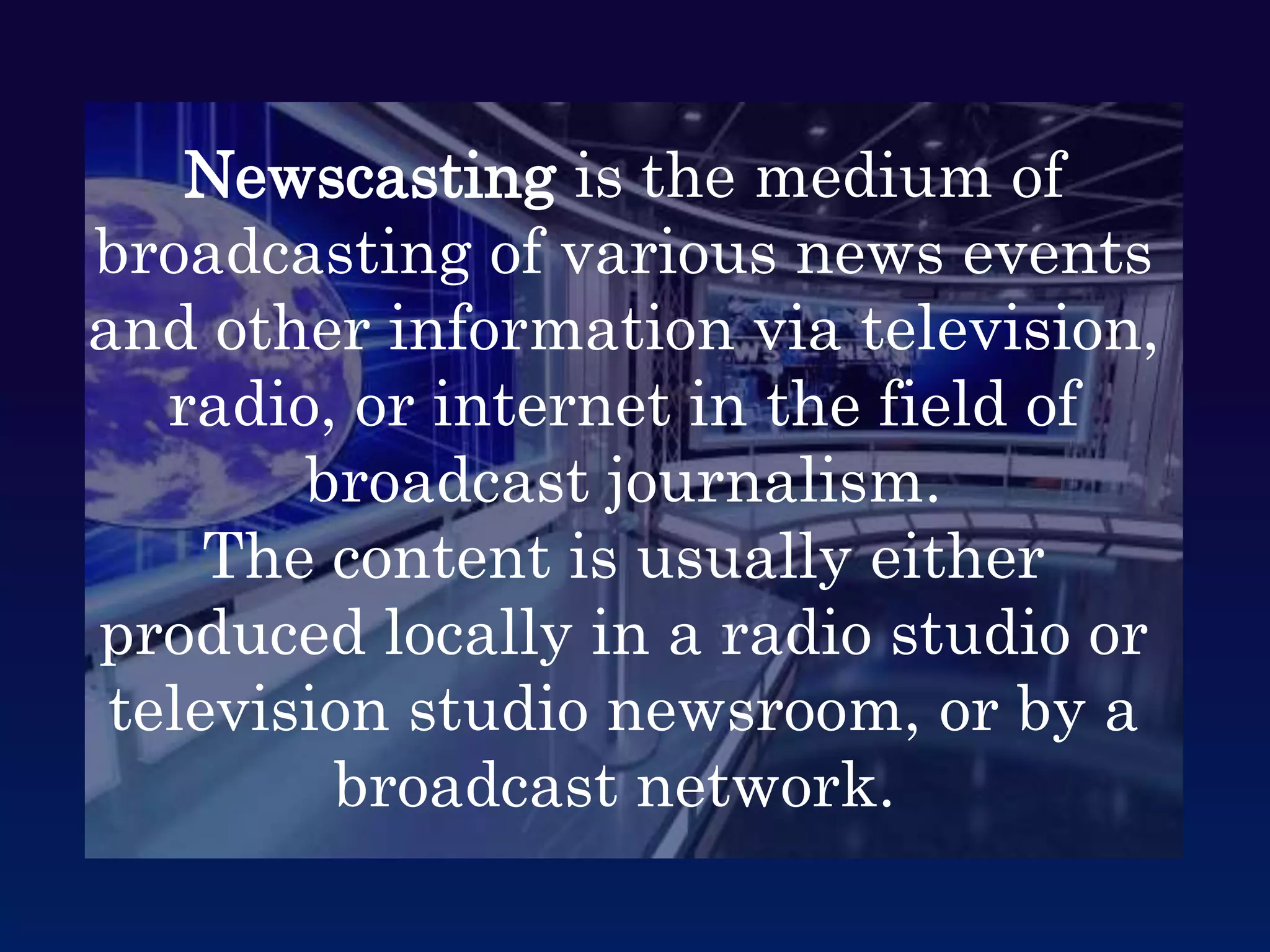
Newscasting is the medium of
broadcasting of various news events
and other information via television,
radio, or internet in the field of
broadcast journalism.
The content is usually either
produced locally in a radio studio or
television studio newsroom, or by a
broadcast network.
NARRATING
TELEVISION
AND RADIO
NEWS STORIES
• Position the microphone properly.
• Remove noise-making distractions.
• Narrate the news story.
• Articulate words correctly.
• Think the thought.
• Think the thought through to the end.
• Talk at a natural speed.
• Breathe properly.
• Use your body.
• Listen to the final product.
• Time the story.
• Practice your narration skills.
A style of writing that tends to emphasize the
active rather than passive, the concrete rather
than the abstract, the specific rather than the
general, and the concise rather than the verbose.
Despite sharing something of a common language

Newscasting

  • 1.
  • 2.
    News is informationabout current events. This may be provided through many different media: word of mouth, printing, postal systems, broadcasting, electronic communication, or through the testimony of observers and witnesses to events.
  • 3.
    The information maybe in respect of the reader’s interest in specific fields. The best ingredient is that it should be of some education value for readers. The readers ought to be of the progress of the country and making in the specific fields. The countrymen have the right to know as to how strangers their country is. It is for the readers of the country. A news is tomorrows history done up in to-days meal package. It enables the people to make up their minds as what to think and how to act.
  • 4.
    • Accuracy • Balance •Objectivity • Concise and Clear • Current and freshness THE IMPORTANT CHARACTERISTICS OF NEWS
  • 5.
    Elements of News •Immediacy or Timeliness • Proximity • Consequences • Prominence • Drama • Oddity • Conflict • Sex • Progress
  • 6.
    You can readin detail the article about news different sources . But here I would like to tell you, we usually get most of your news about what is going on in the world today from the newspaper or radio or television or magazine or talking to people. Source of News
  • 7.
    Radio VS Television •Radio is portable(dynamic) while TV is not(static). • TV provides feasibility to view the picture which lack in Radio • While tuned to Radio one need to use only ears but TV provides the choice to involve both your eyes as well as years to absorb the information • In terms of technology and trend Radio is considered outdated while TV is been a sophisticated tool ever • Market wise TV is a mega star while Radio is still a star
  • 8.
    Broadcast television isthe most common form of television in the United States. Broadcast channels use public airwaves to transmit programs that are theoretically available to any TV set within range of a broadcast transmitter, at no cost to the viewer. TELEVISIO N
  • 9.
    Radio broadcasting is transmissionof audio (sound), sometimes with related metadata, by radio waves to radio receivers belonging to a public audience. RADIO
  • 10.
    Broadcasting is aform of communication and speech that is subject to numerous government regulations. As soon as radio began to develop in the early part of the 20th century, the federal government realized the great potential for broadcasting as a communications medium. The government also recognized a need to place various controls on this rapidly growing industry. Radio Act of 1927 (US) RA No. 3846 (PH)
  • 11.
    On air delivery •The right tone. We speak more slowly on air than in real life, but we need to describe, to tell stories, to create pictures • Respecting others • Accuracy • Balance • Clarity • No commenting • Protect your sources • Keep in touch with the newsroom PRINCIPLESOF BROADCASTING
  • 12.
  • 13.
    WRITING FOR THEEYE AND EAR Writing for radio and television is different from writing for print for several reasons. First, you have less space and time to present news information. Therefore, you must prioritize and summarize the information carefully. Second, your listeners cannot reread sentences they did not understand the first time; they have to understand the information in a broadcast story as they hear it or see it. As a result, you have to keep your writing simple and clear. And third, you are writing for “the ear.” In print news stories, you are writing for “the eye”; the story must read well to your eye.
  • 14.
    • The writingstyle should be conversational. Write the way you talk. • Each sentence should be brief and contain only one idea. We do not always talk in long sentences. Shorter sentences are better in broadcast news writing. Each sentence should focus on one particular idea. • Be simple and direct. If you give your audience too much information, your audience cannot take it in. Choose words that are familiar to everyone. • Read the story out loud. The most important attribute for writing for “the ear” is to read the story aloud. This will give you a feeling for timing, transitions, information flow, and conversation style. Your audience will hear your television or radio news story, so the story has to be appealing to the ear.
  • 15.
    TELEVISION AND RADIO NEWSWRITING STRUCTURE • Be brief. • Use correct grammar. • Put the important information first. • Write good leads. • Use contractions. • Use simple subject-verb-object sentence structures. • Use the active voice and active verbs. • For radio news stories, write with visual imagery.
  • 16.
  • 17.
    • Use aperson’s complete name (first and last name) in the first reference, then the person’s last name thereafter. • Use phonetic spellings for unfamiliar words and words that are difficult to pronounce. • Omit obscure names and places if they are not meaningful to the story. • Titles precede names; therefore, avoid appositives. • In age reference, precede the name with the age. • Avoid writing direct quotations into a news script, if at all possible. Instead, let people say things in their own words during soundbites. A soundbite is the exact words spoken by someone in his or her own recorded voice.
  • 18.
    • The attributionshould come before a quotation, not after it. In contrast to writing for print media, the attribution of paraphrased quotations in broadcast stories should be at the beginning of the sentence, before the paraphrase. • Avoid most all abbreviations, even on second reference, unless it is a well-known abbreviation. • Avoid symbols when you write. • Use correct punctuation. Do not use semicolons. Use double dash marks for longer pauses than commas. Use underlines for emphasis.
  • 19.
    • Use numberscorrectly. Spell out numerals through 11. (This is different from Associated Press Style for print stories, which spells out one through nine, and starts using numerals for 10 and above.) Use numerals for 12 through 999. Use hyphenated combinations for numerals and words above 999. (Examples: 33-thousand; 214-million.) Round off numbers unless the exact number is significant. (Example: Use “a little more than 34 million dollars,” not “34-million, 200-thousand, 22 dollars.”) Use st, nd, th, and rd after dates, addresses, and numbers above “eleventh” to be read as ordinary numbers. (Examples: "Second Street," "May 14th,” “Eleventh Avenue,” “12th Division”—this is different from AP Style for print.)
  • 20.
  • 21.
    • Broadcast newsstories are typed, double-spaced, and in uppercase/lowercase. Many years ago, television news scripts were written in all uppercase, but that practice has changed in recent years. • Make the sentence at the bottom of a page a complete sentence. Do not split a sentence between pages. • Never split words or hyphenated phrases from one line to the next. • Do not use copyediting symbols. Cross out the entire word and write the corrected word above it. This is one reason why broadcast news scripts are double- spaced: so you will have room to make corrections between the lines.
  • 22.
  • 23.
    Newscasting is themedium of broadcasting of various news events and other information via television, radio, or internet in the field of broadcast journalism. The content is usually either produced locally in a radio studio or television studio newsroom, or by a broadcast network.
  • 24.
  • 25.
    • Position themicrophone properly. • Remove noise-making distractions. • Narrate the news story. • Articulate words correctly. • Think the thought. • Think the thought through to the end. • Talk at a natural speed. • Breathe properly. • Use your body. • Listen to the final product. • Time the story. • Practice your narration skills.
  • 26.
    A style ofwriting that tends to emphasize the active rather than passive, the concrete rather than the abstract, the specific rather than the general, and the concise rather than the verbose. Despite sharing something of a common language