News Reporting
News reporting involves discovering all relevant
facts, selecting and presenting the important facts and
weaving a comprehensive story. Reporting involves hard
work, which in turn involves stamina and patience. The
main function of journalistic profession is news reporting.
A reporter needs not only energy to spend long
hours chasing a story, collecting facts from various sources
in an effort to dig up the truth, he needs must have the will
to pursue the course of his investigation to the very end in
order to produce a really comprehensive story without any
missing links or unanswered questions.
News Reporting
TYPES OF NEWS REPORTING
TYPE OF NEWS REPORTING
There are different types of news reporting which are
as under:
• Investigative Reporting
• Court Reporting
• Accidence Reporting
• Political Reporting
• Fashion Reporting
• Business Reporting
• Sports Reporting
• Specialized Reporting
2 KINDS OF NEWS
REPORTING
1st: RADIO Broadcasting
Radio broadcasting is transmission by
radio waves intended to reach a wide audience.
Stations can be linked in radio networks to
broadcast a common radio format, either in
broadcast syndication or simulcast or both.
Alternatives to terrestrial radio broadcasting
include cable radio, local wire television
networks, satellite radio, and internet radio via
streaming media on the Internet. The signal
types can be either analog audio or digital
audio.
TYPES OF RADIO
BROADCASTING
AM
AM stations were the earliest broadcasting
stations to be developed. AM refers to amplitude
modulation, a mode of broadcasting radio waves by
varying the amplitude of the carrier signal in response
to the amplitude of the signal to be transmitted. The
medium-wave band is used worldwide for AM
broadcasting. Europe also uses the long wave band.
In response to the growing popularity of FM stereo
radio stations in the late 1980s and early 1990s, some
North American stations began broadcasting in AM
stereo, though this never gained popularity, and very
few receivers were ever sold.
TYPES OF RADIO
BROADCASTING
FM
FM refers to frequency modulation, and
occurs on VHF airwaves in the frequency
range of 88 to 108 MHz everywhere except
Japan and Russia. Russia, like the former
Soviet Union, uses 65.9 to 74 MHz
frequencies in addition to the world
standard. Japan uses the 76 to 90 MHz
frequency band.
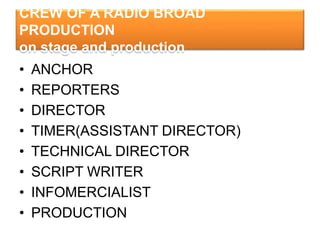
CREW OF A RADIO BROAD
PRODUCTION
on stage and production
• ANCHOR
• REPORTERS
• DIRECTOR
• TIMER(ASSISTANT DIRECTOR)
• TECHNICAL DIRECTOR
• SCRIPT WRITER
• INFOMERCIALIST
• PRODUCTION
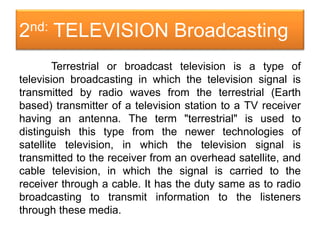
2nd: TELEVISION Broadcasting
Terrestrial or broadcast television is a type of
television broadcasting in which the television signal is
transmitted by radio waves from the terrestrial (Earth
based) transmitter of a television station to a TV receiver
having an antenna. The term "terrestrial" is used to
distinguish this type from the newer technologies of
satellite television, in which the television signal is
transmitted to the receiver from an overhead satellite, and
cable television, in which the signal is carried to the
receiver through a cable. It has the duty same as to radio
broadcasting to transmit information to the listeners
through these media.
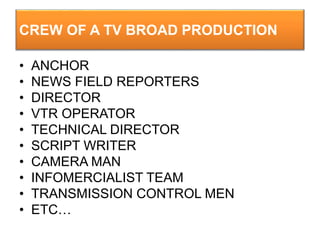
CREW OF A TV BROAD PRODUCTION
• ANCHOR
• NEWS FIELD REPORTERS
• DIRECTOR
• VTR OPERATOR
• TECHNICAL DIRECTOR
• SCRIPT WRITER
• CAMERA MAN
• INFOMERCIALIST TEAM
• TRANSMISSION CONTROL MEN
• ETC…
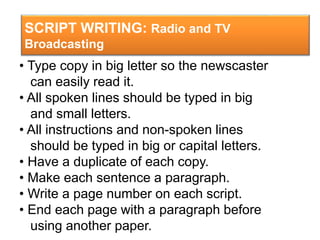
SCRIPT WRITING
• Type copy in big letter so the newscaster
can easily read it.
• All spoken lines should be typed in big
and small letters.
• All instructions and non-spoken lines
should be typed in big or capital letters.
• Have a duplicate of each copy.
• Make each sentence a paragraph.
• Write a page number on each script.
• End each page with a paragraph before
using another paper.
SCRIPT WRITING: Radio and TV
Broadcasting
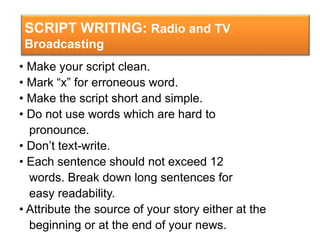
SCRIPT WRITING: Radio and TV
Broadcasting
• Make your script clean.
• Mark “x” for erroneous word.
• Make the script short and simple.
• Do not use words which are hard to
pronounce.
• Don’t text-write.
• Each sentence should not exceed 12
words. Break down long sentences for
easy readability.
• Attribute the source of your story either at the
beginning or at the end of your news.
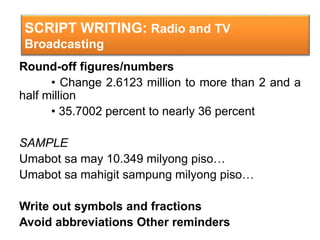
SCRIPT WRITING: Radio and TV
Broadcasting
Round-off figures/numbers
• Change 2.6123 million to more than 2 and a
half million
• 35.7002 percent to nearly 36 percent
SAMPLE
Umabot sa may 10.349 milyong piso…
Umabot sa mahigit sampung milyong piso…
Write out symbols and fractions
Avoid abbreviations Other reminders
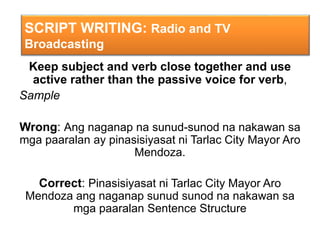
SCRIPT WRITING: Radio and TV
Broadcasting
Keep subject and verb close together and use
active rather than the passive voice for verb,
Sample
Wrong: Ang naganap na sunud-sunod na nakawan sa
mga paaralan ay pinasisiyasat ni Tarlac City Mayor Aro
Mendoza.
Correct: Pinasisiyasat ni Tarlac City Mayor Aro
Mendoza ang naganap sunud sunod na nakawan sa
mga paaralan Sentence Structure
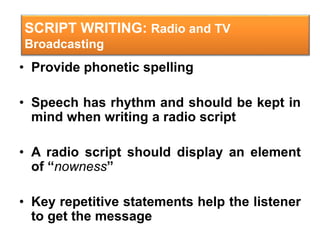
SCRIPT WRITING: Radio and TV
Broadcasting
• Provide phonetic spelling
• Speech has rhythm and should be kept in
mind when writing a radio script
• A radio script should display an element
of “nowness”
• Key repetitive statements help the listener
to get the message
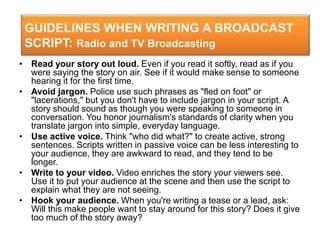
GUIDELINES WHEN WRITING A BROADCAST
SCRIPT: Radio and TV Broadcasting
• Read your story out loud. Even if you read it softly, read as if you
were saying the story on air. See if it would make sense to someone
hearing it for the first time.
• Avoid jargon. Police use such phrases as "fled on foot" or
"lacerations," but you don't have to include jargon in your script. A
story should sound as though you were speaking to someone in
conversation. You honor journalism's standards of clarity when you
translate jargon into simple, everyday language.
• Use active voice. Think "who did what?" to create active, strong
sentences. Scripts written in passive voice can be less interesting to
your audience, they are awkward to read, and they tend to be
longer.
• Write to your video. Video enriches the story your viewers see.
Use it to put your audience at the scene and then use the script to
explain what they are not seeing.
• Hook your audience. When you're writing a tease or a lead, ask:
Will this make people want to stay around for this story? Does it give
too much of the story away?
END

My Report

  • 1.
  • 2.
    News reporting involvesdiscovering all relevant facts, selecting and presenting the important facts and weaving a comprehensive story. Reporting involves hard work, which in turn involves stamina and patience. The main function of journalistic profession is news reporting. A reporter needs not only energy to spend long hours chasing a story, collecting facts from various sources in an effort to dig up the truth, he needs must have the will to pursue the course of his investigation to the very end in order to produce a really comprehensive story without any missing links or unanswered questions. News Reporting
  • 3.
    TYPES OF NEWSREPORTING
  • 4.
    TYPE OF NEWSREPORTING There are different types of news reporting which are as under: • Investigative Reporting • Court Reporting • Accidence Reporting • Political Reporting • Fashion Reporting • Business Reporting • Sports Reporting • Specialized Reporting
  • 5.
    2 KINDS OFNEWS REPORTING
  • 6.
    1st: RADIO Broadcasting Radiobroadcasting is transmission by radio waves intended to reach a wide audience. Stations can be linked in radio networks to broadcast a common radio format, either in broadcast syndication or simulcast or both. Alternatives to terrestrial radio broadcasting include cable radio, local wire television networks, satellite radio, and internet radio via streaming media on the Internet. The signal types can be either analog audio or digital audio.
  • 8.
    TYPES OF RADIO BROADCASTING AM AMstations were the earliest broadcasting stations to be developed. AM refers to amplitude modulation, a mode of broadcasting radio waves by varying the amplitude of the carrier signal in response to the amplitude of the signal to be transmitted. The medium-wave band is used worldwide for AM broadcasting. Europe also uses the long wave band. In response to the growing popularity of FM stereo radio stations in the late 1980s and early 1990s, some North American stations began broadcasting in AM stereo, though this never gained popularity, and very few receivers were ever sold.
  • 9.
    TYPES OF RADIO BROADCASTING FM FMrefers to frequency modulation, and occurs on VHF airwaves in the frequency range of 88 to 108 MHz everywhere except Japan and Russia. Russia, like the former Soviet Union, uses 65.9 to 74 MHz frequencies in addition to the world standard. Japan uses the 76 to 90 MHz frequency band.
  • 10.
    CREW OF ARADIO BROAD PRODUCTION on stage and production • ANCHOR • REPORTERS • DIRECTOR • TIMER(ASSISTANT DIRECTOR) • TECHNICAL DIRECTOR • SCRIPT WRITER • INFOMERCIALIST • PRODUCTION
  • 11.
    2nd: TELEVISION Broadcasting Terrestrialor broadcast television is a type of television broadcasting in which the television signal is transmitted by radio waves from the terrestrial (Earth based) transmitter of a television station to a TV receiver having an antenna. The term "terrestrial" is used to distinguish this type from the newer technologies of satellite television, in which the television signal is transmitted to the receiver from an overhead satellite, and cable television, in which the signal is carried to the receiver through a cable. It has the duty same as to radio broadcasting to transmit information to the listeners through these media.
  • 13.
    CREW OF ATV BROAD PRODUCTION • ANCHOR • NEWS FIELD REPORTERS • DIRECTOR • VTR OPERATOR • TECHNICAL DIRECTOR • SCRIPT WRITER • CAMERA MAN • INFOMERCIALIST TEAM • TRANSMISSION CONTROL MEN • ETC…
  • 14.
  • 16.
    • Type copyin big letter so the newscaster can easily read it. • All spoken lines should be typed in big and small letters. • All instructions and non-spoken lines should be typed in big or capital letters. • Have a duplicate of each copy. • Make each sentence a paragraph. • Write a page number on each script. • End each page with a paragraph before using another paper. SCRIPT WRITING: Radio and TV Broadcasting
  • 17.
    SCRIPT WRITING: Radioand TV Broadcasting • Make your script clean. • Mark “x” for erroneous word. • Make the script short and simple. • Do not use words which are hard to pronounce. • Don’t text-write. • Each sentence should not exceed 12 words. Break down long sentences for easy readability. • Attribute the source of your story either at the beginning or at the end of your news.
  • 18.
    SCRIPT WRITING: Radioand TV Broadcasting Round-off figures/numbers • Change 2.6123 million to more than 2 and a half million • 35.7002 percent to nearly 36 percent SAMPLE Umabot sa may 10.349 milyong piso… Umabot sa mahigit sampung milyong piso… Write out symbols and fractions Avoid abbreviations Other reminders
  • 19.
    SCRIPT WRITING: Radioand TV Broadcasting Keep subject and verb close together and use active rather than the passive voice for verb, Sample Wrong: Ang naganap na sunud-sunod na nakawan sa mga paaralan ay pinasisiyasat ni Tarlac City Mayor Aro Mendoza. Correct: Pinasisiyasat ni Tarlac City Mayor Aro Mendoza ang naganap sunud sunod na nakawan sa mga paaralan Sentence Structure
  • 20.
    SCRIPT WRITING: Radioand TV Broadcasting • Provide phonetic spelling • Speech has rhythm and should be kept in mind when writing a radio script • A radio script should display an element of “nowness” • Key repetitive statements help the listener to get the message
  • 22.
    GUIDELINES WHEN WRITINGA BROADCAST SCRIPT: Radio and TV Broadcasting • Read your story out loud. Even if you read it softly, read as if you were saying the story on air. See if it would make sense to someone hearing it for the first time. • Avoid jargon. Police use such phrases as "fled on foot" or "lacerations," but you don't have to include jargon in your script. A story should sound as though you were speaking to someone in conversation. You honor journalism's standards of clarity when you translate jargon into simple, everyday language. • Use active voice. Think "who did what?" to create active, strong sentences. Scripts written in passive voice can be less interesting to your audience, they are awkward to read, and they tend to be longer. • Write to your video. Video enriches the story your viewers see. Use it to put your audience at the scene and then use the script to explain what they are not seeing. • Hook your audience. When you're writing a tease or a lead, ask: Will this make people want to stay around for this story? Does it give too much of the story away?
  • 23.