News
News
Writing
Writing
Prewriting
Prewriting
Any activity used to
generate writing ideas.
Watching the News
Watching the News
Bolder in CA blocks a road
after a mud slide.
Roofer goes to
Doctor with a tooth
ache only to find out
he has a nail in his
head.
Search crew
looks for missing
person after
avalanche.
Celebrity Lives are of
interest to some.
Sports is always news.
Our country’s
current events are
of great interest.
Types of News
Types of News

Natural Disasters/Emergency

Unusual or wacky
Unusual or wacky

Famous People
Famous People

Sporting Events
Sporting Events

Politics
Politics

Crime/Safety
Crime/Safety
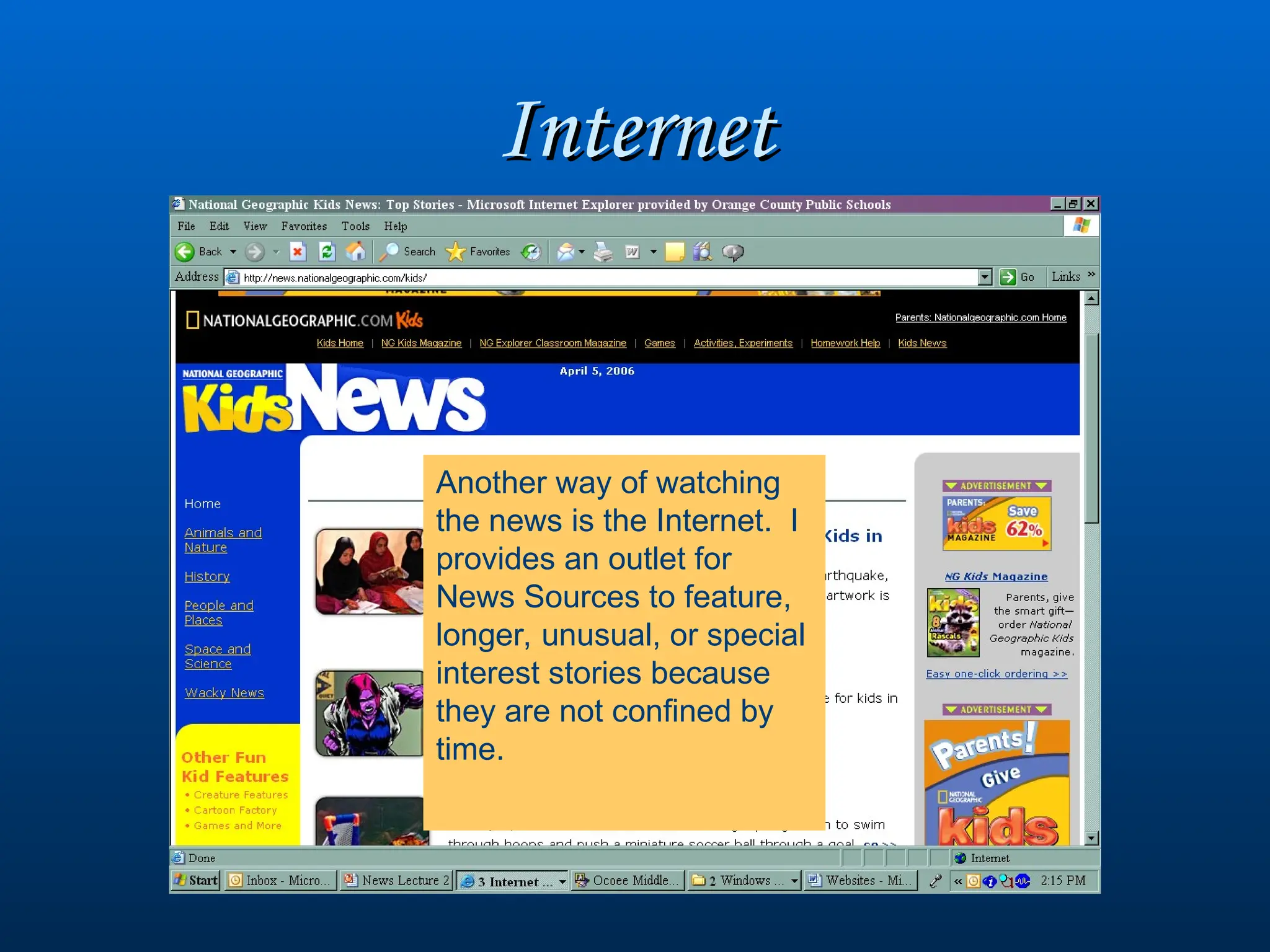
Internet
Internet
Another way of watching
the news is the Internet. I
provides an outlet for
News Sources to feature,
longer, unusual, or special
interest stories because
they are not confined by
time.
Brainstorming
Brainstorming
Everyone contributes
ideas on a topic.
ideas on a topic.
The list is then
The list is then
categorized, prioritized
and defended.
and defended.
Brainstorming Exercise

Brainstorm ideas for news stories.

Search the internet for your ideas.

Make a list of your 3 favorite ideas.

Write the web address of the story

For each idea answer
• Why it’s a good idea
Why it’s a good idea
• What pictures & or graphics can be
What pictures & or graphics can be
found or made to go with it
• Your ideas on how to shoot it
Your ideas on how to shoot it
The 5 W’s
The 5 W’s
When reporters start writing a news story, they
look for the answer to Five simple questions –
known as “The Five W’s”. The answers to these
questions are the basis for every story.
• Who?
Who? – Who is involved? Who did what? To
– Who is involved? Who did what? To
who? Who is affected?
• What?
What? – What happened?
– What happened?
• When?
When? When did it happen? In what order did
When did it happen? In what order did
events take place?
events take place?
• Where?
Where? – Where did this happen? Did the
– Where did this happen? Did the
location change?
location change?
• Why?
Why? – Why did it happen? What caused it?
– Why did it happen? What caused it?
“
“The 5 W’s”
The 5 W’s”

The reporter will often try to include
all or most of the answers in the first
line or paragraph of the news story.
That opening section is often called
“the lede” or “the lead”.

The opening lines give the viewers a
good idea of what happened as soon
a the news story starts.
2 Types of Leads
2 Types of Leads

Introductory – gives us an
“appetizer” before the story,
designed to perk our interest

Informational – summarizes the
entire story, designed to give us all
the facts in one brief statement
The Inverted Pyramid
 This is the style of writing used for television
This is the style of writing used for television
and radio reporting as well as, for newspapers
and magazines.
and magazines.
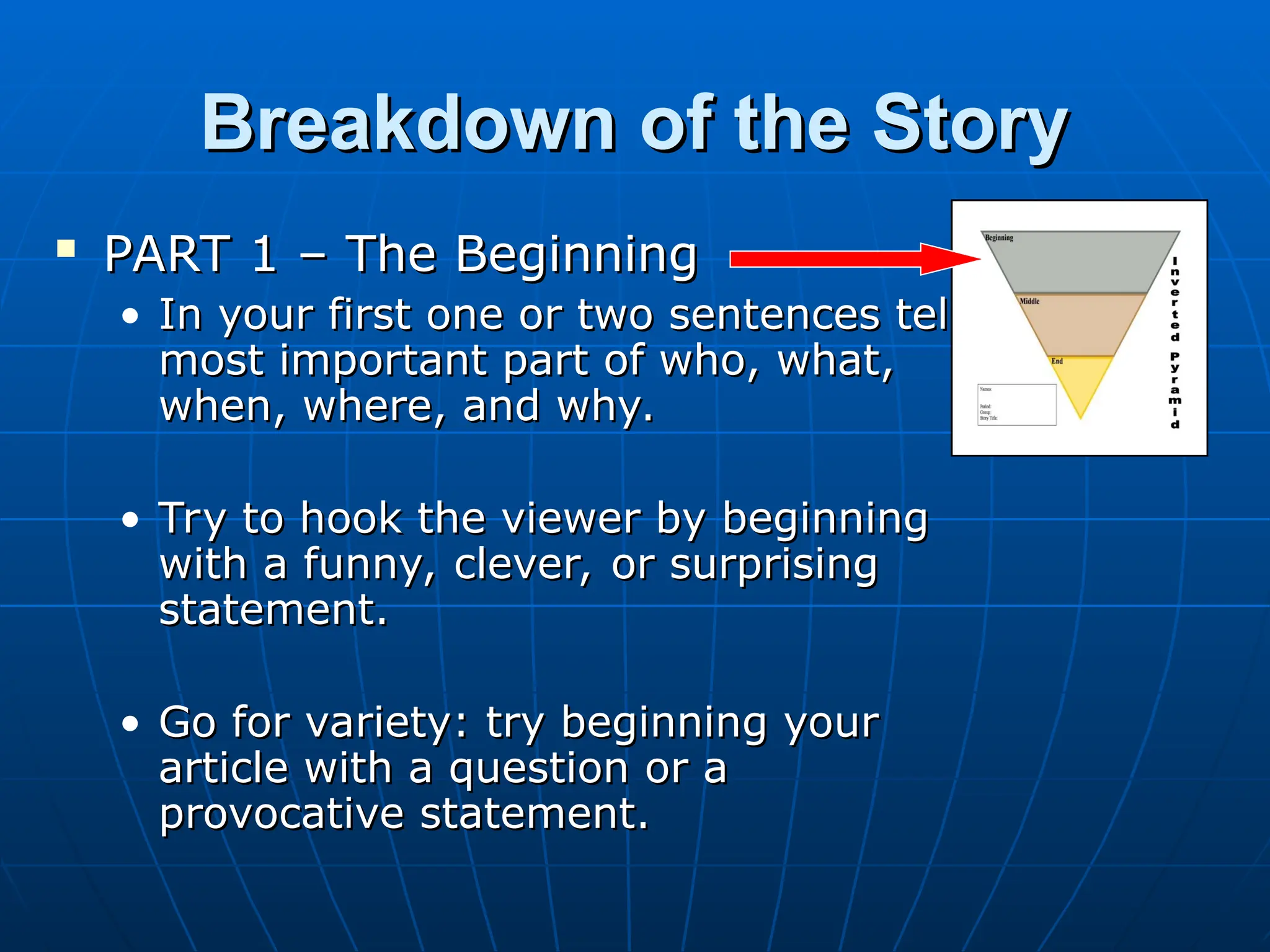
 The inverted pyramid means that stories
The inverted pyramid means that stories
should be written with the most important
information first and the least important last.
 EXAMPLE: 150,000 people are confirmed
EXAMPLE: 150,000 people are confirmed
dead, thousands missing after Tsunami hits
Asia.
Asia.
Breakdown of the Story
 PART 1 – The Beginning
PART 1 – The Beginning
• In your first one or two sentences tell
In your first one or two sentences tell
most important part of who, what,
when, where, and why.
• Try to hook the viewer by beginning
Try to hook the viewer by beginning
with a funny, clever, or surprising
statement.
statement.
• Go for variety: try beginning your
Go for variety: try beginning your
article with a question or a
provocative statement.
Breakdown of the Story

Part 2 – The Middle
Part 2 – The Middle
• Give the viewer the details. Include
Give the viewer the details. Include
one or two quotes from people you
interviewed or will interview.
• Write in the third person (he,
Write in the third person (he,
she, it, they)
she, it, they)
• Be objective (never state your opinion
Be objective (never state your opinion
unless it is an opinion piece)
• Use quotes to express others’
Use quotes to express others’
opinions!
opinions!
Breakdown of the Story

Part 3 – The End
Part 3 – The End
• Wrap it up somehow (don’t leave the
Wrap it up somehow (don’t leave the
viewer hanging)
viewer hanging)
• Please don’t say...”In conclusion” or “To
Please don’t say...”In conclusion” or “To
finish…” (yawn!)
finish…” (yawn!)
• Try ending with a quote or a catchy phrase.
Try ending with a quote or a catchy phrase.
• Use active words (verbs that show what’s
Use active words (verbs that show what’s
really happening.)
really happening.)
ASSIGNMENT
ASSIGNMENT

Using the information from the previous slides write a news
story that would interest a Middle School audience. Make
sure your story has factual information and contains a
beginning, middle, and end using the Inverted pyramid
format. You can search for ideas and information on the
internet but DO NOT plagiarize.

You are not allowed to work together on this assignment,
you must write this story ON YOUR OWN.

Be prepared to read your story to the class and use it for
an upcoming project.

News-Writing.ppt------------------------

  • 1.
  • 2.
    Prewriting Prewriting Any activity usedto Any activity used to generate writing ideas. generate writing ideas.
  • 3.
    Watching the News Watchingthe News Bolder in CA blocks a road after a mud slide. Roofer goes to Doctor with a tooth ache only to find out he has a nail in his head. Search crew looks for missing person after avalanche. Celebrity Lives are of interest to some. Sports is always news. Our country’s current events are of great interest.
  • 4.
    Types of News Typesof News  Natural Disasters/Emergency Natural Disasters/Emergency  Unusual or wacky Unusual or wacky  Famous People Famous People  Sporting Events Sporting Events  Politics Politics  Crime/Safety Crime/Safety
  • 5.
    Internet Internet Another way ofwatching the news is the Internet. I provides an outlet for News Sources to feature, longer, unusual, or special interest stories because they are not confined by time.
  • 6.
    Brainstorming Brainstorming Everyone contributes Everyone contributes ideason a topic. ideas on a topic. The list is then The list is then categorized, prioritized categorized, prioritized and defended. and defended.
  • 7.
    Brainstorming Exercise Brainstorming Exercise  Brainstormideas for news stories. Brainstorm ideas for news stories.  Search the internet for your ideas. Search the internet for your ideas.  Make a list of your 3 favorite ideas. Make a list of your 3 favorite ideas.  Write the web address of the story Write the web address of the story  For each idea answer For each idea answer • Why it’s a good idea Why it’s a good idea • What pictures & or graphics can be What pictures & or graphics can be found or made to go with it found or made to go with it • Your ideas on how to shoot it Your ideas on how to shoot it
  • 8.
    The 5 W’s The5 W’s When reporters start writing a news story, they When reporters start writing a news story, they look for the answer to Five simple questions – look for the answer to Five simple questions – known as “The Five W’s”. The answers to these known as “The Five W’s”. The answers to these questions are the basis for every story. questions are the basis for every story. • Who? Who? – Who is involved? Who did what? To – Who is involved? Who did what? To who? Who is affected? who? Who is affected? • What? What? – What happened? – What happened? • When? When? When did it happen? In what order did When did it happen? In what order did events take place? events take place? • Where? Where? – Where did this happen? Did the – Where did this happen? Did the location change? location change? • Why? Why? – Why did it happen? What caused it? – Why did it happen? What caused it?
  • 9.
    “ “The 5 W’s” The5 W’s”  The reporter will often try to include The reporter will often try to include all or most of the answers in the first all or most of the answers in the first line or paragraph of the news story. line or paragraph of the news story. That opening section is often called That opening section is often called “the lede” or “the lead”. “the lede” or “the lead”.  The opening lines give the viewers a The opening lines give the viewers a good idea of what happened as soon good idea of what happened as soon a the news story starts. a the news story starts.
  • 10.
    2 Types ofLeads 2 Types of Leads  Introductory – gives us an Introductory – gives us an “appetizer” before the story, “appetizer” before the story, designed to perk our interest designed to perk our interest  Informational – summarizes the Informational – summarizes the entire story, designed to give us all entire story, designed to give us all the facts in one brief statement the facts in one brief statement
  • 11.
    The Inverted Pyramid TheInverted Pyramid  This is the style of writing used for television This is the style of writing used for television and radio reporting as well as, for newspapers and radio reporting as well as, for newspapers and magazines. and magazines.  The inverted pyramid means that stories The inverted pyramid means that stories should be written with the most important should be written with the most important information first and the least important last. information first and the least important last.  EXAMPLE: 150,000 people are confirmed EXAMPLE: 150,000 people are confirmed dead, thousands missing after Tsunami hits dead, thousands missing after Tsunami hits Asia. Asia.
  • 12.
    Breakdown of theStory Breakdown of the Story  PART 1 – The Beginning PART 1 – The Beginning • In your first one or two sentences tell In your first one or two sentences tell most important part of who, what, most important part of who, what, when, where, and why. when, where, and why. • Try to hook the viewer by beginning Try to hook the viewer by beginning with a funny, clever, or surprising with a funny, clever, or surprising statement. statement. • Go for variety: try beginning your Go for variety: try beginning your article with a question or a article with a question or a provocative statement. provocative statement.
  • 13.
    Breakdown of theStory Breakdown of the Story  Part 2 – The Middle Part 2 – The Middle • Give the viewer the details. Include Give the viewer the details. Include one or two quotes from people you one or two quotes from people you interviewed or will interview. interviewed or will interview. • Write in the third person (he, Write in the third person (he, she, it, they) she, it, they) • Be objective (never state your opinion Be objective (never state your opinion unless it is an opinion piece) unless it is an opinion piece) • Use quotes to express others’ Use quotes to express others’ opinions! opinions!
  • 14.
    Breakdown of theStory Breakdown of the Story  Part 3 – The End Part 3 – The End • Wrap it up somehow (don’t leave the Wrap it up somehow (don’t leave the viewer hanging) viewer hanging) • Please don’t say...”In conclusion” or “To Please don’t say...”In conclusion” or “To finish…” (yawn!) finish…” (yawn!) • Try ending with a quote or a catchy phrase. Try ending with a quote or a catchy phrase. • Use active words (verbs that show what’s Use active words (verbs that show what’s really happening.) really happening.)
  • 15.
    ASSIGNMENT ASSIGNMENT  Using the informationfrom the previous slides write a news Using the information from the previous slides write a news story that would interest a Middle School audience. Make story that would interest a Middle School audience. Make sure your story has factual information and contains a sure your story has factual information and contains a beginning, middle, and end using the Inverted pyramid beginning, middle, and end using the Inverted pyramid format. You can search for ideas and information on the format. You can search for ideas and information on the internet but DO NOT plagiarize. internet but DO NOT plagiarize.  You are not allowed to work together on this assignment, You are not allowed to work together on this assignment, you must write this story ON YOUR OWN. you must write this story ON YOUR OWN.  Be prepared to read your story to the class and use it for Be prepared to read your story to the class and use it for an upcoming project. an upcoming project.

Editor's Notes

  • #2 News is the latest information about current events. Just look around you. There are potential news stories every where you look.
  • #3 Types of News – Natural Disasters: Bolder in CA blocks a road after a mud slide. Unusual or wacky- Roofer goes to Doctor with a tooth ache only to find out he has a nail in his head. Emergency - Search crew looks for missing person after avalanche. Famous People - Celebrity Lives are of interest to some. Sporting Events - Sports is always news. Politics - Our country’s current events are of great interest.