| 0
Elizabeth Dyas
Senior Product Marketing Manager, Scopus
Scopus, ScienceDirect and
Mendeley
June 12, 2014
| 1
Agenda of the Scopus presentation
• Scopus content coverage
• Scopus coverage of Kazakhstan content
• How does Scopus select journal content?
• How does Scopus select non-serial content
(books and conferences)
• What content expansion programs are ongoing?
• What features are new in Scopus?
| 2
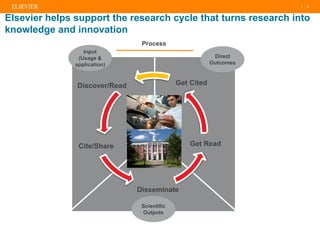
Elsevier helps support the research cycle that turns research into
knowledge and innovation
Input
(Usage &
application)
Process
Discover/Read
Cite/Share
Scientific
Outputs
Disseminate
Direct
Outcomes
Get Read
Get Cited
| 3
Scopus content coverage
| 4
What content does Scopus include?
Scopus is ideal compared to other products because it has the broadest
coverage of global, curated, relevant research, with smart, simple tools to
help track, analyze and visualize research.
53.3M records from 21,912 serial titles and 36,000 books
21.3M pre 1996 records | 32.0M post 1995 records
• Content from > 5,000 publishers
• “Articles in Press” from > 3,750 titles
• Titles from 105 different countries in all
geographical regions
• 40 “local” languages covered
• More than 2,800 Gold Open Access journals
indexed
| 5
Scopus covers different source types for a reason
JOURNALS
• Timely
• Peer-reviewed
(formal research)
CONFERENCES
• Preliminary research
(can be a bit less
formal)
• Newer ideas
BOOKS
• Thorough analysis of
a specific topic
All subject fields, but
typical fields with high
ratio of journal
publication: chemical,
biological, health sciences
etc.
Mainly of importance in
Computer Science and
Engineering-related
subject fields
Mainly of importance in
Social Sciences and the
Arts & Humanities
Different source types are added to ensure that coverage, discoverability,
profiles and impact measurement for research in all subject fields is
accounted for in Scopus.
| 6
CONFERENCES
17k events
5.5M records (10%)
Conf. expansion:
1,000 conferences
6,000 conf. events
400k conf. papers
5M citations
Mainly Engineering
and Physical
Sciences
BOOKS
421 book series
- 28K Volumes
- 925K items
34,485 books
- 356K items
Books expansion:
75K books by 2015
- Focus on Social
Sciences and A&H
PATENTS
24M patents
from 5 major
patent offices
JOURNALS
20,874 peer-reviewed journals
367 trade journals
- Full metadata, abstracts and
cited references (pre-1996)
- >2,800 fully Open Access titles
- Going back to 1823
- Funding data from
acknowledgements
Physical
Sciences
6,600
Health
Sciences
6,300
Social
Sciences
6,350
Life
Sciences
4,050
What content does Scopus include?
| 7
Scopus article growth over last 10 years
0
500,000
1,000,000
1,500,000
2,000,000
2,500,000
3,000,000
3,500,000
2004 2005 2006 2007 2008 2009 2010 2011 2012 2013
Physical Sciences Health Sciences Life Sciences Social Sciences
| 8
Ratio of journals per Publisher in Scopus
10%
8%
5%
5%
2%
1%
1%
1%
1%
1%
1%
1%1%1%
Other
60%
Source: Scopus title list (May 2014)
| 9
0
200
400
600
800
1,000
1,200
1,400
1,600
1,800
2009 2010 2011 2012 2013 2014
Documents
432 445 549
812
Documents with Kazakhstan country affil. 2009–2013
214 active journals from
Russia in Scopus.
+ 118 Russian titles
published by international
publishers (332 active titles
total)
Kazakh coverage in Scopus
Source: Scopus data ,10 June 2014
1 active journal from
Kazakhstan in Scopus.
Eurasian Chemico-
Technological Journal
(since 2007)
1,654
848
| 10
10
Subject areas of Kazakhstan documents
| 11
Comparison with nearest peer
Scopus
24,169
Web of Science
12,491
Scopus
7,410 (+78%)
WoS
4,188
Scopus
6,740 (+97%)
WoS
3,415
Scopus
4,436 (+50%)
WoS
2,954
Scopus
7,684 (+90%)
WoS
4,016
Physical Sciences Health Sciences Life Sciences Social Sciences
~12K titles
~3,300 publishers
Updated weekly
~24K titles
>5,000 publishers
Updated daily
Source: Web of Science Real Facts, Web of Science title list and Scopus’ own data (April 2014)
| 12
Facts about Scopus and Web of Science
~12 thousand titles
54 million records*
3,300 publishers*
“100 years of abstracts”*
6.5 million conference records*
760 million+ cited references*
Updated weekly
Since 1955*
More than 5,600 customers*
~24thousand titles
53 million records
>5,000 publishers
Going back to 1823
5.5 million conference records
700(?) million+ cited references
Updated daily
Since 2004
Around 3,000 customers
* Source: Web of Science Real Facts, Scopus Data
| 13
How does Scopus select
journals?
| 14
How does Scopus select serial content?
• Titles are selected by the
independent Content
Selection & Advisory Board
(CSAB)
• The CSAB is chosen for
their expertise in specific
subject areas; many will
have previously been
(journal) Editors
Focus on quality through content selection by the independent CSAB,
because:
• Provide accurate and relevant search results for users
• No dilution of search results by irrelevant or low quality content
• Support that Scopus is recognized as authoritative
• Support confidence that Scopus “reflects the truth”
| 15
Transparent title evaluation process by an independent
Content Selection & Advisory Board
Publisher
or Editor
Suggest title
Check
Min. criteria
“Enrich”
titles
Review titles
CSAB
External
reviewer
and make decision
Continuous review process using online Scopus Title Evaluation Platform (STEP)
Online suggestion form: http://suggestor.step.scopus.com/index.cfm
| 16
Peer-review English
abstracts
Regular
publication
Roman script
references
Pub. ethics
statement
How does Scopus select serial content?
Journal Policy Quality of Content Journal Standing Regularity Online Availability
All titles should meet all minimum criteria in order to be considered for Scopus review:
Eligible titles are reviewed by the Content Selection & Advisory Board according to a
combination of 14 quantitative and qualitative selection criteria:
• Convincing editorial
concept/policy
• Type of peer-review
• Diversity geographic
distribution of editors
• Diversity geographic
distribution of authors
• Academic
contribution to the
field
• Clarity of abstracts
• Quality and
conformity with stated
aims & scope
• Readability of
articles
• Citedness of journal
articles in Scopus
• Editor standing
• No delay in
publication schedule
• Content available
online
• English-language
journal home page
• Quality of home
page
Info: http://www.elsevier.com/online-tools/scopus/content-overview
Questions: titlesuggestion@scopus.com
| 17
How does Scopus select
non-serial content?
| 18
Selection of non-serial Book and Conference content
Books
Book selection is via a publisher-based approach (no individual suggestions accepted). All books from
selected publishers deemed “in scope” will be selected for coverage. Priority and selection of publisher’s
book lists depends on:
• Reputation and impact of the publisher
• Size and subject area of the books list
• Availability and format of the book content
• Publication policy and editorial mission
• Quality of published book content
Conferences
Engineering related conferences 2005 going forward included on various vetted lists (no individual
suggestions accepted).
• Australian Research Council: ARC-A, ARC-B
• “MIT” Conferences
• DBLP Computer Science Bibliography (orig. db logic program bibliography)
• Microsoft Academic Science – Computer Science, Engineering
• INSPIRES – high-energy physics (Stanford)
• Web of Science – selected engineering-focused/related
• OnePetro – Oil & Gas industries (society conferences from API, SPE, NACE, SEG, etc.)
• OneMine – mining and minerals (society conferences from SME, TMS, AIME, AusIMM, ...)
| 19
What content expansion
projects are ongoing?
| 20
Conference Expansion Program
A special project, designed to
ensure Scopus (and
Compendex) customers
have access to highly
regarded conferences from
specific
respected/authoritative lists
of conferences held
worldwide.
Coverage
years
• Backfill from 2005 – 2012 (8 years)
Number of
conferences
• Around 1,000 new conference titles,
6,000 conference events, 400K
conference papers and 5M references
Which
conferences
• Serial and one-off conferences from
authoritative, respected lists. Focus on
engineering and engineering-related
subject fields
Project
started in
2011
Expected
project end
date: June
2014
Titles
processed
832
In
process,
143
Waiting for
permission
384
No
permission,
194
| 21
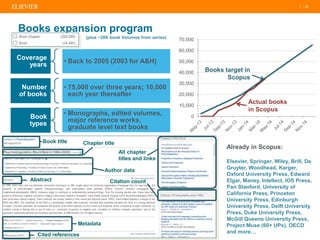
Books expansion program
Coverage
years
• Back to 2005 (2003 for A&H)
Number
of books
• 75,000 over three years; 10,000
each year thereafter
Book
types
• Monographs, edited volumes,
major reference works,
graduate level text books
All chapter
titles and links
Book title Chapter title
Abstract Citation count
0
10,000
20,000
30,000
40,000
50,000
60,000
70,000
Already in Scopus:
Elsevier, Springer, Wiley, Brill, De
Gruyter, Woodhead, Karger,
Oxford University Press, Edward
Elgar, Maney, Intellect, IOS Press,
Pan Stanford, University of
California Press, Princeton
University Press, Edinburgh
University Press, Delft University
Press, Duke University Press,
McGill Queens University Press,
Project Muse (60+ UPs), OECD
and more…
Books target in
Scopus
Actual books
in Scopus
Metadata
Author data
(plus ~28K book Volumes from series)
Cited references
| 22
Scopus cited references expansion program
Scopus will add cited
references to 8 Million
pre-1996 articles going
back to 1970.
| 23
Why?
- Improve the completeness and
coverage of back files in Scopus
- Enhance the relevancy and visibility
of archival content in Scopus
- Measure the impact of pre-1996 –
for both individual assessment and
(historical) trend analysis.
- Increase the accuracy of Scopus
Author Profiles for older researchers
and decision makers.
Pre-1996 cited references expansion program
Coverage
years
• Pre-1996, going back to 1970
Number of
articles
• We estimate 8M+ articles will be
(re-) processed to include cited
references
Which
Archives
• Archives from all major
publishers that have digital
archives available
• All subject areas included
What?
Development of
required systems
and processes has
already started
The first content
with pre-1996
cited references
will be visible in
Q4 2014
Completed by 2016
when >8M articles
from all major
publishers have been
loaded
When?
| 24
January 2014, redesign of Author Profiles
| 25
May 2014, redesign of Author Profiles
| 26
Summary
Scopus has broad coverage providing the most
accurate view of the global research landscape.
Scopus has a transparent content selection
process executed by the independent Scopus
Content Selection & Advisory Board.
Scopus is flexible and we work with you and the
research community to ensure that most relevant
sources are covered.
Scopus is working on content expansion programs
to ensure that coverage, discoverability, profiles and
impact measurement for research in all subject fields
is accounted for in Scopus.
| 27
ScienceDirect
| 28
Agenda of the ScienceDirect presentation
• What problems do researchers have and how
does ScienceDirect help?
• What are some features in ScienceDirect to be
aware of?
• ScienceDirect mobile article page
| 29
Which broad research problems
does ScienceDirect address?
| 30
Problem area 1: reducing the amount of time
spent finding and consuming relevant research
Average time spent
searching for
research information
per week:
3 hours 6 minutes
Average time spent
reading research
articles per week:
4 hours 39 minutes
Average number of
research articles
read per week:
5.1 articles
• Indexing agreements with all relevant web
search engines, A&I DBs and knowledge
platforms
• Customer holding information
• Access options
• Scopus citation
• Author information
• Article recommender
• Interactive and highly structured article (outline),
workspace
• Optimised article layout incl. article outline
• Unique content enrichments such as rich
visualization tools, interactive data viewers,
audio commentaries, and executable papers
• Links to Data sets and supplementary content
| 31
Problem area 2: keeping up to date with
information & developments in my field
Project
set-up,
10%
Authoring,
44%
Extend
knowledge
, 8%
Keeping
up to date,
21%
General,
17%
Thinking about the last time that you searched for or
accessed information related to research, what was
the main reason for conducting the search?
| 32
Problem area 3: finding the relevant research at the
right time
Compared to 5 years ago I now spend more time reading and analyzing
research articles rather than finding them
14% 50% 22% 12% 1%
Strongly agree Agree Neither agree nor disagree Disagree Strongly disagree
| 33
Problem area 4: collaboration with other
researchers
Other research we performed in August 2013 showed us that:
Updates from colleagues on social networking websites offer a way
to learn on a regular basis from people with similar interests and a
similar background
• LinkedIn
• Twitter
• ResearchGate
• Facebook
| 34
Let’s take a look at the product
And also review platform developments
| 35
| 36
Introducing the new ScienceDirect enhanced article page for
mobile devices
• Friendly, inviting, hospitable
• Focused, legible, clear
• Fast, direct, intuitive
| 37
Some initial customer feedback
‘Showing the search results in this
way certainly brings with it a lot of
additional value’
Professor Els Boshuizen, Open
University of The Netherlands
Search results
Overall experience
Performance
Legibility
‘The response time is very good!’
Nynke Kramer, Universiteit
Utrecht
‘Overall a very clear, pleasant
experience! It reads like a book
on an eReader’
Katja J Teerds PhD, Associate
Professor,
Wageningen University
‘The display is very readable, the
font size makes for easy reading,
and the navigation buttons are
simple to use!’
Nynke Kramer, Universiteit
Utrecht
| 38
Mendeley
| 39
What is Mendeley?
| 40
Mendeley is a free reference manager and academic social
network that can help organize your research, collaborate with others
online, and discover the latest research.
• Automatically generate bibliographies
• Collaborate easily with other researchers online
• Easily import papers from other research software
• Find relevant papers based on what you’re reading
• Access your papers from anywhere online
• Read papers on the go, with new iPhone app
www.mendeley.com
40
About Mendeley
Mendeley extracts data
and fulltext from PDFs, ..
..share and discuss their
research in groups, ..
..lets researchers organize
and annotate papers, ..
..and aggregates everything
in the cloud
..share and discuss their
research in groups, ..
Reference manager
Research Database & API
Social Network &
Groups
Enable
Collaboration
Drive
Productivity
Create Insight &
Build Apps
Mendeley key components
| 45
www.elsevier.com/scopus
Thank you & Questions
http://blog.scopus.com/
http://www.twitter.com/scopus
http://blog.sciencedirect.com
http://www.twitter.com/sciencedirect.com
Watch for more developments:

Scopus, ScienceDirect and Mendeley

  • 1.
    | 0 Elizabeth Dyas SeniorProduct Marketing Manager, Scopus Scopus, ScienceDirect and Mendeley June 12, 2014
  • 2.
    | 1 Agenda ofthe Scopus presentation • Scopus content coverage • Scopus coverage of Kazakhstan content • How does Scopus select journal content? • How does Scopus select non-serial content (books and conferences) • What content expansion programs are ongoing? • What features are new in Scopus?
  • 3.
    | 2 Elsevier helpssupport the research cycle that turns research into knowledge and innovation Input (Usage & application) Process Discover/Read Cite/Share Scientific Outputs Disseminate Direct Outcomes Get Read Get Cited
  • 4.
  • 5.
    | 4 What contentdoes Scopus include? Scopus is ideal compared to other products because it has the broadest coverage of global, curated, relevant research, with smart, simple tools to help track, analyze and visualize research. 53.3M records from 21,912 serial titles and 36,000 books 21.3M pre 1996 records | 32.0M post 1995 records • Content from > 5,000 publishers • “Articles in Press” from > 3,750 titles • Titles from 105 different countries in all geographical regions • 40 “local” languages covered • More than 2,800 Gold Open Access journals indexed
  • 6.
    | 5 Scopus coversdifferent source types for a reason JOURNALS • Timely • Peer-reviewed (formal research) CONFERENCES • Preliminary research (can be a bit less formal) • Newer ideas BOOKS • Thorough analysis of a specific topic All subject fields, but typical fields with high ratio of journal publication: chemical, biological, health sciences etc. Mainly of importance in Computer Science and Engineering-related subject fields Mainly of importance in Social Sciences and the Arts & Humanities Different source types are added to ensure that coverage, discoverability, profiles and impact measurement for research in all subject fields is accounted for in Scopus.
  • 7.
    | 6 CONFERENCES 17k events 5.5Mrecords (10%) Conf. expansion: 1,000 conferences 6,000 conf. events 400k conf. papers 5M citations Mainly Engineering and Physical Sciences BOOKS 421 book series - 28K Volumes - 925K items 34,485 books - 356K items Books expansion: 75K books by 2015 - Focus on Social Sciences and A&H PATENTS 24M patents from 5 major patent offices JOURNALS 20,874 peer-reviewed journals 367 trade journals - Full metadata, abstracts and cited references (pre-1996) - >2,800 fully Open Access titles - Going back to 1823 - Funding data from acknowledgements Physical Sciences 6,600 Health Sciences 6,300 Social Sciences 6,350 Life Sciences 4,050 What content does Scopus include?
  • 8.
    | 7 Scopus articlegrowth over last 10 years 0 500,000 1,000,000 1,500,000 2,000,000 2,500,000 3,000,000 3,500,000 2004 2005 2006 2007 2008 2009 2010 2011 2012 2013 Physical Sciences Health Sciences Life Sciences Social Sciences
  • 9.
    | 8 Ratio ofjournals per Publisher in Scopus 10% 8% 5% 5% 2% 1% 1% 1% 1% 1% 1% 1%1%1% Other 60% Source: Scopus title list (May 2014)
  • 10.
    | 9 0 200 400 600 800 1,000 1,200 1,400 1,600 1,800 2009 20102011 2012 2013 2014 Documents 432 445 549 812 Documents with Kazakhstan country affil. 2009–2013 214 active journals from Russia in Scopus. + 118 Russian titles published by international publishers (332 active titles total) Kazakh coverage in Scopus Source: Scopus data ,10 June 2014 1 active journal from Kazakhstan in Scopus. Eurasian Chemico- Technological Journal (since 2007) 1,654 848
  • 11.
    | 10 10 Subject areasof Kazakhstan documents
  • 12.
    | 11 Comparison withnearest peer Scopus 24,169 Web of Science 12,491 Scopus 7,410 (+78%) WoS 4,188 Scopus 6,740 (+97%) WoS 3,415 Scopus 4,436 (+50%) WoS 2,954 Scopus 7,684 (+90%) WoS 4,016 Physical Sciences Health Sciences Life Sciences Social Sciences ~12K titles ~3,300 publishers Updated weekly ~24K titles >5,000 publishers Updated daily Source: Web of Science Real Facts, Web of Science title list and Scopus’ own data (April 2014)
  • 13.
    | 12 Facts aboutScopus and Web of Science ~12 thousand titles 54 million records* 3,300 publishers* “100 years of abstracts”* 6.5 million conference records* 760 million+ cited references* Updated weekly Since 1955* More than 5,600 customers* ~24thousand titles 53 million records >5,000 publishers Going back to 1823 5.5 million conference records 700(?) million+ cited references Updated daily Since 2004 Around 3,000 customers * Source: Web of Science Real Facts, Scopus Data
  • 14.
    | 13 How doesScopus select journals?
  • 15.
    | 14 How doesScopus select serial content? • Titles are selected by the independent Content Selection & Advisory Board (CSAB) • The CSAB is chosen for their expertise in specific subject areas; many will have previously been (journal) Editors Focus on quality through content selection by the independent CSAB, because: • Provide accurate and relevant search results for users • No dilution of search results by irrelevant or low quality content • Support that Scopus is recognized as authoritative • Support confidence that Scopus “reflects the truth”
  • 16.
    | 15 Transparent titleevaluation process by an independent Content Selection & Advisory Board Publisher or Editor Suggest title Check Min. criteria “Enrich” titles Review titles CSAB External reviewer and make decision Continuous review process using online Scopus Title Evaluation Platform (STEP) Online suggestion form: http://suggestor.step.scopus.com/index.cfm
  • 17.
    | 16 Peer-review English abstracts Regular publication Romanscript references Pub. ethics statement How does Scopus select serial content? Journal Policy Quality of Content Journal Standing Regularity Online Availability All titles should meet all minimum criteria in order to be considered for Scopus review: Eligible titles are reviewed by the Content Selection & Advisory Board according to a combination of 14 quantitative and qualitative selection criteria: • Convincing editorial concept/policy • Type of peer-review • Diversity geographic distribution of editors • Diversity geographic distribution of authors • Academic contribution to the field • Clarity of abstracts • Quality and conformity with stated aims & scope • Readability of articles • Citedness of journal articles in Scopus • Editor standing • No delay in publication schedule • Content available online • English-language journal home page • Quality of home page Info: http://www.elsevier.com/online-tools/scopus/content-overview Questions: titlesuggestion@scopus.com
  • 18.
    | 17 How doesScopus select non-serial content?
  • 19.
    | 18 Selection ofnon-serial Book and Conference content Books Book selection is via a publisher-based approach (no individual suggestions accepted). All books from selected publishers deemed “in scope” will be selected for coverage. Priority and selection of publisher’s book lists depends on: • Reputation and impact of the publisher • Size and subject area of the books list • Availability and format of the book content • Publication policy and editorial mission • Quality of published book content Conferences Engineering related conferences 2005 going forward included on various vetted lists (no individual suggestions accepted). • Australian Research Council: ARC-A, ARC-B • “MIT” Conferences • DBLP Computer Science Bibliography (orig. db logic program bibliography) • Microsoft Academic Science – Computer Science, Engineering • INSPIRES – high-energy physics (Stanford) • Web of Science – selected engineering-focused/related • OnePetro – Oil & Gas industries (society conferences from API, SPE, NACE, SEG, etc.) • OneMine – mining and minerals (society conferences from SME, TMS, AIME, AusIMM, ...)
  • 20.
    | 19 What contentexpansion projects are ongoing?
  • 21.
    | 20 Conference ExpansionProgram A special project, designed to ensure Scopus (and Compendex) customers have access to highly regarded conferences from specific respected/authoritative lists of conferences held worldwide. Coverage years • Backfill from 2005 – 2012 (8 years) Number of conferences • Around 1,000 new conference titles, 6,000 conference events, 400K conference papers and 5M references Which conferences • Serial and one-off conferences from authoritative, respected lists. Focus on engineering and engineering-related subject fields Project started in 2011 Expected project end date: June 2014 Titles processed 832 In process, 143 Waiting for permission 384 No permission, 194
  • 22.
    | 21 Books expansionprogram Coverage years • Back to 2005 (2003 for A&H) Number of books • 75,000 over three years; 10,000 each year thereafter Book types • Monographs, edited volumes, major reference works, graduate level text books All chapter titles and links Book title Chapter title Abstract Citation count 0 10,000 20,000 30,000 40,000 50,000 60,000 70,000 Already in Scopus: Elsevier, Springer, Wiley, Brill, De Gruyter, Woodhead, Karger, Oxford University Press, Edward Elgar, Maney, Intellect, IOS Press, Pan Stanford, University of California Press, Princeton University Press, Edinburgh University Press, Delft University Press, Duke University Press, McGill Queens University Press, Project Muse (60+ UPs), OECD and more… Books target in Scopus Actual books in Scopus Metadata Author data (plus ~28K book Volumes from series) Cited references
  • 23.
    | 22 Scopus citedreferences expansion program Scopus will add cited references to 8 Million pre-1996 articles going back to 1970.
  • 24.
    | 23 Why? - Improvethe completeness and coverage of back files in Scopus - Enhance the relevancy and visibility of archival content in Scopus - Measure the impact of pre-1996 – for both individual assessment and (historical) trend analysis. - Increase the accuracy of Scopus Author Profiles for older researchers and decision makers. Pre-1996 cited references expansion program Coverage years • Pre-1996, going back to 1970 Number of articles • We estimate 8M+ articles will be (re-) processed to include cited references Which Archives • Archives from all major publishers that have digital archives available • All subject areas included What? Development of required systems and processes has already started The first content with pre-1996 cited references will be visible in Q4 2014 Completed by 2016 when >8M articles from all major publishers have been loaded When?
  • 25.
    | 24 January 2014,redesign of Author Profiles
  • 26.
    | 25 May 2014,redesign of Author Profiles
  • 27.
    | 26 Summary Scopus hasbroad coverage providing the most accurate view of the global research landscape. Scopus has a transparent content selection process executed by the independent Scopus Content Selection & Advisory Board. Scopus is flexible and we work with you and the research community to ensure that most relevant sources are covered. Scopus is working on content expansion programs to ensure that coverage, discoverability, profiles and impact measurement for research in all subject fields is accounted for in Scopus.
  • 28.
  • 29.
    | 28 Agenda ofthe ScienceDirect presentation • What problems do researchers have and how does ScienceDirect help? • What are some features in ScienceDirect to be aware of? • ScienceDirect mobile article page
  • 30.
    | 29 Which broadresearch problems does ScienceDirect address?
  • 31.
    | 30 Problem area1: reducing the amount of time spent finding and consuming relevant research Average time spent searching for research information per week: 3 hours 6 minutes Average time spent reading research articles per week: 4 hours 39 minutes Average number of research articles read per week: 5.1 articles • Indexing agreements with all relevant web search engines, A&I DBs and knowledge platforms • Customer holding information • Access options • Scopus citation • Author information • Article recommender • Interactive and highly structured article (outline), workspace • Optimised article layout incl. article outline • Unique content enrichments such as rich visualization tools, interactive data viewers, audio commentaries, and executable papers • Links to Data sets and supplementary content
  • 32.
    | 31 Problem area2: keeping up to date with information & developments in my field Project set-up, 10% Authoring, 44% Extend knowledge , 8% Keeping up to date, 21% General, 17% Thinking about the last time that you searched for or accessed information related to research, what was the main reason for conducting the search?
  • 33.
    | 32 Problem area3: finding the relevant research at the right time Compared to 5 years ago I now spend more time reading and analyzing research articles rather than finding them 14% 50% 22% 12% 1% Strongly agree Agree Neither agree nor disagree Disagree Strongly disagree
  • 34.
    | 33 Problem area4: collaboration with other researchers Other research we performed in August 2013 showed us that: Updates from colleagues on social networking websites offer a way to learn on a regular basis from people with similar interests and a similar background • LinkedIn • Twitter • ResearchGate • Facebook
  • 35.
    | 34 Let’s takea look at the product And also review platform developments
  • 36.
  • 37.
    | 36 Introducing thenew ScienceDirect enhanced article page for mobile devices • Friendly, inviting, hospitable • Focused, legible, clear • Fast, direct, intuitive
  • 38.
    | 37 Some initialcustomer feedback ‘Showing the search results in this way certainly brings with it a lot of additional value’ Professor Els Boshuizen, Open University of The Netherlands Search results Overall experience Performance Legibility ‘The response time is very good!’ Nynke Kramer, Universiteit Utrecht ‘Overall a very clear, pleasant experience! It reads like a book on an eReader’ Katja J Teerds PhD, Associate Professor, Wageningen University ‘The display is very readable, the font size makes for easy reading, and the navigation buttons are simple to use!’ Nynke Kramer, Universiteit Utrecht
  • 39.
  • 40.
    | 39 What isMendeley?
  • 41.
    | 40 Mendeley isa free reference manager and academic social network that can help organize your research, collaborate with others online, and discover the latest research. • Automatically generate bibliographies • Collaborate easily with other researchers online • Easily import papers from other research software • Find relevant papers based on what you’re reading • Access your papers from anywhere online • Read papers on the go, with new iPhone app www.mendeley.com 40 About Mendeley
  • 43.
    Mendeley extracts data andfulltext from PDFs, .. ..share and discuss their research in groups, .. ..lets researchers organize and annotate papers, ..
  • 44.
    ..and aggregates everything inthe cloud ..share and discuss their research in groups, ..
  • 45.
    Reference manager Research Database& API Social Network & Groups Enable Collaboration Drive Productivity Create Insight & Build Apps Mendeley key components
  • 46.
    | 45 www.elsevier.com/scopus Thank you& Questions http://blog.scopus.com/ http://www.twitter.com/scopus http://blog.sciencedirect.com http://www.twitter.com/sciencedirect.com Watch for more developments:

Editor's Notes

  • #4 The focus of the value story is to show ROI from investment in Elsevier services as we demonstrate that Elsevier articles have been applied to produce key outputs e.g. articles, patents that contribute to increased research excellence and esteem for the Chinese research community, and where appropriate, societal and economic impacts such as technology innovation and healthcare innovation based on that research.
  • #17 External reviewer in the case of China: Expert Content Selection and Advisory Committee of China - (ECSAC-China) is a local board that has been set up with the cooperation of ISTIC.
  • #26 First major redesign of this page ever! Instead of 2 most recent docs showing in sidebar, 20 most recent will show by default in main panel (in free version too) Main call to action button added – Set Alert feature “rebranded” as Follow this Author. This tested well. Other calls to action are in that corner as well and all the analysis tools grouped together Page optimized for scanning and to be more CV like Just the first stage of a redesign, more to come Sidebar shows 3 most recent citing articles rather than 2 as on doc details page. Some less key information now in sidebar to highlight the most important bits in the main column (there are somethings not yet implemented in this screenshot like still like outward links on the doc list and an Export all button.)
  • #32 Research based on an internal study in Q4, 2012
  • #33 To support researchers in being able to stay up to date we have a number of product features that have been developed, including the alerts for Articles in Press, Journal/volume issues, and the Top 25 Hottest Article
  • #34 To help researchers find the relevant information at the right time, we have provided a mobile enhanced version of the journal article page, we show the cited by in Scopus, we link to data sets and supplementary content, and we publish articles wherein the author has been able to present the research using multi media and other files. One example that we have here is of maps that have been included in the journal article page
  • #35 What you can see here is the opportunity for researchers to collaborate with each other, another key problem area that we have identified researchers have. We offer the possibility to export the article to for example Mendeley, or RefWorks
  • #37 Home page, showing subject areas under which the publications are organised, as well as links to OA and latest articles. The Top 25 is a very popular way for researchers to keep up to date with the most downloaded articles. You can also see on the top right hand corner the amount of articles a researcher will have access to, when using SD
  • #38 From a design perspective, we had very clear principles we applied from the outset, knowing these to be the most focused on the user experience. Friendly, focused, and particularly fast were key criteria that the designers and development teams kept in mind at all times. The design is also accessibility friendly, with special tags with explanatory text added to aid screen-reader software used by visually impaired users
  • #39 We’ve tested the design with various customers primarily in Europe. This is what some of them said about search results, performance, legibility, and the overall experience
  • #45 as