Research Metrics Nazi TorabiResearch & Instructional Librarian  Allyn & Betty Taylor LibraryApril 27, 2011http://www.slideshare.net/ntorabi/1
Objectives To provide an overview of various bibliometrics productsHave a good understanding of limitation of each product How to calculate your own h-index2
3
Why Research Metrics?Get published in a good journalApplication for tenure, promotion, or grant fundingMeasure the impact of an individual’s research4
The MetricsPublication count         measures quantity but not quality (impact) Citation counts Total number of citation count
Total number of citation count in particular time span
Total number of citation per paper
Number of papers cited more than n times
Number of citations to the n most cited papersNormalized citation counts  5
Journal Citation ReportKey metric: Journal Impact Factor (IF)
Journal ranking by discipline
Citing pattern analysis in discipline 6
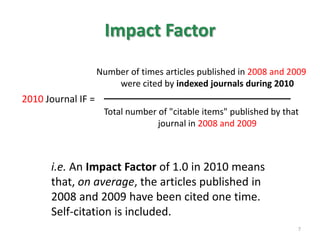
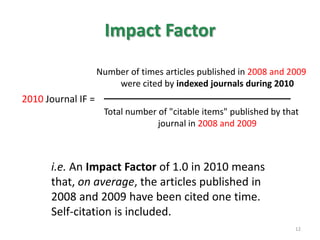
Impact FactorNumber of times articles published in 2008 and 2009 were cited by indexed journals during 2010 Total number of "citable items" published by that journal in 2008 and 20092010 Journal IF = i.e. An Impact Factor of 1.0 in 2010 means that, on average, the articles published in 2008 and 2009 have been cited one time. Self-citation is included.7
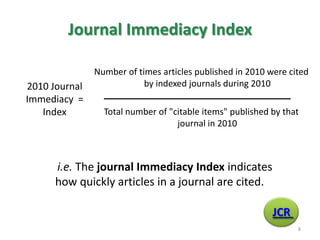
Journal Immediacy IndexNumber of times articles published in 2010 were cited by indexed journals during 2010Total number of "citable items" published by that journal in 20102010 Journal Immediacy  =Index     i.e. The journal Immediacy Index indicates how quickly articles in a journal are cited.JCR 8
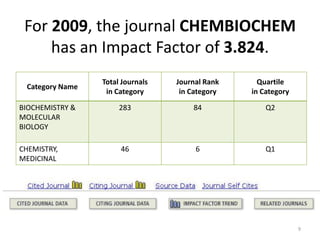
For 2009, the journal CHEMBIOCHEM has an Impact Factor of 3.824.9
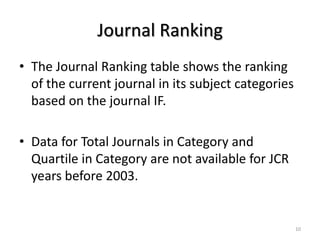
Journal RankingThe Journal Ranking table shows the ranking of the current journal in its subject categories based on the journal IF.  Data for Total Journals in Category and Quartile in Category are not available for JCR years before 2003. 10
IF & its shortcomings Citation pattern is discipline specific Time spanCitation frequencydifferences in citation normsSleeping beautiesSelf-Citation and other!!!Negative citations  Title and journal format changesA questionable validity11
Impact FactorNumber of times articles published in 2008 and 2009 were cited by indexed journals during 2010 Total number of "citable items" published by that journal in 2008 and 20092010 Journal IF = i.e. An Impact Factor of 1.0 in 2010 means that, on average, the articles published in 2008 and 2009 have been cited one time. Self-citation is included.12
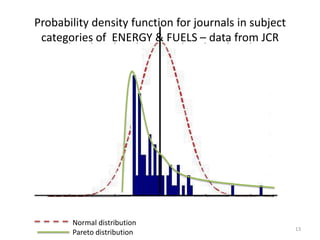
Probability density function for journals in subject categories of  ENERGY & FUELS – data from JCR-5        -4         -3           -2         -1          0          1          2          3          4        5Normal distributionPareto distribution13
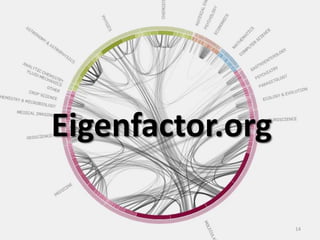
Eigenfactor.org14
Citation Networks  & Network Effects 15
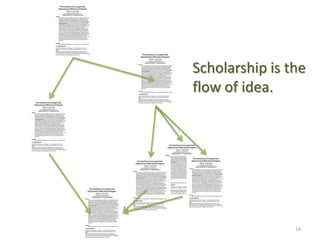
Scholarship is the flow of idea. 16
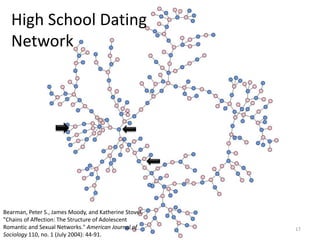
High School Dating NetworkBearman, Peter S., James Moody, and Katherine Stovel. "Chains of Affection: The Structure of Adolescent Romantic and Sexual Networks." American Journal of Sociology 110, no. 1 (July 2004): 44-91. 17
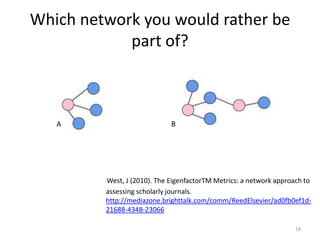
Which network you would rather be part of?West, J (2010). The EigenfactorTM Metrics: a network approach to assessing scholarly journals. http://mediazone.brighttalk.com/comm/ReedElsevier/ad0fb0ef1d-21688-4348-2306618AB
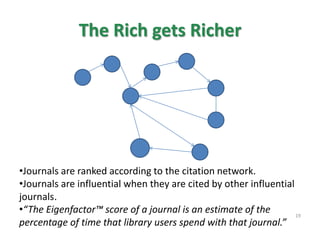
The Rich gets Richer Journals are ranked according to the citation network.
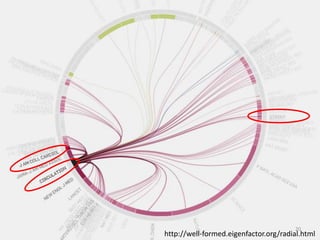
Journals are influential when they are cited by other influential journals.
“The Eigenfactor™ score of a journal is an estimate of the percentage of time that library users spend with that journal.”19
http://well-formed.eigenfactor.org/radial.html20
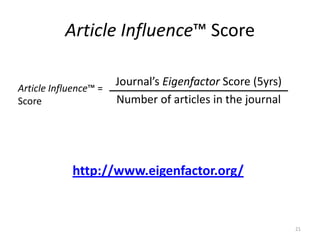
Article Influence™ ScoreJournal’s Eigenfactor Score (5yrs)Number of articles in the journalArticle Influence™ = Scorehttp://www.eigenfactor.org/21
How can we better evaluate the scholarly literature ?How can we better navigate the scholarly literature?22
CWTS Journal IndicatorsKey metric: Source Normalized Impact per Paper (SNIP)
Journal ranking by discipline
Author analysis
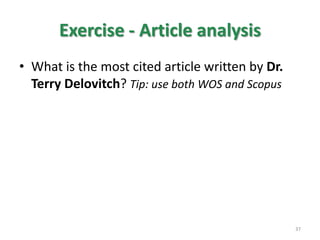
Article analysis23
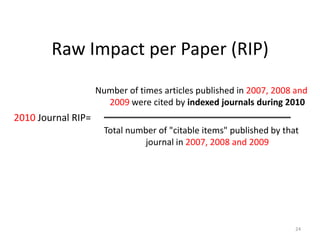
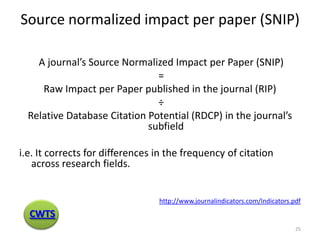
Raw Impact per Paper (RIP)Number of times articles published in 2007, 2008 and 2009 were cited by indexed journals during 2010 Total number of "citable items" published by that journal in 2007, 2008 and 20092010 Journal RIP= 24
Source normalized impact per paper (SNIP)  A journal’s Source Normalized Impact per Paper (SNIP)  =Raw Impact per Paper published in the journal (RIP)  ÷Relative Database Citation Potential (RDCP) in the journal’s subfieldi.e. It corrects for differences in the frequency of citation across research fields.http://www.journalindicators.com/Indicators.pdf25CWTS
SCImagoKey metric: ScImago Journal Ranking (SJR)
Journal and Country ranking by discipline26Scopus
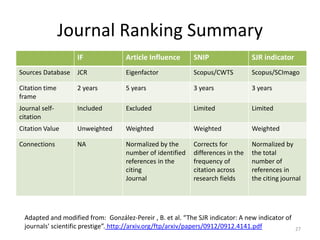
Journal Ranking Summary Adapted and modified from:  González-Pereir , B. et al. “The SJR indicator: A new indicator of journals' scientific prestige”. http://arxiv.org/ftp/arxiv/papers/0912/0912.4141.pdf27
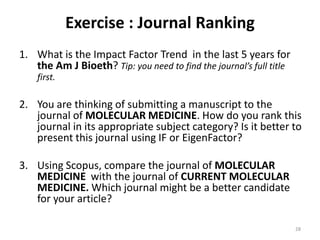
Exercise : Journal RankingWhat is the Impact Factor Trend  in the last 5 yearsfor the Am J Bioeth? Tip: you need to find the journal’s full title first.You are thinking of submitting a manuscript to the journal of MOLECULAR MEDICINE. How do you rank this journal in its appropriate subject category? Is it better to present this journal using IF or EigenFactor? Using Scopus, compare the journal of MOLECULAR MEDICINE  with the journal of CURRENT MOLECULAR MEDICINE. Which journal might be a better candidate for your article?28
h-indexh measures the cumulative impact of a researcher's output by looking at the amount of citation his/her work has received.
i.e. If a researcher has an h-index of 25 if 25 of their papers have been cited at least 25 times (See the graph in the handout).29
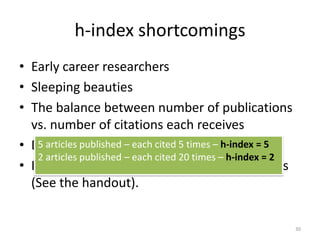
h-index shortcomings Early career researchers Sleeping beautiesThe balance between number of publications vs. number of citations each receivesDatabases are not error freeInconsistency between different metric tools (See the handout). 305 articles published – each cited 5 times – h-index = 52 articles published – each cited 20 times – h-index = 2
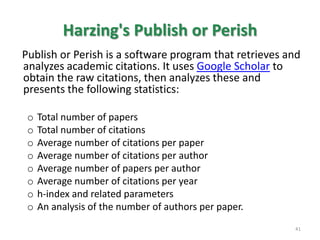
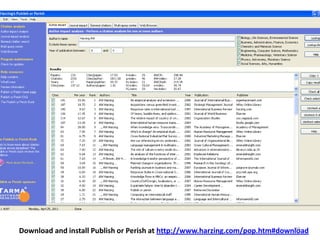
h-index Variantsg-index: more weight is given to the highest cited papers The individual h-index: accounts for co-authorship in calculating impact by giving less weight to such papersThe contemporary h-index: less weight to older cited papers The age-weighted citation rate: accounts for the age of papers  Tarma Software Research (2010). Publish or Perish User’s Manual  http://www.harzing.com/pophelp/metrics.htm#gindex31
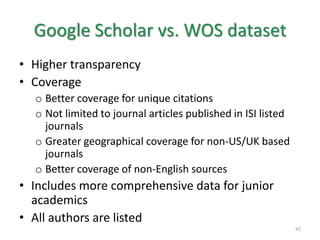
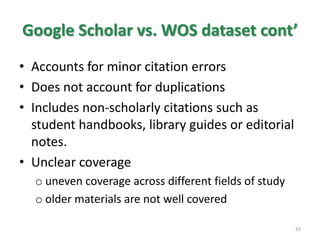
ArticlesRanking F1000ScopusPOPWOS32
Web OF Science33
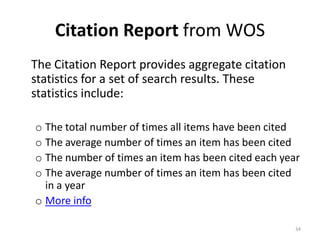
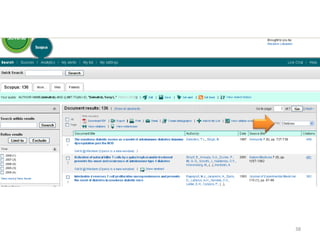
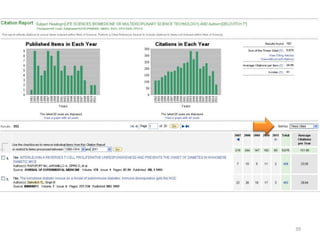
Citation Report from WOS    The Citation Report provides aggregate citation statistics for a set of search results. These statistics include:The total number of times all items have been cited
The average number of times an item has been cited
The number of times an item has been cited each year

Research Metrics

  • 1.
    Research Metrics NaziTorabiResearch & Instructional Librarian Allyn & Betty Taylor LibraryApril 27, 2011http://www.slideshare.net/ntorabi/1
  • 2.
    Objectives To providean overview of various bibliometrics productsHave a good understanding of limitation of each product How to calculate your own h-index2
  • 3.
  • 4.
    Why Research Metrics?Getpublished in a good journalApplication for tenure, promotion, or grant fundingMeasure the impact of an individual’s research4
  • 5.
    The MetricsPublication count measures quantity but not quality (impact) Citation counts Total number of citation count
  • 6.
    Total number ofcitation count in particular time span
  • 7.
    Total number ofcitation per paper
  • 8.
    Number of paperscited more than n times
  • 9.
    Number of citationsto the n most cited papersNormalized citation counts 5
  • 10.
    Journal Citation ReportKeymetric: Journal Impact Factor (IF)
  • 11.
  • 12.
  • 13.
    Impact FactorNumber oftimes articles published in 2008 and 2009 were cited by indexed journals during 2010 Total number of "citable items" published by that journal in 2008 and 20092010 Journal IF = i.e. An Impact Factor of 1.0 in 2010 means that, on average, the articles published in 2008 and 2009 have been cited one time. Self-citation is included.7
  • 14.
    Journal Immediacy IndexNumberof times articles published in 2010 were cited by indexed journals during 2010Total number of "citable items" published by that journal in 20102010 Journal Immediacy =Index i.e. The journal Immediacy Index indicates how quickly articles in a journal are cited.JCR 8
  • 15.
    For 2009, thejournal CHEMBIOCHEM has an Impact Factor of 3.824.9
  • 16.
    Journal RankingThe JournalRanking table shows the ranking of the current journal in its subject categories based on the journal IF. Data for Total Journals in Category and Quartile in Category are not available for JCR years before 2003. 10
  • 17.
    IF & itsshortcomings Citation pattern is discipline specific Time spanCitation frequencydifferences in citation normsSleeping beautiesSelf-Citation and other!!!Negative citations Title and journal format changesA questionable validity11
  • 18.
    Impact FactorNumber oftimes articles published in 2008 and 2009 were cited by indexed journals during 2010 Total number of "citable items" published by that journal in 2008 and 20092010 Journal IF = i.e. An Impact Factor of 1.0 in 2010 means that, on average, the articles published in 2008 and 2009 have been cited one time. Self-citation is included.12
  • 19.
    Probability density functionfor journals in subject categories of ENERGY & FUELS – data from JCR-5 -4 -3 -2 -1 0 1 2 3 4 5Normal distributionPareto distribution13
  • 20.
  • 21.
    Citation Networks & Network Effects 15
  • 22.
    Scholarship is theflow of idea. 16
  • 23.
    High School DatingNetworkBearman, Peter S., James Moody, and Katherine Stovel. "Chains of Affection: The Structure of Adolescent Romantic and Sexual Networks." American Journal of Sociology 110, no. 1 (July 2004): 44-91. 17
  • 24.
    Which network youwould rather be part of?West, J (2010). The EigenfactorTM Metrics: a network approach to assessing scholarly journals. http://mediazone.brighttalk.com/comm/ReedElsevier/ad0fb0ef1d-21688-4348-2306618AB
  • 25.
    The Rich getsRicher Journals are ranked according to the citation network.
  • 26.
    Journals are influentialwhen they are cited by other influential journals.
  • 27.
    “The Eigenfactor™ scoreof a journal is an estimate of the percentage of time that library users spend with that journal.”19
  • 28.
  • 29.
    Article Influence™ ScoreJournal’sEigenfactor Score (5yrs)Number of articles in the journalArticle Influence™ = Scorehttp://www.eigenfactor.org/21
  • 30.
    How can webetter evaluate the scholarly literature ?How can we better navigate the scholarly literature?22
  • 31.
    CWTS Journal IndicatorsKeymetric: Source Normalized Impact per Paper (SNIP)
  • 32.
  • 33.
  • 34.
  • 35.
    Raw Impact perPaper (RIP)Number of times articles published in 2007, 2008 and 2009 were cited by indexed journals during 2010 Total number of "citable items" published by that journal in 2007, 2008 and 20092010 Journal RIP= 24
  • 36.
    Source normalized impactper paper (SNIP) A journal’s Source Normalized Impact per Paper (SNIP) =Raw Impact per Paper published in the journal (RIP) ÷Relative Database Citation Potential (RDCP) in the journal’s subfieldi.e. It corrects for differences in the frequency of citation across research fields.http://www.journalindicators.com/Indicators.pdf25CWTS
  • 37.
    SCImagoKey metric: ScImagoJournal Ranking (SJR)
  • 38.
    Journal and Countryranking by discipline26Scopus
  • 39.
    Journal Ranking SummaryAdapted and modified from: González-Pereir , B. et al. “The SJR indicator: A new indicator of journals' scientific prestige”. http://arxiv.org/ftp/arxiv/papers/0912/0912.4141.pdf27
  • 40.
    Exercise : JournalRankingWhat is the Impact Factor Trend in the last 5 yearsfor the Am J Bioeth? Tip: you need to find the journal’s full title first.You are thinking of submitting a manuscript to the journal of MOLECULAR MEDICINE. How do you rank this journal in its appropriate subject category? Is it better to present this journal using IF or EigenFactor? Using Scopus, compare the journal of MOLECULAR MEDICINE with the journal of CURRENT MOLECULAR MEDICINE. Which journal might be a better candidate for your article?28
  • 41.
    h-indexh measures thecumulative impact of a researcher's output by looking at the amount of citation his/her work has received.
  • 42.
    i.e. If aresearcher has an h-index of 25 if 25 of their papers have been cited at least 25 times (See the graph in the handout).29
  • 43.
    h-index shortcomings Earlycareer researchers Sleeping beautiesThe balance between number of publications vs. number of citations each receivesDatabases are not error freeInconsistency between different metric tools (See the handout). 305 articles published – each cited 5 times – h-index = 52 articles published – each cited 20 times – h-index = 2
  • 44.
    h-index Variantsg-index: moreweight is given to the highest cited papers The individual h-index: accounts for co-authorship in calculating impact by giving less weight to such papersThe contemporary h-index: less weight to older cited papers The age-weighted citation rate: accounts for the age of papers Tarma Software Research (2010). Publish or Perish User’s Manual http://www.harzing.com/pophelp/metrics.htm#gindex31
  • 45.
  • 46.
  • 47.
    Citation Report fromWOS The Citation Report provides aggregate citation statistics for a set of search results. These statistics include:The total number of times all items have been cited
  • 48.
    The average numberof times an item has been cited
  • 49.
    The number oftimes an item has been cited each year

Editor's Notes

  • #8 A = the number of times articles published in 2008 and 2009 were cited by indexed journals during 2010B = the total number of "citable items" published by that journal in 2008 and 2009. 2010 impact factor = A/B("Citable items" are usually articles, reviews, proceedings, or notes; not editorials or Letters-to-the-Editor.)
  • #10 http://admin-apps.isiknowledge.com/JCR/help/h_boxplot.html#category_boxplot
  • #11 the cited half-life: the median age of the articles that were cited in Journal Citation Reports each year. For example, if a journal's half-life in 2005 is 5, that means the citations from 2001-2005 are half of all the citations from that journal in 2005, and the other half of the citations precede 2001
  • #13 A = the number of times articles published in 2008 and 2009 were cited by indexed journals during 2010B = the total number of "citable items" published by that journal in 2008 and 2009. 2010 impact factor = A/B("Citable items" are usually articles, reviews, proceedings, or notes; not editorials or Letters-to-the-Editor.)
  • #14 The impact factor refers to the average number of citations per paper, but this is not a normal distribution. It is rather a Bradford distribution, as predicted by theory. Being an arithmetic mean, the impact factor therefore is not a valid representation of this distribution and unfit for citation evaluation.[7]
  • #18 It was created by Physicist Mark Newman from data published in 2004 by Peter Bearman, James Moody, and Katherine Stovel. http://www.jstor.org/stable/pdfplus/10.1086/386272.pdf?acceptTC=truehttp://mediazone.brighttalk.com/comm/ReedElsevier/ad0fb0ef1d-21688-4348-23066
  • #19 Head developer ofeigenfactor
  • #27 SJR = SCImago Journal Rank reflects prestige of source: value of weighted citations per documentSNIP = Source normalized impact per paper: corrects for differences in the frequency of citation across research fields4 yrs of data is needed
  • #29 Use pubmed journal database = AMERICAN JOURNAL OF BIOETHICS = 2.5- 3.4- 3.9-4.3-4.0IF mol med = 5.02 no ImmediacyIndexIF current mol med = 5.092
  • #30 An index to quantify an individual's scientific research output