Impact and Shock Loading
Padmanabhan.K
3/17/2023 2
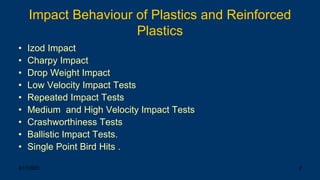
Impact Behaviour of Plastics and Reinforced
Plastics
• Izod Impact
• Charpy Impact
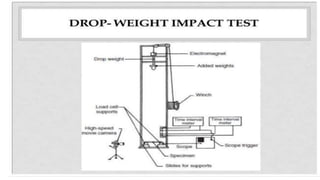
• Drop Weight Impact
• Low Velocity Impact Tests
• Repeated Impact Tests
• Medium and High Velocity Impact Tests
• Crashworthiness Tests
• Ballistic Impact Tests.
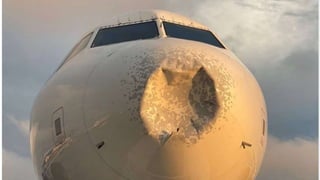
• Single Point Bird Hits .
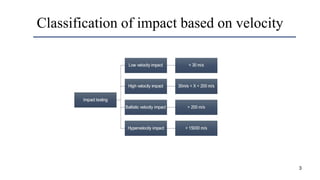
Classification of impact based on velocity
3
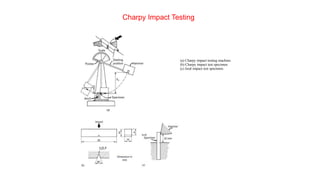
(a) Charpy impact testing machine.
(b) Charpy impact test specimen.
(c) Izod impact test specimen.
Impact Testing
Impact Testing
Charpy Impact Testing
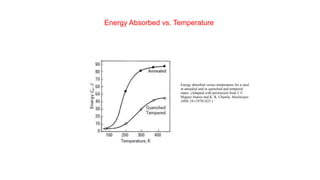
Energy absorbed versus temperature for a steel
in annealed and in quenched and tempered
states. (Adapted with permission from J. C.
Miguez Suarez and K. K. Chawla, Metalurgia-
ABM, 34 (1978) 825.)
Energy Absorbed vs. Temperature
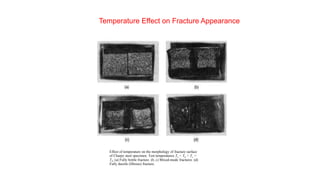
Effect of temperature on the morphology of fracture surface
of Charpy steel specimen. Test temperatures Ta < Tb < Tc <
Td. (a) Fully brittle fracture. (b, c) Mixed-mode fractures. (d)
Fully ductile (fibrous) fracture.
Temperature Effect on Fracture Appearance
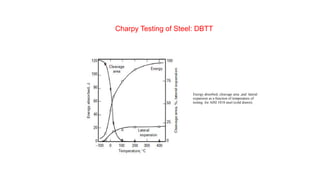
Energy absorbed, cleavage area ,and lateral
expansion as a function of temperature of
testing for AISI 1018 steel (cold drawn).
Charpy Testing of Steel: DBTT
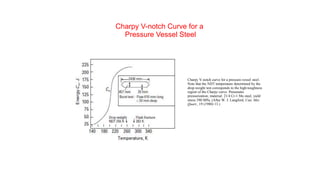
Charpy V-notch curve for a pressure-vessel steel.
Note that the NDT temperature determined by the
drop-weight test corresponds to the high-toughness
region of the Charpy curve. Pneumatic
pressurization; material: 21/4 Cr-1 Mo steel, yield
stress 590 MPa. (After W. J. Langford, Can. Met.
Quart., 19 (1980) 13.)
Charpy V-notch Curve for a
Pressure Vessel Steel
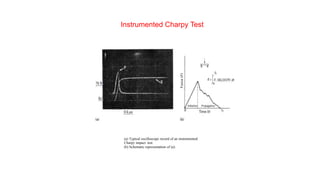
(a) Typical oscilloscope record of an instrumented
Charpy impact test.
(b) Schematic representation of (a).
Instrumented Charpy Test
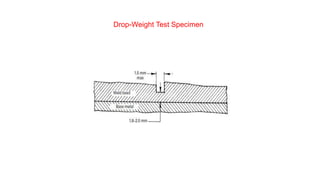
Drop-Weight Test Specimen
Impact velocity and impact force
• During drop weight impact, tup’s gravitational potential energy
is converted to kinetic energy. Conservation of energy as a tool
permits the calculation of the velocity just before it hits the
surface.
12
Average impact force x distance travelled = change in kinetic energy
3/17/2023 13
Impact of Epoxy-Polycarbonate Blends
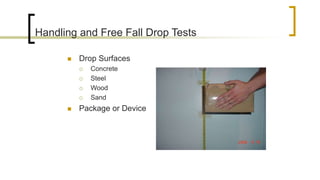
Handling and Free Fall Drop Tests
 Drop Surfaces
 Concrete
 Steel
 Wood
 Sand
 Package or Device
3/17/2023 15
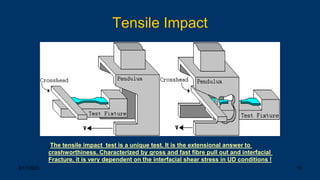
Tensile Impact
The tensile impact test is a unique test. It is the extensional answer to
crashworthiness. Characterized by gross and fast fibre pull out and interfacial
Fracture, it is very dependent on the interfacial shear stress in UD conditions !
SMC 4133 AUTOMOTIVE STRUCTURES
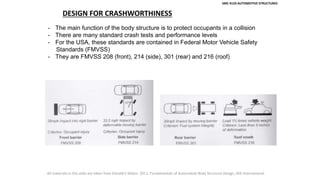
DESIGN FOR CRASHWORTHINESS
- The main function of the body structure is to protect occupants in a collision
- There are many standard crash tests and performance levels
- For the USA, these standards are contained in Federal Motor Vehicle Safety
Standards (FMVSS)
- They are FMVSS 208 (front), 214 (side), 301 (rear) and 216 (roof)
All materials in this slide are taken from Donald E Malen. 2011. Fundamentals of Automobile Body Structure Design, SAE International.
SMC 4133 AUTOMOTIVE STRUCTURES
DESIGN FOR CRASHWORTHINESS
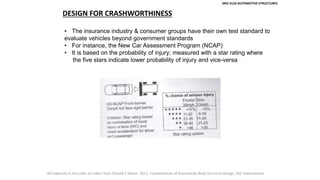
• The insurance industry & consumer groups have their own test standard to
evaluate vehicles beyond government standards
• For instance, the New Car Assessment Program (NCAP)
• It is based on the probability of injury; measured with a star rating where
the five stars indicate lower probability of injury and vice-versa
All materials in this slide are taken from Donald E Malen. 2011. Fundamentals of Automobile Body Structure Design, SAE International.
SMC 4133 AUTOMOTIVE STRUCTURES
DESIGN FOR CRASHWORTHINESS
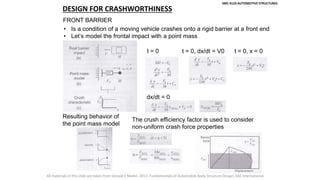
FRONT BARRIER
• Is a condition of a moving vehicle crashes onto a rigid barrier at a front end
• Let’s model the frontal impact with a point mass
t = 0 t = 0, dx/dt = V0 t = 0, x = 0
dx/dt = 0
Resulting behavior of
the point mass model
The crush efficiency factor is used to consider
non-uniform crash force properties
All materials in this slide are taken from Donald E Malen. 2011. Fundamentals of Automobile Body Structure Design, SAE International.
SMC 4133 AUTOMOTIVE STRUCTURES
DESIGN FOR CRASHWORTHINESS
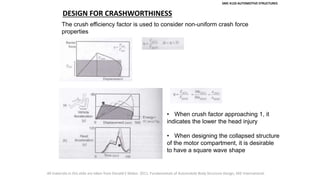
The crush efficiency factor is used to consider non-uniform crash force
properties
• When crush factor approaching 1, it
indicates the lower the head injury
• When designing the collapsed structure
of the motor compartment, it is desirable
to have a square wave shape
All materials in this slide are taken from Donald E Malen. 2011. Fundamentals of Automobile Body Structure Design, SAE International.
SMC 4133 AUTOMOTIVE STRUCTURES
DESIGN FOR CRASHWORTHINESS
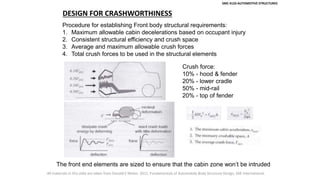
Procedure for establishing Front body structural requirements:
1. Maximum allowable cabin decelerations based on occupant injury
2. Consistent structural efficiency and crush space
3. Average and maximum allowable crush forces
4. Total crush forces to be used in the structural elements
Crush force:
10% - hood & fender
20% - lower cradle
50% - mid-rail
20% - top of fender
The front end elements are sized to ensure that the cabin zone won’t be intruded
All materials in this slide are taken from Donald E Malen. 2011. Fundamentals of Automobile Body Structure Design, SAE International.
SMC 4133 AUTOMOTIVE STRUCTURES
DESIGN FOR CRASHWORTHINESS
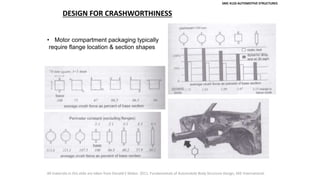
• Motor compartment packaging typically
require flange location & section shapes
All materials in this slide are taken from Donald E Malen. 2011. Fundamentals of Automobile Body Structure Design, SAE International.
SMC 4133 AUTOMOTIVE STRUCTURES
DESIGN FOR CRASHWORTHINESS
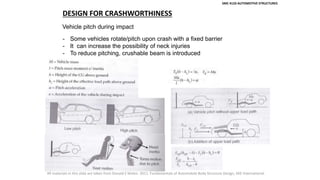
Vehicle pitch during impact
- Some vehicles rotate/pitch upon crash with a fixed barrier
- It can increase the possibility of neck injuries
- To reduce pitching, crushable beam is introduced
All materials in this slide are taken from Donald E Malen. 2011. Fundamentals of Automobile Body Structure Design, SAE International.
SMC 4133 AUTOMOTIVE STRUCTURES
DESIGN FOR CRASHWORTHINESS
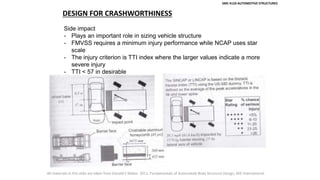
Side impact
- Plays an important role in sizing vehicle structure
- FMVSS requires a minimum injury performance while NCAP uses star
scale
- The injury criterion is TTI index where the larger values indicate a more
severe injury
- TTI < 57 in desirable
All materials in this slide are taken from Donald E Malen. 2011. Fundamentals of Automobile Body Structure Design, SAE International.
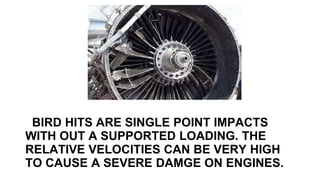
BIRD HITS ARE SINGLE POINT IMPACTS
WITH OUT A SUPPORTED LOADING. THE
RELATIVE VELOCITIES CAN BE VERY HIGH
TO CAUSE A SEVERE DAMGE ON ENGINES.
Shock and Vibration Testing
3/17/2023 27
Thermal Shock Test (JESD22 –
A106B)
• Purpose of this test is to determine the resistance of the part to
sudden exposures of extreme changes in temperature and alternate
exposures to these extremes as well as its ability to withstand cyclical
stresses
• Here the IC packages are baked in an oven for 125ºC/24 Hrs and the
temperature is spiked to 260ºC for lead free product and 240ºC for
leaded product for 5 to 10 minutes.
• If the baking temperature is higher than the glass transition
temperature at this extreme heat the package tends to delaminate or
fail. This failure or delamination can be viewed using SAM (Scanning
Acoustic Microscopy)
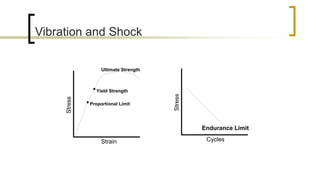
Vibration and Shock
Stress
Cycles
Endurance Limit
Strain
Stress
Yield Strength
Ultimate Strength
Proportional Limit
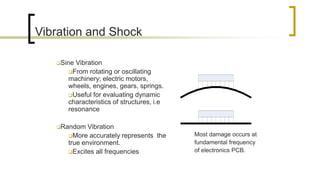
Vibration and Shock
Sine Vibration
From rotating or oscillating
machinery; electric motors,
wheels, engines, gears, springs.
Useful for evaluating dynamic
characteristics of structures, i.e
resonance
Random Vibration
More accurately represents the
true environment.
Excites all frequencies
Most damage occurs at
fundamental frequency
of electronics PCB.
Vibration and Shock
 Shock
 High stresses causing fracture or permanent deformation
 High accelerations which can cause relays to chatter, potentiometers to slip, bolts
to loosen.
 High displacement which can cause impact between adjacent circuit boards
 Usually not considered a fatigue failure if shock quantity less than 1,000 cycles.
Selecting a Vibration Level or a Shock Pulse
 Which Shock Pulse should I Apply?
 How Many?
 Which Level?
 What is the vibration spectrum of interest?
 How long should I test for?
1. Follow the Contract Specifications
2. Create Your Test Based on Existing Specifications as Guidance
3. Make Field Measurements
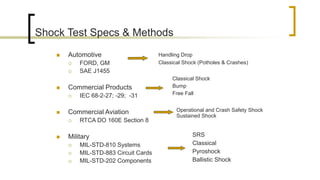
Shock Test Specs & Methods
 Automotive
 FORD, GM
 SAE J1455
 Commercial Products
 IEC 68-2-27; -29; -31
 Commercial Aviation
 RTCA DO 160E Section 8
 Military
 MIL-STD-810 Systems
 MIL-STD-883 Circuit Cards
 MIL-STD-202 Components
Handling Drop
Classical Shock (Potholes & Crashes)
Classical Shock
Bump
Free Fall
Operational and Crash Safety Shock
Sustained Shock
SRS
Classical
Pyroshock
Ballistic Shock
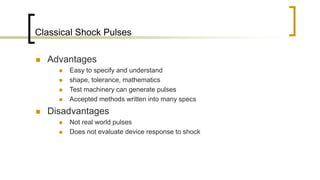
Classical Shock Pulses
 Advantages
 Easy to specify and understand
 shape, tolerance, mathematics
 Test machinery can generate pulses
 Accepted methods written into many specs
 Disadvantages
 Not real world pulses
 Does not evaluate device response to shock
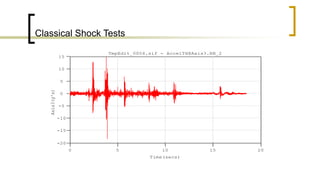
Classical Shock Tests
TmpEdit_0004.sif - AccelTH@Axis3.RN_2
Time(secs)
0 5 10 15 20
Axis3(g's)
-20
-15
-10
-5
0
5
10
15
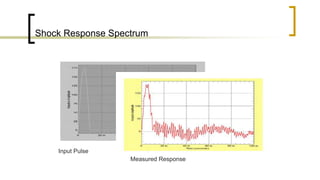
Shock Response Spectrum
Input Pulse
Measured Response
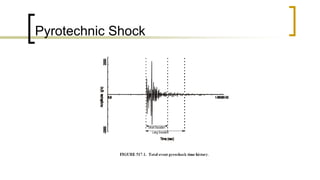
Pyrotechnic Shock
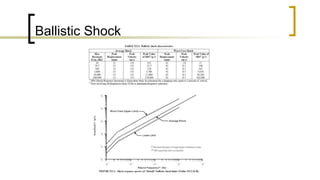
Ballistic Shock
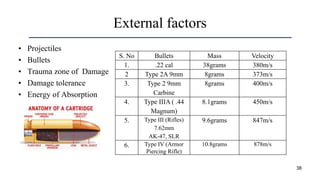
External factors
• Projectiles
• Bullets
• Trauma zone of Damage
• Damage tolerance
• Energy of Absorption
38
S. No Bullets Mass Velocity
1. .22 cal 38grams 380m/s
2 Type 2A 9mm 8grams 373m/s
3. Type 2 9mm
Carbine
8grams 400m/s
4. Type IIIA ( .44
Magnum)
8.1grams 450m/s
5. Type III (Rifles)
7.62mm
AK-47, SLR
9.6grams 847m/s
6. Type IV (Armor
Piercing Rifle)
10.8grams 878m/s
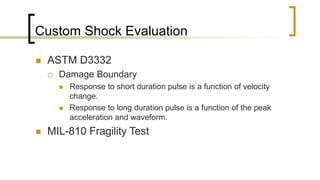
Custom Shock Evaluation
 ASTM D3332
 Damage Boundary
 Response to short duration pulse is a function of velocity
change.
 Response to long duration pulse is a function of the peak
acceleration and waveform.
 MIL-810 Fragility Test

Impact and Shock Loading in Engineering Failure analysis

  • 1.
    Impact and ShockLoading Padmanabhan.K
  • 2.
    3/17/2023 2 Impact Behaviourof Plastics and Reinforced Plastics • Izod Impact • Charpy Impact • Drop Weight Impact • Low Velocity Impact Tests • Repeated Impact Tests • Medium and High Velocity Impact Tests • Crashworthiness Tests • Ballistic Impact Tests. • Single Point Bird Hits .
  • 3.
    Classification of impactbased on velocity 3
  • 4.
    (a) Charpy impacttesting machine. (b) Charpy impact test specimen. (c) Izod impact test specimen. Impact Testing Impact Testing Charpy Impact Testing
  • 5.
    Energy absorbed versustemperature for a steel in annealed and in quenched and tempered states. (Adapted with permission from J. C. Miguez Suarez and K. K. Chawla, Metalurgia- ABM, 34 (1978) 825.) Energy Absorbed vs. Temperature
  • 6.
    Effect of temperatureon the morphology of fracture surface of Charpy steel specimen. Test temperatures Ta < Tb < Tc < Td. (a) Fully brittle fracture. (b, c) Mixed-mode fractures. (d) Fully ductile (fibrous) fracture. Temperature Effect on Fracture Appearance
  • 7.
    Energy absorbed, cleavagearea ,and lateral expansion as a function of temperature of testing for AISI 1018 steel (cold drawn). Charpy Testing of Steel: DBTT
  • 8.
    Charpy V-notch curvefor a pressure-vessel steel. Note that the NDT temperature determined by the drop-weight test corresponds to the high-toughness region of the Charpy curve. Pneumatic pressurization; material: 21/4 Cr-1 Mo steel, yield stress 590 MPa. (After W. J. Langford, Can. Met. Quart., 19 (1980) 13.) Charpy V-notch Curve for a Pressure Vessel Steel
  • 9.
    (a) Typical oscilloscoperecord of an instrumented Charpy impact test. (b) Schematic representation of (a). Instrumented Charpy Test
  • 11.
  • 12.
    Impact velocity andimpact force • During drop weight impact, tup’s gravitational potential energy is converted to kinetic energy. Conservation of energy as a tool permits the calculation of the velocity just before it hits the surface. 12 Average impact force x distance travelled = change in kinetic energy
  • 13.
    3/17/2023 13 Impact ofEpoxy-Polycarbonate Blends
  • 14.
    Handling and FreeFall Drop Tests  Drop Surfaces  Concrete  Steel  Wood  Sand  Package or Device
  • 15.
    3/17/2023 15 Tensile Impact Thetensile impact test is a unique test. It is the extensional answer to crashworthiness. Characterized by gross and fast fibre pull out and interfacial Fracture, it is very dependent on the interfacial shear stress in UD conditions !
  • 16.
    SMC 4133 AUTOMOTIVESTRUCTURES DESIGN FOR CRASHWORTHINESS - The main function of the body structure is to protect occupants in a collision - There are many standard crash tests and performance levels - For the USA, these standards are contained in Federal Motor Vehicle Safety Standards (FMVSS) - They are FMVSS 208 (front), 214 (side), 301 (rear) and 216 (roof) All materials in this slide are taken from Donald E Malen. 2011. Fundamentals of Automobile Body Structure Design, SAE International.
  • 17.
    SMC 4133 AUTOMOTIVESTRUCTURES DESIGN FOR CRASHWORTHINESS • The insurance industry & consumer groups have their own test standard to evaluate vehicles beyond government standards • For instance, the New Car Assessment Program (NCAP) • It is based on the probability of injury; measured with a star rating where the five stars indicate lower probability of injury and vice-versa All materials in this slide are taken from Donald E Malen. 2011. Fundamentals of Automobile Body Structure Design, SAE International.
  • 18.
    SMC 4133 AUTOMOTIVESTRUCTURES DESIGN FOR CRASHWORTHINESS FRONT BARRIER • Is a condition of a moving vehicle crashes onto a rigid barrier at a front end • Let’s model the frontal impact with a point mass t = 0 t = 0, dx/dt = V0 t = 0, x = 0 dx/dt = 0 Resulting behavior of the point mass model The crush efficiency factor is used to consider non-uniform crash force properties All materials in this slide are taken from Donald E Malen. 2011. Fundamentals of Automobile Body Structure Design, SAE International.
  • 19.
    SMC 4133 AUTOMOTIVESTRUCTURES DESIGN FOR CRASHWORTHINESS The crush efficiency factor is used to consider non-uniform crash force properties • When crush factor approaching 1, it indicates the lower the head injury • When designing the collapsed structure of the motor compartment, it is desirable to have a square wave shape All materials in this slide are taken from Donald E Malen. 2011. Fundamentals of Automobile Body Structure Design, SAE International.
  • 20.
    SMC 4133 AUTOMOTIVESTRUCTURES DESIGN FOR CRASHWORTHINESS Procedure for establishing Front body structural requirements: 1. Maximum allowable cabin decelerations based on occupant injury 2. Consistent structural efficiency and crush space 3. Average and maximum allowable crush forces 4. Total crush forces to be used in the structural elements Crush force: 10% - hood & fender 20% - lower cradle 50% - mid-rail 20% - top of fender The front end elements are sized to ensure that the cabin zone won’t be intruded All materials in this slide are taken from Donald E Malen. 2011. Fundamentals of Automobile Body Structure Design, SAE International.
  • 21.
    SMC 4133 AUTOMOTIVESTRUCTURES DESIGN FOR CRASHWORTHINESS • Motor compartment packaging typically require flange location & section shapes All materials in this slide are taken from Donald E Malen. 2011. Fundamentals of Automobile Body Structure Design, SAE International.
  • 22.
    SMC 4133 AUTOMOTIVESTRUCTURES DESIGN FOR CRASHWORTHINESS Vehicle pitch during impact - Some vehicles rotate/pitch upon crash with a fixed barrier - It can increase the possibility of neck injuries - To reduce pitching, crushable beam is introduced All materials in this slide are taken from Donald E Malen. 2011. Fundamentals of Automobile Body Structure Design, SAE International.
  • 23.
    SMC 4133 AUTOMOTIVESTRUCTURES DESIGN FOR CRASHWORTHINESS Side impact - Plays an important role in sizing vehicle structure - FMVSS requires a minimum injury performance while NCAP uses star scale - The injury criterion is TTI index where the larger values indicate a more severe injury - TTI < 57 in desirable All materials in this slide are taken from Donald E Malen. 2011. Fundamentals of Automobile Body Structure Design, SAE International.
  • 25.
    BIRD HITS ARESINGLE POINT IMPACTS WITH OUT A SUPPORTED LOADING. THE RELATIVE VELOCITIES CAN BE VERY HIGH TO CAUSE A SEVERE DAMGE ON ENGINES.
  • 26.
  • 27.
    3/17/2023 27 Thermal ShockTest (JESD22 – A106B) • Purpose of this test is to determine the resistance of the part to sudden exposures of extreme changes in temperature and alternate exposures to these extremes as well as its ability to withstand cyclical stresses • Here the IC packages are baked in an oven for 125ºC/24 Hrs and the temperature is spiked to 260ºC for lead free product and 240ºC for leaded product for 5 to 10 minutes. • If the baking temperature is higher than the glass transition temperature at this extreme heat the package tends to delaminate or fail. This failure or delamination can be viewed using SAM (Scanning Acoustic Microscopy)
  • 28.
    Vibration and Shock Stress Cycles EnduranceLimit Strain Stress Yield Strength Ultimate Strength Proportional Limit
  • 29.
    Vibration and Shock SineVibration From rotating or oscillating machinery; electric motors, wheels, engines, gears, springs. Useful for evaluating dynamic characteristics of structures, i.e resonance Random Vibration More accurately represents the true environment. Excites all frequencies Most damage occurs at fundamental frequency of electronics PCB.
  • 30.
    Vibration and Shock Shock  High stresses causing fracture or permanent deformation  High accelerations which can cause relays to chatter, potentiometers to slip, bolts to loosen.  High displacement which can cause impact between adjacent circuit boards  Usually not considered a fatigue failure if shock quantity less than 1,000 cycles.
  • 31.
    Selecting a VibrationLevel or a Shock Pulse  Which Shock Pulse should I Apply?  How Many?  Which Level?  What is the vibration spectrum of interest?  How long should I test for? 1. Follow the Contract Specifications 2. Create Your Test Based on Existing Specifications as Guidance 3. Make Field Measurements
  • 32.
    Shock Test Specs& Methods  Automotive  FORD, GM  SAE J1455  Commercial Products  IEC 68-2-27; -29; -31  Commercial Aviation  RTCA DO 160E Section 8  Military  MIL-STD-810 Systems  MIL-STD-883 Circuit Cards  MIL-STD-202 Components Handling Drop Classical Shock (Potholes & Crashes) Classical Shock Bump Free Fall Operational and Crash Safety Shock Sustained Shock SRS Classical Pyroshock Ballistic Shock
  • 33.
    Classical Shock Pulses Advantages  Easy to specify and understand  shape, tolerance, mathematics  Test machinery can generate pulses  Accepted methods written into many specs  Disadvantages  Not real world pulses  Does not evaluate device response to shock
  • 34.
    Classical Shock Tests TmpEdit_0004.sif- AccelTH@Axis3.RN_2 Time(secs) 0 5 10 15 20 Axis3(g's) -20 -15 -10 -5 0 5 10 15
  • 35.
    Shock Response Spectrum InputPulse Measured Response
  • 36.
  • 37.
  • 38.
    External factors • Projectiles •Bullets • Trauma zone of Damage • Damage tolerance • Energy of Absorption 38 S. No Bullets Mass Velocity 1. .22 cal 38grams 380m/s 2 Type 2A 9mm 8grams 373m/s 3. Type 2 9mm Carbine 8grams 400m/s 4. Type IIIA ( .44 Magnum) 8.1grams 450m/s 5. Type III (Rifles) 7.62mm AK-47, SLR 9.6grams 847m/s 6. Type IV (Armor Piercing Rifle) 10.8grams 878m/s
  • 39.
    Custom Shock Evaluation ASTM D3332  Damage Boundary  Response to short duration pulse is a function of velocity change.  Response to long duration pulse is a function of the peak acceleration and waveform.  MIL-810 Fragility Test