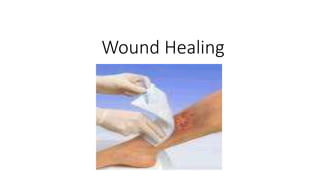
Wound Healing
What is ‘Wound Healing’
• Cascade of immunologic and biologic events resulting in a closed
wound
• Acute wounds proceed through the processes involved in wound
healing in an orderly and timely manner
• Chronic wounds fail to heal in a timely and orderly manner
• Viability of tissues will determine the course and quality of healing
Wound Healing Model Types
• Superficial wound healing
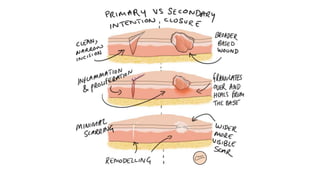
• Primary intention wound healing
• Delayed primary intention wound healing
• Partial thickness wound healing
• Full thickness/secondary intention healing
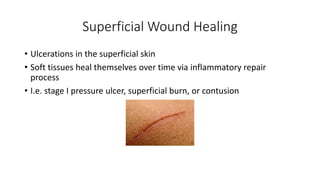
Superficial Wound Healing
• Ulcerations in the superficial skin
• Soft tissues heal themselves over time via inflammatory repair
process
• I.e. stage I pressure ulcer, superficial burn, or contusion
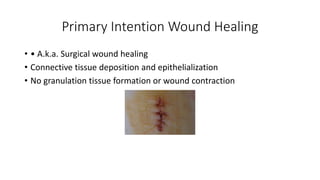
Primary Intention Wound Healing
• • A.k.a. Surgical wound healing
• Connective tissue deposition and epithelialization
• No granulation tissue formation or wound contraction
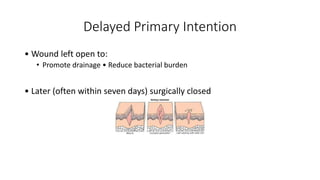
Delayed Primary Intention
• Wound left open to:
• Promote drainage • Reduce bacterial burden
• Later (often within seven days) surgically closed
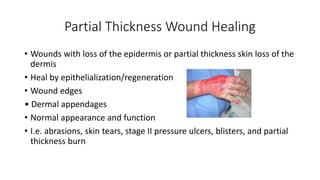
Partial Thickness Wound Healing
• Wounds with loss of the epidermis or partial thickness skin loss of the
dermis
• Heal by epithelialization/regeneration
• Wound edges
• Dermal appendages
• Normal appearance and function
• I.e. abrasions, skin tears, stage II pressure ulcers, blisters, and partial
thickness burn
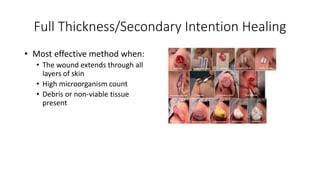
Full Thickness/Secondary Intention Healing
• Most effective method when:
• The wound extends through all
layers of skin
• High microorganism count
• Debris or non-viable tissue
present
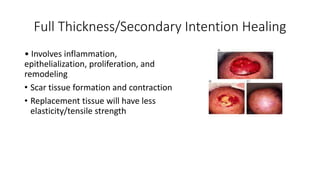
Full Thickness/Secondary Intention Healing
• Involves inflammation,
epithelialization, proliferation, and
remodeling
• Scar tissue formation and contraction
• Replacement tissue will have less
elasticity/tensile strength
Chronic Wound Healing
• Associated with secondary intention
• A chronic wound is one that has “failed to proceed though an orderly
and timely process to produce anatomic and functional integrity, or
proceeded through the repair process without establishing a
sustained anatomic and functional result”
Wound Healing Phases
• Every wound is unique, “with a unique set of physiologic and
social circumstances preventing or retarding wound healing”
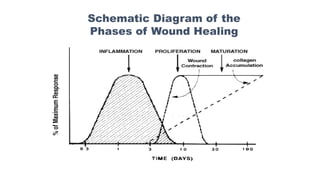
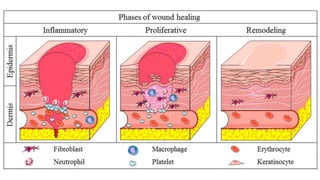
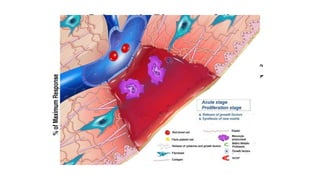
• The normal wound repair process consists of three phases that
occur in a predictable sequence : ▫ Inflammation ▫ Proliferation ▫
Remodeling
Schematic Diagram of the
Phases of Wound Healing
Schematic Diagram of the
Phases of Wound Healing
FACTORS AFFECTING WOUND HEALING
• Intrinsic factors (underlying pathology)
• Extrinsic factors (environmental influences)
• Iatrogenic factors (inappropriate management)
Wound characteristics
• Exudate
• Odour
• Condition of tissue
within the wound
• Condition of the
surrounding skin
The surrounding skin
 Eczema
 Psoriasis
 Maceration/excoriation
due to exudate or
bowel contents
 Self-inflicted damage
Monitoring healing progress
• Wound dimensions
• Photography
 Wound assessment
charts
Frequency of
assessment
 Plan of care
 Useful information
Other methods
Dressing choice
• What is available?
• How do we choose?
• Does the patient have a say?
• Do we consider cost?
• Are choices restricted by a protocol?
• How do we evaluate?
Dressing choice
The purpose of
dressings:
•To aid debridement
•To remove excess
exudate
•To control bleeding
•To protect a wound
•To support healing
The ideal dressing
A dressing that
creates the optimum
environment
Wound debridement
Wound cleansing
Alternative therapies
Dressing choice
• Non-adherent wound contact materials
• Films
• Hydrogels
• Hydrofibre dressings
• Hydrocolloids
• Foams
• Alginates
• Miscellaneous
Dressing choice
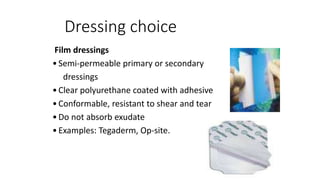
Film dressings
•Semi-permeable primary or secondary
dressings
•Clear polyurethane coated with adhesive
•Conformable, resistant to shear and tear
•Do not absorb exudate
•Examples: Tegaderm, Op-site.
Dressing choice
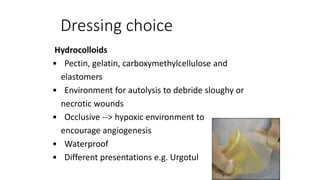
Hydrocolloids
• Pectin, gelatin, carboxymethylcellulose and
elastomers
• Environment for autolysis to debride sloughy or
necrotic wounds
• Occlusive --> hypoxic environment to
encourage angiogenesis
• Waterproof
• Different presentations e.g. Urgotul
Dressing choice
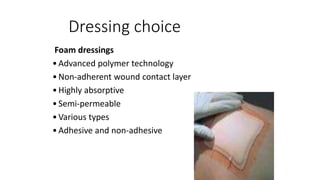
Foam dressings
•Advanced polymer technology
•Non-adherent wound contact layer
•Highly absorptive
•Semi-permeable
•Various types
•Adhesive and non-adhesive
Dressing choice
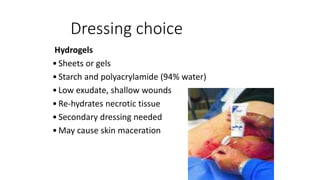
Hydrogels
•Sheets or gels
•Starch and polyacrylamide (94% water)
•Low exudate, shallow wounds
•Re-hydrates necrotic tissue
•Secondary dressing needed
•May cause skin maceration
THANK YOU

CLASS 3 WOUND HEALING.pptx

  • 1.
  • 2.
    What is ‘WoundHealing’ • Cascade of immunologic and biologic events resulting in a closed wound • Acute wounds proceed through the processes involved in wound healing in an orderly and timely manner • Chronic wounds fail to heal in a timely and orderly manner • Viability of tissues will determine the course and quality of healing
  • 3.
    Wound Healing ModelTypes • Superficial wound healing • Primary intention wound healing • Delayed primary intention wound healing • Partial thickness wound healing • Full thickness/secondary intention healing
  • 4.
    Superficial Wound Healing •Ulcerations in the superficial skin • Soft tissues heal themselves over time via inflammatory repair process • I.e. stage I pressure ulcer, superficial burn, or contusion
  • 5.
    Primary Intention WoundHealing • • A.k.a. Surgical wound healing • Connective tissue deposition and epithelialization • No granulation tissue formation or wound contraction
  • 6.
    Delayed Primary Intention •Wound left open to: • Promote drainage • Reduce bacterial burden • Later (often within seven days) surgically closed
  • 7.
    Partial Thickness WoundHealing • Wounds with loss of the epidermis or partial thickness skin loss of the dermis • Heal by epithelialization/regeneration • Wound edges • Dermal appendages • Normal appearance and function • I.e. abrasions, skin tears, stage II pressure ulcers, blisters, and partial thickness burn
  • 8.
    Full Thickness/Secondary IntentionHealing • Most effective method when: • The wound extends through all layers of skin • High microorganism count • Debris or non-viable tissue present
  • 9.
    Full Thickness/Secondary IntentionHealing • Involves inflammation, epithelialization, proliferation, and remodeling • Scar tissue formation and contraction • Replacement tissue will have less elasticity/tensile strength
  • 11.
    Chronic Wound Healing •Associated with secondary intention • A chronic wound is one that has “failed to proceed though an orderly and timely process to produce anatomic and functional integrity, or proceeded through the repair process without establishing a sustained anatomic and functional result”
  • 12.
    Wound Healing Phases •Every wound is unique, “with a unique set of physiologic and social circumstances preventing or retarding wound healing” • The normal wound repair process consists of three phases that occur in a predictable sequence : ▫ Inflammation ▫ Proliferation ▫ Remodeling
  • 13.
    Schematic Diagram ofthe Phases of Wound Healing
  • 15.
    Schematic Diagram ofthe Phases of Wound Healing
  • 16.
    FACTORS AFFECTING WOUNDHEALING • Intrinsic factors (underlying pathology) • Extrinsic factors (environmental influences) • Iatrogenic factors (inappropriate management)
  • 17.
    Wound characteristics • Exudate •Odour • Condition of tissue within the wound • Condition of the surrounding skin The surrounding skin  Eczema  Psoriasis  Maceration/excoriation due to exudate or bowel contents  Self-inflicted damage
  • 18.
    Monitoring healing progress •Wound dimensions • Photography  Wound assessment charts Frequency of assessment  Plan of care  Useful information Other methods
  • 19.
    Dressing choice • Whatis available? • How do we choose? • Does the patient have a say? • Do we consider cost? • Are choices restricted by a protocol? • How do we evaluate?
  • 20.
    Dressing choice The purposeof dressings: •To aid debridement •To remove excess exudate •To control bleeding •To protect a wound •To support healing The ideal dressing A dressing that creates the optimum environment Wound debridement Wound cleansing Alternative therapies
  • 21.
    Dressing choice • Non-adherentwound contact materials • Films • Hydrogels • Hydrofibre dressings • Hydrocolloids • Foams • Alginates • Miscellaneous
  • 22.
    Dressing choice Film dressings •Semi-permeableprimary or secondary dressings •Clear polyurethane coated with adhesive •Conformable, resistant to shear and tear •Do not absorb exudate •Examples: Tegaderm, Op-site.
  • 23.
    Dressing choice Hydrocolloids • Pectin,gelatin, carboxymethylcellulose and elastomers • Environment for autolysis to debride sloughy or necrotic wounds • Occlusive --> hypoxic environment to encourage angiogenesis • Waterproof • Different presentations e.g. Urgotul
  • 24.
    Dressing choice Foam dressings •Advancedpolymer technology •Non-adherent wound contact layer •Highly absorptive •Semi-permeable •Various types •Adhesive and non-adhesive
  • 25.
    Dressing choice Hydrogels •Sheets orgels •Starch and polyacrylamide (94% water) •Low exudate, shallow wounds •Re-hydrates necrotic tissue •Secondary dressing needed •May cause skin maceration
  • 26.