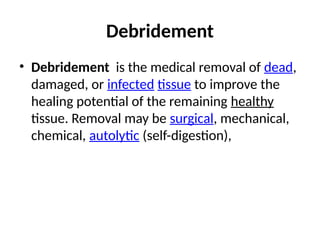
Basic Wound Care
• Learning Objectives:
At the end of class the student’s will able …
List & differentiate classification of wounds
Understand the process of wound healing and
wound management.
Understand the principle of wound care.
Performing proper wound care and its related
interventions
Demonstrate care of a draining wounds
Know wound complication and its
management
Wound
Definition
• A wound is a type of injury which happens relatively
quickly in which skin is torn, cut, or punctured (an open
wound), or where blunt force trauma causes a contusion (a
closed wound).
• In pathology, it specifically refers to a sharp injury which
damages the Epidermis of the skin.
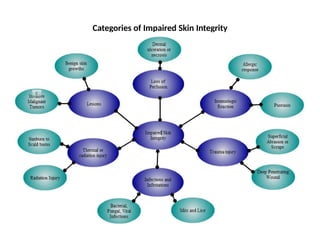
Categories of Impaired Skin Integrity
Classifying wounds
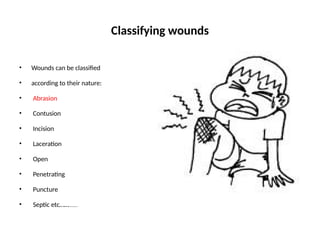
• Wounds can be classified
• according to their nature:
• Abrasion
• Contusion
• Incision
• Laceration
• Open
• Penetrating
• Puncture
• Septic etc……………
Classifying wounds
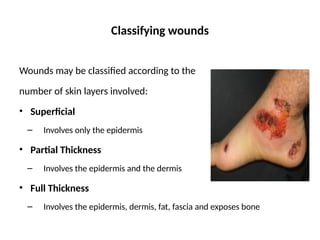
Wounds may be classified according to the
number of skin layers involved:
• Superficial
– Involves only the epidermis
• Partial Thickness
– Involves the epidermis and the dermis
• Full Thickness
– Involves the epidermis, dermis, fat, fascia and exposes bone
Clinical Appearance
• Describes the type of material present In the bas( inside)
on the wound:
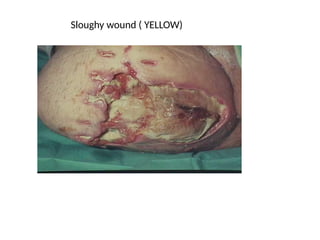
• Slough(yellow)
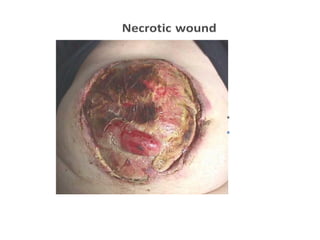
• Necrotic tissue(black)
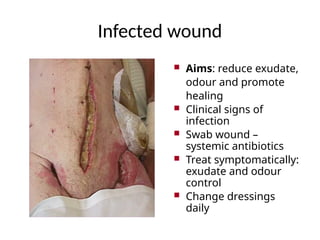
• Infected tissue (green)
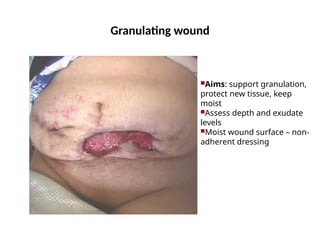
• Granulating tissue(red)
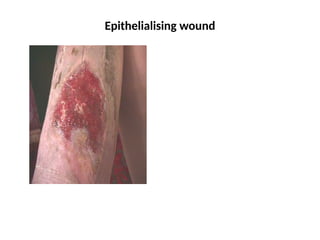
• Epithelialising(pink)
Sloughy wound ( YELLOW)
Infected wound
 Aims: reduce exudate,
odour and promote
healing
 Clinical signs of
infection
 Swab wound –
systemic antibiotics
 Treat symptomatically:
exudate and odour
control
 Change dressings
daily
Granulating wound
Aims: support granulation,
protect new tissue, keep
moist
Assess depth and exudate
levels
Moist wound surface – non-
adherent dressing
Epithelialising wound
Etiology of wound
Both external & internal factors can contribute to formation of
wound
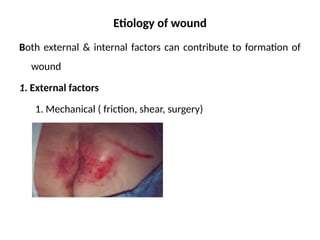
1. External factors
1. Mechanical ( friction, shear, surgery)
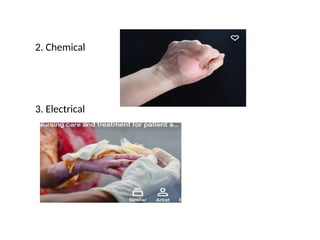
2. Chemical
3. Electrical
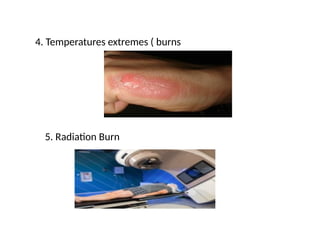
4. Temperatures extremes ( burns
5. Radiation Burn
6. Microorganizm
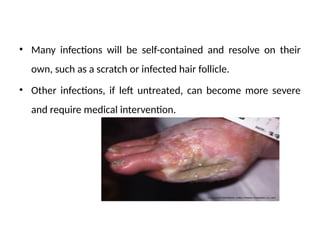
• An infected wound is a localized defect or excavation of the
skin or underlying soft tissue in which pathogenic
organisms have invaded into viable tissue surrounding the
wound.
• Infection of the wound triggers the body's immune response,
causing inflammation and tissue damage, as well as slowing
the healing process.
• Many infections will be self-contained and resolve on their
own, such as a scratch or infected hair follicle.
• Other infections, if left untreated, can become more severe
and require medical intervention.
Etiology of wound
2. Internal
• Circulatory system failure (venous, arterial, lymphatic)
• Endocrine (diabetes)
• Neuropathy
• Malignancy
Purpose of wounding caring
• To minimize scarring
• To prevent infection & remove bacteria
• To prevent further tissue damage
• To promote healing
• To absorb inflammatory exudates &to promote
drainage
• To convert the contaminated wound into a clean
wound
• To prevent hemorrhage
• To apply medications in place
• To improve pt comfort
• To restore the normal function of the body part
• To allow measurement of wound drainage
• Wound can be
1. Intentional
• occur during therapy
e.g. Operations
-Veni punctures
-Radiation burns and Removing of tumor
2. Un intentional
Occur accidental
e.g. Falling
Classification of wound based on
• Extents of tissue injury
• The cause/
• Types of wound
• The presences/ absence of pathogens
Extent(degree or amount )of tissue injury
• Incision (cut)
– cleanly cut by sharp instruments
– no bruising or crushing
– it tends to gap & bleeds freely
– damage to all structure in linear with minimum loss of tissue
– open wound, painful caused by sharp instrument
• e.g. knife, scalpel
Extent of tissue injury
Contusion ( bruise)
• closed wound
• skin appears ecchymotic (bruised) b/c of damage blood vessels
• caused by blow from a blunt instrument
Abrasion(graze)
• open wound involving the skin which is painful
caused by scrapping away of the superficial skin.
• Puncture (stab)
• open wound in which skin & connective tissue are penetrated
• wound is deeper than its breadth & caused by sharp, pointed
narrow objects such as pins, knives, splinters of wood.
• Entrance of wound is surprisingly small
• Extensive concealed blood loss
Extent of tissue injury
Laceration (tear)
• has no regular edge
• caused by tearing, crushing& forcible disruption of
tissue.
• loss of skin continuity
• it has rough edges
• extensive tissue devitalization by loss of blood supply
• bleeding is often at first slight
open wound
There is a cut/break in the continuity of skin or M.M
-caused by a sharp blow/object
it allows
• entry of foreign particles & organisms
• loss of fluid from body
Closed wound
• No break in continuity of skin & M.M
• It is accompanied by the damage of tissue under skin called
contused wound
• Caused by
• Direct blow/some blunt instrument/crushing
• Unusual straining/twisting body part
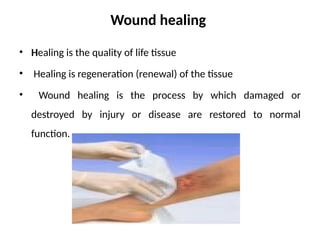
Wound healing
• Healing is the quality of life tissue
• Healing is regeneration (renewal) of the tissue
• Wound healing is the process by which damaged or
destroyed by injury or disease are restored to normal
function.
Wound healing
• There are three types of healing, distinguished by the amount of tissue
loss.
• Primary intention healing
• Is called primary union or 1st
intention healing
• It involves the union of the edges of a wound under aseptic conditions
with out visible granulations.
• It occurs where the tissue surface have been approximated (closed) &
there is minimal or no loss tissue.
• It characterized by the formation of minimal granulation tissue &
scarring
E.g. surgical incision that closed with sutures, clips or skin adhesive.
Secondary intention healing
• Healing by secondary intention occurs when wounds edge cannot be
brought together, involves considerable tissue loss &a wound that is
extensive.
• Wound left open &must fill with new tissue(granulate) until the level
of intact epidermis is reached
– Wounds that heal by secondary intention include:-
– Surgical or traumatic wounds where a large amount of tissue has
been lost
– Heavily infected wound
– Chronic wounds (leg/pressure ulcer)
– In some cases, where a better cosmetic or functional result will be
achieved.
• the repair time is longer
• the scarring greater
• the susceptibility of infection greater
Tertiary healing
• -delayed healing
• -It indicated when reason there is a reason to delays
suturing a wound
Commonly seen wounds as a result of acute/ chronic conditions may
include
• Diabetic ulcers
• Burns wound
• Pressure (decubitas) ulcers
• Tropical ulcers
• Post surgical wound/ surgical incision
• Trauma ; contusion, puncture, laceration, penetrating
Common viral disease includes:
• Herpes simplex I (cold sores)
• Herpes simple II (genital helps)
• Herpes zoster
• Common fungal infections include
• Tinea pedis (athlete’s foot)
• Tinea capitas (ring worm
Wound healing
• All wounds heal following a a specific sequence of phases
which may overlap
• The process of wound healing depends on the type of tissue
which has been damaged and the nature of tissue disruption
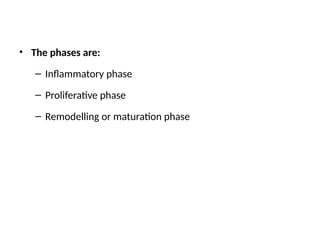
• The phases are:
– Inflammatory phase
– Proliferative phase
– Remodelling or maturation phase
• The phases are:
– Inflammatory phase
– Proliferative phase
– Remodelling or maturation phase
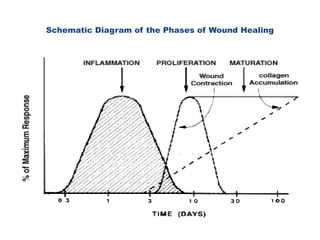
Schematic Diagram of the Phases of Wound Healing
1.Inflammatory Phase.
• This phase begins immediately after wounding and
lasts for 2-3 days.
• During the immediate reaction of tissue injury
haemostatics and inflammation occur.
• It attempts to limit damage by
-Stopping bleeding.
-Sealing the surface.
-Removing necrotic tissue and foreign bodies or
bacterial products.
Characterized by…
- Inflammatory response.
- Vasodilatation.
- Extravasations.
-Migration of inflammatory cells and leukocytes into the wound by chemo taxis.
-Secretion of cytokines and growth factors into
the wound and activation of migratory cells.
-Rapid epithelial growth.
2.The proliferative(Fibroplasia)phase.
• It lasts from 3rd
day-3rd
week.
• Consists mainly of fibroblast activity.
• This phase is characterized by:-
-Re-epithelialization.
-Matrix synthesis.
-Neovascularization/angiogenesis.
-Collagen synthesis mainly type 3 collagen.
-Formation of granulation tissue.
-Production of ground substance.
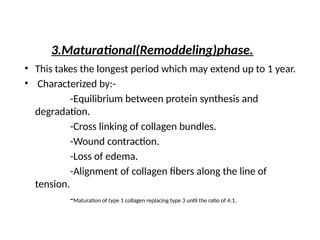
3.Maturational(Remoddeling)phase.
• This takes the longest period which may extend up to 1 year.
• Characterized by:-
-Equilibrium between protein synthesis and
degradation.
-Cross linking of collagen bundles.
-Wound contraction.
-Loss of edema.
-Alignment of collagen fibers along the line of
tension.
-Maturation of type 1 collagen replacing type 3 until the ratio of 4:1.
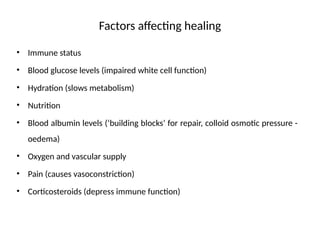
Factors affecting healing
• Immune status
• Blood glucose levels (impaired white cell function)
• Hydration (slows metabolism)
• Nutrition
• Blood albumin levels (‘building blocks’ for repair, colloid osmotic pressure -
oedema)
• Oxygen and vascular supply
• Pain (causes vasoconstriction)
• Corticosteroids (depress immune function)
Practical considerations
• The cause of the wound
• Underlying disease processes
• Current health status
• Medication
• Acute or chronic?
• Attitude to the wound
• Availability of care
Healing Requirements
• Identification of the interference to healing
• Adequate nutritional status
• Adequate perfusion and oxygenation
• High quality, research-based patient and wound management
• Correction of the underlying cause of the problem
• Disease management
Factors that affect wound healing
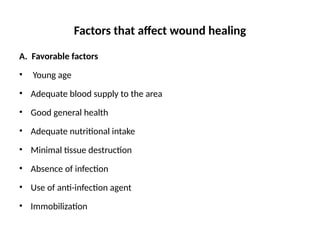
A. Favorable factors
• Young age
• Adequate blood supply to the area
• Good general health
• Adequate nutritional intake
• Minimal tissue destruction
• Absence of infection
• Use of anti-infection agent
• Immobilization
Factors that affect wound healing
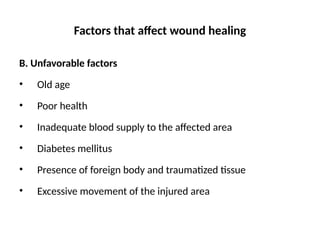
B. Unfavorable factors
• Old age
• Poor health
• Inadequate blood supply to the affected area
• Diabetes mellitus
• Presence of foreign body and traumatized tissue
• Excessive movement of the injured area
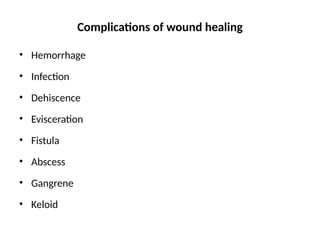
Complications of wound healing
• Hemorrhage
• Infection
• Dehiscence
• Evisceration
• Fistula
• Abscess
• Gangrene
• Keloid
Hemorrhage
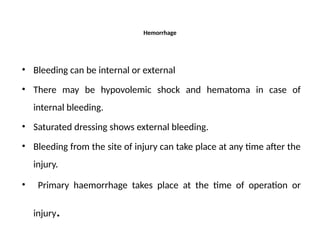
• Bleeding can be internal or external
• There may be hypovolemic shock and hematoma in case of
internal bleeding.
• Saturated dressing shows external bleeding.
• Bleeding from the site of injury can take place at any time after the
injury.
• Primary haemorrhage takes place at the time of operation or
injury.
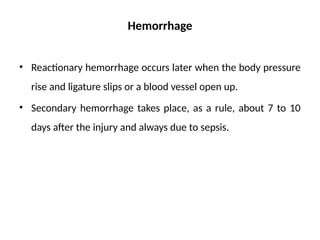
Hemorrhage
• Reactionary hemorrhage occurs later when the body pressure
rise and ligature slips or a blood vessel open up.
• Secondary hemorrhage takes place, as a rule, about 7 to 10
days after the injury and always due to sepsis.
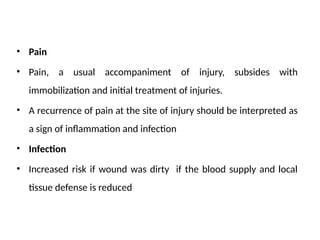
• Pain
• Pain, a usual accompaniment of injury, subsides with
immobilization and initial treatment of injuries.
• A recurrence of pain at the site of injury should be interpreted as
a sign of inflammation and infection
• Infection
• Increased risk if wound was dirty if the blood supply and local
tissue defense is reduced
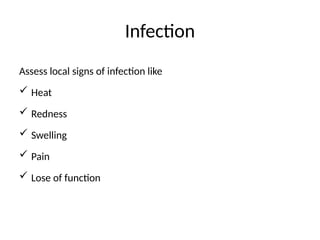
Infection
Assess local signs of infection like
 Heat
 Redness
 Swelling
 Pain
 Lose of function
Infection
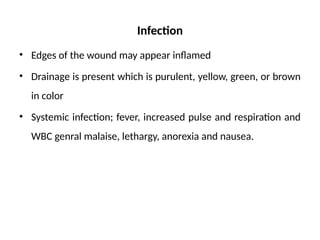
• Edges of the wound may appear inflamed
• Drainage is present which is purulent, yellow, green, or brown
in color
• Systemic infection; fever, increased pulse and respiration and
WBC genral malaise, lethargy, anorexia and nausea.
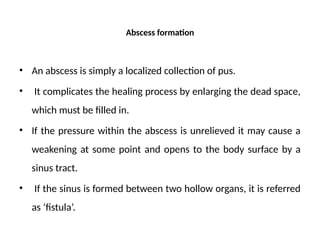
Abscess formation
• An abscess is simply a localized collection of pus.
• It complicates the healing process by enlarging the dead space,
which must be filled in.
• If the pressure within the abscess is unrelieved it may cause a
weakening at some point and opens to the body surface by a
sinus tract.
• If the sinus is formed between two hollow organs, it is referred
as ‘fistula’.
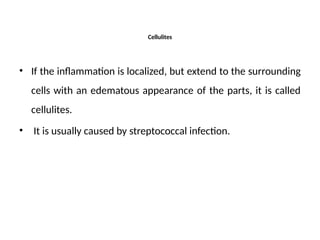
Cellulites
• If the inflammation is localized, but extend to the surrounding
cells with an edematous appearance of the parts, it is called
cellulites.
• It is usually caused by streptococcal infection.
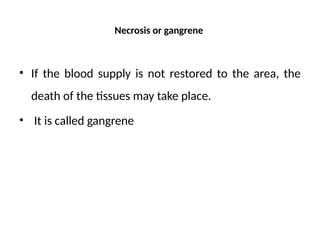
Necrosis or gangrene
• If the blood supply is not restored to the area, the
death of the tissues may take place.
• It is called gangrene
Wound dehiscence with or without evisceration
• When the wound edges separate, it is known as dehiscence.
• If the abdominal organs protrude out through the gap, it is
known as evisceration . The appearance of pink watery fluid
(serosanguineous) on the dressing is a warning sign of wound
dehiscence.
• Kiloid
• These are huge, ugly, tumor-like overgrowths of scar tissues
seen in certain individuals
Contractures
• Contracture of scar tissues leading to disability and severe
deformity occurs when sever injuries are located over a joint
and healed by secondary union.
• Interference with the organ function
Scare tissues, when excessive, can definitely interfere with the
physiologic functioning of the organ.
How to assess wound
• Exudate (drainage), a liquid produced by the body in response
to tissue damage, is present in wounds as they heal.
• It consists of fluid that has leaked out of blood vessels and
closely resembles blood plasma.
• Exudates can result also from conditions that cause edema,
such as inflammation, immobility, limb dependence, and
venous and lymphatic insufficiency.
• Accurate assessment of exudate is important throughout the healing
process because the color, consistency, odor, and amount change as a
result of various physiologic processes and underlying complications
Type of exudate
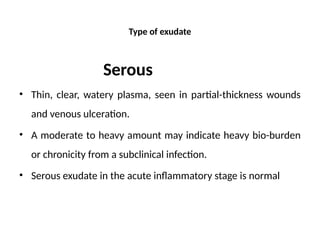
Serous
• Thin, clear, watery plasma, seen in partial-thickness wounds
and venous ulcera­
tion.
• A mod­
er­
ate to heavy amount may indicate heavy bio-burden
or chronicity from a subclinical infection.
• Serous exudate in the acute inflammatory stage is normal
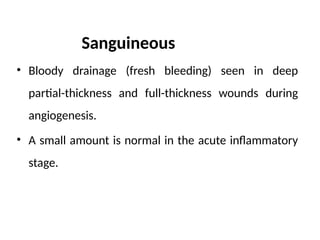
Sanguineous
• Bloody drain­
age (fresh bleeding) seen in deep
partial-thickness and full-thickness wounds during
angiogenesis.
• A small amount is normal in the acute inflammatory
stage.
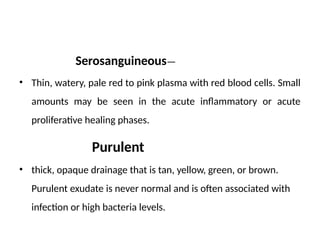
Serosangui­
neous—
• Thin, watery, pale red to pink plasma with red blood cells. Small
amounts may be seen in the acute inflammatory or acute
proliferative healing phases.
Purulent
• thick, opaque drainage that is tan, yellow, green, or brown.
Purulent exudate is never normal and is often associated with
infection or high bacteria levels.
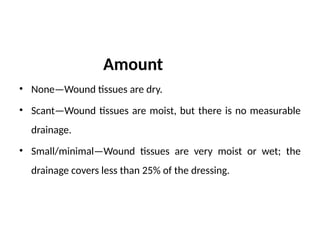
Amount
• None—Wound tissues are dry.
• Scant—Wound tissues are moist, but there is no measurable
drainage.
• Small/minimal—Wound tissues are very moist or wet; the
drainage covers less than 25% of the dressing.
• Moderate—Wound tissues are wet; the drainage involves
more than 25% to 75% of the dressing.
• Large or copious—Wound tissues are filled with fluid that
involves more than 75% of the dressing.
Consistency
• Low viscosity—thin, runny
• High viscosity—thick or sticky; doesn’t flow easily
Wound Odor
• Wound odor, also referred to as malodor, is typically the result
of necrotic tissue or bacterial colonization
Symptoms:
The following scale can be used to qualitatively assess wound
odor for documentation purposes:
• Very strong: Odor is evident on entering the room (6–10 feet
or 2–3 meters from the patient) with the dressing intact.
Strong: Odor is evident on entering the room (6–10 feet or 2–
3 meters from the patient) with the dressing removed.
• Moderate: Odor is evident at close proximity to the patient
when the dressing is intact.
• Slight: Odor is evident at close proximity to the patient when
the dressing is removed.
• No odor: No odor is evident, even at the patient’s bedside
with the dressing removed
• Principles
• Micro- organisms are present in the environment, on the
articles and on the skin.
• Pathogenic organisms are transmitted form the sources to the
new host directly or indirectly.
Principles involved in the care of wounds
.
• Nursing actions:
• Anything that touches the wound should be sterile e.g.
• Dressings, instruments, solutions
• Emphasize on hand washing before and after the procedure.
• Observe strictly the principles of surgical asepsis.
• The wound and the surrounding skin should be cleaned
thoroughly to reduce the number of bacterial.
Nursing actions:
• The wounds should be protected always with clean and sterile
dressings.
• Removal and replacement of the dressings should be done when the
air movement us at minimum.
• No sweeping should be done when the dressings are opened).
• The soiled dressings should be carefully collected and burned to
prevent the spread of infection
•
Nursing actions:
• The contaminated articles should be disinfected before it is used
again
• Keep the environment free form dust and flies
• Practice barrier nursing.
• Isolate patients with clean wounds form those patients with
contaminated wounds.
• Use of gloves, masks and gowns in creases the barriers to the
organisms.
Principles
• Bacterial travel along with the dust particles
• Sweepings and dusting should not be done when the
dressings are in progress. It should be done at least one hour
before the expected time of the dressing.
Nursing actions
• Flapping of the bed cloths and dresses should be avoided to
prevent dust particles entering the wound.
• Sterile articles must be kept covered until it is time for use.
• Prolonged exposure to the air makes them contaminated
• Cleaning an area where there is less number of organisms.
• Before cleaning an area where there are more organisms,
minimize the spread of organisms to the clean area.
Nursing action
• Consider the wound area cleaner than the skin
around even if the wound is infected.
• Keeping this principle in mind, clean the wound from
the center to the periphery, discarding the used swab
after each stroke.
Nursing action
• Skin and mucus membranes normally harbor pathogens.
• If the wound is clean first before the cleaning of the skin
around the wound, there is less chance of introduction the
skin pathogens into the wound.
Principles
• A break in the skin and mucus membrane acts as the
portal of entry for the pathogenic organisms
• Open wounds are to be sealed or dressed as early as
possible to prevent the entrance of pathogenic
organisms into the body.
Nursing
• All precautions are to be taken to prevent further tissue
damage and promote the healing process.
• Use antiseptic solutions of correction strength which are safe
form the skin and mucus membranes.
• Using the antiseptics of high concentration can cause tissue
damage.
Nursing
• When using the heat in the form of hot fomentation or
surgical soak, the temperature should be controlled between
37 to 40.50
C (98 to 1050
F) to prevent tissue burns.
• Respiratory tract harbors micro organisms that can enter the
wound.
Nursing actions
• When dressing large open wounds, masks may be worn by
the nurses to prevent the organisms entering the wounds
through the droplets.
• Avoid talking, coughing, coughing and sneezing while
attending to a wound.
• Respiratory tract harbors micro organisms that can enter the
wound.
• Moisture facilitates growth and movement of micro-
organisms
Nursing actions
• Microbes can neither live nor travel without moisture.
Therefore keep the sterile field dry.
• Replace the soild dressings with dry dressings as soon as they
are wet otherwise the
• Microbes can enter the wound by traveling through the wet
dressings.
Principles
• Unfamiliar situations produce anxiety.
• Nursing actions
• An adequate explanation of the treatment will help the
patient to know what is to be expected.
• This will reduce the fear and anxiety.
Nursing actions
• Maintain the privacy of the patient and avoid unnecessary
exposure.
• Do not expose the wound in front of the patient.
• Turn the patient’s head to one side to avoid unpleasant sight.
• Diversion is provided by conversation or by other means.
• The nurse should try to control the reactions to the sight of
the wound or dressing.
Nursing actions
• The patient frequently studies the face of the person changing
the dressing in order to evaluate the extent of injury or healing
process.
• Systematic ways of working saves time, energy and material
• Nursing actions
• Place the bed and the patient at working height
• Prepare the patient; articles and the environment before the
dressing are opened.
Nursing actions
• Assemble and arrange the articles on the beside locker
conveniently to avoid leaving the patient in between the
procedure.
• Protect the personal clothing and the bed linen with a
waterproof covering.
• Get assistance if needed.
•
Common terms associated with microbiology may
• Commensal
• Microflora
• Normal flora
• Pathogen
• Symbiosis
• Nosocomial infection
• Endogenous
• Exogenous
Components of the chain of infection:
• Infective agent
• Portal of entry
• Portal of exit
• Reservoir
• Susceptible host
Common terms associated with the spread of disease:
• Antibiotic
• Communicable
• Contagious
• Epidemiology
• Epidemic
• Endemic
• Pandemic
• Host
• Incubation
• Infectious
• Acute infection
• Chronic infection
• Latent
• Primary infection
• Secondary infection
• Local infection
• Generalized infection
• Sterilization
• Disinfection
Infection process may include
• Inflammatory process
• Histamine
• Kinins
• Phagocytosis
• Pus
• Tissue repair
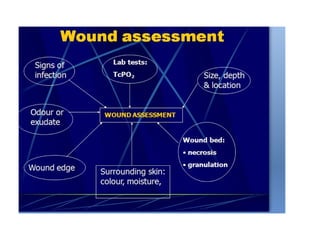
Wound assessment may include: the following classifications:
• Clean/dirty
• Infected
• Surgical/traumatic
• Chronic/acute
• Necrotic/sloughy
• Granulating
• Abrasions/skin tears
• Incisions/lacerations
• Punctures
• Avulsions
• Amputations
• Burns
• Pressure sores
.
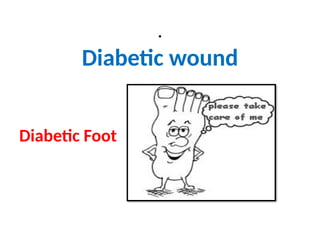
Diabetic wound
Diabetic Foot
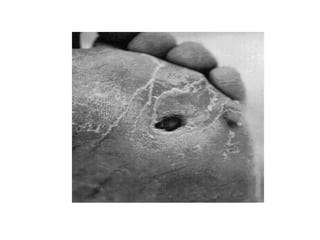
Diabetic foot ulcer
• A foot ulcer is where an area of skin has broken
down and you can see the underlying tissue.
• Diabetic foot ulcer is an ulcer that occurs in diabetic
patients due to certain complications of diabetes
mellitus.
Complication of diabetes that contribute to increased
risk of foot problems and infections
• Peripheral neuropathy
• obesity
• Age older than 40 years
• Poor glycemic control
• Peripheral vascular disease
• Duration of diabetes more than 10 years
• Cigarette smoking
• Immune compromised
• Poor foot wear
1 Peripheral neuropathy it causes loss of pain or
feeling in the toes, feet, legs and arms due to distal
nerve damage and low blood flow .
Complications cont…
2 Peripheral vascular disease.
• Poor circulation of the lower extremities contribute to poor
wound healing and the development of gangrene
3 Immuno compromise.
• Hyperglycemia impairs the ability of specialized leukocytes to destroy
bacteria.
• There for in poorly controlled diabetes there is a lowered resistance to
certain infection.
4 Poor foot care
• Poor footwear that causes skin breakdown or inadequately
protects the skin from high pressure and shear forces
5 Immune compromised……low immunity eg . DM pts
Prevention
Good foot care which includes:
• Looking carefully at feet each day, including between the toes
• Looking is particularly important if there is a reduced sensation in
the feet, as pts may not notice anything wrong at first until they
look.
• Teach the pts to see the doctor if they see anything new (such as
a cut, bruise, blister, redness or bleeding) and don't know what to
do,
Foot care cont…
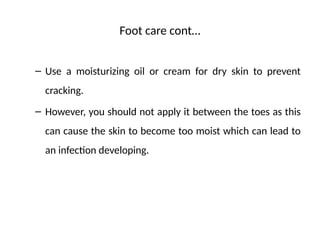
– Use a moisturizing oil or cream for dry skin to prevent
cracking.
– However, you should not apply it between the toes as this
can cause the skin to become too moist which can lead to
an infection developing.
Foot care cont
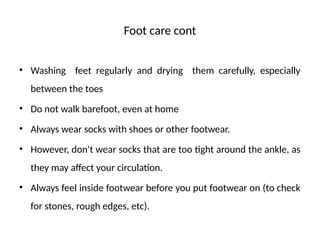
• Washing feet regularly and drying them carefully, especially
between the toes
• Do not walk barefoot, even at home
• Always wear socks with shoes or other footwear.
• However, don't wear socks that are too tight around the ankle, as
they may affect your circulation.
• Always feel inside footwear before you put footwear on (to check
for stones, rough edges, etc).
Foot care cont…
• If your feet are an abnormal shape, or other foot problems, you may
need specially fitted shoes to stop your feet rubbing.
• Tips to avoid foot burns include: checking the bath temperature with
your hand before stepping in; do not use hot water bottles, do not sit too
close to fires.
• Sammary on health education
• 1. teach about foot care 3. teach about medication
• 2 teach about dalily exercise 4. about diet 5. about RBS [low blood
glucose s/sx]
Treatment
• Antibiotic
• Debridement
• Wound dressing
.
Burn wound
Burn Injury
• A burn is an injury caused by extremes of temperature,
electric current, or certain chemicals.
• In this session we will learn how to determine percentage and
severity of burns, proper treatment, and delivery to the
appropriate medical facility.
The cause
Thermal
 Chemical
Electrical
 Radiation
1. Thermal Burn
A thermal burn is a type of burn resulting from making contact
with heated objects, such as boiling water, steam, hot cooking
oil, fire, and hot objects.
The most common type of thermal burn suffered by children, but
for adults thermal burns are most commonly caused by fire.
Burns are generally classified from first degree up to fourth
degree,
2 Chemical
• Chemical burn is a burn to internal or external organs of the body caused by a corrosive
or caustic chemical substance that is a strong acid or base (also known as alkali).
• Chemical burns are usually the result of an accident and can occur in the home, at
school or more commonly, at work, particularly in manufacturing plants that use large
quantities of chemicals.
• Very mild chemical burns result in irritant contact dermatitis.
• Chemical burn from a strong acid or alkali is also known as a caustic burn.
3 Electrical burns
• Electrical burns and injuries happen when electric currents
pass through the body.
• The currents can damage the skin, tissues, and major organs.
• The damage can range from minor to severe.
• Sometimes it is fatal.
• Electrical burns and injuries are caused by contact with
electrical currents. The currents may come from appliances,
exposed wiring, or lightning strikes.
4 Radiation
• A burn caused by exposure to electromagnetic radiation in
the form of ultraviolet rays (sunburn), ionizing rays
(radiation therapy for cancer treatment.
Types of Burn
• Focus on the treatment of life-threatening injuries even
though burn may consume attention.
• There are the three types of Burns
– Superficial (1ST
degree)
– Partial thickness (2nd
degree)
– Full thickness (3rd
degree)
Signs and symptoms
• The characteristics of a burn depend upon its depth.
• Superficial burns cause pain lasting two or three days,
followed by peeling of the skin over the next few days
• Individuals suffering from more severe burns may indicate
discomfort or complain of feeling pressure rather than pain.
Signs and symptoms
• Full-thickness burns may be entirely insensitive to light touch
or puncture.
• While superficial burns are typically red in color, severe burns
may be pink, white or black.
• Burns around the mouth or singed hair inside the nose may
indicate that burns to the airways have occurred, but these
findings are not definitive.
Signs and symptoms
• More worrisome signs include: shortness of breath,
hoarseness, and stridor or wheezing.
• Itchiness is common during the healing process, occurring in
up to 90% of adults and nearly all children.
Signs and symptoms
• Numbness or tingling may persist for a prolonged period of
time after an electrical injury.
• Burns may also produce emotional and psychological distress.
Classification of burn wound
• Superficial or first-degree burns burn that affects only the
superficial skin.
• Partial-thickness or second-degree When damage penetrates
into some of the underlying layers.
Classification of burn wound
• a full-thickness or third-degree burn, the injury extends to all
layers of the skin.
• A fourth-degree burn additionally involves injury to deeper
tissues, such as muscle or bone
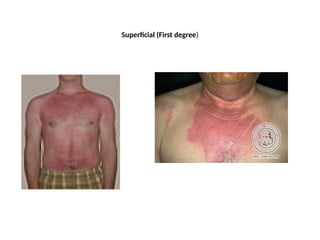
Superficial (First degree)
• Layers involved Epidermis
• Appearance Red without blisters]
• Texture Dry
• Sensation Painful
• Prognosis Heal well; Repeated the risk of skin cancer later in
life
Superficial (First degree)
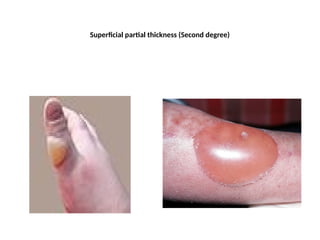
Superficial partial thickness (Second degree)
• Extends into superficial (papillary) dermis
• Redness with clear blister. Blanches with pressure.
• Moist
• Very painful
• less than 2–3 weeks
• Local infection/cellulitis but no scarring typically
Superficial partial thickness (Second degree)
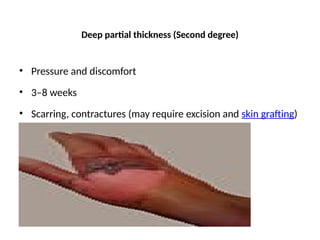
Deep partial thickness (Second degree)
• Extends into deep (reticular) dermis
• Yellow or white. Less blanching. May be blistering.
• Fairly dry
Deep partial thickness (Second degree)
• Pressure and discomfort
• 3–8 weeks
• Scarring, contractures (may require excision and skin grafting)
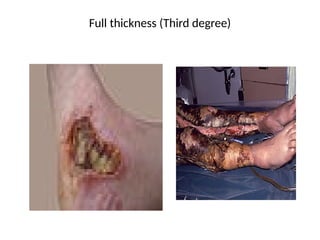
Full thickness (Third degree)
• Extends through entire dermis
• Stiff and white/brown No blanching
• Leathery
• Painless
• Prolonged (months) and incomplete
• Scarring, contractures, amputation (early excision
recommended)
Full thickness (Third degree)
Fourth degree
• Extends through entire skin, and into underlying fat, muscle and
bone
• Black; charred with eschar
• Dry
• Painless
• Requires excision
• Amputation, significant functional impairment and, in some cases,
death.
Fourth degree
.
Management
.
• The treatment required depends on the severity of the burn.
• Superficial burns may be managed with little more than
simple pain relievers,
• Cooling with tap water may help relieve pain and decrease
damage;
• however, prolonged exposure may result in
low body temperature
Management
• Partial-thickness burns may require cleaning, followed by
dressings.
• It is not clear how to manage blisters, but it is probably
reasonable to leave them intact.
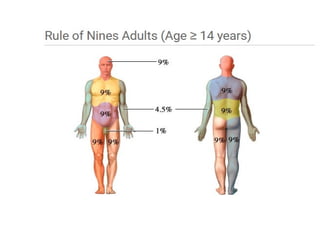
What is the rule of nines?
• The rule of nines is a method doctors and emergency medical
providers use to easily calculate the treatment needs for a
person who’s been burned.
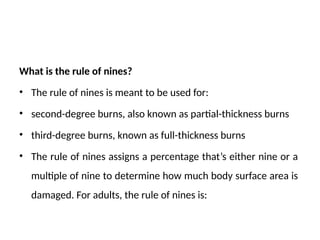
What is the rule of nines?
• The rule of nines is meant to be used for:
• second-degree burns, also known as partial-thickness burns
• third-degree burns, known as full-thickness burns
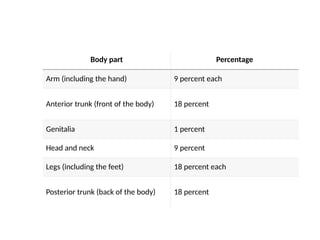
• The rule of nines assigns a percentage that’s either nine or a
multiple of nine to determine how much body surface area is
damaged. For adults, the rule of nines is:
Body part Percentage
Arm (including the hand) 9 percent each
Anterior trunk (front of the body) 18 percent
Genitalia 1 percent
Head and neck 9 percent
Legs (including the feet) 18 percent each
Posterior trunk (back of the body) 18 percent
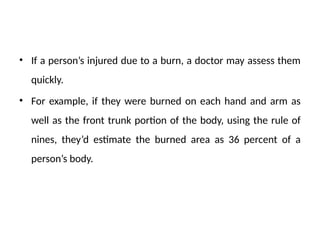
• If a person’s injured due to a burn, a doctor may assess them
quickly.
• For example, if they were burned on each hand and arm as
well as the front trunk portion of the body, using the rule of
nines, they’d estimate the burned area as 36 percent of a
person’s body.
Management
• Full-thickness burns usually require surgical treatments, such as
skin grafting.
• Extensive burns often require large amounts of
intravenous fluids because the subsequent inflammatory
response will result in significant capillary fluid leakage and
edema.
• The most common complications of burns are related to
infection
Diagnosis
• Burns can be classified by depth, mechanism of injury,
extent, and associated injuries.
• The most commonly used classification is based on the
depth of injury.
• The depth of a burn is usually determined via
examination, although a biopsy may also be used.
Diagnosis
• It may be difficult to accurately determine the depth of a
burn on a single examination and repeated examinations over
a few days may be necessary.
• In those who have a headache or are dizzy and have a fire-
related burn, carbon monoxide poisoning should be
considered.
Size
• The size of a burn is measured as a percentage of
total body surface area (TBSA) affected by partial thickness or
full thickness burns.
• First-degree burns that are only red in color and are not
blistering are not included in this estimation.
• Most burns (70%) involve less than 10% of the TBSA.
Size
• There are a number of methods to determine the TBSA,
including the "rule of nines", Lund and Browder charts, and
estimations based on a person's palm size.
• The rule of nines is easy to remember but only accurate in
people over 16 years of age.
Size
• More accurate estimates can be made using Lund and
Browder charts, which take into account the different
proportions of body parts in adults and children.
• The size of a person's handprint (including the palm and
fingers) is approximately 1% of their TBSA.
Size
• In order to determine the need for referral to a specialized
burn unit, the American Burn Association devised a
classification system. Under this system, burns can be
classified as
• major,
• moderate and
• minor.
Size
• This is assessed based on a number of factors, including
• total body surface area affected,
• the involvement of specific anatomical zones,
• the age of the person,
• and associated injuries.
Size
• Minor burns can typically be managed at home, moderate
burns are often managed in hospital, and major burns are
managed by a burn center.
• Resuscitation begins with the assessment and stabilization of
the person's airway, breathing and circulation.
• If inhalation injury is suspected, early intubation maybe
required.
Management
• This is followed by care of the burn wound itself.
• People with extensive burns may be wrapped in clean sheets
until they arrive at a hospital.
• As burn wounds are prone to infection, a tetanus booster shot
should be given if an individual has not been immunized
within the last five [5] years.
Treatment
The treatment required depends on the severity of the burn.
• Superficial burns may be managed with little more than
simple pain relievers, while major burns may require
prolonged treatment in specialized burn centers.
Treatment
• Cooling with tap water may help relieve pain and decrease
damage; however, prolonged exposure may result in
low body temperature.
Partial-thickness burns may require cleaning, followed by
dressings.
• It is not clear how to manage blisters, but it is probably
reasonable to leave them intact.
Treatment cont…
• Full-thickness burns usually require surgical treatments,
such as skin grafting.
• Extensive burns often require large amounts of
intravenous fluids because the subsequent inflammatory
response will result in significant capillary fluid leakage and
edema.
• The most common complications of burns are related to infection
Intravenous fluids
• In those with poor tissue perfusion, boluses of isotonic crystalloid solution
For example [Lactated Ringer’s—[R/L]
• An isotonic crystalloid solution containing the solutes sodium chloride, potassium chloride,
calcium chloride, and sodium lactate, dissolved in sterile water (solvent).]should be given.
• In children with more than 10-20% TBSA burns, and adults with more
than 15% TBSA burns, formal fluid resuscitation and monitoring should
follow.
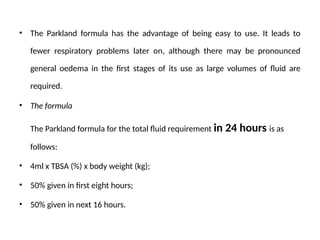
• The Parkland formula has the advantage of being easy to use. It leads to
fewer respiratory problems later on, although there may be pronounced
general oedema in the first stages of its use as large volumes of fluid are
required.
• The formula
The Parkland formula for the total fluid requirement in 24 hours is as
follows:
• 4ml x TBSA (%) x body weight (kg);
• 50% given in first eight hours;
• 50% given in next 16 hours.
Intravenous fluids
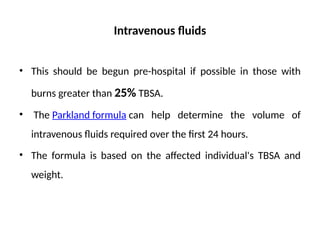
• This should be begun pre-hospital if possible in those with
burns greater than 25% TBSA.
• The Parkland formula can help determine the volume of
intravenous fluids required over the first 24 hours.
• The formula is based on the affected individual's TBSA and
weight.
Intravenous fluids
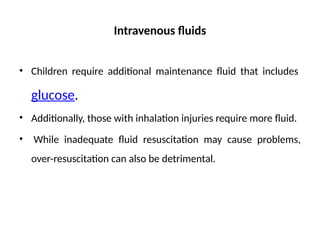
• Children require additional maintenance fluid that includes
glucose.
• Additionally, those with inhalation injuries require more fluid.
• While inadequate fluid resuscitation may cause problems,
over-resuscitation can also be detrimental.
Intravenous fluids
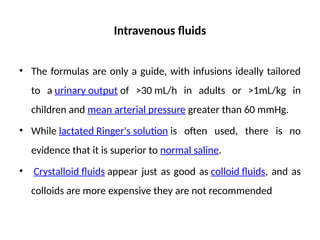
• The formulas are only a guide, with infusions ideally tailored
to a urinary output of >30 mL/h in adults or >1mL/kg in
children and mean arterial pressure greater than 60 mmHg.
• While lactated Ringer's solution is often used, there is no
evidence that it is superior to normal saline.
• Crystalloid fluids appear just as good as colloid fluids, and as
colloids are more expensive they are not recommended
Intravenous fluids
• Blood transfusions are rarely required.
• They are typically only recommended when the hemoglobin
level falls below 60-80 g/L (6-8 g/dL)due to the associated
risk of complications.
• Intravenous catheters may be placed through burned skin if
needed or intraosseous infusions may be used.
Intravenous fluids
• In those with poor tissue perfusion, boluses of
isotonic solution should be given.
• In children with more than 10-20% TBSA burns, and adults
with more than 15% TBSA burns, formal fluid resuscitation
and monitoring should follow.
• This should be begun pre-hospital if possible in those with
burns greater than 25% TBSA.
Parkland formula
• 2-4xTBSAxWt in 24hrs in adults
• Maintenance fluid+2-4 x TBSA x Wt in 24 hrs for children
• Half in the first 8hrs and half in the second 16 hrs.
• Eg. Parkland formula
• 2-4 * Tbsa* wt
• 4* 27* 56= 6048 total fluid for 24
• For 8 hr loding dose = 6048/2= 3024 3024*20/60*8 =126 gtt
• For 16 hr mantanance dose = 3024* 20/60*16 = 63gtt
Wound care
• Early cooling (within 30 minutes of the burn) reduces burn
depth and pain, but care must be taken as over-cooling can
result in hypothermia.
• It should be performed with cool water 10–25 °C (50–77 °F)
and not ice water as the latter can cause further injury.
Wound care
• Cleaning with N/s, removal of dead tissue, and application of
dressings are important aspects of wound care.
• If intact blisters are present, it is not clear what should be
done with them.
• Some cautious evidence supports leaving them intact.
Wound care
• In the management of first and second degree burns, little
quality evidence exists to determine which type of dressing
should be used.
• It is reasonable to manage first degree burns without
dressings.
Medications
• Burns can be very painful and a number of different options maybe used for pain management.
• These include simple analgesics (such as ibuprofen and acetaminophen[PCM) and opioids such
as morphine.
Surgery
• Wounds requiring surgical closure with skin grafts or flaps (typically anything more than
a small full thickness burn) should be dealt with as early as possible.
Complications
• A number of complications may occur, with infections being
the most common.
• In order of frequency, potential complications include:
• Pneumonia,
• cellulitis, urinary tract infections
• and respiratory failure.
Complications
Risk factors for infection include:
• burns of more than 30% TBSA,
• full-thickness burns,
• extremes of age (young or old),
burns involving the legs or perineum.
• Pneumonia occurs particularly commonly in those with
inhalation injuries. CO
Complications
• Anemia secondary to full thickness burns of greater than 10% TBSA is
common.
• Electrical burns may lead to compartment syndrome due to muscle
breakdown.
• Blood clotting in the veins of the legs is estimated to occur in 6 to 25%
of people.
• The hypermetabolic state that may persist for years after a major burn
can result in a decrease in bone density and a loss of muscle mass.
Complications
• Keloids may form subsequent to a burn, particularly in those
who are young and dark skinned.
• Following a burn, children may have significant psychological
trauma and experience post-traumatic stress disorder.
• Scarring may also result in a disturbance in body image.
• In the developing world, significant burns may result in social
isolation, extreme poverty and in children abandonment.
.
Pressure ulcers
• A localized injury to the skin and other underlying tissue,
usually over a body prominence, as a result of pressure
or pressure in combination with shear and/or friction.
• Are unable to move for short periods of time, especially if
they are thin or have blood vessel disease or neurological
diseases.
• Use a wheelchair or bedside chair (a hospital chair that allows
a patient to sit upright next to the bed.)
Pressure ulcers
• Bedsores are common in people in hospitals and nursing
homes and in people being cared for at home.
• Bedsores form where the weight of the person's body presses
the skin against the firm surface of the bed.
Pressure ulcers
• This pressure temporarily cuts off the skin's blood supply.
• This injures skin cells.
• Unless the pressure is relieved and blood flows to the skin
again, the skin soon begins to show signs of injury.
Pressure ulcers
• At first, there may be only a patch of redness. If this red patch
is not protected from additional pressure, the redness can
form blisters or open sores (ulcers).
• In severe cases, damage may extend through the skin and
create a deep crater that exposes muscle or bone.
• Although pressure on the skin is the main cause of bedsores,
other factors often contribute to the problem.
factors often contribute to the problem of bed sore
includes:-
A.Shearing and friction.
• Shearing and friction causes skin to stretch and blood vessels
to kink, which can impair blood circulation in the skin.
• In a person confined to bed, shearing and friction occurs each
time a person slides across the bed sheets.
B. Moisture
• Wetness from perspiration, urine or feces makes skin under
pressure more likely to suffer injury.
• People who can't control their bladders or bowels (people
who are incontinent) are at high risk of developing bedsores
.
C. Decreased movement.
• Bedsores are common in people who can't lift themselves off the bed
sheets or roll from side to side.
• Without these small movements throughout the day, skin that is pressing
against the bed does not get a steady supply of oxygen and nutrients.
• Blood flow is inadequate in these parts of the skin.
• (People who can move without assistance have a lower risk of bedsores
because they can shift their weight periodically.)
D. Decreased sensation.
• Bedsores are common in people who have nerve problems
that decrease their ability to feel pain or discomfort.
• Without these feelings, the person cannot feel the effects of
prolonged pressure on the skin.
.
E. Circulatory problems.
• People with atherosclerosis, circulatory problems from long-
term diabetes or localized swelling (edema) may be more
likely to develop bedsores.
• This is because the blood flow in their skin is weak, even
before pressure is applied to the skin.
.
D. Poor nutrition.
• Bedsores are more likely to develop in people who don't get
enough protein, vitamins and minerals.
Age.
• Elderly people, especially those over 85, are more likely to
develop bedsores because skin usually becomes more fragile
with age.
• Bedsores can lead to severe medical complications, including
bone and blood infections.
Symptoms
• Bedsores are classified into stages, depending on the severity
of skin damage:
• Stage I (earliest signs of skin damage).
• White people or people with pale skin develop a lasting patch
of red skin that does not turn white when you press it with
your finger.
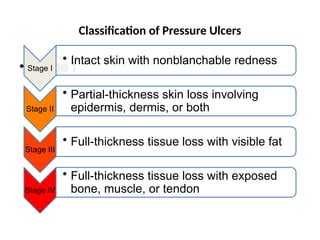
Classification of Pressure Ulcers
• Stage I
Stage I
• Intact skin with nonblanchable redness
Stage II
• Partial-thickness skin loss involving
epidermis, dermis, or both
Stage III
• Full-thickness tissue loss with visible fat
Stage IV
• Full-thickness tissue loss with exposed
bone, muscle, or tendon
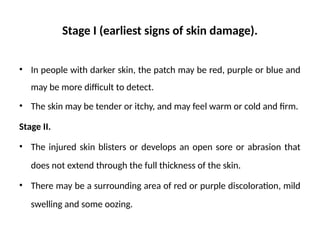
Stage I (earliest signs of skin damage).
• In people with darker skin, the patch may be red, purple or blue and
may be more difficult to detect.
• The skin may be tender or itchy, and may feel warm or cold and firm.
Stage II.
• The injured skin blisters or develops an open sore or abrasion that
does not extend through the full thickness of the skin.
• There may be a surrounding area of red or purple discoloration, mild
swelling and some oozing.
.
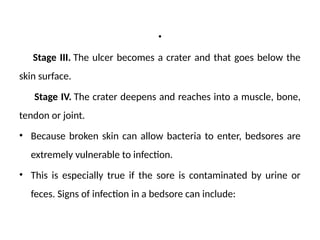
Stage III. The ulcer becomes a crater and that goes below the
skin surface.
Stage IV. The crater deepens and reaches into a muscle, bone,
tendon or joint.
• Because broken skin can allow bacteria to enter, bedsores are
extremely vulnerable to infection.
• This is especially true if the sore is contaminated by urine or
feces. Signs of infection in a bedsore can include:
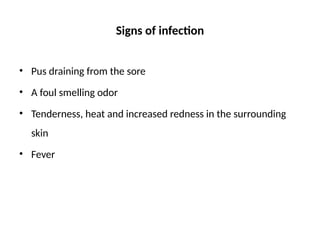
Signs of infection
• Pus draining from the sore
• A foul smelling odor
• Tenderness, heat and increased redness in the surrounding
skin
• Fever
Prevention
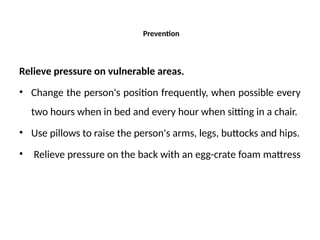
Relieve pressure on vulnerable areas.
• Change the person's position frequently, when possible every
two hours when in bed and every hour when sitting in a chair.
• Use pillows to raise the person's arms, legs, buttocks and hips.
• Relieve pressure on the back with an egg-crate foam mattress
Prevention
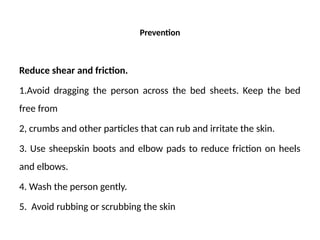
Reduce shear and friction.
1.Avoid dragging the person across the bed sheets. Keep the bed
free from
2, crumbs and other particles that can rub and irritate the skin.
3. Use sheepskin boots and elbow pads to reduce friction on heels
and elbows.
4. Wash the person gently.
5. Avoid rubbing or scrubbing the skin
Prevention
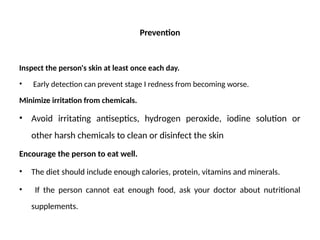
Inspect the person's skin at least once each day.
• Early detection can prevent stage I redness from becoming worse.
Minimize irritation from chemicals.
• Avoid irritating antiseptics, hydrogen peroxide, iodine solution or
other harsh chemicals to clean or disinfect the skin
Encourage the person to eat well.
• The diet should include enough calories, protein, vitamins and minerals.
• If the person cannot eat enough food, ask your doctor about nutritional
supplements.
Prevention
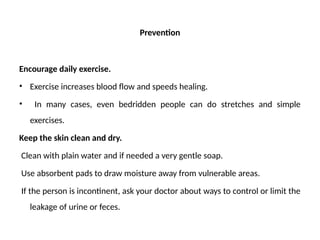
Encourage daily exercise.
• Exercise increases blood flow and speeds healing.
• In many cases, even bedridden people can do stretches and simple
exercises.
Keep the skin clean and dry.
Clean with plain water and if needed a very gentle soap.
Use absorbent pads to draw moisture away from vulnerable areas.
If the person is incontinent, ask your doctor about ways to control or limit the
leakage of urine or feces.
Prevention
Improving sensory perception
• The nurse helps the patient recognize and compensate for
altered sensory perception.
• Depending on the origin of the alteration (eg, decreased level
of consciousness, spinal cord lesion), specific interventions are
selected strategies to improve cognition and sensory
perception may include stimulating the patient to increase
awareness of self in the environment
Prevention
• Encouraging the patent to participate in self-care or
supporting the patient efforts toward active compensation for
loss of sensation( eg, a patient with paraplegia lifting up from
the sitting position every 15 minutes).
Prevention
• A patient with quadriplegia should be weight-shifted every 30
minutes while sitting in a wheelchair.
• When decreased sensory perception exists, the patient and
caregivers are taught to inspect potential pressure areas
visually every morning and evening, using a mirror if
necessary, for evidence of pressure ulcer development
•
Treatment
• Additional treatments, usually done by health care professionals,
depend on the stage of the bedsore.
First, areas of unbroken skin near the bedsore are covered with a
protective film or a lubricant to protect them from injury.
Next, special dressings are applied to the injured area to promote
healing or to help remove small areas of dead tissue.
• If necessary, larger areas of dead tissue may be trimmed away
surgically or dissolved with a special medication.
Dressings
 Changing
 Know type of dressing, placement of drains, and equipment
needed.
 Prepare the patient for a dressing change
 Evaluate pain.
 Describe procedure steps.
 Gather supplies.
 Recognize normal signs of healing.
 Answer questions about the procedure or wound.
During a Dressing Change
 Assess the skin beneath the tape.
 Perform thorough hand hygiene before and after wound care.
 Wear sterile gloves before directly touching an open or fresh
wound.
 Remove or change dressings over closed wounds when they
become wet or if the patient has signs or symptoms of
infection, and as ordered.
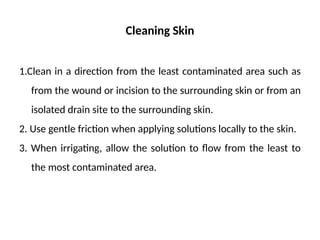
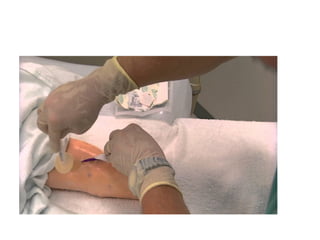
Cleaning Skin
1.Clean in a direction from the least contaminated area such as
from the wound or incision to the surrounding skin or from an
isolated drain site to the surrounding skin.
2. Use gentle friction when applying solutions locally to the skin.
3. When irrigating, allow the solution to flow from the least to
the most contaminated area.
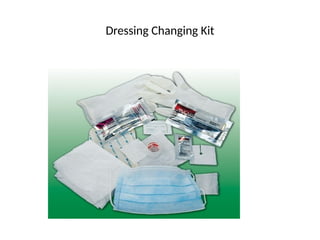
Dressing Changing Kit
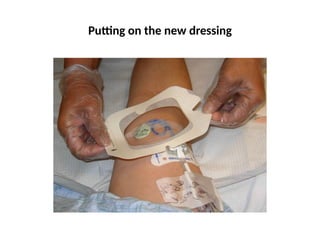
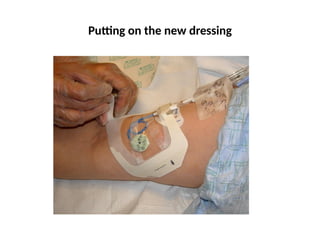
Putting on the new dressing
Treatment
• Deep craters may need skin grafting and other forms of
reconstructive surgery.
• If the person's skin shows any signs of possible infection, the
doctor may prescribe antibiotics, which may be applied as an
ointment, taken as a pill or given intravenously (into a vein).
.
Viral Skin Infections
HERPES ZOSTER
• Herpes zoster, also called shingles, is an
infection caused by the
• varicella-zoster virus, a member of a group of
DNA viruses.
• The viruses causing chickenpox and herpes
zoster are indistinguishable, hence the name
varicella-zoster virus.
HERPES ZOSTER
• The disease is characterized
• by a painful vesicular eruption along the area
of distribution of the sensory nerves from one
or more posterior ganglia.
• It is assumed that herpes zoster represents a
reactivation of latent varicella virus infection
and reflects lowered immunity
Clinical Manifestations
• The eruption is usually accompanied
or preceded by pain, which may
radiate over the entire region
supplied by the affected nerves.
• The pain may be burning, lancinating
(ie, tearing or sharply cutting),
stabbing, or aching.
Clinical Manifestations
• Some patients have no pain, but
itching and tenderness may occur
over the area.
• Sometimes, malaise and
gastrointestinal disturbances
precede the eruption.
Clinical Manifestations
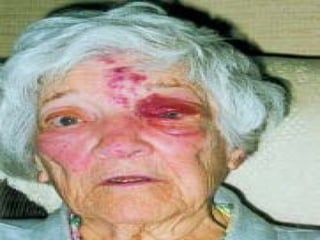
• The patches of grouped vesicles
appear on the red and swollen skin.
• The early vesicles, which contain
serum, later may become purulent,
rupture, and form crusts.
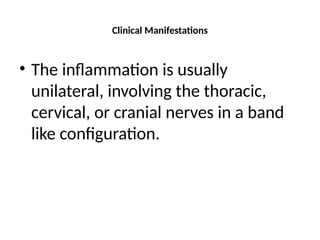
Clinical Manifestations
• The inflammation is usually
unilateral, involving the thoracic,
cervical, or cranial nerves in a band
like configuration.
Clinical Manifestations
• The blisters are usually confined to a
narrow region of the face or trunk .
• The clinical course varies from 1 to 3
weeks.
• If an ophthalmic nerve is involved,
the patient may have eye pain.
• Inflammation and a rash on the trunk
Clinical Manifestations
• may cause pain with the slightest touch. The
healing time varies
• from 7 to 26 days.
• Herpes zoster in healthy adults is usually
localized and benign.
• However, in immuno suppressed patients,
the disease may be severe
• and the clinical course acutely disabling.
Medical Management
• The goals of herpes zoster management
are to relieve the pain and to reduce or
avoid complications, which include
infection, scarring, and postherpetic
neuralgia and eye complications.
• Pain is controlled with analgesics,
because adequate pain control during
• the acute phase helps prevent persistent
pain patterns.
Medical Management
• Systemic corticosteroids may be prescribed
for patients older than age 50 years to
reduce the incidence and duration of
postherpetic neuralgia (ie, persistent pain of
the affected nerve after healing).
• Healing usually occurs sooner in those who
have been treated with corticosteroids.
Medical Management
• There is evidence that infection is
arrested if oral antiviral agents such
as acyclovir (Zovirax), valacyclovir
(Valtrex), or famciclovir (Famvir) are
administered within 24 hours of the
initial eruption.
Medical Management
• Intravenous acyclovir, if started early,
is effective in significantly reducing
the pain and halting the progression
of the disease.
.
• Ophthalmic herpes zoster occurs
when an eye is involved.
• This is considered an ophthalmic
emergency, and the patient should
be referred to an ophthalmologist
immediately to prevent the possible
sequelae of keratitis, uveitis,
ulceration, and blindness.
.
• People who have been exposed to
varicella (ie, chicken pox) by primary
infection or by vaccination are not at
risk for infection after exposure to
patients with herpes zoster.
Nursing Management
• The nurse assesses the patient’s discomfort
and response to medication and collaborates
with the physician to make necessary
adjustments to the treatment regimen.
• The patient is taught how to apply wet
dressings or medication to the lesions and to
follow proper hand hygiene techniques to
avoid spreading the virus.
Nursing Management
• Diversionary activities and relaxation
techniques are encouraged to ensure
restful sleep and to alleviate discomfort.
• A caregiver may be required to assist
with dressings, particularly if the patient
is elderly and unable to apply them.
Nursing Management
• Relatives, neighbors, or a home care
nurse may need to help with
dressing changes and food
preparation for patients who cannot
care for themselves or prepare
nourishing meals.
Herpes simplex
• Herpes simplex (Greek: is a viral disease
caused by the herpes simplex virus.
• Infections are categorized based on the part of
the body infected
There are two types of HSV:
• HSV type 1 most commonly infect the mouth
and causes cold sores. It can also cause genital
herpes.
• HSV type 2 is the usual cause of genital
herpes, but it also can infect the mouth.
OROLABIAL HERPES
• Orolabial herpes, is a type one also called fever
blisters or cold sores, consists of erythematous-
based clusters of grouped vesicles on the lips.
• A prodrome of tingling or burning with pain may
precede the appearance of the vesicles by up to
24 hours.
• Certain triggers, such as sunlight exposure or
increased stress, may cause recurrent episodes.
OROLABIAL HERPES
• Fewer than 1% of people with primary
orolabial herpes infections develop herpetic
gingivostomatitis.
• This complication occurs more in children and
young adults.
• The onset is often accompanied by high fever,
regional lymphadenopathy, and generalized
malaise.
OROLABIAL HERPES
• Another complication of oro labial herpes is
the development of erythema multi forme, an
acute inflammation of the skin and mucous
membranes
GENITAL HERPES
• Genital herpes, or type 2 herpes
simplex, manifests with a broad
spectrum of clinical signs.
Minor infections may produce no
symptoms at all; severe primary
infections with type 1 can cause
systemic flulike illness.
GENITAL HERPES
• Lesions appear as grouped vesicles
on an erythematous base initially
involving the vagina, rectum, or
penis.
• New lesions can continue to appear
for 7 to 14 days.
GENITAL HERPES
• Lesions are symmetric and usually cause
regional lymphadenopathy.
• Fever and flulike symptoms are common.
• Typical recurrences begin with a
prodrome of burning, tingling, or itching
about 24 hours before the vesicles
appear.
GENITAL HERPES
• As the vesicles rupture, erosions and
ulcerations begin to appear.
• Severe infections can cause extensive erosions
of the vaginal or anal canal.
Assessment and Diagnostic Findings
• Herpes simplex infections are
confirmed in several ways.
• Generally, the appearance of the skin
eruption is strongly suggestive.
• Viral cultures and rapid assays are
available, and the type of test used
depends on lesion morphology.
• .
Assessment and Diagnostic Findings
• Acute vesicular lesions are more
likely to react positively to the rapid
assay, whereas older, crusted patches
are better diagnosed with viral
culture.
• .
Assessment and Diagnostic Findings
• In all cases, it is imperative to obtain
enough viral cells for testing, and
careful collection methods are
therefore important
Assessment and Diagnostic Findings
• All crusts should be gently removed
or vesicles gently unroofed.
• A sterile cotton swab premoistened
in viral culture preservative is used to
swab the base of the vesicle to
obtain a specimen for analysis
Medical Management
• In many patients, recurrent orolabial
herpes represents more of a
irritation than a disease.
• Because sun exposure is a common
trigger, those with recurrent
orolabial herpes should use a
sunscreen liberally on the lips and
face.
Medical Management
• Topical treatment with drying agents may
accelerate healing.
• In more severe outbreaks or in patients who
have identified a trigger, intermittent
treatment with 200 mg of acyclovir
administered five times each day for 5 days
• is often started as soon as the earliest
symptoms
Medical Management
• Treatment of genital herpes depends
on the severity, the frequency, and
the psychological impact of
recurrences and on the infectious
status of the sexual partner.
• For people who have mild or rare
outbreaks, no treatment may be
required.
Medical Management
• For those who have more severe
outbreaks, but for whom outbreaks
are still infrequent, intermittent
treatment as described for oral
lesions can be used.
Medical Management
• Because intermittent treatment
reduces the duration of the infection
by only 24 to 36 hours, it should be
initiated as early as possible.
Medical Management
• Patients who have more than six
recurrences per year may benefit
from suppressive therapy.
• Use of acyclovir, valacyclovir, or
famciclovir suppresses 85% of
recurrences, and 20% of patients are
free of recurrences during
suppressive therapy.
Medical Management
• Suppressive therapy also reduces
viral shedding by almost 95%,
making the person less contagious.
• Treatment with suppressive doses of
oral antiviral medications prevents
recurrent erythema multiforme.
.
Fungal infection
TINEA PEDIS: ATHLETE’S FOOT
• Tinea pedis (ie, athlete’s foot) is the
most common fungal infection.
• It is especially prevalent in those who
use communal showers or swimming
pools
Clinical Manifestations
• Tinea pedis may appear as an acute or chronic
infection on the soles of the feet or between
the toes.
• The toenail may also be involved.
• Lymphangitis and cellulitis occur occasionally
when bacterial superinfection occurs.
• Sometimes, a mixed infection involving fungi,
bacteria, and yeast occurs.
Medical Management
• During the acute, vesicular phase, soaks of
Burow’s solution or potassium permanganate
solutions are used to remove the crusts, scales,
and debris and to reduce the inflammation.
Topical antifungal agents (eg, miconazole,
clotrimazole) are applied to the infected areas.
• Topical therapy is continued for several weeks
because of the high rate of recurrence.
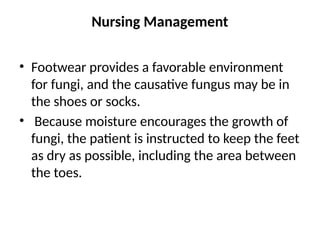
Nursing Management
• Footwear provides a favorable environment
for fungi, and the causative fungus may be in
the shoes or socks.
• Because moisture encourages the growth of
fungi, the patient is instructed to keep the feet
as dry as possible, including the area between
the toes.
Nursing Management
• Socks should be made of cotton,
should have cotton feet, because
cotton is an effective absorber of
perspiration.
• For people whose feet perspire
excessively, perforated shoes permit
better aeration of the feet.
Nursing Management
• Plastic- or rubber-soled footwear should
be avoided.
• Talcum powder or antifungal powder
applied twice daily helps to keep the feet
dry.
• Several pairs of shoes should be alternated
so that they can dry completely before
being worn again
TINEA CAPITIS:
• RINGWORM OF THE SCALP
• Ringworm of the scalp is a
contagious fungal infection of the
hair shafts and a common cause of
hair loss in children.
•
TINEA CAPITIS
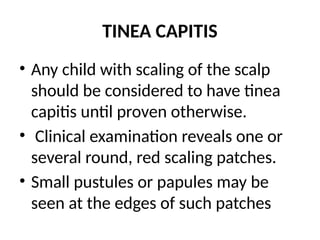
• Any child with scaling of the scalp
should be considered to have tinea
capitis until proven otherwise.
• Clinical examination reveals one or
several round, red scaling patches.
• Small pustules or papules may be
seen at the edges of such patches
TINEA CAPITIS
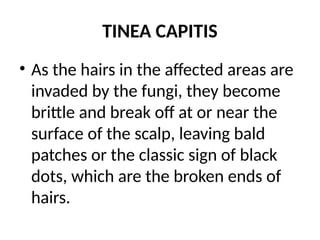
• As the hairs in the affected areas are
invaded by the fungi, they become
brittle and break off at or near the
surface of the scalp, leaving bald
patches or the classic sign of black
dots, which are the broken ends of
hairs.
TINEA CAPITIS
• Because most cases of tinea capitis
heal without scarring, the hair loss is
only temporary.
Medical Management
• Griseofulvin, an antifungal agent, is
prescribed for patients with tinea capitis.
• Topical agents do not provide an effective
cure because the infection occurs within
the hair shaft and below the surface of
the scalp.
• However, topical agents can be used to
inactivate organisms already on the hair.
Medical Management
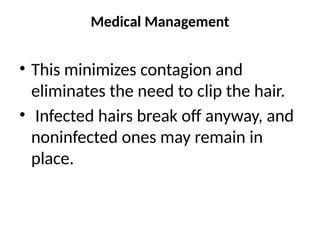
• This minimizes contagion and
eliminates the need to clip the hair.
• Infected hairs break off anyway, and
noninfected ones may remain in
place.
Medical Management
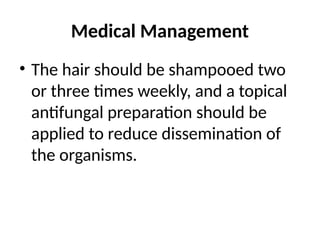
• The hair should be shampooed two
or three times weekly, and a topical
antifungal preparation should be
applied to reduce dissemination of
the organisms.
Nursing Management
• Because tinea capitis is contagious,
the patient and family should be
instructed to set up a hygiene
regimen for home use.
• Each person should have a separate
comb and brush and should avoid
exchanging hats and other headgear.
Nursing Management
• All infected members of the family
must be examined because familial
infections are relatively common.
• Household pets should also be
examined.
.
Dressing of Wounds
The following antiseptics may be used for the cleaning of wounds
• Normal Saline 0.9% for cleaning of
wounds and burns.
• Current research indicates that Normal
Saline is the best solution to use on
uncontaminated wounds, because
although it has no antiseptic properties it
dilutes bacteria and is not toxic to tissue.
Antiseptics
• Hydrogen Peroxide (H2O2) 3% for
cleaning of infected wounds.
• Gentian Violet (G.V.) is also good for
fungal infections of the skin
•
The purpose of dressing a wound is
• 1) to keep the wound clean and free
from contamination
• 2) To protect the wound from injury
• 3) to keep the edges of the wound
together by immobilization, and
• 4) to apply pressure.
Equipment: trolley containing
• Top Shelf
• A sterile dressing-
• pack containing:
• Trolley cover:
• 1hand towel
• 2 gallipot,
• 3 dressing forceps
Equipment: trolley containing
• Bottom shelf
• A Large bowl, lined with plastic bag or paper,
for used dressings
• sterile gloves
• Treatment mack if indicated
• Normal Saline, or others
• Sterile scissors in a container or small pack
• A large bowl for used forceps
Procedure of dressing a wound
• Bed-making and cleaning of the floor
should be completed on hour before
sterile dressings are done to allow
the dust in the air settle
• The ward should be closed to
visitors while dressings are in
progress.
Procedure of dressing a wound
• A Nurse with any form of infection
should not perform sterile dressings
to prevent infection.
• The clean wounds in the ward
should be dressed first, then wounds
with drains, and infected wounds are
dressed last.
Procedure of dressing a wound
• Wounds that are draining should be
dressed frequently, thick dressings
• e.g gamgee dressings should be used for
wounds that are draining, as these
dressings are more absorbent.
• If several dressings are done in
sequence, the hands must be washed
after each dressing.
Procedure of dressing a wound
• Sterile gloves may or may not be needed,
as a non-touch technique using forceps is
sufficient to maintain sterility for the
patient, and protection for the nurse.
• The nurse may hold the swabs for cleaning
the wound directly with the gloved hand,
and this is gentler for the patient.
•
Procedure of dressing a wound
• One nurse can and may do a sterile
dressing by herself, but it is much
easier if she has an assistant.
• Explain the procedure to the patient,
and provide complete privacy.
•
Procedure of dressing a wound
• Disinfect the surgical trolley, open the
pack-Cover, and place the sterile pack on
the top shelf of the trolley, and the
container with the sterile Cheatle forceps
on the patient’s bed-table or locker.
• The sterile hand towel should now be on
the top of the opened pack
Procedure of dressing a wound
• The dressing itself is not removed unless
it has more than one layer, in which case
remove the outer dressings, but leave
the inner one still covering the wound.
• Then wash and dry the hands
Procedure of dressing a wound
• Use a dressing-forceps to remove the
old dressing, and then discard it into
the bag for soiled dressings, and
place the forceps into the bowl of
disinfectant? (Savlon 1-30 aqueous)
• If the dressing sticks to the wound,
moisten it with sterile saline solution.
Otherwise the removal of the
dressing is painful for the patient,
and may open the wound.
Procedure of dressing a wound
• If a specimen for culture is ordered, take it
before the wound is cleaned
• However if the wound is discharging and needs
cleansing, a suitable solution eg. Normal Saline,
or Savlon 1% is poured into the gallipot.
• Eusol( a hypochlorite solution) should not be
used for cleaning wounds as it destroys the new
cells as well as the microorganisms, and thus
delays the healing of the wound
Procedure of dressing a wound
• Use as many cotton swabs as are needed to
clean the wound, but use each swab once
only.
• A curved dressing forceps is better than a
straight forceps or a dissecting forceps for
cleaning a wound, as it does not dig into the
patient.
Procedure of dressing a wound
• When cleaning a wound, first clean
the wound, then the outer border of
the wound, and finally the
surrounding skin
Procedure of dressing a wound
• Then cover the wound with a sterile
dressing, and strap it in position with
adhesive strapping.
• Old adhesive tape marks on the patient’s
skin can be removed with a solvent eg.
Kerosene at a later time when the wound
has healed.
•
Disposal of soiled dressings
• Place soiled dressings and swabs
directly into a plastic bag, or into a
piece of newspaper.
• When the dressing of the wound is
finished, wrap up the paper and
place it directly into the soiled-
dressings bin
Disposal of soiled dressings
• When the entire dressing round is
finished, the contents of the bin
should be emptied directly into the
incinerator, and burnt.
• Soiled dressings must always be
burnt.
Disposal of soiled dressings
• Disposing of them otherwise may
contaminate the environment, attract
flies that will spread disease, and will
cause a bad odour.
• The bin should then be disinfected,
thoroughly washed, allowed to dry, and
re-lined with a plastic bag or newspaper.
Disinfection of used instruments
• Contaminated instruments should be
disinfected before washing them, to
prevent contamination.
• Soak the used instruments in
Chlorine 0.5% solution for
10minutes.
Disinfection of used instruments
• This will kill HIV, HBV, HCV, and most
other microorganism, Do not soak
for longer than 10 minutes, because
Chlorine is highly corrosive of metals.
• Use a plastic basin, not a metal one,
for the same reason.
Disinfection of used instruments
• Wash the instruments in soapy water, and
wear gloves, apron and goggles while washing
them.
• Pay special attention to instruments with
teeth or serrations where blood and tissue is
removed, to prevent splashing, keep the
items being washed under the surface of the
water
Disinfection of used instruments
• Rinse the instrument immediately in
clean water.
• Instruments should never be allowed
to soak in water for more than 1 hour,
as this can lead to rusting.
• Thoroughly dry the instruments, and
then prepare them for sterilization.
Dressing of a Septic wound
• Septic wound should be dressed last, to
reduce the risk of infection to the clear
wounds.
• In addition to the ordinary equipment in a
dressing pack, a thicker dressing may be
needed to absorb the pus or discharge that an
infected wound is likely to produce.
Dressing of a Septic wound
• A test tube or slide may also be
needed to take a swab from the
wound for laboratory testing.
• The Specimen of pus or exudates
must be taken cleaning the wound
Removal of a soiled bandage contaminated with discharge from a wound
• Do not unroll the bandage. Instead, use a
scissors to cut through the bandage on the
opposite side of the wound, and use a forceps to
remove the dressing and bandage together.
• Insert the rounded end of the scissors under the
bandage, not the sharp end, to avoid injury to
the patient.
•
Care of a wound with a Drain
• The purpose of a drainage tube is to
prevent a hematoma or a collection
of fluid from forming in the affected
area, and the drainage tube is placed
where collection of fluid is expected
to gather.
•
Care of a wound with a Drain
• There are different types of drains,
eg. A tubular drain, a ridged drain,
“T” tubes used following
cholecytectomy, and a gauze wick is
used to keep a sinus open so that
healing can take place from the base
of the wound.
Care of a wound with a Drain
• In order to facilitate drainage of the
tissues from the bottom to the top of
the wound, the drain should be
pulled out a bit and shortened daily
until it is ready to fall out.
Care of a wound with a Drain
• Method: Dressings over the drain
need to be changed frequently
• In addition to the ordinary
dressing pack you need a sterile
scissors, sterile safety pin, and sterile
gloves. Scrub up, and open the pack
as usual.
Care of a wound with a Drain
• Open and remove the safety pin that
is already through the drainage tube,
and place it on a square of sterile
gauze on the trolley.
•
Care of a wound with a Drain
• When removing the inner dressing around the
tube, be careful not to pull out the tube with
the dressing. Clean the incision and then the
drain site, and then cut off the suture that is
holding the drain to the skin, and gently turn
the drain in the wound to loosen it.
Care of a wound with a Drain
• Grasp the top of the drain with the
artery forceps and gently ease it out
of the wound,-completely if the drain
is to be removed, or as ordered if it is
only to be shortened (about 2cm).
Care of a wound with a Drain
• Replace the pin through the tube as
near to the skin as possible,
maintaining aseptic technique.
• Close the pin, and cut off the excess
tubing. The purpose of the pin is to
prevent the tube from slipping
deeper into the wound.
Care of a wound with a Drain
• If excoriation of the skin is likely
apply a barrier cream to the skin, or
apply a layer of Vaseline gauze that is
cut towards its centre to fit around
the rubber drainage tube.
•
Care of a wound with a Drain
• Complete the sterile dressing procedure.
Drainage seeks a low level, so the bulk of the
dressings should be toward the lower edge of
the wound.
• Use strapping or bandage to secure the
dressing in position.
• Record the condition of the wound and the
amount and character of the drainage.
WOUND IRRIGATION
• The purpose of wound irrigation is to
clean and maintain free drainage of
infected wounds
WOUND IRRIGATION
• Equipment
• A sterile dressing pack, plus or containing the
following sterile equipment:
• Sterile catheter
• 20ml sterile syringe
• Sterile gloves
• 2 receivers
.
• Normal Saline or other irrigating
solution as appropriate.
• The solution should be warm or at
body temperature, as a cold solution
would cool the wound and thus
delay healing/
Procedure
• It is essential to protect the area well
with a plastic sheet.
• Remove the dressings from the wound,
and position the patient so that the
irrigating fluid will run into the receiver
or other appropriate vessel
Procedure
• Place the receiver in a suitable position to
receive the outflow.
• Draw the desired amount of solution into the
syringe, connect it to the catheters, and direct
the catheter into the wound using sterile
gloves or dissecting forceps.
•
Procedure
• Inject the irrigating solution gently
into the wound and watch for the
outflow
• After wards make sure that the
wound is cleaned and dried properly.
Procedure
• Dress the wound and ensure that it is covered
completely
• Secure the dressings in place with adhesive
tape or bandage.
• N.B. Sometimes instead of using a syringe the
irrigation fluid is hung on an I.V. Pole, and the
irrigation is managed in that way using Normal
Saline.
Debridement
• Debridement is the medical removal of dead,
damaged, or infected tissue to improve the
healing potential of the remaining healthy
tissue. Removal may be surgical, mechanical,
chemical, autolytic (self-digestion),
Thank you

basic wound care for nursing students.pptx AD.pptx

  • 1.
  • 2.
    • Learning Objectives: Atthe end of class the student’s will able … List & differentiate classification of wounds Understand the process of wound healing and wound management. Understand the principle of wound care. Performing proper wound care and its related interventions Demonstrate care of a draining wounds Know wound complication and its management
  • 3.
    Wound Definition • A woundis a type of injury which happens relatively quickly in which skin is torn, cut, or punctured (an open wound), or where blunt force trauma causes a contusion (a closed wound). • In pathology, it specifically refers to a sharp injury which damages the Epidermis of the skin.
  • 4.
    Categories of ImpairedSkin Integrity
  • 5.
    Classifying wounds • Woundscan be classified • according to their nature: • Abrasion • Contusion • Incision • Laceration • Open • Penetrating • Puncture • Septic etc……………
  • 6.
    Classifying wounds Wounds maybe classified according to the number of skin layers involved: • Superficial – Involves only the epidermis • Partial Thickness – Involves the epidermis and the dermis • Full Thickness – Involves the epidermis, dermis, fat, fascia and exposes bone
  • 7.
    Clinical Appearance • Describesthe type of material present In the bas( inside) on the wound: • Slough(yellow) • Necrotic tissue(black) • Infected tissue (green) • Granulating tissue(red) • Epithelialising(pink)
  • 8.
  • 10.
    Infected wound  Aims:reduce exudate, odour and promote healing  Clinical signs of infection  Swab wound – systemic antibiotics  Treat symptomatically: exudate and odour control  Change dressings daily
  • 11.
    Granulating wound Aims: supportgranulation, protect new tissue, keep moist Assess depth and exudate levels Moist wound surface – non- adherent dressing
  • 12.
  • 13.
    Etiology of wound Bothexternal & internal factors can contribute to formation of wound 1. External factors 1. Mechanical ( friction, shear, surgery)
  • 14.
  • 15.
    4. Temperatures extremes( burns 5. Radiation Burn
  • 16.
    6. Microorganizm • Aninfected wound is a localized defect or excavation of the skin or underlying soft tissue in which pathogenic organisms have invaded into viable tissue surrounding the wound. • Infection of the wound triggers the body's immune response, causing inflammation and tissue damage, as well as slowing the healing process.
  • 17.
    • Many infectionswill be self-contained and resolve on their own, such as a scratch or infected hair follicle. • Other infections, if left untreated, can become more severe and require medical intervention.
  • 18.
    Etiology of wound 2.Internal • Circulatory system failure (venous, arterial, lymphatic) • Endocrine (diabetes) • Neuropathy • Malignancy
  • 19.
    Purpose of woundingcaring • To minimize scarring • To prevent infection & remove bacteria • To prevent further tissue damage • To promote healing • To absorb inflammatory exudates &to promote drainage • To convert the contaminated wound into a clean wound
  • 20.
    • To preventhemorrhage • To apply medications in place • To improve pt comfort • To restore the normal function of the body part • To allow measurement of wound drainage • Wound can be 1. Intentional • occur during therapy e.g. Operations -Veni punctures -Radiation burns and Removing of tumor
  • 21.
    2. Un intentional Occuraccidental e.g. Falling Classification of wound based on • Extents of tissue injury • The cause/ • Types of wound • The presences/ absence of pathogens
  • 22.
    Extent(degree or amount)of tissue injury • Incision (cut) – cleanly cut by sharp instruments – no bruising or crushing – it tends to gap & bleeds freely – damage to all structure in linear with minimum loss of tissue – open wound, painful caused by sharp instrument • e.g. knife, scalpel
  • 23.
    Extent of tissueinjury Contusion ( bruise) • closed wound • skin appears ecchymotic (bruised) b/c of damage blood vessels • caused by blow from a blunt instrument Abrasion(graze) • open wound involving the skin which is painful caused by scrapping away of the superficial skin.
  • 24.
    • Puncture (stab) •open wound in which skin & connective tissue are penetrated • wound is deeper than its breadth & caused by sharp, pointed narrow objects such as pins, knives, splinters of wood. • Entrance of wound is surprisingly small • Extensive concealed blood loss
  • 25.
    Extent of tissueinjury Laceration (tear) • has no regular edge • caused by tearing, crushing& forcible disruption of tissue. • loss of skin continuity • it has rough edges • extensive tissue devitalization by loss of blood supply • bleeding is often at first slight
  • 26.
    open wound There isa cut/break in the continuity of skin or M.M -caused by a sharp blow/object it allows • entry of foreign particles & organisms • loss of fluid from body
  • 27.
    Closed wound • Nobreak in continuity of skin & M.M • It is accompanied by the damage of tissue under skin called contused wound • Caused by • Direct blow/some blunt instrument/crushing • Unusual straining/twisting body part
  • 28.
    Wound healing • Healingis the quality of life tissue • Healing is regeneration (renewal) of the tissue • Wound healing is the process by which damaged or destroyed by injury or disease are restored to normal function.
  • 29.
    Wound healing • Thereare three types of healing, distinguished by the amount of tissue loss. • Primary intention healing • Is called primary union or 1st intention healing • It involves the union of the edges of a wound under aseptic conditions with out visible granulations. • It occurs where the tissue surface have been approximated (closed) & there is minimal or no loss tissue.
  • 30.
    • It characterizedby the formation of minimal granulation tissue & scarring E.g. surgical incision that closed with sutures, clips or skin adhesive. Secondary intention healing • Healing by secondary intention occurs when wounds edge cannot be brought together, involves considerable tissue loss &a wound that is extensive.
  • 31.
    • Wound leftopen &must fill with new tissue(granulate) until the level of intact epidermis is reached – Wounds that heal by secondary intention include:- – Surgical or traumatic wounds where a large amount of tissue has been lost – Heavily infected wound – Chronic wounds (leg/pressure ulcer) – In some cases, where a better cosmetic or functional result will be achieved.
  • 32.
    • the repairtime is longer • the scarring greater • the susceptibility of infection greater Tertiary healing • -delayed healing • -It indicated when reason there is a reason to delays suturing a wound
  • 33.
    Commonly seen woundsas a result of acute/ chronic conditions may include • Diabetic ulcers • Burns wound • Pressure (decubitas) ulcers • Tropical ulcers • Post surgical wound/ surgical incision • Trauma ; contusion, puncture, laceration, penetrating
  • 34.
    Common viral diseaseincludes: • Herpes simplex I (cold sores) • Herpes simple II (genital helps) • Herpes zoster • Common fungal infections include • Tinea pedis (athlete’s foot) • Tinea capitas (ring worm
  • 35.
    Wound healing • Allwounds heal following a a specific sequence of phases which may overlap • The process of wound healing depends on the type of tissue which has been damaged and the nature of tissue disruption • The phases are: – Inflammatory phase – Proliferative phase – Remodelling or maturation phase
  • 36.
    • The phasesare: – Inflammatory phase – Proliferative phase – Remodelling or maturation phase
  • 37.
    Schematic Diagram ofthe Phases of Wound Healing
  • 38.
    1.Inflammatory Phase. • Thisphase begins immediately after wounding and lasts for 2-3 days. • During the immediate reaction of tissue injury haemostatics and inflammation occur. • It attempts to limit damage by -Stopping bleeding. -Sealing the surface. -Removing necrotic tissue and foreign bodies or bacterial products.
  • 39.
    Characterized by… - Inflammatoryresponse. - Vasodilatation. - Extravasations. -Migration of inflammatory cells and leukocytes into the wound by chemo taxis. -Secretion of cytokines and growth factors into the wound and activation of migratory cells. -Rapid epithelial growth.
  • 40.
    2.The proliferative(Fibroplasia)phase. • Itlasts from 3rd day-3rd week. • Consists mainly of fibroblast activity. • This phase is characterized by:- -Re-epithelialization. -Matrix synthesis. -Neovascularization/angiogenesis. -Collagen synthesis mainly type 3 collagen. -Formation of granulation tissue. -Production of ground substance.
  • 41.
    3.Maturational(Remoddeling)phase. • This takesthe longest period which may extend up to 1 year. • Characterized by:- -Equilibrium between protein synthesis and degradation. -Cross linking of collagen bundles. -Wound contraction. -Loss of edema. -Alignment of collagen fibers along the line of tension. -Maturation of type 1 collagen replacing type 3 until the ratio of 4:1.
  • 42.
    Factors affecting healing •Immune status • Blood glucose levels (impaired white cell function) • Hydration (slows metabolism) • Nutrition • Blood albumin levels (‘building blocks’ for repair, colloid osmotic pressure - oedema) • Oxygen and vascular supply • Pain (causes vasoconstriction) • Corticosteroids (depress immune function)
  • 43.
    Practical considerations • Thecause of the wound • Underlying disease processes • Current health status • Medication • Acute or chronic? • Attitude to the wound • Availability of care
  • 44.
    Healing Requirements • Identificationof the interference to healing • Adequate nutritional status • Adequate perfusion and oxygenation • High quality, research-based patient and wound management • Correction of the underlying cause of the problem • Disease management
  • 46.
    Factors that affectwound healing A. Favorable factors • Young age • Adequate blood supply to the area • Good general health • Adequate nutritional intake • Minimal tissue destruction • Absence of infection • Use of anti-infection agent • Immobilization
  • 47.
    Factors that affectwound healing B. Unfavorable factors • Old age • Poor health • Inadequate blood supply to the affected area • Diabetes mellitus • Presence of foreign body and traumatized tissue • Excessive movement of the injured area
  • 48.
    Complications of woundhealing • Hemorrhage • Infection • Dehiscence • Evisceration • Fistula • Abscess • Gangrene • Keloid
  • 49.
    Hemorrhage • Bleeding canbe internal or external • There may be hypovolemic shock and hematoma in case of internal bleeding. • Saturated dressing shows external bleeding. • Bleeding from the site of injury can take place at any time after the injury. • Primary haemorrhage takes place at the time of operation or injury.
  • 50.
    Hemorrhage • Reactionary hemorrhageoccurs later when the body pressure rise and ligature slips or a blood vessel open up. • Secondary hemorrhage takes place, as a rule, about 7 to 10 days after the injury and always due to sepsis.
  • 51.
    • Pain • Pain,a usual accompaniment of injury, subsides with immobilization and initial treatment of injuries. • A recurrence of pain at the site of injury should be interpreted as a sign of inflammation and infection • Infection • Increased risk if wound was dirty if the blood supply and local tissue defense is reduced
  • 52.
    Infection Assess local signsof infection like  Heat  Redness  Swelling  Pain  Lose of function
  • 53.
    Infection • Edges ofthe wound may appear inflamed • Drainage is present which is purulent, yellow, green, or brown in color • Systemic infection; fever, increased pulse and respiration and WBC genral malaise, lethargy, anorexia and nausea.
  • 54.
    Abscess formation • Anabscess is simply a localized collection of pus. • It complicates the healing process by enlarging the dead space, which must be filled in. • If the pressure within the abscess is unrelieved it may cause a weakening at some point and opens to the body surface by a sinus tract. • If the sinus is formed between two hollow organs, it is referred as ‘fistula’.
  • 55.
    Cellulites • If theinflammation is localized, but extend to the surrounding cells with an edematous appearance of the parts, it is called cellulites. • It is usually caused by streptococcal infection.
  • 56.
    Necrosis or gangrene •If the blood supply is not restored to the area, the death of the tissues may take place. • It is called gangrene
  • 57.
    Wound dehiscence withor without evisceration • When the wound edges separate, it is known as dehiscence. • If the abdominal organs protrude out through the gap, it is known as evisceration . The appearance of pink watery fluid (serosanguineous) on the dressing is a warning sign of wound dehiscence. • Kiloid • These are huge, ugly, tumor-like overgrowths of scar tissues seen in certain individuals
  • 58.
    Contractures • Contracture ofscar tissues leading to disability and severe deformity occurs when sever injuries are located over a joint and healed by secondary union. • Interference with the organ function Scare tissues, when excessive, can definitely interfere with the physiologic functioning of the organ.
  • 59.
    How to assesswound • Exudate (drainage), a liquid produced by the body in response to tissue damage, is present in wounds as they heal. • It consists of fluid that has leaked out of blood vessels and closely resembles blood plasma. • Exudates can result also from conditions that cause edema, such as inflammation, immobility, limb dependence, and venous and lymphatic insufficiency.
  • 60.
    • Accurate assessmentof exudate is important throughout the healing process because the color, consistency, odor, and amount change as a result of various physiologic processes and underlying complications
  • 61.
    Type of exudate Serous •Thin, clear, watery plasma, seen in partial-thickness wounds and venous ulcera­ tion. • A mod­ er­ ate to heavy amount may indicate heavy bio-burden or chronicity from a subclinical infection. • Serous exudate in the acute inflammatory stage is normal
  • 62.
    Sanguineous • Bloody drain­ age(fresh bleeding) seen in deep partial-thickness and full-thickness wounds during angiogenesis. • A small amount is normal in the acute inflammatory stage.
  • 63.
    Serosangui­ neous— • Thin, watery,pale red to pink plasma with red blood cells. Small amounts may be seen in the acute inflammatory or acute proliferative healing phases. Purulent • thick, opaque drainage that is tan, yellow, green, or brown. Purulent exudate is never normal and is often associated with infection or high bacteria levels.
  • 64.
    Amount • None—Wound tissuesare dry. • Scant—Wound tissues are moist, but there is no measurable drainage. • Small/minimal—Wound tissues are very moist or wet; the drainage covers less than 25% of the dressing.
  • 65.
    • Moderate—Wound tissuesare wet; the drainage involves more than 25% to 75% of the dressing. • Large or copious—Wound tissues are filled with fluid that involves more than 75% of the dressing.
  • 66.
    Consistency • Low viscosity—thin,runny • High viscosity—thick or sticky; doesn’t flow easily Wound Odor • Wound odor, also referred to as malodor, is typically the result of necrotic tissue or bacterial colonization
  • 67.
    Symptoms: The following scalecan be used to qualitatively assess wound odor for documentation purposes: • Very strong: Odor is evident on entering the room (6–10 feet or 2–3 meters from the patient) with the dressing intact. Strong: Odor is evident on entering the room (6–10 feet or 2– 3 meters from the patient) with the dressing removed.
  • 68.
    • Moderate: Odoris evident at close proximity to the patient when the dressing is intact. • Slight: Odor is evident at close proximity to the patient when the dressing is removed. • No odor: No odor is evident, even at the patient’s bedside with the dressing removed
  • 69.
    • Principles • Micro-organisms are present in the environment, on the articles and on the skin. • Pathogenic organisms are transmitted form the sources to the new host directly or indirectly. Principles involved in the care of wounds
  • 70.
    . • Nursing actions: •Anything that touches the wound should be sterile e.g. • Dressings, instruments, solutions • Emphasize on hand washing before and after the procedure. • Observe strictly the principles of surgical asepsis. • The wound and the surrounding skin should be cleaned thoroughly to reduce the number of bacterial.
  • 71.
    Nursing actions: • Thewounds should be protected always with clean and sterile dressings. • Removal and replacement of the dressings should be done when the air movement us at minimum. • No sweeping should be done when the dressings are opened). • The soiled dressings should be carefully collected and burned to prevent the spread of infection •
  • 72.
    Nursing actions: • Thecontaminated articles should be disinfected before it is used again • Keep the environment free form dust and flies • Practice barrier nursing. • Isolate patients with clean wounds form those patients with contaminated wounds. • Use of gloves, masks and gowns in creases the barriers to the organisms.
  • 73.
    Principles • Bacterial travelalong with the dust particles • Sweepings and dusting should not be done when the dressings are in progress. It should be done at least one hour before the expected time of the dressing.
  • 74.
    Nursing actions • Flappingof the bed cloths and dresses should be avoided to prevent dust particles entering the wound. • Sterile articles must be kept covered until it is time for use. • Prolonged exposure to the air makes them contaminated • Cleaning an area where there is less number of organisms. • Before cleaning an area where there are more organisms, minimize the spread of organisms to the clean area.
  • 75.
    Nursing action • Considerthe wound area cleaner than the skin around even if the wound is infected. • Keeping this principle in mind, clean the wound from the center to the periphery, discarding the used swab after each stroke.
  • 76.
    Nursing action • Skinand mucus membranes normally harbor pathogens. • If the wound is clean first before the cleaning of the skin around the wound, there is less chance of introduction the skin pathogens into the wound.
  • 77.
    Principles • A breakin the skin and mucus membrane acts as the portal of entry for the pathogenic organisms • Open wounds are to be sealed or dressed as early as possible to prevent the entrance of pathogenic organisms into the body.
  • 78.
    Nursing • All precautionsare to be taken to prevent further tissue damage and promote the healing process. • Use antiseptic solutions of correction strength which are safe form the skin and mucus membranes. • Using the antiseptics of high concentration can cause tissue damage.
  • 79.
    Nursing • When usingthe heat in the form of hot fomentation or surgical soak, the temperature should be controlled between 37 to 40.50 C (98 to 1050 F) to prevent tissue burns. • Respiratory tract harbors micro organisms that can enter the wound.
  • 80.
    Nursing actions • Whendressing large open wounds, masks may be worn by the nurses to prevent the organisms entering the wounds through the droplets. • Avoid talking, coughing, coughing and sneezing while attending to a wound. • Respiratory tract harbors micro organisms that can enter the wound. • Moisture facilitates growth and movement of micro- organisms
  • 81.
    Nursing actions • Microbescan neither live nor travel without moisture. Therefore keep the sterile field dry. • Replace the soild dressings with dry dressings as soon as they are wet otherwise the • Microbes can enter the wound by traveling through the wet dressings.
  • 82.
    Principles • Unfamiliar situationsproduce anxiety. • Nursing actions • An adequate explanation of the treatment will help the patient to know what is to be expected. • This will reduce the fear and anxiety.
  • 83.
    Nursing actions • Maintainthe privacy of the patient and avoid unnecessary exposure. • Do not expose the wound in front of the patient. • Turn the patient’s head to one side to avoid unpleasant sight. • Diversion is provided by conversation or by other means. • The nurse should try to control the reactions to the sight of the wound or dressing.
  • 84.
    Nursing actions • Thepatient frequently studies the face of the person changing the dressing in order to evaluate the extent of injury or healing process. • Systematic ways of working saves time, energy and material • Nursing actions • Place the bed and the patient at working height • Prepare the patient; articles and the environment before the dressing are opened.
  • 85.
    Nursing actions • Assembleand arrange the articles on the beside locker conveniently to avoid leaving the patient in between the procedure. • Protect the personal clothing and the bed linen with a waterproof covering. • Get assistance if needed. •
  • 86.
    Common terms associatedwith microbiology may • Commensal • Microflora • Normal flora • Pathogen • Symbiosis • Nosocomial infection • Endogenous • Exogenous
  • 87.
    Components of thechain of infection: • Infective agent • Portal of entry • Portal of exit • Reservoir • Susceptible host
  • 88.
    Common terms associatedwith the spread of disease: • Antibiotic • Communicable • Contagious • Epidemiology • Epidemic • Endemic • Pandemic • Host
  • 89.
    • Incubation • Infectious •Acute infection • Chronic infection • Latent
  • 90.
    • Primary infection •Secondary infection • Local infection • Generalized infection • Sterilization • Disinfection
  • 91.
    Infection process mayinclude • Inflammatory process • Histamine • Kinins • Phagocytosis • Pus • Tissue repair
  • 92.
    Wound assessment mayinclude: the following classifications: • Clean/dirty • Infected • Surgical/traumatic • Chronic/acute • Necrotic/sloughy • Granulating • Abrasions/skin tears
  • 93.
    • Incisions/lacerations • Punctures •Avulsions • Amputations • Burns • Pressure sores
  • 94.
  • 95.
    Diabetic foot ulcer •A foot ulcer is where an area of skin has broken down and you can see the underlying tissue. • Diabetic foot ulcer is an ulcer that occurs in diabetic patients due to certain complications of diabetes mellitus.
  • 96.
    Complication of diabetesthat contribute to increased risk of foot problems and infections • Peripheral neuropathy • obesity • Age older than 40 years • Poor glycemic control • Peripheral vascular disease
  • 98.
    • Duration ofdiabetes more than 10 years • Cigarette smoking • Immune compromised • Poor foot wear 1 Peripheral neuropathy it causes loss of pain or feeling in the toes, feet, legs and arms due to distal nerve damage and low blood flow .
  • 99.
    Complications cont… 2 Peripheralvascular disease. • Poor circulation of the lower extremities contribute to poor wound healing and the development of gangrene 3 Immuno compromise. • Hyperglycemia impairs the ability of specialized leukocytes to destroy bacteria. • There for in poorly controlled diabetes there is a lowered resistance to certain infection.
  • 100.
    4 Poor footcare • Poor footwear that causes skin breakdown or inadequately protects the skin from high pressure and shear forces 5 Immune compromised……low immunity eg . DM pts
  • 101.
    Prevention Good foot carewhich includes: • Looking carefully at feet each day, including between the toes • Looking is particularly important if there is a reduced sensation in the feet, as pts may not notice anything wrong at first until they look. • Teach the pts to see the doctor if they see anything new (such as a cut, bruise, blister, redness or bleeding) and don't know what to do,
  • 102.
    Foot care cont… –Use a moisturizing oil or cream for dry skin to prevent cracking. – However, you should not apply it between the toes as this can cause the skin to become too moist which can lead to an infection developing.
  • 103.
    Foot care cont •Washing feet regularly and drying them carefully, especially between the toes • Do not walk barefoot, even at home • Always wear socks with shoes or other footwear. • However, don't wear socks that are too tight around the ankle, as they may affect your circulation. • Always feel inside footwear before you put footwear on (to check for stones, rough edges, etc).
  • 104.
    Foot care cont… •If your feet are an abnormal shape, or other foot problems, you may need specially fitted shoes to stop your feet rubbing. • Tips to avoid foot burns include: checking the bath temperature with your hand before stepping in; do not use hot water bottles, do not sit too close to fires. • Sammary on health education • 1. teach about foot care 3. teach about medication • 2 teach about dalily exercise 4. about diet 5. about RBS [low blood glucose s/sx]
  • 105.
  • 106.
  • 107.
    Burn Injury • Aburn is an injury caused by extremes of temperature, electric current, or certain chemicals. • In this session we will learn how to determine percentage and severity of burns, proper treatment, and delivery to the appropriate medical facility.
  • 108.
  • 109.
    1. Thermal Burn Athermal burn is a type of burn resulting from making contact with heated objects, such as boiling water, steam, hot cooking oil, fire, and hot objects. The most common type of thermal burn suffered by children, but for adults thermal burns are most commonly caused by fire. Burns are generally classified from first degree up to fourth degree,
  • 110.
    2 Chemical • Chemicalburn is a burn to internal or external organs of the body caused by a corrosive or caustic chemical substance that is a strong acid or base (also known as alkali). • Chemical burns are usually the result of an accident and can occur in the home, at school or more commonly, at work, particularly in manufacturing plants that use large quantities of chemicals. • Very mild chemical burns result in irritant contact dermatitis. • Chemical burn from a strong acid or alkali is also known as a caustic burn.
  • 111.
    3 Electrical burns •Electrical burns and injuries happen when electric currents pass through the body. • The currents can damage the skin, tissues, and major organs. • The damage can range from minor to severe. • Sometimes it is fatal. • Electrical burns and injuries are caused by contact with electrical currents. The currents may come from appliances, exposed wiring, or lightning strikes.
  • 112.
    4 Radiation • Aburn caused by exposure to electromagnetic radiation in the form of ultraviolet rays (sunburn), ionizing rays (radiation therapy for cancer treatment.
  • 113.
    Types of Burn •Focus on the treatment of life-threatening injuries even though burn may consume attention. • There are the three types of Burns – Superficial (1ST degree) – Partial thickness (2nd degree) – Full thickness (3rd degree)
  • 114.
    Signs and symptoms •The characteristics of a burn depend upon its depth. • Superficial burns cause pain lasting two or three days, followed by peeling of the skin over the next few days • Individuals suffering from more severe burns may indicate discomfort or complain of feeling pressure rather than pain.
  • 115.
    Signs and symptoms •Full-thickness burns may be entirely insensitive to light touch or puncture. • While superficial burns are typically red in color, severe burns may be pink, white or black. • Burns around the mouth or singed hair inside the nose may indicate that burns to the airways have occurred, but these findings are not definitive.
  • 116.
    Signs and symptoms •More worrisome signs include: shortness of breath, hoarseness, and stridor or wheezing. • Itchiness is common during the healing process, occurring in up to 90% of adults and nearly all children.
  • 117.
    Signs and symptoms •Numbness or tingling may persist for a prolonged period of time after an electrical injury. • Burns may also produce emotional and psychological distress.
  • 118.
    Classification of burnwound • Superficial or first-degree burns burn that affects only the superficial skin. • Partial-thickness or second-degree When damage penetrates into some of the underlying layers.
  • 119.
    Classification of burnwound • a full-thickness or third-degree burn, the injury extends to all layers of the skin. • A fourth-degree burn additionally involves injury to deeper tissues, such as muscle or bone
  • 120.
    Superficial (First degree) •Layers involved Epidermis • Appearance Red without blisters] • Texture Dry • Sensation Painful • Prognosis Heal well; Repeated the risk of skin cancer later in life
  • 121.
  • 122.
    Superficial partial thickness(Second degree) • Extends into superficial (papillary) dermis • Redness with clear blister. Blanches with pressure. • Moist • Very painful • less than 2–3 weeks • Local infection/cellulitis but no scarring typically
  • 123.
  • 124.
    Deep partial thickness(Second degree) • Extends into deep (reticular) dermis • Yellow or white. Less blanching. May be blistering. • Fairly dry
  • 125.
    Deep partial thickness(Second degree) • Pressure and discomfort • 3–8 weeks • Scarring, contractures (may require excision and skin grafting)
  • 126.
    Full thickness (Thirddegree) • Extends through entire dermis • Stiff and white/brown No blanching • Leathery • Painless • Prolonged (months) and incomplete • Scarring, contractures, amputation (early excision recommended)
  • 127.
  • 128.
    Fourth degree • Extendsthrough entire skin, and into underlying fat, muscle and bone • Black; charred with eschar • Dry • Painless • Requires excision • Amputation, significant functional impairment and, in some cases, death.
  • 129.
  • 130.
  • 131.
    . • The treatmentrequired depends on the severity of the burn. • Superficial burns may be managed with little more than simple pain relievers, • Cooling with tap water may help relieve pain and decrease damage; • however, prolonged exposure may result in low body temperature
  • 132.
    Management • Partial-thickness burnsmay require cleaning, followed by dressings. • It is not clear how to manage blisters, but it is probably reasonable to leave them intact.
  • 133.
    What is therule of nines? • The rule of nines is a method doctors and emergency medical providers use to easily calculate the treatment needs for a person who’s been burned.
  • 134.
    What is therule of nines? • The rule of nines is meant to be used for: • second-degree burns, also known as partial-thickness burns • third-degree burns, known as full-thickness burns • The rule of nines assigns a percentage that’s either nine or a multiple of nine to determine how much body surface area is damaged. For adults, the rule of nines is:
  • 135.
    Body part Percentage Arm(including the hand) 9 percent each Anterior trunk (front of the body) 18 percent Genitalia 1 percent Head and neck 9 percent Legs (including the feet) 18 percent each Posterior trunk (back of the body) 18 percent
  • 136.
    • If aperson’s injured due to a burn, a doctor may assess them quickly. • For example, if they were burned on each hand and arm as well as the front trunk portion of the body, using the rule of nines, they’d estimate the burned area as 36 percent of a person’s body.
  • 137.
    Management • Full-thickness burnsusually require surgical treatments, such as skin grafting. • Extensive burns often require large amounts of intravenous fluids because the subsequent inflammatory response will result in significant capillary fluid leakage and edema. • The most common complications of burns are related to infection
  • 138.
    Diagnosis • Burns canbe classified by depth, mechanism of injury, extent, and associated injuries. • The most commonly used classification is based on the depth of injury. • The depth of a burn is usually determined via examination, although a biopsy may also be used.
  • 139.
    Diagnosis • It maybe difficult to accurately determine the depth of a burn on a single examination and repeated examinations over a few days may be necessary. • In those who have a headache or are dizzy and have a fire- related burn, carbon monoxide poisoning should be considered.
  • 140.
    Size • The sizeof a burn is measured as a percentage of total body surface area (TBSA) affected by partial thickness or full thickness burns. • First-degree burns that are only red in color and are not blistering are not included in this estimation. • Most burns (70%) involve less than 10% of the TBSA.
  • 141.
    Size • There area number of methods to determine the TBSA, including the "rule of nines", Lund and Browder charts, and estimations based on a person's palm size. • The rule of nines is easy to remember but only accurate in people over 16 years of age.
  • 142.
    Size • More accurateestimates can be made using Lund and Browder charts, which take into account the different proportions of body parts in adults and children. • The size of a person's handprint (including the palm and fingers) is approximately 1% of their TBSA.
  • 143.
    Size • In orderto determine the need for referral to a specialized burn unit, the American Burn Association devised a classification system. Under this system, burns can be classified as • major, • moderate and • minor.
  • 144.
    Size • This isassessed based on a number of factors, including • total body surface area affected, • the involvement of specific anatomical zones, • the age of the person, • and associated injuries.
  • 145.
    Size • Minor burnscan typically be managed at home, moderate burns are often managed in hospital, and major burns are managed by a burn center. • Resuscitation begins with the assessment and stabilization of the person's airway, breathing and circulation. • If inhalation injury is suspected, early intubation maybe required.
  • 146.
    Management • This isfollowed by care of the burn wound itself. • People with extensive burns may be wrapped in clean sheets until they arrive at a hospital. • As burn wounds are prone to infection, a tetanus booster shot should be given if an individual has not been immunized within the last five [5] years.
  • 147.
    Treatment The treatment requireddepends on the severity of the burn. • Superficial burns may be managed with little more than simple pain relievers, while major burns may require prolonged treatment in specialized burn centers.
  • 148.
    Treatment • Cooling withtap water may help relieve pain and decrease damage; however, prolonged exposure may result in low body temperature. Partial-thickness burns may require cleaning, followed by dressings. • It is not clear how to manage blisters, but it is probably reasonable to leave them intact.
  • 149.
    Treatment cont… • Full-thicknessburns usually require surgical treatments, such as skin grafting. • Extensive burns often require large amounts of intravenous fluids because the subsequent inflammatory response will result in significant capillary fluid leakage and edema. • The most common complications of burns are related to infection
  • 150.
    Intravenous fluids • Inthose with poor tissue perfusion, boluses of isotonic crystalloid solution For example [Lactated Ringer’s—[R/L] • An isotonic crystalloid solution containing the solutes sodium chloride, potassium chloride, calcium chloride, and sodium lactate, dissolved in sterile water (solvent).]should be given. • In children with more than 10-20% TBSA burns, and adults with more than 15% TBSA burns, formal fluid resuscitation and monitoring should follow.
  • 151.
    • The Parklandformula has the advantage of being easy to use. It leads to fewer respiratory problems later on, although there may be pronounced general oedema in the first stages of its use as large volumes of fluid are required. • The formula The Parkland formula for the total fluid requirement in 24 hours is as follows: • 4ml x TBSA (%) x body weight (kg); • 50% given in first eight hours; • 50% given in next 16 hours.
  • 152.
    Intravenous fluids • Thisshould be begun pre-hospital if possible in those with burns greater than 25% TBSA. • The Parkland formula can help determine the volume of intravenous fluids required over the first 24 hours. • The formula is based on the affected individual's TBSA and weight.
  • 153.
    Intravenous fluids • Childrenrequire additional maintenance fluid that includes glucose. • Additionally, those with inhalation injuries require more fluid. • While inadequate fluid resuscitation may cause problems, over-resuscitation can also be detrimental.
  • 154.
    Intravenous fluids • Theformulas are only a guide, with infusions ideally tailored to a urinary output of >30 mL/h in adults or >1mL/kg in children and mean arterial pressure greater than 60 mmHg. • While lactated Ringer's solution is often used, there is no evidence that it is superior to normal saline. • Crystalloid fluids appear just as good as colloid fluids, and as colloids are more expensive they are not recommended
  • 155.
    Intravenous fluids • Bloodtransfusions are rarely required. • They are typically only recommended when the hemoglobin level falls below 60-80 g/L (6-8 g/dL)due to the associated risk of complications. • Intravenous catheters may be placed through burned skin if needed or intraosseous infusions may be used.
  • 157.
    Intravenous fluids • Inthose with poor tissue perfusion, boluses of isotonic solution should be given. • In children with more than 10-20% TBSA burns, and adults with more than 15% TBSA burns, formal fluid resuscitation and monitoring should follow. • This should be begun pre-hospital if possible in those with burns greater than 25% TBSA.
  • 158.
    Parkland formula • 2-4xTBSAxWtin 24hrs in adults • Maintenance fluid+2-4 x TBSA x Wt in 24 hrs for children • Half in the first 8hrs and half in the second 16 hrs. • Eg. Parkland formula • 2-4 * Tbsa* wt • 4* 27* 56= 6048 total fluid for 24 • For 8 hr loding dose = 6048/2= 3024 3024*20/60*8 =126 gtt • For 16 hr mantanance dose = 3024* 20/60*16 = 63gtt
  • 159.
    Wound care • Earlycooling (within 30 minutes of the burn) reduces burn depth and pain, but care must be taken as over-cooling can result in hypothermia. • It should be performed with cool water 10–25 °C (50–77 °F) and not ice water as the latter can cause further injury.
  • 160.
    Wound care • Cleaningwith N/s, removal of dead tissue, and application of dressings are important aspects of wound care. • If intact blisters are present, it is not clear what should be done with them. • Some cautious evidence supports leaving them intact.
  • 161.
    Wound care • Inthe management of first and second degree burns, little quality evidence exists to determine which type of dressing should be used. • It is reasonable to manage first degree burns without dressings.
  • 162.
    Medications • Burns canbe very painful and a number of different options maybe used for pain management. • These include simple analgesics (such as ibuprofen and acetaminophen[PCM) and opioids such as morphine. Surgery • Wounds requiring surgical closure with skin grafts or flaps (typically anything more than a small full thickness burn) should be dealt with as early as possible.
  • 163.
    Complications • A numberof complications may occur, with infections being the most common. • In order of frequency, potential complications include: • Pneumonia, • cellulitis, urinary tract infections • and respiratory failure.
  • 164.
    Complications Risk factors forinfection include: • burns of more than 30% TBSA, • full-thickness burns, • extremes of age (young or old), burns involving the legs or perineum. • Pneumonia occurs particularly commonly in those with inhalation injuries. CO
  • 165.
    Complications • Anemia secondaryto full thickness burns of greater than 10% TBSA is common. • Electrical burns may lead to compartment syndrome due to muscle breakdown. • Blood clotting in the veins of the legs is estimated to occur in 6 to 25% of people. • The hypermetabolic state that may persist for years after a major burn can result in a decrease in bone density and a loss of muscle mass.
  • 166.
    Complications • Keloids mayform subsequent to a burn, particularly in those who are young and dark skinned. • Following a burn, children may have significant psychological trauma and experience post-traumatic stress disorder. • Scarring may also result in a disturbance in body image. • In the developing world, significant burns may result in social isolation, extreme poverty and in children abandonment.
  • 167.
  • 168.
    • A localizedinjury to the skin and other underlying tissue, usually over a body prominence, as a result of pressure or pressure in combination with shear and/or friction. • Are unable to move for short periods of time, especially if they are thin or have blood vessel disease or neurological diseases. • Use a wheelchair or bedside chair (a hospital chair that allows a patient to sit upright next to the bed.)
  • 169.
    Pressure ulcers • Bedsoresare common in people in hospitals and nursing homes and in people being cared for at home. • Bedsores form where the weight of the person's body presses the skin against the firm surface of the bed.
  • 170.
    Pressure ulcers • Thispressure temporarily cuts off the skin's blood supply. • This injures skin cells. • Unless the pressure is relieved and blood flows to the skin again, the skin soon begins to show signs of injury.
  • 171.
    Pressure ulcers • Atfirst, there may be only a patch of redness. If this red patch is not protected from additional pressure, the redness can form blisters or open sores (ulcers). • In severe cases, damage may extend through the skin and create a deep crater that exposes muscle or bone. • Although pressure on the skin is the main cause of bedsores, other factors often contribute to the problem.
  • 172.
    factors often contributeto the problem of bed sore includes:- A.Shearing and friction. • Shearing and friction causes skin to stretch and blood vessels to kink, which can impair blood circulation in the skin. • In a person confined to bed, shearing and friction occurs each time a person slides across the bed sheets.
  • 173.
    B. Moisture • Wetnessfrom perspiration, urine or feces makes skin under pressure more likely to suffer injury. • People who can't control their bladders or bowels (people who are incontinent) are at high risk of developing bedsores
  • 174.
    . C. Decreased movement. •Bedsores are common in people who can't lift themselves off the bed sheets or roll from side to side. • Without these small movements throughout the day, skin that is pressing against the bed does not get a steady supply of oxygen and nutrients. • Blood flow is inadequate in these parts of the skin. • (People who can move without assistance have a lower risk of bedsores because they can shift their weight periodically.)
  • 175.
    D. Decreased sensation. •Bedsores are common in people who have nerve problems that decrease their ability to feel pain or discomfort. • Without these feelings, the person cannot feel the effects of prolonged pressure on the skin.
  • 176.
    . E. Circulatory problems. •People with atherosclerosis, circulatory problems from long- term diabetes or localized swelling (edema) may be more likely to develop bedsores. • This is because the blood flow in their skin is weak, even before pressure is applied to the skin.
  • 177.
    . D. Poor nutrition. •Bedsores are more likely to develop in people who don't get enough protein, vitamins and minerals. Age. • Elderly people, especially those over 85, are more likely to develop bedsores because skin usually becomes more fragile with age. • Bedsores can lead to severe medical complications, including bone and blood infections.
  • 178.
    Symptoms • Bedsores areclassified into stages, depending on the severity of skin damage: • Stage I (earliest signs of skin damage). • White people or people with pale skin develop a lasting patch of red skin that does not turn white when you press it with your finger.
  • 179.
    Classification of PressureUlcers • Stage I Stage I • Intact skin with nonblanchable redness Stage II • Partial-thickness skin loss involving epidermis, dermis, or both Stage III • Full-thickness tissue loss with visible fat Stage IV • Full-thickness tissue loss with exposed bone, muscle, or tendon
  • 180.
    Stage I (earliestsigns of skin damage). • In people with darker skin, the patch may be red, purple or blue and may be more difficult to detect. • The skin may be tender or itchy, and may feel warm or cold and firm. Stage II. • The injured skin blisters or develops an open sore or abrasion that does not extend through the full thickness of the skin. • There may be a surrounding area of red or purple discoloration, mild swelling and some oozing.
  • 181.
    . Stage III. Theulcer becomes a crater and that goes below the skin surface. Stage IV. The crater deepens and reaches into a muscle, bone, tendon or joint. • Because broken skin can allow bacteria to enter, bedsores are extremely vulnerable to infection. • This is especially true if the sore is contaminated by urine or feces. Signs of infection in a bedsore can include:
  • 182.
    Signs of infection •Pus draining from the sore • A foul smelling odor • Tenderness, heat and increased redness in the surrounding skin • Fever
  • 183.
    Prevention Relieve pressure onvulnerable areas. • Change the person's position frequently, when possible every two hours when in bed and every hour when sitting in a chair. • Use pillows to raise the person's arms, legs, buttocks and hips. • Relieve pressure on the back with an egg-crate foam mattress
  • 184.
    Prevention Reduce shear andfriction. 1.Avoid dragging the person across the bed sheets. Keep the bed free from 2, crumbs and other particles that can rub and irritate the skin. 3. Use sheepskin boots and elbow pads to reduce friction on heels and elbows. 4. Wash the person gently. 5. Avoid rubbing or scrubbing the skin
  • 185.
    Prevention Inspect the person'sskin at least once each day. • Early detection can prevent stage I redness from becoming worse. Minimize irritation from chemicals. • Avoid irritating antiseptics, hydrogen peroxide, iodine solution or other harsh chemicals to clean or disinfect the skin Encourage the person to eat well. • The diet should include enough calories, protein, vitamins and minerals. • If the person cannot eat enough food, ask your doctor about nutritional supplements.
  • 186.
    Prevention Encourage daily exercise. •Exercise increases blood flow and speeds healing. • In many cases, even bedridden people can do stretches and simple exercises. Keep the skin clean and dry. Clean with plain water and if needed a very gentle soap. Use absorbent pads to draw moisture away from vulnerable areas. If the person is incontinent, ask your doctor about ways to control or limit the leakage of urine or feces.
  • 187.
    Prevention Improving sensory perception •The nurse helps the patient recognize and compensate for altered sensory perception. • Depending on the origin of the alteration (eg, decreased level of consciousness, spinal cord lesion), specific interventions are selected strategies to improve cognition and sensory perception may include stimulating the patient to increase awareness of self in the environment
  • 188.
    Prevention • Encouraging thepatent to participate in self-care or supporting the patient efforts toward active compensation for loss of sensation( eg, a patient with paraplegia lifting up from the sitting position every 15 minutes).
  • 189.
    Prevention • A patientwith quadriplegia should be weight-shifted every 30 minutes while sitting in a wheelchair. • When decreased sensory perception exists, the patient and caregivers are taught to inspect potential pressure areas visually every morning and evening, using a mirror if necessary, for evidence of pressure ulcer development •
  • 190.
    Treatment • Additional treatments,usually done by health care professionals, depend on the stage of the bedsore. First, areas of unbroken skin near the bedsore are covered with a protective film or a lubricant to protect them from injury. Next, special dressings are applied to the injured area to promote healing or to help remove small areas of dead tissue. • If necessary, larger areas of dead tissue may be trimmed away surgically or dissolved with a special medication.
  • 191.
    Dressings  Changing  Knowtype of dressing, placement of drains, and equipment needed.  Prepare the patient for a dressing change  Evaluate pain.  Describe procedure steps.  Gather supplies.  Recognize normal signs of healing.  Answer questions about the procedure or wound.
  • 192.
    During a DressingChange  Assess the skin beneath the tape.  Perform thorough hand hygiene before and after wound care.  Wear sterile gloves before directly touching an open or fresh wound.  Remove or change dressings over closed wounds when they become wet or if the patient has signs or symptoms of infection, and as ordered.
  • 193.
    Cleaning Skin 1.Clean ina direction from the least contaminated area such as from the wound or incision to the surrounding skin or from an isolated drain site to the surrounding skin. 2. Use gentle friction when applying solutions locally to the skin. 3. When irrigating, allow the solution to flow from the least to the most contaminated area.
  • 194.
  • 196.
    Putting on thenew dressing
  • 197.
    Putting on thenew dressing
  • 198.
    Treatment • Deep cratersmay need skin grafting and other forms of reconstructive surgery. • If the person's skin shows any signs of possible infection, the doctor may prescribe antibiotics, which may be applied as an ointment, taken as a pill or given intravenously (into a vein).
  • 199.
  • 200.
    HERPES ZOSTER • Herpeszoster, also called shingles, is an infection caused by the • varicella-zoster virus, a member of a group of DNA viruses. • The viruses causing chickenpox and herpes zoster are indistinguishable, hence the name varicella-zoster virus.
  • 201.
    HERPES ZOSTER • Thedisease is characterized • by a painful vesicular eruption along the area of distribution of the sensory nerves from one or more posterior ganglia. • It is assumed that herpes zoster represents a reactivation of latent varicella virus infection and reflects lowered immunity
  • 202.
    Clinical Manifestations • Theeruption is usually accompanied or preceded by pain, which may radiate over the entire region supplied by the affected nerves. • The pain may be burning, lancinating (ie, tearing or sharply cutting), stabbing, or aching.
  • 203.
    Clinical Manifestations • Somepatients have no pain, but itching and tenderness may occur over the area. • Sometimes, malaise and gastrointestinal disturbances precede the eruption.
  • 204.
    Clinical Manifestations • Thepatches of grouped vesicles appear on the red and swollen skin. • The early vesicles, which contain serum, later may become purulent, rupture, and form crusts.
  • 205.
    Clinical Manifestations • Theinflammation is usually unilateral, involving the thoracic, cervical, or cranial nerves in a band like configuration.
  • 206.
    Clinical Manifestations • Theblisters are usually confined to a narrow region of the face or trunk . • The clinical course varies from 1 to 3 weeks. • If an ophthalmic nerve is involved, the patient may have eye pain. • Inflammation and a rash on the trunk
  • 207.
    Clinical Manifestations • maycause pain with the slightest touch. The healing time varies • from 7 to 26 days. • Herpes zoster in healthy adults is usually localized and benign. • However, in immuno suppressed patients, the disease may be severe • and the clinical course acutely disabling.
  • 208.
    Medical Management • Thegoals of herpes zoster management are to relieve the pain and to reduce or avoid complications, which include infection, scarring, and postherpetic neuralgia and eye complications. • Pain is controlled with analgesics, because adequate pain control during • the acute phase helps prevent persistent pain patterns.
  • 209.
    Medical Management • Systemiccorticosteroids may be prescribed for patients older than age 50 years to reduce the incidence and duration of postherpetic neuralgia (ie, persistent pain of the affected nerve after healing). • Healing usually occurs sooner in those who have been treated with corticosteroids.
  • 210.
    Medical Management • Thereis evidence that infection is arrested if oral antiviral agents such as acyclovir (Zovirax), valacyclovir (Valtrex), or famciclovir (Famvir) are administered within 24 hours of the initial eruption.
  • 211.
    Medical Management • Intravenousacyclovir, if started early, is effective in significantly reducing the pain and halting the progression of the disease.
  • 212.
    . • Ophthalmic herpeszoster occurs when an eye is involved. • This is considered an ophthalmic emergency, and the patient should be referred to an ophthalmologist immediately to prevent the possible sequelae of keratitis, uveitis, ulceration, and blindness.
  • 214.
    . • People whohave been exposed to varicella (ie, chicken pox) by primary infection or by vaccination are not at risk for infection after exposure to patients with herpes zoster.
  • 215.
    Nursing Management • Thenurse assesses the patient’s discomfort and response to medication and collaborates with the physician to make necessary adjustments to the treatment regimen. • The patient is taught how to apply wet dressings or medication to the lesions and to follow proper hand hygiene techniques to avoid spreading the virus.
  • 216.
    Nursing Management • Diversionaryactivities and relaxation techniques are encouraged to ensure restful sleep and to alleviate discomfort. • A caregiver may be required to assist with dressings, particularly if the patient is elderly and unable to apply them.
  • 217.
    Nursing Management • Relatives,neighbors, or a home care nurse may need to help with dressing changes and food preparation for patients who cannot care for themselves or prepare nourishing meals.
  • 218.
    Herpes simplex • Herpessimplex (Greek: is a viral disease caused by the herpes simplex virus. • Infections are categorized based on the part of the body infected
  • 219.
    There are twotypes of HSV: • HSV type 1 most commonly infect the mouth and causes cold sores. It can also cause genital herpes. • HSV type 2 is the usual cause of genital herpes, but it also can infect the mouth.
  • 220.
    OROLABIAL HERPES • Orolabialherpes, is a type one also called fever blisters or cold sores, consists of erythematous- based clusters of grouped vesicles on the lips. • A prodrome of tingling or burning with pain may precede the appearance of the vesicles by up to 24 hours. • Certain triggers, such as sunlight exposure or increased stress, may cause recurrent episodes.
  • 221.
    OROLABIAL HERPES • Fewerthan 1% of people with primary orolabial herpes infections develop herpetic gingivostomatitis. • This complication occurs more in children and young adults. • The onset is often accompanied by high fever, regional lymphadenopathy, and generalized malaise.
  • 222.
    OROLABIAL HERPES • Anothercomplication of oro labial herpes is the development of erythema multi forme, an acute inflammation of the skin and mucous membranes
  • 223.
    GENITAL HERPES • Genitalherpes, or type 2 herpes simplex, manifests with a broad spectrum of clinical signs. Minor infections may produce no symptoms at all; severe primary infections with type 1 can cause systemic flulike illness.
  • 224.
    GENITAL HERPES • Lesionsappear as grouped vesicles on an erythematous base initially involving the vagina, rectum, or penis. • New lesions can continue to appear for 7 to 14 days.
  • 225.
    GENITAL HERPES • Lesionsare symmetric and usually cause regional lymphadenopathy. • Fever and flulike symptoms are common. • Typical recurrences begin with a prodrome of burning, tingling, or itching about 24 hours before the vesicles appear.
  • 226.
    GENITAL HERPES • Asthe vesicles rupture, erosions and ulcerations begin to appear. • Severe infections can cause extensive erosions of the vaginal or anal canal.
  • 227.
    Assessment and DiagnosticFindings • Herpes simplex infections are confirmed in several ways. • Generally, the appearance of the skin eruption is strongly suggestive. • Viral cultures and rapid assays are available, and the type of test used depends on lesion morphology. • .
  • 228.
    Assessment and DiagnosticFindings • Acute vesicular lesions are more likely to react positively to the rapid assay, whereas older, crusted patches are better diagnosed with viral culture. • .
  • 229.
    Assessment and DiagnosticFindings • In all cases, it is imperative to obtain enough viral cells for testing, and careful collection methods are therefore important
  • 230.
    Assessment and DiagnosticFindings • All crusts should be gently removed or vesicles gently unroofed. • A sterile cotton swab premoistened in viral culture preservative is used to swab the base of the vesicle to obtain a specimen for analysis
  • 231.
    Medical Management • Inmany patients, recurrent orolabial herpes represents more of a irritation than a disease. • Because sun exposure is a common trigger, those with recurrent orolabial herpes should use a sunscreen liberally on the lips and face.
  • 232.
    Medical Management • Topicaltreatment with drying agents may accelerate healing. • In more severe outbreaks or in patients who have identified a trigger, intermittent treatment with 200 mg of acyclovir administered five times each day for 5 days • is often started as soon as the earliest symptoms
  • 233.
    Medical Management • Treatmentof genital herpes depends on the severity, the frequency, and the psychological impact of recurrences and on the infectious status of the sexual partner. • For people who have mild or rare outbreaks, no treatment may be required.
  • 234.
    Medical Management • Forthose who have more severe outbreaks, but for whom outbreaks are still infrequent, intermittent treatment as described for oral lesions can be used.
  • 235.
    Medical Management • Becauseintermittent treatment reduces the duration of the infection by only 24 to 36 hours, it should be initiated as early as possible.
  • 236.
    Medical Management • Patientswho have more than six recurrences per year may benefit from suppressive therapy. • Use of acyclovir, valacyclovir, or famciclovir suppresses 85% of recurrences, and 20% of patients are free of recurrences during suppressive therapy.
  • 237.
    Medical Management • Suppressivetherapy also reduces viral shedding by almost 95%, making the person less contagious. • Treatment with suppressive doses of oral antiviral medications prevents recurrent erythema multiforme.
  • 238.
  • 239.
    TINEA PEDIS: ATHLETE’SFOOT • Tinea pedis (ie, athlete’s foot) is the most common fungal infection. • It is especially prevalent in those who use communal showers or swimming pools
  • 240.
    Clinical Manifestations • Tineapedis may appear as an acute or chronic infection on the soles of the feet or between the toes. • The toenail may also be involved. • Lymphangitis and cellulitis occur occasionally when bacterial superinfection occurs. • Sometimes, a mixed infection involving fungi, bacteria, and yeast occurs.
  • 241.
    Medical Management • Duringthe acute, vesicular phase, soaks of Burow’s solution or potassium permanganate solutions are used to remove the crusts, scales, and debris and to reduce the inflammation. Topical antifungal agents (eg, miconazole, clotrimazole) are applied to the infected areas. • Topical therapy is continued for several weeks because of the high rate of recurrence.
  • 242.
    Nursing Management • Footwearprovides a favorable environment for fungi, and the causative fungus may be in the shoes or socks. • Because moisture encourages the growth of fungi, the patient is instructed to keep the feet as dry as possible, including the area between the toes.
  • 243.
    Nursing Management • Socksshould be made of cotton, should have cotton feet, because cotton is an effective absorber of perspiration. • For people whose feet perspire excessively, perforated shoes permit better aeration of the feet.
  • 244.
    Nursing Management • Plastic-or rubber-soled footwear should be avoided. • Talcum powder or antifungal powder applied twice daily helps to keep the feet dry. • Several pairs of shoes should be alternated so that they can dry completely before being worn again
  • 245.
    TINEA CAPITIS: • RINGWORMOF THE SCALP • Ringworm of the scalp is a contagious fungal infection of the hair shafts and a common cause of hair loss in children. •
  • 246.
    TINEA CAPITIS • Anychild with scaling of the scalp should be considered to have tinea capitis until proven otherwise. • Clinical examination reveals one or several round, red scaling patches. • Small pustules or papules may be seen at the edges of such patches
  • 247.
    TINEA CAPITIS • Asthe hairs in the affected areas are invaded by the fungi, they become brittle and break off at or near the surface of the scalp, leaving bald patches or the classic sign of black dots, which are the broken ends of hairs.
  • 248.
    TINEA CAPITIS • Becausemost cases of tinea capitis heal without scarring, the hair loss is only temporary.
  • 249.
    Medical Management • Griseofulvin,an antifungal agent, is prescribed for patients with tinea capitis. • Topical agents do not provide an effective cure because the infection occurs within the hair shaft and below the surface of the scalp. • However, topical agents can be used to inactivate organisms already on the hair.
  • 250.
    Medical Management • Thisminimizes contagion and eliminates the need to clip the hair. • Infected hairs break off anyway, and noninfected ones may remain in place.
  • 251.
    Medical Management • Thehair should be shampooed two or three times weekly, and a topical antifungal preparation should be applied to reduce dissemination of the organisms.
  • 252.
    Nursing Management • Becausetinea capitis is contagious, the patient and family should be instructed to set up a hygiene regimen for home use. • Each person should have a separate comb and brush and should avoid exchanging hats and other headgear.
  • 253.
    Nursing Management • Allinfected members of the family must be examined because familial infections are relatively common. • Household pets should also be examined.
  • 254.
  • 255.
    The following antisepticsmay be used for the cleaning of wounds • Normal Saline 0.9% for cleaning of wounds and burns. • Current research indicates that Normal Saline is the best solution to use on uncontaminated wounds, because although it has no antiseptic properties it dilutes bacteria and is not toxic to tissue.
  • 256.
    Antiseptics • Hydrogen Peroxide(H2O2) 3% for cleaning of infected wounds. • Gentian Violet (G.V.) is also good for fungal infections of the skin •
  • 257.
    The purpose ofdressing a wound is • 1) to keep the wound clean and free from contamination • 2) To protect the wound from injury • 3) to keep the edges of the wound together by immobilization, and • 4) to apply pressure.
  • 258.
    Equipment: trolley containing •Top Shelf • A sterile dressing- • pack containing: • Trolley cover: • 1hand towel • 2 gallipot, • 3 dressing forceps
  • 259.
    Equipment: trolley containing •Bottom shelf • A Large bowl, lined with plastic bag or paper, for used dressings • sterile gloves • Treatment mack if indicated • Normal Saline, or others • Sterile scissors in a container or small pack • A large bowl for used forceps
  • 260.
    Procedure of dressinga wound • Bed-making and cleaning of the floor should be completed on hour before sterile dressings are done to allow the dust in the air settle • The ward should be closed to visitors while dressings are in progress.
  • 261.
    Procedure of dressinga wound • A Nurse with any form of infection should not perform sterile dressings to prevent infection. • The clean wounds in the ward should be dressed first, then wounds with drains, and infected wounds are dressed last.
  • 262.
    Procedure of dressinga wound • Wounds that are draining should be dressed frequently, thick dressings • e.g gamgee dressings should be used for wounds that are draining, as these dressings are more absorbent. • If several dressings are done in sequence, the hands must be washed after each dressing.
  • 263.
    Procedure of dressinga wound • Sterile gloves may or may not be needed, as a non-touch technique using forceps is sufficient to maintain sterility for the patient, and protection for the nurse. • The nurse may hold the swabs for cleaning the wound directly with the gloved hand, and this is gentler for the patient. •
  • 264.
    Procedure of dressinga wound • One nurse can and may do a sterile dressing by herself, but it is much easier if she has an assistant. • Explain the procedure to the patient, and provide complete privacy. •
  • 265.
    Procedure of dressinga wound • Disinfect the surgical trolley, open the pack-Cover, and place the sterile pack on the top shelf of the trolley, and the container with the sterile Cheatle forceps on the patient’s bed-table or locker. • The sterile hand towel should now be on the top of the opened pack
  • 266.
    Procedure of dressinga wound • The dressing itself is not removed unless it has more than one layer, in which case remove the outer dressings, but leave the inner one still covering the wound. • Then wash and dry the hands
  • 267.
    Procedure of dressinga wound • Use a dressing-forceps to remove the old dressing, and then discard it into the bag for soiled dressings, and place the forceps into the bowl of disinfectant? (Savlon 1-30 aqueous)
  • 268.
    • If thedressing sticks to the wound, moisten it with sterile saline solution. Otherwise the removal of the dressing is painful for the patient, and may open the wound.
  • 269.
    Procedure of dressinga wound • If a specimen for culture is ordered, take it before the wound is cleaned • However if the wound is discharging and needs cleansing, a suitable solution eg. Normal Saline, or Savlon 1% is poured into the gallipot. • Eusol( a hypochlorite solution) should not be used for cleaning wounds as it destroys the new cells as well as the microorganisms, and thus delays the healing of the wound
  • 270.
    Procedure of dressinga wound • Use as many cotton swabs as are needed to clean the wound, but use each swab once only. • A curved dressing forceps is better than a straight forceps or a dissecting forceps for cleaning a wound, as it does not dig into the patient.
  • 271.
    Procedure of dressinga wound • When cleaning a wound, first clean the wound, then the outer border of the wound, and finally the surrounding skin
  • 272.
    Procedure of dressinga wound • Then cover the wound with a sterile dressing, and strap it in position with adhesive strapping. • Old adhesive tape marks on the patient’s skin can be removed with a solvent eg. Kerosene at a later time when the wound has healed. •
  • 273.
    Disposal of soileddressings • Place soiled dressings and swabs directly into a plastic bag, or into a piece of newspaper. • When the dressing of the wound is finished, wrap up the paper and place it directly into the soiled- dressings bin
  • 274.
    Disposal of soileddressings • When the entire dressing round is finished, the contents of the bin should be emptied directly into the incinerator, and burnt. • Soiled dressings must always be burnt.
  • 275.
    Disposal of soileddressings • Disposing of them otherwise may contaminate the environment, attract flies that will spread disease, and will cause a bad odour. • The bin should then be disinfected, thoroughly washed, allowed to dry, and re-lined with a plastic bag or newspaper.
  • 276.
    Disinfection of usedinstruments • Contaminated instruments should be disinfected before washing them, to prevent contamination. • Soak the used instruments in Chlorine 0.5% solution for 10minutes.
  • 277.
    Disinfection of usedinstruments • This will kill HIV, HBV, HCV, and most other microorganism, Do not soak for longer than 10 minutes, because Chlorine is highly corrosive of metals. • Use a plastic basin, not a metal one, for the same reason.
  • 278.
    Disinfection of usedinstruments • Wash the instruments in soapy water, and wear gloves, apron and goggles while washing them. • Pay special attention to instruments with teeth or serrations where blood and tissue is removed, to prevent splashing, keep the items being washed under the surface of the water
  • 279.
    Disinfection of usedinstruments • Rinse the instrument immediately in clean water. • Instruments should never be allowed to soak in water for more than 1 hour, as this can lead to rusting. • Thoroughly dry the instruments, and then prepare them for sterilization.
  • 280.
    Dressing of aSeptic wound • Septic wound should be dressed last, to reduce the risk of infection to the clear wounds. • In addition to the ordinary equipment in a dressing pack, a thicker dressing may be needed to absorb the pus or discharge that an infected wound is likely to produce.
  • 281.
    Dressing of aSeptic wound • A test tube or slide may also be needed to take a swab from the wound for laboratory testing. • The Specimen of pus or exudates must be taken cleaning the wound
  • 282.
    Removal of asoiled bandage contaminated with discharge from a wound • Do not unroll the bandage. Instead, use a scissors to cut through the bandage on the opposite side of the wound, and use a forceps to remove the dressing and bandage together. • Insert the rounded end of the scissors under the bandage, not the sharp end, to avoid injury to the patient. •
  • 283.
    Care of awound with a Drain • The purpose of a drainage tube is to prevent a hematoma or a collection of fluid from forming in the affected area, and the drainage tube is placed where collection of fluid is expected to gather. •
  • 284.
    Care of awound with a Drain • There are different types of drains, eg. A tubular drain, a ridged drain, “T” tubes used following cholecytectomy, and a gauze wick is used to keep a sinus open so that healing can take place from the base of the wound.
  • 285.
    Care of awound with a Drain • In order to facilitate drainage of the tissues from the bottom to the top of the wound, the drain should be pulled out a bit and shortened daily until it is ready to fall out.
  • 286.
    Care of awound with a Drain • Method: Dressings over the drain need to be changed frequently • In addition to the ordinary dressing pack you need a sterile scissors, sterile safety pin, and sterile gloves. Scrub up, and open the pack as usual.
  • 287.
    Care of awound with a Drain • Open and remove the safety pin that is already through the drainage tube, and place it on a square of sterile gauze on the trolley. •
  • 288.
    Care of awound with a Drain • When removing the inner dressing around the tube, be careful not to pull out the tube with the dressing. Clean the incision and then the drain site, and then cut off the suture that is holding the drain to the skin, and gently turn the drain in the wound to loosen it.
  • 289.
    Care of awound with a Drain • Grasp the top of the drain with the artery forceps and gently ease it out of the wound,-completely if the drain is to be removed, or as ordered if it is only to be shortened (about 2cm).
  • 290.
    Care of awound with a Drain • Replace the pin through the tube as near to the skin as possible, maintaining aseptic technique. • Close the pin, and cut off the excess tubing. The purpose of the pin is to prevent the tube from slipping deeper into the wound.
  • 291.
    Care of awound with a Drain • If excoriation of the skin is likely apply a barrier cream to the skin, or apply a layer of Vaseline gauze that is cut towards its centre to fit around the rubber drainage tube. •
  • 292.
    Care of awound with a Drain • Complete the sterile dressing procedure. Drainage seeks a low level, so the bulk of the dressings should be toward the lower edge of the wound. • Use strapping or bandage to secure the dressing in position. • Record the condition of the wound and the amount and character of the drainage.
  • 293.
    WOUND IRRIGATION • Thepurpose of wound irrigation is to clean and maintain free drainage of infected wounds
  • 294.
    WOUND IRRIGATION • Equipment •A sterile dressing pack, plus or containing the following sterile equipment: • Sterile catheter • 20ml sterile syringe • Sterile gloves • 2 receivers
  • 295.
    . • Normal Salineor other irrigating solution as appropriate. • The solution should be warm or at body temperature, as a cold solution would cool the wound and thus delay healing/
  • 296.
    Procedure • It isessential to protect the area well with a plastic sheet. • Remove the dressings from the wound, and position the patient so that the irrigating fluid will run into the receiver or other appropriate vessel
  • 297.
    Procedure • Place thereceiver in a suitable position to receive the outflow. • Draw the desired amount of solution into the syringe, connect it to the catheters, and direct the catheter into the wound using sterile gloves or dissecting forceps. •
  • 298.
    Procedure • Inject theirrigating solution gently into the wound and watch for the outflow • After wards make sure that the wound is cleaned and dried properly.
  • 299.
    Procedure • Dress thewound and ensure that it is covered completely • Secure the dressings in place with adhesive tape or bandage. • N.B. Sometimes instead of using a syringe the irrigation fluid is hung on an I.V. Pole, and the irrigation is managed in that way using Normal Saline.
  • 300.
    Debridement • Debridement isthe medical removal of dead, damaged, or infected tissue to improve the healing potential of the remaining healthy tissue. Removal may be surgical, mechanical, chemical, autolytic (self-digestion),
  • 301.

Editor's Notes