Dr T Balasubramanian


    Otolaryngology online   1
History
                    
 Concept described by Lazars in 1826
 Syme first performed it in 1829
 Portman described sublabial transoral approach in
 1927
 Smith described extended maxillectomy in 1954
 Fairbanks & Barbosa described infratemporal fossa
 approach for advanced maxillary sinus tumors in
 1961
 Midfacial degloving approach was popularized in
 1970
                     Otolaryngology online            2
Dangers - Historic
              
   Bleeding was the most common danger
   Complications due to anesthesia
   Post op sepsis
   Secondary deformity due to poor prosthesis support


                      Otolaryngology online              3
Indications
                  
 Malignant tumors involving maxilla
 Benign tumors of maxilla causing extensive bone
 destruction (fibrous dysplasia)
 May be performed as a part of combined resection
 of skull base neoplasm
 May be needed in patients with extensive fungal /
 granulomatous infections (rare)
 Malignant tumors of oral cavity with extensive
 involvement of palate
                     Otolaryngology online            4
Tips
                       
 Not indicated in the management of
 lymphoreticular tumors which are better managed
 medically
 Tumors involving inferior aspect of maxillary sinus
 can be managed by performing partial maxillectomy
 Rehabilitation and prosthesis issues should be
 planned well in advance in consultation with dental
 surgeons


                     Otolaryngology online              5
Contraindications
                
    Poor general condition of the patient
    Bilateral tumors with bilateral orbital involvement
    Malignant tumors with skull base extension.
    Patient not consenting to undergo the procedure
    Systemic disorders like uncontrolled diabetes / poor
    cardio respiratory reserve


                       Otolaryngology online                6
Bilateral tumors
                
 Involvement of orbits on both sides – This could
 compromise the vision because orbital exenteration
 will have to be performed
 Removing bilateral tumors is not only a surgical
 challenge but also a challenge to design appropriate
 prosthesis. Since it is rather difficult to design
 prosthesis for patients who undergo bilateral total
 maxillectomy it is a relative contraindication


                     Otolaryngology online              7
Imaging
                    
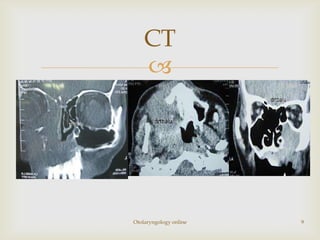
 Both axial and coronal CT scans will have to be
 performed in order to ascertain the extent of lesion
 MRI will have to be performed in patients with
 erosion of skull base to rule out intracranial
 extension
 Imaging helps in deciding osteotomy location.
 Superior osteotomy above the level of
 frontoethmoidal suture line will result in intracranial
 injury and CSF leak

                      Otolaryngology online                8
CT
    


Otolaryngology online   9
Ocular evaluation
              
 Vision should always be tested before taking the
 patient up for surgery
 Tumor involvement of orbit is an indication of
 orbital exenteration
 If orbital exenteration is planned appropriate
 prosthesis should be designed to fill up the defect


                      Otolaryngology online            10
Complications
                
   Bleeding
   Infection
   Epiphora
   Break down of skin graft
   Numbness of cheek area
   Atrophic rhinitis


                      Otolaryngology online   11
Bleeding
                    
 Can be minimized by coagulating bleeders
 Angular vessels should be secured properly
 Breaking maxilla from pterygoid process will cause
 bleeding from internal maxillary artery. Simple hot
 packs will help in reducing bleeding during this
 stage
 When lip splitting incision is used bleeding from
 labial vessels is common and should be secured at
 the earliest

                     Otolaryngology online             12
Infection
                   
 Can be minimized by following strict asepsis
 Avoiding undue use of cautery will minimize tissue
 necrosis / infection
 Post op antibiotics
 By conserving skin as much as possible without
 compromising tumor margins


                     Otolaryngology online             13
Epiphora
                   
 Nasolacrimal duct is transected during
 maxillectomy thus causing epiphora
 Simple transection of nasolacrimal duct rarely
 causes epiphora unless followed by stricture which
 usually occurs following radiotherapy
 Insertion of silicone tube after transection of
 nasolacrimal duct
 Marsupialization of nasolacrimal duct


                     Otolaryngology online            14
Numbness of cheek area
         
 Caused due to transection of infraorbial nerve
 Infraorbital nerve can be conserved if not involved
 by the tumor


                      Otolaryngology online             15
Otolaryngology online   16
Consent issues
                 
   Dental extraction
   Tracheostomy
   Prosthesis issues
   Cosmetic defects


                        Otolaryngology online   17
Surgical steps
                 
 General anaesthesia
 Infiltration with 1% xylocaine with 1 in 100,000
 adrenaline
 Marking incision site
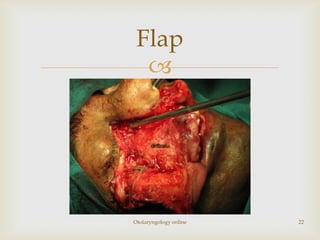
 Reflection of skin flap over maxilla
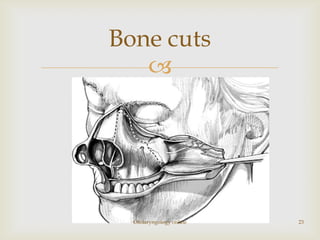
 Bone cuts
 Disarticulation of maxilla


                      Otolaryngology online          18
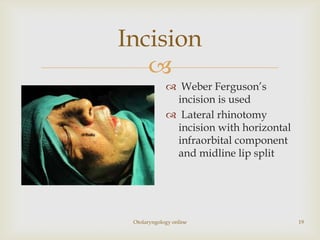
Incision
   
              Weber Ferguson’s
              incision is used
              Lateral rhinotomy
              incision with horizontal
              infraorbital component
              and midline lip split


 Otolaryngology online                   19
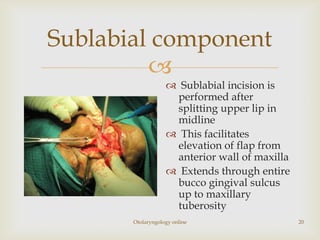
Sublabial component
         
                    Sublabial incision is
                    performed after
                    splitting upper lip in
                    midline
                    This facilitates
                    elevation of flap from
                    anterior wall of maxilla
                    Extends through entire
                    bucco gingival sulcus
                    up to maxillary
                    tuberosity
       Otolaryngology online                   20
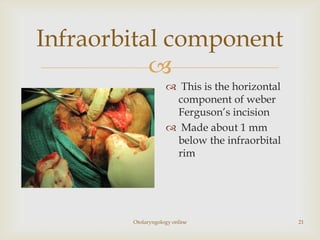
Infraorbital component
           
                     This is the horizontal
                     component of weber
                     Ferguson’s incision
                     Made about 1 mm
                     below the infraorbital
                     rim


        Otolaryngology online                  21
Flap
  


Otolaryngology online   22
Bone cuts
   


  Otolaryngology online   23
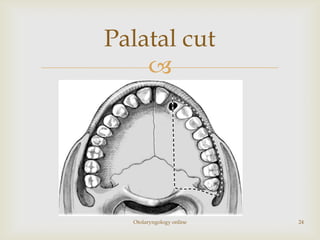
Palatal cut
    


  Otolaryngology online   24
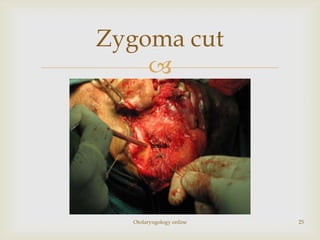
Zygoma cut
    


  Otolaryngology online   25
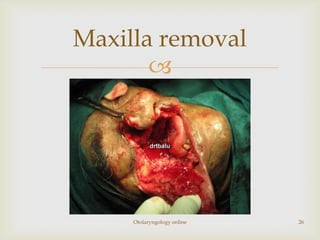
Maxilla removal
       


     Otolaryngology online   26
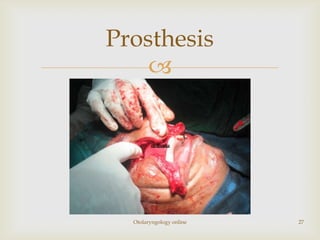
Prosthesis
    


  Otolaryngology online   27
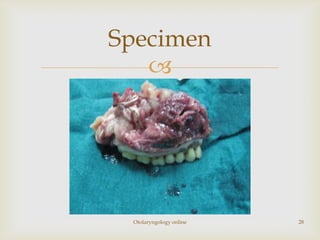
Specimen
   


 Otolaryngology online   28
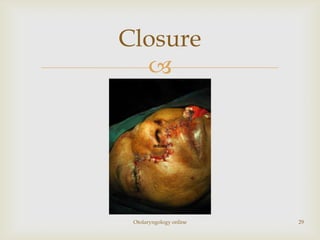
Closure
  


 Otolaryngology online   29
Eye protection
                 
 Temporary tarsorraphy
 Corneal shield
 Significant laceration of periorbita should be
 sutured


                      Otolaryngology online        30
Otolaryngology online   31

Maxillectomy a review

  • 1.
    Dr T Balasubramanian Otolaryngology online 1
  • 2.
    History   Concept described by Lazars in 1826  Syme first performed it in 1829  Portman described sublabial transoral approach in 1927  Smith described extended maxillectomy in 1954  Fairbanks & Barbosa described infratemporal fossa approach for advanced maxillary sinus tumors in 1961  Midfacial degloving approach was popularized in 1970 Otolaryngology online 2
  • 3.
    Dangers - Historic   Bleeding was the most common danger  Complications due to anesthesia  Post op sepsis  Secondary deformity due to poor prosthesis support Otolaryngology online 3
  • 4.
    Indications   Malignant tumors involving maxilla  Benign tumors of maxilla causing extensive bone destruction (fibrous dysplasia)  May be performed as a part of combined resection of skull base neoplasm  May be needed in patients with extensive fungal / granulomatous infections (rare)  Malignant tumors of oral cavity with extensive involvement of palate Otolaryngology online 4
  • 5.
    Tips   Not indicated in the management of lymphoreticular tumors which are better managed medically  Tumors involving inferior aspect of maxillary sinus can be managed by performing partial maxillectomy  Rehabilitation and prosthesis issues should be planned well in advance in consultation with dental surgeons Otolaryngology online 5
  • 6.
    Contraindications   Poor general condition of the patient  Bilateral tumors with bilateral orbital involvement  Malignant tumors with skull base extension.  Patient not consenting to undergo the procedure  Systemic disorders like uncontrolled diabetes / poor cardio respiratory reserve Otolaryngology online 6
  • 7.
    Bilateral tumors   Involvement of orbits on both sides – This could compromise the vision because orbital exenteration will have to be performed  Removing bilateral tumors is not only a surgical challenge but also a challenge to design appropriate prosthesis. Since it is rather difficult to design prosthesis for patients who undergo bilateral total maxillectomy it is a relative contraindication Otolaryngology online 7
  • 8.
    Imaging   Both axial and coronal CT scans will have to be performed in order to ascertain the extent of lesion  MRI will have to be performed in patients with erosion of skull base to rule out intracranial extension  Imaging helps in deciding osteotomy location. Superior osteotomy above the level of frontoethmoidal suture line will result in intracranial injury and CSF leak Otolaryngology online 8
  • 9.
    CT  Otolaryngology online 9
  • 10.
    Ocular evaluation   Vision should always be tested before taking the patient up for surgery  Tumor involvement of orbit is an indication of orbital exenteration  If orbital exenteration is planned appropriate prosthesis should be designed to fill up the defect Otolaryngology online 10
  • 11.
    Complications   Bleeding  Infection  Epiphora  Break down of skin graft  Numbness of cheek area  Atrophic rhinitis Otolaryngology online 11
  • 12.
    Bleeding   Can be minimized by coagulating bleeders  Angular vessels should be secured properly  Breaking maxilla from pterygoid process will cause bleeding from internal maxillary artery. Simple hot packs will help in reducing bleeding during this stage  When lip splitting incision is used bleeding from labial vessels is common and should be secured at the earliest Otolaryngology online 12
  • 13.
    Infection   Can be minimized by following strict asepsis  Avoiding undue use of cautery will minimize tissue necrosis / infection  Post op antibiotics  By conserving skin as much as possible without compromising tumor margins Otolaryngology online 13
  • 14.
    Epiphora   Nasolacrimal duct is transected during maxillectomy thus causing epiphora  Simple transection of nasolacrimal duct rarely causes epiphora unless followed by stricture which usually occurs following radiotherapy  Insertion of silicone tube after transection of nasolacrimal duct  Marsupialization of nasolacrimal duct Otolaryngology online 14
  • 15.
    Numbness of cheekarea   Caused due to transection of infraorbial nerve  Infraorbital nerve can be conserved if not involved by the tumor Otolaryngology online 15
  • 16.
  • 17.
    Consent issues   Dental extraction  Tracheostomy  Prosthesis issues  Cosmetic defects Otolaryngology online 17
  • 18.
    Surgical steps   General anaesthesia  Infiltration with 1% xylocaine with 1 in 100,000 adrenaline  Marking incision site  Reflection of skin flap over maxilla  Bone cuts  Disarticulation of maxilla Otolaryngology online 18
  • 19.
    Incision   Weber Ferguson’s incision is used  Lateral rhinotomy incision with horizontal infraorbital component and midline lip split Otolaryngology online 19
  • 20.
    Sublabial component   Sublabial incision is performed after splitting upper lip in midline  This facilitates elevation of flap from anterior wall of maxilla  Extends through entire bucco gingival sulcus up to maxillary tuberosity Otolaryngology online 20
  • 21.
    Infraorbital component   This is the horizontal component of weber Ferguson’s incision  Made about 1 mm below the infraorbital rim Otolaryngology online 21
  • 22.
  • 23.
    Bone cuts  Otolaryngology online 23
  • 24.
    Palatal cut  Otolaryngology online 24
  • 25.
    Zygoma cut  Otolaryngology online 25
  • 26.
    Maxilla removal  Otolaryngology online 26
  • 27.
    Prosthesis  Otolaryngology online 27
  • 28.
    Specimen  Otolaryngology online 28
  • 29.
    Closure  Otolaryngology online 29
  • 30.
    Eye protection   Temporary tarsorraphy  Corneal shield  Significant laceration of periorbita should be sutured Otolaryngology online 30
  • 31.