








Tips on using my ppt.
1. You can freely download, edit, modify and put your
name etc.
2. Don’t be concerned about number of slides. Half the
slides are blanks except for the title.
3. First show the blank slides (eg. Aetiology ) > Ask
students what they already know about ethology of
today's topic. > Then show next slide which enumerates
aetiologies.
4. At the end rerun the show – show blank> ask questions >
show next slide.
5. This will be an ACTIVE LEARNING SESSION x
three revisions.
6. Good for self study also.
7. See notes for bibliography.
Definition of wound.
• An injury or damage to tissues caused
by physical means with disruption of
normal continuity .
Types of wounds
Types of wounds
i. Incised wound
ii. Lacerated wound
iii. Bruising and contusion
iv. Haematoma
v. Puncture wound
vi. Abrasion
vii.Crush injury
viii.Injuries to bone and joint (maybe open or
closed)
Types of wounds
ix.Injuries to nerve (either clean cut or crush)
x. Injuries to arteries and veins
xi. Penetrating wounds
xii. Degloving injury.
Classification of surgical
wounds
Classification of surgical
wounds
a) Clean wound
b) Clean contaminated wound
c) Contaminated wound
d) Dirty infected wound
Healing
Healing
I Treat God Cures
• The ability to heal is inbuilt in our
physiology . We only help body to heal
itself and remove any obstacles in the
path of healing.
• There are no healing medicines / घाव
सूखनेकी दवा
TYPES OF WOUND HEALING
• Healing by first (Primary) intention -wounds with
opposed edges.
• Healing by second intention wounds with separated
edges
• By Third intention (tertiary intention)-delayed
primary
Wound initially left open
Edges later opposed when healing conditions
favourable
• Partial thickness wounds –Abrasions- heal by
epithelisation.
Healing by first intention (wounds with
opposed edges)
Healing by first intention (wounds with
opposed edges)
Healing of wound with following characteristics:
• Clean and uninfected
• Surgically incised
• Without much loss of cells and tissue
• Edges of wound are approximated by surgical
sutures.
• Wounds with opposed edges
• Primary union
• The incision causes
 death of a limited number of epithelial cells and
connective tissue cells
 disruption of epithelial basal membrane continuity
• The narrow incisional space immediately fills with
clotted blood containing fibrin and blood cells;
dehydration of the surface clot forms the well known
scab that covers the wound.
Healing by second intention
• Wounds with separated edges
• Secondary union
• When there is more extensive loss of cells and tissue
• Regeneration of parenchymal cells cannot
completely reconstitute the original architecture.
• Abundant granulation tissue grows in from the
margin to complete the repair.
Secondary healing VS primary healing
• Inflammatory reaction is more intense
• Much larger amounts of granulation tissue
are formed
• Wound contraction occurs in large surface
wounds
• Substantial scar formation and thinning of
the epidermis occurs
Difference between 1˚ & 2˚ union of
wound
Difference between 1˚ & 2˚ union of
wound
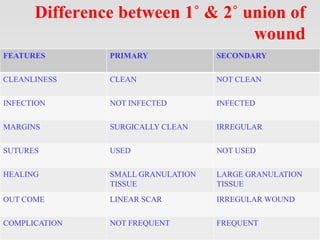
FEATURES PRIMARY SECONDARY
CLEANLINESS CLEAN NOT CLEAN
INFECTION NOT INFECTED INFECTED
MARGINS SURGICALLY CLEAN IRREGULAR
SUTURES USED NOT USED
HEALING SMALL GRANULATION
TISSUE
LARGE GRANULATION
TISSUE
OUT COME LINEAR SCAR IRREGULAR WOUND
COMPLICATION NOT FREQUENT FREQUENT
Phases of Healing
Phases of Healing
I. Inflammatory (Reactive)
- Haemostasis > Inflammation
II.Proliferative (Regenerative/Reparative)
Epithelial migration proliferation
Maturation
III.Maturational (Remodeling)
Contraction scarring Remodeling
Phases of Healing
• The inflammatory phase occurs
immediately following the injury and lasts
approximately 6 days.
• The fibroblastic (Proliferative) phase
occurs at the termination of the
inflammatory phase and can last up to 4
weeks.
• Scar maturation begins at the fourth week
and can last for years.
Wound Contraction
Wound Contraction
• Contraction of a wound across a joint can
cause contracture.
• Can be limited by skin grafts, full better
than split thickness.
• The earlier the graft the less contraction.
• Splints temporarily slow contraction.
Disturbances in Wound
Healing
Disturbances in Wound
Healing
• Local Factors
• Systemic Factors
Local Factors
Local Factors
• Immobility- Pressure sore/bed
sore/decubitus ulcer
• Ischemia
• Venous congestion.
• Lymphedema
• Infection: impairs healing.
• Smoking: increased platelet adhesiveness,
decreased O2 carrying capacity of blood,
abnormal collagen.
• Radiation:
Wound Infection
A positive wound culture does not
confirm a wound infection.
Wound Infection: Systemic features
• Tachycardia
• Malaise
• Fever
• Chills
• Leukocytosis
• elevated erythrocyte sedimentation rate
Wound Infection: Local features
• Foul-smelling drainage
• spontaneously bleeding wound bed
• flimsy friable tissue
• increased levels of wound exudates
• increasing pain
• surrounding -
– cellulitis
– Crepitus
– necrosis,
– Fasciitis
– regional lymphadenopathy
Wound Infection: Local features
Osteomyelitis
• Fevers, malaise, chronic fatigue, and limited range
of motion of the affected extremity,
• patients often present with only a nonhealing
wound or a chronic draining sinus tract overlying
a bone or joint.
• Probe to bone test.
• Plain radiographs, CT scans, radionuclide bone
scans, and MRI
• Osteomyelitis is treated with surgical curettage
and appropriate systemic antibiotics.
Systemic Factors
Systemic Factors
• Malnutrition
• Cancer
• Old Age
• Diabetes- impaired neutrophil chemotaxis,
phagocytosis.
• Steroids and immunosuppression suppresses
macrophage migration, fibroblast proliferation,
collagen accumulation, and angiogenesis.
Reversed by Vitamin A 25,000 IU per day.
• Superstitions
Abnormal Response to Injury
• Inadequate Regeneration
• Inadequate Scar Formation
• Excessive Regeneration
• Excessive Scar Formation
Keloids and Hypertrophic
Scars
Keloids and Hypertrophic
Scars
• Both from an overall increase in the
quantity of collagen synthesized.
• Recent evidence suggests that the
fibroblasts within keloids are different from
those within normal dermis in terms of their
responsiveness.
• No modality of treatment is predictably
effective for these lesions.
Drugs affecting wound healing
• Negative
– antibiotics,
– anticonvulsants
– Steroids
– nonsteroidal anti-inflammatory drugs.
• Beneficial
– ferrous sulphate,
– insulin,
– thyroid hormones,
– vitamins
Wound Management
Wound Management
• Systemic measures.
• Local measures
Wound Management
Local measures- “The golden hour”
• Haemostasis
• Anaesthesia
• Decontamination
• Repair and closure
• Delayed closure-
• Late presentation
• Heavy contamination
• Lot of dead and devitalized tissue.
Wound Management
• Local measures-
• Surgically debride nonvitalized tissue and
with appropriate irrigation
• Dressing changes require clean but not
necessarily sterile technique.
• Remove foreign bodies
• Pat the wound surface with soft moist
gauze; do not disrupt viable granulation
tissue.
Wound Management
Pressure sores
• Mobilise
• Appropriate turning and positioning
• Use of offloading support surface
• Appropriate wound care
• Appropriate management of incontinence
• Appropriate nutritional management
Wound Management
• Pressure sores
•
Wound Management
Venous Ulcers
• Appropriate wound care
• Compression dressings.
Wound Management
Diabetic foot ulcers
• Appropriate wound care
• Liberal debridement
• Maintain euglycemia with insulin.
• Antibiotics only if evidence of infection.
• Reperfusion.
Wound Management
Surgical Care
• Skin grafting
• Cadaveric allografting
• Application of bioengineered skin
substitutes
• Use of flap closures
Future and Controversies
• Human cell–conditioned media developed
in embryologiclike conditions
• transforming growth factor (TGF)–β3
• Hyperbaric oxygen has also been used to
promote healing.
• Agents such as platelet-rich plasma (PRP)
and erythropoietin (EPO
• Engineered tissue matrices
• Stem Cells
Take home messages
• Early closure of clean wounds.
• Delayed closure of dirty / infected wounds.
• Antibiotics are generally not indicated in
abrassions, contusions.
• For open wounds give three dosage of
antibiotic.
• Further antibiotics only if evidence of
infection.
• Spirit, Betadine,Savlon, Hydrogen peroxide
Sumag should not be applied on wounds.
Get this ppt in mobile
1. Download Microsoft
PowerPoint from play
store.
2. Open Google assistant
3. Open Google lens.
4. Scan qr code from
next slide.
Get this ppt in mobile
Get my ppt collection
• https://www.slideshare.net/drpradeeppande/
edit_my_uploads
• https://www.dropbox.com/sh/x600md3cvj8
5woy/AACVMHuQtvHvl_K8ehc3ltkEa?dl
=0
• https://www.facebook.com/doctorpradeeppa
nde/?ref=pages_you_manage

Wound healing.pptx

  • 1.
    Tips on usingmy ppt. 1. You can freely download, edit, modify and put your name etc. 2. Don’t be concerned about number of slides. Half the slides are blanks except for the title. 3. First show the blank slides (eg. Aetiology ) > Ask students what they already know about ethology of today's topic. > Then show next slide which enumerates aetiologies. 4. At the end rerun the show – show blank> ask questions > show next slide. 5. This will be an ACTIVE LEARNING SESSION x three revisions. 6. Good for self study also. 7. See notes for bibliography.
  • 2.
  • 3.
    Definition of wound. •An injury or damage to tissues caused by physical means with disruption of normal continuity .
  • 4.
  • 5.
    Types of wounds i.Incised wound ii. Lacerated wound iii. Bruising and contusion iv. Haematoma v. Puncture wound vi. Abrasion vii.Crush injury viii.Injuries to bone and joint (maybe open or closed)
  • 6.
    Types of wounds ix.Injuriesto nerve (either clean cut or crush) x. Injuries to arteries and veins xi. Penetrating wounds xii. Degloving injury.
  • 7.
  • 8.
    Classification of surgical wounds a)Clean wound b) Clean contaminated wound c) Contaminated wound d) Dirty infected wound
  • 9.
  • 10.
    Healing I Treat GodCures • The ability to heal is inbuilt in our physiology . We only help body to heal itself and remove any obstacles in the path of healing. • There are no healing medicines / घाव सूखनेकी दवा
  • 11.
  • 12.
    TYPES OF WOUNDHEALING • Healing by first (Primary) intention -wounds with opposed edges. • Healing by second intention wounds with separated edges • By Third intention (tertiary intention)-delayed primary Wound initially left open Edges later opposed when healing conditions favourable • Partial thickness wounds –Abrasions- heal by epithelisation.
  • 13.
    Healing by firstintention (wounds with opposed edges)
  • 14.
    Healing by firstintention (wounds with opposed edges) Healing of wound with following characteristics: • Clean and uninfected • Surgically incised • Without much loss of cells and tissue • Edges of wound are approximated by surgical sutures. • Wounds with opposed edges • Primary union
  • 15.
    • The incisioncauses  death of a limited number of epithelial cells and connective tissue cells  disruption of epithelial basal membrane continuity • The narrow incisional space immediately fills with clotted blood containing fibrin and blood cells; dehydration of the surface clot forms the well known scab that covers the wound.
  • 16.
  • 17.
    Healing by secondintention • Wounds with separated edges • Secondary union • When there is more extensive loss of cells and tissue • Regeneration of parenchymal cells cannot completely reconstitute the original architecture. • Abundant granulation tissue grows in from the margin to complete the repair.
  • 18.
    Secondary healing VSprimary healing
  • 19.
    Secondary healing VSprimary healing • Inflammatory reaction is more intense • Much larger amounts of granulation tissue are formed • Wound contraction occurs in large surface wounds • Substantial scar formation and thinning of the epidermis occurs
  • 20.
    Difference between 1˚& 2˚ union of wound
  • 21.
    Difference between 1˚& 2˚ union of wound FEATURES PRIMARY SECONDARY CLEANLINESS CLEAN NOT CLEAN INFECTION NOT INFECTED INFECTED MARGINS SURGICALLY CLEAN IRREGULAR SUTURES USED NOT USED HEALING SMALL GRANULATION TISSUE LARGE GRANULATION TISSUE OUT COME LINEAR SCAR IRREGULAR WOUND COMPLICATION NOT FREQUENT FREQUENT
  • 22.
  • 23.
    Phases of Healing I.Inflammatory (Reactive) - Haemostasis > Inflammation II.Proliferative (Regenerative/Reparative) Epithelial migration proliferation Maturation III.Maturational (Remodeling) Contraction scarring Remodeling
  • 24.
    Phases of Healing •The inflammatory phase occurs immediately following the injury and lasts approximately 6 days. • The fibroblastic (Proliferative) phase occurs at the termination of the inflammatory phase and can last up to 4 weeks. • Scar maturation begins at the fourth week and can last for years.
  • 25.
  • 26.
    Wound Contraction • Contractionof a wound across a joint can cause contracture. • Can be limited by skin grafts, full better than split thickness. • The earlier the graft the less contraction. • Splints temporarily slow contraction.
  • 27.
  • 28.
    Disturbances in Wound Healing •Local Factors • Systemic Factors
  • 29.
  • 30.
    Local Factors • Immobility-Pressure sore/bed sore/decubitus ulcer • Ischemia • Venous congestion. • Lymphedema • Infection: impairs healing. • Smoking: increased platelet adhesiveness, decreased O2 carrying capacity of blood, abnormal collagen. • Radiation:
  • 31.
    Wound Infection A positivewound culture does not confirm a wound infection.
  • 32.
  • 33.
    Wound Infection: Systemicfeatures • Tachycardia • Malaise • Fever • Chills • Leukocytosis • elevated erythrocyte sedimentation rate
  • 34.
    Wound Infection: Localfeatures • Foul-smelling drainage • spontaneously bleeding wound bed • flimsy friable tissue • increased levels of wound exudates • increasing pain • surrounding - – cellulitis – Crepitus – necrosis, – Fasciitis – regional lymphadenopathy
  • 35.
    Wound Infection: Localfeatures Osteomyelitis • Fevers, malaise, chronic fatigue, and limited range of motion of the affected extremity, • patients often present with only a nonhealing wound or a chronic draining sinus tract overlying a bone or joint. • Probe to bone test. • Plain radiographs, CT scans, radionuclide bone scans, and MRI • Osteomyelitis is treated with surgical curettage and appropriate systemic antibiotics.
  • 36.
  • 37.
    Systemic Factors • Malnutrition •Cancer • Old Age • Diabetes- impaired neutrophil chemotaxis, phagocytosis. • Steroids and immunosuppression suppresses macrophage migration, fibroblast proliferation, collagen accumulation, and angiogenesis. Reversed by Vitamin A 25,000 IU per day. • Superstitions
  • 38.
  • 39.
    Abnormal Response toInjury • Inadequate Regeneration • Inadequate Scar Formation • Excessive Regeneration • Excessive Scar Formation
  • 40.
  • 41.
    Keloids and Hypertrophic Scars •Both from an overall increase in the quantity of collagen synthesized. • Recent evidence suggests that the fibroblasts within keloids are different from those within normal dermis in terms of their responsiveness. • No modality of treatment is predictably effective for these lesions.
  • 42.
  • 43.
    Drugs affecting woundhealing • Negative – antibiotics, – anticonvulsants – Steroids – nonsteroidal anti-inflammatory drugs. • Beneficial – ferrous sulphate, – insulin, – thyroid hormones, – vitamins
  • 44.
  • 45.
    Wound Management • Systemicmeasures. • Local measures
  • 46.
    Wound Management Local measures-“The golden hour” • Haemostasis • Anaesthesia • Decontamination • Repair and closure • Delayed closure- • Late presentation • Heavy contamination • Lot of dead and devitalized tissue.
  • 47.
    Wound Management • Localmeasures- • Surgically debride nonvitalized tissue and with appropriate irrigation • Dressing changes require clean but not necessarily sterile technique. • Remove foreign bodies • Pat the wound surface with soft moist gauze; do not disrupt viable granulation tissue.
  • 48.
    Wound Management Pressure sores •Mobilise • Appropriate turning and positioning • Use of offloading support surface • Appropriate wound care • Appropriate management of incontinence • Appropriate nutritional management
  • 49.
  • 50.
    Wound Management Venous Ulcers •Appropriate wound care • Compression dressings.
  • 51.
    Wound Management Diabetic footulcers • Appropriate wound care • Liberal debridement • Maintain euglycemia with insulin. • Antibiotics only if evidence of infection. • Reperfusion.
  • 52.
    Wound Management Surgical Care •Skin grafting • Cadaveric allografting • Application of bioengineered skin substitutes • Use of flap closures
  • 53.
  • 54.
    Future and Controversies •Human cell–conditioned media developed in embryologiclike conditions • transforming growth factor (TGF)–β3 • Hyperbaric oxygen has also been used to promote healing. • Agents such as platelet-rich plasma (PRP) and erythropoietin (EPO • Engineered tissue matrices • Stem Cells
  • 55.
    Take home messages •Early closure of clean wounds. • Delayed closure of dirty / infected wounds. • Antibiotics are generally not indicated in abrassions, contusions. • For open wounds give three dosage of antibiotic. • Further antibiotics only if evidence of infection. • Spirit, Betadine,Savlon, Hydrogen peroxide Sumag should not be applied on wounds.
  • 57.
    Get this pptin mobile 1. Download Microsoft PowerPoint from play store. 2. Open Google assistant 3. Open Google lens. 4. Scan qr code from next slide.
  • 58.
    Get this pptin mobile
  • 59.
    Get my pptcollection • https://www.slideshare.net/drpradeeppande/ edit_my_uploads • https://www.dropbox.com/sh/x600md3cvj8 5woy/AACVMHuQtvHvl_K8ehc3ltkEa?dl =0 • https://www.facebook.com/doctorpradeeppa nde/?ref=pages_you_manage