
LIP
RECONSTRUCTION
DR S ARAVIND
FINAL YEAR RESIDENT, SURGICAL ONCOLOGY,GRH
Prof Subbiah et al
Prof Subbiah et al
Prof Subbiah et al
SURGICAL ANATOMY
• The upper lip is formed by fusion of lateral maxillary processes and a central nasofrontal
process.
• Hence contralateral neck metastases in upper lip is extremely rare.
• The lower lip is formed by the fusion of two lateral mandibular processes in the midline, hence
contralateral neck metastases is common.
• Blood supply : superior and inferior labial arteries branches of the facial artery.
• The labial arteries form an arcade -lesions in the lateral aspect of the lip receive blood supply both
from its medial and lateral regions.
Prof Subbiah et al
• Sensory supply to the skin and the vermilion border of the upper and lower lips: maxillary
and mandibular divisions of the trigeminal nerve, respectively.
• Lesions of the lateral aspect of the upper lip: buccal, peri parotid, and prevascular facial
lymph nodes.
• Lymphatics of the lower lip initially drain to lymph nodes at the level I in the submental
(Ia)and submandibular (Ib) regions and to the prevascular facial nodes
Prof Subbiah et al
Prof Subbiah et al
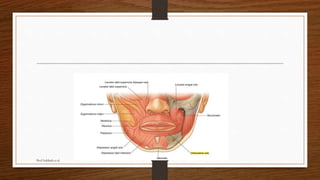
• The laminar structure of the lips consists of three layers: mucosa, muscle, and skin.
• Oral sphincter- Orbicularis oris.
• The superficial fibers -protrude the lips away; the deep and oblique fibers approximate the
lips to the alveolar arch.
• The modiolus is just lateral to the oral commissure-thick fibrovascular region of muscle
fiber intersection of the levator muscles (zygomaticus major and levator anguli oris) and
the depressor muscles( depressor anguli oris and platysma) that attach firmly to the
dermis.
• The appearance of the labial commissures is significantly affected by the movement of the
modiolus on each side.
Prof Subbiah et al
Prof Subbiah et al
Prof Subbiah et al
Prof Subbiah et al
ABBE ESTLANDER FLAP
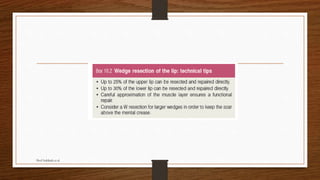
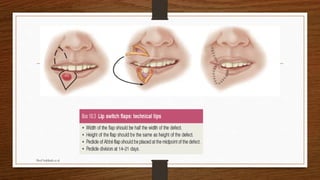
• Resection of more than 30 % of either upper or lower lip : mobilisation of flap from
opposite lip is necessary.
• The technique was popularized by Abbe for upper lip and by Estlander for lower lip.
• The principle of Abbe-Estlander flap repair is such that the width of the base of the
triangular flap is half that of the width of the base of the triangular surgical defect.
Prof Subbiah et al
Prof Subbiah et al
Prof Subbiah et al
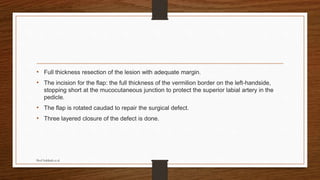
• Full thickness resection of the lesion with adequate margin.
• The incision for the flap: the full thickness of the vermilion border on the left-handside,
stopping short at the mucocutaneous junction to protect the superior labial artery in the
pedicle.
• The flap is rotated caudad to repair the surgical defect.
• Three layered closure of the defect is done.
Prof Subbiah et al
KARAPANDZIC FLAP
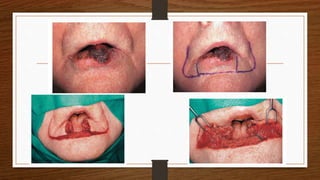
• Karapandzic flap- defects of the lower lip - 80% or more of the lower lip is resected in its
central
part, leaving the lateral ends near the commissures intact.
• The principle : mobilization of the skin, muscle, and mucosa of the lower portion of the
nasolabial region medially, preserving the nerve and blood supply to the orbicularis oris
muscle, which is mobilized medially.
• For flap elevation- stay in the plane superficial to the orbicularis muscle and the mucosa
deep to the muscle, thereby keeping the muscle itself intact.
• The skin incision placed approximately 2 cm inferior to the vermilion border to encompass
the full width of the orbicularis oris muscle.
• The mucosal incision is placed at the gingivolabial sulcus.
Prof Subbiah et al
• PROS: Reliable, commonly performed due to reproducibility.
• CONS: Microstomia
Prof Subbiah et al
Prof Subbiah et al
Prof Subbiah et al
JOHANSEN STEP LADDER
ADVANCEMENT FLAP
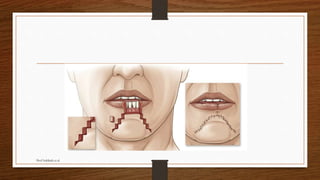
• Two-thirds of the lower lip can be reconstructed.
• involves the excision of 2–4 small rectangles arranged in a stair-step fashion that descend
from medial to lateral at a 45° angle from either side of the base of the defect.
• the width of each step - half of its height.
• Unilateral for lateral defects and bilateral for central defects.
• PROS: able to excise only skin and subcutaneous tissue; incision is away from the
labiomental crease, hence aesthetic unit is preserved.
Prof Subbiah et al
Prof Subbiah et al
Prof Subbiah et al
• A triangle is excised with its apex located inferiorly.
• The Johanson flap begins with the lip lesion being resected in a full-thickness rectangular
fashion.
• A full-thickness horizontal incision is then extended from the inferior defect margin in one
or both directions for a unilateral or bilateral flap, respectively.
• Partial-thickness incisions are stair-stepped inferolaterally for a total of two to four steps.
Prof Subbiah et al
GILLIES FAN FLAP
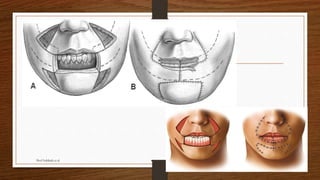
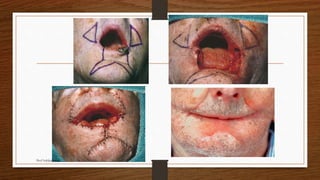
• full-thickness flap, that moves lip and cheek tissue around the corner of the mouth to
reconstruct a lateral defect of the upper or lower lip.
• full-thickness incision that begins laterally, turns vertically and then turns back towards the
opposite lip
• The flap is rotated around the commissure.
• CON: Blunting of the commissure.
Prof Subbiah et al
Prof Subbiah et al
WEBSTER -BERNARD FLAP
• The lower lip is excised in its entirety along with soft tissues and skin; with the resulting
defect closed by lateral cheek flaps –forming a new lower lip.
• triangles of skin are excised from both sides of the upper lip, preserving the mucous
membrane, to help form a new vermilion border.
• PROS: Ability to reconstruct the entire lower lip in a single-stage procedure.
• CONS: Permanent smile deformity and microstomia.
Prof Subbiah et al
Prof Subbiah et al
• Two horizontal full-thickness incisions are made, with one at the level of the commissure,
• second at the level of the resection margin.
• Partial thickness crescent triangles are then excised from the upper and lower cheeks to
allow medial advancement of the flaps.
Prof Subbiah et al
Prof Subbiah et al
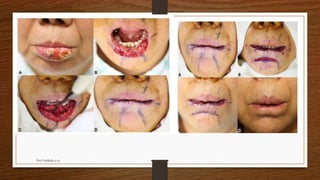
VERMILLION RECONSTRUCTION
• LIP SHAVE AKA VERMILLIONECTOMY:
• Vermillionectomy - very superficial lesions in the vermillion- superficial squamous cell
carcinoma, or actinic cheilitis.
• MUCOSAL ADVANCEMENT FLAP: Undermining the labial mucosa in a plane deep to
the minor salivary glands and superficial to the posterior surface of the orbicularis oris.
• achieved by advancing the buccal mucosa to cover the defect and to re-establish the
mucocutaneous junction.
Prof Subbiah et al
Prof Subbiah et al
Prof Subbiah et al
SURGICAL COMPLICATIONS
• Wound dehiscence
• Flap necrosis
• Microstomia
• Rounding of commissures
• Esthetic considerations
Prof Subbiah et al
COMMISUROPLASTY-
BUCCAL MUCOSA ADVANCEMENT
FLAP
• Done for microstomia
• Originally described by Diffenbach
• Unilateral or bilateral
A linear horizontal incision through the lateral extent of oral commissure,
• incising through skin and intraoral mucosa to the depth of the orbicularis oris muscle.
• A triangular area of skin be excised till the required extent.
Prof Subbiah et al
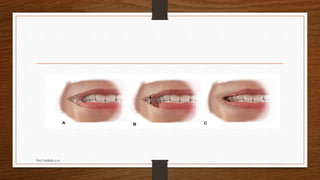
• Mucosal incision should be continued laterally 1 cm past the skin incision as
• two oblique incisions creating three mucosal flaps (superior, inferior, and lateral).
• Buccal mucosa is advanced to create the neo-commissure.
Prof Subbiah et al
Prof Subbiah et al
REFERENCES
1. Reconstruction of the lips
Craig l. Cupp, cdr, mc, usnr, wayne f. Larrabee, jr, md
1043-1810/93/0401-000705.00/0
2. Lip reconstruction using the Gillies fan flap
Prabhat K. Bhama, MD, MPH, FACS http://doi.org/10.1016/j.otot.2019.12.005
3. Use of Bernard-Webster flap for lower lip reconstruction after excision of squamous cell carcinoma: analysis of
functional results RAFAEL DENADA et al DOI:10.5935/2177-1235.2015RBCP0110
4. Lip Reconstruction Kate E. McCarn, MD, Stephen S. Park, MD, FACS doi:10.1016/j.fsc.2004.11.005
5. Commissuroplasty Sean M Parsel, DOa , Ryan D Winters, MD http://doi.org/10.1016/j.otot.2019.12.008
Prof Subbiah et al
6.Correction of vermilion lip retraction after mucosal advancement flap: A countertraction
technique Jebyeong Chae, MD et al http://dx.doi.org/10.1016/j.jaad.2017.05.048
Prof Subbiah et al
Prof Subbiah et al

LIP RECONSTRUCTION ppt.pptx

  • 1.
    LIP RECONSTRUCTION DR S ARAVIND FINALYEAR RESIDENT, SURGICAL ONCOLOGY,GRH Prof Subbiah et al
  • 2.
  • 3.
  • 4.
    SURGICAL ANATOMY • Theupper lip is formed by fusion of lateral maxillary processes and a central nasofrontal process. • Hence contralateral neck metastases in upper lip is extremely rare. • The lower lip is formed by the fusion of two lateral mandibular processes in the midline, hence contralateral neck metastases is common. • Blood supply : superior and inferior labial arteries branches of the facial artery. • The labial arteries form an arcade -lesions in the lateral aspect of the lip receive blood supply both from its medial and lateral regions. Prof Subbiah et al
  • 5.
    • Sensory supplyto the skin and the vermilion border of the upper and lower lips: maxillary and mandibular divisions of the trigeminal nerve, respectively. • Lesions of the lateral aspect of the upper lip: buccal, peri parotid, and prevascular facial lymph nodes. • Lymphatics of the lower lip initially drain to lymph nodes at the level I in the submental (Ia)and submandibular (Ib) regions and to the prevascular facial nodes Prof Subbiah et al
  • 6.
  • 7.
    • The laminarstructure of the lips consists of three layers: mucosa, muscle, and skin. • Oral sphincter- Orbicularis oris. • The superficial fibers -protrude the lips away; the deep and oblique fibers approximate the lips to the alveolar arch. • The modiolus is just lateral to the oral commissure-thick fibrovascular region of muscle fiber intersection of the levator muscles (zygomaticus major and levator anguli oris) and the depressor muscles( depressor anguli oris and platysma) that attach firmly to the dermis. • The appearance of the labial commissures is significantly affected by the movement of the modiolus on each side. Prof Subbiah et al
  • 8.
  • 9.
  • 10.
  • 11.
    ABBE ESTLANDER FLAP •Resection of more than 30 % of either upper or lower lip : mobilisation of flap from opposite lip is necessary. • The technique was popularized by Abbe for upper lip and by Estlander for lower lip. • The principle of Abbe-Estlander flap repair is such that the width of the base of the triangular flap is half that of the width of the base of the triangular surgical defect. Prof Subbiah et al
  • 12.
  • 13.
  • 14.
    • Full thicknessresection of the lesion with adequate margin. • The incision for the flap: the full thickness of the vermilion border on the left-handside, stopping short at the mucocutaneous junction to protect the superior labial artery in the pedicle. • The flap is rotated caudad to repair the surgical defect. • Three layered closure of the defect is done. Prof Subbiah et al
  • 15.
    KARAPANDZIC FLAP • Karapandzicflap- defects of the lower lip - 80% or more of the lower lip is resected in its central part, leaving the lateral ends near the commissures intact. • The principle : mobilization of the skin, muscle, and mucosa of the lower portion of the nasolabial region medially, preserving the nerve and blood supply to the orbicularis oris muscle, which is mobilized medially. • For flap elevation- stay in the plane superficial to the orbicularis muscle and the mucosa deep to the muscle, thereby keeping the muscle itself intact. • The skin incision placed approximately 2 cm inferior to the vermilion border to encompass the full width of the orbicularis oris muscle. • The mucosal incision is placed at the gingivolabial sulcus. Prof Subbiah et al
  • 16.
    • PROS: Reliable,commonly performed due to reproducibility. • CONS: Microstomia Prof Subbiah et al
  • 17.
  • 18.
  • 19.
    JOHANSEN STEP LADDER ADVANCEMENTFLAP • Two-thirds of the lower lip can be reconstructed. • involves the excision of 2–4 small rectangles arranged in a stair-step fashion that descend from medial to lateral at a 45° angle from either side of the base of the defect. • the width of each step - half of its height. • Unilateral for lateral defects and bilateral for central defects. • PROS: able to excise only skin and subcutaneous tissue; incision is away from the labiomental crease, hence aesthetic unit is preserved. Prof Subbiah et al
  • 20.
  • 21.
  • 22.
    • A triangleis excised with its apex located inferiorly. • The Johanson flap begins with the lip lesion being resected in a full-thickness rectangular fashion. • A full-thickness horizontal incision is then extended from the inferior defect margin in one or both directions for a unilateral or bilateral flap, respectively. • Partial-thickness incisions are stair-stepped inferolaterally for a total of two to four steps. Prof Subbiah et al
  • 23.
    GILLIES FAN FLAP •full-thickness flap, that moves lip and cheek tissue around the corner of the mouth to reconstruct a lateral defect of the upper or lower lip. • full-thickness incision that begins laterally, turns vertically and then turns back towards the opposite lip • The flap is rotated around the commissure. • CON: Blunting of the commissure. Prof Subbiah et al
  • 24.
  • 25.
    WEBSTER -BERNARD FLAP •The lower lip is excised in its entirety along with soft tissues and skin; with the resulting defect closed by lateral cheek flaps –forming a new lower lip. • triangles of skin are excised from both sides of the upper lip, preserving the mucous membrane, to help form a new vermilion border. • PROS: Ability to reconstruct the entire lower lip in a single-stage procedure. • CONS: Permanent smile deformity and microstomia. Prof Subbiah et al
  • 26.
  • 27.
    • Two horizontalfull-thickness incisions are made, with one at the level of the commissure, • second at the level of the resection margin. • Partial thickness crescent triangles are then excised from the upper and lower cheeks to allow medial advancement of the flaps. Prof Subbiah et al
  • 28.
  • 29.
    VERMILLION RECONSTRUCTION • LIPSHAVE AKA VERMILLIONECTOMY: • Vermillionectomy - very superficial lesions in the vermillion- superficial squamous cell carcinoma, or actinic cheilitis. • MUCOSAL ADVANCEMENT FLAP: Undermining the labial mucosa in a plane deep to the minor salivary glands and superficial to the posterior surface of the orbicularis oris. • achieved by advancing the buccal mucosa to cover the defect and to re-establish the mucocutaneous junction. Prof Subbiah et al
  • 30.
  • 31.
  • 32.
    SURGICAL COMPLICATIONS • Wounddehiscence • Flap necrosis • Microstomia • Rounding of commissures • Esthetic considerations Prof Subbiah et al
  • 33.
    COMMISUROPLASTY- BUCCAL MUCOSA ADVANCEMENT FLAP •Done for microstomia • Originally described by Diffenbach • Unilateral or bilateral A linear horizontal incision through the lateral extent of oral commissure, • incising through skin and intraoral mucosa to the depth of the orbicularis oris muscle. • A triangular area of skin be excised till the required extent. Prof Subbiah et al
  • 34.
    • Mucosal incisionshould be continued laterally 1 cm past the skin incision as • two oblique incisions creating three mucosal flaps (superior, inferior, and lateral). • Buccal mucosa is advanced to create the neo-commissure. Prof Subbiah et al
  • 35.
  • 36.
    REFERENCES 1. Reconstruction ofthe lips Craig l. Cupp, cdr, mc, usnr, wayne f. Larrabee, jr, md 1043-1810/93/0401-000705.00/0 2. Lip reconstruction using the Gillies fan flap Prabhat K. Bhama, MD, MPH, FACS http://doi.org/10.1016/j.otot.2019.12.005 3. Use of Bernard-Webster flap for lower lip reconstruction after excision of squamous cell carcinoma: analysis of functional results RAFAEL DENADA et al DOI:10.5935/2177-1235.2015RBCP0110 4. Lip Reconstruction Kate E. McCarn, MD, Stephen S. Park, MD, FACS doi:10.1016/j.fsc.2004.11.005 5. Commissuroplasty Sean M Parsel, DOa , Ryan D Winters, MD http://doi.org/10.1016/j.otot.2019.12.008 Prof Subbiah et al
  • 37.
    6.Correction of vermilionlip retraction after mucosal advancement flap: A countertraction technique Jebyeong Chae, MD et al http://dx.doi.org/10.1016/j.jaad.2017.05.048 Prof Subbiah et al
  • 38.