A) GENERAL INTRODUCTION
OF INSTRUMENTS
1) AUTOCLAVE
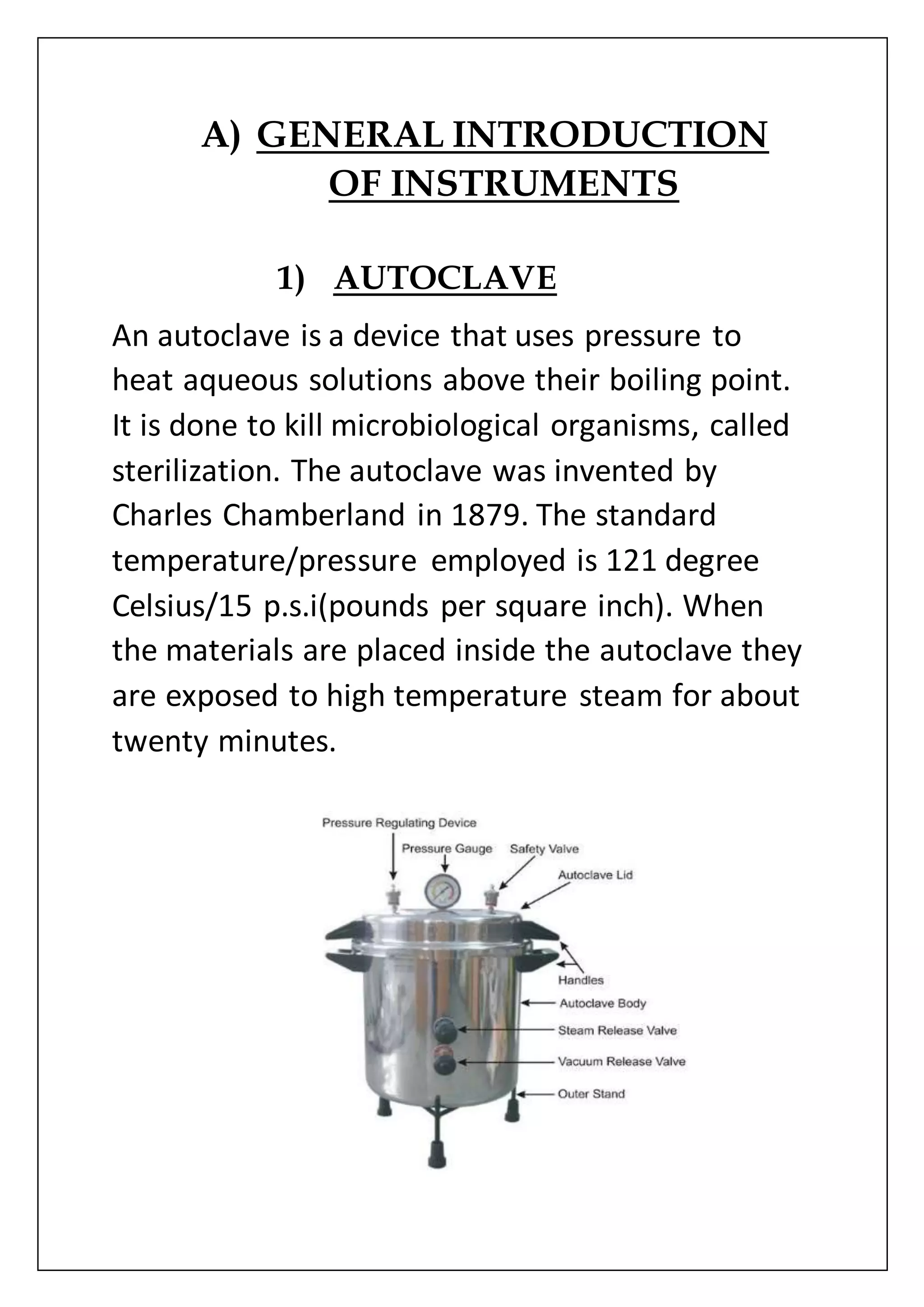
An autoclave is a device that uses pressure to
heat aqueous solutions above their boiling point.
It is done to kill microbiological organisms, called
sterilization. The autoclave was invented by
Charles Chamberland in 1879. The standard
temperature/pressure employed is 121 degree
Celsius/15 p.s.i(pounds per square inch). When
the materials are placed inside the autoclave they
are exposed to high temperature steam for about
twenty minutes.
 Principle:- The principle of the autoclave or
steam sterilizers is that water boils when its
vapour pressure equals that of the
surrounding atmosphere. When pressure
inside the closed vessel increases, the
temperature at which water boils also
increases.
2) HOT AIR OVEN
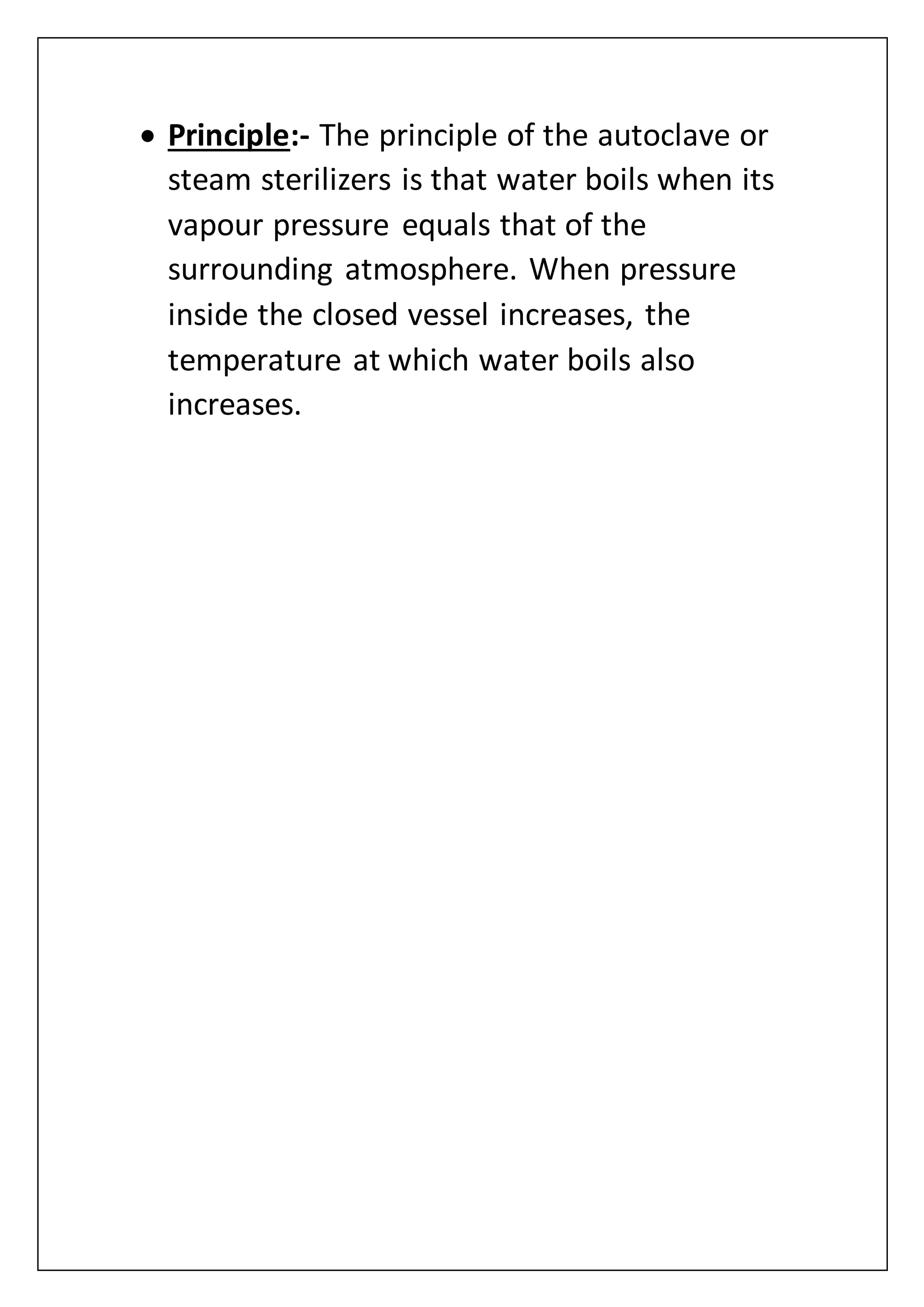
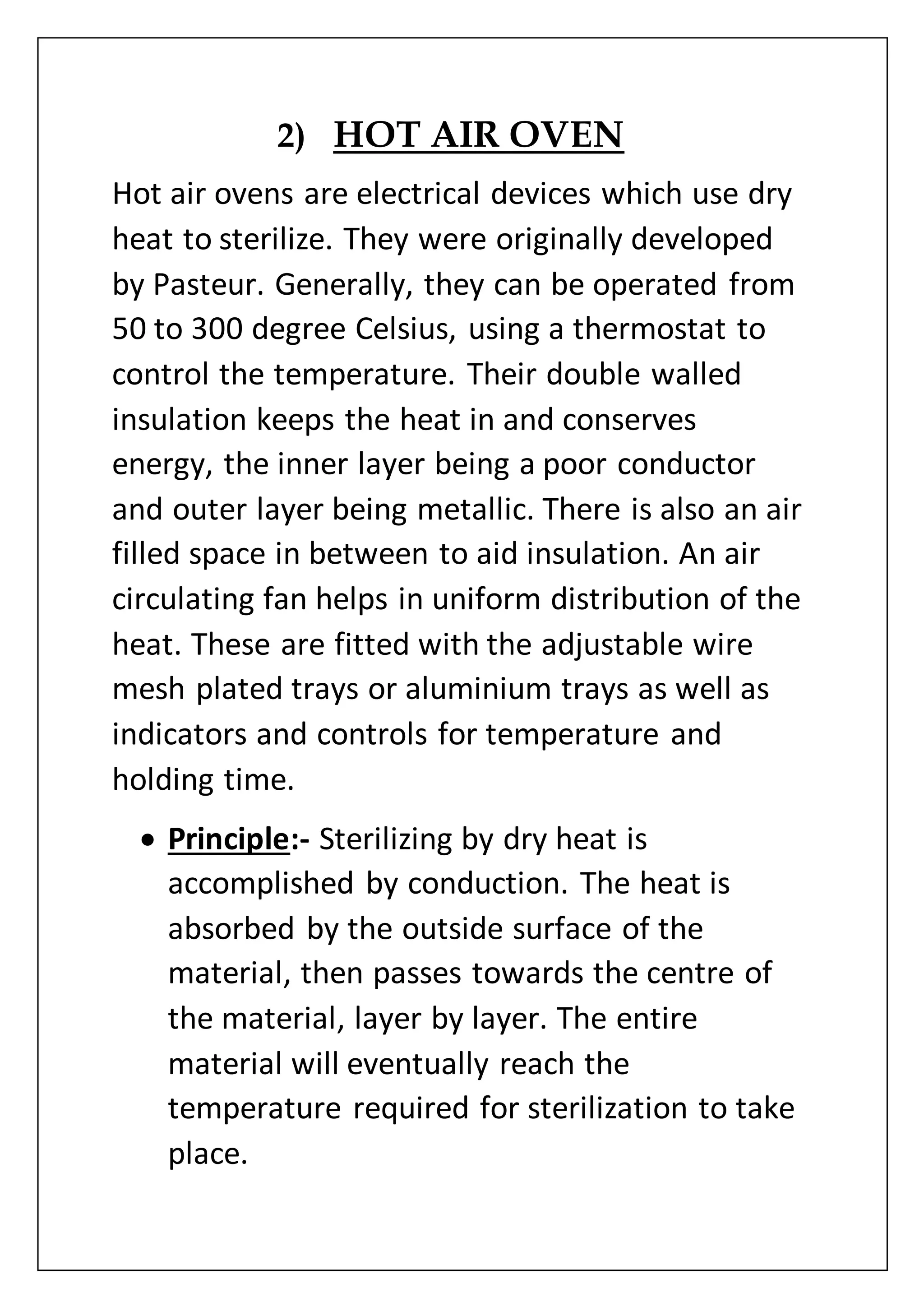
Hot air ovens are electrical devices which use dry
heat to sterilize. They were originally developed
by Pasteur. Generally, they can be operated from
50 to 300 degree Celsius, using a thermostat to
control the temperature. Their double walled
insulation keeps the heat in and conserves
energy, the inner layer being a poor conductor
and outer layer being metallic. There is also an air
filled space in between to aid insulation. An air
circulating fan helps in uniform distribution of the
heat. These are fitted with the adjustable wire
mesh plated trays or aluminium trays as well as
indicators and controls for temperature and
holding time.
 Principle:- Sterilizing by dry heat is
accomplished by conduction. The heat is
absorbed by the outside surface of the
material, then passes towards the centre of
the material, layer by layer. The entire
material will eventually reach the
temperature required for sterilization to take
place.
 Advantages & Disadvantages:- They do not
require water and there is not much pressure
build up within the oven, like an autoclave,
making them safer to work with. This also
makes them more suitable to be used in a
laboratory environment. They can be more
rapid than an autoclave and higher
temperatures can be reached compared to
other means.
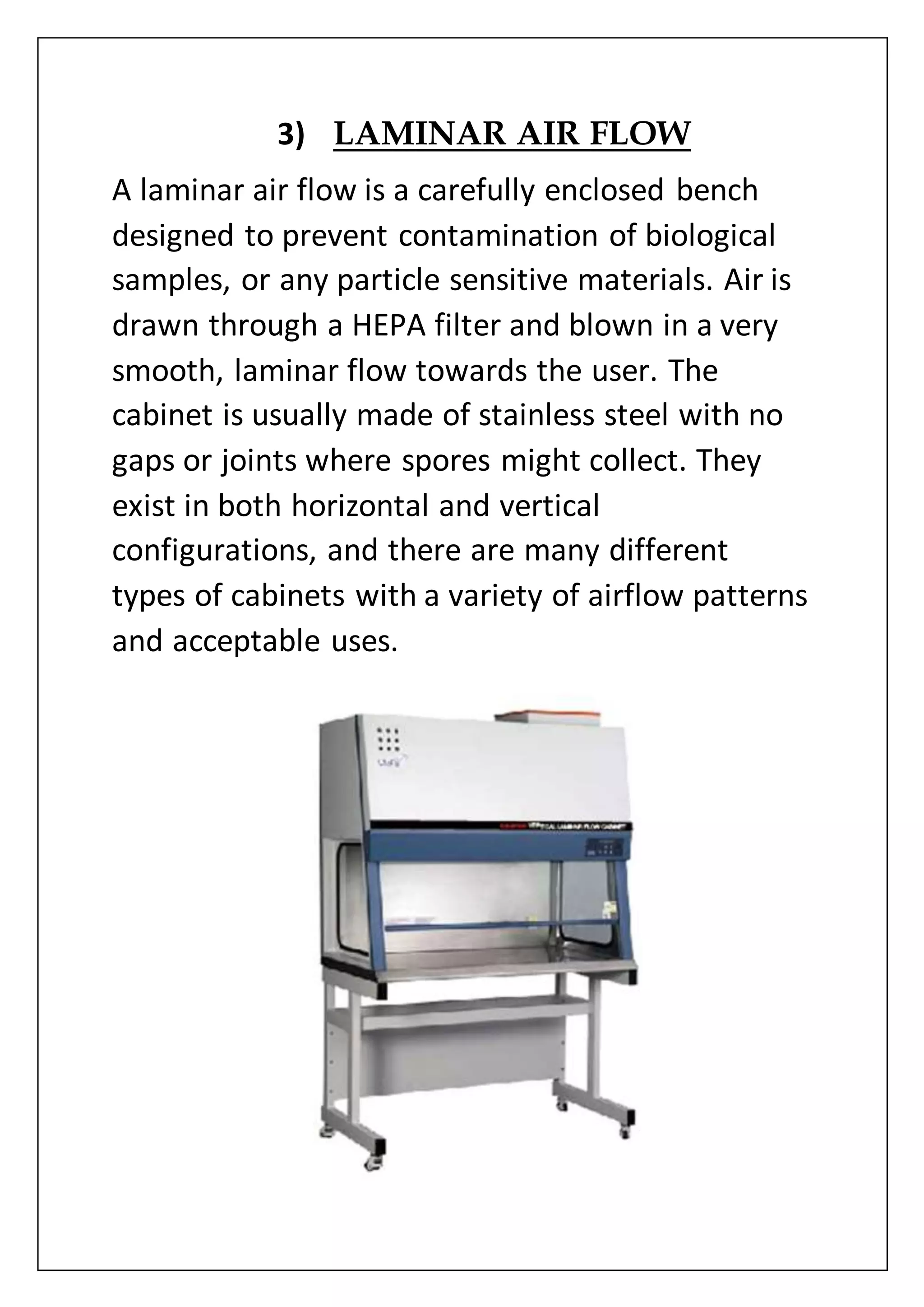
3) LAMINAR AIR FLOW
A laminar air flow is a carefully enclosed bench
designed to prevent contamination of biological
samples, or any particle sensitive materials. Air is
drawn through a HEPA filter and blown in a very
smooth, laminar flow towards the user. The
cabinet is usually made of stainless steel with no
gaps or joints where spores might collect. They
exist in both horizontal and vertical
configurations, and there are many different
types of cabinets with a variety of airflow patterns
and acceptable uses.
Laminar air flow have a UV light to sterilize the
interior and contents before usage to prevent the
contamination of experiment. UV is usually kept
on for 15 minutes to sterilize the interior and no
contact is to be made with a laminar air flow
during this time(It is important to switch this light
off during use, to limit exposure to skin and eyes
as stray ultraviolet light emissions can cause
mutations.)
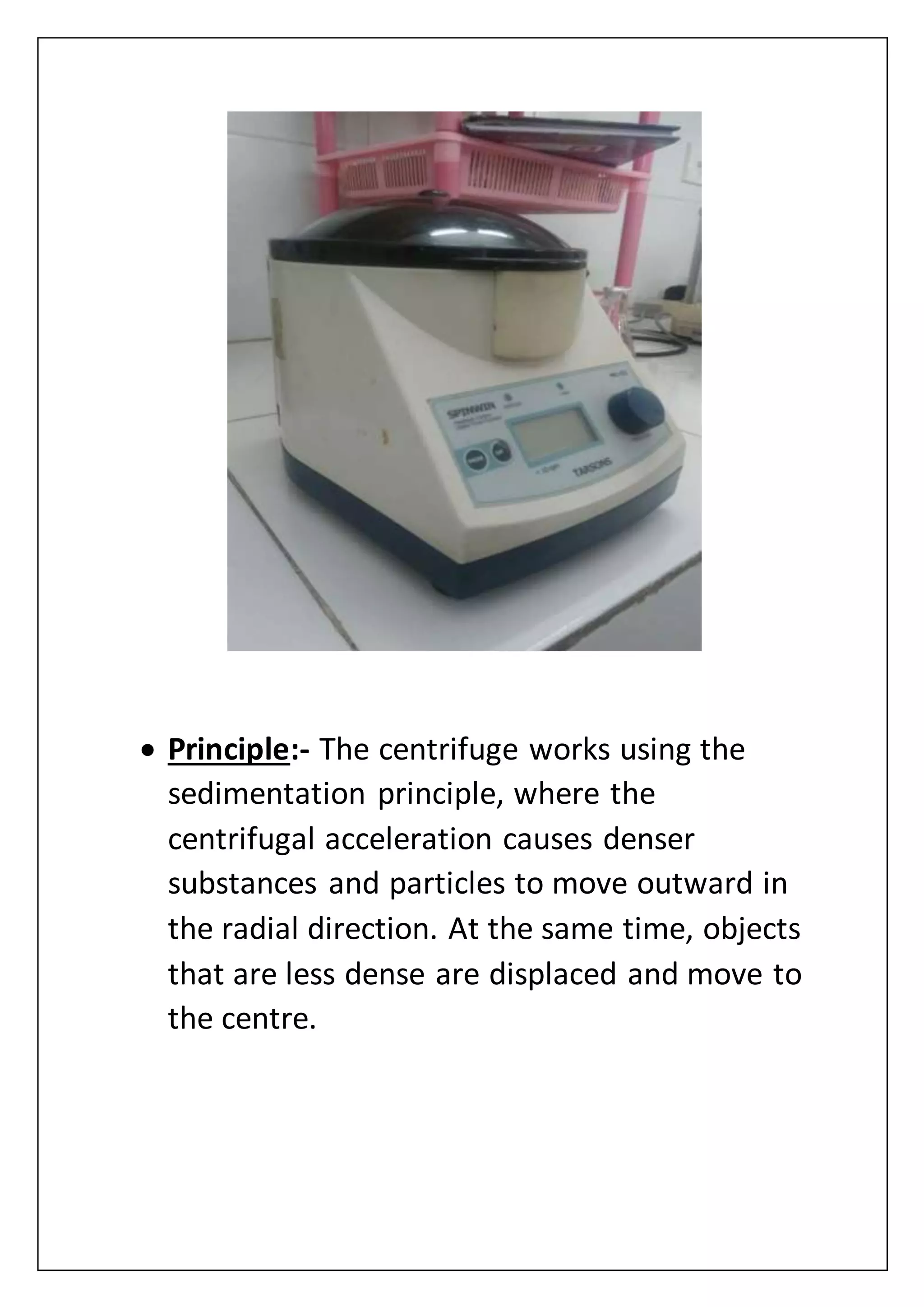
4) CENTRIFUGE
A centrifuge is a piece of equipment that puts an
object in rotation around a fixed axis(spins it in a
circle) applying a force perpendicular to the axis
of spin(outward) that can be very strong. In a
laboratory centrifuge that uses sample tubes, the
radial acceleration causes denser particles to
settle to the bottom of the tube, while low
density substances rise to the top.
A wide variety of laboratory scale centrifuges are
used in chemistry, biology, biochemistry and
clinical medicine for isolating and separating
suspensions and immiscible liquids. DNA
preparation is another common application for
clinical diagnosis. DNA samples are purified and
the DNA is prepped for separation by adding
buffers and then centrifuging it for a certain
amount of time.
The rotating unit, called the rotor, has fixed holes
drilled at an angle. Sample tubes are placed in
these slots and the motor is spun. These angle
rotors are very popular in the lab for routine use.
 Principle:- The centrifuge works using the
sedimentation principle, where the
centrifugal acceleration causes denser
substances and particles to move outward in
the radial direction. At the same time, objects
that are less dense are displaced and move to
the centre.
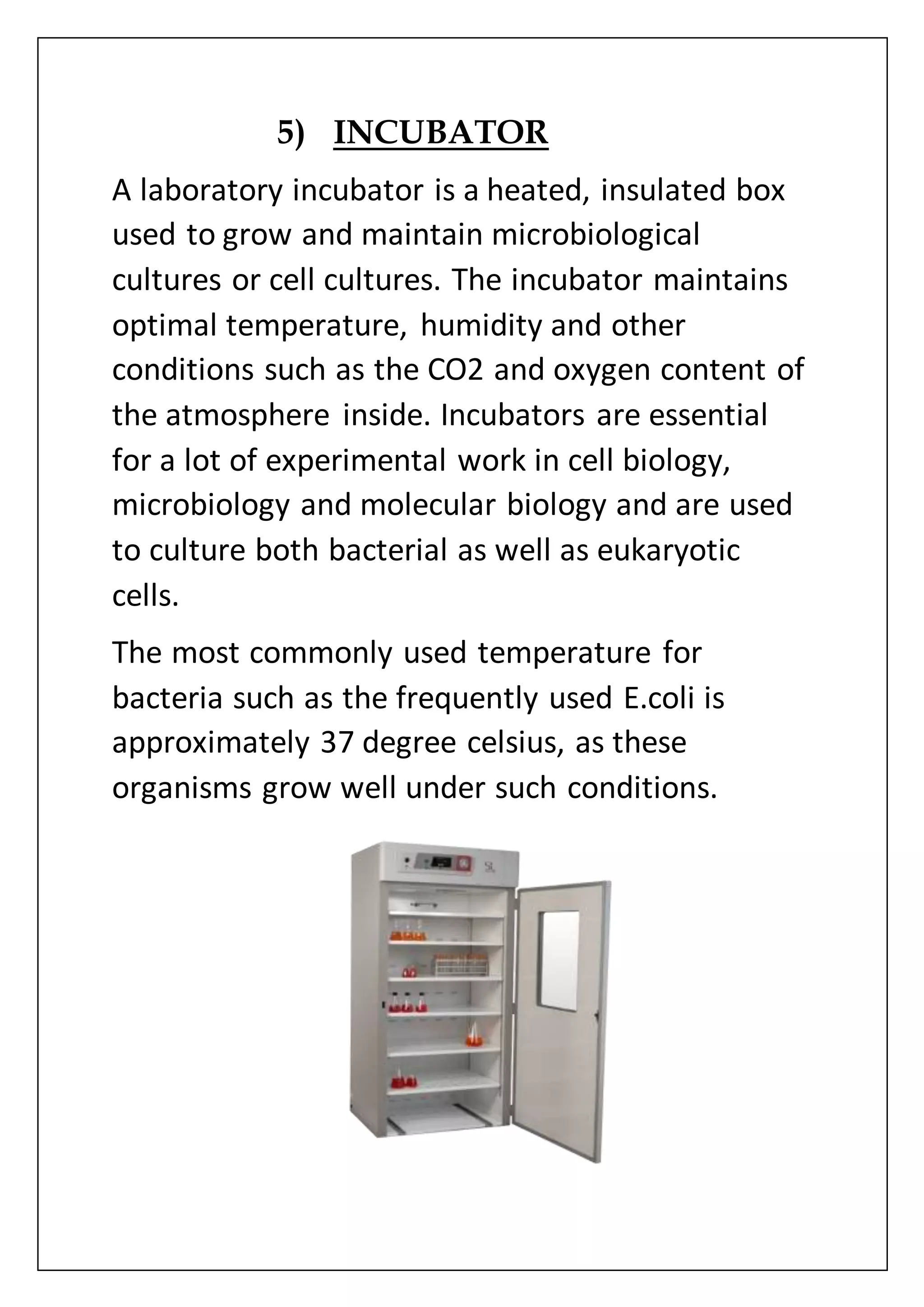
5) INCUBATOR
A laboratory incubator is a heated, insulated box
used to grow and maintain microbiological
cultures or cell cultures. The incubator maintains
optimal temperature, humidity and other
conditions such as the CO2 and oxygen content of
the atmosphere inside. Incubators are essential
for a lot of experimental work in cell biology,
microbiology and molecular biology and are used
to culture both bacterial as well as eukaryotic
cells.
The most commonly used temperature for
bacteria such as the frequently used E.coli is
approximately 37 degree celsius, as these
organisms grow well under such conditions.
An incubator is made up of a chamber with a
regulated temperature. Some incubators also
regulate humidity, gas composition, or ventilation
within that chamber. The main purpose of the
incubator is to create a stable, controlled
environment conducive to research, study and
cultivation.
Incubators serve a variety of functions in a
scientific lab. Incubators generally maintain a
constant temperature, however additional
features are often built in. Many incubators also
control humidity. Shaking incubators incorporate
movement to mix cultures. Some incubators have
a means of circulating the air inside of them to
ensure even distribution of temperatures. Many
incubators built for laboratory use have a
redundant power source, to ensure that power
outages do not disrupt experiments. Incubators
are made in a variety of sizes, from tabletop
models, to warm rooms, which serve as
incubators for large numbers of samples.
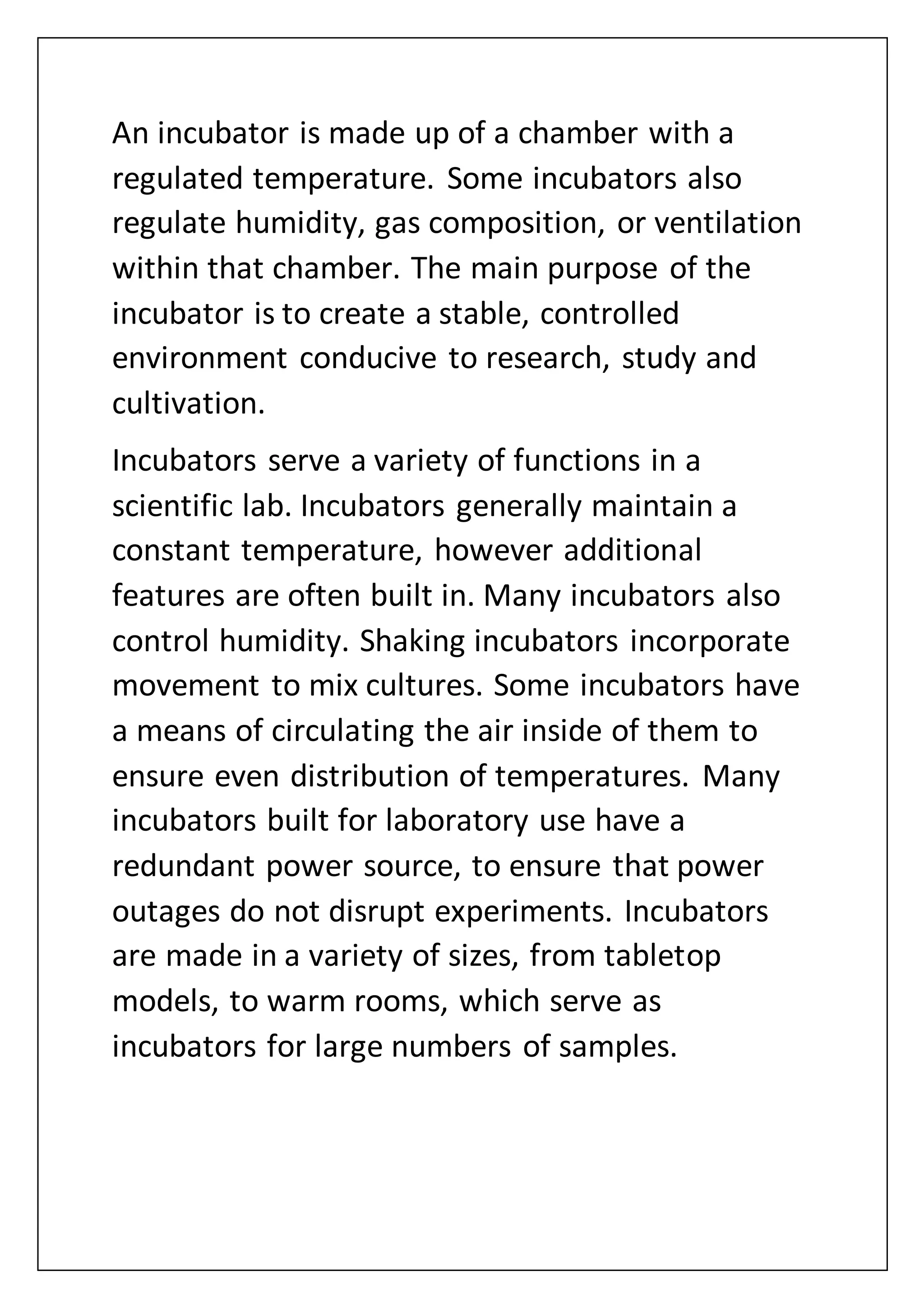
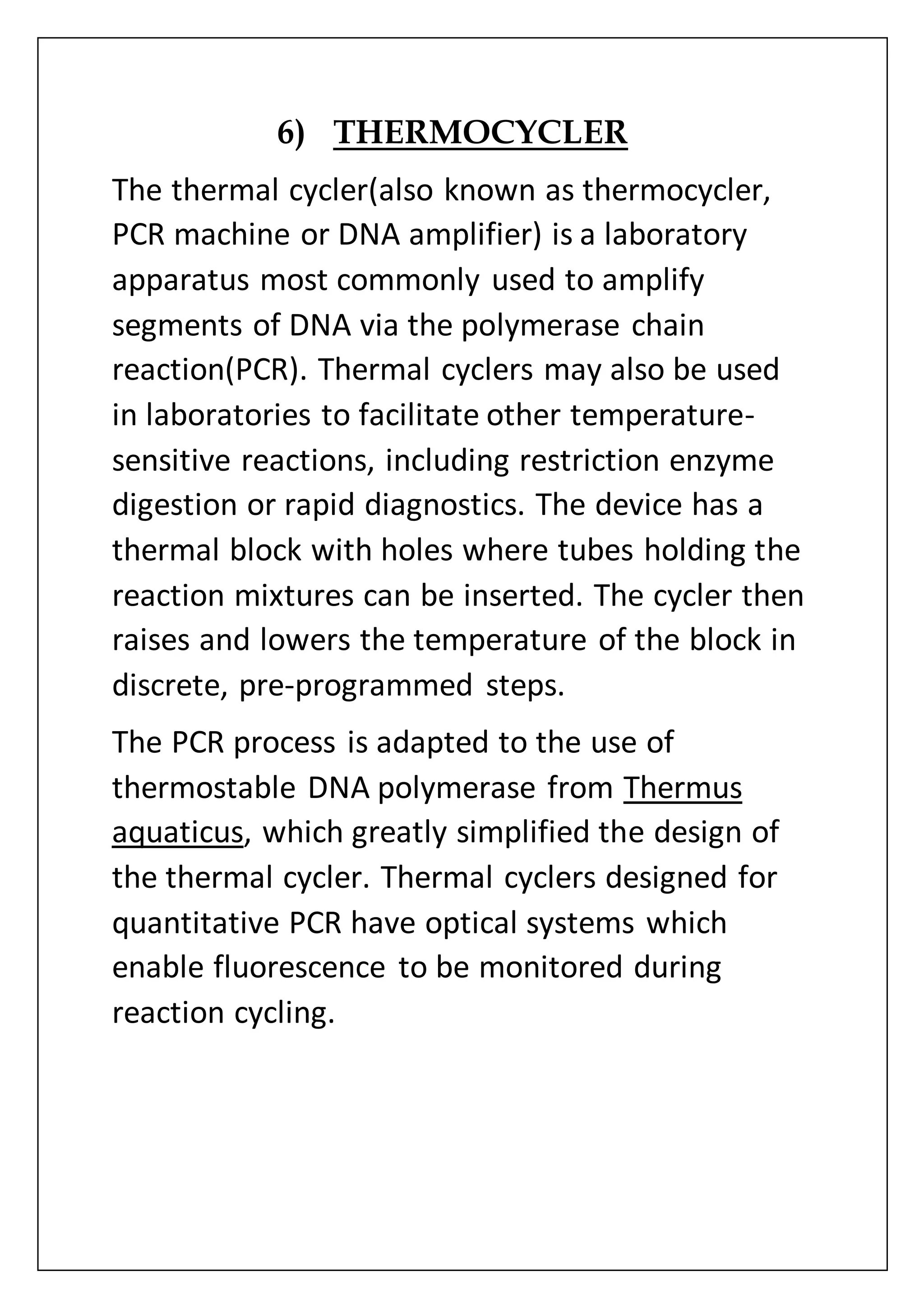
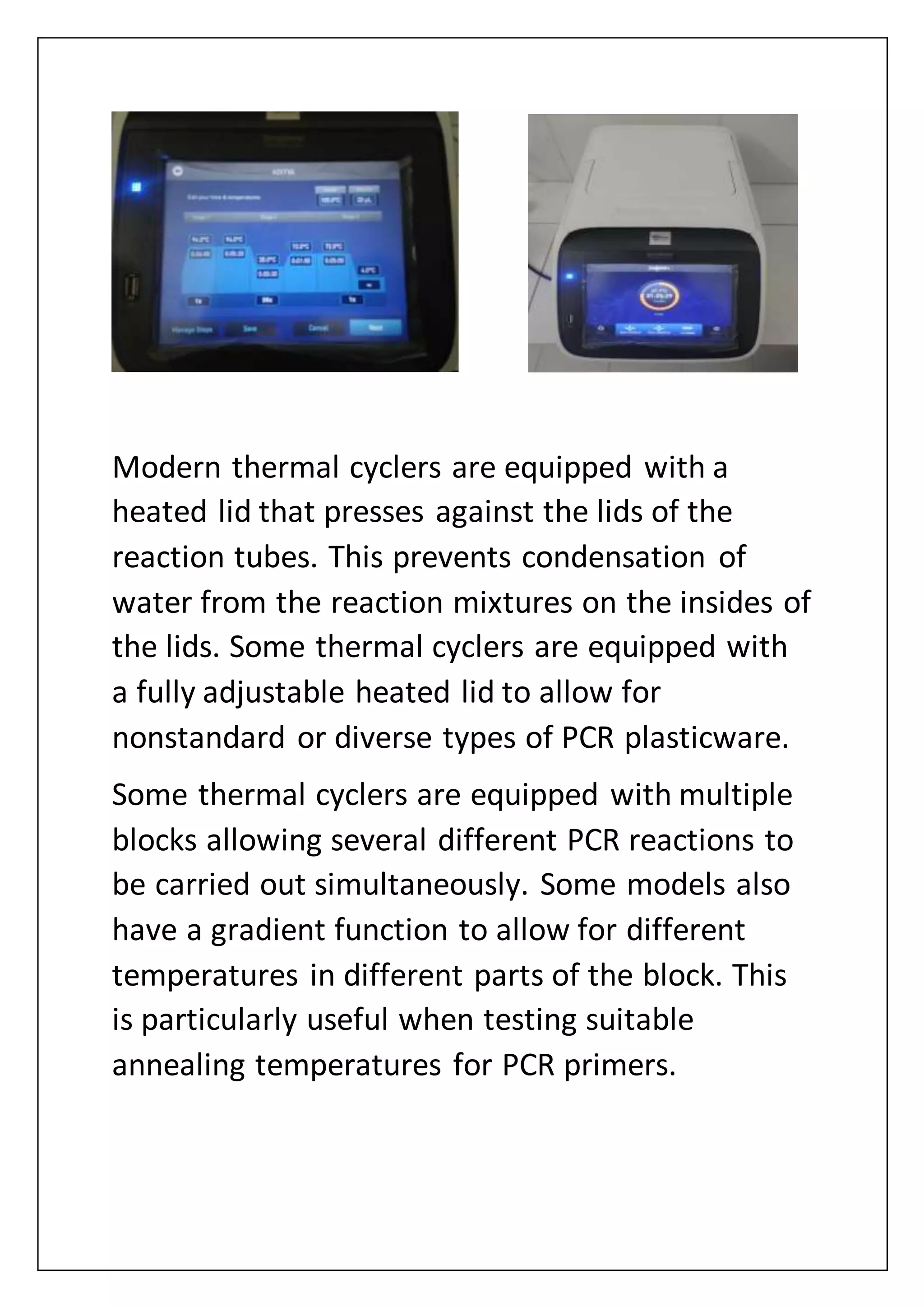
6) THERMOCYCLER
The thermal cycler(also known as thermocycler,
PCR machine or DNA amplifier) is a laboratory
apparatus most commonly used to amplify
segments of DNA via the polymerase chain
reaction(PCR). Thermal cyclers may also be used
in laboratories to facilitate other temperature-
sensitive reactions, including restriction enzyme
digestion or rapid diagnostics. The device has a
thermal block with holes where tubes holding the
reaction mixtures can be inserted. The cycler then
raises and lowers the temperature of the block in
discrete, pre-programmed steps.
The PCR process is adapted to the use of
thermostable DNA polymerase from Thermus
aquaticus, which greatly simplified the design of
the thermal cycler. Thermal cyclers designed for
quantitative PCR have optical systems which
enable fluorescence to be monitored during
reaction cycling.
Modern thermal cyclers are equipped with a
heated lid that presses against the lids of the
reaction tubes. This prevents condensation of
water from the reaction mixtures on the insides of
the lids. Some thermal cyclers are equipped with
a fully adjustable heated lid to allow for
nonstandard or diverse types of PCR plasticware.
Some thermal cyclers are equipped with multiple
blocks allowing several different PCR reactions to
be carried out simultaneously. Some models also
have a gradient function to allow for different
temperatures in different parts of the block. This
is particularly useful when testing suitable
annealing temperatures for PCR primers.
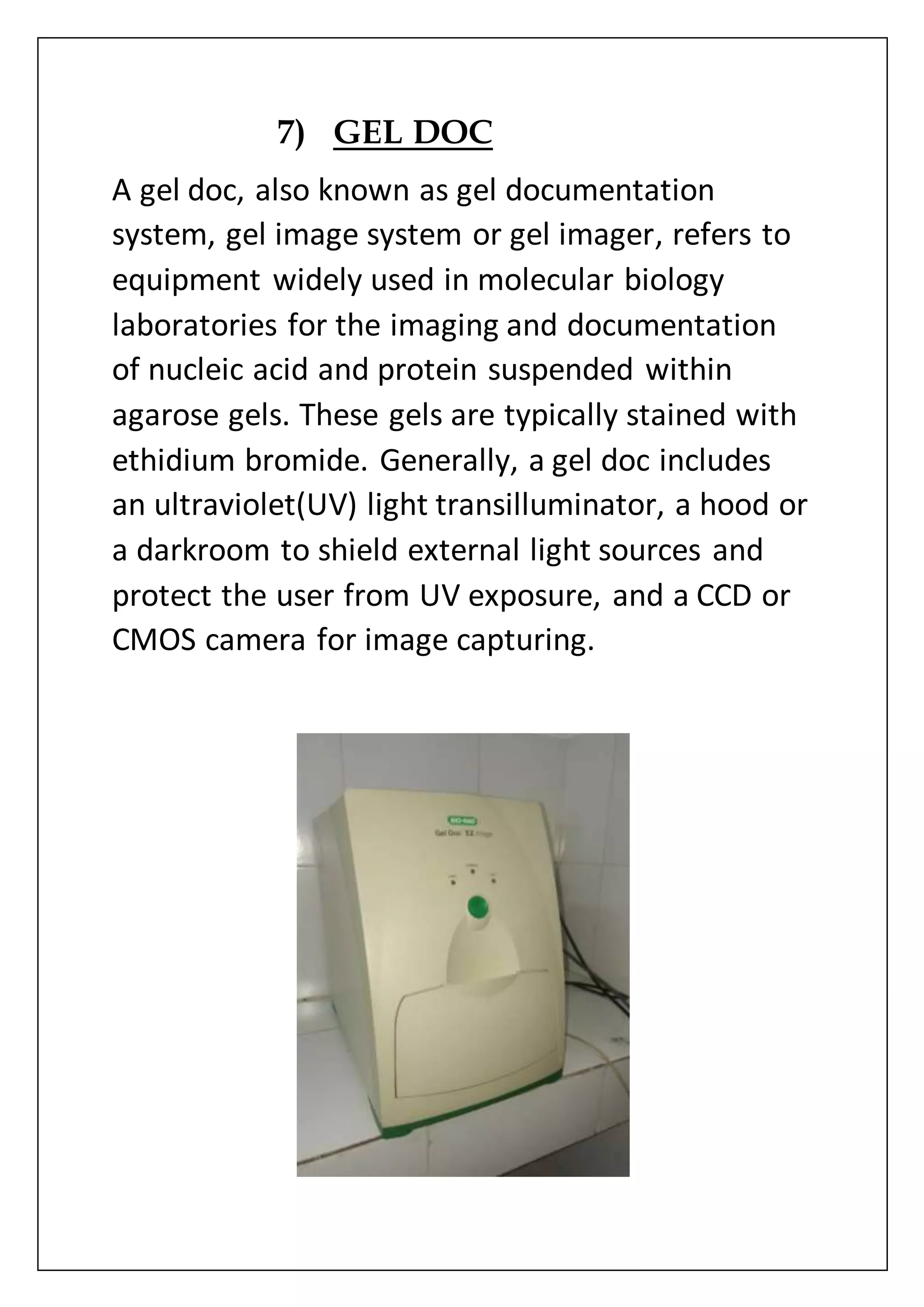
7) GEL DOC
A gel doc, also known as gel documentation
system, gel image system or gel imager, refers to
equipment widely used in molecular biology
laboratories for the imaging and documentation
of nucleic acid and protein suspended within
agarose gels. These gels are typically stained with
ethidium bromide. Generally, a gel doc includes
an ultraviolet(UV) light transilluminator, a hood or
a darkroom to shield external light sources and
protect the user from UV exposure, and a CCD or
CMOS camera for image capturing.
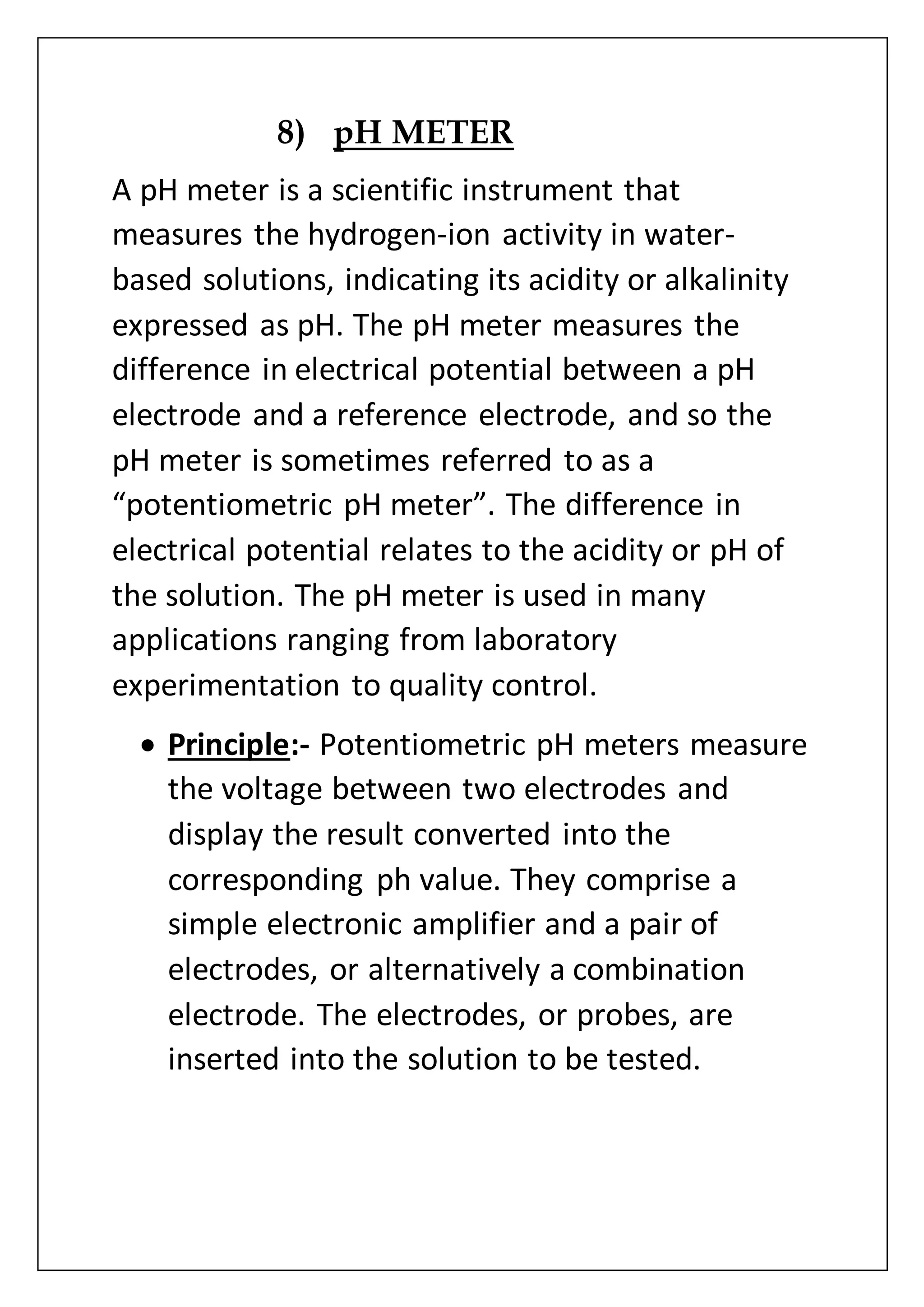
8) pH METER
A pH meter is a scientific instrument that
measures the hydrogen-ion activity in water-
based solutions, indicating its acidity or alkalinity
expressed as pH. The pH meter measures the
difference in electrical potential between a pH
electrode and a reference electrode, and so the
pH meter is sometimes referred to as a
“potentiometric pH meter”. The difference in
electrical potential relates to the acidity or pH of
the solution. The pH meter is used in many
applications ranging from laboratory
experimentation to quality control.
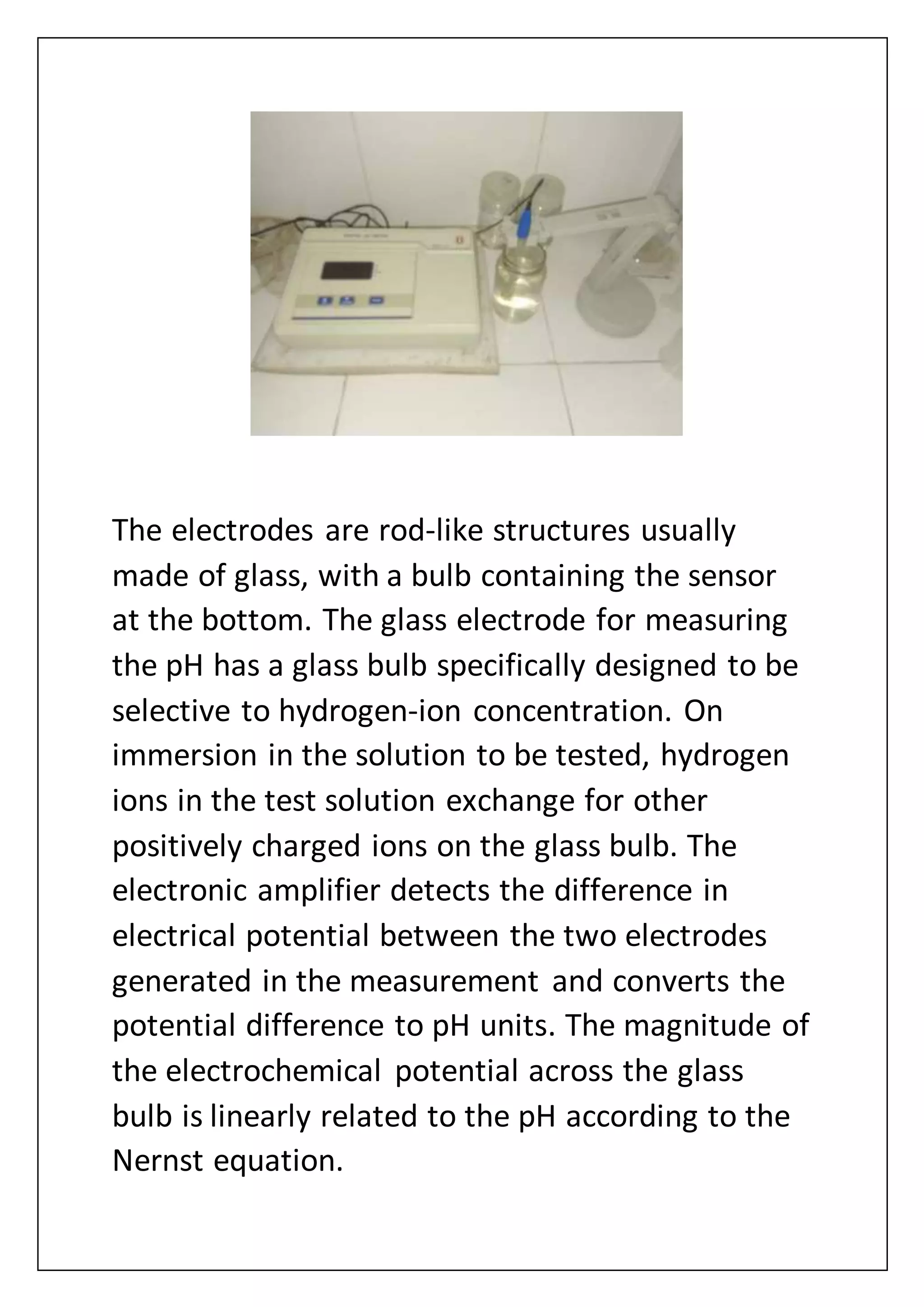
 Principle:- Potentiometric pH meters measure
the voltage between two electrodes and
display the result converted into the
corresponding ph value. They comprise a
simple electronic amplifier and a pair of
electrodes, or alternatively a combination
electrode. The electrodes, or probes, are
inserted into the solution to be tested.
The electrodes are rod-like structures usually
made of glass, with a bulb containing the sensor
at the bottom. The glass electrode for measuring
the pH has a glass bulb specifically designed to be
selective to hydrogen-ion concentration. On
immersion in the solution to be tested, hydrogen
ions in the test solution exchange for other
positively charged ions on the glass bulb. The
electronic amplifier detects the difference in
electrical potential between the two electrodes
generated in the measurement and converts the
potential difference to pH units. The magnitude of
the electrochemical potential across the glass
bulb is linearly related to the pH according to the
Nernst equation.
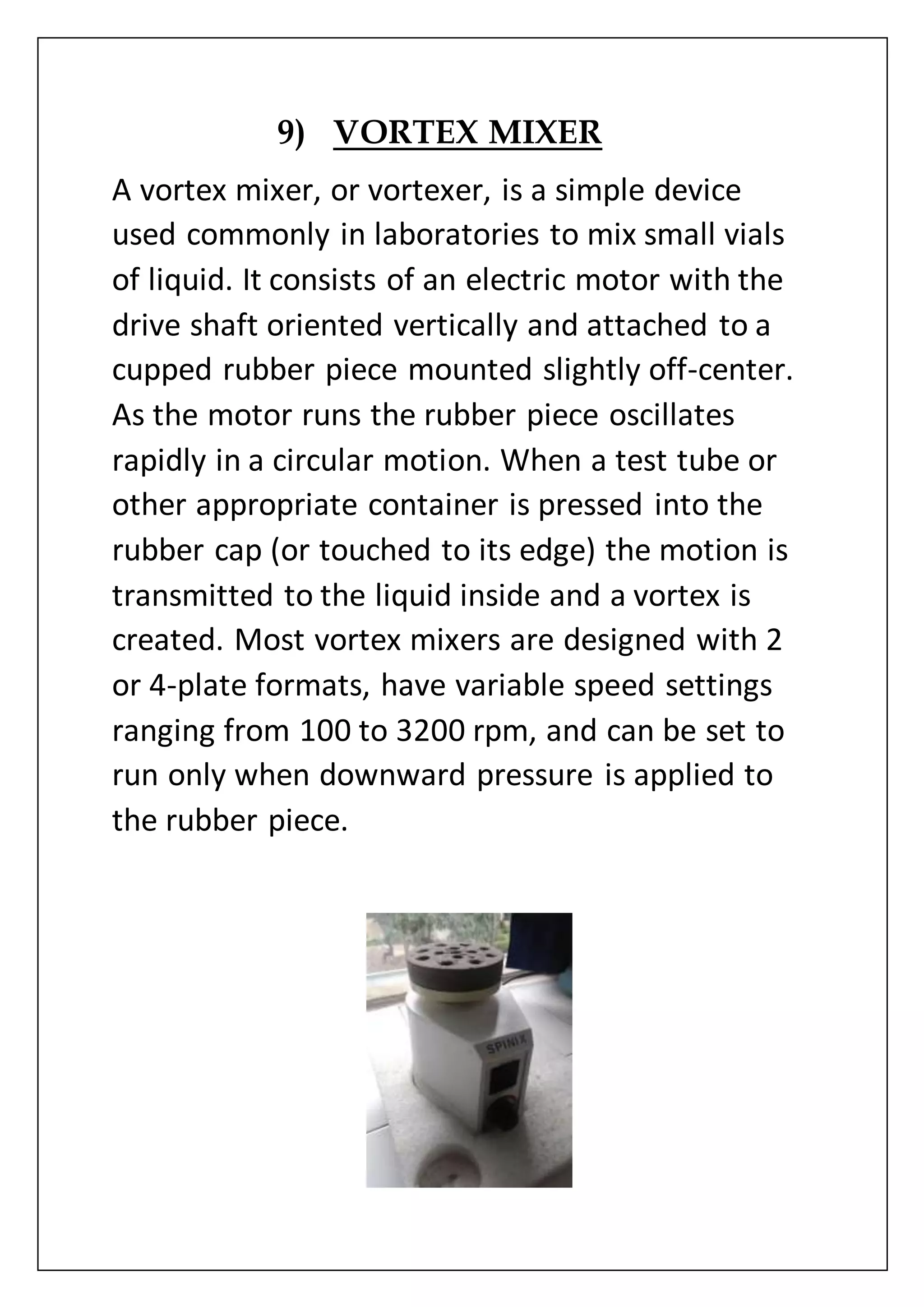
9) VORTEX MIXER
A vortex mixer, or vortexer, is a simple device
used commonly in laboratories to mix small vials
of liquid. It consists of an electric motor with the
drive shaft oriented vertically and attached to a
cupped rubber piece mounted slightly off-center.
As the motor runs the rubber piece oscillates
rapidly in a circular motion. When a test tube or
other appropriate container is pressed into the
rubber cap (or touched to its edge) the motion is
transmitted to the liquid inside and a vortex is
created. Most vortex mixers are designed with 2
or 4-plate formats, have variable speed settings
ranging from 100 to 3200 rpm, and can be set to
run only when downward pressure is applied to
the rubber piece.
In cell culture and microbiology laboratories they
may be used to suspend cells. In a biochemical or
analytical laboratory they may be used to mix the
reagents of an assay or to mix an experimental
sample and a dilutant.
The vortex mixer was invented by the Kraft
brothers(Jack A. Kraft and Harold D. Kraft) while
working for Scientific Industries.
An alternative to the electric vortex mixer is the
“finger vortex” technique in which a vortex is
created manually by striking a test tube in a
forward and downward motion with one’s finger
or thumb.
Vortex mixers are ideal for a wide variety of
molecular biology applications including
immunochemical reactions, enzyme and protein
analysis, and microarray analysis.
10) WATER BATH
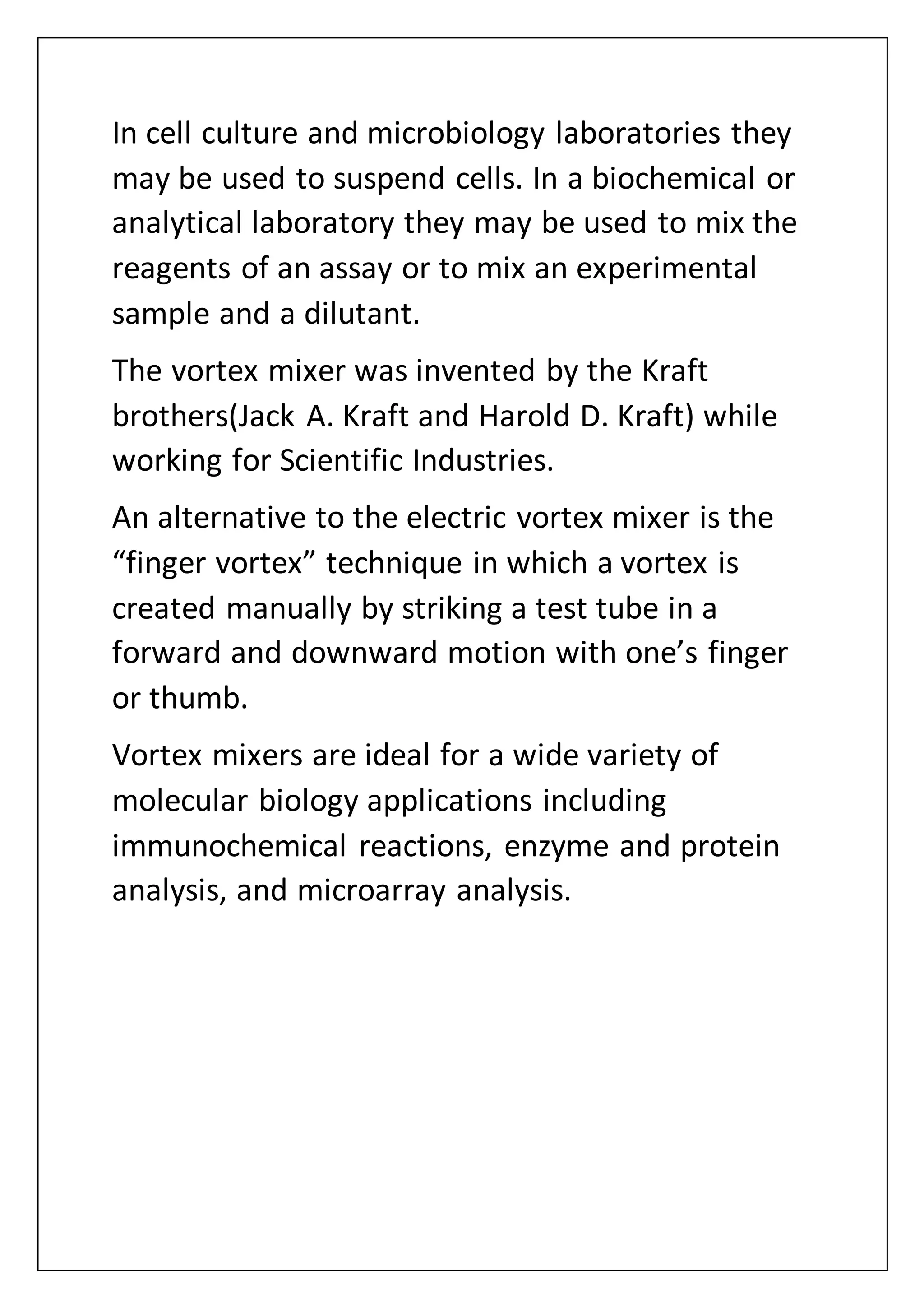
A water bath is laboratory experiment made from
a container filled with heated water. It is used to
incubate samples in water at a constant
temperature over a long period of time. All water
baths have a digital or an analogue interface to
allow users to set a desired temperature.
Utilisations include warming of reagents, melting
of substrates or incubation of cell cultures. It is
also used to enable certain chemical reactions to
occur at high temperature. Water bath is a
preferred heat source for heating flammable
chemicals instead of an open flame to prevent
ignition. For all water baths, it can be used up to
99.9 degree celsius.
11) MAGNETIC STIRRER
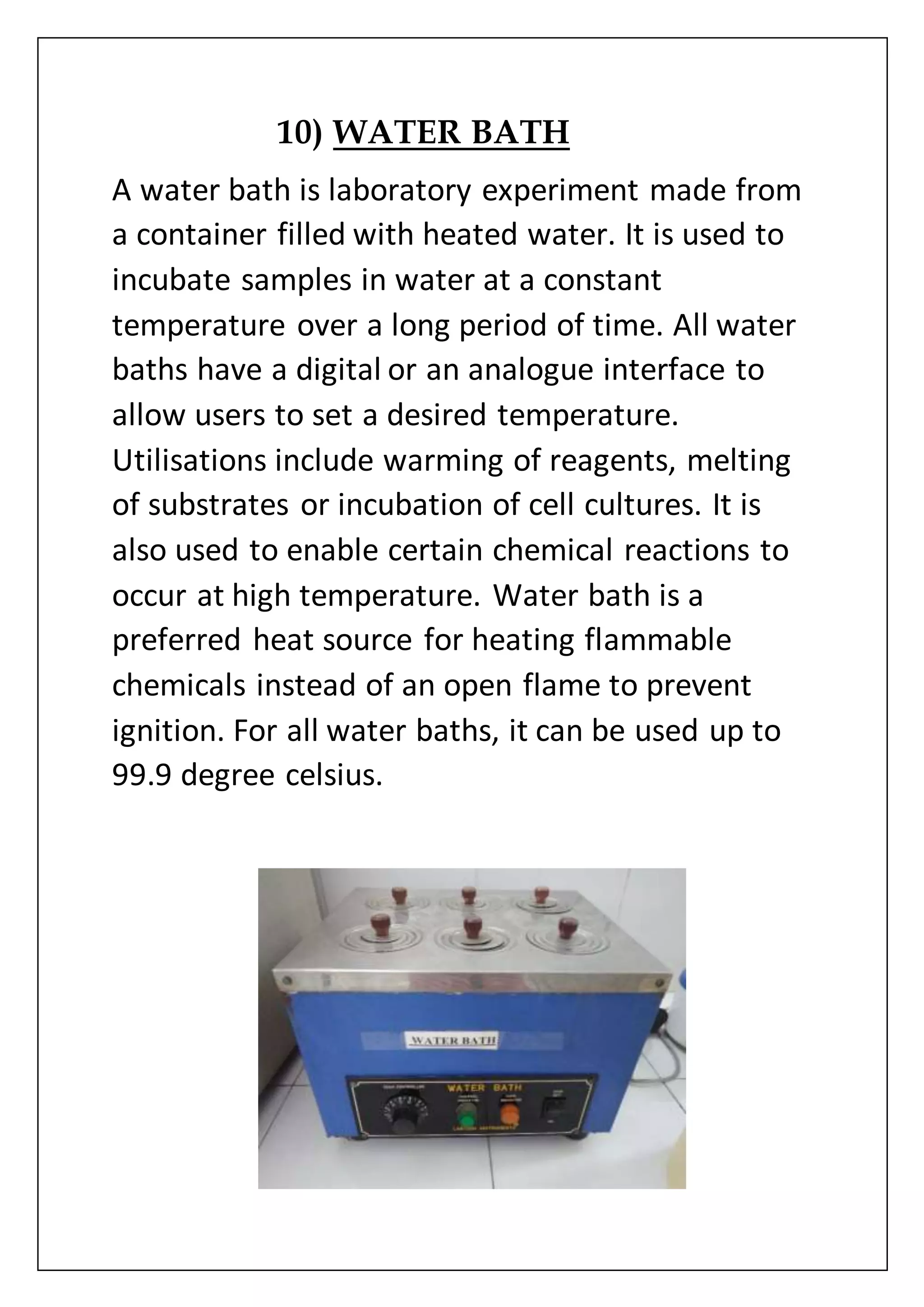
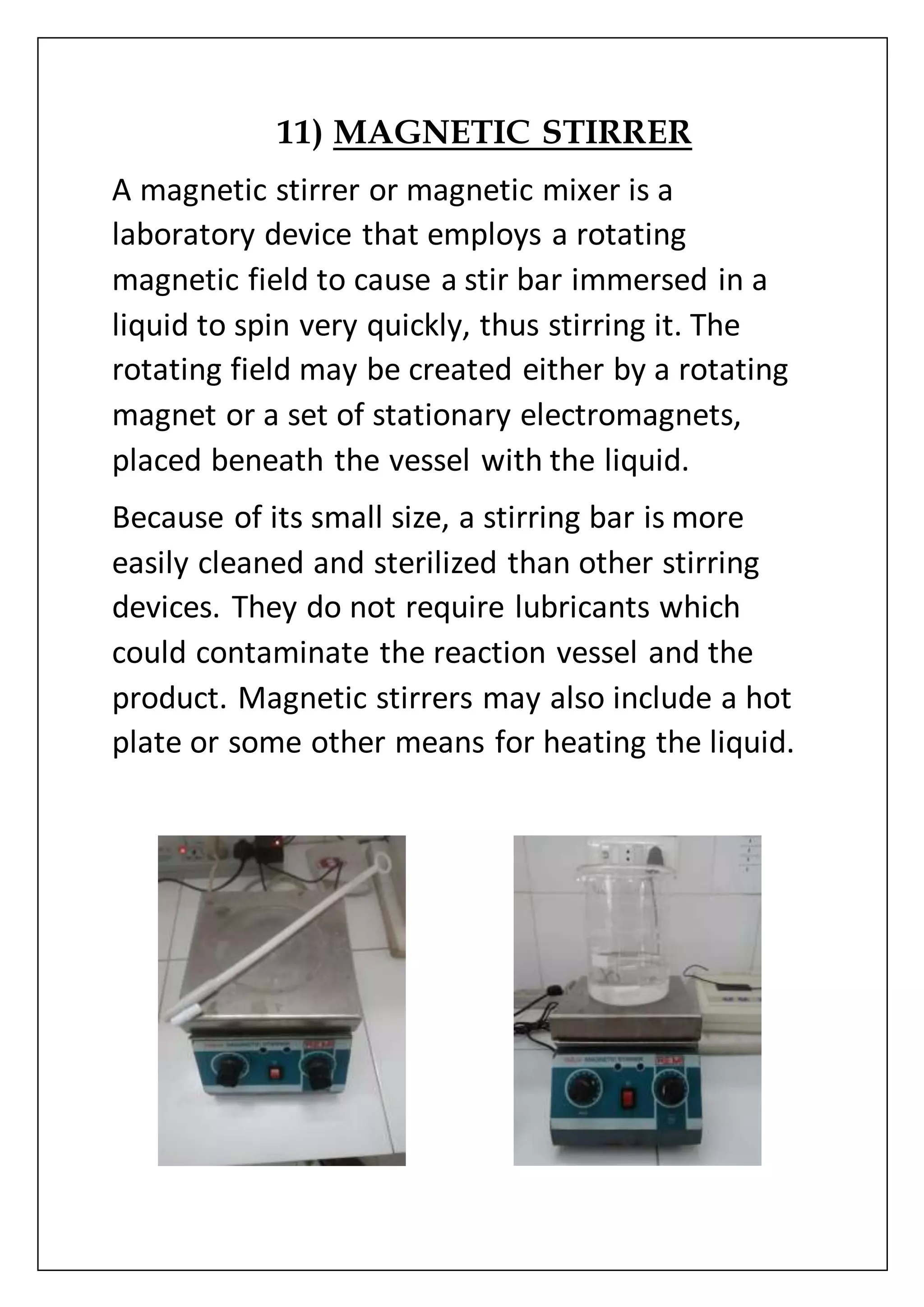
A magnetic stirrer or magnetic mixer is a
laboratory device that employs a rotating
magnetic field to cause a stir bar immersed in a
liquid to spin very quickly, thus stirring it. The
rotating field may be created either by a rotating
magnet or a set of stationary electromagnets,
placed beneath the vessel with the liquid.
Because of its small size, a stirring bar is more
easily cleaned and sterilized than other stirring
devices. They do not require lubricants which
could contaminate the reaction vessel and the
product. Magnetic stirrers may also include a hot
plate or some other means for heating the liquid.
12) ORBITAL SHAKER
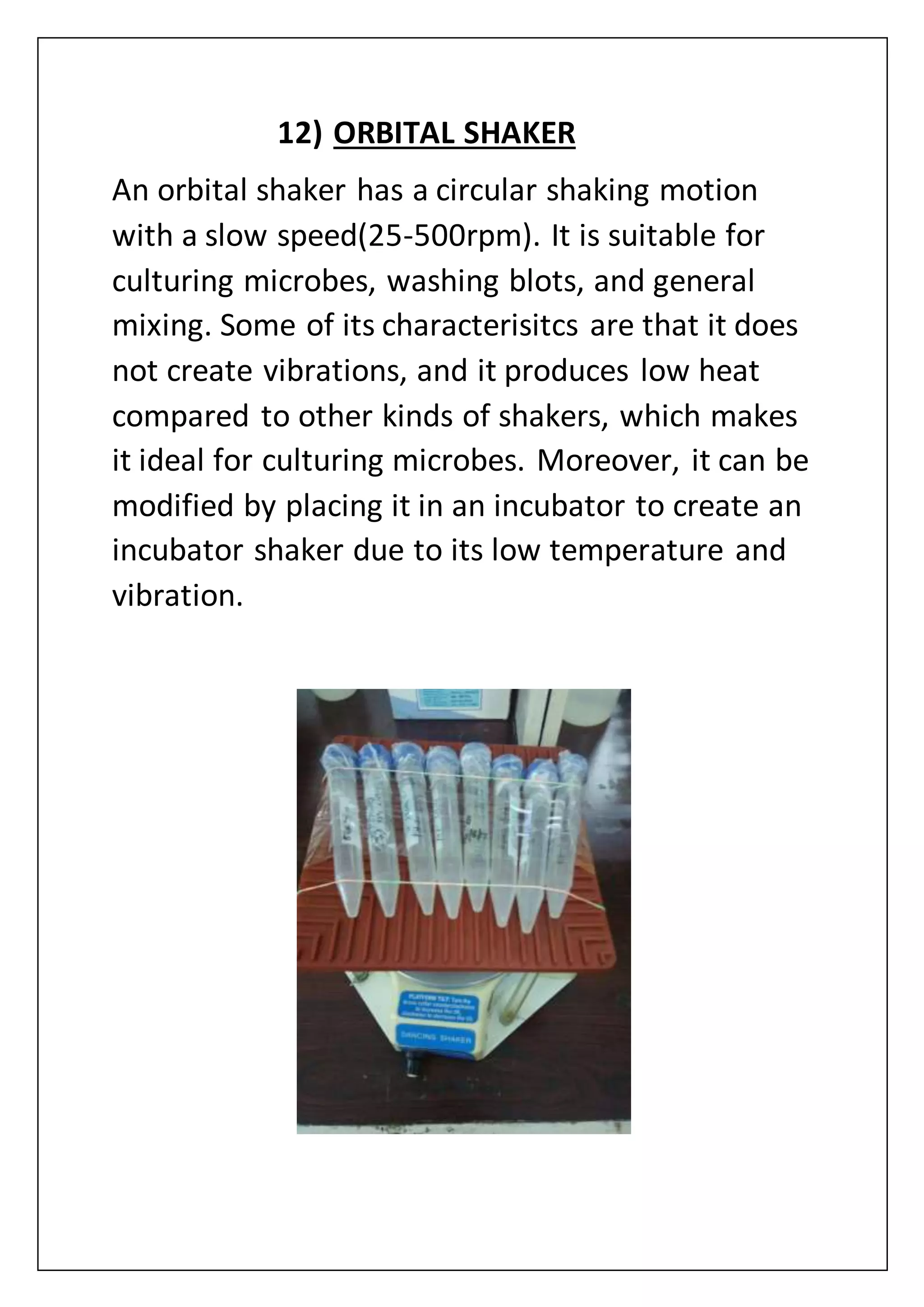
An orbital shaker has a circular shaking motion
with a slow speed(25-500rpm). It is suitable for
culturing microbes, washing blots, and general
mixing. Some of its characterisitcs are that it does
not create vibrations, and it produces low heat
compared to other kinds of shakers, which makes
it ideal for culturing microbes. Moreover, it can be
modified by placing it in an incubator to create an
incubator shaker due to its low temperature and
vibration.
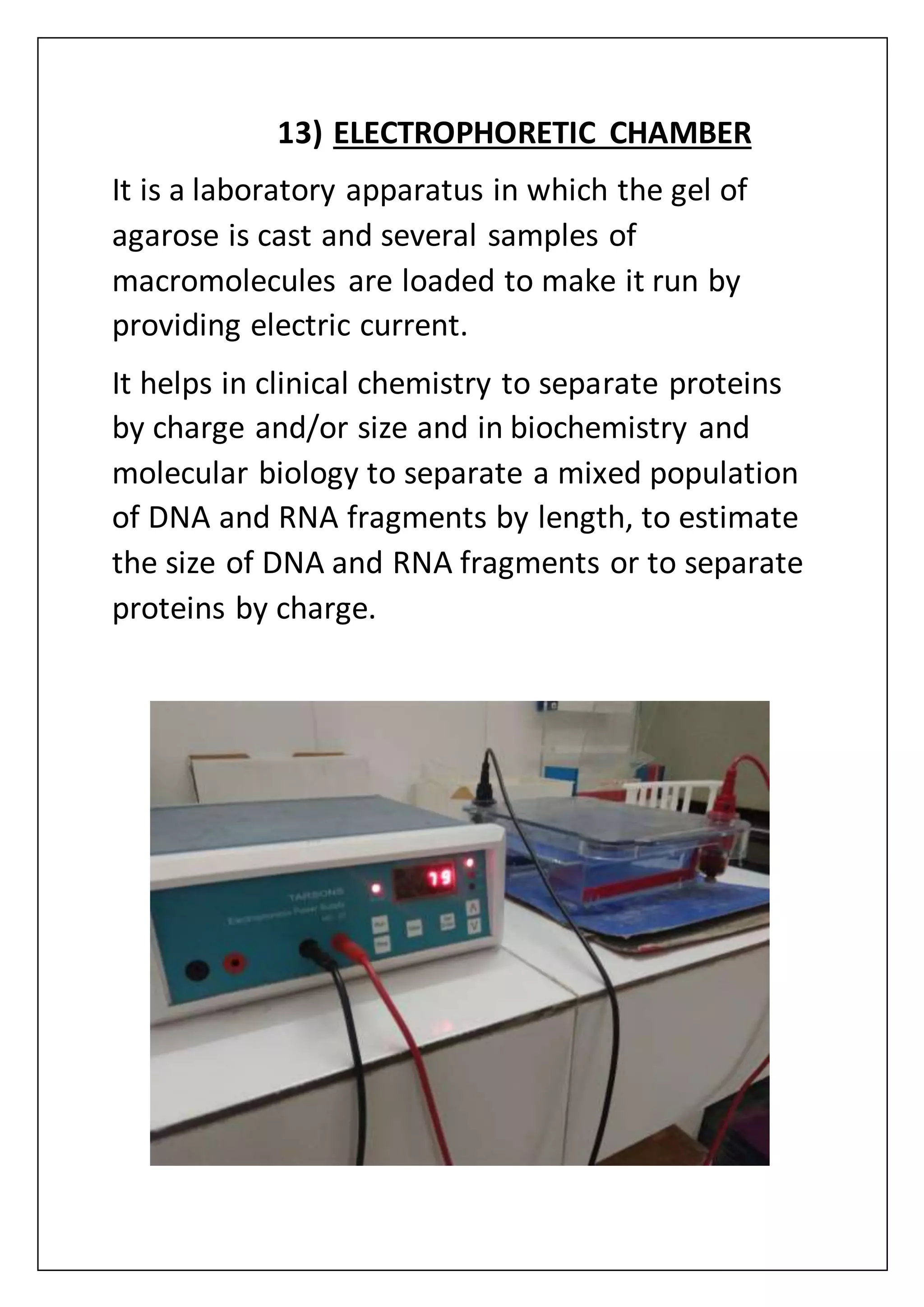
13) ELECTROPHORETIC CHAMBER
It is a laboratory apparatus in which the gel of
agarose is cast and several samples of
macromolecules are loaded to make it run by
providing electric current.
It helps in clinical chemistry to separate proteins
by charge and/or size and in biochemistry and
molecular biology to separate a mixed population
of DNA and RNA fragments by length, to estimate
the size of DNA and RNA fragments or to separate
proteins by charge.
B) MOLECULAR BIOLOGY
TECHNIQUES
Molecular biology techniques are common
methods used in molecular biology, biochemistry,
genetics and biophysics which generally involve
manipulation and analysis of DNA, RNA, protein
and lipid.
1) PLANT DNA ISOLATION BY
“cTAB” METHOD
 Introduction:-The use of cTAB based
extraction method facilitates the separation
of polysaccharides during the purification
while additives, such as polyvinyl pyrolidone
helps in removal of polyphenols. cTAB based
extraction buffers are widely used for
purifying DNA from plant samples.
 Materials:-
cTAB buffer
Appendorf tubes
Liquid nitrogen
Micropistil
Absolute alcohol(chilled)
70% ethanol(chilled)
3M Sodium acetate
Chloroform & Isoamyl
alcohol(24:1)
1% β mercaptoethanol
MQ
 Methods:-
COLLECTION OF LEAF
Fresh leaf sample was collected from the female
chilli plant(Capsicum annum). The DNA was
isolated by modified cTAB method(Cetyl Trimethyl
Ammonium bromide).
STOCK SOLUTION PREPARATION
 0.5M EDTA(pH 8.0)
18.62 gm EDTA in 100ml distilled water
 3M Sodium Acetate
20.412 of sodium acetate was dissolved in
50ml distilled water
 50x TAE(pH 8.3)
 Chloroform:Isoamyl alcohol(C.I.=24:1)
Chloroform=96ml
Isoamyl alcohol=4ml
 Protocol for DNA isolation by cTAB method:-
I. Collection of leaf sample.
(Leaf samples are collected in double
disc form in an appendorf tube)
II. 10mg PVP(Poly Vinyl Pyrolidone) is
then added to the tube.
III. Crushing of leaf samples is done by
adding liquid nitrogen to the tube via
micropistil.
IV. 650µl cTAB buffer is added along with
1% β mercapto ethanol to the tube
and mix the sample properly.
V. Keep the sample in water bath for 45
min. at 65°C and shake the sample
after every 10 min.
VI. After cooling add 650µl CI(24:1) and
shake.
VII. Centrifuge the tubes at 10000rpm for
10 min.
VIII. Collect the supernatant carefully in a
different tube and add equal amount
of CI to it.
IX. Centrifuge the tubes at 10000rpm for
10 min.
X. Take out the supernatant carefully
and add 1/10 3M sodium acetate(pH-
5.2) and double the volume of
absolute alcohol(chilled).
XI. Shake the tubes and observe tiny
threads of DNA.
XII. Keep the DNA samples for 1-2 hours
at -20°C.
XIII. Take the sample and centrifuge the
tubes at 10000rpm for 10 min.
XIV. Discard the supernatant and wash the
pallet with 200µl of 70% ethanol.
XV. After washing centrifuge at 10000rpm
for 5 min. and dry the pallet at 45°C-
60°C in hot air oven.
XVI. Now add 50µl MQ per sample, then
keep the appendorf tube in hot air
oven so that the DNA will dissolve in
MQ(5-10 min. at 65°C).
XVII. Store the DNA sample at -4°C.
2) ELECTROPHORESIS OF PLANT
DNA
 Introduction:- Gel electrophoresis is a method
for separation and analysis of
macromolecules(DNA, RNA and Proteins) and
their fragments, based on their size and
charge. Nucleic acid molecules are separated
by applying electric field to move the
negatively charged molecules through a
matrix of agarose.
Checking the quality of DNA is done by
agarose gel electrophoresis. For quantification
of DNA sample, 1% agarose gel is prepared
and checked in a gel doc system.
 Materials:-
Agarose powder
TAE buffer
Distilled water
Ethidium bromide
Gel casting tray & comb
Electrophoretic chamber
Dye(Bromo Phenol Blue)
Paraffin
MQ
 Steps for preparing the agarose gel:-
The 1% agarose gel is prepared by taking:
 2ml 50x TAE buffer
 98ml distilled water
 1gm agarose powder
 6µl ethidium bromide(conc.-10mg/ml)
I. Preparation of 1% agarose gel:
Mix 1gm agarose powder with 98ml
distilled water and 2ml 50x TAE buffer
and heat in the microwave oven until the
agarose powder is dissolved completely.
II. Preparation of gel bed:
The agarose gel is poured in a gel casting
tray and comb is added and allowed to set
for 15-20 min.
After the solidification of agarose gel,
remove the comb carefully.
III. Electrophoresis chamber:
Fill the electrophoresis chamber with
buffer completely
 14ml 50x TAE
 686ml distilled water
IV. Loading DNA samples:
Mix 5µl loading dye(Bromo Phenol Blue)
with 5µl MQ and 7µl DNA sample. Load 17
µl(Dye+MQ+DNA sample) into the wells in
a consecutive order with the help of a
micropipette.
V. Running the gel:
After loading of sample carefully, close
the cover onto the electrode terminals.
Make sure that the positive and negative
on the cover and apparatus chamberare
properly oriented(black-negative and red-
positive).
VI. Turn on the power source at 100 V and
200 mA for 1.5 hrs.
VII. Allow the tracking dye to migrate(4-5 cm)
from the well for adequate separation of
DNA bands. Turn off the power.
VIII. Now carefully remove the gel from its bed
and transfer the gel onto the UV tray.
IX. Observe the results on a gel doc system.
 Result:-
Fig. ELECTROPHORESISANALYSIS BANDS OF
ISOLATED GENOMIC DNA
3) PCR AMPLIFICATION OF PLANT
DNA
 Introduction:- PCR(Polymerase Chain
Reaction) is the technique developed by kary
mullis, in 1983. It is a technique used in
molecular biology to amplify a single copy or a
few copies of segment of DNA across several
orders of magnitude generating thousands to
millions of copies of a particular sequence of
DNA. It is an easy, cheap, reliable way to
repeatedly replicate a focused segment of
DNA. The process of PCR is carried out in
device called thermal cycler. it was
programmed for 38 cycles. Products of PCR
were taken and then electrophoresis was
done and was visualized under gel doc
system.
*The type of PCR used here is End Point PCR.*
 Requirements:-
[MASTERMIX]
MQ
10x TBE buffer
Mgcl2
dNTPs
BSA
Tween
Taq polymerase
Primer
DNA sample
 Procedure:-
All the PCR components are mixed together
and are taken through series of three major
cycle reactions conducted in an automated,
self contained thermocycler machine.
I. DENATURATION: This step involves heating
the reaction mixture to 94°C for 20-30 sec.
during this, the double stranded DNA is
denatured to single strands due to breakage
in weak hydrogen bonds.
II. ANNEALING: The reaction temperature is
rapidly lowered to 45°C for 20-40 sec. This
allows the primers to bind(anneal) to their
complementary sequence in the template
DNA.
III. EXTENSION: Extension occurs at 72-80°C for
01:50 min. In this step, the DNA polymerase
synthesizes a new DNA strand complementary
to the DNA template strand by adding free
dNTPs from the reaction mixture that are
complementary to the template in the 5’ to 3’
direction, condensing the 5’-phosphate group
of the dNTps with the 3’ hydroxy group at the
end of the elongating DNA strand.
 PCR Components:-
S. NO. COMPONENTS QUANTITY(µl)
1 Standard
Buffer
2
2 Mgcl2 1
3 BSA 1
4 Dntp 1
5 Tween 0.3
6 Taq
Polymerase
0.2
7 Primer 2
8 DNA template 1
9 MQ 11.5
Total quantity 20
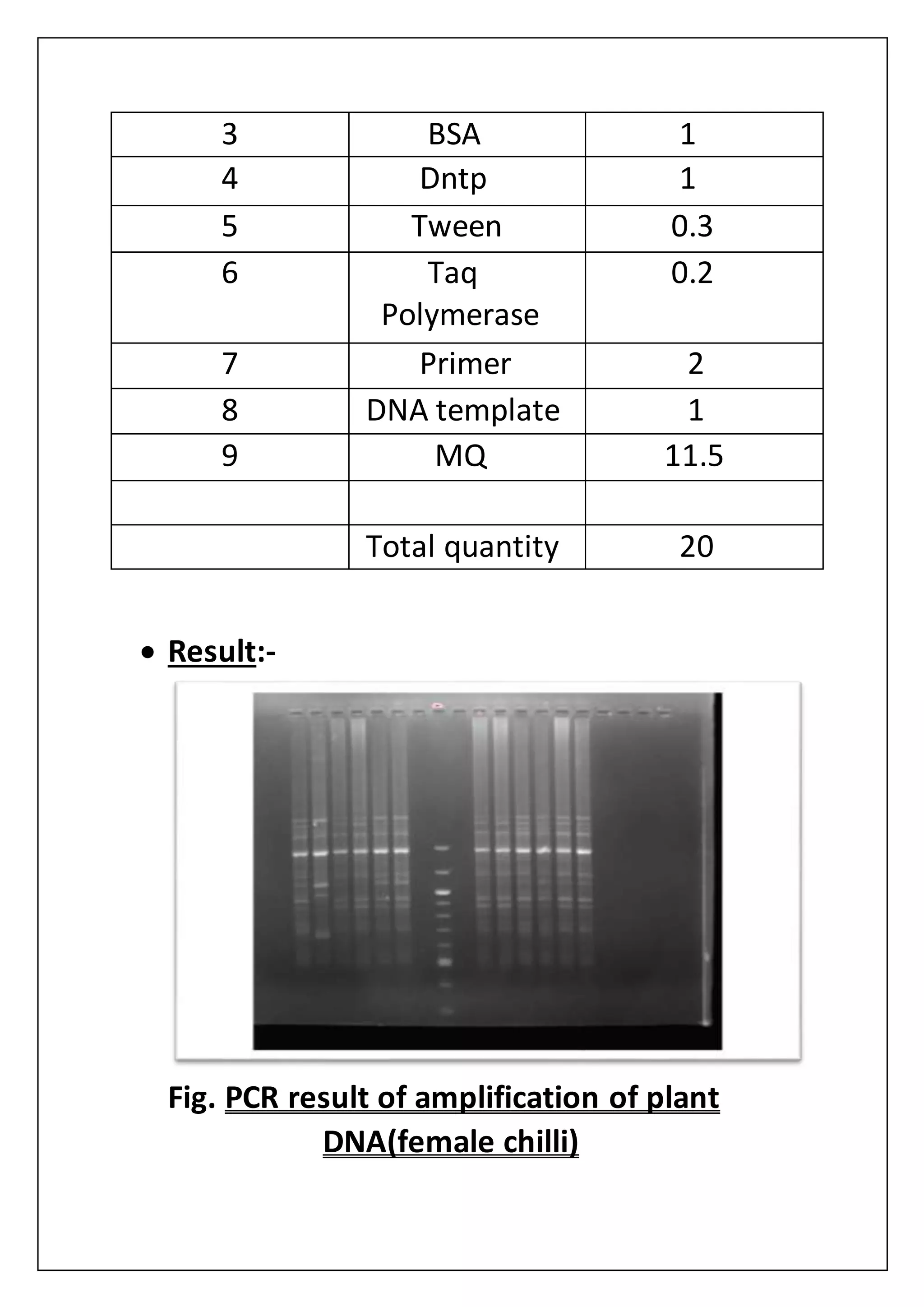
 Result:-
Fig. PCR result of amplification of plant
DNA(female chilli)
4) GENE CLONING &
CHARACTERIZATION
 Introduction:- The production of exact copies
of DNA sequence using genetic engineering
techniques is known as gene cloning. The DNA
containing the target gene is split into
fragments using restriction enzymes. These
fragments are then inserted into cloning
vectors, which transfer the recombinant DNA
to suitable host cells, such as bacterium E.coli.
This new genetic combinations clones are of
value to science, medicine, agriculture and
industry.
 Procedure:-
I. LIGATION OF BACTERIAL DNA
DNA ligases are used restricton enzymes to
insert DNA fragments, often genes, into plasmids.
 Ligation buffer(10x)= 2ml
 Vector= 2µl
 Insert= 4µl
 Ligase(T4 DNA ligase)
 MQ=11µl
Keep it in 4°C overnight.
II. PREPARATION OF BACTERIAL
COMPETENT CELLS
Competent cells are calcium chloride treated to
facilitate attachement of the plasmid DNA to the
competent cell membrane. The competent cell is
alternatively heated in a waterbath. This opens
the pores of the cell membrane allowing entry of
the plasmid.
i. Take overnight culture of E.Coli in vial(2ml).
ii. Centrifuge at 10000rpm for 5 min.(37°C).
iii. Discard the supernatant and add 0.1M
Cacl2(equal to the volume of culture= 2ml).
iv. Incubate in ice for 30 min.
v. Centrifuge at 10000rpm for 8 min.
vi. Discard the supernatant and add 600µl Cacl2.
vii. Distribute 200µl of cells in each vial.
viii. For preservation add 1/10 DMSO(Dimethyl
Sulfoxide) or glycerol.
III. TRANSFORMATION BY HEAT
SHOCK METHOD
Transformation is the process in which the genetic
makeup of cell is changed by the introduction of
DNA from the outer environment.
i. Keep the ligation mixture at 65°C for 10min.
ii. Add different amount of ligation mixture into
200µl of cells(generally 3µl of ligation mixture
is added).
iii. After this add +ve control(2µl) in one vial, and
one was kept –ve.
iv. Give heat shock at 43°c for 2 min. and mix it
properly.
v. Again give ice incubation for 5 min.
vi. Then add 800µl of LB broth and keep on
shaking at 37°C for 1 hour.
vii. Spin at 10000rpm fpr 2 min.
viii. Remove 600µl of supernatant and spread
200µl of bacterial cells on
antiobiotic(ampicillin-AMP) conatining plates.
Fig. AMP BACTERIAL CULTURE PLATES
1) LB
2) LB
3) +ve CONTROL
4) –ve
IV. REPLICA PLATING
Replica plating is a microbiological technique in
which one or more secondary petri plates
containing different solid(agar-based) selective
growth media are inoculated with the same
colonies of microorganisms from a primary plate,
reproducind the original spatial pattern of
colonies.
i. Make some columns(say 30) in fresh media
plate(AMP plates) and mark each box.
ii. Take bacterial culture which was previously
grown overnight with the help of tip.
iii. Inoculate the different picked bacterial
culture in the fresh media plate by dotting it
in the columns.
iv. Place it in shaking incubator for overnight(24
hrs.) at 37°C.
V. PLASMID ISOLATION
i. Take 2ml of culture.
ii. Spin the tube at 10000rpm for 1 min. amd
discard supernatant.
iii. Again add 2ml of culture in vial, spin for 2 min
at 10000rpm.
iv. Add 250µl of “soln. A” and vortex it, incubate
in ice for 2 min.
v. Add 500µl of “soln. B” and incubate it in ice
for 5 min.
vi. Add 400µl of “soln. C”, vortex it and incubate
it in ice for 5 min.
vii. Spin in 10000rpm for 5 min.
viii. Take 800µl of supernatant.
ix. Add 700µl CI and vortex it.
x. Spin at 10000rpm for 5 min.
xi. Take supernatant 700µl.
xii. Add 1/10th
volume of 3M sodium
acetate(70µl; pH- 5.2) and double the volume
of isopropanol(1400µl).
xiii. Freeze in liquid nitrogen.
xiv. Spin at 10000rpm for 10 min.
xv. Discard supernatant and add 200µl of 75%
alcohol.
xvi. Vaccum dry and add 50µl of MQ.
 Precautions:-
Solution should be pre-chilled.
Incubation should be done in ice.
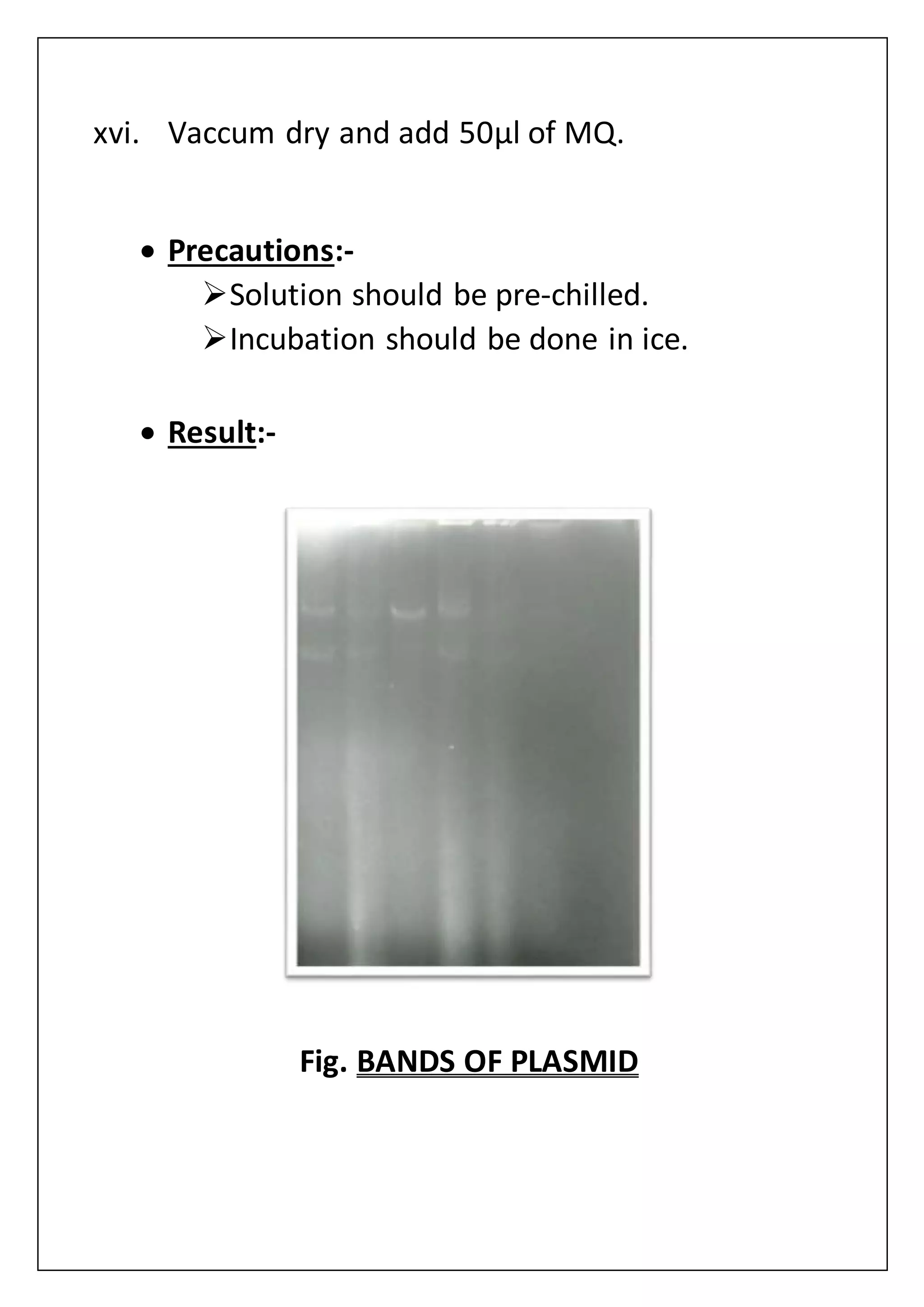
 Result:-
Fig. BANDS OF PLASMID
C) MICROBIOLOGY
TECHNIQUES
Microbiology techniques are methods used for
the study of microbes, including bacteria and
microscopic fungi and protists. They include
methods to survey, culture, stain, identify,
engineer and manipulate microbes.
1) ISOLATION OF PURE CULTURE
 Introduction:- A pure culture theoretically
consists a single bacterial species. There are a
number of procedures available for the
isolation of pure cultures from mixed
populations. A pure culture may be isolated
by the use of special media with specific
chemical or physical agents that allow the
enrichment or selection of one organism over
another.
Simpler methods for isolation of a pure
culture include:
 Spread plating on solid agar medium with
a glass spreader
 Streak plating with a loop
The purpose of spread plating and streak
plating is to isolate individual bacterial
cells(colony-forming units) on a nutrient medium.
I. SPREAD PLATE TECHNIQUE
 Introduction:- Spread plate technique is the
method of isolation and enumeration of
microorganisms in a mixed culture and
distributing it evenly. The technique makes it
easier to quantify bacteria in a solution.
The spread plate technique involves using a
sterilized spreader with a smooth surface
made of metal or glass to apply a small
amount of bacteria suspended in a solution
over a plate. The plate needs to be dry and
kept at room temperature so that the agar
can absorb the bacteria more readily. A
successful spread plate will have a countable
number of isolated bacterial colonies evenly
distributed on the plate.
 Procedure:-
i. Make a dilution series from a sample.
ii. Pipette out 0.1ml from the appropriate
desired dilution series onto the center of
the surface of an agar media plate.
iii. Dip the L-shaped glass spreader into
alcohol.
iv. Flame the glass spreader over a bunsen
burner.
v. Spread the sample evenly over the
surface of agar using the sterile glass
spreader, carefully rotating the petridish
underneath at the same time.
vi. Incubate the plate at 37°C for 24 hrs.
 Result:-
Fig. SPREAD PLATE METHOD
 Applications:-
i. It is used for viable plate counts, in which
the total number of colony forming units
on a single plate is enumerated.
ii. It is used to calculate the concentration
of cells in the tube from which the
sample was plated.
iii. Spread plating is routinely used in
enrichment, selection and screening
experiments.
II. STREAK PLATE TECHNIQUE
 Introduction:- Streak plate technique is used
for the isolation into pure culture of the
organisms(mostly bacteria), from mixed
population. The inoculum is streaked over the
agar surface in such a way that it separates
the bacteria. Some individual bacterial cells
are separated and well spaced from each
other. As the original sample is diluted by
streaking it over successive quadrants, the
number of organisms decreases. Usually by
the third or fourth quadrant only a few
organisms are transferred which will give
discrete colony forming units(CFUs).
 Principle:- The sample/inoculum is diluted by
streaking it across the surface of the agar
plate. While streaking in successive areas of
the plate, the inoculum is diluted to the point
where there is only one bacterial cell
deposited every few millimeters on the
surface of the agar plate. When these lone
bacterial cells divide and give rise to
thousands and thousands of new bacterial
cells, an isolated colony is formed. Pure
cultures can be obtained by picking well
isolated colonies and re-streaking these on
fresh agar plates.
 Procedure:-
i. Sterilize the inoculating loop in the
bunsen burner by putting the loop into
the flame until it is red hot. Allow it to
cool.
ii. Pick an isolated colony from the agar
plate culture and spread it over the first
quadrant(approx. 1/4th
of the plate) using
closed parallel streaks or insert your loop
into the tube/culture bottle and remove
some inoculum. A huge chunk is not
needed.
iii. Immediately streak the inoculating loop
very gently over a quarter of the plate
using a back and forth motion.
iv. Flame the loop again and allow it to cool.
v. Repeat the above process if another
culture plate is streaked.
 Result:- Streaked plates are incubated at 37°C
for 24 hrs. Examine the colonies grown in the
plate carefully. All colonies should have the
same general appearance.
[1] [2]
Fig. ZIG-ZAG STREAKING[1]
QUADRANT STREAKING[2]
2) FUNGAL DNA ISOLATION
I. PROTOCOL FOR FUNGAL DNA
ISOLATION
 Inoculation:-
i. Prepare the PDB broth(24gm for 1000ml).
ii. After this, autoclave the broth at 15p.s.i
and 121°C.
iii. Take a previously grown fungi culture
plate for inoculation in PDB broth.
iv. Pick a small culture with the help of tip
and drop(inoculate) it in the falcum tube
containing the PDB broth.
v. Cover tightly with clean rap and place it in
shaking incubator at 27-28°C for max. 7
days(growth can also be observed in min.
3 days).
 Isolation:-
i. Take appendorf tube of 1.5ml and add
300µl lysis buffer(when we use broth
culture first spin the culture and then add
lysis buffer in the pallet).
Lysis buffer is used for purpose of breaking open
cells for use in experiments that analyze the
compounds of the cell.
ii. Add small lump of mycelium from culture
by using sterile tip.
iii. Incubate the tube at R.T. for 10min.
iv. After that add 150µl of potassium
acetate(pH-4.8).
Potassium acetate helps in DNA percipitation.
v. Vortex the tube.
vi. Centrifuge at 10000rpm for 1 min.
vii. Transfer the supernatant in another 1.5ml
appendorf tube.
viii. Centrifuge again at 10000rpm for 1 min.
ix. Again transfer the supernatant in new
tube and add equal volume of isopropyl
alcohol.
x. Again mix by inversion.
xi. Centrifuge at 10000rpm for 2 min.
xii. Discard the supernatant.
xiii. Wash the DNA pallet in 300µl of 70%
ethanol.
xiv. Centrifuge at 10000rpm for 1 min.
xv. Discard the supernatant.
xvi. Vaccum dry the DNA pallet and store it by
adding 50µl MQ.
II. ELECTROPHORESIS OF FUNGAL DNA
Agarose gel electrophoresis of a subset of the
DNA preparation:-
III. PCR AMPLIFICATION OF FUNGAL DNA
 Requirements:-
10x TAE buffer
BSA
dNTPs
Taq polymerase
2 primers(Forward- ITS4R;
Reverse- ITS1SSF)
DNA template
MQ
 Result:-
D) PLANT TISSUE CULTURE
 Introduction:- Plant tissue culture is an
essential component of plant biotechnology.
Apart from mass multiplication of elites, it
also provides the means to multiply and
regenerate novel plants from genetically
engineered cells. The promising plant thus
produced may be readily cloned in cultures
under aseptic conditions
Tissue culture is widely used in:
 Obtaining disease free plants.
Rapid propagation of plants those are
difficult to propagate.
Somatic hybridization.
Genetic improvement of commercial
plants.
 Types of tissue culture:-
i. Callus culture: Callus culture may be
defined as production and
maintenance of an unorganised mass
of proliferative cell from isolated
plant cell, tissue or organ by growing
them on artificial nutrient medium in
glass vials under controlled aseptic
conditions.
ii. Organ culture:- The organ culture
refers to the in vitro culture and
maintenance of an excised organ
primordial or whole part of an organ
in way and function. That may allow
differentiation and preservation of
the architecture.
 MS media:-
i. Principle:- Growth and morphogenesis of
plant tissue in vitro are largely governed
by composition of culture media. The
basic requirements of cultured plant
tissue are similar to those of whole plant,
but in practice, nutritional components
promoting optimal growth of tissue
under laboratory conditions may vary
with respect to particular species. Media
composition are therefore prepared
considering specific requirement of
particular culture system. Plant tissue
culture media greatly influence the
growth of various types of cells or explant
and further helps to achieve regeneration
of plants.
Murashige and Skoog in 1962 deviced a
medium to induce the organogenesis and
regeneration of plant tissues in a culture
medium. It has been the most widely
used medium for regeneration of plant
tissues now a days.
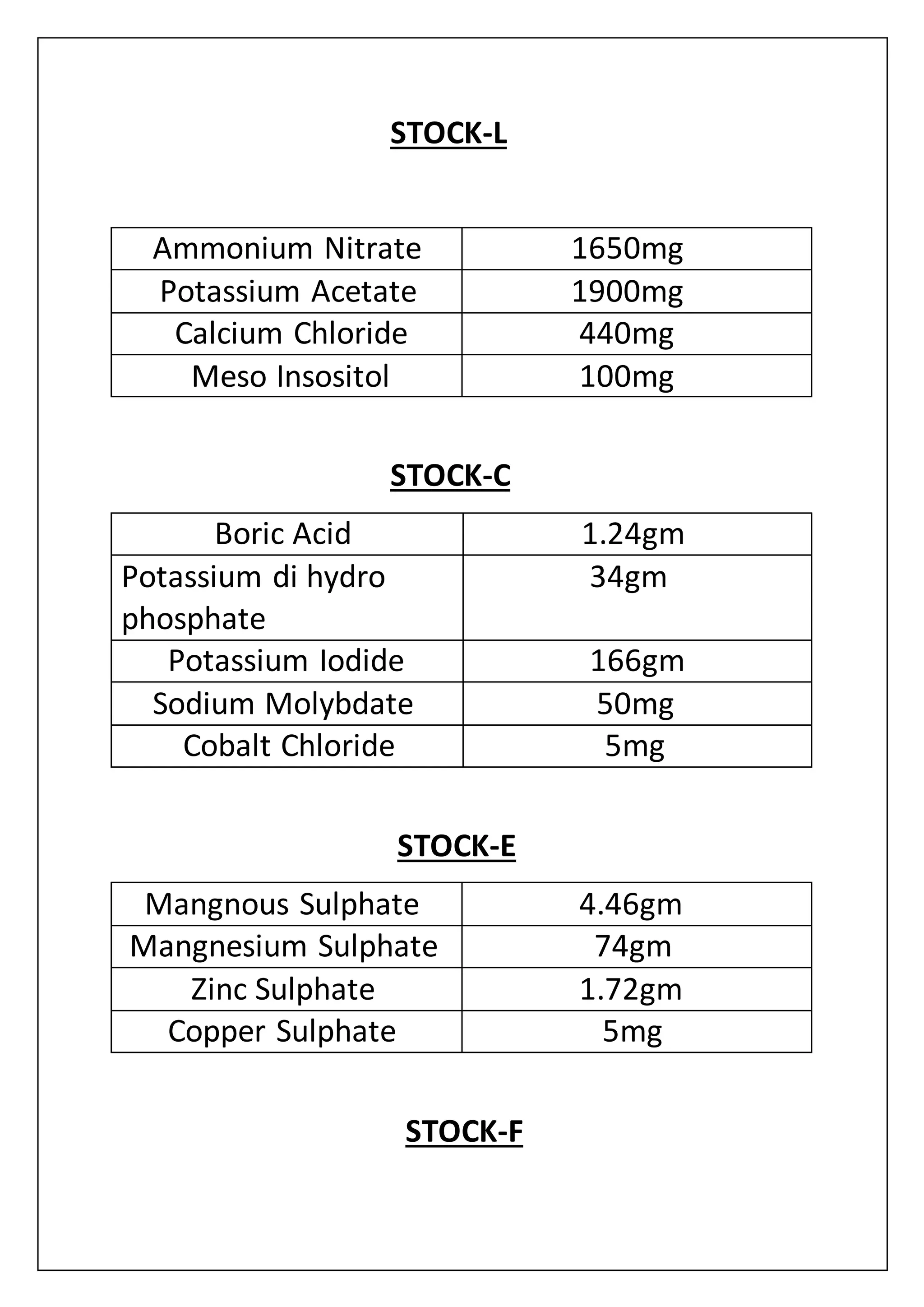
ii. MS media composition:-
STOCK-L
Ammonium Nitrate 1650mg
Potassium Acetate 1900mg
Calcium Chloride 440mg
Meso Insositol 100mg
STOCK-C
Boric Acid 1.24gm
Potassium di hydro
phosphate
34gm
Potassium Iodide 166gm
Sodium Molybdate 50mg
Cobalt Chloride 5mg
STOCK-E
Mangnous Sulphate 4.46gm
Mangnesium Sulphate 74gm
Zinc Sulphate 1.72gm
Copper Sulphate 5mg
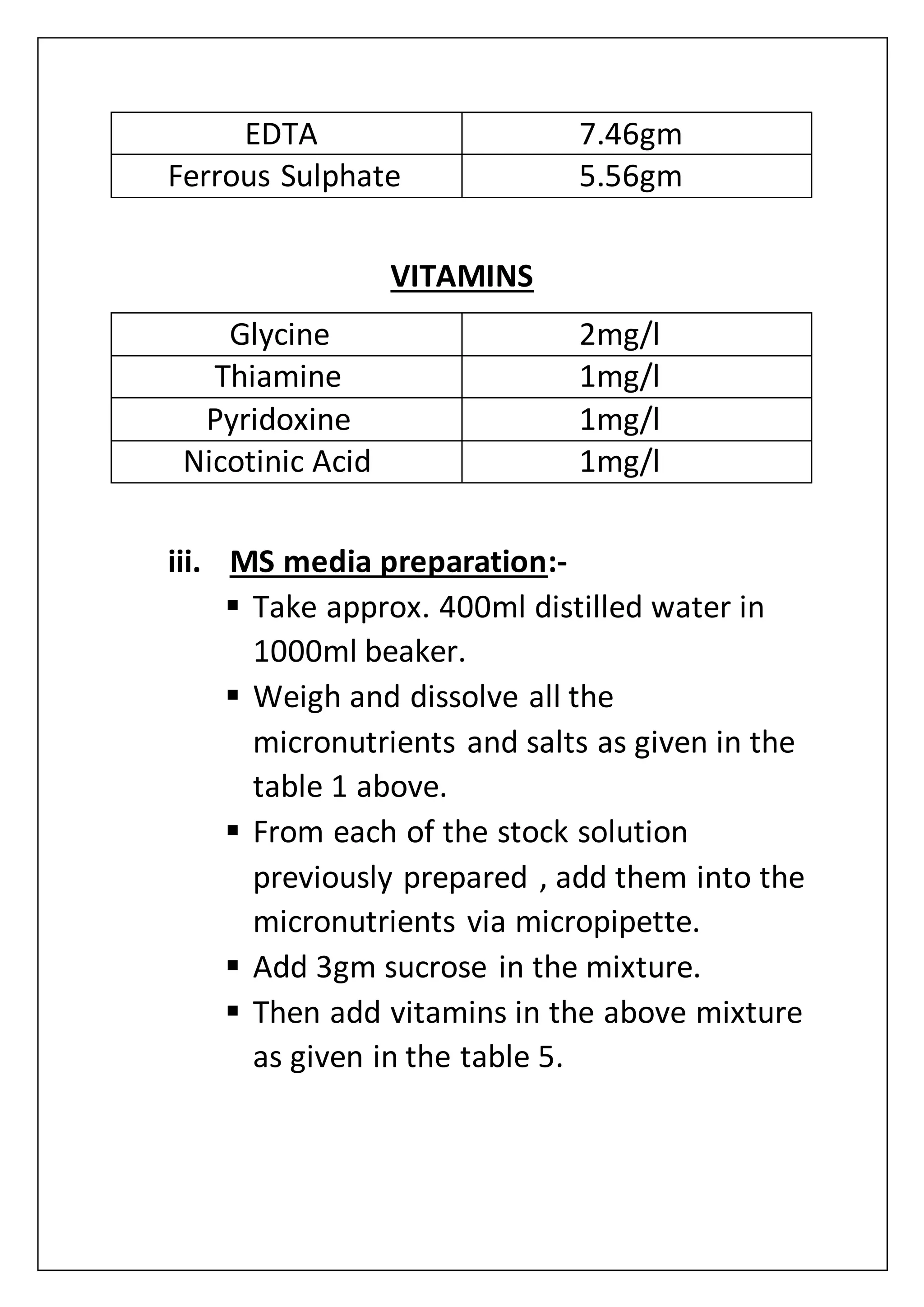
STOCK-F
EDTA 7.46gm
Ferrous Sulphate 5.56gm
VITAMINS
Glycine 2mg/l
Thiamine 1mg/l
Pyridoxine 1mg/l
Nicotinic Acid 1mg/l
iii. MS media preparation:-
 Take approx. 400ml distilled water in
1000ml beaker.
 Weigh and dissolve all the
micronutrients and salts as given in the
table 1 above.
 From each of the stock solution
previously prepared , add them into the
micronutrients via micropipette.
 Add 3gm sucrose in the mixture.
 Then add vitamins in the above mixture
as given in the table 5.
 While stirring the solution, pH of the
soluton is maintained at 5.8 by adding
NaOH and HCL.
 Add double distilled water until the
volume of mixture becomes
500ml(volume makeup).
 Add 15gm agar into the mixture and
dissolve it properly by heating the
mixture in microwave.
 After slight cooling, pour the mixture
into the culture bottles and close it
tightly and clean wrap it.
 Autoclave the culture bottles at 15p.s.i.
and 121°C.
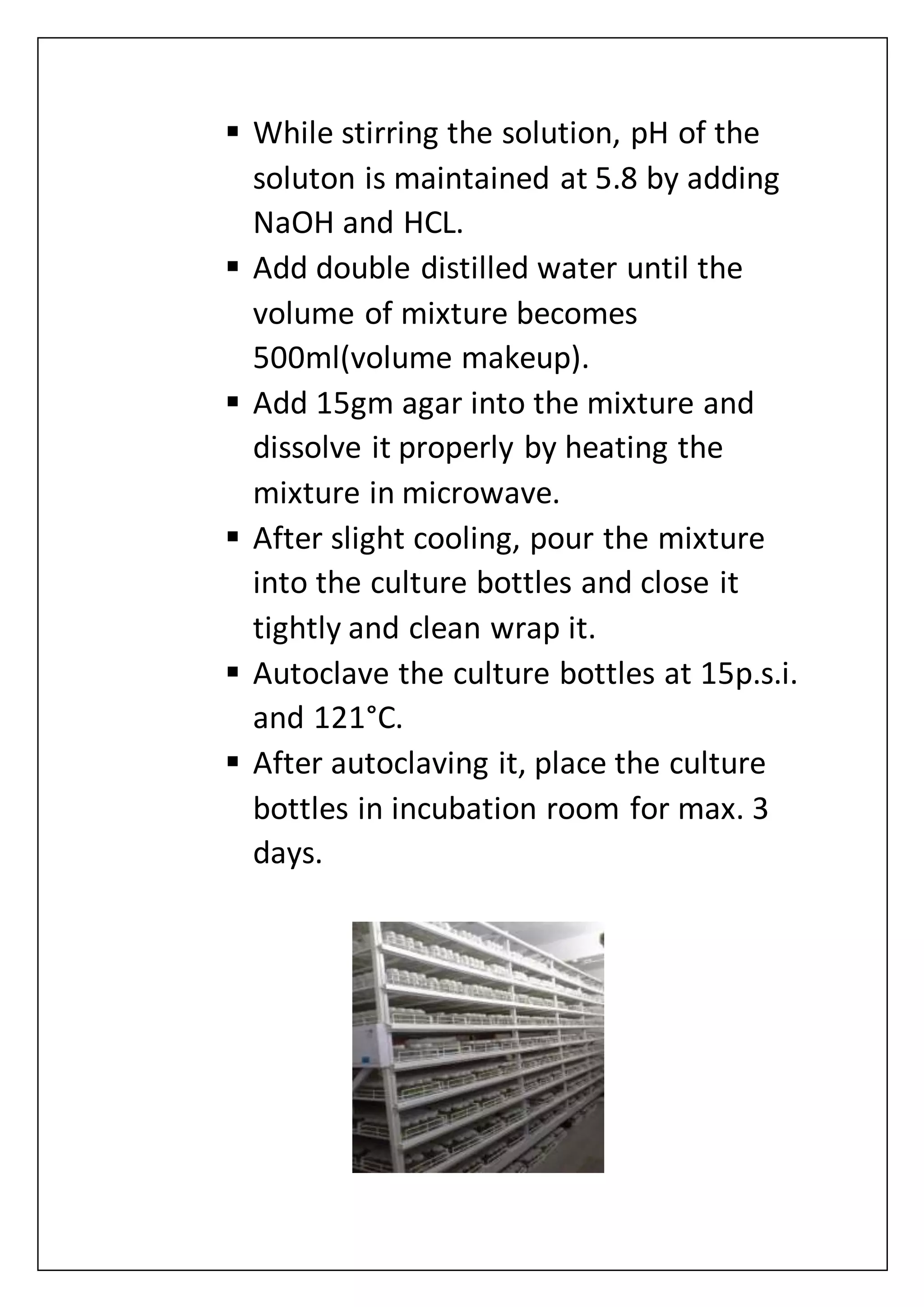
 After autoclaving it, place the culture
bottles in incubation room for max. 3
days.
BANANA TISSUE CULTURE
METHODOLOGY:-
i. Explant(sucker) Selection: Shoot tips of
youthful suckers of 40cm to 100cm are
utilized as an explants for fast in-vitro
duplication of banana. For these shoots,
tissue of around 1 cubic cm to 2 cubic cm
containing the apical meristem is isolated
from the banana suckers. The development
of shoot societies will begin routinely from
any plant part that contains a shoot
meristem, i.e., the horizontal, little suckers,
parental pseudo stem and peepers.
The explants are then further decreased in
size(0.5mm to 1mm length).
Fig. SUCKER SELECTION
ii. Sterilization of Explant: The readied suckers
are taken into the lab for further process.
To expel or kill parasitic spores and growth,
the cut part of suckers are firstly dipped in
5% NaOCl(Sodium hypochloride) for 20 min.
After the second cutting, the cut parts are
dipped in mixture of 0.1%
bavistin(fungicide) and ampicillin(antibiotic-
500mg/lt.) for 20 min. The complete
washing process described above is for
surface sterilisation of the explant taken.
The steps after this is performed in laminar
air flow.
Wash the cut parts in distilled water for 2 to
3 times. Further, dip the cut parts in 0.5%
HgCl2 for 45min. or 1hr. Again wash the cut
parts with double distilled water for 3 times.
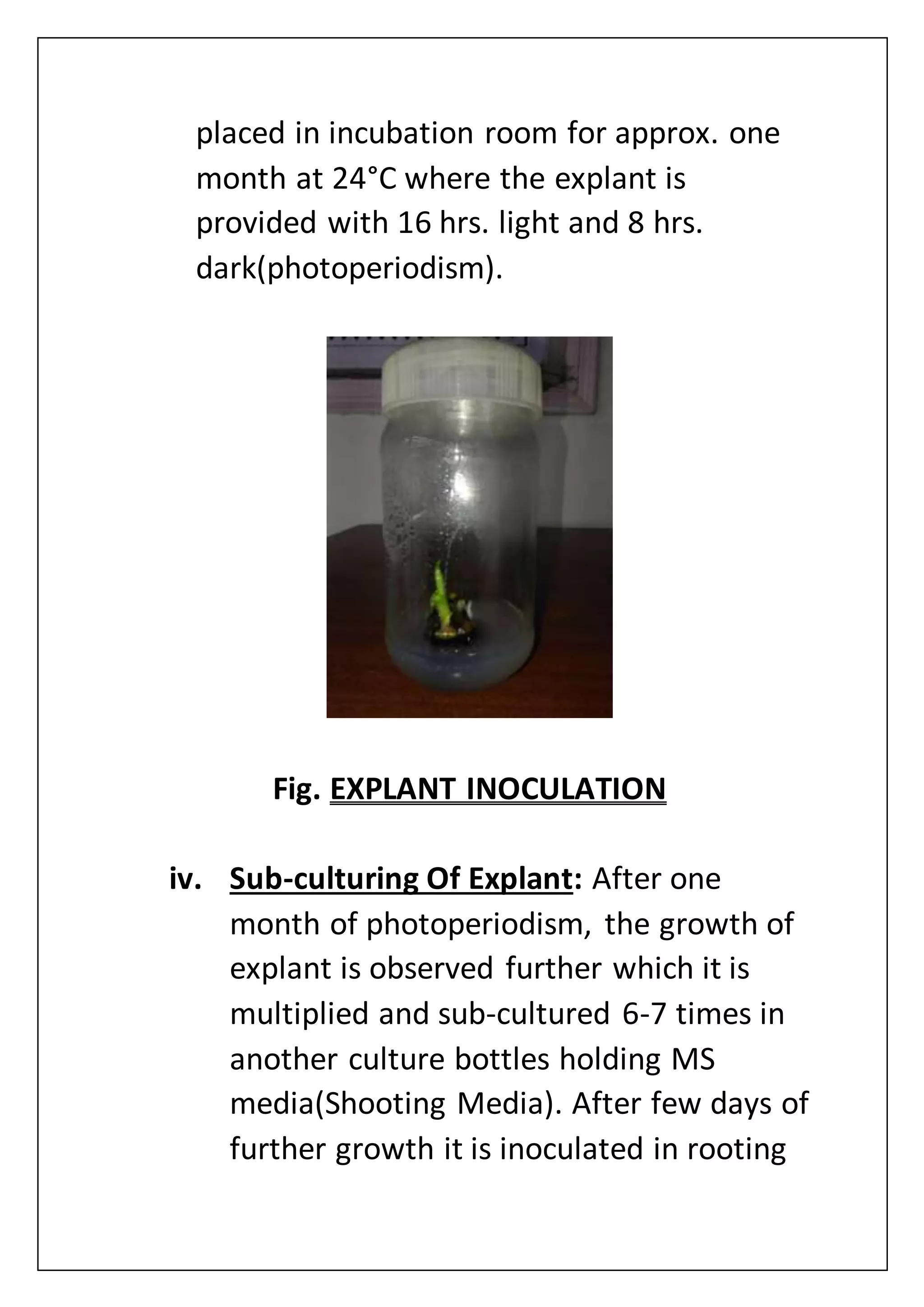
iii. Inoculation Of Explant: After the prolonged
sterilization process, the explant is
inoculated in MS media very carefully
without disturbing the gel. After the
completion of inoculation process, the
culture bottles are clean wrapped and
placed in incubation room for approx. one
month at 24°C where the explant is
provided with 16 hrs. light and 8 hrs.
dark(photoperiodism).
Fig. EXPLANT INOCULATION
iv. Sub-culturing Of Explant: After one
month of photoperiodism, the growth of
explant is observed further which it is
multiplied and sub-cultured 6-7 times in
another culture bottles holding MS
media(Shooting Media). After few days of
further growth it is inoculated in rooting
media(MS media+charcoal). This time MS
media consists of auxin instead of
cytokinin.
[In shooting media the explant
multiplies in terms of branches while in
rooting media it elongates and give rise
to roots.]
[1] [2]
Fig. SHOOTING MEDIA[1]
ROOTING MEDIA[2]
After few days of growth in rooting media, small
saplings are transferred into green house where it
is planted in cocopits containing autoclaved
coconut husk and the temperature is slightly
increased(28°c) as compared to the temperature
of incubation room and the humidity is kept
approx. 75-76.
After three months of growth in green house, the
grown plants are transferred to shade house
where it is kept under sun rays which reaches to it
after being filtered via net.
Further, it is planted in the main field.
 Importance Of Tissue Culture:
i. In a relatively short time and space a large
number of plantlets can be produced
starting from the single explant.
ii. Taking an explant does not usually
destroy the mother plant, so rare and
endangered plants can be cloned safely.
iii. It is easy to select desirable traits directly
from the culture setup(in vitro) thereby
decreasing the amount of space required,
for field trials.
iv. Once established, a plant tissue culture
line can give a continuous supply of young
plants throughout the year.
v. The time required is much shortened, so
no need to wait for the whole life cycle of
seed development. For species that have
long generation time, low level of seed
production, or seeds that readily do not
germinate, rapid propagation is possible.
vi. In vitro, growing plants are usually free
from the bacterial and fungal diseases.
Due to virus eradication and maintenance
of plants in virus free state, it is possible
to facilitate movement of plants across
international boundaries.
vii. Plant tissue banks can be frozen and then
regenerated through tissue culture. It
preserves the pollen and cell collections
from which plants maybe propagated.
 Advantages Of Tissue Culture:- Suckers for
the most part would have been as of now
tainted with a few pathogens and nematodes,
so they can be treated with anti-infection
agents before refined.
To defeat variety in size of sucker and age,
reaping is drawn out and administration gets
to be troublesome. They are sound, sickness
free, uniform and credible, true to the kind of
mother plant under well administration, pests
and malady free plantlet seedlings, explants
yield, uniform development, early
development of product-greatest area use is
conceivable in marsh holding nation like India.
World Of Biotechnology

World Of Biotechnology

  • 1.
    A) GENERAL INTRODUCTION OFINSTRUMENTS 1) AUTOCLAVE An autoclave is a device that uses pressure to heat aqueous solutions above their boiling point. It is done to kill microbiological organisms, called sterilization. The autoclave was invented by Charles Chamberland in 1879. The standard temperature/pressure employed is 121 degree Celsius/15 p.s.i(pounds per square inch). When the materials are placed inside the autoclave they are exposed to high temperature steam for about twenty minutes.
  • 2.
     Principle:- Theprinciple of the autoclave or steam sterilizers is that water boils when its vapour pressure equals that of the surrounding atmosphere. When pressure inside the closed vessel increases, the temperature at which water boils also increases.
  • 3.
    2) HOT AIROVEN Hot air ovens are electrical devices which use dry heat to sterilize. They were originally developed by Pasteur. Generally, they can be operated from 50 to 300 degree Celsius, using a thermostat to control the temperature. Their double walled insulation keeps the heat in and conserves energy, the inner layer being a poor conductor and outer layer being metallic. There is also an air filled space in between to aid insulation. An air circulating fan helps in uniform distribution of the heat. These are fitted with the adjustable wire mesh plated trays or aluminium trays as well as indicators and controls for temperature and holding time.  Principle:- Sterilizing by dry heat is accomplished by conduction. The heat is absorbed by the outside surface of the material, then passes towards the centre of the material, layer by layer. The entire material will eventually reach the temperature required for sterilization to take place.
  • 4.
     Advantages &Disadvantages:- They do not require water and there is not much pressure build up within the oven, like an autoclave, making them safer to work with. This also makes them more suitable to be used in a laboratory environment. They can be more rapid than an autoclave and higher temperatures can be reached compared to other means.
  • 5.
    3) LAMINAR AIRFLOW A laminar air flow is a carefully enclosed bench designed to prevent contamination of biological samples, or any particle sensitive materials. Air is drawn through a HEPA filter and blown in a very smooth, laminar flow towards the user. The cabinet is usually made of stainless steel with no gaps or joints where spores might collect. They exist in both horizontal and vertical configurations, and there are many different types of cabinets with a variety of airflow patterns and acceptable uses.
  • 6.
    Laminar air flowhave a UV light to sterilize the interior and contents before usage to prevent the contamination of experiment. UV is usually kept on for 15 minutes to sterilize the interior and no contact is to be made with a laminar air flow during this time(It is important to switch this light off during use, to limit exposure to skin and eyes as stray ultraviolet light emissions can cause mutations.)
  • 7.
    4) CENTRIFUGE A centrifugeis a piece of equipment that puts an object in rotation around a fixed axis(spins it in a circle) applying a force perpendicular to the axis of spin(outward) that can be very strong. In a laboratory centrifuge that uses sample tubes, the radial acceleration causes denser particles to settle to the bottom of the tube, while low density substances rise to the top. A wide variety of laboratory scale centrifuges are used in chemistry, biology, biochemistry and clinical medicine for isolating and separating suspensions and immiscible liquids. DNA preparation is another common application for clinical diagnosis. DNA samples are purified and the DNA is prepped for separation by adding buffers and then centrifuging it for a certain amount of time. The rotating unit, called the rotor, has fixed holes drilled at an angle. Sample tubes are placed in these slots and the motor is spun. These angle rotors are very popular in the lab for routine use.
  • 8.
     Principle:- Thecentrifuge works using the sedimentation principle, where the centrifugal acceleration causes denser substances and particles to move outward in the radial direction. At the same time, objects that are less dense are displaced and move to the centre.
  • 9.
    5) INCUBATOR A laboratoryincubator is a heated, insulated box used to grow and maintain microbiological cultures or cell cultures. The incubator maintains optimal temperature, humidity and other conditions such as the CO2 and oxygen content of the atmosphere inside. Incubators are essential for a lot of experimental work in cell biology, microbiology and molecular biology and are used to culture both bacterial as well as eukaryotic cells. The most commonly used temperature for bacteria such as the frequently used E.coli is approximately 37 degree celsius, as these organisms grow well under such conditions.
  • 10.
    An incubator ismade up of a chamber with a regulated temperature. Some incubators also regulate humidity, gas composition, or ventilation within that chamber. The main purpose of the incubator is to create a stable, controlled environment conducive to research, study and cultivation. Incubators serve a variety of functions in a scientific lab. Incubators generally maintain a constant temperature, however additional features are often built in. Many incubators also control humidity. Shaking incubators incorporate movement to mix cultures. Some incubators have a means of circulating the air inside of them to ensure even distribution of temperatures. Many incubators built for laboratory use have a redundant power source, to ensure that power outages do not disrupt experiments. Incubators are made in a variety of sizes, from tabletop models, to warm rooms, which serve as incubators for large numbers of samples.
  • 11.
    6) THERMOCYCLER The thermalcycler(also known as thermocycler, PCR machine or DNA amplifier) is a laboratory apparatus most commonly used to amplify segments of DNA via the polymerase chain reaction(PCR). Thermal cyclers may also be used in laboratories to facilitate other temperature- sensitive reactions, including restriction enzyme digestion or rapid diagnostics. The device has a thermal block with holes where tubes holding the reaction mixtures can be inserted. The cycler then raises and lowers the temperature of the block in discrete, pre-programmed steps. The PCR process is adapted to the use of thermostable DNA polymerase from Thermus aquaticus, which greatly simplified the design of the thermal cycler. Thermal cyclers designed for quantitative PCR have optical systems which enable fluorescence to be monitored during reaction cycling.
  • 12.
    Modern thermal cyclersare equipped with a heated lid that presses against the lids of the reaction tubes. This prevents condensation of water from the reaction mixtures on the insides of the lids. Some thermal cyclers are equipped with a fully adjustable heated lid to allow for nonstandard or diverse types of PCR plasticware. Some thermal cyclers are equipped with multiple blocks allowing several different PCR reactions to be carried out simultaneously. Some models also have a gradient function to allow for different temperatures in different parts of the block. This is particularly useful when testing suitable annealing temperatures for PCR primers.
  • 13.
    7) GEL DOC Agel doc, also known as gel documentation system, gel image system or gel imager, refers to equipment widely used in molecular biology laboratories for the imaging and documentation of nucleic acid and protein suspended within agarose gels. These gels are typically stained with ethidium bromide. Generally, a gel doc includes an ultraviolet(UV) light transilluminator, a hood or a darkroom to shield external light sources and protect the user from UV exposure, and a CCD or CMOS camera for image capturing.
  • 14.
    8) pH METER ApH meter is a scientific instrument that measures the hydrogen-ion activity in water- based solutions, indicating its acidity or alkalinity expressed as pH. The pH meter measures the difference in electrical potential between a pH electrode and a reference electrode, and so the pH meter is sometimes referred to as a “potentiometric pH meter”. The difference in electrical potential relates to the acidity or pH of the solution. The pH meter is used in many applications ranging from laboratory experimentation to quality control.  Principle:- Potentiometric pH meters measure the voltage between two electrodes and display the result converted into the corresponding ph value. They comprise a simple electronic amplifier and a pair of electrodes, or alternatively a combination electrode. The electrodes, or probes, are inserted into the solution to be tested.
  • 15.
    The electrodes arerod-like structures usually made of glass, with a bulb containing the sensor at the bottom. The glass electrode for measuring the pH has a glass bulb specifically designed to be selective to hydrogen-ion concentration. On immersion in the solution to be tested, hydrogen ions in the test solution exchange for other positively charged ions on the glass bulb. The electronic amplifier detects the difference in electrical potential between the two electrodes generated in the measurement and converts the potential difference to pH units. The magnitude of the electrochemical potential across the glass bulb is linearly related to the pH according to the Nernst equation.
  • 16.
    9) VORTEX MIXER Avortex mixer, or vortexer, is a simple device used commonly in laboratories to mix small vials of liquid. It consists of an electric motor with the drive shaft oriented vertically and attached to a cupped rubber piece mounted slightly off-center. As the motor runs the rubber piece oscillates rapidly in a circular motion. When a test tube or other appropriate container is pressed into the rubber cap (or touched to its edge) the motion is transmitted to the liquid inside and a vortex is created. Most vortex mixers are designed with 2 or 4-plate formats, have variable speed settings ranging from 100 to 3200 rpm, and can be set to run only when downward pressure is applied to the rubber piece.
  • 17.
    In cell cultureand microbiology laboratories they may be used to suspend cells. In a biochemical or analytical laboratory they may be used to mix the reagents of an assay or to mix an experimental sample and a dilutant. The vortex mixer was invented by the Kraft brothers(Jack A. Kraft and Harold D. Kraft) while working for Scientific Industries. An alternative to the electric vortex mixer is the “finger vortex” technique in which a vortex is created manually by striking a test tube in a forward and downward motion with one’s finger or thumb. Vortex mixers are ideal for a wide variety of molecular biology applications including immunochemical reactions, enzyme and protein analysis, and microarray analysis.
  • 18.
    10) WATER BATH Awater bath is laboratory experiment made from a container filled with heated water. It is used to incubate samples in water at a constant temperature over a long period of time. All water baths have a digital or an analogue interface to allow users to set a desired temperature. Utilisations include warming of reagents, melting of substrates or incubation of cell cultures. It is also used to enable certain chemical reactions to occur at high temperature. Water bath is a preferred heat source for heating flammable chemicals instead of an open flame to prevent ignition. For all water baths, it can be used up to 99.9 degree celsius.
  • 19.
    11) MAGNETIC STIRRER Amagnetic stirrer or magnetic mixer is a laboratory device that employs a rotating magnetic field to cause a stir bar immersed in a liquid to spin very quickly, thus stirring it. The rotating field may be created either by a rotating magnet or a set of stationary electromagnets, placed beneath the vessel with the liquid. Because of its small size, a stirring bar is more easily cleaned and sterilized than other stirring devices. They do not require lubricants which could contaminate the reaction vessel and the product. Magnetic stirrers may also include a hot plate or some other means for heating the liquid.
  • 20.
    12) ORBITAL SHAKER Anorbital shaker has a circular shaking motion with a slow speed(25-500rpm). It is suitable for culturing microbes, washing blots, and general mixing. Some of its characterisitcs are that it does not create vibrations, and it produces low heat compared to other kinds of shakers, which makes it ideal for culturing microbes. Moreover, it can be modified by placing it in an incubator to create an incubator shaker due to its low temperature and vibration.
  • 21.
    13) ELECTROPHORETIC CHAMBER Itis a laboratory apparatus in which the gel of agarose is cast and several samples of macromolecules are loaded to make it run by providing electric current. It helps in clinical chemistry to separate proteins by charge and/or size and in biochemistry and molecular biology to separate a mixed population of DNA and RNA fragments by length, to estimate the size of DNA and RNA fragments or to separate proteins by charge.
  • 22.
    B) MOLECULAR BIOLOGY TECHNIQUES Molecularbiology techniques are common methods used in molecular biology, biochemistry, genetics and biophysics which generally involve manipulation and analysis of DNA, RNA, protein and lipid. 1) PLANT DNA ISOLATION BY “cTAB” METHOD  Introduction:-The use of cTAB based extraction method facilitates the separation of polysaccharides during the purification while additives, such as polyvinyl pyrolidone helps in removal of polyphenols. cTAB based extraction buffers are widely used for purifying DNA from plant samples.  Materials:- cTAB buffer Appendorf tubes
  • 23.
    Liquid nitrogen Micropistil Absolute alcohol(chilled) 70%ethanol(chilled) 3M Sodium acetate Chloroform & Isoamyl alcohol(24:1) 1% β mercaptoethanol MQ  Methods:- COLLECTION OF LEAF Fresh leaf sample was collected from the female chilli plant(Capsicum annum). The DNA was isolated by modified cTAB method(Cetyl Trimethyl Ammonium bromide). STOCK SOLUTION PREPARATION  0.5M EDTA(pH 8.0) 18.62 gm EDTA in 100ml distilled water
  • 24.
     3M SodiumAcetate 20.412 of sodium acetate was dissolved in 50ml distilled water  50x TAE(pH 8.3)  Chloroform:Isoamyl alcohol(C.I.=24:1) Chloroform=96ml Isoamyl alcohol=4ml  Protocol for DNA isolation by cTAB method:- I. Collection of leaf sample. (Leaf samples are collected in double disc form in an appendorf tube) II. 10mg PVP(Poly Vinyl Pyrolidone) is then added to the tube. III. Crushing of leaf samples is done by adding liquid nitrogen to the tube via micropistil. IV. 650µl cTAB buffer is added along with 1% β mercapto ethanol to the tube and mix the sample properly. V. Keep the sample in water bath for 45 min. at 65°C and shake the sample after every 10 min.
  • 25.
    VI. After coolingadd 650µl CI(24:1) and shake. VII. Centrifuge the tubes at 10000rpm for 10 min. VIII. Collect the supernatant carefully in a different tube and add equal amount of CI to it. IX. Centrifuge the tubes at 10000rpm for 10 min. X. Take out the supernatant carefully and add 1/10 3M sodium acetate(pH- 5.2) and double the volume of absolute alcohol(chilled). XI. Shake the tubes and observe tiny threads of DNA. XII. Keep the DNA samples for 1-2 hours at -20°C. XIII. Take the sample and centrifuge the tubes at 10000rpm for 10 min. XIV. Discard the supernatant and wash the pallet with 200µl of 70% ethanol. XV. After washing centrifuge at 10000rpm for 5 min. and dry the pallet at 45°C- 60°C in hot air oven.
  • 26.
    XVI. Now add50µl MQ per sample, then keep the appendorf tube in hot air oven so that the DNA will dissolve in MQ(5-10 min. at 65°C). XVII. Store the DNA sample at -4°C. 2) ELECTROPHORESIS OF PLANT DNA  Introduction:- Gel electrophoresis is a method for separation and analysis of macromolecules(DNA, RNA and Proteins) and their fragments, based on their size and charge. Nucleic acid molecules are separated by applying electric field to move the negatively charged molecules through a matrix of agarose. Checking the quality of DNA is done by agarose gel electrophoresis. For quantification of DNA sample, 1% agarose gel is prepared and checked in a gel doc system.  Materials:- Agarose powder TAE buffer
  • 27.
    Distilled water Ethidium bromide Gelcasting tray & comb Electrophoretic chamber Dye(Bromo Phenol Blue) Paraffin MQ  Steps for preparing the agarose gel:- The 1% agarose gel is prepared by taking:  2ml 50x TAE buffer  98ml distilled water  1gm agarose powder  6µl ethidium bromide(conc.-10mg/ml) I. Preparation of 1% agarose gel: Mix 1gm agarose powder with 98ml distilled water and 2ml 50x TAE buffer and heat in the microwave oven until the agarose powder is dissolved completely. II. Preparation of gel bed:
  • 28.
    The agarose gelis poured in a gel casting tray and comb is added and allowed to set for 15-20 min. After the solidification of agarose gel, remove the comb carefully. III. Electrophoresis chamber: Fill the electrophoresis chamber with buffer completely  14ml 50x TAE  686ml distilled water IV. Loading DNA samples: Mix 5µl loading dye(Bromo Phenol Blue) with 5µl MQ and 7µl DNA sample. Load 17 µl(Dye+MQ+DNA sample) into the wells in a consecutive order with the help of a micropipette. V. Running the gel: After loading of sample carefully, close the cover onto the electrode terminals. Make sure that the positive and negative on the cover and apparatus chamberare properly oriented(black-negative and red- positive).
  • 29.
    VI. Turn onthe power source at 100 V and 200 mA for 1.5 hrs. VII. Allow the tracking dye to migrate(4-5 cm) from the well for adequate separation of DNA bands. Turn off the power. VIII. Now carefully remove the gel from its bed and transfer the gel onto the UV tray. IX. Observe the results on a gel doc system.  Result:- Fig. ELECTROPHORESISANALYSIS BANDS OF ISOLATED GENOMIC DNA
  • 30.
    3) PCR AMPLIFICATIONOF PLANT DNA  Introduction:- PCR(Polymerase Chain Reaction) is the technique developed by kary mullis, in 1983. It is a technique used in molecular biology to amplify a single copy or a few copies of segment of DNA across several orders of magnitude generating thousands to millions of copies of a particular sequence of DNA. It is an easy, cheap, reliable way to repeatedly replicate a focused segment of DNA. The process of PCR is carried out in device called thermal cycler. it was programmed for 38 cycles. Products of PCR were taken and then electrophoresis was done and was visualized under gel doc system. *The type of PCR used here is End Point PCR.*  Requirements:-
  • 31.
    [MASTERMIX] MQ 10x TBE buffer Mgcl2 dNTPs BSA Tween Taqpolymerase Primer DNA sample  Procedure:- All the PCR components are mixed together and are taken through series of three major cycle reactions conducted in an automated, self contained thermocycler machine. I. DENATURATION: This step involves heating the reaction mixture to 94°C for 20-30 sec. during this, the double stranded DNA is denatured to single strands due to breakage in weak hydrogen bonds.
  • 32.
    II. ANNEALING: Thereaction temperature is rapidly lowered to 45°C for 20-40 sec. This allows the primers to bind(anneal) to their complementary sequence in the template DNA. III. EXTENSION: Extension occurs at 72-80°C for 01:50 min. In this step, the DNA polymerase synthesizes a new DNA strand complementary to the DNA template strand by adding free dNTPs from the reaction mixture that are complementary to the template in the 5’ to 3’ direction, condensing the 5’-phosphate group of the dNTps with the 3’ hydroxy group at the end of the elongating DNA strand.  PCR Components:- S. NO. COMPONENTS QUANTITY(µl) 1 Standard Buffer 2 2 Mgcl2 1
  • 33.
    3 BSA 1 4Dntp 1 5 Tween 0.3 6 Taq Polymerase 0.2 7 Primer 2 8 DNA template 1 9 MQ 11.5 Total quantity 20  Result:- Fig. PCR result of amplification of plant DNA(female chilli)
  • 34.
    4) GENE CLONING& CHARACTERIZATION  Introduction:- The production of exact copies of DNA sequence using genetic engineering techniques is known as gene cloning. The DNA containing the target gene is split into fragments using restriction enzymes. These fragments are then inserted into cloning vectors, which transfer the recombinant DNA to suitable host cells, such as bacterium E.coli. This new genetic combinations clones are of value to science, medicine, agriculture and industry.  Procedure:- I. LIGATION OF BACTERIAL DNA DNA ligases are used restricton enzymes to insert DNA fragments, often genes, into plasmids.  Ligation buffer(10x)= 2ml  Vector= 2µl  Insert= 4µl  Ligase(T4 DNA ligase)
  • 35.
     MQ=11µl Keep itin 4°C overnight. II. PREPARATION OF BACTERIAL COMPETENT CELLS Competent cells are calcium chloride treated to facilitate attachement of the plasmid DNA to the competent cell membrane. The competent cell is alternatively heated in a waterbath. This opens the pores of the cell membrane allowing entry of the plasmid. i. Take overnight culture of E.Coli in vial(2ml). ii. Centrifuge at 10000rpm for 5 min.(37°C). iii. Discard the supernatant and add 0.1M Cacl2(equal to the volume of culture= 2ml). iv. Incubate in ice for 30 min. v. Centrifuge at 10000rpm for 8 min. vi. Discard the supernatant and add 600µl Cacl2. vii. Distribute 200µl of cells in each vial. viii. For preservation add 1/10 DMSO(Dimethyl Sulfoxide) or glycerol.
  • 36.
    III. TRANSFORMATION BYHEAT SHOCK METHOD Transformation is the process in which the genetic makeup of cell is changed by the introduction of DNA from the outer environment. i. Keep the ligation mixture at 65°C for 10min. ii. Add different amount of ligation mixture into 200µl of cells(generally 3µl of ligation mixture is added). iii. After this add +ve control(2µl) in one vial, and one was kept –ve. iv. Give heat shock at 43°c for 2 min. and mix it properly. v. Again give ice incubation for 5 min. vi. Then add 800µl of LB broth and keep on shaking at 37°C for 1 hour. vii. Spin at 10000rpm fpr 2 min. viii. Remove 600µl of supernatant and spread 200µl of bacterial cells on antiobiotic(ampicillin-AMP) conatining plates.
  • 37.
    Fig. AMP BACTERIALCULTURE PLATES 1) LB 2) LB 3) +ve CONTROL 4) –ve
  • 38.
    IV. REPLICA PLATING Replicaplating is a microbiological technique in which one or more secondary petri plates containing different solid(agar-based) selective growth media are inoculated with the same colonies of microorganisms from a primary plate, reproducind the original spatial pattern of colonies. i. Make some columns(say 30) in fresh media plate(AMP plates) and mark each box. ii. Take bacterial culture which was previously grown overnight with the help of tip. iii. Inoculate the different picked bacterial culture in the fresh media plate by dotting it in the columns. iv. Place it in shaking incubator for overnight(24 hrs.) at 37°C.
  • 39.
    V. PLASMID ISOLATION i.Take 2ml of culture. ii. Spin the tube at 10000rpm for 1 min. amd discard supernatant. iii. Again add 2ml of culture in vial, spin for 2 min at 10000rpm. iv. Add 250µl of “soln. A” and vortex it, incubate in ice for 2 min. v. Add 500µl of “soln. B” and incubate it in ice for 5 min. vi. Add 400µl of “soln. C”, vortex it and incubate it in ice for 5 min. vii. Spin in 10000rpm for 5 min. viii. Take 800µl of supernatant. ix. Add 700µl CI and vortex it. x. Spin at 10000rpm for 5 min. xi. Take supernatant 700µl. xii. Add 1/10th volume of 3M sodium acetate(70µl; pH- 5.2) and double the volume of isopropanol(1400µl). xiii. Freeze in liquid nitrogen. xiv. Spin at 10000rpm for 10 min. xv. Discard supernatant and add 200µl of 75% alcohol.
  • 40.
    xvi. Vaccum dryand add 50µl of MQ.  Precautions:- Solution should be pre-chilled. Incubation should be done in ice.  Result:- Fig. BANDS OF PLASMID
  • 41.
    C) MICROBIOLOGY TECHNIQUES Microbiology techniquesare methods used for the study of microbes, including bacteria and microscopic fungi and protists. They include methods to survey, culture, stain, identify, engineer and manipulate microbes. 1) ISOLATION OF PURE CULTURE  Introduction:- A pure culture theoretically consists a single bacterial species. There are a number of procedures available for the isolation of pure cultures from mixed populations. A pure culture may be isolated by the use of special media with specific chemical or physical agents that allow the enrichment or selection of one organism over another. Simpler methods for isolation of a pure culture include:
  • 42.
     Spread platingon solid agar medium with a glass spreader  Streak plating with a loop The purpose of spread plating and streak plating is to isolate individual bacterial cells(colony-forming units) on a nutrient medium. I. SPREAD PLATE TECHNIQUE  Introduction:- Spread plate technique is the method of isolation and enumeration of microorganisms in a mixed culture and distributing it evenly. The technique makes it easier to quantify bacteria in a solution. The spread plate technique involves using a sterilized spreader with a smooth surface made of metal or glass to apply a small amount of bacteria suspended in a solution over a plate. The plate needs to be dry and kept at room temperature so that the agar can absorb the bacteria more readily. A successful spread plate will have a countable
  • 43.
    number of isolatedbacterial colonies evenly distributed on the plate.  Procedure:- i. Make a dilution series from a sample. ii. Pipette out 0.1ml from the appropriate desired dilution series onto the center of the surface of an agar media plate. iii. Dip the L-shaped glass spreader into alcohol. iv. Flame the glass spreader over a bunsen burner. v. Spread the sample evenly over the surface of agar using the sterile glass spreader, carefully rotating the petridish underneath at the same time. vi. Incubate the plate at 37°C for 24 hrs.
  • 44.
     Result:- Fig. SPREADPLATE METHOD  Applications:- i. It is used for viable plate counts, in which the total number of colony forming units on a single plate is enumerated. ii. It is used to calculate the concentration of cells in the tube from which the sample was plated. iii. Spread plating is routinely used in enrichment, selection and screening experiments.
  • 45.
    II. STREAK PLATETECHNIQUE  Introduction:- Streak plate technique is used for the isolation into pure culture of the organisms(mostly bacteria), from mixed population. The inoculum is streaked over the agar surface in such a way that it separates the bacteria. Some individual bacterial cells are separated and well spaced from each other. As the original sample is diluted by streaking it over successive quadrants, the number of organisms decreases. Usually by the third or fourth quadrant only a few organisms are transferred which will give discrete colony forming units(CFUs).  Principle:- The sample/inoculum is diluted by streaking it across the surface of the agar plate. While streaking in successive areas of the plate, the inoculum is diluted to the point where there is only one bacterial cell deposited every few millimeters on the surface of the agar plate. When these lone
  • 46.
    bacterial cells divideand give rise to thousands and thousands of new bacterial cells, an isolated colony is formed. Pure cultures can be obtained by picking well isolated colonies and re-streaking these on fresh agar plates.  Procedure:- i. Sterilize the inoculating loop in the bunsen burner by putting the loop into the flame until it is red hot. Allow it to cool. ii. Pick an isolated colony from the agar plate culture and spread it over the first quadrant(approx. 1/4th of the plate) using closed parallel streaks or insert your loop into the tube/culture bottle and remove some inoculum. A huge chunk is not needed. iii. Immediately streak the inoculating loop very gently over a quarter of the plate using a back and forth motion. iv. Flame the loop again and allow it to cool.
  • 47.
    v. Repeat theabove process if another culture plate is streaked.  Result:- Streaked plates are incubated at 37°C for 24 hrs. Examine the colonies grown in the plate carefully. All colonies should have the same general appearance. [1] [2] Fig. ZIG-ZAG STREAKING[1] QUADRANT STREAKING[2]
  • 48.
    2) FUNGAL DNAISOLATION I. PROTOCOL FOR FUNGAL DNA ISOLATION  Inoculation:- i. Prepare the PDB broth(24gm for 1000ml). ii. After this, autoclave the broth at 15p.s.i and 121°C. iii. Take a previously grown fungi culture plate for inoculation in PDB broth. iv. Pick a small culture with the help of tip and drop(inoculate) it in the falcum tube containing the PDB broth. v. Cover tightly with clean rap and place it in shaking incubator at 27-28°C for max. 7 days(growth can also be observed in min. 3 days).  Isolation:- i. Take appendorf tube of 1.5ml and add 300µl lysis buffer(when we use broth
  • 49.
    culture first spinthe culture and then add lysis buffer in the pallet). Lysis buffer is used for purpose of breaking open cells for use in experiments that analyze the compounds of the cell. ii. Add small lump of mycelium from culture by using sterile tip. iii. Incubate the tube at R.T. for 10min. iv. After that add 150µl of potassium acetate(pH-4.8). Potassium acetate helps in DNA percipitation. v. Vortex the tube. vi. Centrifuge at 10000rpm for 1 min. vii. Transfer the supernatant in another 1.5ml appendorf tube. viii. Centrifuge again at 10000rpm for 1 min. ix. Again transfer the supernatant in new tube and add equal volume of isopropyl alcohol. x. Again mix by inversion. xi. Centrifuge at 10000rpm for 2 min. xii. Discard the supernatant.
  • 50.
    xiii. Wash theDNA pallet in 300µl of 70% ethanol. xiv. Centrifuge at 10000rpm for 1 min. xv. Discard the supernatant. xvi. Vaccum dry the DNA pallet and store it by adding 50µl MQ. II. ELECTROPHORESIS OF FUNGAL DNA Agarose gel electrophoresis of a subset of the DNA preparation:-
  • 51.
    III. PCR AMPLIFICATIONOF FUNGAL DNA  Requirements:- 10x TAE buffer BSA dNTPs Taq polymerase 2 primers(Forward- ITS4R; Reverse- ITS1SSF) DNA template MQ  Result:-
  • 52.
    D) PLANT TISSUECULTURE  Introduction:- Plant tissue culture is an essential component of plant biotechnology. Apart from mass multiplication of elites, it also provides the means to multiply and regenerate novel plants from genetically engineered cells. The promising plant thus produced may be readily cloned in cultures under aseptic conditions Tissue culture is widely used in:  Obtaining disease free plants. Rapid propagation of plants those are difficult to propagate. Somatic hybridization. Genetic improvement of commercial plants.
  • 53.
     Types oftissue culture:- i. Callus culture: Callus culture may be defined as production and maintenance of an unorganised mass of proliferative cell from isolated plant cell, tissue or organ by growing them on artificial nutrient medium in glass vials under controlled aseptic conditions. ii. Organ culture:- The organ culture refers to the in vitro culture and maintenance of an excised organ primordial or whole part of an organ in way and function. That may allow differentiation and preservation of the architecture.  MS media:- i. Principle:- Growth and morphogenesis of plant tissue in vitro are largely governed
  • 54.
    by composition ofculture media. The basic requirements of cultured plant tissue are similar to those of whole plant, but in practice, nutritional components promoting optimal growth of tissue under laboratory conditions may vary with respect to particular species. Media composition are therefore prepared considering specific requirement of particular culture system. Plant tissue culture media greatly influence the growth of various types of cells or explant and further helps to achieve regeneration of plants. Murashige and Skoog in 1962 deviced a medium to induce the organogenesis and regeneration of plant tissues in a culture medium. It has been the most widely used medium for regeneration of plant tissues now a days. ii. MS media composition:-
  • 55.
    STOCK-L Ammonium Nitrate 1650mg PotassiumAcetate 1900mg Calcium Chloride 440mg Meso Insositol 100mg STOCK-C Boric Acid 1.24gm Potassium di hydro phosphate 34gm Potassium Iodide 166gm Sodium Molybdate 50mg Cobalt Chloride 5mg STOCK-E Mangnous Sulphate 4.46gm Mangnesium Sulphate 74gm Zinc Sulphate 1.72gm Copper Sulphate 5mg STOCK-F
  • 56.
    EDTA 7.46gm Ferrous Sulphate5.56gm VITAMINS Glycine 2mg/l Thiamine 1mg/l Pyridoxine 1mg/l Nicotinic Acid 1mg/l iii. MS media preparation:-  Take approx. 400ml distilled water in 1000ml beaker.  Weigh and dissolve all the micronutrients and salts as given in the table 1 above.  From each of the stock solution previously prepared , add them into the micronutrients via micropipette.  Add 3gm sucrose in the mixture.  Then add vitamins in the above mixture as given in the table 5.
  • 57.
     While stirringthe solution, pH of the soluton is maintained at 5.8 by adding NaOH and HCL.  Add double distilled water until the volume of mixture becomes 500ml(volume makeup).  Add 15gm agar into the mixture and dissolve it properly by heating the mixture in microwave.  After slight cooling, pour the mixture into the culture bottles and close it tightly and clean wrap it.  Autoclave the culture bottles at 15p.s.i. and 121°C.  After autoclaving it, place the culture bottles in incubation room for max. 3 days.
  • 58.
    BANANA TISSUE CULTURE METHODOLOGY:- i.Explant(sucker) Selection: Shoot tips of youthful suckers of 40cm to 100cm are utilized as an explants for fast in-vitro duplication of banana. For these shoots, tissue of around 1 cubic cm to 2 cubic cm containing the apical meristem is isolated from the banana suckers. The development of shoot societies will begin routinely from any plant part that contains a shoot meristem, i.e., the horizontal, little suckers, parental pseudo stem and peepers. The explants are then further decreased in size(0.5mm to 1mm length). Fig. SUCKER SELECTION
  • 59.
    ii. Sterilization ofExplant: The readied suckers are taken into the lab for further process. To expel or kill parasitic spores and growth, the cut part of suckers are firstly dipped in 5% NaOCl(Sodium hypochloride) for 20 min. After the second cutting, the cut parts are dipped in mixture of 0.1% bavistin(fungicide) and ampicillin(antibiotic- 500mg/lt.) for 20 min. The complete washing process described above is for surface sterilisation of the explant taken. The steps after this is performed in laminar air flow. Wash the cut parts in distilled water for 2 to 3 times. Further, dip the cut parts in 0.5% HgCl2 for 45min. or 1hr. Again wash the cut parts with double distilled water for 3 times. iii. Inoculation Of Explant: After the prolonged sterilization process, the explant is inoculated in MS media very carefully without disturbing the gel. After the completion of inoculation process, the culture bottles are clean wrapped and
  • 60.
    placed in incubationroom for approx. one month at 24°C where the explant is provided with 16 hrs. light and 8 hrs. dark(photoperiodism). Fig. EXPLANT INOCULATION iv. Sub-culturing Of Explant: After one month of photoperiodism, the growth of explant is observed further which it is multiplied and sub-cultured 6-7 times in another culture bottles holding MS media(Shooting Media). After few days of further growth it is inoculated in rooting
  • 61.
    media(MS media+charcoal). Thistime MS media consists of auxin instead of cytokinin. [In shooting media the explant multiplies in terms of branches while in rooting media it elongates and give rise to roots.] [1] [2] Fig. SHOOTING MEDIA[1] ROOTING MEDIA[2]
  • 62.
    After few daysof growth in rooting media, small saplings are transferred into green house where it is planted in cocopits containing autoclaved coconut husk and the temperature is slightly increased(28°c) as compared to the temperature of incubation room and the humidity is kept approx. 75-76. After three months of growth in green house, the grown plants are transferred to shade house where it is kept under sun rays which reaches to it after being filtered via net. Further, it is planted in the main field.  Importance Of Tissue Culture: i. In a relatively short time and space a large number of plantlets can be produced starting from the single explant. ii. Taking an explant does not usually destroy the mother plant, so rare and endangered plants can be cloned safely. iii. It is easy to select desirable traits directly from the culture setup(in vitro) thereby
  • 63.
    decreasing the amountof space required, for field trials. iv. Once established, a plant tissue culture line can give a continuous supply of young plants throughout the year. v. The time required is much shortened, so no need to wait for the whole life cycle of seed development. For species that have long generation time, low level of seed production, or seeds that readily do not germinate, rapid propagation is possible. vi. In vitro, growing plants are usually free from the bacterial and fungal diseases. Due to virus eradication and maintenance of plants in virus free state, it is possible to facilitate movement of plants across international boundaries. vii. Plant tissue banks can be frozen and then regenerated through tissue culture. It preserves the pollen and cell collections from which plants maybe propagated.  Advantages Of Tissue Culture:- Suckers for the most part would have been as of now
  • 64.
    tainted with afew pathogens and nematodes, so they can be treated with anti-infection agents before refined. To defeat variety in size of sucker and age, reaping is drawn out and administration gets to be troublesome. They are sound, sickness free, uniform and credible, true to the kind of mother plant under well administration, pests and malady free plantlet seedlings, explants yield, uniform development, early development of product-greatest area use is conceivable in marsh holding nation like India.