INSTRUMENTS IN
MICROBIOLOGY
LAB PRESENTATION
SUBMITTED BY PRASHANT SINGH
B.Sc CHEMISTRY, Ist Year
SUBMITTED TO Dr. Anju Rani
BOTANY DEPARTMENT
UNIT: I MICROBIAL TECHNIQUES & INSTRUMENTATION
USES
An electromagnet is used to create a force required to
achieve a balance with the mass of the substance, and
the resulting force is displayed.
These types of balances are made with a measuring
pan enclosed in a transparent covering that prevents
small particles or air currents from getting collected on
the pan.
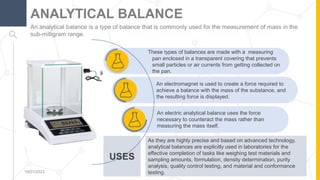
An analytical balance is a type of balance that is commonly used for the measurement of mass in the
sub-milligram range.
ANALYTICAL BALANCE
19/01/2023 2
An electric analytical balance uses the force
necessary to counteract the mass rather than
measuring the mass itself.
As they are highly precise and based on advanced technology,
analytical balances are explicitly used in laboratories for the
effective completion of tasks like weighing test materials and
sampling amounts, formulation, density determination, purity
analysis, quality control testing, and material and conformance
testing.
An Autoclave is a pressurized chamber used for the process of sterilization and disinfection by
combining three factors: time, pressure, and steam.
AUTOCLAVE
19/01/2023 3
1. Autoclaves are mostly used for the
sterilization of medical or laboratory
equipment with the capacity of
sterilizing a large number of materials
at once.
2. They are commonly used for the
preparation of culture media during
laboratory applications.
USES
1. Autoclaves use steam as their
sterilization agent. The basic principle
of an autoclave is that all the items
within the autoclave come in direct
contact with the steam for a particular
period irrespective of the nature of
the material- whether it is liquid,
plastic ware, or glassware.
2. The amount of time and the
temperature depends on the type of
material being sterilized and the
increase in temperature of the cycle
allows for shorter periods.
WORKING PRINCIPLE
USES
On the sides of the tube are openings that can be
adjusted with a collar to control the amount of air that
can enter.
This burner is made with a metal tube on a flat base with
a gas inlet at the bottom of the tube, which may have
an adjustable valve.
Bunsen burner is a standard tool used in laboratories, named after Robert Bunsen. It is a gas-fueled
single open flame.
BUNSEN BURNER
19/01/2023 4
Once the burner is connected to a gas source, the
gas is forced by the gas pressure so that the gas
reaches the top where the flame is ignited with a
match or a lighter.
It is commonly used for processes like sterilization, combustion,
and heating. In medical or microbiology laboratories, it is
commonly used for micro-loop sterilization.
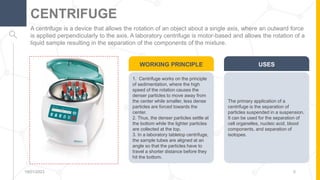
A centrifuge is a device that allows the rotation of an object about a single axis, where an outward force
is applied perpendicularly to the axis. A laboratory centrifuge is motor-based and allows the rotation of a
liquid sample resulting in the separation of the components of the mixture.
CENTRIFUGE
19/01/2023 5
The primary application of a
centrifuge is the separation of
particles suspended in a suspension.
It can be used for the separation of
cell organelles, nucleic acid, blood
components, and separation of
isotopes.
USES
1. Centrifuge works on the principle
of sedimentation, where the high
speed of the rotation causes the
denser particles to move away from
the center while smaller, less dense
particles are forced towards the
center.
2. Thus, the denser particles settle at
the bottom while the lighter particles
are collected at the top.
3. In a laboratory tabletop centrifuge,
the sample tubes are aligned at an
angle so that the particles have to
travel a shorter distance before they
hit the bottom.
WORKING PRINCIPLE
DEEP FREEZER
19/01/2023 6
1. A deep freezer can be used for the
preservation of different things used
in the laboratories for a very long
period of time. Deep freezers are
used in laboratories to store and
preserve medical equipment, food
items, blood samples, medicines,
and injections, etc. for a more
extended period of time.
USES
1. Deep freezers are based on the
principle that under extremely low
temperatures, there is minimum
microbial growth which allows for the
protection and preservation of
different substances.
2. Based on this principle, we can
even preserve cultures over a long
period of time without any change in
the concentration of the
microorganisms.
WORKING PRINCIPLE
A hot air oven is an electrical device that is used for sterilization of medical equipment or samples using dry heat.
HOT AIR OVEN
19/01/2023 7
WORKING PRINCIPLE
1. A hot air oven is a type of dry
heat sterilization which is
performed on dry materials and
on substances that do not melt
or catch fire under high
temperatures.
2. The equipment inside the
oven acquires heat and passes
the heat towards the center, one
layer at a time which allows for
effective dry heat sterilization.
USES
1. A hot air oven can be used to
sterilize materials like glassware,
metal equipment, powders, etc.
2. It allows for the destruction of
microorganisms as well as
bacterial spores.
USES
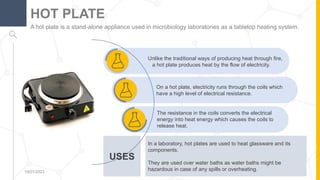
On a hot plate, electricity runs through the coils which
have a high level of electrical resistance.
Unlike the traditional ways of producing heat through fire,
a hot plate produces heat by the flow of electricity.
A hot plate is a stand-alone appliance used in microbiology laboratories as a tabletop heating system.
HOT PLATE
19/01/2023 8
The resistance in the coils converts the electrical
energy into heat energy which causes the coils to
release heat.
In a laboratory, hot plates are used to heat glassware and its
components.
They are used over water baths as water baths might be
hazardous in case of any spills or overheating.
An incubator is a device that is used in laboratories for the growth and maintenance of microorganisms and cultures.
Incubator provides an optimal temperature, pressure, moisture, among other things required for the growth of
microorganisms.
INCUBATER
19/01/2023 9
WORKING PRINCIPLE
1. Incubators have a heating
system that allows for the
temperature within the incubator
to be adjusted according to the
type of organism cultivated
inside.
2. Similarly, they are provided
with adjustments for maintaining
the concentration of CO2 to
balance the pH and humidity
required for the growth of the
organisms.
USES
1. Incubators have a wide range
of applications including cell
culture, pharmaceutical studies,
hematological studies, and
biochemical studies.
2. Incubators can also be used
in the steam cell research area.
Laminar Hood is a closed device primarily for processes or instruments sensitive to microbial contamination. A
Laminar Hood is made up of stainless steel, avoiding joints and corners to prevent the accumulation of bacterial
spores.
LAMINAR AIR FLOW/LAMINAR HOOD
19/01/2023 10
WORKING PRINCIPLE
1. This device creates a sterile
environment with the flow of
sterile air through a High-
Efficiency Particulate Air (HEPA)
filter and shortwave ultraviolet
germicidal lamp that sterilizes
the workstation.
2. Laminar Air Flow has to turn
on 15 minutes before to ensure
complete sterilization and the
workstation should be cleaned
with ethanol before and after
use.
USES
1. Laminar Hood is commonly
used to conduct processes that
are sensitive to contamination.
2. It is used for experiments
related to plant tissue culture
and for the experiments of
genetic transformation.
USES
It is coupled with a heating system to heat the liquid
while it is mixed.
This device consists of a rotating magnetic or an
electromagnet creating a rotating magnetic field that
allows the stir bar (a piece of heavy metal) to move
around in the vessel.
Magnetic Stirrer is a device commonly used in microbiology laboratories for the purpose of mixing
liquids.
MAGNETIC STIRRER
19/01/2023 11
1. It is usually used for mixing various liquid components in a
mixture in a chemical or microbiology laboratory.
2. This device is used in place of other stirrers as it is noise-
free and because the size of the stir bar is so tiny, there is less
chance of contamination.
Microscopes are devices that allow the observer to have an exceedingly close view of minute particles.
MICROSCOPE
19/01/2023 12
WORKING PRINCIPLE
1. The basic principle in a
microscope is magnification.
Based on the relative position of
the object from the lens or
electromagnets, different
positions, nature, and
magnification of the image can
be achieved.
2. Different types of microscopes
are developed to cater to the
specific needs of the
observation. However, the
common theme is magnification.
USES
1. Based on the type of
microscopes, different
microscopes are used for
different purposes.
2. They are primarily used for
the observation of minute
particles which cannot be
observed with naked eyes.
A pH meter is a device used in laboratories that measure the H-ion concentration in water-based
solutions to determine the acidity or alkalinity of the solution. A pH meter is often termed a
“potentiometric pH meter” as it measures the difference in electric potential between the reference and a
pH electrode.
pH METER
19/01/2023 13
1. A pH meter is primarily used to
measure the acidity of
pharmaceutical chemicals, cultures,
soil, and water treatment plant.
2. It can be used to measure the
acidity level in wine and cheese
during their production.
USES
1. In a potentiometric pH meter,
single or multiple glass electrodes,
connected to a bulb selective to
hydrogen ions, are attached to a
metal rod.
2. When the bulb with the electrodes
is dipped into a solution, hydrogen
ions in the solution exchange with
positive charges on the electrode
generating an electrochemical
potential which is displayed in terms
of pH units on display.
WORKING PRINCIPLE
The spectrophotometer is an optical instrument for measuring the intensity of light in relation to
wavelength. Based on the amount of light absorbed by a colored solution, a quantitative analysis of the
solution can be done.
SPECTROPHOTOMETER
19/01/2023 14
1. In a microbiology laboratory, a
spectrophotometer is applied for the
measurement of the substance
concentration of protein, nucleic
acids, bacterial growth, and
enzymatic reactions.
USES
1. Spectrophotometry is based on the
Beer-Lambert Law, which states the
absorbance of light by a solution (of a
particular wavelength) is directly
proportional to the concentration of
the substance.
2. Different wavelengths of light are
passed through a solution as different
substances have better absorbance
at different wavelengths. Based on
the absorbance of a particular
wavelength, the quantitative analysis
of a solution can be done.
WORKING PRINCIPLE
USES
According to this process, water is first brought to a boil
and then condensed into liquid form to obtain pure
distilled water.
A water distiller is based on the principle of distillation.
A water distiller is a device that purifies water by the process of distillation. This instrument is commonly
used in medical laboratories, microbiology laboratories, organic chemistry laboratories, and medical
industries.
WATER DISTILLER
19/01/2023 15
It is used to obtain distilled water required for many lab tests
as well as for the preparation of culture media
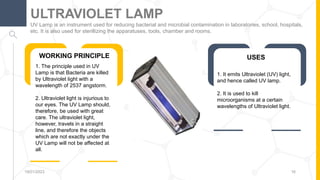
UV Lamp is an instrument used for reducing bacterial and microbial contamination in laboratories, school, hospitals,
etc. It is also used for sterillizing the apparatuses, tools, chamber and rooms.
ULTRAVIOLET LAMP
19/01/2023 16
WORKING PRINCIPLE
1. The principle used in UV
Lamp is that Bacteria are killed
by Ultraviolet light with a
wavelength of 2537 angstorm.
2. Ultraviolet light is injurious to
our eyes. The UV Lamp should,
therefore, be used with great
care. The ultraviolet light,
however, travels in a straight
line, and therefore the objects
which are not exactly under the
UV Lamp will not be affected at
all.
USES
1. It emits Ultraviolet (UV) light,
and hence called UV lamp.
2. It is used to kill
microorganisms at a certain
wavelengths of Ultraviolet light.
THANK YOU

MICROBIO.pptx

  • 1.
    INSTRUMENTS IN MICROBIOLOGY LAB PRESENTATION SUBMITTEDBY PRASHANT SINGH B.Sc CHEMISTRY, Ist Year SUBMITTED TO Dr. Anju Rani BOTANY DEPARTMENT UNIT: I MICROBIAL TECHNIQUES & INSTRUMENTATION
  • 2.
    USES An electromagnet isused to create a force required to achieve a balance with the mass of the substance, and the resulting force is displayed. These types of balances are made with a measuring pan enclosed in a transparent covering that prevents small particles or air currents from getting collected on the pan. An analytical balance is a type of balance that is commonly used for the measurement of mass in the sub-milligram range. ANALYTICAL BALANCE 19/01/2023 2 An electric analytical balance uses the force necessary to counteract the mass rather than measuring the mass itself. As they are highly precise and based on advanced technology, analytical balances are explicitly used in laboratories for the effective completion of tasks like weighing test materials and sampling amounts, formulation, density determination, purity analysis, quality control testing, and material and conformance testing.
  • 3.
    An Autoclave isa pressurized chamber used for the process of sterilization and disinfection by combining three factors: time, pressure, and steam. AUTOCLAVE 19/01/2023 3 1. Autoclaves are mostly used for the sterilization of medical or laboratory equipment with the capacity of sterilizing a large number of materials at once. 2. They are commonly used for the preparation of culture media during laboratory applications. USES 1. Autoclaves use steam as their sterilization agent. The basic principle of an autoclave is that all the items within the autoclave come in direct contact with the steam for a particular period irrespective of the nature of the material- whether it is liquid, plastic ware, or glassware. 2. The amount of time and the temperature depends on the type of material being sterilized and the increase in temperature of the cycle allows for shorter periods. WORKING PRINCIPLE
  • 4.
    USES On the sidesof the tube are openings that can be adjusted with a collar to control the amount of air that can enter. This burner is made with a metal tube on a flat base with a gas inlet at the bottom of the tube, which may have an adjustable valve. Bunsen burner is a standard tool used in laboratories, named after Robert Bunsen. It is a gas-fueled single open flame. BUNSEN BURNER 19/01/2023 4 Once the burner is connected to a gas source, the gas is forced by the gas pressure so that the gas reaches the top where the flame is ignited with a match or a lighter. It is commonly used for processes like sterilization, combustion, and heating. In medical or microbiology laboratories, it is commonly used for micro-loop sterilization.
  • 5.
    A centrifuge isa device that allows the rotation of an object about a single axis, where an outward force is applied perpendicularly to the axis. A laboratory centrifuge is motor-based and allows the rotation of a liquid sample resulting in the separation of the components of the mixture. CENTRIFUGE 19/01/2023 5 The primary application of a centrifuge is the separation of particles suspended in a suspension. It can be used for the separation of cell organelles, nucleic acid, blood components, and separation of isotopes. USES 1. Centrifuge works on the principle of sedimentation, where the high speed of the rotation causes the denser particles to move away from the center while smaller, less dense particles are forced towards the center. 2. Thus, the denser particles settle at the bottom while the lighter particles are collected at the top. 3. In a laboratory tabletop centrifuge, the sample tubes are aligned at an angle so that the particles have to travel a shorter distance before they hit the bottom. WORKING PRINCIPLE
  • 6.
    DEEP FREEZER 19/01/2023 6 1.A deep freezer can be used for the preservation of different things used in the laboratories for a very long period of time. Deep freezers are used in laboratories to store and preserve medical equipment, food items, blood samples, medicines, and injections, etc. for a more extended period of time. USES 1. Deep freezers are based on the principle that under extremely low temperatures, there is minimum microbial growth which allows for the protection and preservation of different substances. 2. Based on this principle, we can even preserve cultures over a long period of time without any change in the concentration of the microorganisms. WORKING PRINCIPLE
  • 7.
    A hot airoven is an electrical device that is used for sterilization of medical equipment or samples using dry heat. HOT AIR OVEN 19/01/2023 7 WORKING PRINCIPLE 1. A hot air oven is a type of dry heat sterilization which is performed on dry materials and on substances that do not melt or catch fire under high temperatures. 2. The equipment inside the oven acquires heat and passes the heat towards the center, one layer at a time which allows for effective dry heat sterilization. USES 1. A hot air oven can be used to sterilize materials like glassware, metal equipment, powders, etc. 2. It allows for the destruction of microorganisms as well as bacterial spores.
  • 8.
    USES On a hotplate, electricity runs through the coils which have a high level of electrical resistance. Unlike the traditional ways of producing heat through fire, a hot plate produces heat by the flow of electricity. A hot plate is a stand-alone appliance used in microbiology laboratories as a tabletop heating system. HOT PLATE 19/01/2023 8 The resistance in the coils converts the electrical energy into heat energy which causes the coils to release heat. In a laboratory, hot plates are used to heat glassware and its components. They are used over water baths as water baths might be hazardous in case of any spills or overheating.
  • 9.
    An incubator isa device that is used in laboratories for the growth and maintenance of microorganisms and cultures. Incubator provides an optimal temperature, pressure, moisture, among other things required for the growth of microorganisms. INCUBATER 19/01/2023 9 WORKING PRINCIPLE 1. Incubators have a heating system that allows for the temperature within the incubator to be adjusted according to the type of organism cultivated inside. 2. Similarly, they are provided with adjustments for maintaining the concentration of CO2 to balance the pH and humidity required for the growth of the organisms. USES 1. Incubators have a wide range of applications including cell culture, pharmaceutical studies, hematological studies, and biochemical studies. 2. Incubators can also be used in the steam cell research area.
  • 10.
    Laminar Hood isa closed device primarily for processes or instruments sensitive to microbial contamination. A Laminar Hood is made up of stainless steel, avoiding joints and corners to prevent the accumulation of bacterial spores. LAMINAR AIR FLOW/LAMINAR HOOD 19/01/2023 10 WORKING PRINCIPLE 1. This device creates a sterile environment with the flow of sterile air through a High- Efficiency Particulate Air (HEPA) filter and shortwave ultraviolet germicidal lamp that sterilizes the workstation. 2. Laminar Air Flow has to turn on 15 minutes before to ensure complete sterilization and the workstation should be cleaned with ethanol before and after use. USES 1. Laminar Hood is commonly used to conduct processes that are sensitive to contamination. 2. It is used for experiments related to plant tissue culture and for the experiments of genetic transformation.
  • 11.
    USES It is coupledwith a heating system to heat the liquid while it is mixed. This device consists of a rotating magnetic or an electromagnet creating a rotating magnetic field that allows the stir bar (a piece of heavy metal) to move around in the vessel. Magnetic Stirrer is a device commonly used in microbiology laboratories for the purpose of mixing liquids. MAGNETIC STIRRER 19/01/2023 11 1. It is usually used for mixing various liquid components in a mixture in a chemical or microbiology laboratory. 2. This device is used in place of other stirrers as it is noise- free and because the size of the stir bar is so tiny, there is less chance of contamination.
  • 12.
    Microscopes are devicesthat allow the observer to have an exceedingly close view of minute particles. MICROSCOPE 19/01/2023 12 WORKING PRINCIPLE 1. The basic principle in a microscope is magnification. Based on the relative position of the object from the lens or electromagnets, different positions, nature, and magnification of the image can be achieved. 2. Different types of microscopes are developed to cater to the specific needs of the observation. However, the common theme is magnification. USES 1. Based on the type of microscopes, different microscopes are used for different purposes. 2. They are primarily used for the observation of minute particles which cannot be observed with naked eyes.
  • 13.
    A pH meteris a device used in laboratories that measure the H-ion concentration in water-based solutions to determine the acidity or alkalinity of the solution. A pH meter is often termed a “potentiometric pH meter” as it measures the difference in electric potential between the reference and a pH electrode. pH METER 19/01/2023 13 1. A pH meter is primarily used to measure the acidity of pharmaceutical chemicals, cultures, soil, and water treatment plant. 2. It can be used to measure the acidity level in wine and cheese during their production. USES 1. In a potentiometric pH meter, single or multiple glass electrodes, connected to a bulb selective to hydrogen ions, are attached to a metal rod. 2. When the bulb with the electrodes is dipped into a solution, hydrogen ions in the solution exchange with positive charges on the electrode generating an electrochemical potential which is displayed in terms of pH units on display. WORKING PRINCIPLE
  • 14.
    The spectrophotometer isan optical instrument for measuring the intensity of light in relation to wavelength. Based on the amount of light absorbed by a colored solution, a quantitative analysis of the solution can be done. SPECTROPHOTOMETER 19/01/2023 14 1. In a microbiology laboratory, a spectrophotometer is applied for the measurement of the substance concentration of protein, nucleic acids, bacterial growth, and enzymatic reactions. USES 1. Spectrophotometry is based on the Beer-Lambert Law, which states the absorbance of light by a solution (of a particular wavelength) is directly proportional to the concentration of the substance. 2. Different wavelengths of light are passed through a solution as different substances have better absorbance at different wavelengths. Based on the absorbance of a particular wavelength, the quantitative analysis of a solution can be done. WORKING PRINCIPLE
  • 15.
    USES According to thisprocess, water is first brought to a boil and then condensed into liquid form to obtain pure distilled water. A water distiller is based on the principle of distillation. A water distiller is a device that purifies water by the process of distillation. This instrument is commonly used in medical laboratories, microbiology laboratories, organic chemistry laboratories, and medical industries. WATER DISTILLER 19/01/2023 15 It is used to obtain distilled water required for many lab tests as well as for the preparation of culture media
  • 16.
    UV Lamp isan instrument used for reducing bacterial and microbial contamination in laboratories, school, hospitals, etc. It is also used for sterillizing the apparatuses, tools, chamber and rooms. ULTRAVIOLET LAMP 19/01/2023 16 WORKING PRINCIPLE 1. The principle used in UV Lamp is that Bacteria are killed by Ultraviolet light with a wavelength of 2537 angstorm. 2. Ultraviolet light is injurious to our eyes. The UV Lamp should, therefore, be used with great care. The ultraviolet light, however, travels in a straight line, and therefore the objects which are not exactly under the UV Lamp will not be affected at all. USES 1. It emits Ultraviolet (UV) light, and hence called UV lamp. 2. It is used to kill microorganisms at a certain wavelengths of Ultraviolet light.
  • 17.