PRINCIPLESANDUSES OFMICROBIOLOGICAL
INSTRUMENTS
SIVASANGARI
SHANMUGAM
CONTENTS
1. Microscope 8. Vortex mixture
2. Analytical balance
10. Autoclave
3. Deep freezer
11. Heating plate
4. Bunsen burner
12. Centrifuge
5. Laminar air flow
13. Colony counter
6. Water bath
14. pH mete
7. Water distiller
9. Incubator
15. Spectrophotometer
16. Magnetic stirrer
17. Hot air oven
18. Homogenizer
19. Micropipette
20. Heating mantle
21. Shaking incubator
22. BOD incubator
23. Gel electrophoresis
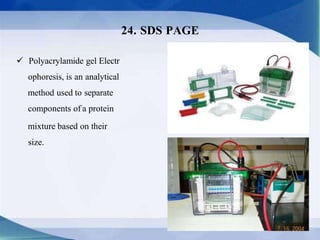
24. SDS PAGE
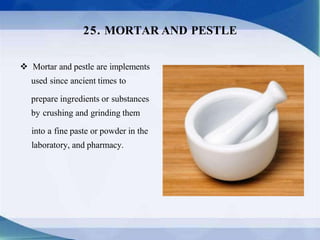
25. Mortar and pestle
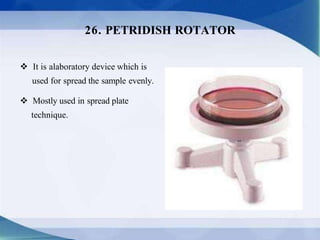
26. Petri dish rotator
CONTENTS
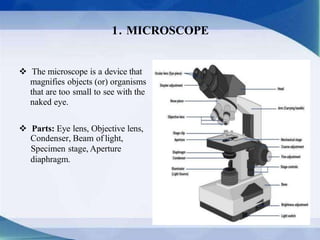
 The microscope is a device that
magnifies objects (or) organisms
that are too small to see with the
naked eye.
 Parts: Eye lens, Objective lens,
Condenser, Beam of light,
Specimen stage, Aperture
diaphragm.
1. MICROSCOPE
Principle:
 Light is produced from either an internal (or) external light source and
passes through the iris diaphragm.
 The light then passes through the condenser which focuses the light onto
the specimen.
 The objective lens magnifies the image ofthe specimen before the light
travels through the barrel ofthe microscope.
 Finally light is passes through the eyepieces lens & into the viewer’s eye
which sends impulses to the brain which in turn interprets the image.
Uses:
In biological field, microscopes are used to study bacteria, cells and many
more.
This device helps biologists in their study of living organisms and their cell
structures.
used for visual observation ofmorphology, motility, staining and
fluorescent reactions ofbacteria.
 An analytical balance is a type of
balance that is commonly used for the
measurement ofmass in the sub-
milligram range.
 They are made with a measuring pan
enclosed in a transparent covering that
prevents smalls particles (or) air
currents from getting collected on the
pan.
 It uses the force necessary to counteract
the mass rather than measuring the
mass itself.
 An electromagnet is used to create a
force required to achieve a balance with
the mass ofthe substance, and the
resulting force is displayed.
2.ANALYTICAL BALANCE
Principle:
 Modern electronic laboratory balances work on the principle ofmagnetic
force restoration.
 In this system, the force exerted by the object being weighed is lifted by an
electromagnet. A detector measures the current required to oppose the
downward motion of the weight in the magnetic field.
Uses:
Analytical balances are used in laboratories for weighing test materials
and sampling amounts, formulation, density determination, purity
analysis, quality control testing, and material and conformance testing.
 A freezer is used to preserve foods
between 25 & 10degrees
fahrenheit for use usually within a
few weeks (or) months at most.
3. DEEP FREEZER
Principle:
 Deep freezers are based on the principle that under extremely low
temperatures, there is minimum microbial growth which allows for the
protection and preservation of different substances.
 Based on this principle, we can even preserve cultures over along period of
time without any change in the concentration ofthe microorganisms.
Uses:
1. A deep freeze can be used for the preservation of different things used in
the laboratories for a very long period oftime.
2. Deep freezers are used in laboratories to store and preserve medical
equipment, food items, blood samples, medicines, and injections, etc. for a
more extended period oftime.
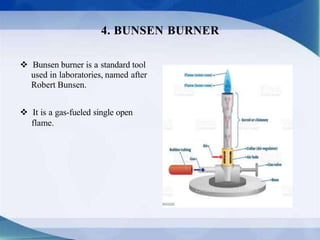
 Bunsen burner is a standard tool
used in laboratories, named after
Robert Bunsen.
 It is a gas-fueled single open
flame.
4. BUNSEN BURNER
Principle:
 This burner is made with a metal tube on a flat base with a gas inlet at the bottom of
the tube, which may have an adjustable valve. On the sides of the tube are openings
which can be adjusted with a collar to control the amount of air that can enter.
Uses:
1. It is commonly used for processes like sterilization, combustion, and heating. In
medical or microbiology laboratories, it is commonly used for micro-loop
sterilization.
 Once the burner is connected to a gas source, the gas is forced by the gas pressure
so that the gas reaches the top where the flame is ignited with a match or a lighter.
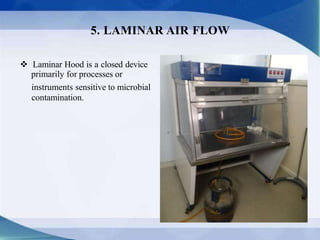
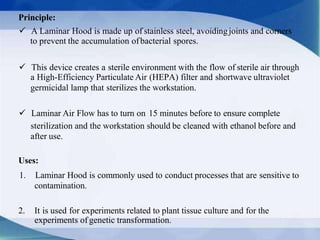
 Laminar Hood is a closed device
primarily for processes or
instruments sensitive to microbial
contamination.
5. LAMINAR AIR FLOW
Principle:
 A Laminar Hood is made up of stainless steel, avoidingjoints and corners
to prevent the accumulation ofbacterial spores.
 This device creates a sterile environment with the flow of sterile air through
a High-Efficiency Particulate Air (HEPA) filter and shortwave ultraviolet
germicidal lamp that sterilizes the workstation.
 Laminar Air Flow has to turn on 15 minutes before to ensure complete
sterilization and the workstation should be cleaned with ethanol before and
after use.
Uses:
1. Laminar Hood is commonly used to conduct processes that are sensitive to
contamination.
2. It is used for experiments related to plant tissue culture and for the
experiments of genetic transformation.
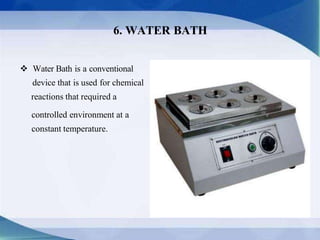
 Water Bath is a conventional
device that is used for chemical
reactions that required a
controlled environment at a
constant temperature.
6. WATER BATH
Principle:
 A sensor in the device transfers water temperature to a reference value
which is then amplified and a control system generates a signal for the
heating system which heats the water to the desired temperature.
Uses:
1. Water baths are primarily used for heating samples under a controlled
temperature.
2. These are suitable for heating chemicals that might be flammable under
direct ignition.
 This instrument is commonly used
in medical laboratories,
microbiology laboratories, organic
chemistry laboratories and
medical industries.
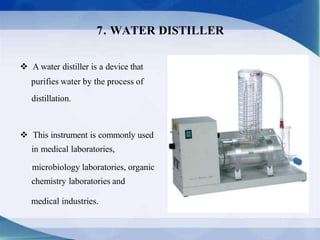
 A water distiller is a device that
purifies water by the process of
distillation.
7. WATER DISTILLER
Principle:
 A water distiller is based on the principle of distillation.
 According to this process, water is first brought to a boil and then
condensed into liquid form to obtain pure distilled water.
Uses:
1. It is used to obtain distilled water required for many lab tests as well as for
the preparation of culture media.
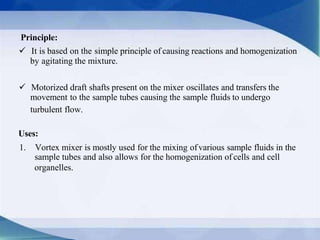
 A vortex mixture is one ofthe
basic technologies used for the
mixing of samples in glass tubes
or flasks in laboratories.
8. VORTEX MIXTURE/VORTEXER
Principle:
 It is based on the simple principle of causing reactions and homogenization
by agitating the mixture.
 Motorized draft shafts present on the mixer oscillates and transfers the
movement to the sample tubes causing the sample fluids to undergo
turbulent flow.
Uses:
1. Vortex mixer is mostly used for the mixing ofvarious sample fluids in the
sample tubes and also allows for the homogenization of cells and cell
organelles.
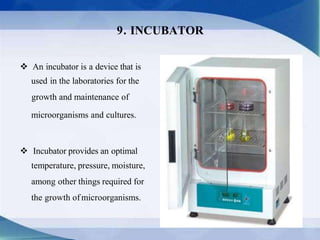
 Incubator provides an optimal
temperature, pressure, moisture,
among other things required for
the growth of microorganisms.
 An incubator is a device that is
used in the laboratories for the
growth and maintenance of
microorganisms and cultures.
9. INCUBATOR
Principle:
 The incubator is based on the principle of maintaining a proper atmosphere for
the growth of microorganisms.
 Incubators have a heating system that allows for the temperature within the
incubator to be adjusted according to the type of organism cultivated inside.
 Similarly, they are provided with adjustments for maintaining the concentration
of CO2 to balance the pH and humidity required for the growth of the
organisms.
 Variation of the incubator like a shaking incubator is also available, which
allows for the continuous movement of the culture required for cell aeration
and solubility studies.
Uses:
1. Incubators have a wide range of applications including cell culture,
pharmaceutical studies, hematological studies, and biochemical studies.
2. Incubators can also be used in the steam cell research area.
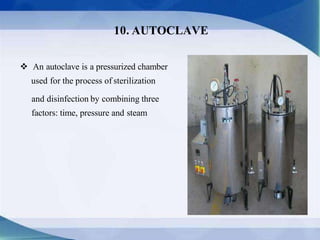
 An autoclave is a pressurized chamber
used for the process of sterilization
and disinfection by combining three
factors: time, pressure and steam
10. AUTOCLAVE
Principle:
 Autoclaves usesteam as their sterilization agent. The basic principle of an
autoclave is that all the items within the autoclave come in direct contact
with the steam for a particular period irrespective ofthe nature ofthe
material- whether it is liquid, plastic ware, or glassware.
 The amount oftime and the temperature depends on the type ofmaterial
being sterilized and the increase in temperature ofthe cycle allows for
shorter periods.
Uses:
1. Autoclavesare mostly used for the sterilization ofmedical or laboratory
equipment with the capacity of sterilizing a large number ofmaterials at
once.
2. They are commonly used for the preparation of culture media during
laboratory applications.
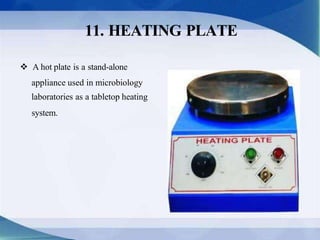
 A hot plate is a stand-alone
appliance used in microbiology
laboratories as a tabletop heating
system.
11. HEATING PLATE
Principle:
 Unlike the traditional ways ofproducing heat through the fire,a hot plate
produces heat by the flow of electricity.
 On a hot plate, electricity runs through the coils which have a high level of
electrical resistance. The resistance in the coils converts the electrical
energy into heat energy which causes the coils to release heat.
Uses:
1. In a laboratory, hot plates are used to heat glassware and their
components.
2. They are used over water baths as in water baths might be hazardous in
case of any spills or overheat.
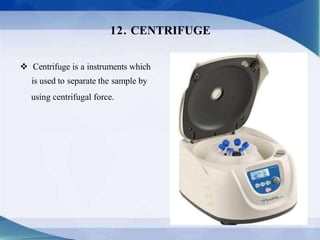
 Centrifuge is a instruments which
is used to separate the sample by
using centrifugal force.
12. CENTRIFUGE
Principle:
 A centrifuge works on the principle of sedimentation, where the high speed
ofthe rotation causes the denser particles to move away from the center
while smaller, less dense particles are forced towards the center.
 Thus, the denser particles settle at the bottom while the lighter particles are
collected at the top.
 In a laboratory tabletop centrifuge, the sample tubes are aligned at an angle
so that the particles have to travel a shorter distance before they hit the
bottom.
Uses
1. The primary application of a centrifuge is the separation ofparticles
suspended in a suspension. It can be used for the separation of cell
organelles, nucleic acid, blood components, and separation of isotopes.
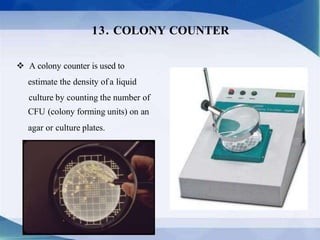
 A colony counter is used to
estimate the density of a liquid
culture by counting the number of
CFU (colony forming units) on an
agar or culture plates.
13. COLONY COUNTER
Principle:
 This instrument can accommodate different sizes of plates which are
scanned on top with UV, white light and/or fluorescent illumination.
 One can accomplish the counting either manually with the touch
pressure or with a digital counter.
Uses:
1. A colony counter is primarily used for counting the number of
colonies present on a culture plate to estimate the concentration of
microorganisms in liquid culture.
 pH meter is a device used in
laboratories that measure the H-ion
concentration in water-based
solutions to determine the acidity /
alkalinity of the solution.
 A pH meter is often termed as
“potentiometric pH meter” as it
measures the difference in electric
potential between the reference and
a pH electrode.
14. pH METER
Principle:
 In a potentiometric pH meter, single or multiple glass electrodes, connected
to a bulb selective to hydrogen ions, are attached to a metal rod.
 When the bulb with the electrodes is dipped into a solution, hydrogen ions
in the solution exchange with positive charges on the electrode generating
an electrochemical potential which is displayed in terms ofpH units on
display.
Uses:
1. A pH meter is primarily used to measure the acidity ofpharmaceutical
chemicals, cultures, soil, and water treatment plant.
2. It can be used to measure the acidity level in wine and cheese during their
production.
 The spectrophotometer is an
optical instrument for measuring
the intensity of light in relation to
the wavelength.
 Based on the amount of light
absorbed by a colored solution, a
quantitative analysis ofthe
solution can be done.
15. SPECTROPHOTOMETER
Principle:
 Spectrophotometry is based on the Beer-Lambert Law, which states the
absorbance of light by a solution (of a particular wavelength) is directly
proportional to the concentration ofthe substance.
 Different wavelengths of lights are passed through a solution as different
substances have better absorbance at different wavelengths. Based on the
absorbance of a particular wavelength, the quantitative analysis of a
solution can be done.
Uses:
1. In a microbiology laboratory, a spectrophotometer is applied for the
measurement of substance concentration ofprotein, nucleic acids,
bacterial growth, and enzymatic reactions.
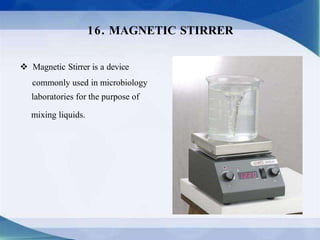
 Magnetic Stirrer is a device
commonly used in microbiology
laboratories for the purpose of
mixing liquids.
16. MAGNETIC STIRRER
Principle:
 This device consists of a rotating magnetic or an electromagnet creating a
rotating magnetic field that allows the stir bar (a piece ofheavy metal) to
move around in the vessel.
 It is coupled with a heating system to heat the liquid while it mixed.
Uses:
1. It is usually used for mixing various liquid components in a mixture in a
chemical or microbiology laboratory.
2. This device is used in place of other stirrers as it is noise-free and because
the size ofthe stir bar is so tiny, there is less chance of contamination.
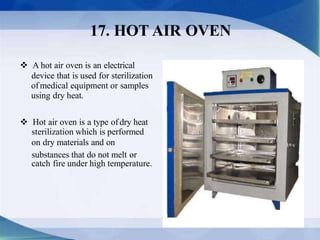
 A hot air oven is an electrical
device that is used for sterilization
ofmedical equipment or samples
using dry heat.
 Hot air oven is a type of dry heat
sterilization which is performed
on dry materials and on
substances that do not melt or
catch fire under high temperature.
17. HOT AIR OVEN
Principle:
 There are two types ofhot air oven based on the working principle
. Forced air hot air oven: In this type ofhot air oven, the heated air inside the
oven is distributed throughout the oven with a fan. This prevents the rising of
hot air towards the top while keeping the cold air at the bottom. This allows for
the adequate heating of materials inside the oven.
. Static air hot air oven: In this type of oven, the heat is produced by coils
present at the bottom of the oven with no fan. The hot air rises and doesn’t
allow the effective sterilization of the materials.
 The equipment inside the oven acquire heat and pass the heat towards the center,
one layer at atime which allows for effective dry heat sterilization.
Uses:
1. Hot air oven can be used to sterilize materials like glassware, metal equipment,
powders, etc.
2. It allows for the destruction ofmicroorganisms as well as bacterial spores.
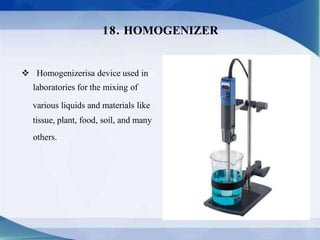
 Homogenizerisa device used in
laboratories for the mixing of
various liquids and materials like
tissue, plant, food, soil, and many
others.
18. HOMOGENIZER
Principle:
 This instrument is based on the principle that when large globules in coarse
emulsion are passed under high pressure through a narrow orifice, they
breakdown into smaller particles giving a more uniform and stable
mixture.
 A homogenizerhas a metal rod with narrow parallel openings in the form
of a comb at the end which acts as the orifice for the homogenization
process.
Uses:
1. A homogenizer is primarily used to disrupt cells to acquire cell
organelles for different microbiological processes.
2. It is used in the preparation step before the extraction and purification
of different macromolecules like proteins, nucleic acids, and lipids.
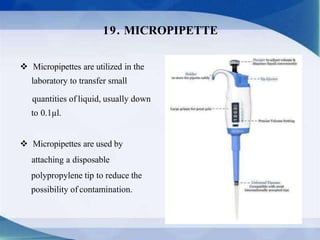
 Micropipettes are utilized in the
laboratory to transfer small
quantities of liquid, usually down
to 0.1µl.
 Micropipettes are used by
attaching a disposable
polypropylene tip to reduce the
possibility of contamination.
19. MICROPIPETTE
Principle:
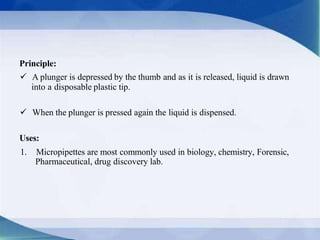
 A plunger is depressed by the thumb and as it is released, liquid is drawn
into a disposable plastic tip.
 When the plunger is pressed again the liquid is dispensed.
Uses:
1. Micropipettes are most commonly used in biology, chemistry, Forensic,
Pharmaceutical, drug discovery lab.
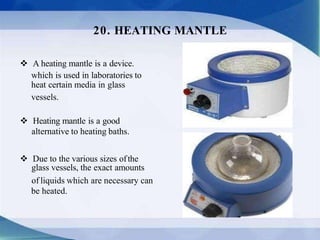
 A heating mantle is a device.
which is used in laboratories to
heat certain media in glass
vessels.
 Heating mantle is a good
alternative to heating baths.
 Due to the various sizes ofthe
glass vessels, the exact amounts
of liquids which are necessary can
be heated.
20. HEATING MANTLE
Principle:
 Heating mantles produce energy by converting AC voltage.
 Intense energy is consumed to generate a high degree of required heat.
 This can result in blowing of the socket (or) melting of the fuse.
 For this reason,one should never connect the mantle directly to a wall socket,
instead, a transformer can be used.
 Note that the mantle takes a while to heat up so you can pre-heat it if required.
 Remove the flask from the mantle once you turnoff the heat for letting it cool
down.
Uses:
1. It is used in laboratories to heat certain media in glass vessels.
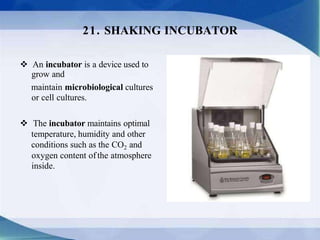
 An incubator is a device used to
grow and
maintain microbiological cultures
or cell cultures.
 The incubator maintains optimal
temperature, humidity and other
conditions such as the CO2 and
oxygen content ofthe atmosphere
inside.
21. SHAKING INCUBATOR
Uses:
1. Shaking incubators are very convenient. they can shake and incubate
samples simultaneously.
2. The machine also maintains a stable internal atmosphere.
3. It doesn't change even while you adjust the shaking parameters.
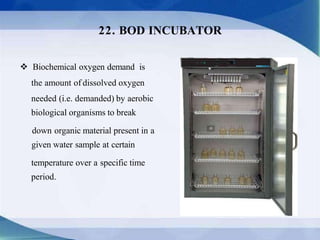
 Biochemical oxygen demand is
the amount of dissolved oxygen
needed (i.e. demanded) by aerobic
biological organisms to break
down organic material present in a
given water sample at certain
temperature over a specific time
period.
22. BOD INCUBATOR
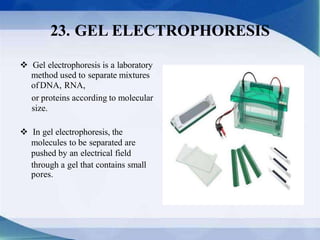
 Gel electrophoresis is a laboratory
method used to separate mixtures
ofDNA, RNA,
or proteins according to molecular
size.
 In gel electrophoresis, the
molecules to be separated are
pushed by an electrical field
through a gel that contains small
pores.
23. GEL ELECTROPHORESIS
Principle:
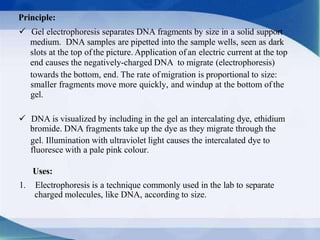
 Gel electrophoresis separates DNA fragments by size in a solid support
medium. DNA samples are pipetted into the sample wells, seen as dark
slots at the top ofthe picture. Application of an electric current at the top
end causes the negatively-charged DNA to migrate (electrophoresis)
towards the bottom, end. The rate ofmigration is proportional to size:
smaller fragments move more quickly, and windup at the bottom of the
gel.
 DNA is visualized by including in the gel an intercalating dye, ethidium
bromide. DNA fragments take up the dye as they migrate through the
gel. Illumination with ultraviolet light causes the intercalated dye to
fluoresce with a pale pink colour.
Uses:
1. Electrophoresis is a technique commonly used in the lab to separate
charged molecules, like DNA, according to size.
 Polyacrylamide gel Electr
ophoresis, is an analytical
method used to separate
components of a protein
mixture based on their
size.
24. SDS PAGE
Principle:
 The technique is based upon the principle that a charged molecule will
migrate in an electric field towards an electrode with opposite sign.
 Mortar and pestle are implements
used since ancient times to
prepare ingredients or substances
by crushing and grinding them
into a fine paste or powder in the
laboratory, and pharmacy.
25. MORTAR AND PESTLE
 It is alaboratory device which is
used for spread the sample evenly.
 Mostly used in spread plate
technique.
26. PETRIDISH ROTATOR
THANK YOU

microbiologicalinstrumentations-201011084351.pptx

  • 1.
  • 2.
    CONTENTS 1. Microscope 8.Vortex mixture 2. Analytical balance 10. Autoclave 3. Deep freezer 11. Heating plate 4. Bunsen burner 12. Centrifuge 5. Laminar air flow 13. Colony counter 6. Water bath 14. pH mete 7. Water distiller 9. Incubator
  • 3.
    15. Spectrophotometer 16. Magneticstirrer 17. Hot air oven 18. Homogenizer 19. Micropipette 20. Heating mantle 21. Shaking incubator 22. BOD incubator 23. Gel electrophoresis 24. SDS PAGE 25. Mortar and pestle 26. Petri dish rotator CONTENTS
  • 4.
     The microscopeis a device that magnifies objects (or) organisms that are too small to see with the naked eye.  Parts: Eye lens, Objective lens, Condenser, Beam of light, Specimen stage, Aperture diaphragm. 1. MICROSCOPE
  • 5.
    Principle:  Light isproduced from either an internal (or) external light source and passes through the iris diaphragm.  The light then passes through the condenser which focuses the light onto the specimen.  The objective lens magnifies the image ofthe specimen before the light travels through the barrel ofthe microscope.  Finally light is passes through the eyepieces lens & into the viewer’s eye which sends impulses to the brain which in turn interprets the image. Uses: In biological field, microscopes are used to study bacteria, cells and many more. This device helps biologists in their study of living organisms and their cell structures. used for visual observation ofmorphology, motility, staining and fluorescent reactions ofbacteria.
  • 6.
     An analyticalbalance is a type of balance that is commonly used for the measurement ofmass in the sub- milligram range.  They are made with a measuring pan enclosed in a transparent covering that prevents smalls particles (or) air currents from getting collected on the pan.  It uses the force necessary to counteract the mass rather than measuring the mass itself.  An electromagnet is used to create a force required to achieve a balance with the mass ofthe substance, and the resulting force is displayed. 2.ANALYTICAL BALANCE
  • 7.
    Principle:  Modern electroniclaboratory balances work on the principle ofmagnetic force restoration.  In this system, the force exerted by the object being weighed is lifted by an electromagnet. A detector measures the current required to oppose the downward motion of the weight in the magnetic field. Uses: Analytical balances are used in laboratories for weighing test materials and sampling amounts, formulation, density determination, purity analysis, quality control testing, and material and conformance testing.
  • 8.
     A freezeris used to preserve foods between 25 & 10degrees fahrenheit for use usually within a few weeks (or) months at most. 3. DEEP FREEZER
  • 9.
    Principle:  Deep freezersare based on the principle that under extremely low temperatures, there is minimum microbial growth which allows for the protection and preservation of different substances.  Based on this principle, we can even preserve cultures over along period of time without any change in the concentration ofthe microorganisms. Uses: 1. A deep freeze can be used for the preservation of different things used in the laboratories for a very long period oftime. 2. Deep freezers are used in laboratories to store and preserve medical equipment, food items, blood samples, medicines, and injections, etc. for a more extended period oftime.
  • 10.
     Bunsen burneris a standard tool used in laboratories, named after Robert Bunsen.  It is a gas-fueled single open flame. 4. BUNSEN BURNER
  • 11.
    Principle:  This burneris made with a metal tube on a flat base with a gas inlet at the bottom of the tube, which may have an adjustable valve. On the sides of the tube are openings which can be adjusted with a collar to control the amount of air that can enter. Uses: 1. It is commonly used for processes like sterilization, combustion, and heating. In medical or microbiology laboratories, it is commonly used for micro-loop sterilization.  Once the burner is connected to a gas source, the gas is forced by the gas pressure so that the gas reaches the top where the flame is ignited with a match or a lighter.
  • 12.
     Laminar Hoodis a closed device primarily for processes or instruments sensitive to microbial contamination. 5. LAMINAR AIR FLOW
  • 13.
    Principle:  A LaminarHood is made up of stainless steel, avoidingjoints and corners to prevent the accumulation ofbacterial spores.  This device creates a sterile environment with the flow of sterile air through a High-Efficiency Particulate Air (HEPA) filter and shortwave ultraviolet germicidal lamp that sterilizes the workstation.  Laminar Air Flow has to turn on 15 minutes before to ensure complete sterilization and the workstation should be cleaned with ethanol before and after use. Uses: 1. Laminar Hood is commonly used to conduct processes that are sensitive to contamination. 2. It is used for experiments related to plant tissue culture and for the experiments of genetic transformation.
  • 14.
     Water Bathis a conventional device that is used for chemical reactions that required a controlled environment at a constant temperature. 6. WATER BATH
  • 15.
    Principle:  A sensorin the device transfers water temperature to a reference value which is then amplified and a control system generates a signal for the heating system which heats the water to the desired temperature. Uses: 1. Water baths are primarily used for heating samples under a controlled temperature. 2. These are suitable for heating chemicals that might be flammable under direct ignition.
  • 16.
     This instrumentis commonly used in medical laboratories, microbiology laboratories, organic chemistry laboratories and medical industries.  A water distiller is a device that purifies water by the process of distillation. 7. WATER DISTILLER
  • 17.
    Principle:  A waterdistiller is based on the principle of distillation.  According to this process, water is first brought to a boil and then condensed into liquid form to obtain pure distilled water. Uses: 1. It is used to obtain distilled water required for many lab tests as well as for the preparation of culture media.
  • 18.
     A vortexmixture is one ofthe basic technologies used for the mixing of samples in glass tubes or flasks in laboratories. 8. VORTEX MIXTURE/VORTEXER
  • 19.
    Principle:  It isbased on the simple principle of causing reactions and homogenization by agitating the mixture.  Motorized draft shafts present on the mixer oscillates and transfers the movement to the sample tubes causing the sample fluids to undergo turbulent flow. Uses: 1. Vortex mixer is mostly used for the mixing ofvarious sample fluids in the sample tubes and also allows for the homogenization of cells and cell organelles.
  • 20.
     Incubator providesan optimal temperature, pressure, moisture, among other things required for the growth of microorganisms.  An incubator is a device that is used in the laboratories for the growth and maintenance of microorganisms and cultures. 9. INCUBATOR
  • 21.
    Principle:  The incubatoris based on the principle of maintaining a proper atmosphere for the growth of microorganisms.  Incubators have a heating system that allows for the temperature within the incubator to be adjusted according to the type of organism cultivated inside.  Similarly, they are provided with adjustments for maintaining the concentration of CO2 to balance the pH and humidity required for the growth of the organisms.  Variation of the incubator like a shaking incubator is also available, which allows for the continuous movement of the culture required for cell aeration and solubility studies. Uses: 1. Incubators have a wide range of applications including cell culture, pharmaceutical studies, hematological studies, and biochemical studies. 2. Incubators can also be used in the steam cell research area.
  • 22.
     An autoclaveis a pressurized chamber used for the process of sterilization and disinfection by combining three factors: time, pressure and steam 10. AUTOCLAVE
  • 23.
    Principle:  Autoclaves usesteamas their sterilization agent. The basic principle of an autoclave is that all the items within the autoclave come in direct contact with the steam for a particular period irrespective ofthe nature ofthe material- whether it is liquid, plastic ware, or glassware.  The amount oftime and the temperature depends on the type ofmaterial being sterilized and the increase in temperature ofthe cycle allows for shorter periods. Uses: 1. Autoclavesare mostly used for the sterilization ofmedical or laboratory equipment with the capacity of sterilizing a large number ofmaterials at once. 2. They are commonly used for the preparation of culture media during laboratory applications.
  • 24.
     A hotplate is a stand-alone appliance used in microbiology laboratories as a tabletop heating system. 11. HEATING PLATE
  • 25.
    Principle:  Unlike thetraditional ways ofproducing heat through the fire,a hot plate produces heat by the flow of electricity.  On a hot plate, electricity runs through the coils which have a high level of electrical resistance. The resistance in the coils converts the electrical energy into heat energy which causes the coils to release heat. Uses: 1. In a laboratory, hot plates are used to heat glassware and their components. 2. They are used over water baths as in water baths might be hazardous in case of any spills or overheat.
  • 26.
     Centrifuge isa instruments which is used to separate the sample by using centrifugal force. 12. CENTRIFUGE
  • 27.
    Principle:  A centrifugeworks on the principle of sedimentation, where the high speed ofthe rotation causes the denser particles to move away from the center while smaller, less dense particles are forced towards the center.  Thus, the denser particles settle at the bottom while the lighter particles are collected at the top.  In a laboratory tabletop centrifuge, the sample tubes are aligned at an angle so that the particles have to travel a shorter distance before they hit the bottom. Uses 1. The primary application of a centrifuge is the separation ofparticles suspended in a suspension. It can be used for the separation of cell organelles, nucleic acid, blood components, and separation of isotopes.
  • 28.
     A colonycounter is used to estimate the density of a liquid culture by counting the number of CFU (colony forming units) on an agar or culture plates. 13. COLONY COUNTER
  • 29.
    Principle:  This instrumentcan accommodate different sizes of plates which are scanned on top with UV, white light and/or fluorescent illumination.  One can accomplish the counting either manually with the touch pressure or with a digital counter. Uses: 1. A colony counter is primarily used for counting the number of colonies present on a culture plate to estimate the concentration of microorganisms in liquid culture.
  • 30.
     pH meteris a device used in laboratories that measure the H-ion concentration in water-based solutions to determine the acidity / alkalinity of the solution.  A pH meter is often termed as “potentiometric pH meter” as it measures the difference in electric potential between the reference and a pH electrode. 14. pH METER
  • 31.
    Principle:  In apotentiometric pH meter, single or multiple glass electrodes, connected to a bulb selective to hydrogen ions, are attached to a metal rod.  When the bulb with the electrodes is dipped into a solution, hydrogen ions in the solution exchange with positive charges on the electrode generating an electrochemical potential which is displayed in terms ofpH units on display. Uses: 1. A pH meter is primarily used to measure the acidity ofpharmaceutical chemicals, cultures, soil, and water treatment plant. 2. It can be used to measure the acidity level in wine and cheese during their production.
  • 32.
     The spectrophotometeris an optical instrument for measuring the intensity of light in relation to the wavelength.  Based on the amount of light absorbed by a colored solution, a quantitative analysis ofthe solution can be done. 15. SPECTROPHOTOMETER
  • 33.
    Principle:  Spectrophotometry isbased on the Beer-Lambert Law, which states the absorbance of light by a solution (of a particular wavelength) is directly proportional to the concentration ofthe substance.  Different wavelengths of lights are passed through a solution as different substances have better absorbance at different wavelengths. Based on the absorbance of a particular wavelength, the quantitative analysis of a solution can be done. Uses: 1. In a microbiology laboratory, a spectrophotometer is applied for the measurement of substance concentration ofprotein, nucleic acids, bacterial growth, and enzymatic reactions.
  • 34.
     Magnetic Stirreris a device commonly used in microbiology laboratories for the purpose of mixing liquids. 16. MAGNETIC STIRRER
  • 35.
    Principle:  This deviceconsists of a rotating magnetic or an electromagnet creating a rotating magnetic field that allows the stir bar (a piece ofheavy metal) to move around in the vessel.  It is coupled with a heating system to heat the liquid while it mixed. Uses: 1. It is usually used for mixing various liquid components in a mixture in a chemical or microbiology laboratory. 2. This device is used in place of other stirrers as it is noise-free and because the size ofthe stir bar is so tiny, there is less chance of contamination.
  • 36.
     A hotair oven is an electrical device that is used for sterilization ofmedical equipment or samples using dry heat.  Hot air oven is a type of dry heat sterilization which is performed on dry materials and on substances that do not melt or catch fire under high temperature. 17. HOT AIR OVEN
  • 37.
    Principle:  There aretwo types ofhot air oven based on the working principle . Forced air hot air oven: In this type ofhot air oven, the heated air inside the oven is distributed throughout the oven with a fan. This prevents the rising of hot air towards the top while keeping the cold air at the bottom. This allows for the adequate heating of materials inside the oven. . Static air hot air oven: In this type of oven, the heat is produced by coils present at the bottom of the oven with no fan. The hot air rises and doesn’t allow the effective sterilization of the materials.  The equipment inside the oven acquire heat and pass the heat towards the center, one layer at atime which allows for effective dry heat sterilization. Uses: 1. Hot air oven can be used to sterilize materials like glassware, metal equipment, powders, etc. 2. It allows for the destruction ofmicroorganisms as well as bacterial spores.
  • 38.
     Homogenizerisa deviceused in laboratories for the mixing of various liquids and materials like tissue, plant, food, soil, and many others. 18. HOMOGENIZER
  • 39.
    Principle:  This instrumentis based on the principle that when large globules in coarse emulsion are passed under high pressure through a narrow orifice, they breakdown into smaller particles giving a more uniform and stable mixture.  A homogenizerhas a metal rod with narrow parallel openings in the form of a comb at the end which acts as the orifice for the homogenization process. Uses: 1. A homogenizer is primarily used to disrupt cells to acquire cell organelles for different microbiological processes. 2. It is used in the preparation step before the extraction and purification of different macromolecules like proteins, nucleic acids, and lipids.
  • 40.
     Micropipettes areutilized in the laboratory to transfer small quantities of liquid, usually down to 0.1µl.  Micropipettes are used by attaching a disposable polypropylene tip to reduce the possibility of contamination. 19. MICROPIPETTE
  • 41.
    Principle:  A plungeris depressed by the thumb and as it is released, liquid is drawn into a disposable plastic tip.  When the plunger is pressed again the liquid is dispensed. Uses: 1. Micropipettes are most commonly used in biology, chemistry, Forensic, Pharmaceutical, drug discovery lab.
  • 42.
     A heatingmantle is a device. which is used in laboratories to heat certain media in glass vessels.  Heating mantle is a good alternative to heating baths.  Due to the various sizes ofthe glass vessels, the exact amounts of liquids which are necessary can be heated. 20. HEATING MANTLE
  • 43.
    Principle:  Heating mantlesproduce energy by converting AC voltage.  Intense energy is consumed to generate a high degree of required heat.  This can result in blowing of the socket (or) melting of the fuse.  For this reason,one should never connect the mantle directly to a wall socket, instead, a transformer can be used.  Note that the mantle takes a while to heat up so you can pre-heat it if required.  Remove the flask from the mantle once you turnoff the heat for letting it cool down. Uses: 1. It is used in laboratories to heat certain media in glass vessels.
  • 44.
     An incubatoris a device used to grow and maintain microbiological cultures or cell cultures.  The incubator maintains optimal temperature, humidity and other conditions such as the CO2 and oxygen content ofthe atmosphere inside. 21. SHAKING INCUBATOR
  • 45.
    Uses: 1. Shaking incubatorsare very convenient. they can shake and incubate samples simultaneously. 2. The machine also maintains a stable internal atmosphere. 3. It doesn't change even while you adjust the shaking parameters.
  • 46.
     Biochemical oxygendemand is the amount of dissolved oxygen needed (i.e. demanded) by aerobic biological organisms to break down organic material present in a given water sample at certain temperature over a specific time period. 22. BOD INCUBATOR
  • 47.
     Gel electrophoresisis a laboratory method used to separate mixtures ofDNA, RNA, or proteins according to molecular size.  In gel electrophoresis, the molecules to be separated are pushed by an electrical field through a gel that contains small pores. 23. GEL ELECTROPHORESIS
  • 48.
    Principle:  Gel electrophoresisseparates DNA fragments by size in a solid support medium. DNA samples are pipetted into the sample wells, seen as dark slots at the top ofthe picture. Application of an electric current at the top end causes the negatively-charged DNA to migrate (electrophoresis) towards the bottom, end. The rate ofmigration is proportional to size: smaller fragments move more quickly, and windup at the bottom of the gel.  DNA is visualized by including in the gel an intercalating dye, ethidium bromide. DNA fragments take up the dye as they migrate through the gel. Illumination with ultraviolet light causes the intercalated dye to fluoresce with a pale pink colour. Uses: 1. Electrophoresis is a technique commonly used in the lab to separate charged molecules, like DNA, according to size.
  • 49.
     Polyacrylamide gelElectr ophoresis, is an analytical method used to separate components of a protein mixture based on their size. 24. SDS PAGE
  • 50.
    Principle:  The techniqueis based upon the principle that a charged molecule will migrate in an electric field towards an electrode with opposite sign.
  • 51.
     Mortar andpestle are implements used since ancient times to prepare ingredients or substances by crushing and grinding them into a fine paste or powder in the laboratory, and pharmacy. 25. MORTAR AND PESTLE
  • 52.
     It isalaboratory device which is used for spread the sample evenly.  Mostly used in spread plate technique. 26. PETRIDISH ROTATOR
  • 53.