NEXT
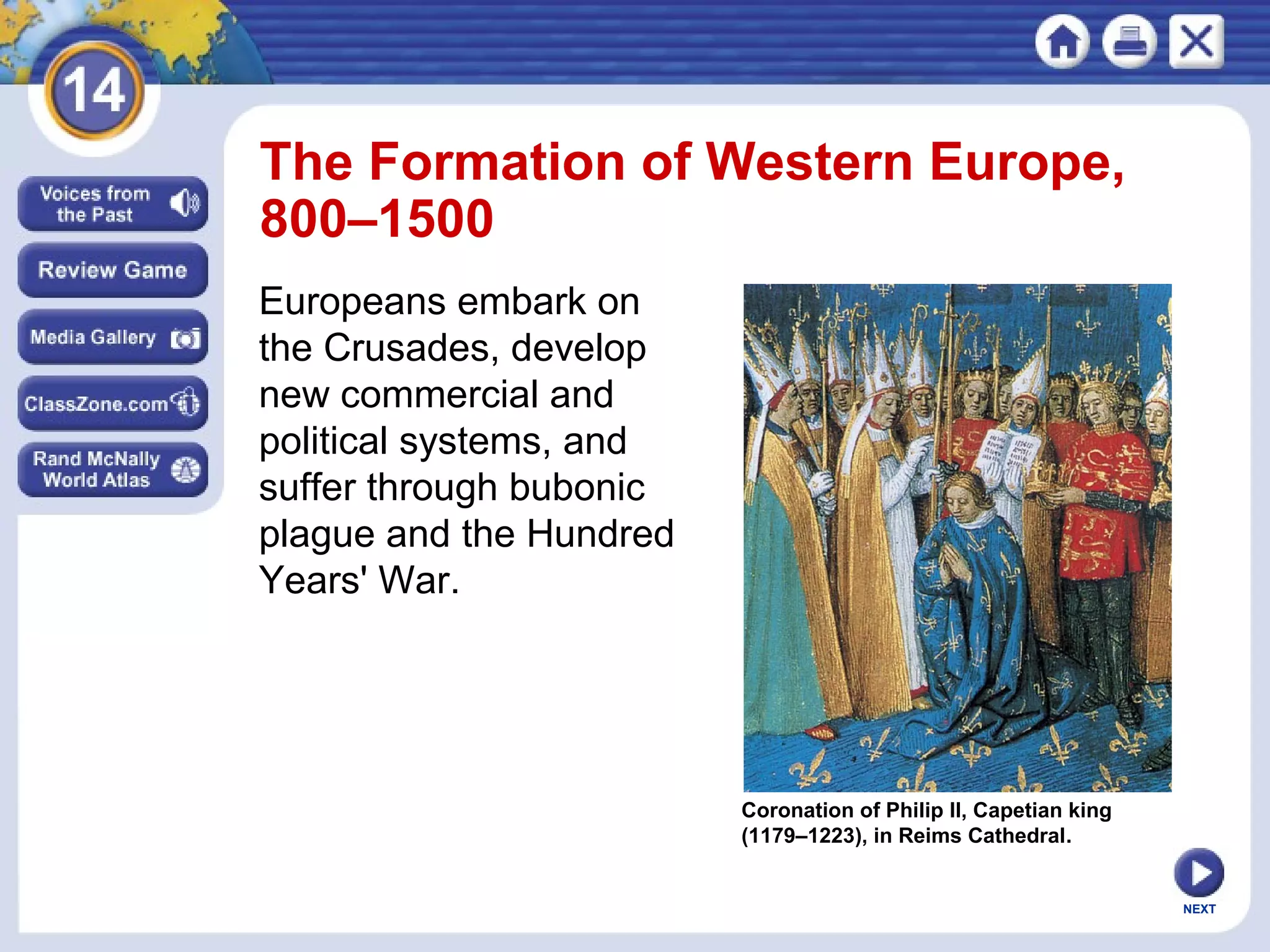
Coronation of Philip II, Capetian king
(1179–1223), in Reims Cathedral.
The Formation of Western Europe,
800–1500
Europeans embark on
the Crusades, develop
new commercial and
political systems, and
suffer through bubonic
plague and the Hundred
Years' War.
NEXT
The Formation of Western Europe,
800–1500
Map
SECTION 1
SECTION 2
SECTION 3
SECTION 4
Church Reform and the Crusades
Changes in Medieval Society
England and France Develop
The Hundred Years’ War and the Plague
Chart
NEXT
Section 1
Church Reform and the
Crusades
The Catholic Church undergoes reform and
launches Crusades against Muslims.
NEXT
The Age of Faith
Church Reform and the Crusades
Spiritual Revival
• Starting in 900s, monasteries help bring about a
spiritual revival
• Reformers help restore and expand Church power
Problems in the Church
• Some Church officials marry even though the
Church objects
• Some officials practice simony—selling religious
offices
• Kings use lay investiture to appoint bishops
• Reformers believe only the Church should appoint
bishops
SECTION
1
Continued . . .
Image
NEXT
continued The Age of Faith
SECTION
1
Reform and Church Organization
• Starting in 1100s, popes reorganize Church like a
kingdom
• Pope’s advisors make Church laws; diplomats travel
throughout Europe
• Church collects tithes; uses money to care for sick,
poor
New Religious Orders
• Dominican and Franciscan orders form
• Friars in these orders vow poverty; travel and
preach to the poor
• Some new orders for women are founded
Image
Image
NEXT
Cathedrals—Cities of God
SECTION
1
Early Cathedrals
• Between 800–1100, churches are built in
Romanesque style
• Style includes thick walls and pillars, small
windows, round arches
A New Style of Church Architecture
• Gothic style evolves around 1100; term from
Germanic tribe, Goths
• Gothic style has large, tall windows for more light;
pointed arches
• Churches have stained glass windows, many
sculptures
• About 500 Gothic churches are built from 1170 to
1270
Image
NEXT
The Crusades
SECTION
1
The Beginning of the Crusades
• In 1093, Byzantine emperor asks for help fighting
the Turks
• Pope Urban II issues a call for a Crusade—a “holy
war”
Goals of the Crusades
• Pope wants to reclaim Jerusalem and reunite
Christianity
• Kings use the Crusades to send away knights
who cause trouble
• Younger sons hope to earn land or win glory by
fighting
• Later, merchants join Crusades to try to gain
wealth through trade
Continued . . .
Interactive
NEXT
continued The Crusades
SECTION
1
The First and Second Crusades
• Pope promises Crusaders who die a place in heaven
• First Crusade: three armies gather at Constantinople
in 1097
• Crusaders capture Jerusalem in 1099
• Captured lands along coast divided into four
Crusader states
• Muslims take back Edessa in 1144; Second Crusade
fails to retake it
• In 1187 Saladin—Muslim leader and Kurdish
warrior—retakes Jerusalem
Continued . . .
NEXT
continued The Crusades
SECTION
1
The Third Crusade
• Third Crusade led by three powerful rulers
• One is Richard the Lion-Hearted—king of England
• Phillip II of France abandons Crusade after arguing
with Richard
• Frederick I of Germany drowns during the journey
• In 1192 Richard and Saladin make peace after many
battles
• Saladin keeps Jerusalem but allows Christian
pilgrims to enter city
NEXT
The Crusading Spirit Dwindles
SECTION
1
Later Crusades
• Fourth Crusade: Crusaders loot Constantinople
in 1204
• Two other Crusades strike Egypt, but fail to
weaken Muslims
The Children’s Crusade
• In 1212 thousands of children die or are enslaved
in failed crusade
Image
A Spanish Crusade
• Most of Spain controlled by Moors, a Muslim people
• Christians fight Reconquista—drive Muslims
from Spain, 1100 to 1492
• Spain has Inquisition—court to suppress heresy;
expels non-Christians
Image
NEXT
The Effects of the Crusades
SECTION
1
The Crusades Change Life
• Crusades show power of Church in convincing
thousands to fight
• Women who stay home manage the estate and
business affairs
• Merchants expand trade, bring back many goods
from Southwest Asia
• Failure of later crusades weakens pope and
nobles, strengthens kings
• Crusades create lasting bitterness between
Muslims and Christians
NEXT
The feudal system declines as agriculture,
trade, finance, towns, and universities
develop.
Section 2
Changes in Medieval
Society
NEXT
A Growing Food Supply
Changes in Medieval Society
Changes in Agriculture
• From 800 to 1200 the climate warms, opening more
land to farming
• Changes in technology result in more food production
SECTION
2
Switch to Horsepower
• Harnessed horses replace oxen in pulling plows and
wagons
• Horses plow three times as much a day, increasing
food supply
The Three-Field System
• Around 800 three-field system used—plant two
fields, let one rest
• This produces more food and leads to population
increase
NEXT
The Guilds
Development of Guilds
• Guilds develop—organization of people in the
same occupation
• Merchant guilds begin first; they keep prices up,
provide security
• Skilled artisans, men and women, form craft
guilds
• Guilds set standards for quality, prices, wages,
working conditions
• Guilds supervise training of new members of their
craft
• The wealth of guilds influences government and
economy
SECTION
2
Chart
NEXT
Commercial Revolution
Fairs and Trade
• Europe sees Commercial Revolution—changes
in business and trade
• Trade fairs are held several times a year in towns
• Trade routes open to Asia, North Africa, and
Byzantine ports
SECTION
2
Business and Banking
• Merchants develop credit to avoid carrying large
sums of money
• Merchants take out loans to purchase goods, and
banking grows
Society Changes
• Economic changes lead to the growth of cities and
of paying jobs
Chart
NEXT
Urban Life Flourishes
Growing Urban Population
• 1000–1150, Europe’s population rises from 30
million to 42 million
• Most towns are small, but they help drive change
SECTION
2
Trade and Towns Grow Together
• Towns are uncomfortable: crowded, dirty, full of fire
hazards
• Serfs can become free by living in a town for a year
and a day
Merchant Class Shifts the Social Order
• Feudal lords tax and govern towns, causing
resentment
• Towns are taken over by burghers—town
merchants
NEXT
The Revival of Learning
The Muslim Connection
• Christian scholars read translations of Greek
works made by Muslims
• Crusaders return with Muslim knowledge of
navigation, ships, weapons
SECTION
2
Scholars and the University
• Groups of scholars gather to teach and learn; form
universities
• Written works not in Latin but in vernacular—
everyday language
Aquinas and Medieval Philosophy
• Thomas Aquinas, a religious scholar, mixes Greek
and Christian thought
• He is a scholastic—university man; debates issues
to increase knowledge
Section 3
England and France
Develop
As the kingdoms of England and France
begin to develop into nations, certain
democratic traditions evolve.
NEXT
NEXT
England Absorbs Waves of Invaders
Early Invasions
• Danish Vikings invade England throughout the 800s
• Alfred the Great and his successors gradually unite
England
• Danish king Canute invades in 1016, uniting Vikings
and Anglo-Saxons
SECTION
3
The Norman Conquest
• In 1066, England is invaded for last time by William
the Conqueror
• He defeats his rival for English crown, becomes king
• William keeps one-fifth of land; hands out rest to
supporters
Image
England and France Develop
NEXT
England’s Evolving Government
King and Vassal
• English rulers’ goal: to control lands in both
England and France
• Henry II—king of England—gains more French
land through marriage
• Henry is king in England and a vassal in France
Juries and Common Law
• Henry sends judges to all parts of England and
institutes juries
• The judges’ decisions form English common law—
unified body of laws
• Common law forms the basis of law in many
English-speaking countries
SECTION
3
Continued . . .
NEXT
The Magna Carta
• In 1215 English nobles force King John to sign
Magna Carta
• Magna Carta—limits king’s power and
guarantees basic political rights
• English people argue the rights are for all people,
not just nobles
continued England’s Evolving Government
The Model Parliament
• In 1295, Edward I summons wealthy townsmen and
knights to raise taxes
• Together with bishops and lords, they form a
parliament—legislative body
• Parliament has two houses: House of Lords, House
of Commons
SECTION
3
NEXT
Capetian Dynasty Rules France
The End of the Carolingians
• New French dynasty founded by Hugh Capet—a
duke from central France
• The Capetians rule France from Paris from 987–
1328
France Becomes a Separate Kingdom
• Early Capetians are weak rulers; gradually kings
become stronger
SECTION
3
Philip II Expands His Power
• Philip II—a powerful Capetian, rules 1180–1223
• Philip expands land controlled by French king
• He establishes bailiffs to collect taxes and run courts
Continued . . .
NEXT
Philip II’s Heirs
• 1226 to 1270 grandson Louis IX strengthens the
central government
• 1285 to 1314 Philip IV rules; questions pope’s
authority in France
• Philip calls meeting of lords and bishops to
support his policies
• He decides to include commoners in the meeting
continued Capetian Dynasty Rules France
SECTION
3
Continued . . .
NEXT
Beginnings of Democracy
• England and France begin to establish a
democratic tradition
• A centralized government is created to rule
widespread lands
• Common law and court system support a central
government
• Commoners included in decision making
continued Capetian Dynasty Rules France
SECTION
3
Estates-General
• The meeting is called the Estates-General
• Participants in the council come from France’s three Estates
- First Estate—Church leaders
- Second Estate—lords
- Third Estate—commoners, landholders,
merchants
NEXT
Section 4
The Hundred Years’ War
and the Plague
In the 1300s, Europe was torn apart by
religious strife, the bubonic plague, and the
Hundred Years’ War.
NEXT
A Church Divided
The Hundred Years’ War
and the Plague
Pope and King Collide
• In 1300, Pope Boniface VIII asserts authority over
France’s Philip IV
• Philip has him imprisoned; pope dies soon after
Avignon and the Great Schism
• In 1305, French pope is chosen; moves to
Avignon—city in France
• In 1378, two popes chosen—one in Rome, one in
Avignon
• Each declares the other false, causing split called
Great Schism
• In 1417, Council of Constance ends schism,
chooses Martin V as pope
SECTION
4
Continued . . .
Image
NEXT
Scholars Challenge Church Authority
• Englishman John Wycliffe argues Jesus is head
of the Church, not pope
• Wycliffe preaches against wealth and worldliness
of clergy
• Wycliffe inspires English translation of New
Testament
• Jan Hus—Bohemian professor—teaches that
Bible is final authority
• Hus is excommunicated, tried as a heretic,
burned at stake in 1415
continued A Church Divided
SECTION
4
NEXT
The Bubonic Plague Strikes
Origins and Impact of the Plague
• In 1300s, Europe suffers bubonic plague—
extremely deadly disease
• Begins in Asia; spreads to Italy and other
countries over trade routes
• About one-third of Europe’s population dies in the
epidemic
SECTION
4
Effects of the Plague
• Town populations fall, trade declines, prices rise
• Some serfs leave manors for paying work
• Many Jews blamed and killed; Church suffers
weakened stature
Chart
Interactive
NEXT
The Hundred Years’ War
England and France
• Hundred Years’ War—lasts from 1337–1453,
between England and France
• English king Edward III claims French throne
• War marks the end of medieval society; change
in style of warfare
SECTION
4
The Longbow Changes Warfare
• In 1346, English army with longbows beats much
larger French army
• The English win other victories with longbows in
1356 and 1415
• Victory of longbows signals end of reliance on
knights
Continued . . .
Image
Chart
NEXT
Joan of Arc
• Joan of Arc—French peasant girl who believes
in visions of saints
• She leads French army to victory at Orléans;
Charles VII crowned king
• In 1430 England’s allies, the Burgundians,
capture Joan in battle
• The Church condemns Joan as a witch and
heretic
• On May 30, 1431, she is burned at the stake
continued The Hundred Years’ War
SECTION
4
Continued . . .
NEXT
The Impact of the Hundred Years’ War
• Hundred Years’ War ends in 1453
• France and England experience major changes
- rise in nationalistic feelings; king becomes
national leader
- power and prestige of French monarch
increases
- religious devotion and the code of chivalry
crumbles
• England begins period of turmoil, War of the
Roses
continued The Hundred Years’ War
SECTION
4
This is the end of the chapter presentation of
lecture notes. Click the HOME or EXIT button.
BACK
Print Slide Show
1. On the File menu, select Print
2. In the pop-up menu, select Microsoft PowerPoint
If the dialog box does not include this pop-up, continue
to step 4
3. In the Print what box, choose the presentation format
you want to print: slides, notes, handouts, or outline
4. Click the Print button to print the PowerPoint
presentation
Print Text Version
1. Click the Print Text button below; a text file will open
in Adobe Acrobat
2. On the File menu, select Print
3. Click the Print button to print the entire document, or
select the pages you want to print
Print TextPrint Text

Chapter 14

  • 1.
    NEXT Coronation of PhilipII, Capetian king (1179–1223), in Reims Cathedral. The Formation of Western Europe, 800–1500 Europeans embark on the Crusades, develop new commercial and political systems, and suffer through bubonic plague and the Hundred Years' War.
  • 2.
    NEXT The Formation ofWestern Europe, 800–1500 Map SECTION 1 SECTION 2 SECTION 3 SECTION 4 Church Reform and the Crusades Changes in Medieval Society England and France Develop The Hundred Years’ War and the Plague Chart
  • 3.
    NEXT Section 1 Church Reformand the Crusades The Catholic Church undergoes reform and launches Crusades against Muslims.
  • 4.
    NEXT The Age ofFaith Church Reform and the Crusades Spiritual Revival • Starting in 900s, monasteries help bring about a spiritual revival • Reformers help restore and expand Church power Problems in the Church • Some Church officials marry even though the Church objects • Some officials practice simony—selling religious offices • Kings use lay investiture to appoint bishops • Reformers believe only the Church should appoint bishops SECTION 1 Continued . . . Image
  • 5.
    NEXT continued The Ageof Faith SECTION 1 Reform and Church Organization • Starting in 1100s, popes reorganize Church like a kingdom • Pope’s advisors make Church laws; diplomats travel throughout Europe • Church collects tithes; uses money to care for sick, poor New Religious Orders • Dominican and Franciscan orders form • Friars in these orders vow poverty; travel and preach to the poor • Some new orders for women are founded Image Image
  • 6.
    NEXT Cathedrals—Cities of God SECTION 1 EarlyCathedrals • Between 800–1100, churches are built in Romanesque style • Style includes thick walls and pillars, small windows, round arches A New Style of Church Architecture • Gothic style evolves around 1100; term from Germanic tribe, Goths • Gothic style has large, tall windows for more light; pointed arches • Churches have stained glass windows, many sculptures • About 500 Gothic churches are built from 1170 to 1270 Image
  • 7.
    NEXT The Crusades SECTION 1 The Beginningof the Crusades • In 1093, Byzantine emperor asks for help fighting the Turks • Pope Urban II issues a call for a Crusade—a “holy war” Goals of the Crusades • Pope wants to reclaim Jerusalem and reunite Christianity • Kings use the Crusades to send away knights who cause trouble • Younger sons hope to earn land or win glory by fighting • Later, merchants join Crusades to try to gain wealth through trade Continued . . . Interactive
  • 8.
    NEXT continued The Crusades SECTION 1 TheFirst and Second Crusades • Pope promises Crusaders who die a place in heaven • First Crusade: three armies gather at Constantinople in 1097 • Crusaders capture Jerusalem in 1099 • Captured lands along coast divided into four Crusader states • Muslims take back Edessa in 1144; Second Crusade fails to retake it • In 1187 Saladin—Muslim leader and Kurdish warrior—retakes Jerusalem Continued . . .
  • 9.
    NEXT continued The Crusades SECTION 1 TheThird Crusade • Third Crusade led by three powerful rulers • One is Richard the Lion-Hearted—king of England • Phillip II of France abandons Crusade after arguing with Richard • Frederick I of Germany drowns during the journey • In 1192 Richard and Saladin make peace after many battles • Saladin keeps Jerusalem but allows Christian pilgrims to enter city
  • 10.
    NEXT The Crusading SpiritDwindles SECTION 1 Later Crusades • Fourth Crusade: Crusaders loot Constantinople in 1204 • Two other Crusades strike Egypt, but fail to weaken Muslims The Children’s Crusade • In 1212 thousands of children die or are enslaved in failed crusade Image A Spanish Crusade • Most of Spain controlled by Moors, a Muslim people • Christians fight Reconquista—drive Muslims from Spain, 1100 to 1492 • Spain has Inquisition—court to suppress heresy; expels non-Christians Image
  • 11.
    NEXT The Effects ofthe Crusades SECTION 1 The Crusades Change Life • Crusades show power of Church in convincing thousands to fight • Women who stay home manage the estate and business affairs • Merchants expand trade, bring back many goods from Southwest Asia • Failure of later crusades weakens pope and nobles, strengthens kings • Crusades create lasting bitterness between Muslims and Christians
  • 12.
    NEXT The feudal systemdeclines as agriculture, trade, finance, towns, and universities develop. Section 2 Changes in Medieval Society
  • 13.
    NEXT A Growing FoodSupply Changes in Medieval Society Changes in Agriculture • From 800 to 1200 the climate warms, opening more land to farming • Changes in technology result in more food production SECTION 2 Switch to Horsepower • Harnessed horses replace oxen in pulling plows and wagons • Horses plow three times as much a day, increasing food supply The Three-Field System • Around 800 three-field system used—plant two fields, let one rest • This produces more food and leads to population increase
  • 14.
    NEXT The Guilds Development ofGuilds • Guilds develop—organization of people in the same occupation • Merchant guilds begin first; they keep prices up, provide security • Skilled artisans, men and women, form craft guilds • Guilds set standards for quality, prices, wages, working conditions • Guilds supervise training of new members of their craft • The wealth of guilds influences government and economy SECTION 2 Chart
  • 15.
    NEXT Commercial Revolution Fairs andTrade • Europe sees Commercial Revolution—changes in business and trade • Trade fairs are held several times a year in towns • Trade routes open to Asia, North Africa, and Byzantine ports SECTION 2 Business and Banking • Merchants develop credit to avoid carrying large sums of money • Merchants take out loans to purchase goods, and banking grows Society Changes • Economic changes lead to the growth of cities and of paying jobs Chart
  • 16.
    NEXT Urban Life Flourishes GrowingUrban Population • 1000–1150, Europe’s population rises from 30 million to 42 million • Most towns are small, but they help drive change SECTION 2 Trade and Towns Grow Together • Towns are uncomfortable: crowded, dirty, full of fire hazards • Serfs can become free by living in a town for a year and a day Merchant Class Shifts the Social Order • Feudal lords tax and govern towns, causing resentment • Towns are taken over by burghers—town merchants
  • 17.
    NEXT The Revival ofLearning The Muslim Connection • Christian scholars read translations of Greek works made by Muslims • Crusaders return with Muslim knowledge of navigation, ships, weapons SECTION 2 Scholars and the University • Groups of scholars gather to teach and learn; form universities • Written works not in Latin but in vernacular— everyday language Aquinas and Medieval Philosophy • Thomas Aquinas, a religious scholar, mixes Greek and Christian thought • He is a scholastic—university man; debates issues to increase knowledge
  • 18.
    Section 3 England andFrance Develop As the kingdoms of England and France begin to develop into nations, certain democratic traditions evolve. NEXT
  • 19.
    NEXT England Absorbs Wavesof Invaders Early Invasions • Danish Vikings invade England throughout the 800s • Alfred the Great and his successors gradually unite England • Danish king Canute invades in 1016, uniting Vikings and Anglo-Saxons SECTION 3 The Norman Conquest • In 1066, England is invaded for last time by William the Conqueror • He defeats his rival for English crown, becomes king • William keeps one-fifth of land; hands out rest to supporters Image England and France Develop
  • 20.
    NEXT England’s Evolving Government Kingand Vassal • English rulers’ goal: to control lands in both England and France • Henry II—king of England—gains more French land through marriage • Henry is king in England and a vassal in France Juries and Common Law • Henry sends judges to all parts of England and institutes juries • The judges’ decisions form English common law— unified body of laws • Common law forms the basis of law in many English-speaking countries SECTION 3 Continued . . .
  • 21.
    NEXT The Magna Carta •In 1215 English nobles force King John to sign Magna Carta • Magna Carta—limits king’s power and guarantees basic political rights • English people argue the rights are for all people, not just nobles continued England’s Evolving Government The Model Parliament • In 1295, Edward I summons wealthy townsmen and knights to raise taxes • Together with bishops and lords, they form a parliament—legislative body • Parliament has two houses: House of Lords, House of Commons SECTION 3
  • 22.
    NEXT Capetian Dynasty RulesFrance The End of the Carolingians • New French dynasty founded by Hugh Capet—a duke from central France • The Capetians rule France from Paris from 987– 1328 France Becomes a Separate Kingdom • Early Capetians are weak rulers; gradually kings become stronger SECTION 3 Philip II Expands His Power • Philip II—a powerful Capetian, rules 1180–1223 • Philip expands land controlled by French king • He establishes bailiffs to collect taxes and run courts Continued . . .
  • 23.
    NEXT Philip II’s Heirs •1226 to 1270 grandson Louis IX strengthens the central government • 1285 to 1314 Philip IV rules; questions pope’s authority in France • Philip calls meeting of lords and bishops to support his policies • He decides to include commoners in the meeting continued Capetian Dynasty Rules France SECTION 3 Continued . . .
  • 24.
    NEXT Beginnings of Democracy •England and France begin to establish a democratic tradition • A centralized government is created to rule widespread lands • Common law and court system support a central government • Commoners included in decision making continued Capetian Dynasty Rules France SECTION 3 Estates-General • The meeting is called the Estates-General • Participants in the council come from France’s three Estates - First Estate—Church leaders - Second Estate—lords - Third Estate—commoners, landholders, merchants
  • 25.
    NEXT Section 4 The HundredYears’ War and the Plague In the 1300s, Europe was torn apart by religious strife, the bubonic plague, and the Hundred Years’ War.
  • 26.
    NEXT A Church Divided TheHundred Years’ War and the Plague Pope and King Collide • In 1300, Pope Boniface VIII asserts authority over France’s Philip IV • Philip has him imprisoned; pope dies soon after Avignon and the Great Schism • In 1305, French pope is chosen; moves to Avignon—city in France • In 1378, two popes chosen—one in Rome, one in Avignon • Each declares the other false, causing split called Great Schism • In 1417, Council of Constance ends schism, chooses Martin V as pope SECTION 4 Continued . . . Image
  • 27.
    NEXT Scholars Challenge ChurchAuthority • Englishman John Wycliffe argues Jesus is head of the Church, not pope • Wycliffe preaches against wealth and worldliness of clergy • Wycliffe inspires English translation of New Testament • Jan Hus—Bohemian professor—teaches that Bible is final authority • Hus is excommunicated, tried as a heretic, burned at stake in 1415 continued A Church Divided SECTION 4
  • 28.
    NEXT The Bubonic PlagueStrikes Origins and Impact of the Plague • In 1300s, Europe suffers bubonic plague— extremely deadly disease • Begins in Asia; spreads to Italy and other countries over trade routes • About one-third of Europe’s population dies in the epidemic SECTION 4 Effects of the Plague • Town populations fall, trade declines, prices rise • Some serfs leave manors for paying work • Many Jews blamed and killed; Church suffers weakened stature Chart Interactive
  • 29.
    NEXT The Hundred Years’War England and France • Hundred Years’ War—lasts from 1337–1453, between England and France • English king Edward III claims French throne • War marks the end of medieval society; change in style of warfare SECTION 4 The Longbow Changes Warfare • In 1346, English army with longbows beats much larger French army • The English win other victories with longbows in 1356 and 1415 • Victory of longbows signals end of reliance on knights Continued . . . Image Chart
  • 30.
    NEXT Joan of Arc •Joan of Arc—French peasant girl who believes in visions of saints • She leads French army to victory at Orléans; Charles VII crowned king • In 1430 England’s allies, the Burgundians, capture Joan in battle • The Church condemns Joan as a witch and heretic • On May 30, 1431, she is burned at the stake continued The Hundred Years’ War SECTION 4 Continued . . .
  • 31.
    NEXT The Impact ofthe Hundred Years’ War • Hundred Years’ War ends in 1453 • France and England experience major changes - rise in nationalistic feelings; king becomes national leader - power and prestige of French monarch increases - religious devotion and the code of chivalry crumbles • England begins period of turmoil, War of the Roses continued The Hundred Years’ War SECTION 4
  • 32.
    This is theend of the chapter presentation of lecture notes. Click the HOME or EXIT button.
  • 33.
    BACK Print Slide Show 1.On the File menu, select Print 2. In the pop-up menu, select Microsoft PowerPoint If the dialog box does not include this pop-up, continue to step 4 3. In the Print what box, choose the presentation format you want to print: slides, notes, handouts, or outline 4. Click the Print button to print the PowerPoint presentation Print Text Version 1. Click the Print Text button below; a text file will open in Adobe Acrobat 2. On the File menu, select Print 3. Click the Print button to print the entire document, or select the pages you want to print Print TextPrint Text

Editor's Notes

  • #3 These are my notes for slide 2