The Crusades
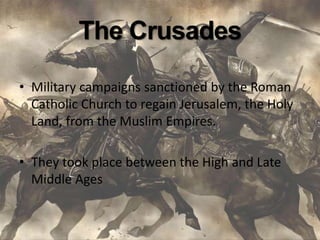
• Military campaigns sanctioned by the Roman
Catholic Church to regain Jerusalem, the Holy
Land, from the Muslim Empires.
• They took place between the High and Late
Middle Ages
The Buildup to the Crusades
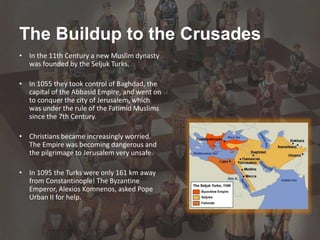
• In the 11th Century a new Muslim dynasty
was founded by the Seljuk Turks.
• In 1055 they took control of Baghdad, the
capital of the Abbasid Empire, and went on
to conquer the city of Jerusalem, which
was under the rule of the Fatimid Muslims
since the 7th Century.
• Christians became increasingly worried.
The Empire was becoming dangerous and
the pilgrimage to Jerusalem very unsafe.
• In 1095 the Turks were only 161 km away
from Constantinople! The Byzantine
Emperor, Alexios Komnenos, asked Pope
Urban II for help.
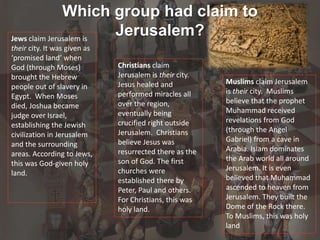
Which group had claim to
Jerusalem?Jews claim Jerusalem is
their city. It was given as
ā€˜promised land’ when
God (through Moses)
brought the Hebrew
people out of slavery in
Egypt. When Moses
died, Joshua became
judge over Israel,
establishing the Jewish
civilization in Jerusalem
and the surrounding
areas. According to Jews,
this was God-given holy
land.
Christians claim
Jerusalem is their city.
Jesus healed and
performed miracles all
over the region,
eventually being
crucified right outside
Jerusalem. Christians
believe Jesus was
resurrected there as the
son of God. The first
churches were
established there by
Peter, Paul and others.
For Christians, this was
holy land.
Muslims claim Jerusalem
is their city. Muslims
believe that the prophet
Muhammad received
revelations from God
(through the Angel
Gabriel) from a cave in
Arabia. Islam dominates
the Arab world all around
Jerusalem. It is even
believed that Muhammad
ascended to heaven from
Jerusalem. They built the
Dome of the Rock there.
To Muslims, this was holy
land
The Buildup to the Crusades
ā€œAll who die by the way, whether by land or by sea, or in
battle against the pagans, shall have immediate remission of
sins. This I grant them through the power of God with which I
am invested.ā€
Pope Urban II, extract from speech at Council of Clermont, 1095.
• A council gathered in Clermont, France, where Pope Urban II called for the 1st
Crusade.
• Knights, craftsmen, townspeople and peasants all enlisted to reclaim what they
believed was theirs.
• Religious desire was only one of the reasons to fight: many saw trading
opportunities and, especially sons of noblemen, hoped to gain their own land in
Jerusalem.
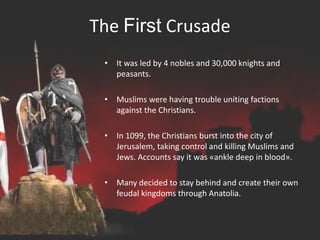
The First Crusade
• It was led by 4 nobles and 30,000 knights and
peasants.
• Muslims were having trouble uniting factions
against the Christians.
• In 1099, the Christians burst into the city of
Jerusalem, taking control and killing Muslims and
Jews. Accounts say it was «ankle deep in blood».
• Many decided to stay behind and create their own
feudal kingdoms through Anatolia.
The Second Crusade
• Muslims realized that uniting against the
Christians would work in their favour.
• In 1144 they were able to capture Edessa, the
new capital set by the Christians.
• Many Crusaders died on the way to Jerusalem
and those who arrived there, were defeated by
an alliance of Muslims who came to the city’s aid.
The Holy Land was reclaimed by them.
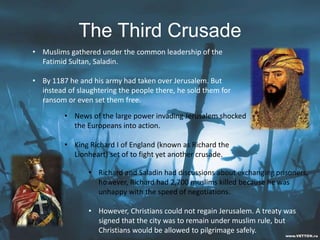
The Third Crusade
• Muslims gathered under the common leadership of the
Fatimid Sultan, Saladin.
• By 1187 he and his army had taken over Jerusalem. But
instead of slaughtering the people there, he sold them for
ransom or even set them free.
• News of the large power invading Jerusalem shocked
the Europeans into action.
• King Richard I of England (known as Richard the
Lionheart) set of to fight yet another crusade.
• Richard and Saladin had discussions about exchanging prisoners,
however, Richard had 2,700 muslims killed because he was
unhappy with the speed of negotiations.
• However, Christians could not regain Jerusalem. A treaty was
signed that the city was to remain under muslim rule, but
Christians would be allowed to pilgrimage safely.
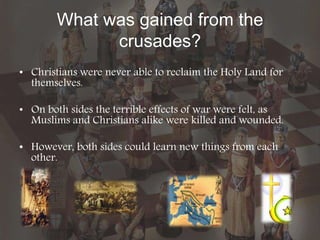
What was gained from the
crusades?
• Christians were never able to reclaim the Holy Land for
themselves.
• On both sides the terrible effects of war were felt, as
Muslims and Christians alike were killed and wounded.
• However, both sides could learn new things from each
other.
How were Christians impacted?
• Economic: more money
circulation, loans,
investment on certain
war industries.
• Social: monarchs
tightened their power,
peasants found ways to
leave the manors.
• Cultural: algebra, chess,
new fabrics, food and
spices, mirrors, carpets,
better irrigation
systems, Arabic figures
0 - 9, far superior
muslim Castle building
and others.
How were Muslims impacted?
• They were only able to learn from what
Crusaders brought with them: different cloth like
linen or leather, weapons and armour, and the
idea of a professional army.
• Since the arab world was more technologically
advanced, they had little to gain from Europe.
• However, many schools and mosques were built
with the money earned from the increased
trading.

The Crusades

  • 1.
    The Crusades • Militarycampaigns sanctioned by the Roman Catholic Church to regain Jerusalem, the Holy Land, from the Muslim Empires. • They took place between the High and Late Middle Ages
  • 2.
    The Buildup tothe Crusades • In the 11th Century a new Muslim dynasty was founded by the Seljuk Turks. • In 1055 they took control of Baghdad, the capital of the Abbasid Empire, and went on to conquer the city of Jerusalem, which was under the rule of the Fatimid Muslims since the 7th Century. • Christians became increasingly worried. The Empire was becoming dangerous and the pilgrimage to Jerusalem very unsafe. • In 1095 the Turks were only 161 km away from Constantinople! The Byzantine Emperor, Alexios Komnenos, asked Pope Urban II for help.
  • 3.
    Which group hadclaim to Jerusalem?Jews claim Jerusalem is their city. It was given as ā€˜promised land’ when God (through Moses) brought the Hebrew people out of slavery in Egypt. When Moses died, Joshua became judge over Israel, establishing the Jewish civilization in Jerusalem and the surrounding areas. According to Jews, this was God-given holy land. Christians claim Jerusalem is their city. Jesus healed and performed miracles all over the region, eventually being crucified right outside Jerusalem. Christians believe Jesus was resurrected there as the son of God. The first churches were established there by Peter, Paul and others. For Christians, this was holy land. Muslims claim Jerusalem is their city. Muslims believe that the prophet Muhammad received revelations from God (through the Angel Gabriel) from a cave in Arabia. Islam dominates the Arab world all around Jerusalem. It is even believed that Muhammad ascended to heaven from Jerusalem. They built the Dome of the Rock there. To Muslims, this was holy land
  • 4.
    The Buildup tothe Crusades ā€œAll who die by the way, whether by land or by sea, or in battle against the pagans, shall have immediate remission of sins. This I grant them through the power of God with which I am invested.ā€ Pope Urban II, extract from speech at Council of Clermont, 1095. • A council gathered in Clermont, France, where Pope Urban II called for the 1st Crusade. • Knights, craftsmen, townspeople and peasants all enlisted to reclaim what they believed was theirs. • Religious desire was only one of the reasons to fight: many saw trading opportunities and, especially sons of noblemen, hoped to gain their own land in Jerusalem.
  • 5.
    The First Crusade •It was led by 4 nobles and 30,000 knights and peasants. • Muslims were having trouble uniting factions against the Christians. • In 1099, the Christians burst into the city of Jerusalem, taking control and killing Muslims and Jews. Accounts say it was Ā«ankle deep in bloodĀ». • Many decided to stay behind and create their own feudal kingdoms through Anatolia.
  • 6.
    The Second Crusade •Muslims realized that uniting against the Christians would work in their favour. • In 1144 they were able to capture Edessa, the new capital set by the Christians. • Many Crusaders died on the way to Jerusalem and those who arrived there, were defeated by an alliance of Muslims who came to the city’s aid. The Holy Land was reclaimed by them.
  • 7.
    The Third Crusade •Muslims gathered under the common leadership of the Fatimid Sultan, Saladin. • By 1187 he and his army had taken over Jerusalem. But instead of slaughtering the people there, he sold them for ransom or even set them free. • News of the large power invading Jerusalem shocked the Europeans into action. • King Richard I of England (known as Richard the Lionheart) set of to fight yet another crusade. • Richard and Saladin had discussions about exchanging prisoners, however, Richard had 2,700 muslims killed because he was unhappy with the speed of negotiations. • However, Christians could not regain Jerusalem. A treaty was signed that the city was to remain under muslim rule, but Christians would be allowed to pilgrimage safely.
  • 8.
    What was gainedfrom the crusades? • Christians were never able to reclaim the Holy Land for themselves. • On both sides the terrible effects of war were felt, as Muslims and Christians alike were killed and wounded. • However, both sides could learn new things from each other.
  • 9.
    How were Christiansimpacted? • Economic: more money circulation, loans, investment on certain war industries. • Social: monarchs tightened their power, peasants found ways to leave the manors. • Cultural: algebra, chess, new fabrics, food and spices, mirrors, carpets, better irrigation systems, Arabic figures 0 - 9, far superior muslim Castle building and others.
  • 10.
    How were Muslimsimpacted? • They were only able to learn from what Crusaders brought with them: different cloth like linen or leather, weapons and armour, and the idea of a professional army. • Since the arab world was more technologically advanced, they had little to gain from Europe. • However, many schools and mosques were built with the money earned from the increased trading.