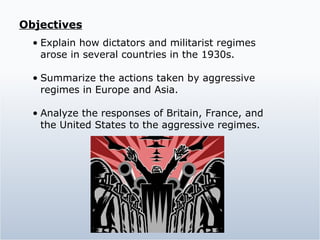
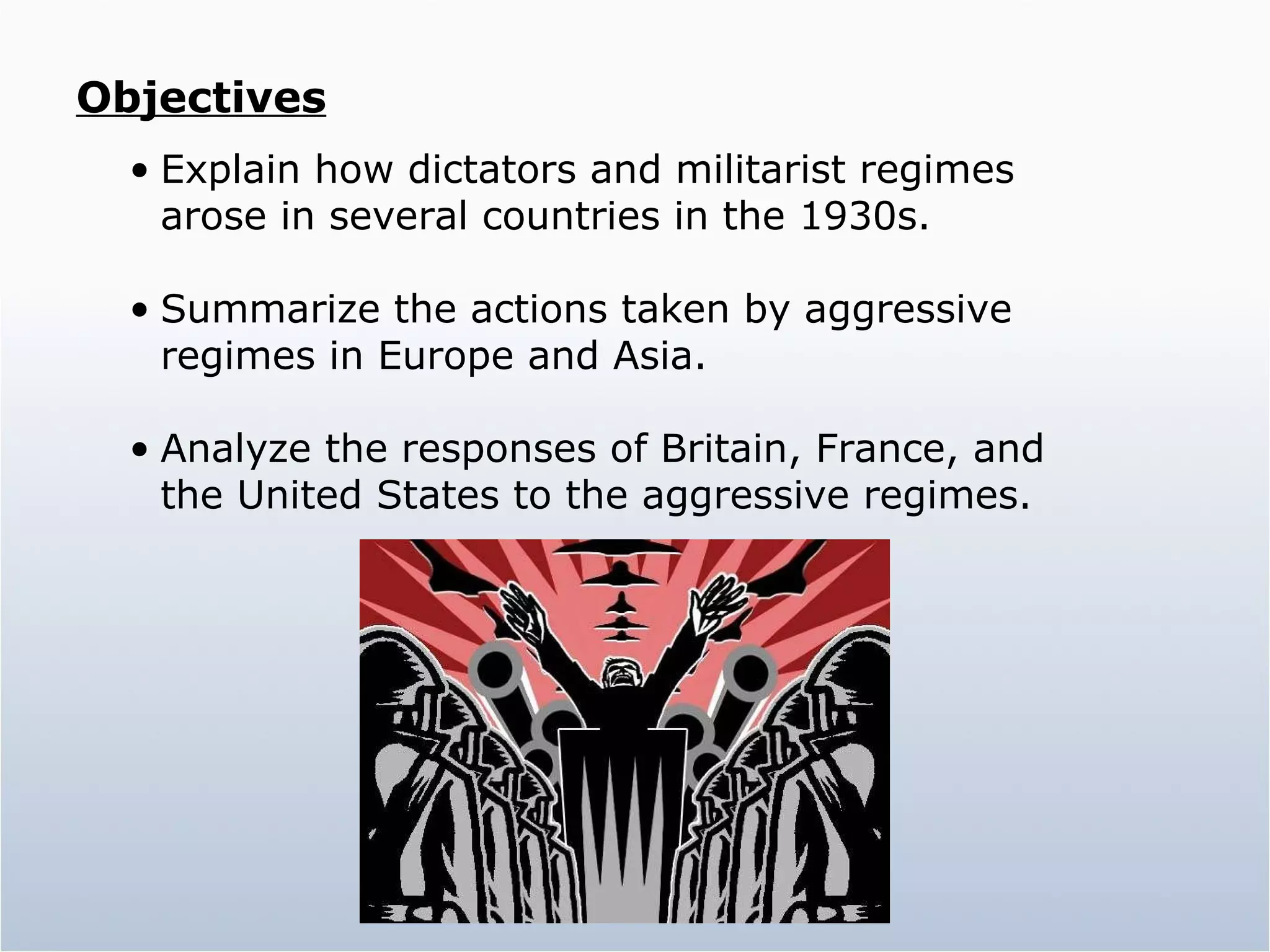
Explain how dictators and militarist regimes arose in several countries in the 1930s. Summarize the actions taken by aggressive regimes in Europe and Asia. Analyze the responses of Britain, France, and the United States to the aggressive regimes.  Objectives
Why did totalitarian states rise after World War I, and what did they do?  World War I and the Great Depression had devastating effects throughout the world. In some countries, people turned to new leaders who would be responsible for creating an even deadlier global conflict.
Geography Review Major Countries United States Soviet Union (USSR) Germany Italy England France Japan China Spain
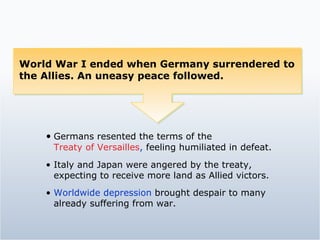
• Germans resented the terms of the  Treaty of Versailles ,  feeling humiliated in defeat. Italy and Japan were angered by the treaty, expecting to receive more land as Allied victors. • Worldwide depression  brought despair to many already suffering from war.  World War I ended when Germany surrendered to the Allies. An uneasy peace followed.
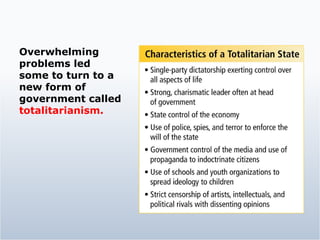
Overwhelming problems led some to turn to a  new form of government called  totalitarianism.
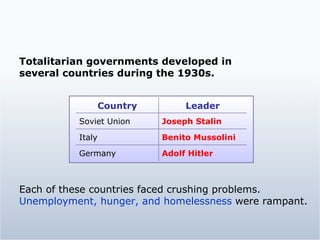
Totalitarian governments developed in  several countries during the 1930s. Each of these countries faced crushing problems.  Unemployment, hunger, and homelessness  were rampant.  Country Leader Soviet Union Joseph Stalin Italy Benito Mussolini Germany Adolf Hitler
Totalitarian leaders promised to  bring jobs, food, and prosperity. They promised to make their countries great again. In reality, however, the brutal tactics used by totalitarian leaders resulted in the deaths of millions of people.
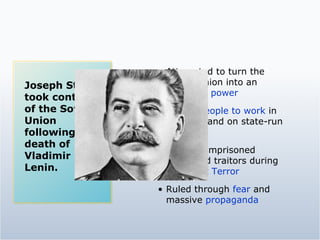
Attempted to turn the Soviet Union into an  industrial power Forced people to work  in factories and on state-run farms Killed or imprisoned  suspected traitors during the  Great Terror Ruled through  fear  and massive  propaganda Joseph Stalin took control of the Soviet Union following the death of Vladimir Lenin.
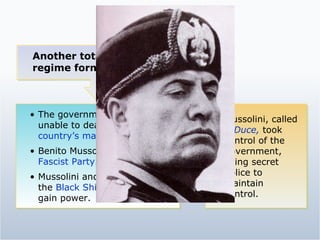
Another totalitarian regime formed in Italy. The government seemed unable to deal with the  country’s many problems. Benito Mussolini formed the  Fascist Party. Mussolini and his followers, the  Black Shirts,  fought to gain power. Mussolini, called   Il Duce,   took control of the government, using secret police to maintain control.
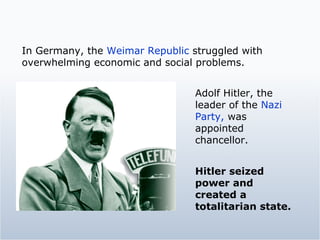
Adolf Hitler, the leader of the  Nazi Party,  was appointed chancellor.  In Germany, the  Weimar Republic  struggled with overwhelming economic and social problems. Hitler seized power and created a totalitarian state.
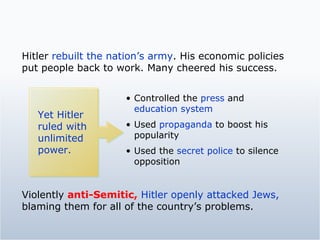
Hitler  rebuilt the nation’s army . His economic policies put people back to work. Many cheered his success. Yet Hitler ruled with unlimited power. Controlled the  press  and  education system Used  propaganda  to boost his popularity Used the  secret police  to silence opposition Violently  anti-Semitic,   Hitler openly attacked Jews,  blaming them for all of the country’s problems.
These leaders attempted to solve their country’s economic problems through  aggressive military conquests. Japan did not become a totalitarian dictatorship, but it did come under the influence of strong military leaders.
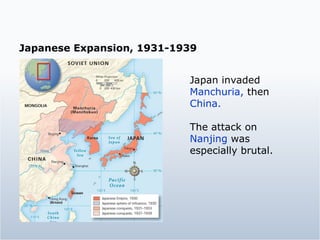
Japanese Expansion, 1931-1939 Japan invaded  Manchuria,  then  China. The attack on  Nanjing  was especially brutal.
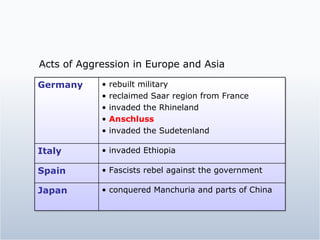
Acts of Aggression in Europe and Asia Germany •  rebuilt military •  reclaimed Saar region from France •  invaded the Rhineland •  Anschluss •  invaded the Sudetenland Italy •  invaded Ethiopia Spain •  Fascists rebel against the government Japan •  conquered Manchuria and parts of China
A weak League of Nations did little to stop the aggression of the totalitarian states or of Japan.  Many  feared involvement in another war. Some believed the  Soviet Union posed a greater threat  than Nazi Germany. Others questioned the resolve of their own country and their allies, and embraced a policy of  isolationism.
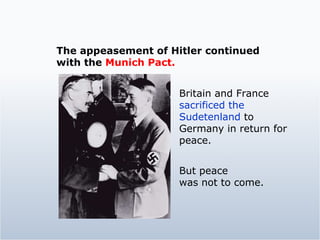
The appeasement of Hitler continued  with the  Munich Pact. Britain and France  sacrificed the Sudetenland  to Germany in return for peace. But peace  was not to come.
Terms and People totalitarianism  −  theory of government in which a single party or leader controls the economic, social, and cultural lives of its people Joseph Stalin  −  dictator and   head of the Communist Party in Russia Benito Mussolini  −  founder of the Fascist Party and Italian dictator  Adolf Hitler  −  leader of the Nazi Party in Germany who seized power and attempted world domination anti-Semitic  −  prejudiced against Jewish people
Terms and People   (continued)

Lesson 1 Dictators & War

  • 1.
    Explain how dictatorsand militarist regimes arose in several countries in the 1930s. Summarize the actions taken by aggressive regimes in Europe and Asia. Analyze the responses of Britain, France, and the United States to the aggressive regimes. Objectives
  • 2.
    Why did totalitarianstates rise after World War I, and what did they do? World War I and the Great Depression had devastating effects throughout the world. In some countries, people turned to new leaders who would be responsible for creating an even deadlier global conflict.
  • 3.
    Geography Review MajorCountries United States Soviet Union (USSR) Germany Italy England France Japan China Spain
  • 4.
    • Germans resentedthe terms of the Treaty of Versailles , feeling humiliated in defeat. Italy and Japan were angered by the treaty, expecting to receive more land as Allied victors. • Worldwide depression brought despair to many already suffering from war. World War I ended when Germany surrendered to the Allies. An uneasy peace followed.
  • 5.
    Overwhelming problems ledsome to turn to a new form of government called totalitarianism.
  • 6.
    Totalitarian governments developedin several countries during the 1930s. Each of these countries faced crushing problems. Unemployment, hunger, and homelessness were rampant. Country Leader Soviet Union Joseph Stalin Italy Benito Mussolini Germany Adolf Hitler
  • 7.
    Totalitarian leaders promisedto bring jobs, food, and prosperity. They promised to make their countries great again. In reality, however, the brutal tactics used by totalitarian leaders resulted in the deaths of millions of people.
  • 8.
    Attempted to turnthe Soviet Union into an industrial power Forced people to work in factories and on state-run farms Killed or imprisoned suspected traitors during the Great Terror Ruled through fear and massive propaganda Joseph Stalin took control of the Soviet Union following the death of Vladimir Lenin.
  • 9.
    Another totalitarian regimeformed in Italy. The government seemed unable to deal with the country’s many problems. Benito Mussolini formed the Fascist Party. Mussolini and his followers, the Black Shirts, fought to gain power. Mussolini, called Il Duce, took control of the government, using secret police to maintain control.
  • 10.
    Adolf Hitler, theleader of the Nazi Party, was appointed chancellor. In Germany, the Weimar Republic struggled with overwhelming economic and social problems. Hitler seized power and created a totalitarian state.
  • 11.
    Hitler rebuiltthe nation’s army . His economic policies put people back to work. Many cheered his success. Yet Hitler ruled with unlimited power. Controlled the press and education system Used propaganda to boost his popularity Used the secret police to silence opposition Violently anti-Semitic, Hitler openly attacked Jews, blaming them for all of the country’s problems.
  • 12.
    These leaders attemptedto solve their country’s economic problems through aggressive military conquests. Japan did not become a totalitarian dictatorship, but it did come under the influence of strong military leaders.
  • 13.
    Japanese Expansion, 1931-1939Japan invaded Manchuria, then China. The attack on Nanjing was especially brutal.
  • 14.
    Acts of Aggressionin Europe and Asia Germany • rebuilt military • reclaimed Saar region from France • invaded the Rhineland • Anschluss • invaded the Sudetenland Italy • invaded Ethiopia Spain • Fascists rebel against the government Japan • conquered Manchuria and parts of China
  • 15.
    A weak Leagueof Nations did little to stop the aggression of the totalitarian states or of Japan. Many feared involvement in another war. Some believed the Soviet Union posed a greater threat than Nazi Germany. Others questioned the resolve of their own country and their allies, and embraced a policy of isolationism.
  • 16.
    The appeasement ofHitler continued with the Munich Pact. Britain and France sacrificed the Sudetenland to Germany in return for peace. But peace was not to come.
  • 17.
    Terms and Peopletotalitarianism − theory of government in which a single party or leader controls the economic, social, and cultural lives of its people Joseph Stalin − dictator and head of the Communist Party in Russia Benito Mussolini − founder of the Fascist Party and Italian dictator Adolf Hitler − leader of the Nazi Party in Germany who seized power and attempted world domination anti-Semitic − prejudiced against Jewish people
  • 18.
    Terms and People (continued)