Title Page Photo “ I've lived in good climate, and it bores the hell out of me. I like weather rather than climate.” — John Steinbeck (Brainquote.com)
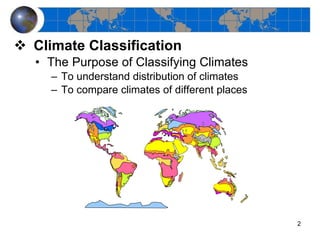
Climate Classification The Purpose of Classifying Climates To understand distribution of climates To compare climates of different places
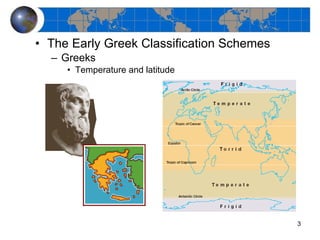
The Early Greek Classification Schemes Greeks Temperature and latitude
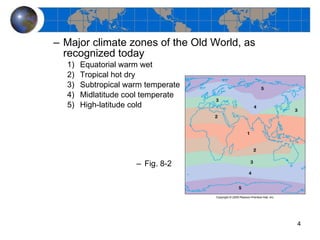
Major climate zones of the Old World, as recognized today Equatorial warm wet Tropical hot dry Subtropical warm temperate Midlatitude cool temperate High-latitude cold Fig. 8-2
The K öppen Classification System Empirical System Has a numerical basis Temperature data Precipitation data Teaching tool Simple to comprehend and to use Shows an orderly pattern over the world Gives some indication of climate origin (genesis)
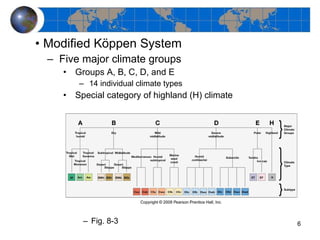
Modified K öppen System Five major climate groups Groups A, B, C, D, and E 14 individual climate types Special category of highland (H) climate Fig. 8-3
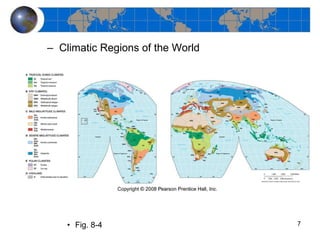
Climatic Regions of the World Fig. 8-4
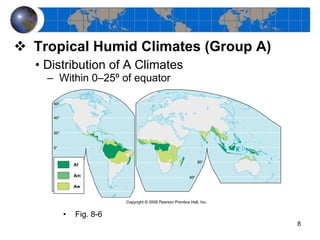
Tropical Humid Climates (Group A) Distribution of A Climates Within 0 – 25 º of equator Fig. 8-6
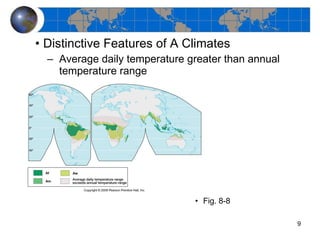
Fig. 8-8 Distinctive Features of A Climates Average daily temperature greater than annual temperature range
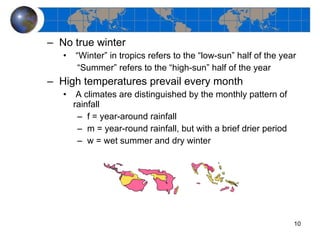
No true winter “ Winter” in tropics refers to the “low-sun” half of the year “ Summer” refers to the “high-sun” half of the year High temperatures prevail every month A climates are distinguished by the monthly pattern of rainfall f = year-around rainfall m = year-round rainfall, but with a brief drier period w = wet summer and dry winter
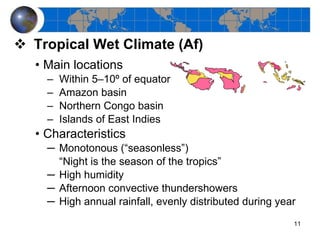
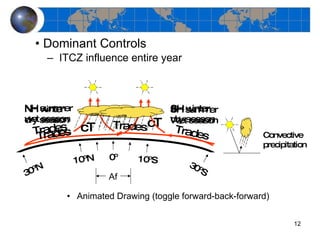
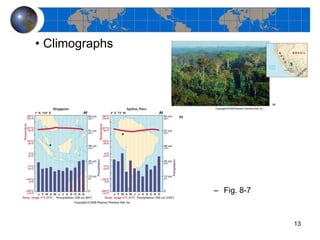
Tropical Wet Climate (Af) Main locations Within 5 –10º of equator  Amazon basin Northern Congo basin Islands of East Indies Characteristics Monotonous (“seasonless”) “ Night is the season of the tropics” High humidity Afternoon convective thundershowers High annual rainfall, evenly distributed during year
Dominant Controls ITCZ influence entire year Animated Drawing (toggle forward-back-forward) Af Convective precipitation 30ºN 30ºS 0º 10ºS 10ºN cT NH summer wet season Trades Trades SH winter dry season cT NH winter dry season Trades Trades SH summer Wet season
Climographs Fig. 8-7
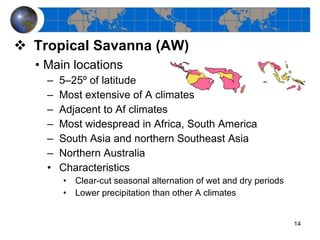
Main locations 5 – 25 º of latitude Most extensive of A climates  Adjacent to Af climates Most widespread in Africa, South America South Asia and northern Southeast Asia Northern Australia Characteristics Clear-cut seasonal alternation of wet and dry periods Lower precipitation than other A climates Tropical Savanna (AW)
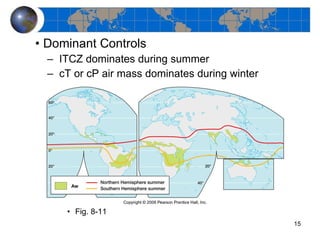
Dominant Controls ITCZ dominates during summer  cT or cP air mass dominates during winter Fig. 8-11
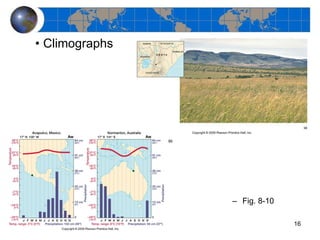
Climographs Fig. 8-10
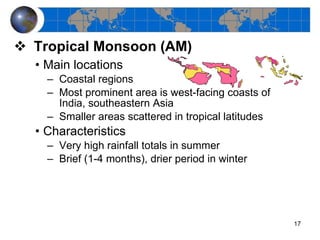
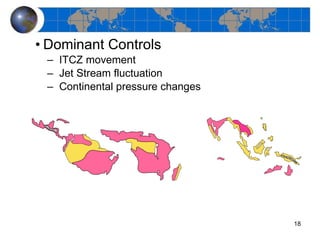
Tropical Monsoon (AM) Main locations Coastal regions Most prominent area is west-facing coasts of India, southeastern Asia Smaller areas scattered in tropical latitudes Characteristics Very high rainfall totals in summer Brief (1-4 months), drier period in winter
Dominant Controls ITCZ movement Jet Stream fluctuation Continental pressure changes
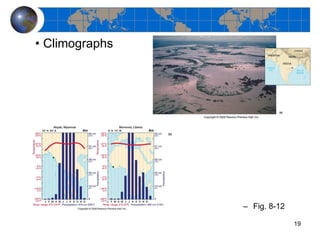
Climographs Fig. 8-12
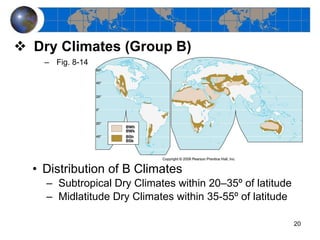
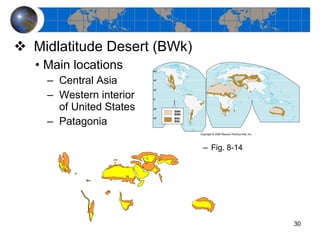
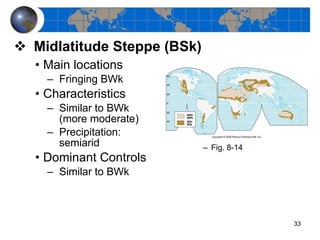
Dry Climates (Group B) Fig. 8-14 Distribution of B Climates Subtropical Dry Climates within 20 –35º of latitude Midlatitude Dry Climates within 35-55º of latitude
Distinctive Features of B climates Cover 30% of the total land area of the world More area than any other climate group Dry conditions prevail all year Potential evapotranspiration is greater than precipitation Two main sub-types based on precipitation BW is extremely arid (desert) BS is steppe (semi-arid) The two sub-types are further subdivided based on temperature h is for the hot subtropical desert (BWh, BSh) k is for the cold midlatitude desert (BWk, BSk)
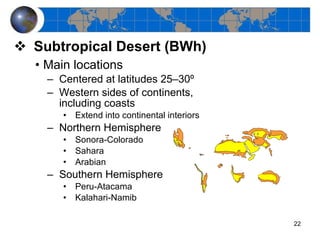
Subtropical Desert (BWh) Main locations Centered at latitudes 25–30º Western sides of continents, including coasts Extend into continental interiors Northern Hemisphere Sonora-Colorado Sahara Arabian Southern Hemisphere Peru-Atacama Kalahari-Namib
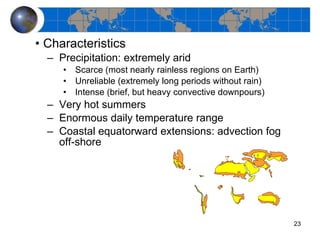
Characteristics Precipitation: extremely arid Scarce (most nearly rainless regions on Earth) Unreliable (extremely long periods without rain) Intense (brief, but heavy convective downpours) Very hot summers Enormous daily temperature range Coastal equatorward extensions: advection fog off-shore
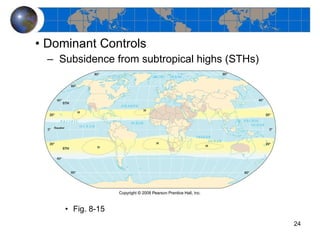
Dominant Controls Subsidence from subtropical highs (STHs) Fig. 8-15
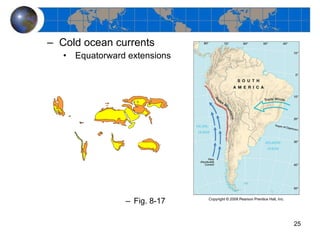
Cold ocean currents Equatorward extensions Fig. 8-17
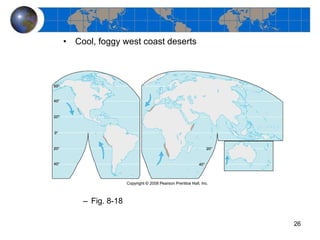
Cool, foggy west coast deserts Fig. 8-18
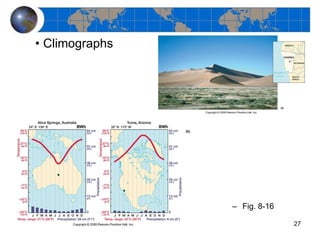
Climographs Fig. 8-16
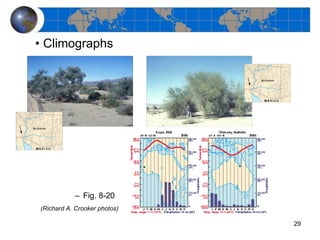
Subtropical Steppe (BSh) Main locations Fringing BWh except on west coasts Characteristics Similar to BWh but more moderate Precipitation: semiarid Dominant Controls Similar to BWh
Climographs Fig. 8-20 (Richard A. Crooker photos)
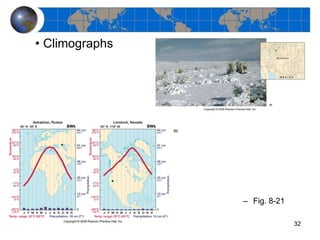
Midlatitude Desert (BWk) Main locations Central Asia Western interior of United States Patagonia Fig. 8-14
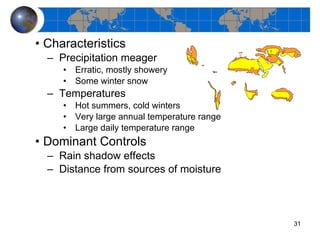
Characteristics Precipitation meager Erratic, mostly showery Some winter snow Temperatures Hot summers, cold winters Very large annual temperature range Large daily temperature range Dominant Controls Rain shadow effects Distance from sources of moisture
Climographs Fig. 8-21
Midlatitude Steppe (BSk) Main locations Fringing BWk Characteristics Similar to BWk  (more moderate) Precipitation: semiarid Dominant Controls Similar to BWk Fig. 8-14
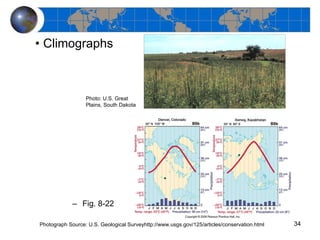
Climographs Fig. 8-22 Photograph Source: U.S. Geological Surveyhttp://www.usgs.gov/125/articles/conservation.html Photo: U.S. Great Plains, South Dakota
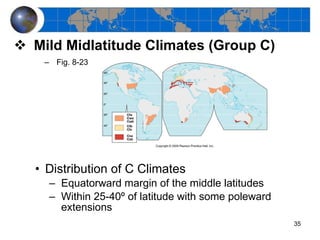
Mild Midlatitude Climates (Group C) Fig. 8-23 Distribution of C Climates Equatorward margin of the middle latitudes Within 25-40º of latitude with some poleward extensions
Distinctive Features of C climates Temperatures Long summers, usually hot Short winters, relatively mild Precipitation No year-round moisture deficiency Some climates have seasonal shortages Three subtypes Mediterranean (Csa, Csb) Humid subtropical (Cfa) Marine west coast (Cfb, Cfc)
Mediterranean Climates (Csa, Csb) Main locations Western side of continents 30–40º of latitude Mediterranean coast California Central Chile Southern tip of Africa (Cape Town) Australia (Perth & Adelaide)
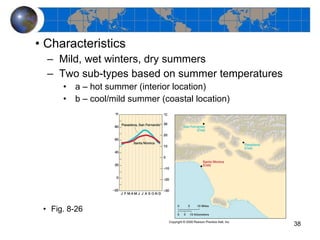
Characteristics Mild, wet winters, dry summers Two sub-types based on summer temperatures a – hot summer (interior location) b – cool/mild summer (coastal location) Fig. 8-26
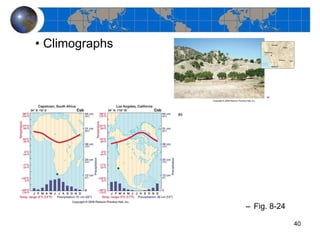
Dominant Controls STH subsidence in summer (forces cyclonic storms poleward) Westerly winds and cyclonic storms shift equatorward in winter Precipitation Moderate annually Winter maximum (midlatitude cyclonic storms)
Climographs Fig. 8-24
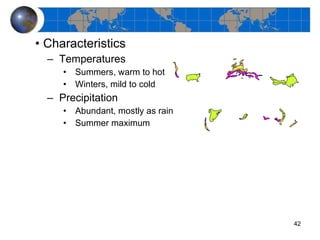
Humid Subtropical (Cfa, Cwa) Main locations Eastern sides of continents 25–30º of latitude Southeastern United States Eastern China Southern Brazil and Uruguay Small areas in Africa and Australia
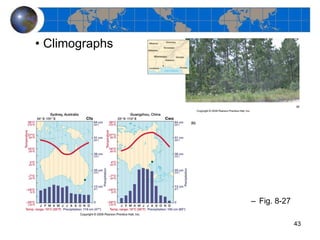
Characteristics Temperatures Summers, warm to hot Winters, mild to cold Precipitation Abundant, mostly as rain Summer maximum
Climographs Fig. 8-27
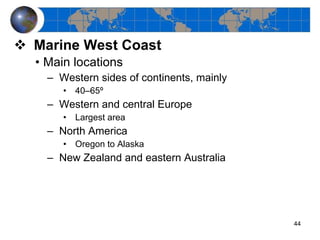
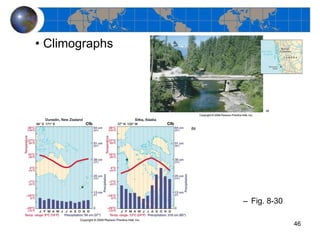
Marine West Coast Main locations Western sides of continents, mainly 40–65º Western and central Europe Largest area North America Oregon to Alaska New Zealand and eastern Australia
Characteristics Temperature Very mild winters for latitude Precipitation Moderate to abundant, mostly in winter Many rainy days Much cloudiness Dominant Controls Westerly flow and oceanic influence year-round
Climographs Fig. 8-30
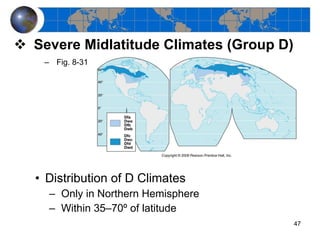
Severe Midlatitude Climates (Group D) Fig. 8-31 Distribution of D Climates Only in Northern Hemisphere Within 35 –70º of latitude
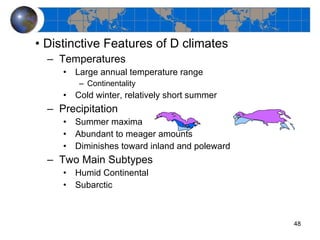
Distinctive Features of D climates Temperatures Large annual temperature range Continentality Cold winter, relatively short summer Precipitation Summer maxima Abundant to meager amounts Diminishes toward inland and poleward Two Main Subtypes Humid Continental Subarctic
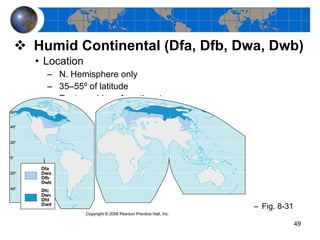
Humid Continental (Dfa, Dfb, Dwa, Dwb) Location N. Hemisphere only 35 –55º of latitude Eastern sides of continents Fig. 8-31
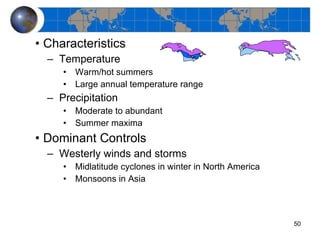
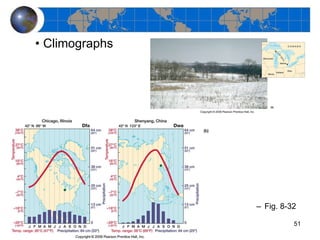
Characteristics Temperature Warm/hot summers Large annual temperature range Precipitation Moderate to abundant Summer maxima Dominant Controls Westerly winds and storms Midlatitude cyclones in winter in North America Monsoons in Asia
Climographs Fig. 8-32
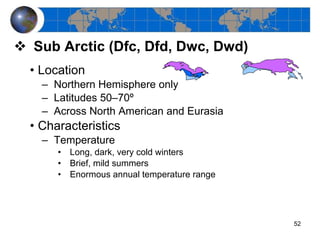
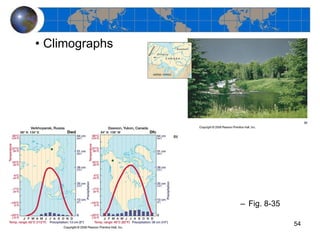
Sub Arctic (Dfc, Dfd, Dwc, Dwd) Location Northern Hemisphere only Latitudes 50–70º Across North American and Eurasia Characteristics Temperature Long, dark, very cold winters Brief, mild summers Enormous annual temperature range
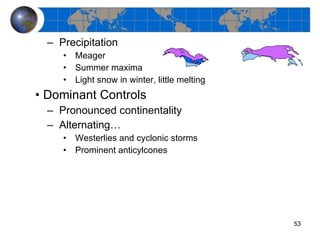
Precipitation Meager Summer maxima Light snow in winter, little melting Dominant Controls Pronounced continentality Alternating… Westerlies and cyclonic storms Prominent anticylcones
Climographs Fig. 8-35
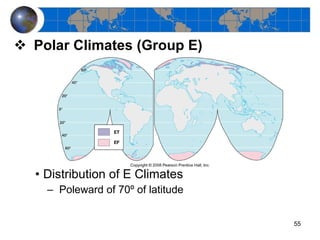
Polar Climates (Group E) Distribution of E Climates Poleward of 70º of latitude
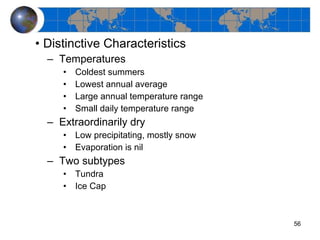
Distinctive Characteristics Temperatures Coldest summers Lowest annual average Large annual temperature range Small daily temperature range Extraordinarily dry Low precipitating, mostly snow Evaporation is nil Two subtypes Tundra Ice Cap
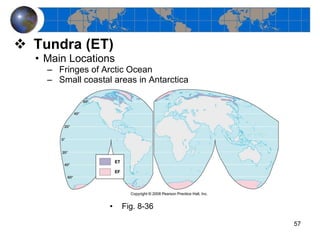
Tundra (ET) Main Locations Fringes of Arctic Ocean Small coastal areas in Antarctica Fig. 8-36
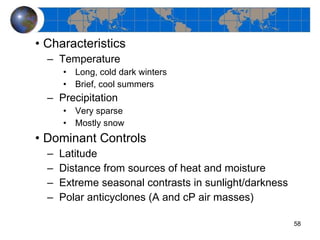
Characteristics Temperature Long, cold dark winters Brief, cool summers Precipitation Very sparse Mostly snow Dominant Controls Latitude Distance from sources of heat and moisture Extreme seasonal contrasts in sunlight/darkness Polar anticyclones (A and cP air masses)
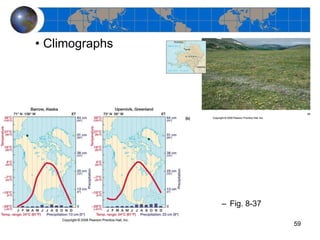
Climographs Fig. 8-37
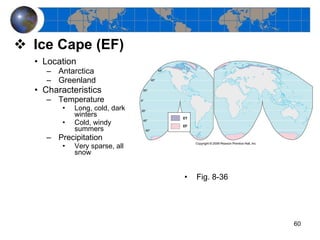
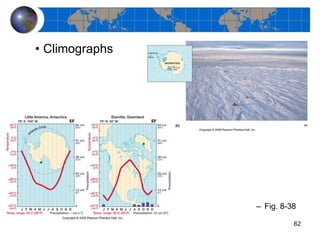
Ice Cape (EF) Location Antarctica Greenland Characteristics Temperature Long, cold, dark winters Cold, windy summers Precipitation Very sparse, all snow Fig. 8-36
Dominant Controls Latitude Distances from sources of heat and moisture Extreme seasonal contrasts in sunlight/darkness Polar anticyclones (A and cP air masses)
Climographs Fig. 8-38
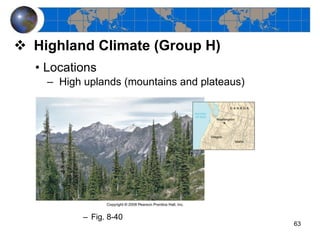
Highland Climate (Group H) Locations High uplands (mountains and plateaus) Fig. 8-40
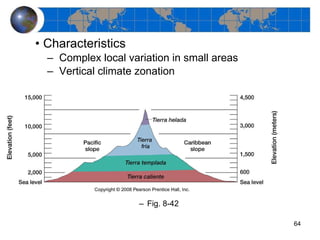
Characteristics Complex local variation in small areas Vertical climate zonation Fig. 8-42
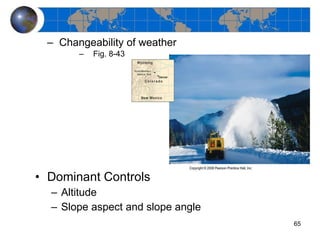
Changeability of weather Fig. 8-43 Dominant Controls Altitude Slope aspect and slope angle
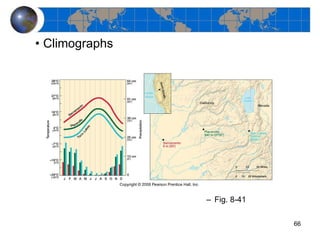
Climographs Fig. 8-41
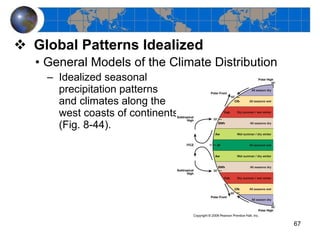
Global Patterns Idealized General Models of the Climate Distribution Idealized seasonal precipitation patterns and climates along the west coasts of continents (Fig. 8-44).
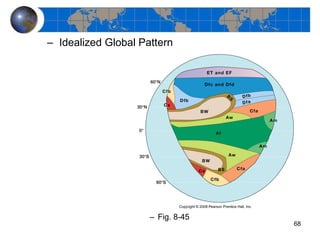
Idealized Global Pattern Fig. 8-45
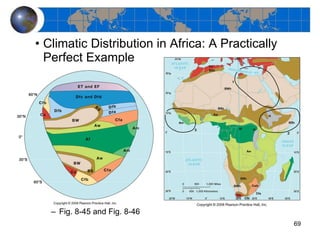
Climatic Distribution in Africa: A Practically Perfect Example Fig. 8-45 and Fig. 8-46
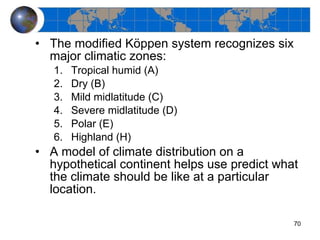
The modified  K öppen system recognizes six major climatic zones: Tropical humid (A) Dry (B) Mild midlatitude (C) Severe midlatitude (D) Polar (E) Highland (H) A model of climate distribution on a hypothetical continent helps use predict what the climate should be like at a particular location.
Chapter eight

  • 1.
    Title Page Photo“ I've lived in good climate, and it bores the hell out of me. I like weather rather than climate.” — John Steinbeck (Brainquote.com)
  • 2.
    Climate Classification ThePurpose of Classifying Climates To understand distribution of climates To compare climates of different places
  • 3.
    The Early GreekClassification Schemes Greeks Temperature and latitude
  • 4.
    Major climate zonesof the Old World, as recognized today Equatorial warm wet Tropical hot dry Subtropical warm temperate Midlatitude cool temperate High-latitude cold Fig. 8-2
  • 5.
    The K öppenClassification System Empirical System Has a numerical basis Temperature data Precipitation data Teaching tool Simple to comprehend and to use Shows an orderly pattern over the world Gives some indication of climate origin (genesis)
  • 6.
    Modified K öppenSystem Five major climate groups Groups A, B, C, D, and E 14 individual climate types Special category of highland (H) climate Fig. 8-3
  • 7.
    Climatic Regions ofthe World Fig. 8-4
  • 8.
    Tropical Humid Climates(Group A) Distribution of A Climates Within 0 – 25 º of equator Fig. 8-6
  • 9.
    Fig. 8-8 DistinctiveFeatures of A Climates Average daily temperature greater than annual temperature range
  • 10.
    No true winter“ Winter” in tropics refers to the “low-sun” half of the year “ Summer” refers to the “high-sun” half of the year High temperatures prevail every month A climates are distinguished by the monthly pattern of rainfall f = year-around rainfall m = year-round rainfall, but with a brief drier period w = wet summer and dry winter
  • 11.
    Tropical Wet Climate(Af) Main locations Within 5 –10º of equator Amazon basin Northern Congo basin Islands of East Indies Characteristics Monotonous (“seasonless”) “ Night is the season of the tropics” High humidity Afternoon convective thundershowers High annual rainfall, evenly distributed during year
  • 12.
    Dominant Controls ITCZinfluence entire year Animated Drawing (toggle forward-back-forward) Af Convective precipitation 30ºN 30ºS 0º 10ºS 10ºN cT NH summer wet season Trades Trades SH winter dry season cT NH winter dry season Trades Trades SH summer Wet season
  • 13.
  • 14.
    Main locations 5– 25 º of latitude Most extensive of A climates Adjacent to Af climates Most widespread in Africa, South America South Asia and northern Southeast Asia Northern Australia Characteristics Clear-cut seasonal alternation of wet and dry periods Lower precipitation than other A climates Tropical Savanna (AW)
  • 15.
    Dominant Controls ITCZdominates during summer cT or cP air mass dominates during winter Fig. 8-11
  • 16.
  • 17.
    Tropical Monsoon (AM)Main locations Coastal regions Most prominent area is west-facing coasts of India, southeastern Asia Smaller areas scattered in tropical latitudes Characteristics Very high rainfall totals in summer Brief (1-4 months), drier period in winter
  • 18.
    Dominant Controls ITCZmovement Jet Stream fluctuation Continental pressure changes
  • 19.
  • 20.
    Dry Climates (GroupB) Fig. 8-14 Distribution of B Climates Subtropical Dry Climates within 20 –35º of latitude Midlatitude Dry Climates within 35-55º of latitude
  • 21.
    Distinctive Features ofB climates Cover 30% of the total land area of the world More area than any other climate group Dry conditions prevail all year Potential evapotranspiration is greater than precipitation Two main sub-types based on precipitation BW is extremely arid (desert) BS is steppe (semi-arid) The two sub-types are further subdivided based on temperature h is for the hot subtropical desert (BWh, BSh) k is for the cold midlatitude desert (BWk, BSk)
  • 22.
    Subtropical Desert (BWh)Main locations Centered at latitudes 25–30º Western sides of continents, including coasts Extend into continental interiors Northern Hemisphere Sonora-Colorado Sahara Arabian Southern Hemisphere Peru-Atacama Kalahari-Namib
  • 23.
    Characteristics Precipitation: extremelyarid Scarce (most nearly rainless regions on Earth) Unreliable (extremely long periods without rain) Intense (brief, but heavy convective downpours) Very hot summers Enormous daily temperature range Coastal equatorward extensions: advection fog off-shore
  • 24.
    Dominant Controls Subsidencefrom subtropical highs (STHs) Fig. 8-15
  • 25.
    Cold ocean currentsEquatorward extensions Fig. 8-17
  • 26.
    Cool, foggy westcoast deserts Fig. 8-18
  • 27.
  • 28.
    Subtropical Steppe (BSh)Main locations Fringing BWh except on west coasts Characteristics Similar to BWh but more moderate Precipitation: semiarid Dominant Controls Similar to BWh
  • 29.
    Climographs Fig. 8-20(Richard A. Crooker photos)
  • 30.
    Midlatitude Desert (BWk)Main locations Central Asia Western interior of United States Patagonia Fig. 8-14
  • 31.
    Characteristics Precipitation meagerErratic, mostly showery Some winter snow Temperatures Hot summers, cold winters Very large annual temperature range Large daily temperature range Dominant Controls Rain shadow effects Distance from sources of moisture
  • 32.
  • 33.
    Midlatitude Steppe (BSk)Main locations Fringing BWk Characteristics Similar to BWk (more moderate) Precipitation: semiarid Dominant Controls Similar to BWk Fig. 8-14
  • 34.
    Climographs Fig. 8-22Photograph Source: U.S. Geological Surveyhttp://www.usgs.gov/125/articles/conservation.html Photo: U.S. Great Plains, South Dakota
  • 35.
    Mild Midlatitude Climates(Group C) Fig. 8-23 Distribution of C Climates Equatorward margin of the middle latitudes Within 25-40º of latitude with some poleward extensions
  • 36.
    Distinctive Features ofC climates Temperatures Long summers, usually hot Short winters, relatively mild Precipitation No year-round moisture deficiency Some climates have seasonal shortages Three subtypes Mediterranean (Csa, Csb) Humid subtropical (Cfa) Marine west coast (Cfb, Cfc)
  • 37.
    Mediterranean Climates (Csa,Csb) Main locations Western side of continents 30–40º of latitude Mediterranean coast California Central Chile Southern tip of Africa (Cape Town) Australia (Perth & Adelaide)
  • 38.
    Characteristics Mild, wetwinters, dry summers Two sub-types based on summer temperatures a – hot summer (interior location) b – cool/mild summer (coastal location) Fig. 8-26
  • 39.
    Dominant Controls STHsubsidence in summer (forces cyclonic storms poleward) Westerly winds and cyclonic storms shift equatorward in winter Precipitation Moderate annually Winter maximum (midlatitude cyclonic storms)
  • 40.
  • 41.
    Humid Subtropical (Cfa,Cwa) Main locations Eastern sides of continents 25–30º of latitude Southeastern United States Eastern China Southern Brazil and Uruguay Small areas in Africa and Australia
  • 42.
    Characteristics Temperatures Summers,warm to hot Winters, mild to cold Precipitation Abundant, mostly as rain Summer maximum
  • 43.
  • 44.
    Marine West CoastMain locations Western sides of continents, mainly 40–65º Western and central Europe Largest area North America Oregon to Alaska New Zealand and eastern Australia
  • 45.
    Characteristics Temperature Verymild winters for latitude Precipitation Moderate to abundant, mostly in winter Many rainy days Much cloudiness Dominant Controls Westerly flow and oceanic influence year-round
  • 46.
  • 47.
    Severe Midlatitude Climates(Group D) Fig. 8-31 Distribution of D Climates Only in Northern Hemisphere Within 35 –70º of latitude
  • 48.
    Distinctive Features ofD climates Temperatures Large annual temperature range Continentality Cold winter, relatively short summer Precipitation Summer maxima Abundant to meager amounts Diminishes toward inland and poleward Two Main Subtypes Humid Continental Subarctic
  • 49.
    Humid Continental (Dfa,Dfb, Dwa, Dwb) Location N. Hemisphere only 35 –55º of latitude Eastern sides of continents Fig. 8-31
  • 50.
    Characteristics Temperature Warm/hotsummers Large annual temperature range Precipitation Moderate to abundant Summer maxima Dominant Controls Westerly winds and storms Midlatitude cyclones in winter in North America Monsoons in Asia
  • 51.
  • 52.
    Sub Arctic (Dfc,Dfd, Dwc, Dwd) Location Northern Hemisphere only Latitudes 50–70º Across North American and Eurasia Characteristics Temperature Long, dark, very cold winters Brief, mild summers Enormous annual temperature range
  • 53.
    Precipitation Meager Summermaxima Light snow in winter, little melting Dominant Controls Pronounced continentality Alternating… Westerlies and cyclonic storms Prominent anticylcones
  • 54.
  • 55.
    Polar Climates (GroupE) Distribution of E Climates Poleward of 70º of latitude
  • 56.
    Distinctive Characteristics TemperaturesColdest summers Lowest annual average Large annual temperature range Small daily temperature range Extraordinarily dry Low precipitating, mostly snow Evaporation is nil Two subtypes Tundra Ice Cap
  • 57.
    Tundra (ET) MainLocations Fringes of Arctic Ocean Small coastal areas in Antarctica Fig. 8-36
  • 58.
    Characteristics Temperature Long,cold dark winters Brief, cool summers Precipitation Very sparse Mostly snow Dominant Controls Latitude Distance from sources of heat and moisture Extreme seasonal contrasts in sunlight/darkness Polar anticyclones (A and cP air masses)
  • 59.
  • 60.
    Ice Cape (EF)Location Antarctica Greenland Characteristics Temperature Long, cold, dark winters Cold, windy summers Precipitation Very sparse, all snow Fig. 8-36
  • 61.
    Dominant Controls LatitudeDistances from sources of heat and moisture Extreme seasonal contrasts in sunlight/darkness Polar anticyclones (A and cP air masses)
  • 62.
  • 63.
    Highland Climate (GroupH) Locations High uplands (mountains and plateaus) Fig. 8-40
  • 64.
    Characteristics Complex localvariation in small areas Vertical climate zonation Fig. 8-42
  • 65.
    Changeability of weatherFig. 8-43 Dominant Controls Altitude Slope aspect and slope angle
  • 66.
  • 67.
    Global Patterns IdealizedGeneral Models of the Climate Distribution Idealized seasonal precipitation patterns and climates along the west coasts of continents (Fig. 8-44).
  • 68.
  • 69.
    Climatic Distribution inAfrica: A Practically Perfect Example Fig. 8-45 and Fig. 8-46
  • 70.
    The modified K öppen system recognizes six major climatic zones: Tropical humid (A) Dry (B) Mild midlatitude (C) Severe midlatitude (D) Polar (E) Highland (H) A model of climate distribution on a hypothetical continent helps use predict what the climate should be like at a particular location.