Different
Climates
around the
World.
Abdulah “Mr. Abdi” Mohamed
World Climates Defined.
"World Climates" refers to the classification and study of
various climate patterns found worldwide. It encompasses the
systematic categorization of Earth's diverse climatic
conditions based on factors like temperature, precipitation,
humidity, and seasonal variations.
Lesson Structure
Warm-up Activity.
 Discussion Questions:
 What's the weather like in your country right now?
 Which season do you prefer and why?
 Have you ever traveled to a place with a very different climate? How was it
different?
More info on World Climates
 Geographic Classification:
 World climates are typically organized into
major categories, including tropical,
temperate, polar, arid, and
 Mediterranean climates. Each category has
distinct characteristics - for example, tropical
climates feature high temperatures year-
round with wet and dry seasons, while polar
climates have frigid temperatures and
minimal precipitation.
 Academic Study:
 In geography, meteorology, and
environmental science, "world climates"
refers to the comprehensive study of
how different regions experience
weather patterns over long periods. This
includes understanding the factors that
create these patterns, such as latitude,
altitude, ocean currents, and landforms.
More info on World Climates
 Climate Zones:
 The concept helps identify and map
climate zones around the world,
which is crucial for understanding
biodiversity, agriculture, human
settlement patterns, and economic
activities in different regions.
 Comparative Analysis:
 World climates allow scientists and
researchers to compare and contrast
different regions' environmental
conditions, helping predict how
climate change might affect various
parts of the planet differently.
The study of world climates is essential for understanding global weather
systems, predicting climate trends, planning agricultural activities, and
addressing environmental challenges on a planetary scale.
Climate vs. Weather
 Weather refers to the conditions of the atmosphere at a specific place and time, including elements such as
temperature, wind, humidity, precipitation (rain, snow, etc.), cloudiness, and atmospheric pressure. It
describes what is happening right now or over a short period (hours or days), unlike climate, which refers to
long-term patterns.
 Climate refers to the average weather conditions in a particular region over a long period of time, usually 30
years or more. It includes patterns of temperature, humidity, precipitation, wind, and seasonal variations.
While weather tells us what’s happening now or tomorrow, climate tells us what the weather is usually like in
a certain place over time.
 Climate Zones are regions of the Earth that are classified based on their long-term weather patterns, including
temperature, precipitation, humidity, and seasonal variations. Each climate zone has its typical climate
characteristics, and these zones help scientists, geographers, and meteorologists understand and predict the
general conditions of different parts of the world. Climate zones are mainly determined by latitude (how far a
place is from the equator), altitude (height above sea level), ocean currents, and geographic features like
mountains and deserts.
Reading Text: "Earth's Climate Zones“
Our planet Earth has five main climate zones, each with distinct characteristics that shape the lives of people,
animals, and plants living there.
The Tropical Zone stretches around the Earth's equator, including countries like Brazil, Indonesia, and Kenya. This
zone experiences hot temperatures year-round, typically between 20-30°C (68-86°F). The Amazon rainforest in
South America represents this climate perfectly, receiving over 2,000mm of rainfall annually. People in tropical
areas often build houses on stilts to avoid flooding and wear light, breathable clothing.
The Arid Zone covers about one-third of Earth's land surface. The Sahara Desert in North Africa and the Mojave
Desert in the United States are prime examples. These areas receive less than 250mm of rain per year and
experience extreme temperature differences between day and night. While daytime temperatures can reach 50°C
(122°F), nighttime temperatures may drop to near freezing. Traditional desert dwellers, like the Bedouins, have
adapted by wearing loose, long clothing and traveling during cooler hours.
The Mediterranean Zone exists in only a few regions worldwide: the Mediterranean Sea area (Spain, Italy, Greece),
California, central Chile, southwestern Australia, and the Western Cape of South Africa. This climate features
warm, dry summers and mild, wet winters. The temperature rarely goes below 0°C (32°F) or above 35°C (95°F).
This climate is ideal for growing olives, grapes, and citrus fruits, which is why these crops are common in all
Mediterranean regions.
The Temperate Zone includes much of North America, Europe, and East Asia. Cities like New York, London, and
Beijing experience four distinct seasons with moderate rainfall throughout the year. Summer temperatures range
from 20-30°C (68-86°F), while winters can drop below freezing. This climate supports diverse agriculture and
deciduous forests that change color dramatically in autumn.
The Polar Zone covers the Arctic and Antarctic regions, where temperatures rarely rise above 10°C (50°F) even in
summer. Antarctica is the coldest place on Earth, with winter temperatures reaching -80°C (-112°F). Despite the
harsh conditions, indigenous peoples like the Inuit have thrived here for thousands of years by developing
specialized hunting techniques and building insulated shelters.
Climate change is now affecting all these zones. The Arctic is warming twice as fast as the global average, causing ice
caps to melt. Tropical regions are experiencing more intense hurricanes, while arid zones are expanding into
previously temperate areas. Mediterranean climates are becoming drier, and temperate zones are seeing more
extreme weather events.
Aspect Zone 1: _________ Zone 2: _________
Temperature Range
Rainfall Pattern
Seasonal Changes
Common Vegetation
Human Adaptations
Major Challenges
Comparative Analysis Activity
Climate Comparison Chart
Instructions: Compare any two climate zones using these categories:
Reading Comprehension Questions
 Section A: Basic Comprehension
 How many main climate zones does Earth have?
 Which climate zone has the most rainfall?
 What is the temperature range in the
Mediterranean zone?
 Name three regions that have a Mediterranean
climate.
 Which climate zone experiences the most
extreme temperature differences between day
and night?
 Section B: Detailed Understanding
 Compare the housing styles mentioned for
tropical and polar regions. Why are they different?
 What similarities exist between all Mediterranean
climate regions in terms of agriculture?
 How do the seasonal patterns differ between
temperate and tropical zones?
 What adaptations have people made to live in
arid climates?
 According to the text, which climate zone is being
affected most dramatically by climate change?
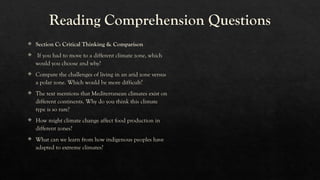
Reading Comprehension Questions
 Section C: Critical Thinking & Comparison
 If you had to move to a different climate zone, which
would you choose and why?
 Compare the challenges of living in an arid zone versus
a polar zone. Which would be more difficult?
 The text mentions that Mediterranean climates exist on
different continents. Why do you think this climate
type is so rare?
 How might climate change affect food production in
different zones?
 What can we learn from how indigenous peoples have
adapted to extreme climates?
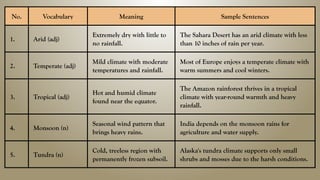
No. Vocabulary Meaning Sample Sentences
1. Arid (adj)
Extremely dry with little to
no rainfall.
The Sahara Desert has an arid climate with less
than 10 inches of rain per year.
2. Temperate (adj)
Mild climate with moderate
temperatures and rainfall.
Most of Europe enjoys a temperate climate with
warm summers and cool winters.
3. Tropical (adj)
Hot and humid climate
found near the equator.
The Amazon rainforest thrives in a tropical
climate with year-round warmth and heavy
rainfall.
4. Monsoon (n)
Seasonal wind pattern that
brings heavy rains.
India depends on the monsoon rains for
agriculture and water supply.
5. Tundra (n)
Cold, treeless region with
permanently frozen subsoil.
Alaska's tundra climate supports only small
shrubs and mosses due to the harsh conditions.
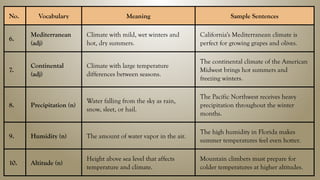
No. Vocabulary Meaning Sample Sentences
6.
Mediterranean
(adj)
Climate with mild, wet winters and
hot, dry summers.
California's Mediterranean climate is
perfect for growing grapes and olives.
7.
Continental
(adj)
Climate with large temperature
differences between seasons.
The continental climate of the American
Midwest brings hot summers and
freezing winters.
8. Precipitation (n)
Water falling from the sky as rain,
snow, sleet, or hail.
The Pacific Northwest receives heavy
precipitation throughout the winter
months.
9. Humidity (n) The amount of water vapor in the air.
The high humidity in Florida makes
summer temperatures feel even hotter.
10. Altitude (n)
Height above sea level that affects
temperature and climate.
Mountain climbers must prepare for
colder temperatures at higher altitudes.
Wrap-up Discussion Final Questions:
• What was the most surprising thing you learned about world climates today?
• How does your country's climate compare to the zones we discussed?
• Which climate zone would you most like to visit and experience?


Different Climates around the World.pptx

  • 1.
  • 2.
    World Climates Defined. "WorldClimates" refers to the classification and study of various climate patterns found worldwide. It encompasses the systematic categorization of Earth's diverse climatic conditions based on factors like temperature, precipitation, humidity, and seasonal variations.
  • 3.
    Lesson Structure Warm-up Activity. Discussion Questions:  What's the weather like in your country right now?  Which season do you prefer and why?  Have you ever traveled to a place with a very different climate? How was it different?
  • 4.
    More info onWorld Climates  Geographic Classification:  World climates are typically organized into major categories, including tropical, temperate, polar, arid, and  Mediterranean climates. Each category has distinct characteristics - for example, tropical climates feature high temperatures year- round with wet and dry seasons, while polar climates have frigid temperatures and minimal precipitation.  Academic Study:  In geography, meteorology, and environmental science, "world climates" refers to the comprehensive study of how different regions experience weather patterns over long periods. This includes understanding the factors that create these patterns, such as latitude, altitude, ocean currents, and landforms.
  • 5.
    More info onWorld Climates  Climate Zones:  The concept helps identify and map climate zones around the world, which is crucial for understanding biodiversity, agriculture, human settlement patterns, and economic activities in different regions.  Comparative Analysis:  World climates allow scientists and researchers to compare and contrast different regions' environmental conditions, helping predict how climate change might affect various parts of the planet differently. The study of world climates is essential for understanding global weather systems, predicting climate trends, planning agricultural activities, and addressing environmental challenges on a planetary scale.
  • 6.
    Climate vs. Weather Weather refers to the conditions of the atmosphere at a specific place and time, including elements such as temperature, wind, humidity, precipitation (rain, snow, etc.), cloudiness, and atmospheric pressure. It describes what is happening right now or over a short period (hours or days), unlike climate, which refers to long-term patterns.  Climate refers to the average weather conditions in a particular region over a long period of time, usually 30 years or more. It includes patterns of temperature, humidity, precipitation, wind, and seasonal variations. While weather tells us what’s happening now or tomorrow, climate tells us what the weather is usually like in a certain place over time.  Climate Zones are regions of the Earth that are classified based on their long-term weather patterns, including temperature, precipitation, humidity, and seasonal variations. Each climate zone has its typical climate characteristics, and these zones help scientists, geographers, and meteorologists understand and predict the general conditions of different parts of the world. Climate zones are mainly determined by latitude (how far a place is from the equator), altitude (height above sea level), ocean currents, and geographic features like mountains and deserts.
  • 7.
    Reading Text: "Earth'sClimate Zones“ Our planet Earth has five main climate zones, each with distinct characteristics that shape the lives of people, animals, and plants living there. The Tropical Zone stretches around the Earth's equator, including countries like Brazil, Indonesia, and Kenya. This zone experiences hot temperatures year-round, typically between 20-30°C (68-86°F). The Amazon rainforest in South America represents this climate perfectly, receiving over 2,000mm of rainfall annually. People in tropical areas often build houses on stilts to avoid flooding and wear light, breathable clothing. The Arid Zone covers about one-third of Earth's land surface. The Sahara Desert in North Africa and the Mojave Desert in the United States are prime examples. These areas receive less than 250mm of rain per year and experience extreme temperature differences between day and night. While daytime temperatures can reach 50°C (122°F), nighttime temperatures may drop to near freezing. Traditional desert dwellers, like the Bedouins, have adapted by wearing loose, long clothing and traveling during cooler hours. The Mediterranean Zone exists in only a few regions worldwide: the Mediterranean Sea area (Spain, Italy, Greece), California, central Chile, southwestern Australia, and the Western Cape of South Africa. This climate features warm, dry summers and mild, wet winters. The temperature rarely goes below 0°C (32°F) or above 35°C (95°F). This climate is ideal for growing olives, grapes, and citrus fruits, which is why these crops are common in all
  • 8.
    Mediterranean regions. The TemperateZone includes much of North America, Europe, and East Asia. Cities like New York, London, and Beijing experience four distinct seasons with moderate rainfall throughout the year. Summer temperatures range from 20-30°C (68-86°F), while winters can drop below freezing. This climate supports diverse agriculture and deciduous forests that change color dramatically in autumn. The Polar Zone covers the Arctic and Antarctic regions, where temperatures rarely rise above 10°C (50°F) even in summer. Antarctica is the coldest place on Earth, with winter temperatures reaching -80°C (-112°F). Despite the harsh conditions, indigenous peoples like the Inuit have thrived here for thousands of years by developing specialized hunting techniques and building insulated shelters. Climate change is now affecting all these zones. The Arctic is warming twice as fast as the global average, causing ice caps to melt. Tropical regions are experiencing more intense hurricanes, while arid zones are expanding into previously temperate areas. Mediterranean climates are becoming drier, and temperate zones are seeing more extreme weather events.
  • 9.
    Aspect Zone 1:_________ Zone 2: _________ Temperature Range Rainfall Pattern Seasonal Changes Common Vegetation Human Adaptations Major Challenges Comparative Analysis Activity Climate Comparison Chart Instructions: Compare any two climate zones using these categories:
  • 10.
    Reading Comprehension Questions Section A: Basic Comprehension  How many main climate zones does Earth have?  Which climate zone has the most rainfall?  What is the temperature range in the Mediterranean zone?  Name three regions that have a Mediterranean climate.  Which climate zone experiences the most extreme temperature differences between day and night?  Section B: Detailed Understanding  Compare the housing styles mentioned for tropical and polar regions. Why are they different?  What similarities exist between all Mediterranean climate regions in terms of agriculture?  How do the seasonal patterns differ between temperate and tropical zones?  What adaptations have people made to live in arid climates?  According to the text, which climate zone is being affected most dramatically by climate change?
  • 11.
    Reading Comprehension Questions Section C: Critical Thinking & Comparison  If you had to move to a different climate zone, which would you choose and why?  Compare the challenges of living in an arid zone versus a polar zone. Which would be more difficult?  The text mentions that Mediterranean climates exist on different continents. Why do you think this climate type is so rare?  How might climate change affect food production in different zones?  What can we learn from how indigenous peoples have adapted to extreme climates?
  • 12.
    No. Vocabulary MeaningSample Sentences 1. Arid (adj) Extremely dry with little to no rainfall. The Sahara Desert has an arid climate with less than 10 inches of rain per year. 2. Temperate (adj) Mild climate with moderate temperatures and rainfall. Most of Europe enjoys a temperate climate with warm summers and cool winters. 3. Tropical (adj) Hot and humid climate found near the equator. The Amazon rainforest thrives in a tropical climate with year-round warmth and heavy rainfall. 4. Monsoon (n) Seasonal wind pattern that brings heavy rains. India depends on the monsoon rains for agriculture and water supply. 5. Tundra (n) Cold, treeless region with permanently frozen subsoil. Alaska's tundra climate supports only small shrubs and mosses due to the harsh conditions.
  • 13.
    No. Vocabulary MeaningSample Sentences 6. Mediterranean (adj) Climate with mild, wet winters and hot, dry summers. California's Mediterranean climate is perfect for growing grapes and olives. 7. Continental (adj) Climate with large temperature differences between seasons. The continental climate of the American Midwest brings hot summers and freezing winters. 8. Precipitation (n) Water falling from the sky as rain, snow, sleet, or hail. The Pacific Northwest receives heavy precipitation throughout the winter months. 9. Humidity (n) The amount of water vapor in the air. The high humidity in Florida makes summer temperatures feel even hotter. 10. Altitude (n) Height above sea level that affects temperature and climate. Mountain climbers must prepare for colder temperatures at higher altitudes.
  • 14.
    Wrap-up Discussion FinalQuestions: • What was the most surprising thing you learned about world climates today? • How does your country's climate compare to the zones we discussed? • Which climate zone would you most like to visit and experience?