ClimateZones
by:
Prof Liwayway Memije-Cruz
Climateand Biomes
 Climate is the characteristic condition of the atmosphere
near the earth's surface at a certain place on earth. It is the
long-term weather of that area (at least 30 years). This
includes the region's general pattern of weather conditions,
seasons and weather extremes like hurricanes, droughts, or
rainy periods. Two of the most important factors determining
an area's climate are air temperature and precipitation.
 World biomes are controlled by climate. The climate of a
region will determine what plants will grow there, and what
animals will inhabit it. All three components, climate, plants
and animals are interwoven to create the fabric of a biome.
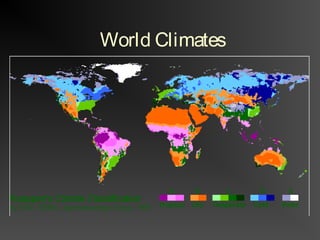
World Climates
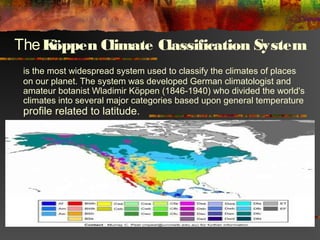
The Köppen Climate Classification System
is the most widespread system used to classify the climates of places
on our planet. The system was developed German climatologist and
amateur botanist Wladimir Köppen (1846-1940) who divided the world's
climates into several major categories based upon general temperature
profile related to latitude.
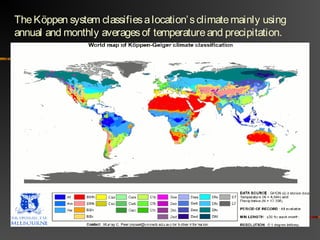
TheKöppen system classifiesalocation’sclimatemainly using
annual and monthly averagesof temperatureand precipitation.
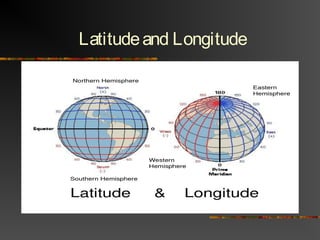
Latitudeand Longitude
Major Köppen ClimateCategories
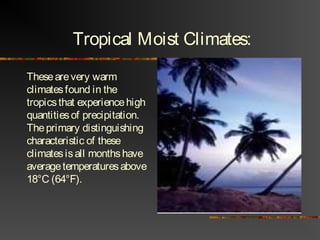
Tropical Moist Climates:
Thesearevery warm
climatesfound in the
tropicsthat experiencehigh
quantitiesof precipitation.
Theprimary distinguishing
characteristic of these
climatesisall monthshave
averagetemperaturesabove
18°C (64°F).
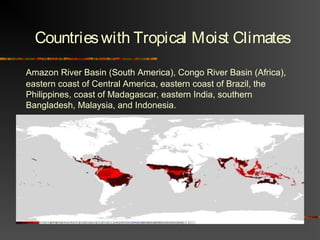
Countrieswith Tropical Moist Climates
Amazon River Basin (South America), Congo River Basin (Africa),
eastern coast of Central America, eastern coast of Brazil, the
Philippines, coast of Madagascar, eastern India, southern
Bangladesh, Malaysia, and Indonesia.
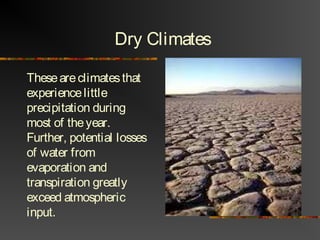
Dry Climates
Theseareclimatesthat
experiencelittle
precipitation during
most of theyear.
Further, potential losses
of water from
evaporation and
transpiration greatly
exceed atmospheric
input.
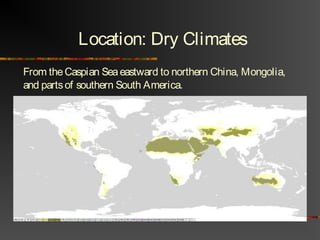
Location: Dry Climates
From theCaspian Seaeastward to northern China, Mongolia,
and partsof southern South America.
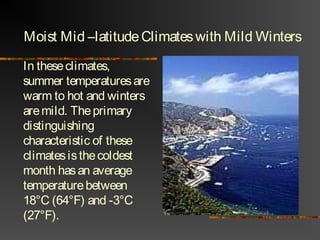
Moist Mid –latitudeClimateswith Mild Winters
In theseclimates,
summer temperaturesare
warm to hot and winters
aremild. Theprimary
distinguishing
characteristic of these
climatesisthecoldest
month hasan average
temperaturebetween
18°C (64°F) and -3°C
(27°F).
Location: Moist Mid –latitudeClimateswith
Mild Winters
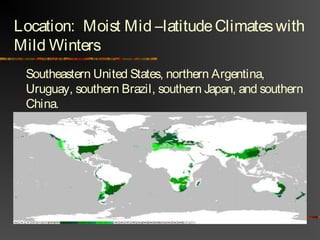
Southeastern United States, northern Argentina,
Uruguay, southern Brazil, southern Japan, and southern
China.
Moist Mid –latitudeClimateswith Cold
Winters
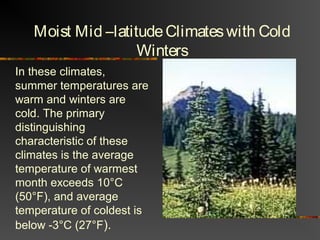
In these climates,
summer temperatures are
warm and winters are
cold. The primary
distinguishing
characteristic of these
climates is the average
temperature of warmest
month exceeds 10°C
(50°F), and average
temperature of coldest is
below -3°C (27°F).
Location: Moist Mid –latitudeClimateswith
Cold Winters
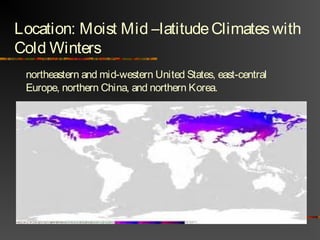
northeastern and mid-western United States, east-central
Europe, northern China, and northern Korea.
Polar Climates
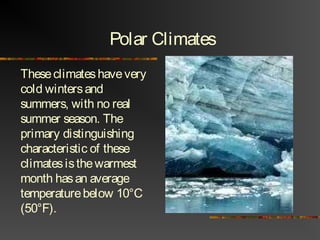
Theseclimateshavevery
cold wintersand
summers, with no real
summer season. The
primary distinguishing
characteristic of these
climatesisthewarmest
month hasan average
temperaturebelow 10°C
(50°F).
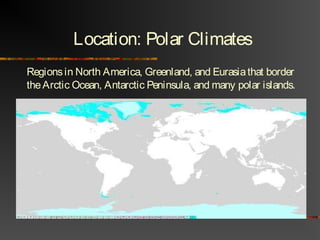
Location: Polar Climates
Regionsin North America, Greenland, and Eurasiathat border
theArctic Ocean, Antarctic Peninsula, and many polar islands.
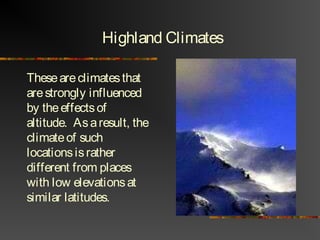
Highland Climates
Theseareclimatesthat
arestrongly influenced
by theeffectsof
altitude.  Asaresult, the
climateof such
locationsisrather
different from places
with low elevationsat
similar latitudes.
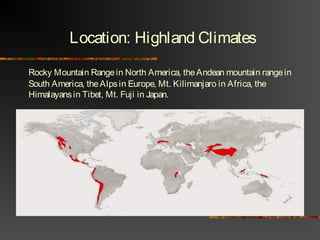
Location: Highland Climates
Rocky Mountain Rangein North America, theAndean mountain rangein
South America, theAlpsin Europe, Mt. Kilimanjaro in Africa, the
Himalayansin Tibet, Mt. Fuji in Japan.
Thank You!

Climate Zones

  • 1.
  • 2.
    Climateand Biomes  Climateis the characteristic condition of the atmosphere near the earth's surface at a certain place on earth. It is the long-term weather of that area (at least 30 years). This includes the region's general pattern of weather conditions, seasons and weather extremes like hurricanes, droughts, or rainy periods. Two of the most important factors determining an area's climate are air temperature and precipitation.  World biomes are controlled by climate. The climate of a region will determine what plants will grow there, and what animals will inhabit it. All three components, climate, plants and animals are interwoven to create the fabric of a biome.
  • 3.
  • 4.
    The Köppen Climate ClassificationSystem is the most widespread system used to classify the climates of places on our planet. The system was developed German climatologist and amateur botanist Wladimir Köppen (1846-1940) who divided the world's climates into several major categories based upon general temperature profile related to latitude.
  • 5.
    TheKöppen system classifiesalocation’sclimatemainlyusing annual and monthly averagesof temperatureand precipitation.
  • 6.
  • 7.
  • 8.
    Tropical Moist Climates: Theseareverywarm climatesfound in the tropicsthat experiencehigh quantitiesof precipitation. Theprimary distinguishing characteristic of these climatesisall monthshave averagetemperaturesabove 18°C (64°F).
  • 9.
    Countrieswith Tropical MoistClimates Amazon River Basin (South America), Congo River Basin (Africa), eastern coast of Central America, eastern coast of Brazil, the Philippines, coast of Madagascar, eastern India, southern Bangladesh, Malaysia, and Indonesia.
  • 10.
    Dry Climates Theseareclimatesthat experiencelittle precipitation during mostof theyear. Further, potential losses of water from evaporation and transpiration greatly exceed atmospheric input.
  • 11.
    Location: Dry Climates FromtheCaspian Seaeastward to northern China, Mongolia, and partsof southern South America.
  • 12.
    Moist Mid –latitudeClimateswithMild Winters In theseclimates, summer temperaturesare warm to hot and winters aremild. Theprimary distinguishing characteristic of these climatesisthecoldest month hasan average temperaturebetween 18°C (64°F) and -3°C (27°F).
  • 13.
    Location: Moist Mid–latitudeClimateswith Mild Winters Southeastern United States, northern Argentina, Uruguay, southern Brazil, southern Japan, and southern China.
  • 14.
    Moist Mid –latitudeClimateswithCold Winters In these climates, summer temperatures are warm and winters are cold. The primary distinguishing characteristic of these climates is the average temperature of warmest month exceeds 10°C (50°F), and average temperature of coldest is below -3°C (27°F).
  • 15.
    Location: Moist Mid–latitudeClimateswith Cold Winters northeastern and mid-western United States, east-central Europe, northern China, and northern Korea.
  • 16.
    Polar Climates Theseclimateshavevery cold wintersand summers,with no real summer season. The primary distinguishing characteristic of these climatesisthewarmest month hasan average temperaturebelow 10°C (50°F).
  • 17.
    Location: Polar Climates RegionsinNorth America, Greenland, and Eurasiathat border theArctic Ocean, Antarctic Peninsula, and many polar islands.
  • 18.
    Highland Climates Theseareclimatesthat arestrongly influenced bytheeffectsof altitude.  Asaresult, the climateof such locationsisrather different from places with low elevationsat similar latitudes.
  • 19.
    Location: Highland Climates RockyMountain Rangein North America, theAndean mountain rangein South America, theAlpsin Europe, Mt. Kilimanjaro in Africa, the Himalayansin Tibet, Mt. Fuji in Japan.
  • 20.