Climate : Elements and Factors
Email: tanvirhridoy74@gmail.com
Tanvir Ahmed
Roll : 1007
MESM - 2020
• The long-term state of the atmosphere is a function of a
variety of interacting elements.
• They are :
Temperature
Humidity
Precipitation
Atmospheric Pressure
Topography
Wind
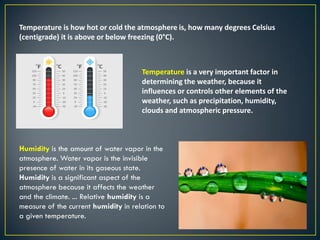
Temperature is how hot or cold the atmosphere is, how many degrees Celsius
(centigrade) it is above or below freezing (0°C).
Temperature is a very important factor in
determining the weather, because it
influences or controls other elements of the
weather, such as precipitation, humidity,
clouds and atmospheric pressure.
Humidity is the amount of water vapor in the
atmosphere. Water vapor is the invisible
presence of water in its gaseous state.
Humidity is a significant aspect of the
atmosphere because it affects the weather
and the climate. ... Relative humidity is a
measure of the current humidity in relation to
a given temperature.
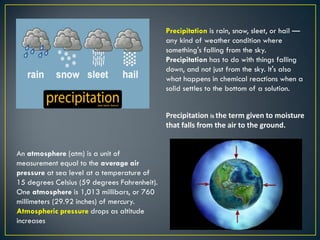
Precipitation is rain, snow, sleet, or hail —
any kind of weather condition where
something's falling from the sky.
Precipitation has to do with things falling
down, and not just from the sky. It's also
what happens in chemical reactions when a
solid settles to the bottom of a solution.
Precipitation is the term given to moisture
that falls from the air to the ground.
An atmosphere (atm) is a unit of
measurement equal to the average air
pressure at sea level at a temperature of
15 degrees Celsius (59 degrees Fahrenheit).
One atmosphere is 1,013 millibars, or 760
millimeters (29.92 inches) of mercury.
Atmospheric pressure drops as altitude
increases
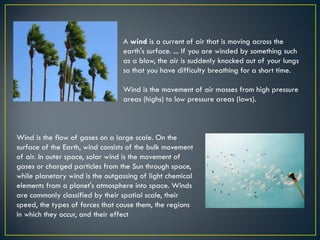
A wind is a current of air that is moving across the
earth's surface. ... If you are winded by something such
as a blow, the air is suddenly knocked out of your lungs
so that you have difficulty breathing for a short time.
Wind is the movement of air masses from high pressure
areas (highs) to low pressure areas (lows).
Wind is the flow of gases on a large scale. On the
surface of the Earth, wind consists of the bulk movement
of air. In outer space, solar wind is the movement of
gases or charged particles from the Sun through space,
while planetary wind is the outgassing of light chemical
elements from a planet's atmosphere into space. Winds
are commonly classified by their spatial scale, their
speed, the types of forces that cause them, the regions
in which they occur, and their effect
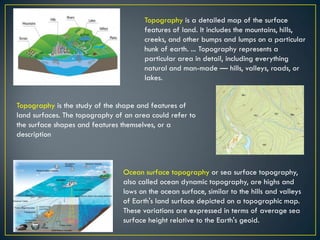
Topography is a detailed map of the surface
features of land. It includes the mountains, hills,
creeks, and other bumps and lumps on a particular
hunk of earth. ... Topography represents a
particular area in detail, including everything
natural and man-made — hills, valleys, roads, or
lakes.
Topography is the study of the shape and features of
land surfaces. The topography of an area could refer to
the surface shapes and features themselves, or a
description
Ocean surface topography or sea surface topography,
also called ocean dynamic topography, are highs and
lows on the ocean surface, similar to the hills and valleys
of Earth's land surface depicted on a topographic map.
These variations are expressed in terms of average sea
surface height relative to the Earth's geoid.
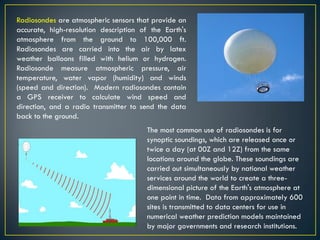
Radiosondes are atmospheric sensors that provide an
accurate, high-resolution description of the Earth's
atmosphere from the ground to 100,000 ft.
Radiosondes are carried into the air by latex
weather balloons filled with helium or hydrogen.
Radiosonde measure atmospheric pressure, air
temperature, water vapor (humidity) and winds
(speed and direction). Modern radiosondes contain
a GPS receiver to calculate wind speed and
direction, and a radio transmitter to send the data
back to the ground.
The most common use of radiosondes is for
synoptic soundings, which are released once or
twice a day (at 00Z and 12Z) from the same
locations around the globe. These soundings are
carried out simultaneously by national weather
services around the world to create a three-
dimensional picture of the Earth's atmosphere at
one point in time. Data from approximately 600
sites is transmitted to data centers for use in
numerical weather prediction models maintained
by major governments and research institutions.
Factors affecting local weather and climate are seemingly
endless, though there are a few that have the most influence.
The important FACTORS are :
Latitude
Latitude is an angle (defined below) which ranges
from 0° at the Equator to 90° (North or South) at the
poles. Lines of constant latitude, or parallels, run east–
west as circles parallel to the equator. Latitude is used
together with longitude to specify the precise location
of features on the surface of the Earth.
If you live close to the equator, the climate will be
warmer, while moving north or south from the equator
brings a cooler climate.
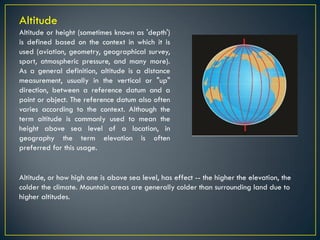
Altitude
Altitude or height (sometimes known as 'depth')
is defined based on the context in which it is
used (aviation, geometry, geographical survey,
sport, atmospheric pressure, and many more).
As a general definition, altitude is a distance
measurement, usually in the vertical or "up"
direction, between a reference datum and a
point or object. The reference datum also often
varies according to the context. Although the
term altitude is commonly used to mean the
height above sea level of a location, in
geography the term elevation is often
preferred for this usage.
Altitude, or how high one is above sea level, has effect -- the higher the elevation, the
colder the climate. Mountain areas are generally colder than surrounding land due to
higher altitudes.
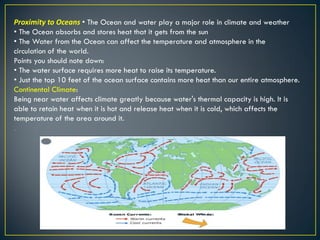
Proximity to Oceans • The Ocean and water play a major role in climate and weather
• The Ocean absorbs and stores heat that it gets from the sun
• The Water from the Ocean can affect the temperature and atmosphere in the
circulation of the world.
Points you should note down:
• The water surface requires more heat to raise its temperature.
• Just the top 10 feet of the ocean surface contains more heat than our entire atmosphere.
Continental Climate:
Being near water affects climate greatly because water's thermal capacity is high. It is
able to retain heat when it is hot and release heat when it is cold, which affects the
temperature of the area around it.
.
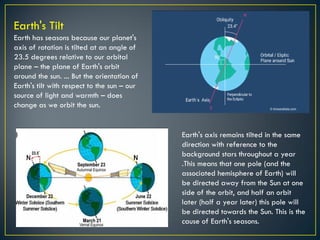
Earth's Tilt
Earth has seasons because our planet's
axis of rotation is tilted at an angle of
23.5 degrees relative to our orbital
plane – the plane of Earth's orbit
around the sun. ... But the orientation of
Earth's tilt with respect to the sun – our
source of light and warmth – does
change as we orbit the sun.
Earth's axis remains tilted in the same
direction with reference to the
background stars throughout a year
.This means that one pole (and the
associated hemisphere of Earth) will
be directed away from the Sun at one
side of the orbit, and half an orbit
later (half a year later) this pole will
be directed towards the Sun. This is the
cause of Earth's seasons.
Climate : Eliments and Factors

Climate : Eliments and Factors

  • 1.
    Climate : Elementsand Factors Email: tanvirhridoy74@gmail.com Tanvir Ahmed Roll : 1007 MESM - 2020
  • 2.
    • The long-termstate of the atmosphere is a function of a variety of interacting elements. • They are : Temperature Humidity Precipitation Atmospheric Pressure Topography Wind
  • 3.
    Temperature is howhot or cold the atmosphere is, how many degrees Celsius (centigrade) it is above or below freezing (0°C). Temperature is a very important factor in determining the weather, because it influences or controls other elements of the weather, such as precipitation, humidity, clouds and atmospheric pressure. Humidity is the amount of water vapor in the atmosphere. Water vapor is the invisible presence of water in its gaseous state. Humidity is a significant aspect of the atmosphere because it affects the weather and the climate. ... Relative humidity is a measure of the current humidity in relation to a given temperature.
  • 4.
    Precipitation is rain,snow, sleet, or hail — any kind of weather condition where something's falling from the sky. Precipitation has to do with things falling down, and not just from the sky. It's also what happens in chemical reactions when a solid settles to the bottom of a solution. Precipitation is the term given to moisture that falls from the air to the ground. An atmosphere (atm) is a unit of measurement equal to the average air pressure at sea level at a temperature of 15 degrees Celsius (59 degrees Fahrenheit). One atmosphere is 1,013 millibars, or 760 millimeters (29.92 inches) of mercury. Atmospheric pressure drops as altitude increases
  • 5.
    A wind isa current of air that is moving across the earth's surface. ... If you are winded by something such as a blow, the air is suddenly knocked out of your lungs so that you have difficulty breathing for a short time. Wind is the movement of air masses from high pressure areas (highs) to low pressure areas (lows). Wind is the flow of gases on a large scale. On the surface of the Earth, wind consists of the bulk movement of air. In outer space, solar wind is the movement of gases or charged particles from the Sun through space, while planetary wind is the outgassing of light chemical elements from a planet's atmosphere into space. Winds are commonly classified by their spatial scale, their speed, the types of forces that cause them, the regions in which they occur, and their effect
  • 6.
    Topography is adetailed map of the surface features of land. It includes the mountains, hills, creeks, and other bumps and lumps on a particular hunk of earth. ... Topography represents a particular area in detail, including everything natural and man-made — hills, valleys, roads, or lakes. Topography is the study of the shape and features of land surfaces. The topography of an area could refer to the surface shapes and features themselves, or a description Ocean surface topography or sea surface topography, also called ocean dynamic topography, are highs and lows on the ocean surface, similar to the hills and valleys of Earth's land surface depicted on a topographic map. These variations are expressed in terms of average sea surface height relative to the Earth's geoid.
  • 7.
    Radiosondes are atmosphericsensors that provide an accurate, high-resolution description of the Earth's atmosphere from the ground to 100,000 ft. Radiosondes are carried into the air by latex weather balloons filled with helium or hydrogen. Radiosonde measure atmospheric pressure, air temperature, water vapor (humidity) and winds (speed and direction). Modern radiosondes contain a GPS receiver to calculate wind speed and direction, and a radio transmitter to send the data back to the ground. The most common use of radiosondes is for synoptic soundings, which are released once or twice a day (at 00Z and 12Z) from the same locations around the globe. These soundings are carried out simultaneously by national weather services around the world to create a three- dimensional picture of the Earth's atmosphere at one point in time. Data from approximately 600 sites is transmitted to data centers for use in numerical weather prediction models maintained by major governments and research institutions.
  • 8.
    Factors affecting localweather and climate are seemingly endless, though there are a few that have the most influence. The important FACTORS are : Latitude Latitude is an angle (defined below) which ranges from 0° at the Equator to 90° (North or South) at the poles. Lines of constant latitude, or parallels, run east– west as circles parallel to the equator. Latitude is used together with longitude to specify the precise location of features on the surface of the Earth. If you live close to the equator, the climate will be warmer, while moving north or south from the equator brings a cooler climate.
  • 9.
    Altitude Altitude or height(sometimes known as 'depth') is defined based on the context in which it is used (aviation, geometry, geographical survey, sport, atmospheric pressure, and many more). As a general definition, altitude is a distance measurement, usually in the vertical or "up" direction, between a reference datum and a point or object. The reference datum also often varies according to the context. Although the term altitude is commonly used to mean the height above sea level of a location, in geography the term elevation is often preferred for this usage. Altitude, or how high one is above sea level, has effect -- the higher the elevation, the colder the climate. Mountain areas are generally colder than surrounding land due to higher altitudes.
  • 10.
    Proximity to Oceans• The Ocean and water play a major role in climate and weather • The Ocean absorbs and stores heat that it gets from the sun • The Water from the Ocean can affect the temperature and atmosphere in the circulation of the world. Points you should note down: • The water surface requires more heat to raise its temperature. • Just the top 10 feet of the ocean surface contains more heat than our entire atmosphere. Continental Climate: Being near water affects climate greatly because water's thermal capacity is high. It is able to retain heat when it is hot and release heat when it is cold, which affects the temperature of the area around it. .
  • 11.
    Earth's Tilt Earth hasseasons because our planet's axis of rotation is tilted at an angle of 23.5 degrees relative to our orbital plane – the plane of Earth's orbit around the sun. ... But the orientation of Earth's tilt with respect to the sun – our source of light and warmth – does change as we orbit the sun. Earth's axis remains tilted in the same direction with reference to the background stars throughout a year .This means that one pole (and the associated hemisphere of Earth) will be directed away from the Sun at one side of the orbit, and half an orbit later (half a year later) this pole will be directed towards the Sun. This is the cause of Earth's seasons.