1
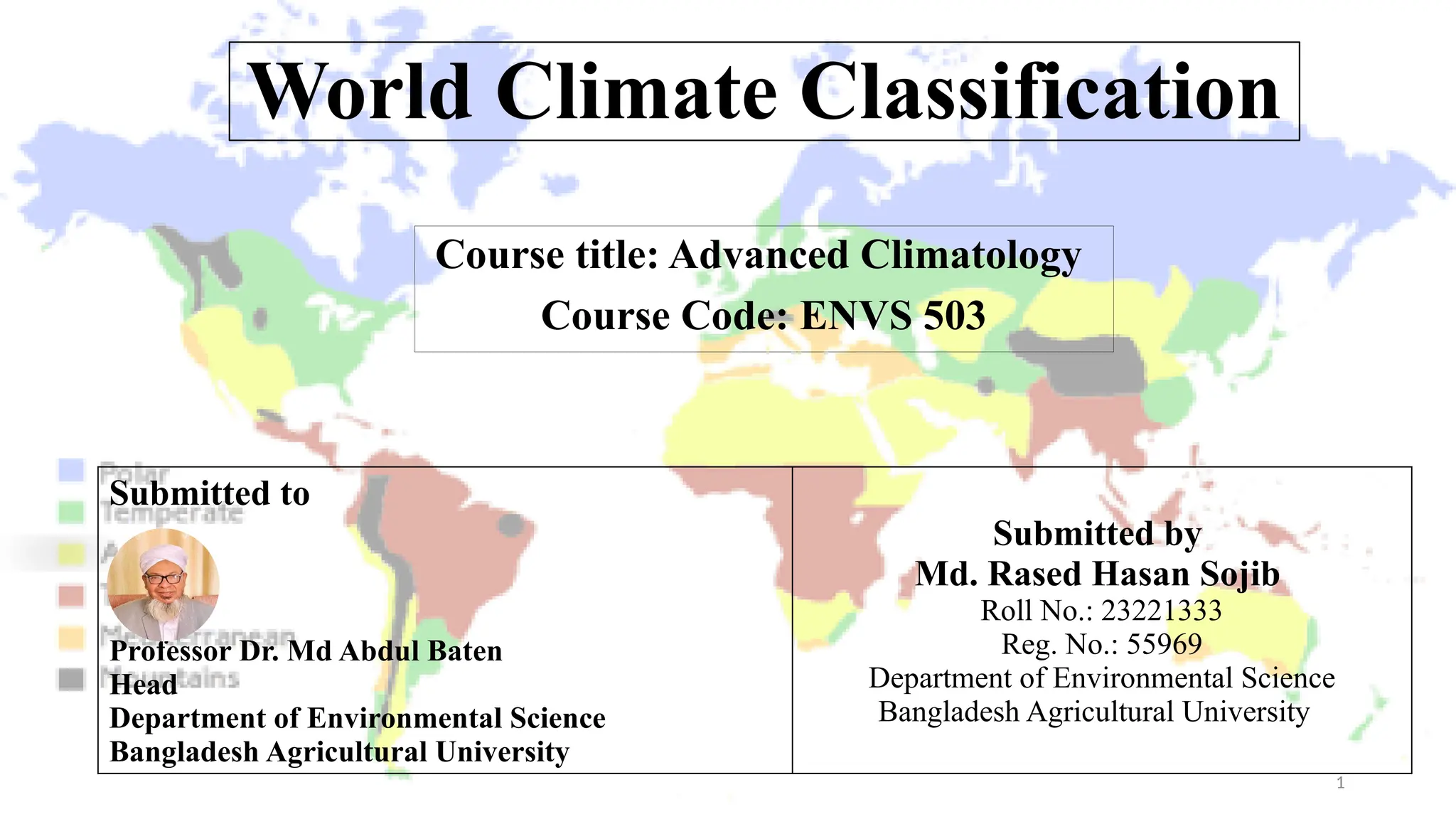
World Climate Classification
Course title: Advanced Climatology
Course Code: ENVS 503
Submitted to
Professor Dr. Md Abdul Baten
Head
Department of Environmental Science
Bangladesh Agricultural University
Submitted by
Md. Rased Hasan Sojib
Roll No.: 23221333
Reg. No.: 55969
Department of Environmental Science
Bangladesh Agricultural University
2
Outline
• Introductions
• Climate Elements
• World Climate
• A Country's Climate Depends on Four Main Factors
• Climate Group
• Conclusions
3
Climate
• The climate is the reoccurring average weather found in any particular place, measured
over 30 year intervals.
• The Earth's tilt, rotation and land/sea distribution affect these global weather patterns,
resulting in variations between different locations.
• The most important elements in climate descriptions are temperature and precipitation
inasmuch as they have the greatest influence on people and their activities and also have
as important impact on the distribution of vegetation and the development of soils.
4
CLIMATE ELEMENTS
 Temperature is how hot or cold the atmosphere is - ie, how many degrees Celsius
(centigrade) it is above or below freezing (0°C)
 Farenheit and Celsius scale
 Precipitation is the term given to moisture that falls from the air to the ground.
 Atmospheric pressure (or air pressure) is the weight of air resting on the earth's surface.
Pressure is shown on a weather map, often called a synoptic map, with lines called isobars.
Low pressure occurs when air becomes warmer. The air molecules expand, become lighter
and it rises.
High pressure occurs when air becomes colder. The air molecules contract, become denser,
heavier and sink towards the earth.
 Wind is the movement of air masses from high pressure areas (high) to low pressure areas
(low). The effect of this movement of air is to rebalance the pressure in the atmosphere.
5
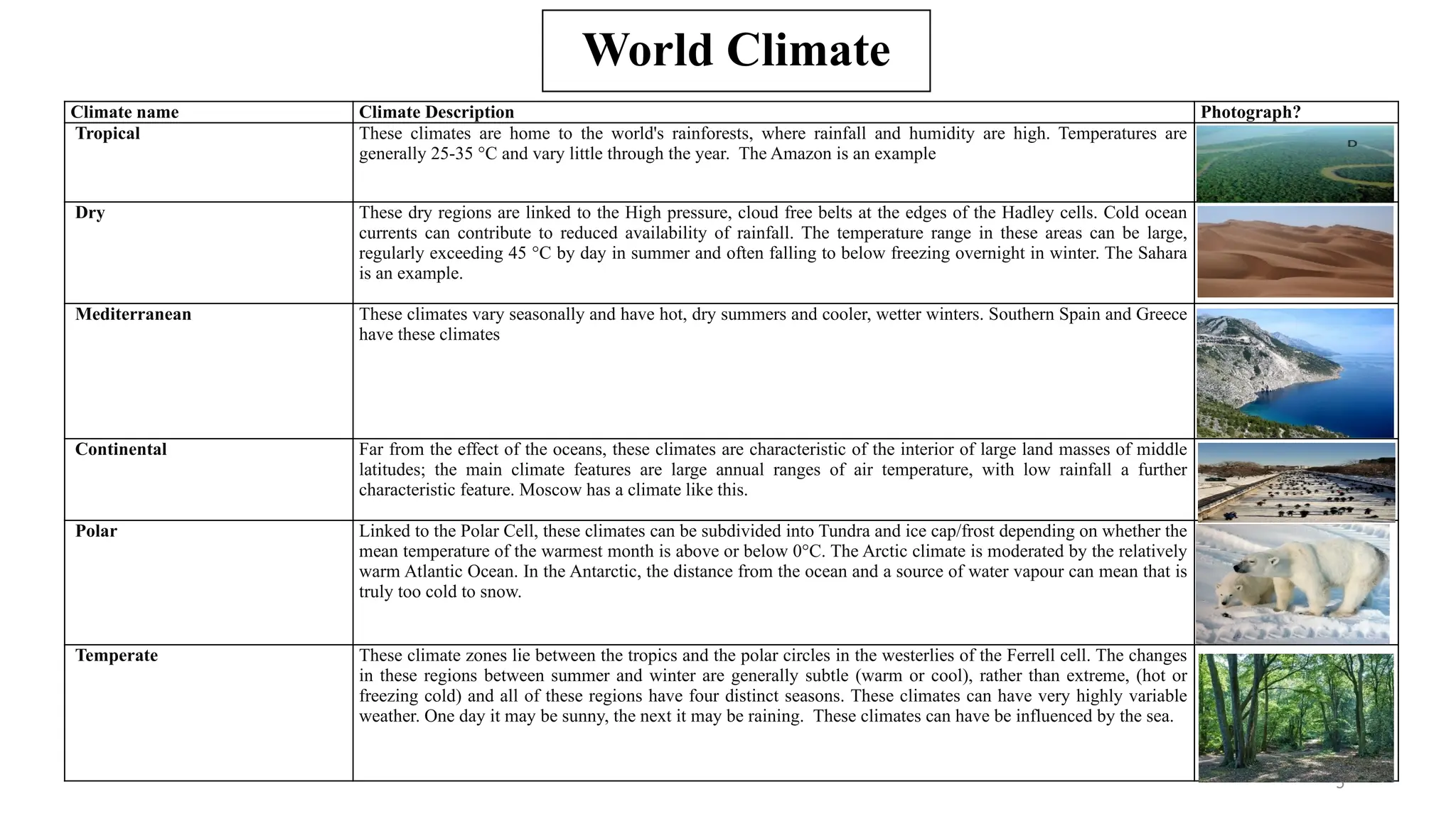
World Climate
Climate name Climate Description Photograph?
Tropical These climates are home to the world's rainforests, where rainfall and humidity are high. Temperatures are
generally 25-35 °C and vary little through the year. The Amazon is an example
Dry These dry regions are linked to the High pressure, cloud free belts at the edges of the Hadley cells. Cold ocean
currents can contribute to reduced availability of rainfall. The temperature range in these areas can be large,
regularly exceeding 45 °C by day in summer and often falling to below freezing overnight in winter. The Sahara
is an example.
Mediterranean These climates vary seasonally and have hot, dry summers and cooler, wetter winters. Southern Spain and Greece
have these climates
Continental Far from the effect of the oceans, these climates are characteristic of the interior of large land masses of middle
latitudes; the main climate features are large annual ranges of air temperature, with low rainfall a further
characteristic feature. Moscow has a climate like this.
Polar Linked to the Polar Cell, these climates can be subdivided into Tundra and ice cap/frost depending on whether the
mean temperature of the warmest month is above or below 0°C. The Arctic climate is moderated by the relatively
warm Atlantic Ocean. In the Antarctic, the distance from the ocean and a source of water vapour can mean that is
truly too cold to snow.
Temperate These climate zones lie between the tropics and the polar circles in the westerlies of the Ferrell cell. The changes
in these regions between summer and winter are generally subtle (warm or cool), rather than extreme, (hot or
freezing cold) and all of these regions have four distinct seasons. These climates can have very highly variable
weather. One day it may be sunny, the next it may be raining. These climates can have be influenced by the sea.
6
Outline Sketch map of the World’s Climatic zones
7
A COUNTRY'S CLIMATE DEPENDS ON
FOUR MAIN FACTORS
• Latitude is the distance of a location from the equator. The hottest temperatures are found
at the equator. As you move further away from the equator towards the polar regions, less
and less sun is received during the year and the climates become colder and colder.
• Altitude is the height above sea level or the height above the earth's surface. The higher the
altitude, the lower the temperature will be. On average for every 1,000 metres higher to go
the temperature will fall about 6.5 °C.
• Proximity to the sea affects the temperature of a place because the sea temperature changes
slower than land temperature. So the sea will keep coastal areas warmer than inland area
during the winter and cooler than inland areas during the summer.
• Currents exist in all the oceans. Currents that move water from tropical areas towards the
poles (North Atlantic Drift starts in the Gulf of Mexico) are known as warm currents. Those
currents moving from northern (or southern) colder seas, nearer the poles towards the
equator are known as cool currents, an example is the Canaries current
8
CLIMATE GROUP
• Three major climate groups show the dominance of special combinations of air-mass
source regions.
• Group I
• Low-latitude Climates: These climates are controlled by equatorial a tropical air masses.
• Group II
• Mid-latitude Climates: Climates in this zone are affected by two different air-masses.
The tropical air-masses are moving towards the poles and the polar air-masses are moving
towards the equator. These two air masses are in constant conflict. Either air mass may
dominate the area, but neither has exclusive control.
• Group III
• High-latitude climates: Polar and arctic air masses dominate these regions. Canada and
Siberia are two air-mass sources which fall into this group. A southern hemisphere
counterpart to these continental centers does not exist. Air masses of arctic origin meet
polar continental air masses along the 60th and 70th parallels.
9
Group-I
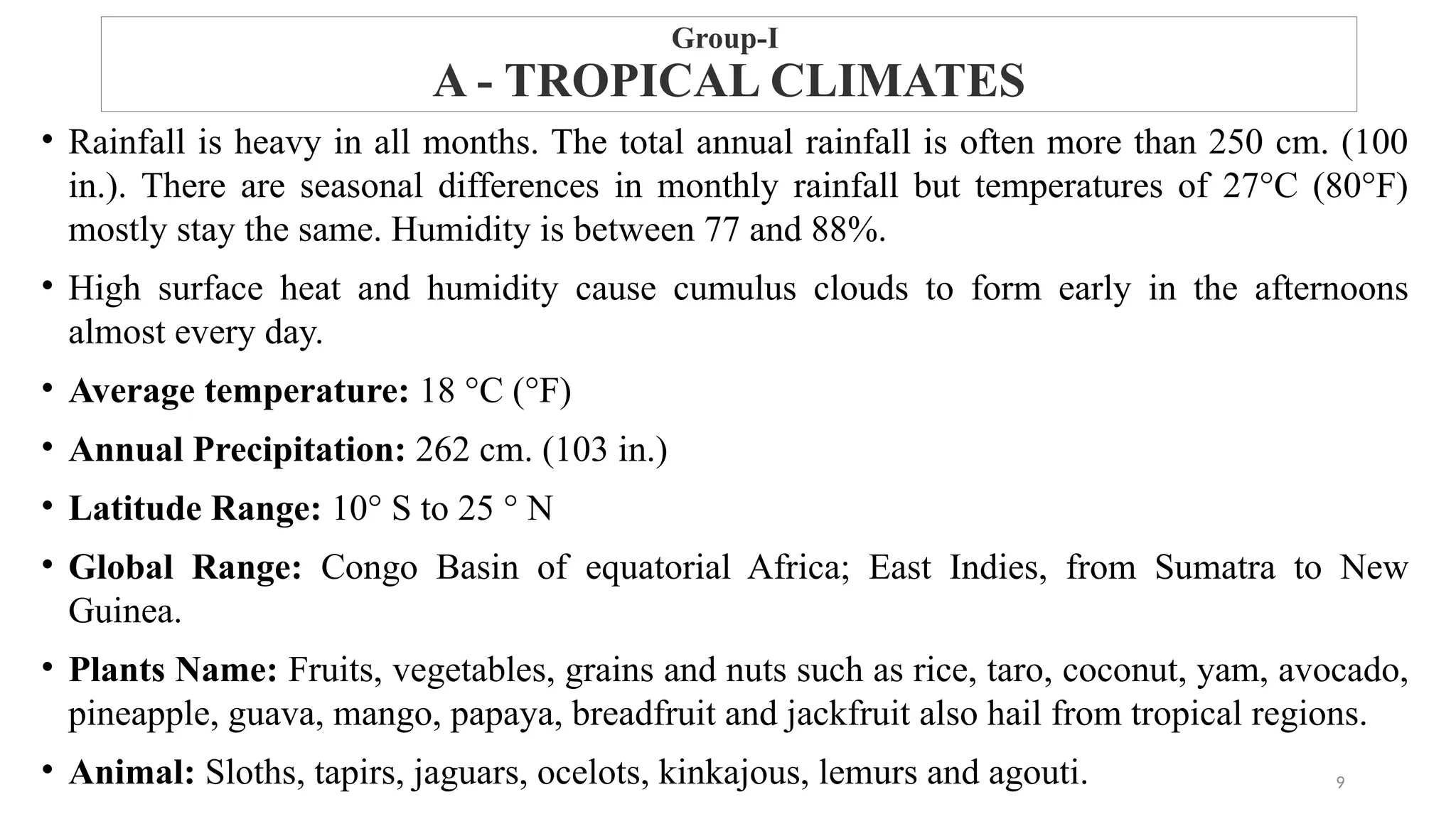
A - TROPICAL CLIMATES
• Rainfall is heavy in all months. The total annual rainfall is often more than 250 cm. (100
in.). There are seasonal differences in monthly rainfall but temperatures of 27°C (80°F)
mostly stay the same. Humidity is between 77 and 88%.
• High surface heat and humidity cause cumulus clouds to form early in the afternoons
almost every day.
• Average temperature: 18 °C (°F)
• Annual Precipitation: 262 cm. (103 in.)
• Latitude Range: 10° S to 25 ° N
• Global Range: Congo Basin of equatorial Africa; East Indies, from Sumatra to New
Guinea.
• Plants Name: Fruits, vegetables, grains and nuts such as rice, taro, coconut, yam, avocado,
pineapple, guava, mango, papaya, breadfruit and jackfruit also hail from tropical regions.
• Animal: Sloths, tapirs, jaguars, ocelots, kinkajous, lemurs and agouti.
10
Group-I
(B) Wet-Dry Tropical Climates
A seasonal change occurs between wet tropical air masses and dry tropical air masses. As
a result, there is a very wet season and a very dry season. Trade winds dominate during the
dry season. It gets a little cooler during this dry season but will become very hot just
before the wet season.
• Temperature Range: 18o
C (64.4o
F) to above 25o
C (77o
F)
• Annual Precipitation: 0.25 cm. (0.1 in.). All months less than 0.25 cm. (0.1 in.)
• Latitude Range: 15 ° to 25 ° N and S
• Global Range: India, Indochina, West Africa, Southern Africa, South America and the
north coast of Australia.
• Plants Name: Kapok (Ceiba pentandra), Mango (Mangifera indica), Neem (Azadirachta
indica), Bamboo (Bambusoideae)
• Animal Name: wildebeests, gazelles, zebras, elephants, giraffes, etc.
11
Group-I
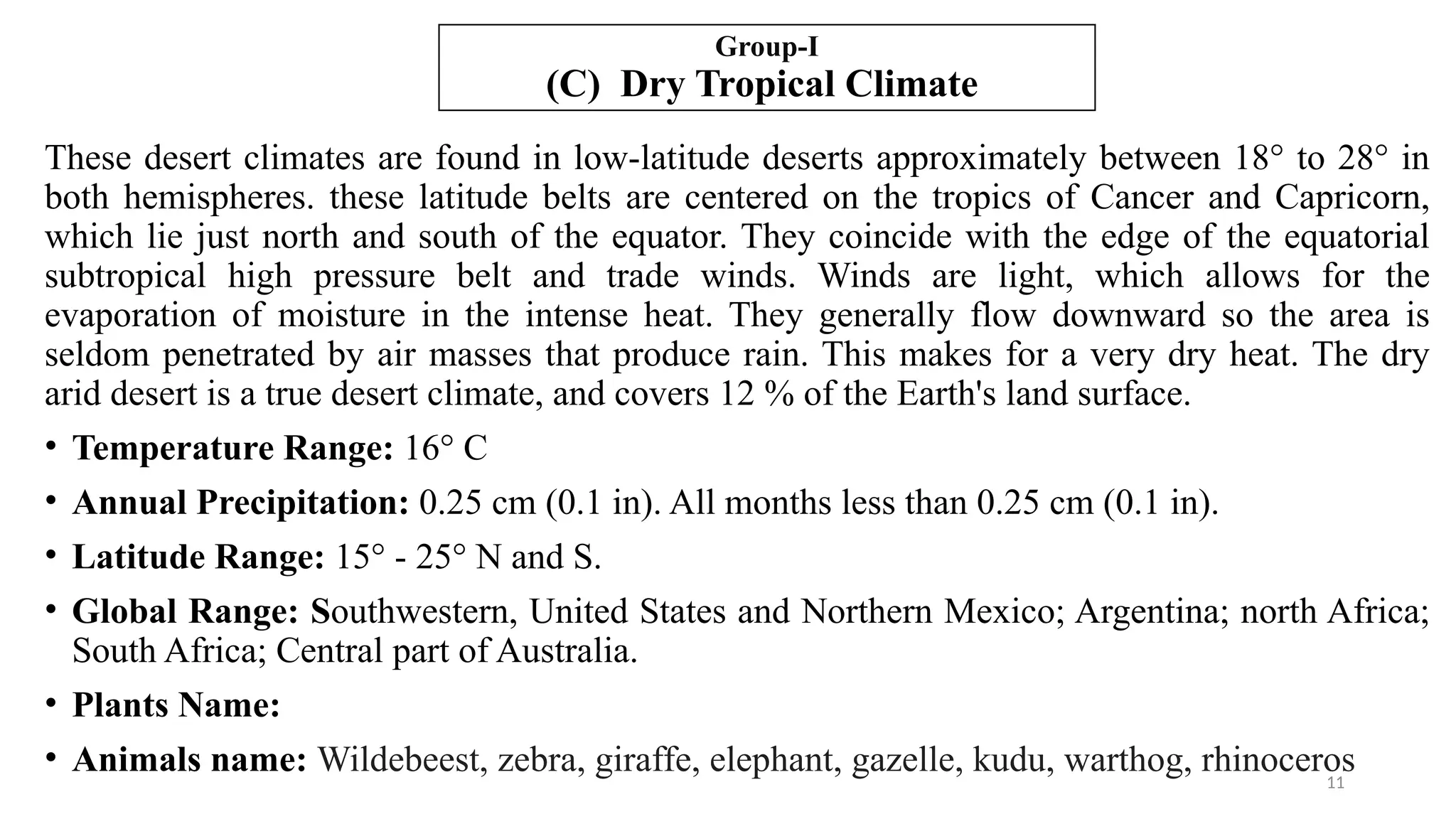
(C) Dry Tropical Climate
These desert climates are found in low-latitude deserts approximately between 18° to 28° in
both hemispheres. these latitude belts are centered on the tropics of Cancer and Capricorn,
which lie just north and south of the equator. They coincide with the edge of the equatorial
subtropical high pressure belt and trade winds. Winds are light, which allows for the
evaporation of moisture in the intense heat. They generally flow downward so the area is
seldom penetrated by air masses that produce rain. This makes for a very dry heat. The dry
arid desert is a true desert climate, and covers 12 % of the Earth's land surface.
• Temperature Range: 16° C
• Annual Precipitation: 0.25 cm (0.1 in). All months less than 0.25 cm (0.1 in).
• Latitude Range: 15° - 25° N and S.
• Global Range: Southwestern, United States and Northern Mexico; Argentina; north Africa;
South Africa; Central part of Australia.
• Plants Name:
• Animals name: Wildebeest, zebra, giraffe, elephant, gazelle, kudu, warthog, rhinoceros
12
Group-II
(A) Dry Midlatitude Climates
This dry climate exists in the interior regions of the North American and Eurasian
continents. Moist ocean air masses are blocked by mountain ranges to the west and south.
These mountain ranges also trap polar air in winter, making winters very cold. Summers are
warm to hot.
• Temperature Range: 24° C (43° F).
• Annual Precipitation: less than 10 cm (4 in) in the driest regions to 50 cm (20 in) in the
moister steppes.
• Latitude Range: 35° - 55° N.
• Global Range: Western North America (Great Basin, Columbia Plateau, Great Plains);
Eurasian interior, from steppes of Eastern Europe to the Gobi Desert and North China.
• Plants Name: Cactus, sagebrush, desert marigold, Mesquite, acacia, palo verde, Joshua
tree
• Animal Name: Coyote (North American deserts) , Arabian oryx (Arabian Peninsula),
Fennec fox (Sahara Desert), Burrowing owl
13
Group-II
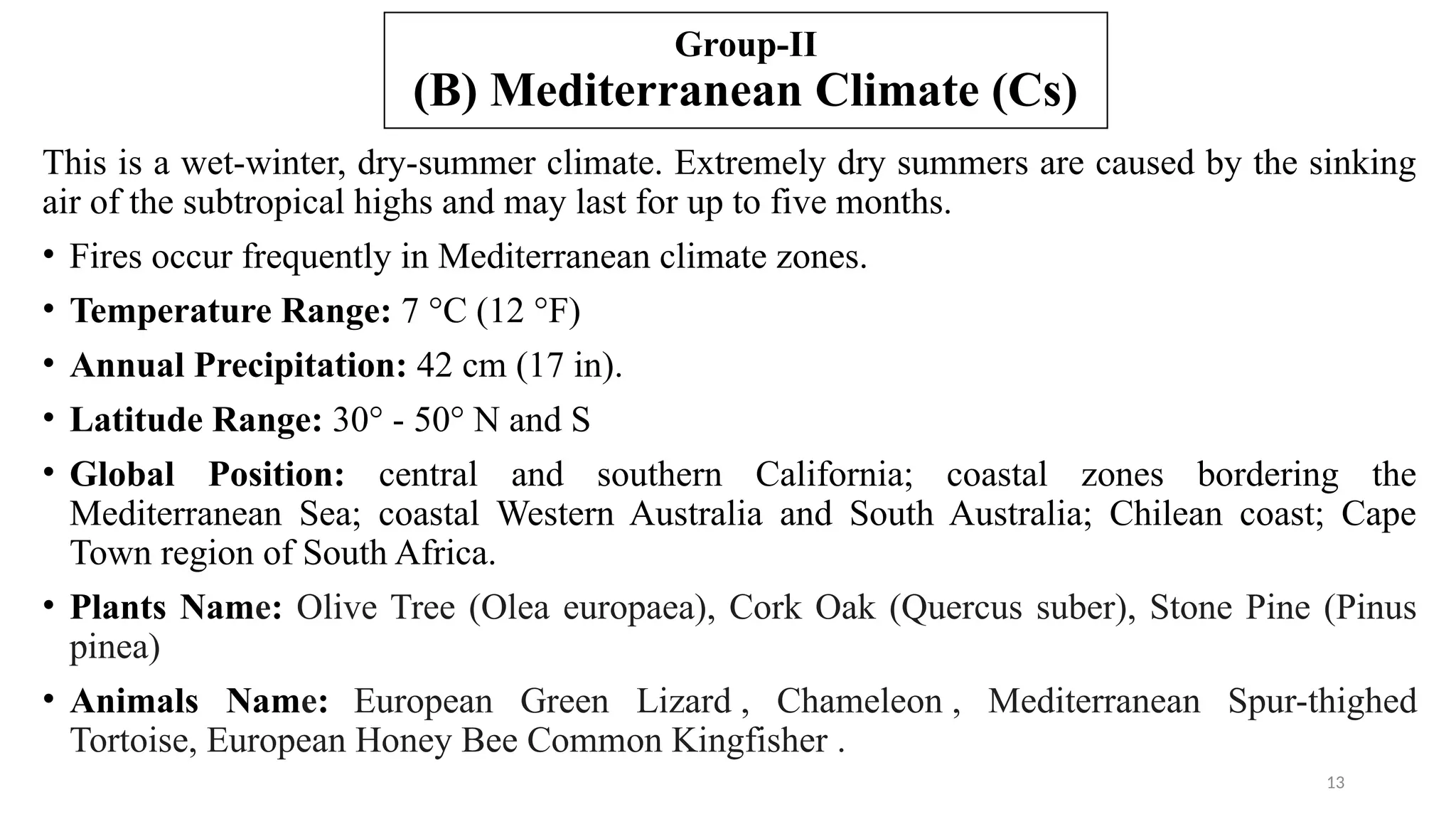
(B) Mediterranean Climate (Cs)
This is a wet-winter, dry-summer climate. Extremely dry summers are caused by the sinking
air of the subtropical highs and may last for up to five months.
• Fires occur frequently in Mediterranean climate zones.
• Temperature Range: 7 °C (12 °F)
• Annual Precipitation: 42 cm (17 in).
• Latitude Range: 30° - 50° N and S
• Global Position: central and southern California; coastal zones bordering the
Mediterranean Sea; coastal Western Australia and South Australia; Chilean coast; Cape
Town region of South Africa.
• Plants Name: Olive Tree (Olea europaea), Cork Oak (Quercus suber), Stone Pine (Pinus
pinea)
• Animals Name: European Green Lizard , Chameleon , Mediterranean Spur-thighed
Tortoise, European Honey Bee Common Kingfisher .
14
(C) Dry Midlatitude Climates (Bs)
• These dry climates are limited to the interiors of North America and Eurasia.
• Ocean air masses are blocked by mountain ranges to the west and south. This allows polar
air masses to dominate in winter months. In the summer, a local continental air mass is
dominant. A small amount of rain falls during this season.
• Annual temperatures range widely. Summers are warm to hot, but winters are cold.
• Temperature Range: 31 °C (56°F).
• Annual Precipitation: 81 cm. (32 in.).
• Latitude Range: 30° - 55° N and S
• Global Position: western North America (Great Basin, Columbia Plateau, Great Plains);
Eurasian interior.
• Animals : Coyote (North American deserts, Fennec fox (Sahara Desert), Komodo dragon
(Indonesia), Horned lizard (North American deserts)
• Plants : Mesquite, acacia, palo verde, Joshua tree
15
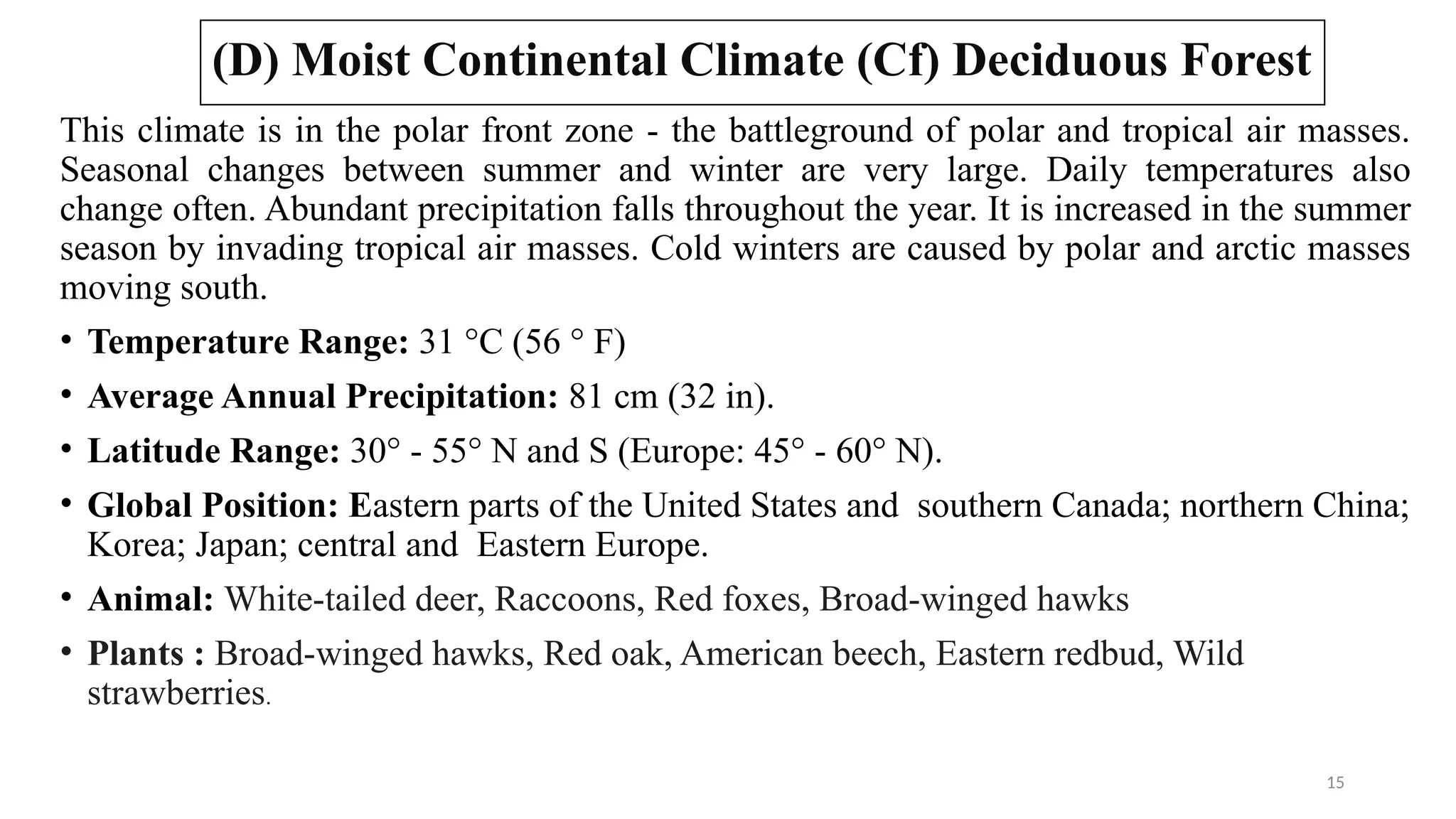
(D) Moist Continental Climate (Cf) Deciduous Forest
This climate is in the polar front zone - the battleground of polar and tropical air masses.
Seasonal changes between summer and winter are very large. Daily temperatures also
change often. Abundant precipitation falls throughout the year. It is increased in the summer
season by invading tropical air masses. Cold winters are caused by polar and arctic masses
moving south.
• Temperature Range: 31 °C (56 ° F)
• Average Annual Precipitation: 81 cm (32 in).
• Latitude Range: 30° - 55° N and S (Europe: 45° - 60° N).
• Global Position: Eastern parts of the United States and southern Canada; northern China;
Korea; Japan; central and Eastern Europe.
• Animal: White-tailed deer, Raccoons, Red foxes, Broad-winged hawks
• Plants : Broad-winged hawks, Red oak, American beech, Eastern redbud, Wild
strawberries.
16
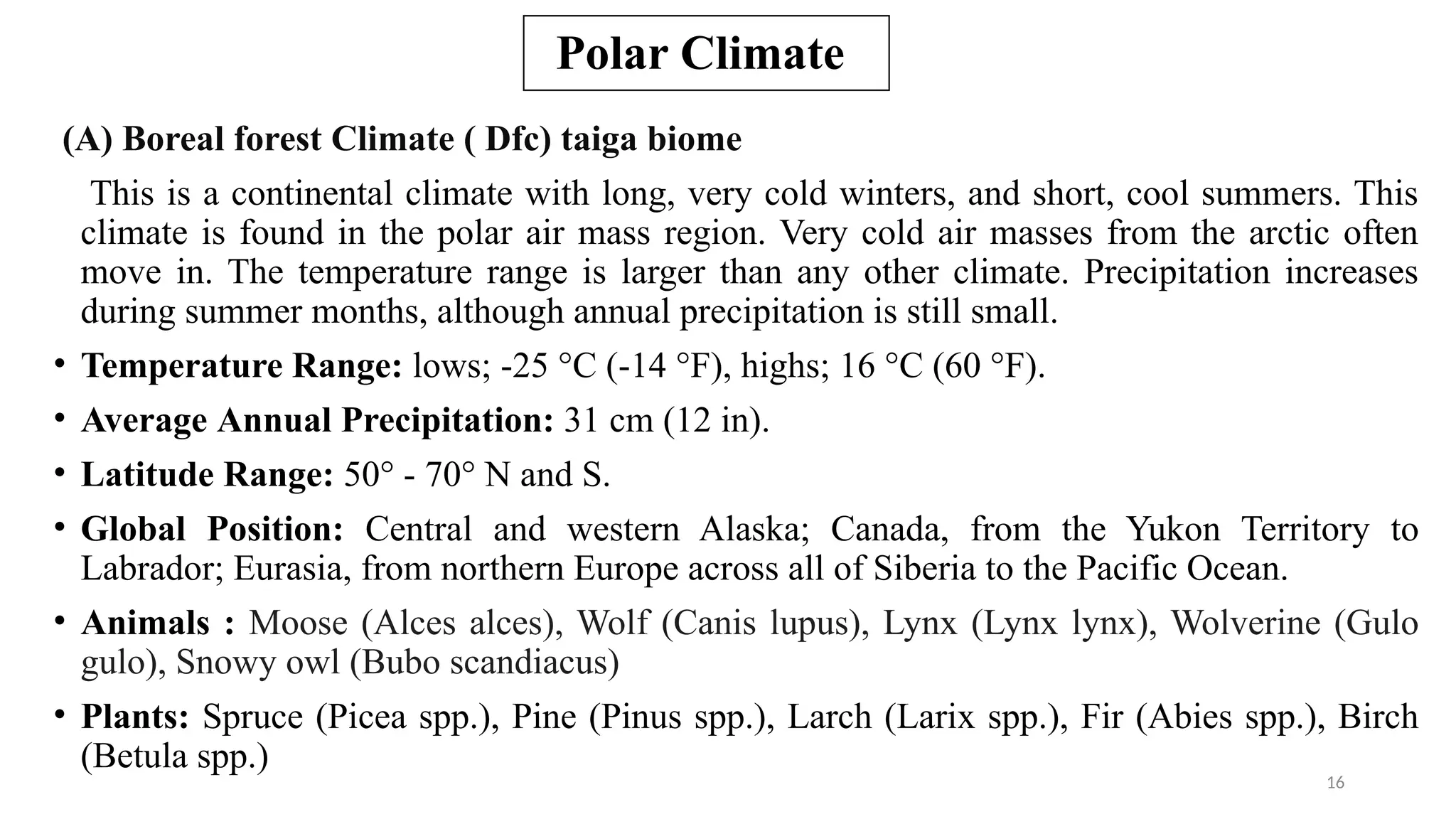
Polar Climate
(A) Boreal forest Climate ( Dfc) taiga biome
This is a continental climate with long, very cold winters, and short, cool summers. This
climate is found in the polar air mass region. Very cold air masses from the arctic often
move in. The temperature range is larger than any other climate. Precipitation increases
during summer months, although annual precipitation is still small.
• Temperature Range: lows; -25 °C (-14 °F), highs; 16 °C (60 °F).
• Average Annual Precipitation: 31 cm (12 in).
• Latitude Range: 50° - 70° N and S.
• Global Position: Central and western Alaska; Canada, from the Yukon Territory to
Labrador; Eurasia, from northern Europe across all of Siberia to the Pacific Ocean.
• Animals : Moose (Alces alces), Wolf (Canis lupus), Lynx (Lynx lynx), Wolverine (Gulo
gulo), Snowy owl (Bubo scandiacus)
• Plants: Spruce (Picea spp.), Pine (Pinus spp.), Larch (Larix spp.), Fir (Abies spp.), Birch
(Betula spp.)
17
Polar Climate
(B) Tundra Climate (E) tundra biome
• The tundra climate is found along arctic coastal areas. Polar and arctic air masses
dominate the tundra climate. The winter season is long and severe. A short, mild season
exists, but not a true summer season. Moderating ocean winds keep the temperatures from
being as severe as interior regions.
• Temperature Range: -22 °C to 6 °C (-10 °F to 41 °F).
• Average Annual Precipitation: 20 cm (8 in).
• Latitude Range: 60° - 75° N.
• Global Position: Arctic zone of North America; Hudson Bay region; Greenland coast;
Northern Siberia bordering the Arctic Ocean.
• Animal: Arctic fox (Vulpes lagopus), Polar bear (Ursus maritimus), Musk ox (Ovibos
moschatus), Snowy owl (Bubo scandiacus), Arctic Hare (Lepus arcticus)
• Plants: Lichen, Mosses, Dwarf shrubs, Sedges and grasses
18
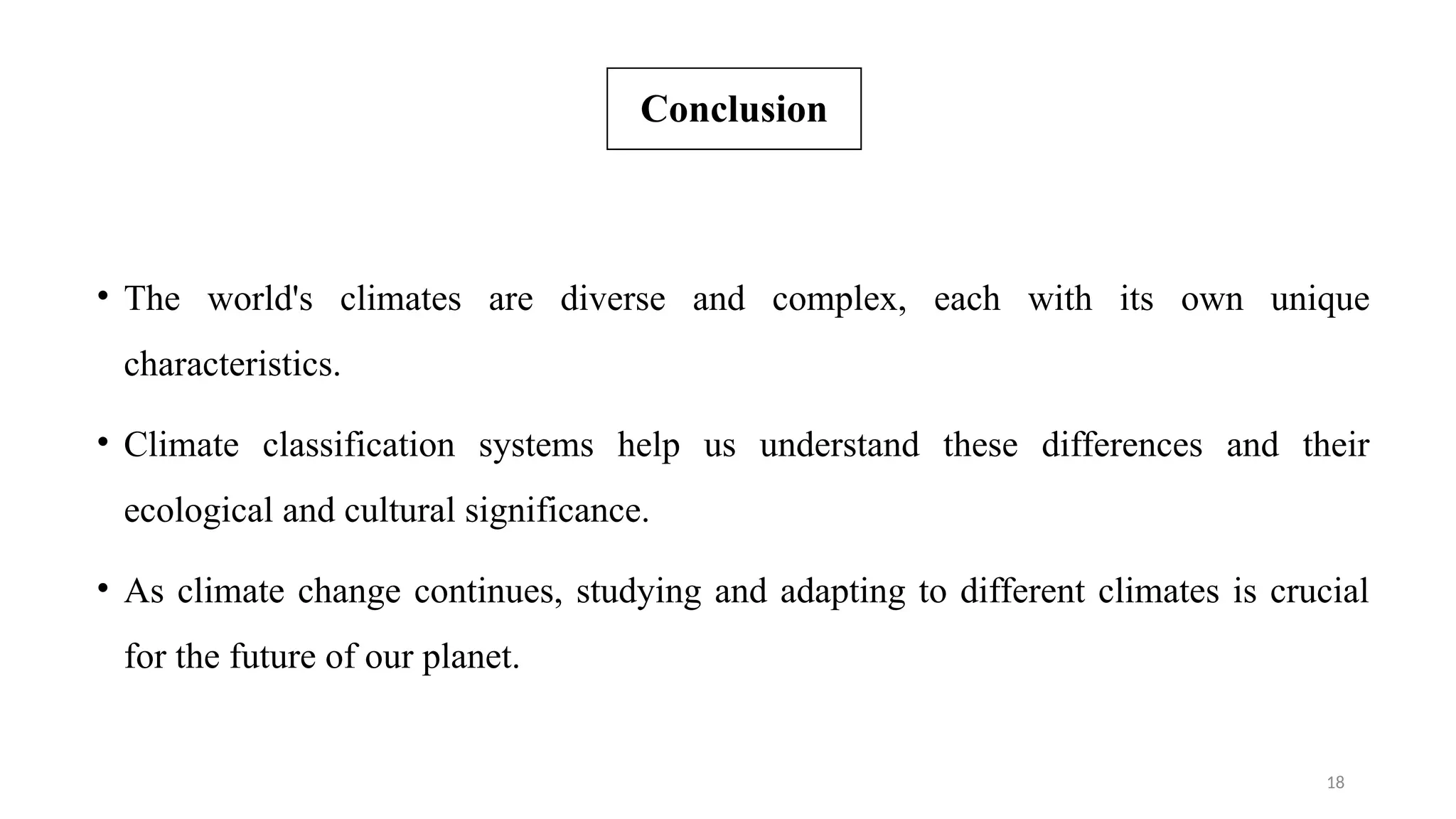
Conclusion
• The world's climates are diverse and complex, each with its own unique
characteristics.
• Climate classification systems help us understand these differences and their
ecological and cultural significance.
• As climate change continues, studying and adapting to different climates is crucial
for the future of our planet.
19
References
• Beck, Hylke E.; Zimmermann, Niklaus E.; McVicar, Tim R.; Vergopolan, Noemi;
Berg, Alexis; Wood, Eric F. (30 October 2018). "Present and future Köppen-Geiger
climate classification maps at 1-km resolution". Scientific Data. 5: 180214.
Bibcode:2018NatSD...580214B. doi:10.1038/sdata.2018.214. ISSN 2052-4463.
PMC 6207062. PMID 30375988.
• United States National Arboretum. USDA Plant Hardiness Zone Map. Archived
2012-07-04 at the Wayback Machine Retrieved on 2008-03-09
• "Thornthwaite Moisture Index". Glossary of Meteorology. American Meteorological
Society. Retrieved 2008-05-21.
• Field behavior of chemical, biological, and radiological agents. Dept. of Defense
Depts. of the Army and the Air Force. 1969.
• "Airmass Classification". Glossary of Meteorology. American Meteorological
Society. Retrieved 2008-05-22.
20
Thank You All!

World Climate Classification! Advanced Climatology

  • 1.
    1 World Climate Classification Coursetitle: Advanced Climatology Course Code: ENVS 503 Submitted to Professor Dr. Md Abdul Baten Head Department of Environmental Science Bangladesh Agricultural University Submitted by Md. Rased Hasan Sojib Roll No.: 23221333 Reg. No.: 55969 Department of Environmental Science Bangladesh Agricultural University
  • 2.
    2 Outline • Introductions • ClimateElements • World Climate • A Country's Climate Depends on Four Main Factors • Climate Group • Conclusions
  • 3.
    3 Climate • The climateis the reoccurring average weather found in any particular place, measured over 30 year intervals. • The Earth's tilt, rotation and land/sea distribution affect these global weather patterns, resulting in variations between different locations. • The most important elements in climate descriptions are temperature and precipitation inasmuch as they have the greatest influence on people and their activities and also have as important impact on the distribution of vegetation and the development of soils.
  • 4.
    4 CLIMATE ELEMENTS  Temperatureis how hot or cold the atmosphere is - ie, how many degrees Celsius (centigrade) it is above or below freezing (0°C)  Farenheit and Celsius scale  Precipitation is the term given to moisture that falls from the air to the ground.  Atmospheric pressure (or air pressure) is the weight of air resting on the earth's surface. Pressure is shown on a weather map, often called a synoptic map, with lines called isobars. Low pressure occurs when air becomes warmer. The air molecules expand, become lighter and it rises. High pressure occurs when air becomes colder. The air molecules contract, become denser, heavier and sink towards the earth.  Wind is the movement of air masses from high pressure areas (high) to low pressure areas (low). The effect of this movement of air is to rebalance the pressure in the atmosphere.
  • 5.
    5 World Climate Climate nameClimate Description Photograph? Tropical These climates are home to the world's rainforests, where rainfall and humidity are high. Temperatures are generally 25-35 °C and vary little through the year. The Amazon is an example Dry These dry regions are linked to the High pressure, cloud free belts at the edges of the Hadley cells. Cold ocean currents can contribute to reduced availability of rainfall. The temperature range in these areas can be large, regularly exceeding 45 °C by day in summer and often falling to below freezing overnight in winter. The Sahara is an example. Mediterranean These climates vary seasonally and have hot, dry summers and cooler, wetter winters. Southern Spain and Greece have these climates Continental Far from the effect of the oceans, these climates are characteristic of the interior of large land masses of middle latitudes; the main climate features are large annual ranges of air temperature, with low rainfall a further characteristic feature. Moscow has a climate like this. Polar Linked to the Polar Cell, these climates can be subdivided into Tundra and ice cap/frost depending on whether the mean temperature of the warmest month is above or below 0°C. The Arctic climate is moderated by the relatively warm Atlantic Ocean. In the Antarctic, the distance from the ocean and a source of water vapour can mean that is truly too cold to snow. Temperate These climate zones lie between the tropics and the polar circles in the westerlies of the Ferrell cell. The changes in these regions between summer and winter are generally subtle (warm or cool), rather than extreme, (hot or freezing cold) and all of these regions have four distinct seasons. These climates can have very highly variable weather. One day it may be sunny, the next it may be raining. These climates can have be influenced by the sea.
  • 6.
    6 Outline Sketch mapof the World’s Climatic zones
  • 7.
    7 A COUNTRY'S CLIMATEDEPENDS ON FOUR MAIN FACTORS • Latitude is the distance of a location from the equator. The hottest temperatures are found at the equator. As you move further away from the equator towards the polar regions, less and less sun is received during the year and the climates become colder and colder. • Altitude is the height above sea level or the height above the earth's surface. The higher the altitude, the lower the temperature will be. On average for every 1,000 metres higher to go the temperature will fall about 6.5 °C. • Proximity to the sea affects the temperature of a place because the sea temperature changes slower than land temperature. So the sea will keep coastal areas warmer than inland area during the winter and cooler than inland areas during the summer. • Currents exist in all the oceans. Currents that move water from tropical areas towards the poles (North Atlantic Drift starts in the Gulf of Mexico) are known as warm currents. Those currents moving from northern (or southern) colder seas, nearer the poles towards the equator are known as cool currents, an example is the Canaries current
  • 8.
    8 CLIMATE GROUP • Threemajor climate groups show the dominance of special combinations of air-mass source regions. • Group I • Low-latitude Climates: These climates are controlled by equatorial a tropical air masses. • Group II • Mid-latitude Climates: Climates in this zone are affected by two different air-masses. The tropical air-masses are moving towards the poles and the polar air-masses are moving towards the equator. These two air masses are in constant conflict. Either air mass may dominate the area, but neither has exclusive control. • Group III • High-latitude climates: Polar and arctic air masses dominate these regions. Canada and Siberia are two air-mass sources which fall into this group. A southern hemisphere counterpart to these continental centers does not exist. Air masses of arctic origin meet polar continental air masses along the 60th and 70th parallels.
  • 9.
    9 Group-I A - TROPICALCLIMATES • Rainfall is heavy in all months. The total annual rainfall is often more than 250 cm. (100 in.). There are seasonal differences in monthly rainfall but temperatures of 27°C (80°F) mostly stay the same. Humidity is between 77 and 88%. • High surface heat and humidity cause cumulus clouds to form early in the afternoons almost every day. • Average temperature: 18 °C (°F) • Annual Precipitation: 262 cm. (103 in.) • Latitude Range: 10° S to 25 ° N • Global Range: Congo Basin of equatorial Africa; East Indies, from Sumatra to New Guinea. • Plants Name: Fruits, vegetables, grains and nuts such as rice, taro, coconut, yam, avocado, pineapple, guava, mango, papaya, breadfruit and jackfruit also hail from tropical regions. • Animal: Sloths, tapirs, jaguars, ocelots, kinkajous, lemurs and agouti.
  • 10.
    10 Group-I (B) Wet-Dry TropicalClimates A seasonal change occurs between wet tropical air masses and dry tropical air masses. As a result, there is a very wet season and a very dry season. Trade winds dominate during the dry season. It gets a little cooler during this dry season but will become very hot just before the wet season. • Temperature Range: 18o C (64.4o F) to above 25o C (77o F) • Annual Precipitation: 0.25 cm. (0.1 in.). All months less than 0.25 cm. (0.1 in.) • Latitude Range: 15 ° to 25 ° N and S • Global Range: India, Indochina, West Africa, Southern Africa, South America and the north coast of Australia. • Plants Name: Kapok (Ceiba pentandra), Mango (Mangifera indica), Neem (Azadirachta indica), Bamboo (Bambusoideae) • Animal Name: wildebeests, gazelles, zebras, elephants, giraffes, etc.
  • 11.
    11 Group-I (C) Dry TropicalClimate These desert climates are found in low-latitude deserts approximately between 18° to 28° in both hemispheres. these latitude belts are centered on the tropics of Cancer and Capricorn, which lie just north and south of the equator. They coincide with the edge of the equatorial subtropical high pressure belt and trade winds. Winds are light, which allows for the evaporation of moisture in the intense heat. They generally flow downward so the area is seldom penetrated by air masses that produce rain. This makes for a very dry heat. The dry arid desert is a true desert climate, and covers 12 % of the Earth's land surface. • Temperature Range: 16° C • Annual Precipitation: 0.25 cm (0.1 in). All months less than 0.25 cm (0.1 in). • Latitude Range: 15° - 25° N and S. • Global Range: Southwestern, United States and Northern Mexico; Argentina; north Africa; South Africa; Central part of Australia. • Plants Name: • Animals name: Wildebeest, zebra, giraffe, elephant, gazelle, kudu, warthog, rhinoceros
  • 12.
    12 Group-II (A) Dry MidlatitudeClimates This dry climate exists in the interior regions of the North American and Eurasian continents. Moist ocean air masses are blocked by mountain ranges to the west and south. These mountain ranges also trap polar air in winter, making winters very cold. Summers are warm to hot. • Temperature Range: 24° C (43° F). • Annual Precipitation: less than 10 cm (4 in) in the driest regions to 50 cm (20 in) in the moister steppes. • Latitude Range: 35° - 55° N. • Global Range: Western North America (Great Basin, Columbia Plateau, Great Plains); Eurasian interior, from steppes of Eastern Europe to the Gobi Desert and North China. • Plants Name: Cactus, sagebrush, desert marigold, Mesquite, acacia, palo verde, Joshua tree • Animal Name: Coyote (North American deserts) , Arabian oryx (Arabian Peninsula), Fennec fox (Sahara Desert), Burrowing owl
  • 13.
    13 Group-II (B) Mediterranean Climate(Cs) This is a wet-winter, dry-summer climate. Extremely dry summers are caused by the sinking air of the subtropical highs and may last for up to five months. • Fires occur frequently in Mediterranean climate zones. • Temperature Range: 7 °C (12 °F) • Annual Precipitation: 42 cm (17 in). • Latitude Range: 30° - 50° N and S • Global Position: central and southern California; coastal zones bordering the Mediterranean Sea; coastal Western Australia and South Australia; Chilean coast; Cape Town region of South Africa. • Plants Name: Olive Tree (Olea europaea), Cork Oak (Quercus suber), Stone Pine (Pinus pinea) • Animals Name: European Green Lizard , Chameleon , Mediterranean Spur-thighed Tortoise, European Honey Bee Common Kingfisher .
  • 14.
    14 (C) Dry MidlatitudeClimates (Bs) • These dry climates are limited to the interiors of North America and Eurasia. • Ocean air masses are blocked by mountain ranges to the west and south. This allows polar air masses to dominate in winter months. In the summer, a local continental air mass is dominant. A small amount of rain falls during this season. • Annual temperatures range widely. Summers are warm to hot, but winters are cold. • Temperature Range: 31 °C (56°F). • Annual Precipitation: 81 cm. (32 in.). • Latitude Range: 30° - 55° N and S • Global Position: western North America (Great Basin, Columbia Plateau, Great Plains); Eurasian interior. • Animals : Coyote (North American deserts, Fennec fox (Sahara Desert), Komodo dragon (Indonesia), Horned lizard (North American deserts) • Plants : Mesquite, acacia, palo verde, Joshua tree
  • 15.
    15 (D) Moist ContinentalClimate (Cf) Deciduous Forest This climate is in the polar front zone - the battleground of polar and tropical air masses. Seasonal changes between summer and winter are very large. Daily temperatures also change often. Abundant precipitation falls throughout the year. It is increased in the summer season by invading tropical air masses. Cold winters are caused by polar and arctic masses moving south. • Temperature Range: 31 °C (56 ° F) • Average Annual Precipitation: 81 cm (32 in). • Latitude Range: 30° - 55° N and S (Europe: 45° - 60° N). • Global Position: Eastern parts of the United States and southern Canada; northern China; Korea; Japan; central and Eastern Europe. • Animal: White-tailed deer, Raccoons, Red foxes, Broad-winged hawks • Plants : Broad-winged hawks, Red oak, American beech, Eastern redbud, Wild strawberries.
  • 16.
    16 Polar Climate (A) Borealforest Climate ( Dfc) taiga biome This is a continental climate with long, very cold winters, and short, cool summers. This climate is found in the polar air mass region. Very cold air masses from the arctic often move in. The temperature range is larger than any other climate. Precipitation increases during summer months, although annual precipitation is still small. • Temperature Range: lows; -25 °C (-14 °F), highs; 16 °C (60 °F). • Average Annual Precipitation: 31 cm (12 in). • Latitude Range: 50° - 70° N and S. • Global Position: Central and western Alaska; Canada, from the Yukon Territory to Labrador; Eurasia, from northern Europe across all of Siberia to the Pacific Ocean. • Animals : Moose (Alces alces), Wolf (Canis lupus), Lynx (Lynx lynx), Wolverine (Gulo gulo), Snowy owl (Bubo scandiacus) • Plants: Spruce (Picea spp.), Pine (Pinus spp.), Larch (Larix spp.), Fir (Abies spp.), Birch (Betula spp.)
  • 17.
    17 Polar Climate (B) TundraClimate (E) tundra biome • The tundra climate is found along arctic coastal areas. Polar and arctic air masses dominate the tundra climate. The winter season is long and severe. A short, mild season exists, but not a true summer season. Moderating ocean winds keep the temperatures from being as severe as interior regions. • Temperature Range: -22 °C to 6 °C (-10 °F to 41 °F). • Average Annual Precipitation: 20 cm (8 in). • Latitude Range: 60° - 75° N. • Global Position: Arctic zone of North America; Hudson Bay region; Greenland coast; Northern Siberia bordering the Arctic Ocean. • Animal: Arctic fox (Vulpes lagopus), Polar bear (Ursus maritimus), Musk ox (Ovibos moschatus), Snowy owl (Bubo scandiacus), Arctic Hare (Lepus arcticus) • Plants: Lichen, Mosses, Dwarf shrubs, Sedges and grasses
  • 18.
    18 Conclusion • The world'sclimates are diverse and complex, each with its own unique characteristics. • Climate classification systems help us understand these differences and their ecological and cultural significance. • As climate change continues, studying and adapting to different climates is crucial for the future of our planet.
  • 19.
    19 References • Beck, HylkeE.; Zimmermann, Niklaus E.; McVicar, Tim R.; Vergopolan, Noemi; Berg, Alexis; Wood, Eric F. (30 October 2018). "Present and future Köppen-Geiger climate classification maps at 1-km resolution". Scientific Data. 5: 180214. Bibcode:2018NatSD...580214B. doi:10.1038/sdata.2018.214. ISSN 2052-4463. PMC 6207062. PMID 30375988. • United States National Arboretum. USDA Plant Hardiness Zone Map. Archived 2012-07-04 at the Wayback Machine Retrieved on 2008-03-09 • "Thornthwaite Moisture Index". Glossary of Meteorology. American Meteorological Society. Retrieved 2008-05-21. • Field behavior of chemical, biological, and radiological agents. Dept. of Defense Depts. of the Army and the Air Force. 1969. • "Airmass Classification". Glossary of Meteorology. American Meteorological Society. Retrieved 2008-05-22.
  • 20.