


Wood WorkshopWood WorkshopWood WorkshopWood Workshop
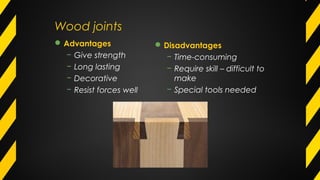
Wood joints
Disadvantages
− Time-consuming
− Require skill – difficult to
make
− Special tools needed
Advantages
− Give strength
− Long lasting
− Decorative
− Resist forces well
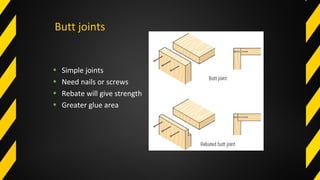
Butt joints
• Simple joints
• Need nails or screws
• Rebate will give strength
• Greater glue area
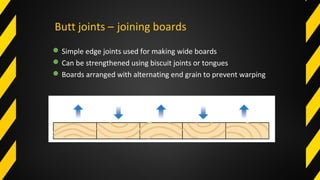
Butt joints – joining boards
Simple edge joints used for making wide boards
Can be strengthened using biscuit joints or tongues
Boards arranged with alternating end grain to prevent warping
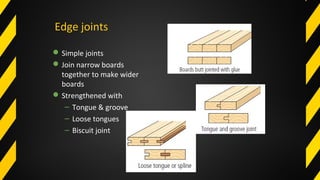
Edge joints
Simple joints
Join narrow boards
together to make wider
boards
Strengthened with
– Tongue & groove
– Loose tongues
– Biscuit joint
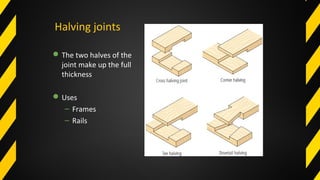
Halving joints
The two halves of the
joint make up the full
thickness
Uses
– Frames
– Rails
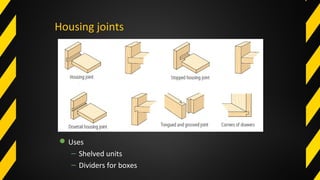
Housing joints
Uses
– Shelved units
– Dividers for boxes
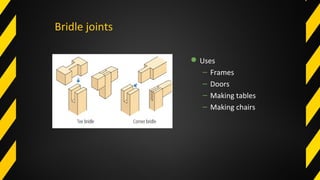
Bridle joints
Uses
– Frames
– Doors
– Making tables
– Making chairs
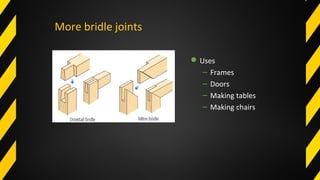
More bridle joints
Uses
– Frames
– Doors
– Making tables
– Making chairs
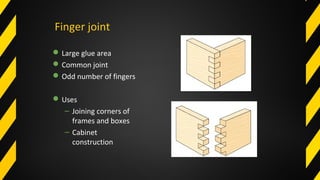
Finger joint
Large glue area
Common joint
Odd number of fingers
Uses
– Joining corners of
frames and boxes
– Cabinet
construction
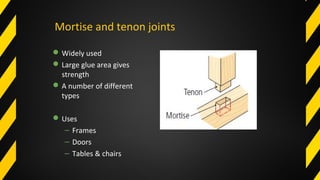
Mortise and tenon joints
Widely used
Large glue area gives
strength
A number of different
types
Uses
– Frames
– Doors
– Tables & chairs
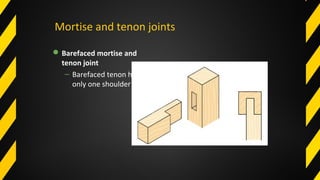
Mortise and tenon joints
Barefaced mortise and
tenon joint
– Barefaced tenon has
only one shoulder
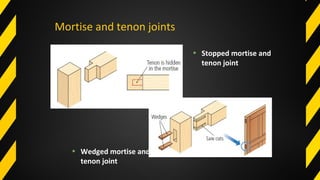
Mortise and tenon joints
• Stopped mortise and
tenon joint
• Wedged mortise and
tenon joint
Mortise and tenon joints
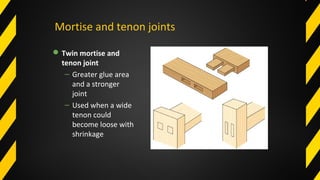
Twin mortise and
tenon joint
– Greater glue area
and a stronger
joint
– Used when a wide
tenon could
become loose with
shrinkage
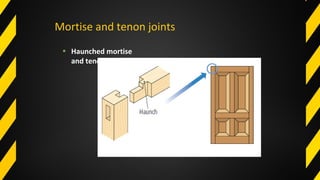
• Haunched mortise
and tenon joint
Mortise and tenon joints
Slope of the dovetail
Softwood Hardwood
1 : 6 1 : 8
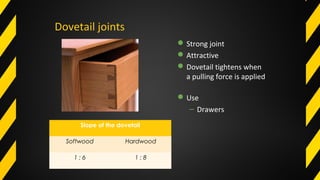
Dovetail joints
Strong joint
Attractive
Dovetail tightens when
a pulling force is applied
Use
– Drawers
Slope of the dovetail
Softwood Hardwood
1 : 6 1 : 8
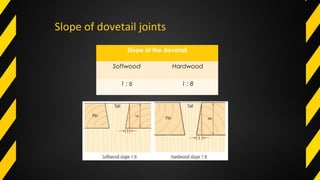
Slope of dovetail joints
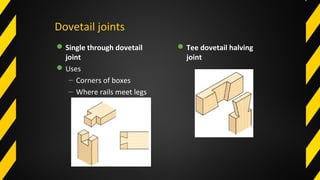
Dovetail joints
Tee dovetail halving
joint
Single through dovetail
joint
Uses
– Corners of boxes
– Where rails meet legs
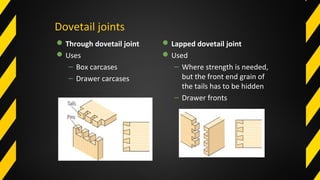
Through dovetail joint
Uses
– Box carcases
– Drawer carcases
Dovetail joints
Lapped dovetail joint
Used
– Where strength is needed,
but the front end grain of
the tails has to be hidden
– Drawer fronts
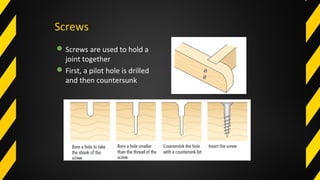
Screws
Screws are used to hold a
joint together
First, a pilot hole is drilled
and then countersunk
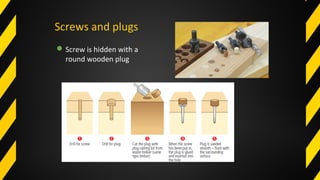
Screws and plugs
Screw is hidden with a
round wooden plug
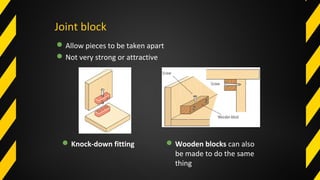
Joint block
Allow pieces to be taken apart
Not very strong or attractive
Knock-down fitting Wooden blocks can also
be made to do the same
thing
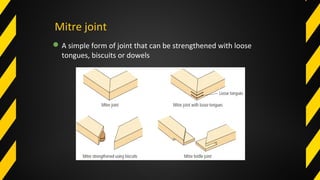
Mitre joint
A simple form of joint that can be strengthened with loose
tongues, biscuits or dowels
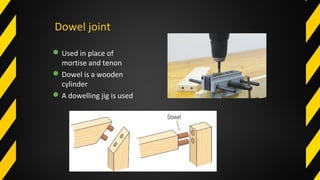
Dowel joint
Used in place of
mortise and tenon
Dowel is a wooden
cylinder
A dowelling jig is used
Example
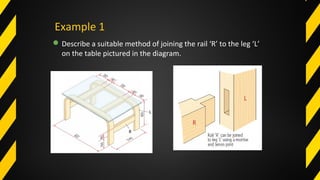
Example 1
Describe a suitable method of joining the rail ‘R’ to the leg ‘L’
on the table pictured in the diagram.
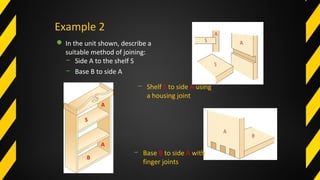
Example 2
 In the unit shown, describe a
suitable method of joining:
A
S
A
B
− Base B to side A with
finger joints
− Shelf S to side A using
a housing joint
− Side A to the shelf S
− Base B to side A
Skillcruise.com

Workshop Technology- wood workshop