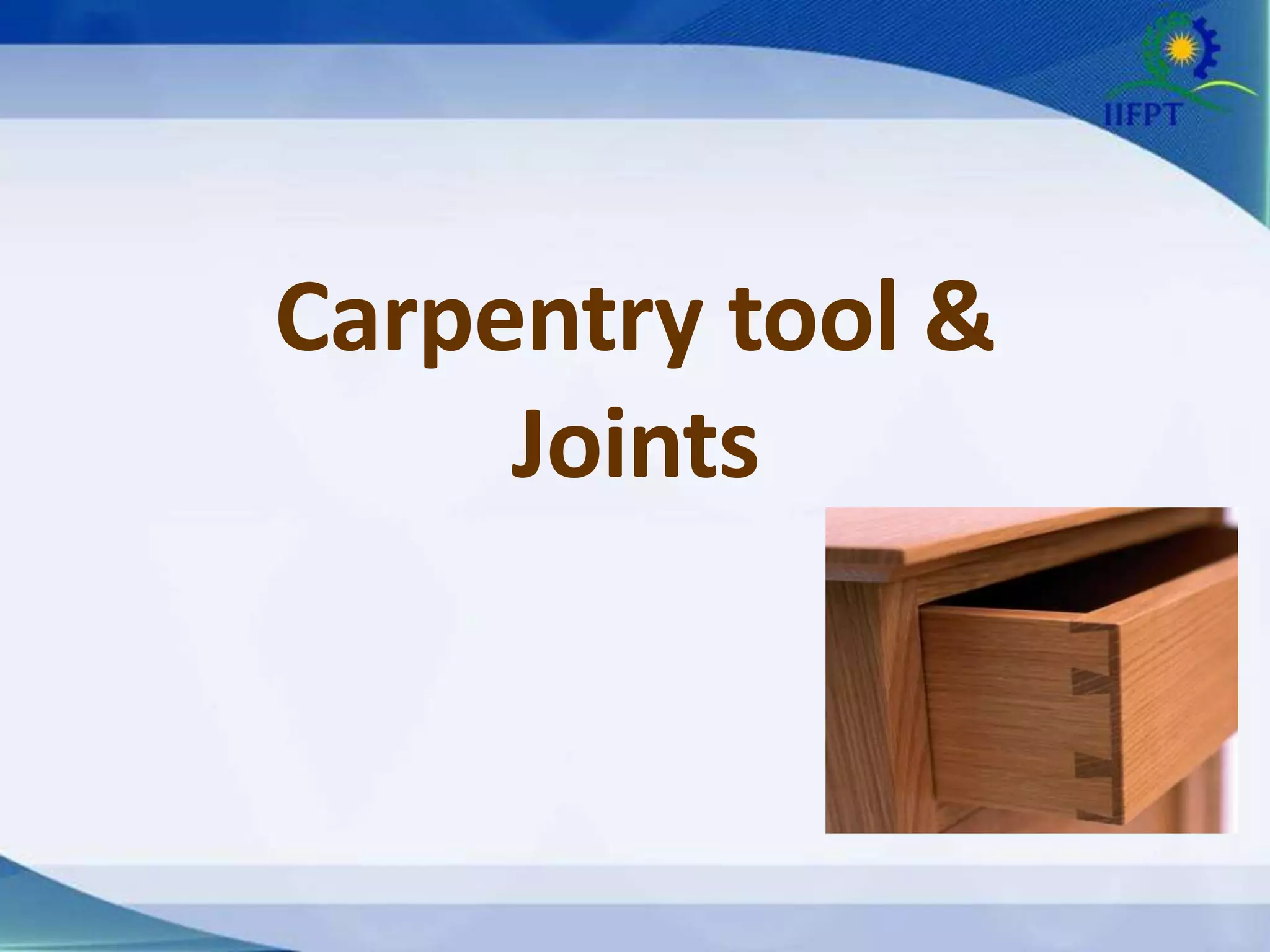
Carpentry tool &
Joints
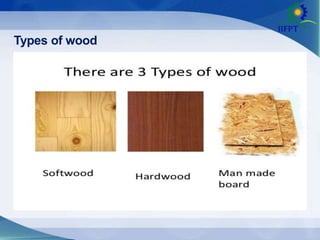
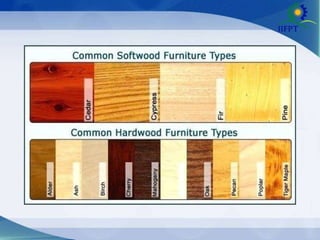
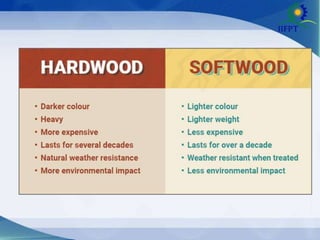
Types of wood
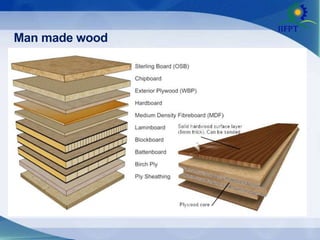
Man made wood
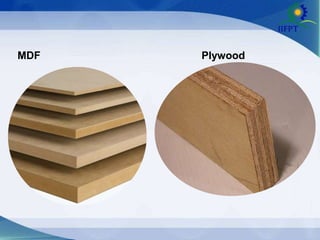
MDF Plywood
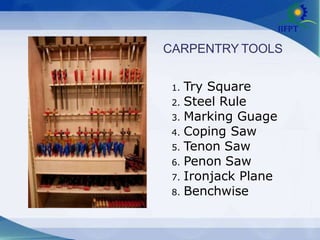
CARPENTRY TOOLS
1. Try Square
2. Steel Rule
3. Marking Guage
4. Coping Saw
5. Tenon Saw
6. Penon Saw
7. Ironjack Plane
8. Benchwise
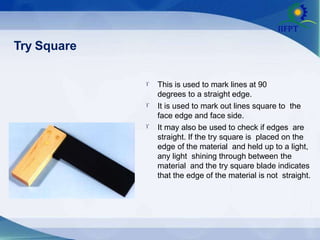
Try Square



This is used to mark lines at 90
degrees to a straight edge.
It is used to mark out lines square to the
face edge and face side.
It may also be used to check if edges are
straight. If the try square is placed on the
edge of the material and held up to a light,
any light shining through between the
material and the try square blade indicates
that the edge of the material is not straight.
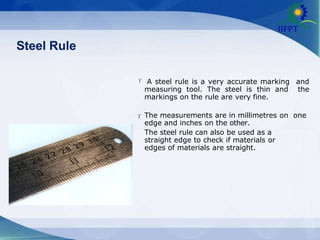
Steel Rule
A steel rule is a very accurate marking and
measuring tool. The steel is thin and the
markings on the rule are very fine.
The measurements are in millimetres on one
edge and inches on the other.
The steel rule can also be used as a
straight edge to check if materials or
edges of materials are straight.


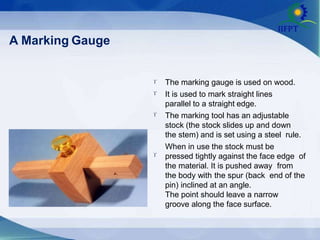
A Marking Gauge




The marking gauge is used on wood.
It is used to mark straight lines
parallel to a straight edge.
The marking tool has an adjustable
stock (the stock slides up and down
the stem) and is set using a steel rule.
When in use the stock must be
pressed tightly against the face edge of
the material. It is pushed away from
the body with the spur (back end of the
pin) inclined at an angle.
The point should leave a narrow
groove along the face surface.
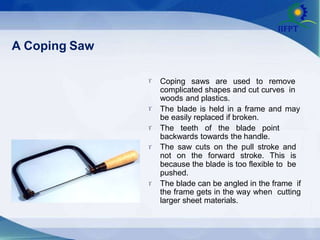
A Coping Saw





Coping saws are used to remove
complicated shapes and cut curves in
woods and plastics.
The blade is held in a frame and may
be easily replaced if broken.
The teeth of the blade point
backwards towards the handle.
The saw cuts on the pull stroke and
not on the forward stroke. This is
because the blade is too flexible to be
pushed.
The blade can be angled in the frame if
the frame gets in the way when cutting
larger sheet materials.
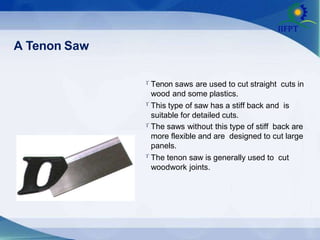
A Tenon Saw




Tenon saws are used to cut straight cuts in
wood and some plastics.
This type of saw has a stiff back and is
suitable for detailed cuts.
The saws without this type of stiff back are
more flexible and are designed to cut large
panels.
The tenon saw is generally used to cut
woodwork joints.
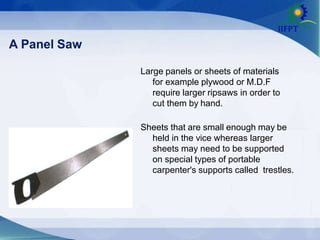
Large panels or sheets of materials
for example plywood or M.D.F
require larger ripsaws in order to
cut them by hand.
Sheets that are small enough may be
held in the vice whereas larger
sheets may need to be supported
on special types of portable
carpenter's supports called trestles.
A Panel Saw
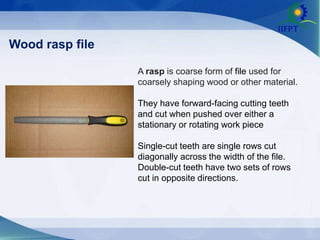
Wood rasp file
A rasp is coarse form of file used for
coarsely shaping wood or other material.
They have forward-facing cutting teeth
and cut when pushed over either a
stationary or rotating work piece
Single-cut teeth are single rows cut
diagonally across the width of the file.
Double-cut teeth have two sets of rows
cut in opposite directions.
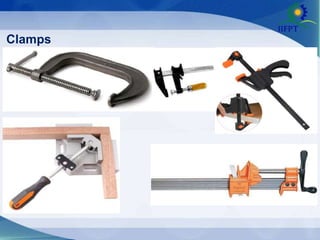
Clamps
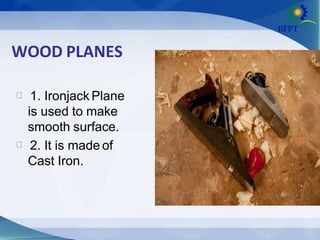
WOOD PLANES
1. Ironjack Plane
is used to make
smooth surface.
2. It is made of
Cast Iron.
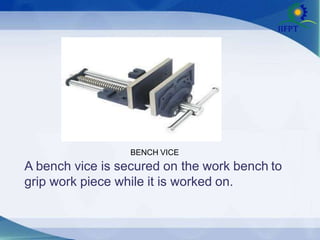
A bench vice is secured on the work bench to
grip work piece while it is worked on.
BENCH VICE
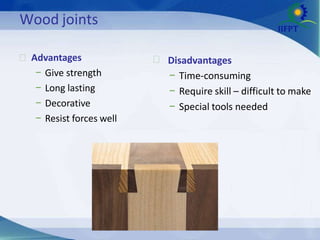
Wood joints
 Disadvantages
− Time-consuming
− Require skill – difficult to make
− Special tools needed
 Advantages
− Give strength
− Long lasting
− Decorative
− Resist forces well
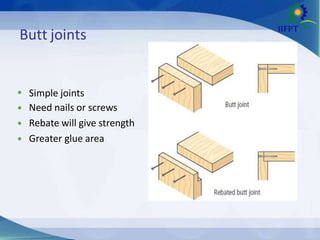
Butt joints
•
•
•
•
Simple joints
Need nails or screws
Rebate will give strength
Greater glue area
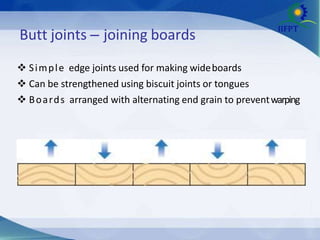
Butt joints – joining boards
 Simple edge joints used for making wideboards
 Can be strengthened using biscuit joints or tongues
 Boards arranged with alternating end grain to preventwarping
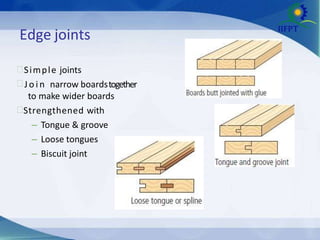
Edge joints
Simple joints
 J o i n narrow boardstogether
to make wider boards
Strengthened with
– Tongue & groove
– Loose tongues
– Biscuit joint
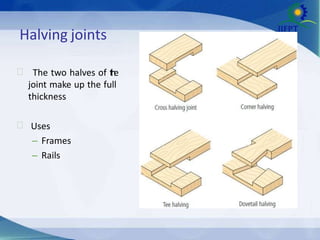
Halving joints
 The two halves of t
h
e
joint make up the full
thickness
 Uses
– Frames
– Rails
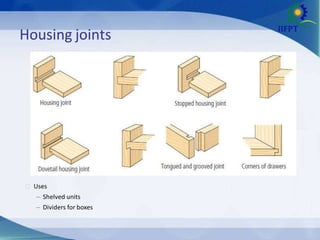
Housing joints
 Uses
– Shelved units
– Dividers for boxes
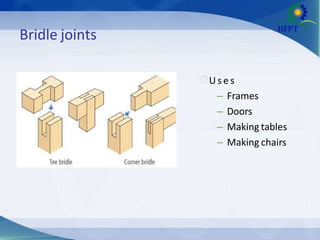
Bridle joints
 U s e s
– Frames
– Doors
– Making tables
– Making chairs
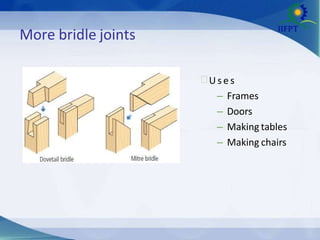
More bridle joints
 U s e s
– Frames
– Doors
– Making tables
– Making chairs
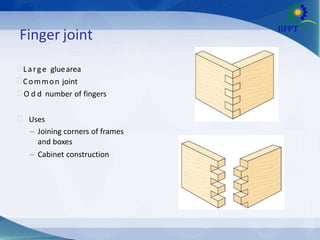
Finger joint
Large gluearea
Common joint
 O d d number of fingers
 Uses
– Joining corners of frames
and boxes
– Cabinet construction
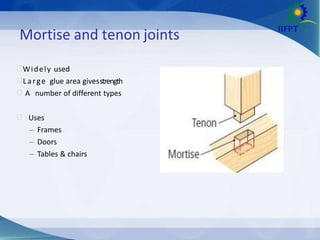
Mortise and tenon joints
Widely used
Large glue area givesstrength
 A number of different types
 Uses
– Frames
– Doors
– Tables & chairs
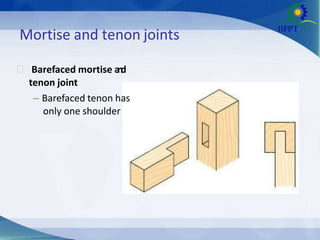
Mortise and tenon joints
 Barefaced mortise a
n
d
tenon joint
– Barefaced tenon has
only one shoulder
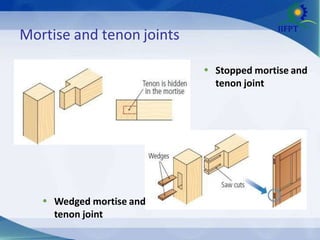
Mortise and tenon joints
• Stopped mortise and
tenon joint
• Wedged mortise and
tenon joint
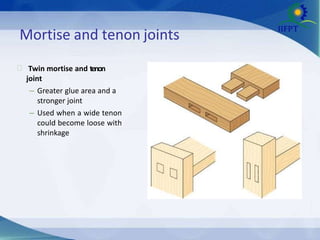
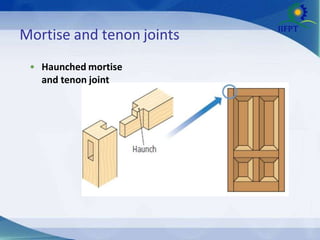
Mortise and tenon joints
 Twin mortise and tenon
joint
– Greater glue area and a
stronger joint
– Used when a wide tenon
could become loose with
shrinkage
• Haunched mortise
and tenon joint
Mortise and tenon joints
Slope of the dovetail
Softwood Hardwood
1: 6 1: 8
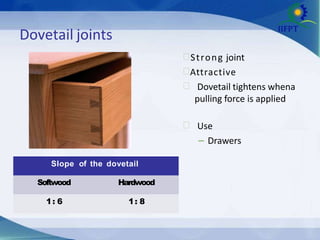
Dovetail joints
Strong joint
Attractive
 Dovetail tightens whena
pulling force is applied
 Use
– Drawers
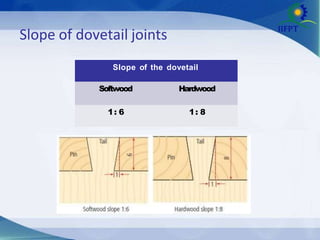
Slope of the dovetail
Softwood Hardwood
1: 6 1: 8
Slope of dovetail joints
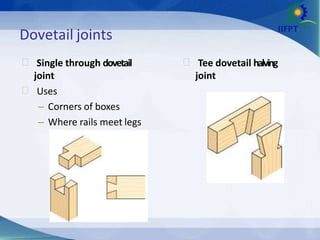
Dovetail joints
 Tee dovetail halving
joint
 Single through dovetail
joint
 Uses
– Corners of boxes
– Where rails meet legs
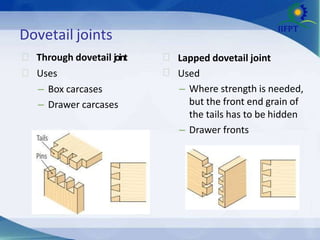
 Through dovetail joint
 Uses
– Box carcases
– Drawer carcases
Dovetail joints
 Lapped dovetail joint
 Used
– Where strength is needed,
but the front end grain of
the tails has to be hidden
– Drawer fronts
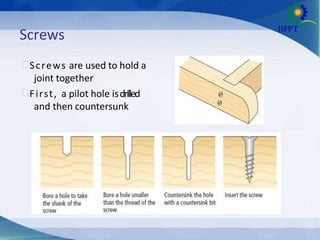
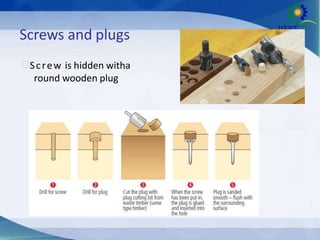
Screws
Screws are used to hold a
joint together
First, a pilot hole isdrilled
and then countersunk
Screws and plugs
Screw is hidden witha
round wooden plug
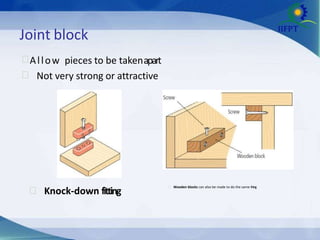
Joint block
Allow pieces to be takenapart
 Not very strong or attractive
 Knock-down fitting
 Wooden blocks can also be made to do the same thing
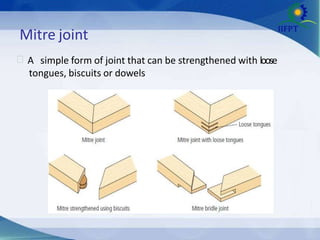
Mitre joint
 A simple form of joint that can be strengthened with loose
tongues, biscuits or dowels
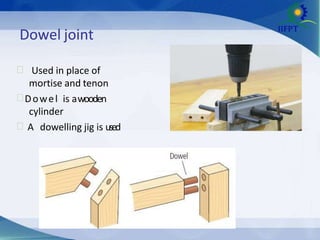
Dowel joint
 Used in place of
mortise and tenon
Dowel is awooden
cylinder
 A dowelling jig is used
carpentry assistant.pdf

carpentry assistant.pdf

  • 1.
  • 2.
  • 5.
  • 6.
  • 7.
    CARPENTRY TOOLS 1. TrySquare 2. Steel Rule 3. Marking Guage 4. Coping Saw 5. Tenon Saw 6. Penon Saw 7. Ironjack Plane 8. Benchwise
  • 8.
    Try Square    This isused to mark lines at 90 degrees to a straight edge. It is used to mark out lines square to the face edge and face side. It may also be used to check if edges are straight. If the try square is placed on the edge of the material and held up to a light, any light shining through between the material and the try square blade indicates that the edge of the material is not straight.
  • 9.
    Steel Rule A steelrule is a very accurate marking and measuring tool. The steel is thin and the markings on the rule are very fine. The measurements are in millimetres on one edge and inches on the other. The steel rule can also be used as a straight edge to check if materials or edges of materials are straight.  
  • 10.
    A Marking Gauge     Themarking gauge is used on wood. It is used to mark straight lines parallel to a straight edge. The marking tool has an adjustable stock (the stock slides up and down the stem) and is set using a steel rule. When in use the stock must be pressed tightly against the face edge of the material. It is pushed away from the body with the spur (back end of the pin) inclined at an angle. The point should leave a narrow groove along the face surface.
  • 11.
    A Coping Saw      Copingsaws are used to remove complicated shapes and cut curves in woods and plastics. The blade is held in a frame and may be easily replaced if broken. The teeth of the blade point backwards towards the handle. The saw cuts on the pull stroke and not on the forward stroke. This is because the blade is too flexible to be pushed. The blade can be angled in the frame if the frame gets in the way when cutting larger sheet materials.
  • 12.
    A Tenon Saw     Tenonsaws are used to cut straight cuts in wood and some plastics. This type of saw has a stiff back and is suitable for detailed cuts. The saws without this type of stiff back are more flexible and are designed to cut large panels. The tenon saw is generally used to cut woodwork joints.
  • 13.
    Large panels orsheets of materials for example plywood or M.D.F require larger ripsaws in order to cut them by hand. Sheets that are small enough may be held in the vice whereas larger sheets may need to be supported on special types of portable carpenter's supports called trestles. A Panel Saw
  • 14.
    Wood rasp file Arasp is coarse form of file used for coarsely shaping wood or other material. They have forward-facing cutting teeth and cut when pushed over either a stationary or rotating work piece Single-cut teeth are single rows cut diagonally across the width of the file. Double-cut teeth have two sets of rows cut in opposite directions.
  • 15.
  • 16.
    WOOD PLANES 1. IronjackPlane is used to make smooth surface. 2. It is made of Cast Iron.
  • 17.
    A bench viceis secured on the work bench to grip work piece while it is worked on. BENCH VICE
  • 18.
    Wood joints  Disadvantages −Time-consuming − Require skill – difficult to make − Special tools needed  Advantages − Give strength − Long lasting − Decorative − Resist forces well
  • 19.
    Butt joints • • • • Simple joints Neednails or screws Rebate will give strength Greater glue area
  • 20.
    Butt joints –joining boards  Simple edge joints used for making wideboards  Can be strengthened using biscuit joints or tongues  Boards arranged with alternating end grain to preventwarping
  • 21.
    Edge joints Simple joints J o i n narrow boardstogether to make wider boards Strengthened with – Tongue & groove – Loose tongues – Biscuit joint
  • 22.
    Halving joints  Thetwo halves of t h e joint make up the full thickness  Uses – Frames – Rails
  • 23.
    Housing joints  Uses –Shelved units – Dividers for boxes
  • 24.
    Bridle joints  Us e s – Frames – Doors – Making tables – Making chairs
  • 25.
    More bridle joints U s e s – Frames – Doors – Making tables – Making chairs
  • 26.
    Finger joint Large gluearea Commonjoint  O d d number of fingers  Uses – Joining corners of frames and boxes – Cabinet construction
  • 27.
    Mortise and tenonjoints Widely used Large glue area givesstrength  A number of different types  Uses – Frames – Doors – Tables & chairs
  • 28.
    Mortise and tenonjoints  Barefaced mortise a n d tenon joint – Barefaced tenon has only one shoulder
  • 29.
    Mortise and tenonjoints • Stopped mortise and tenon joint • Wedged mortise and tenon joint
  • 30.
    Mortise and tenonjoints  Twin mortise and tenon joint – Greater glue area and a stronger joint – Used when a wide tenon could become loose with shrinkage
  • 31.
    • Haunched mortise andtenon joint Mortise and tenon joints
  • 32.
    Slope of thedovetail Softwood Hardwood 1: 6 1: 8 Dovetail joints Strong joint Attractive  Dovetail tightens whena pulling force is applied  Use – Drawers
  • 33.
    Slope of thedovetail Softwood Hardwood 1: 6 1: 8 Slope of dovetail joints
  • 34.
    Dovetail joints  Teedovetail halving joint  Single through dovetail joint  Uses – Corners of boxes – Where rails meet legs
  • 35.
     Through dovetailjoint  Uses – Box carcases – Drawer carcases Dovetail joints  Lapped dovetail joint  Used – Where strength is needed, but the front end grain of the tails has to be hidden – Drawer fronts
  • 36.
    Screws Screws are usedto hold a joint together First, a pilot hole isdrilled and then countersunk
  • 37.
    Screws and plugs Screwis hidden witha round wooden plug
  • 38.
    Joint block Allow piecesto be takenapart  Not very strong or attractive  Knock-down fitting  Wooden blocks can also be made to do the same thing
  • 39.
    Mitre joint  Asimple form of joint that can be strengthened with loose tongues, biscuits or dowels
  • 40.
    Dowel joint  Usedin place of mortise and tenon Dowel is awooden cylinder  A dowelling jig is used