Fundamentals of an actuatorFundamentals of an actuatorFundamentals of an actuatorFundamentals of an actuator
What is an actuator?What is an actuator?
• Actuators are devices used to produce action or motion.
• Input(mainly electrical signal , air, fluids)
• Electrical signal can be low power or high power.
• Actuators output can be position or rate i. e.
• linear displacement or velocity.
• Actuation can be from few microns to few meters
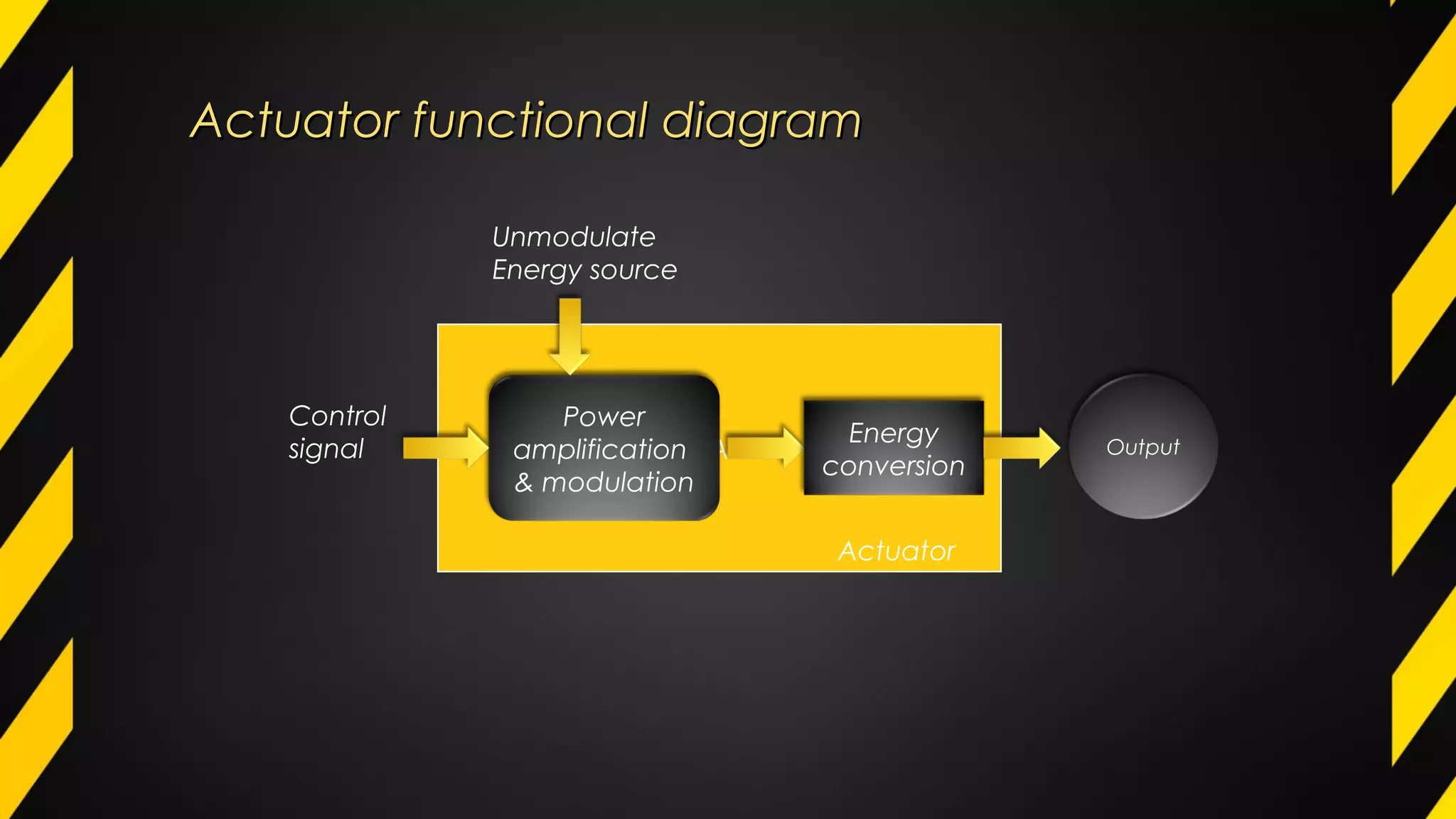
Actuator functional diagramActuator functional diagram
A
Power
amplification
& modulation
Energy
conversion
Control
signal
Actuator
Output
Unmodulate
Energy source
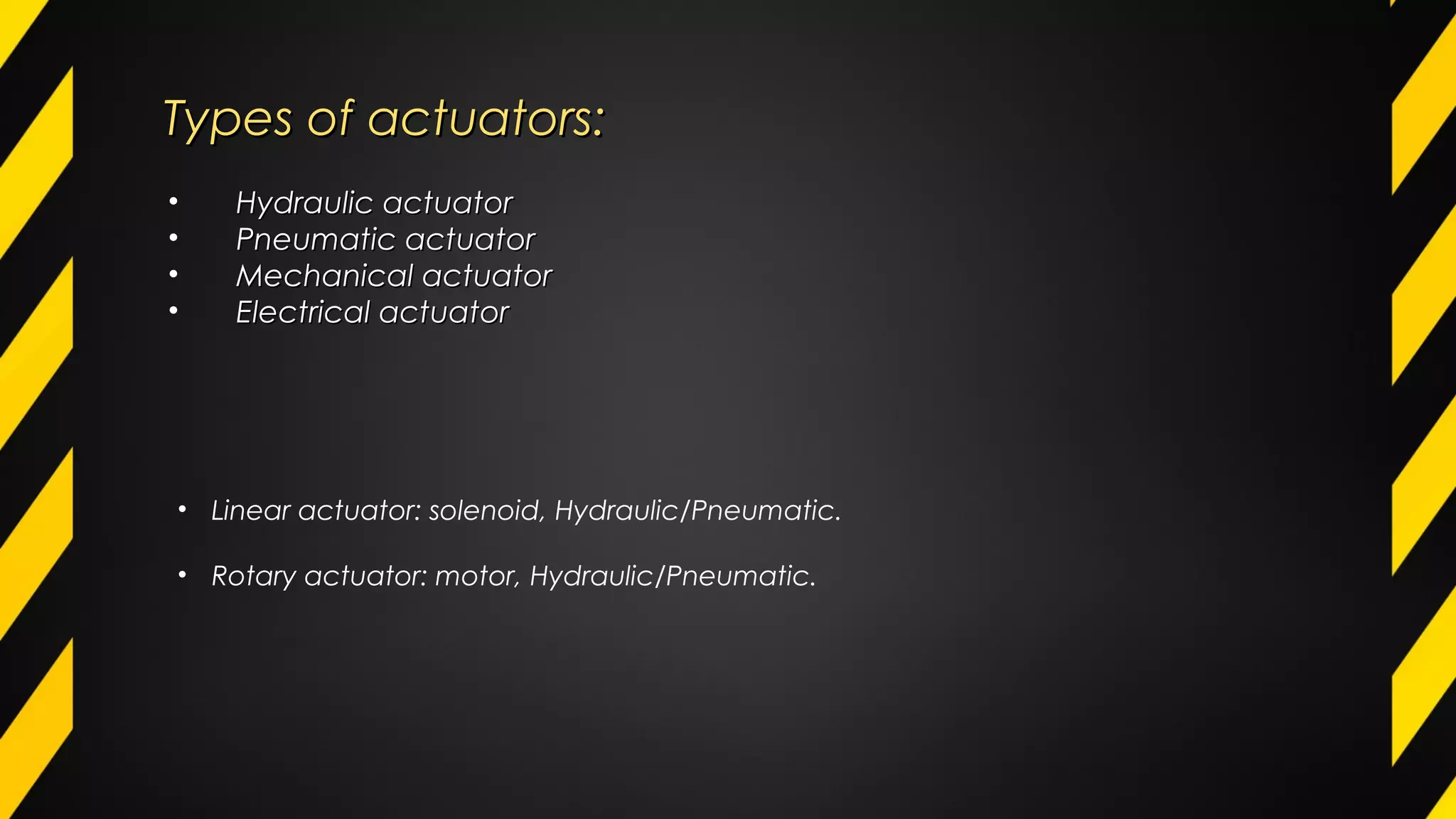
Types of actuators:Types of actuators:
• Hydraulic actuatorHydraulic actuator
• Pneumatic actuatorPneumatic actuator
• Mechanical actuatorMechanical actuator
• Electrical actuatorElectrical actuator
• Linear actuator: solenoid, Hydraulic/Pneumatic.
• Rotary actuator: motor, Hydraulic/Pneumatic.
SolenoidSolenoid
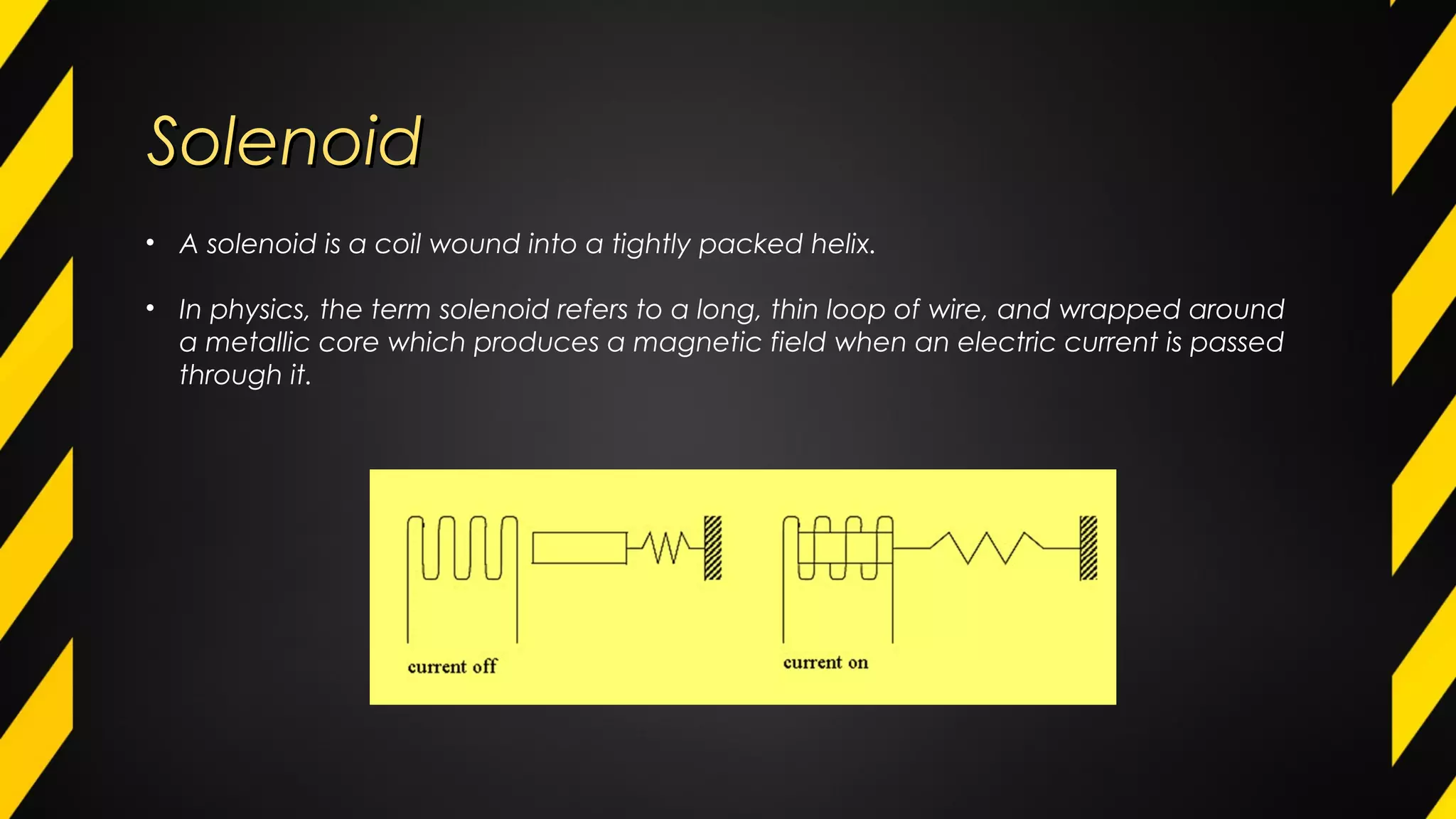
• A solenoid is a coil wound into a tightly packed helix.
• In physics, the term solenoid refers to a long, thin loop of wire, and wrapped around
a metallic core which produces a magnetic field when an electric current is passed
through it.
ApplicationApplication
• Pneumatic valve.
• Car door openers.
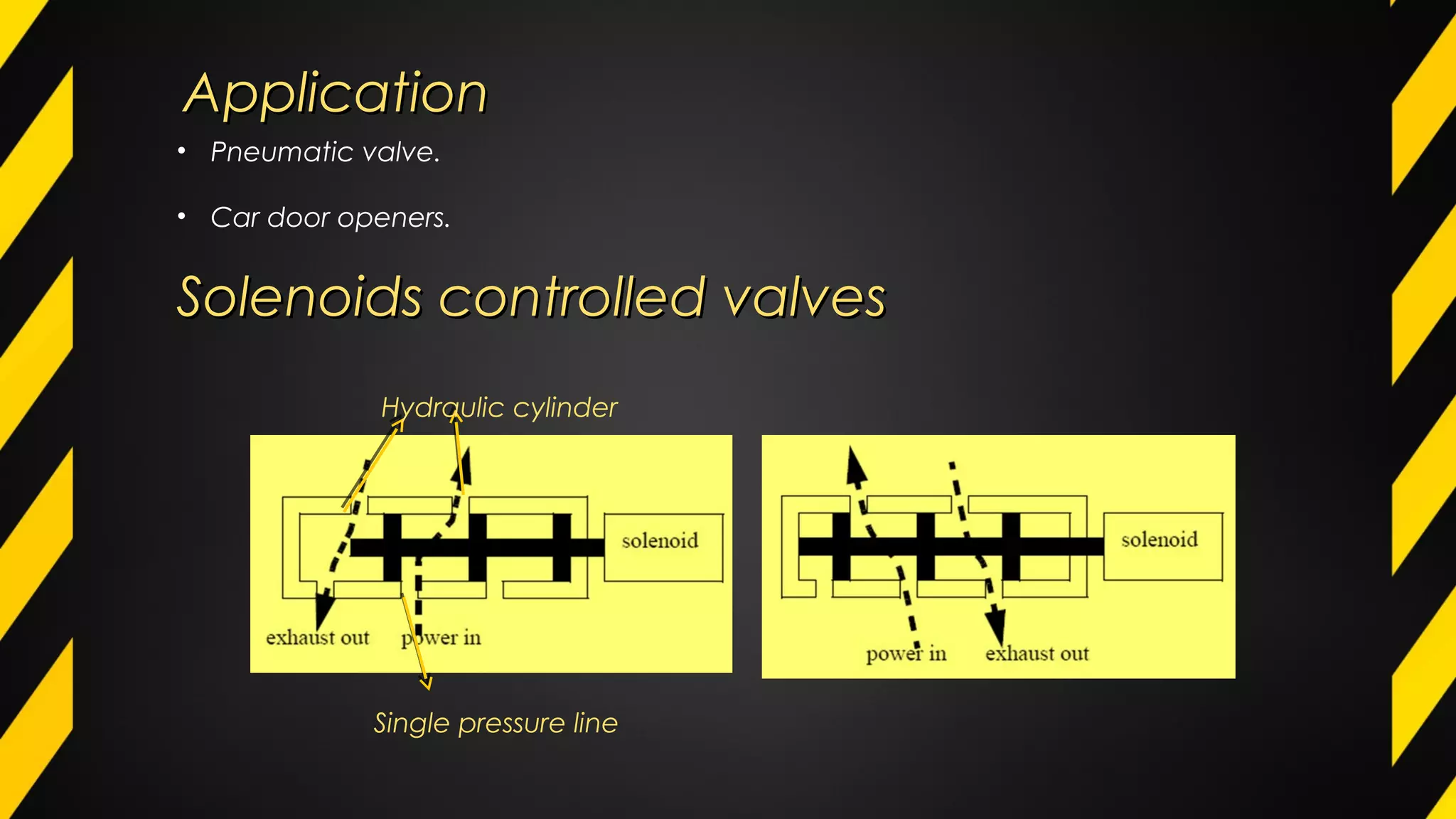
Solenoids controlled valvesSolenoids controlled valves
Hydraulic cylinder
Single pressure line
Hydraulic actuator:Hydraulic actuator:
• Hydraulic systems are used to control & transmit power.
• A pump driven by prime mover (electric motor) creates flow of fluid
Linear actuator (hydraulic cylinder)
•Provides motion in straight line.
•Linear displacement depends on stroke length.
•Usually referred to as cylinders, rams (single acting cylinders) or
jacks.
Rotary actuators (Hydraulic motors)
•Produces continuous rotational motion.
•Pump shaft is rotated to generate flow.
•A motor shaft is caused to rotate by fluid being forced into the
driving chambers.
Types of hydraulic actuatorTypes of hydraulic actuator
Semi rotary actuatorsSemi rotary actuators
•Produces non-continuous rotational motion.
•Limited to less than one revolution (<360°).
•Used to produce oscillatory motions in mechanisms.
ApplicationsApplications
• Hydraulic jack.
• Hydraulic brake.
• Hydraulic ram.
• Used as sensor.
• Close loop velocity controlling.
• Highly precise positioning for heavy loads.
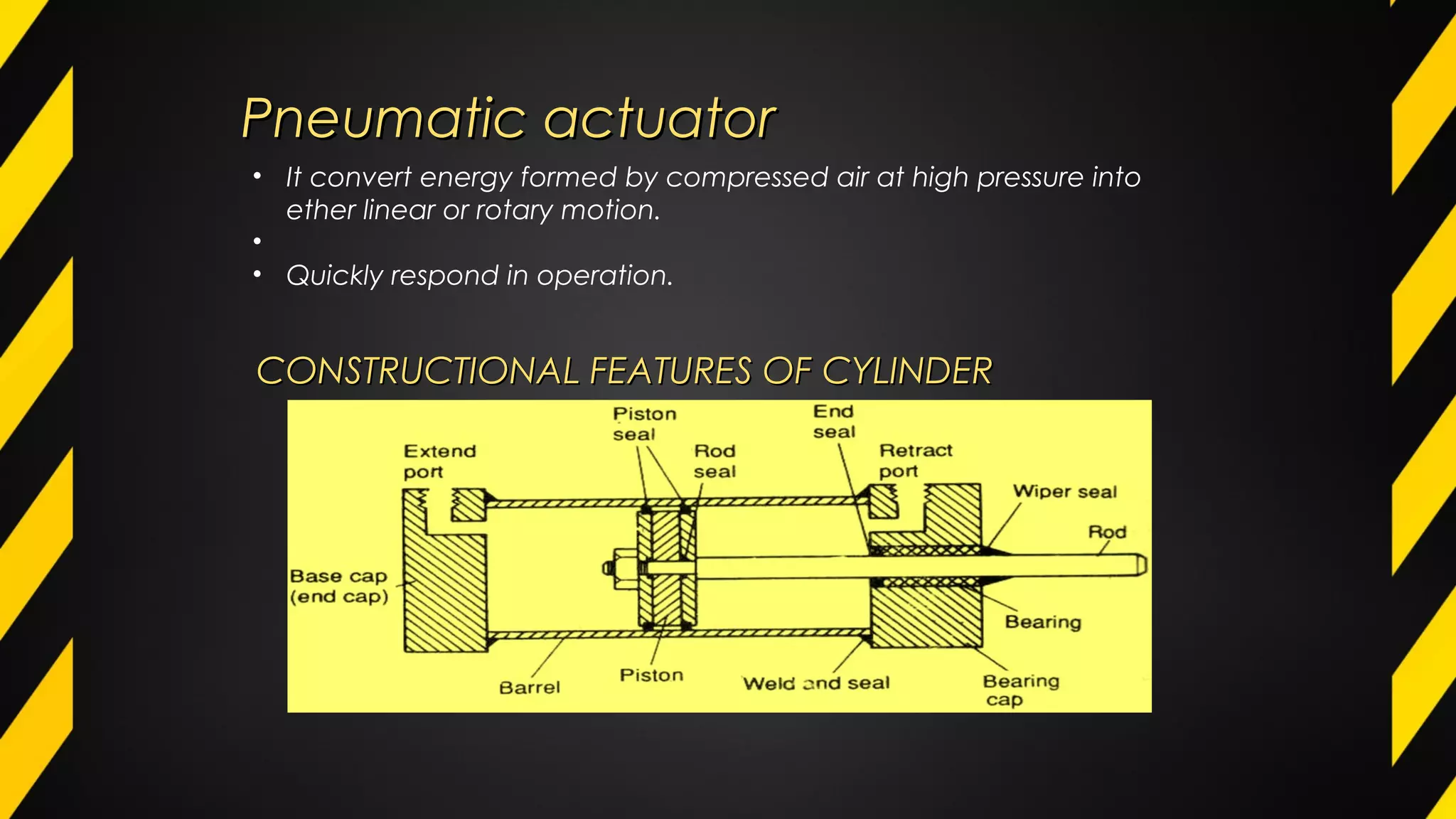
• It convert energy formed by compressed air at high pressure into
ether linear or rotary motion.
•
• Quickly respond in operation.
Pneumatic actuatorPneumatic actuator
CONSTRUCTIONAL FEATURES OF CYLINDERCONSTRUCTIONAL FEATURES OF CYLINDER
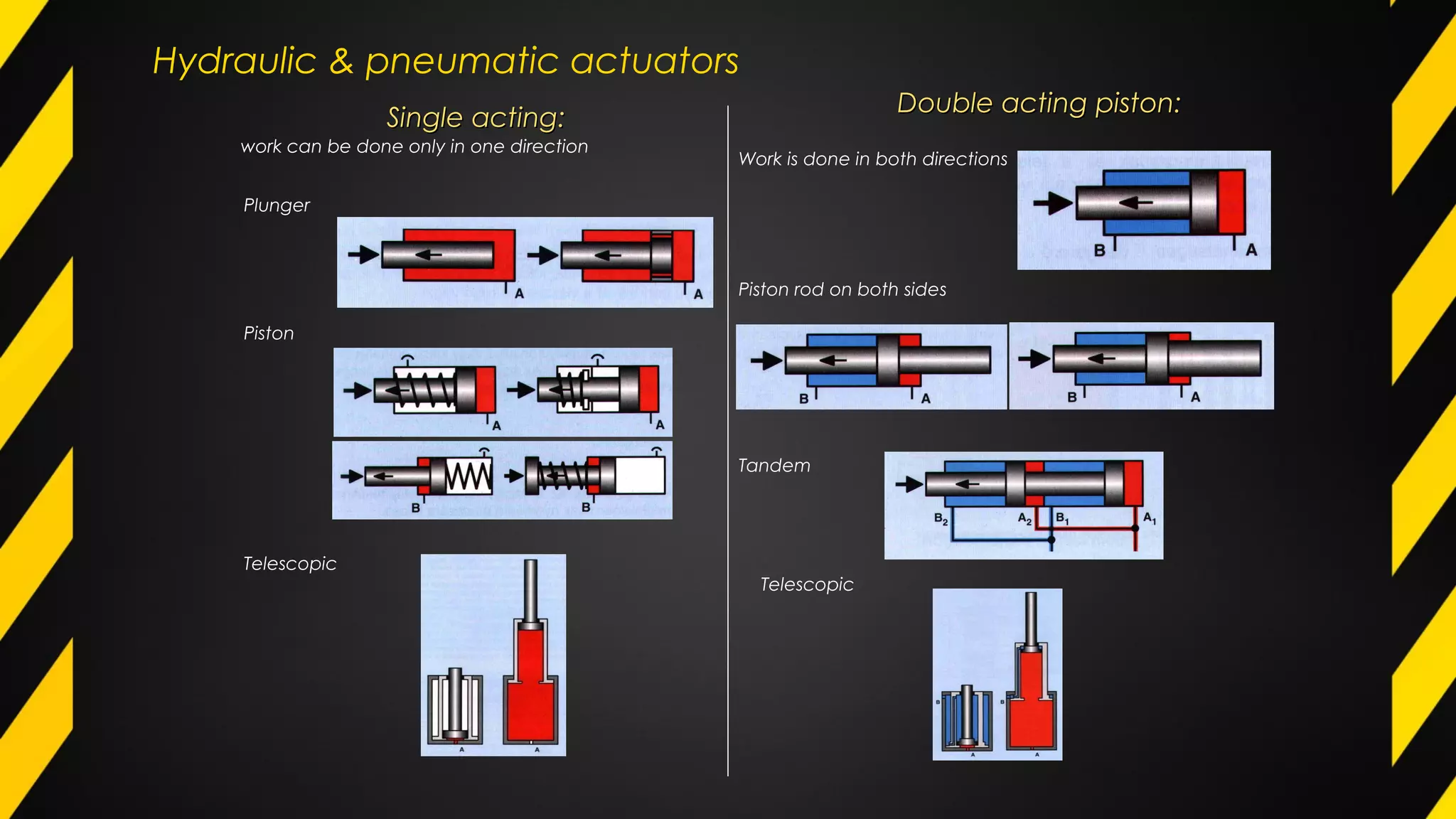
Hydraulic & pneumatic actuators
Single acting:Single acting:
work can be done only in one direction
Piston
Double actingDouble acting piston:piston:
Piston rod on both sides
Plunger
Work is done in both directions
Telescopic
Telescopic
Tandem
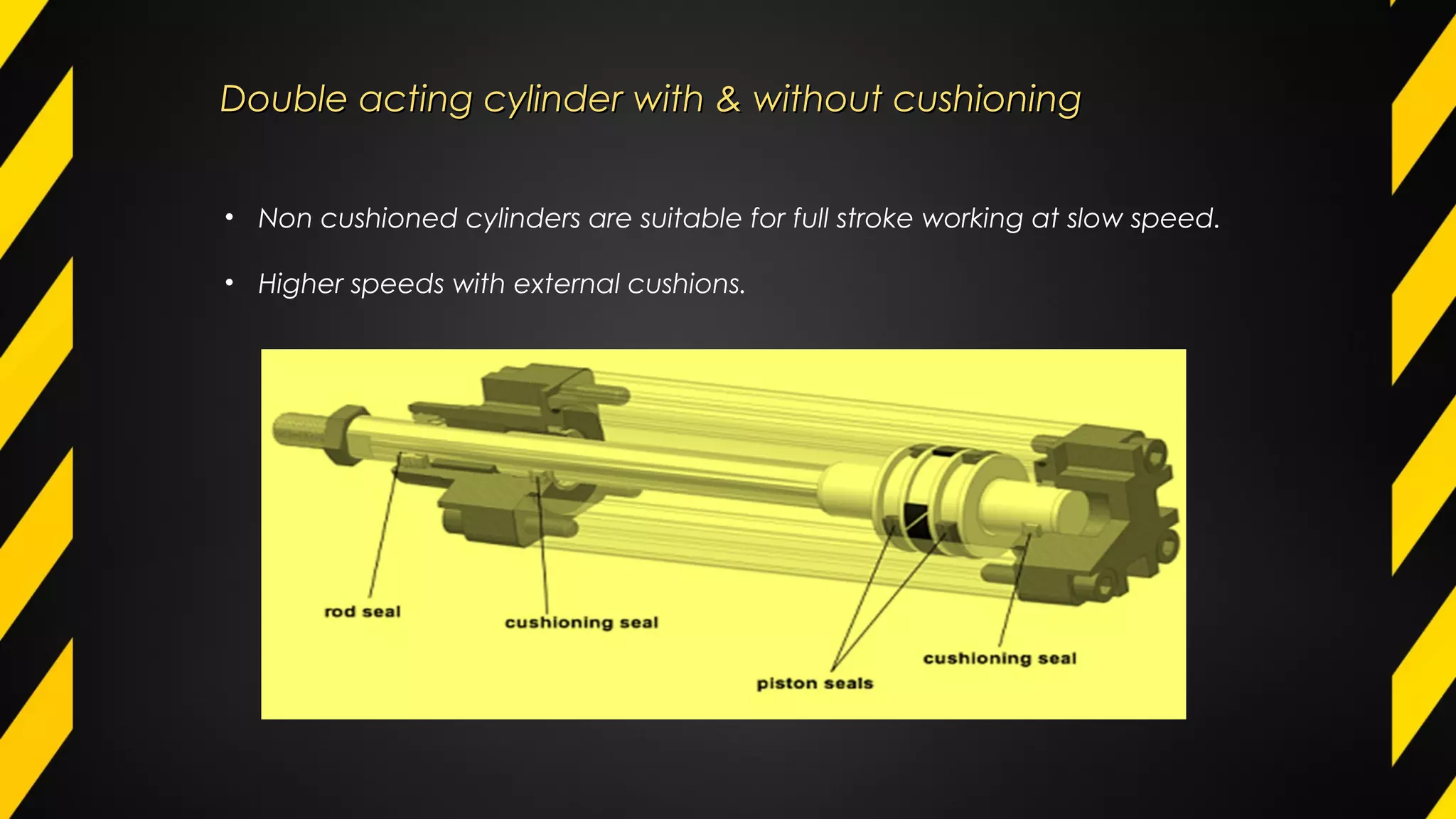
• Non cushioned cylinders are suitable for full stroke working at slow speed.
• Higher speeds with external cushions.
Double acting cylinder with & without cushioningDouble acting cylinder with & without cushioning
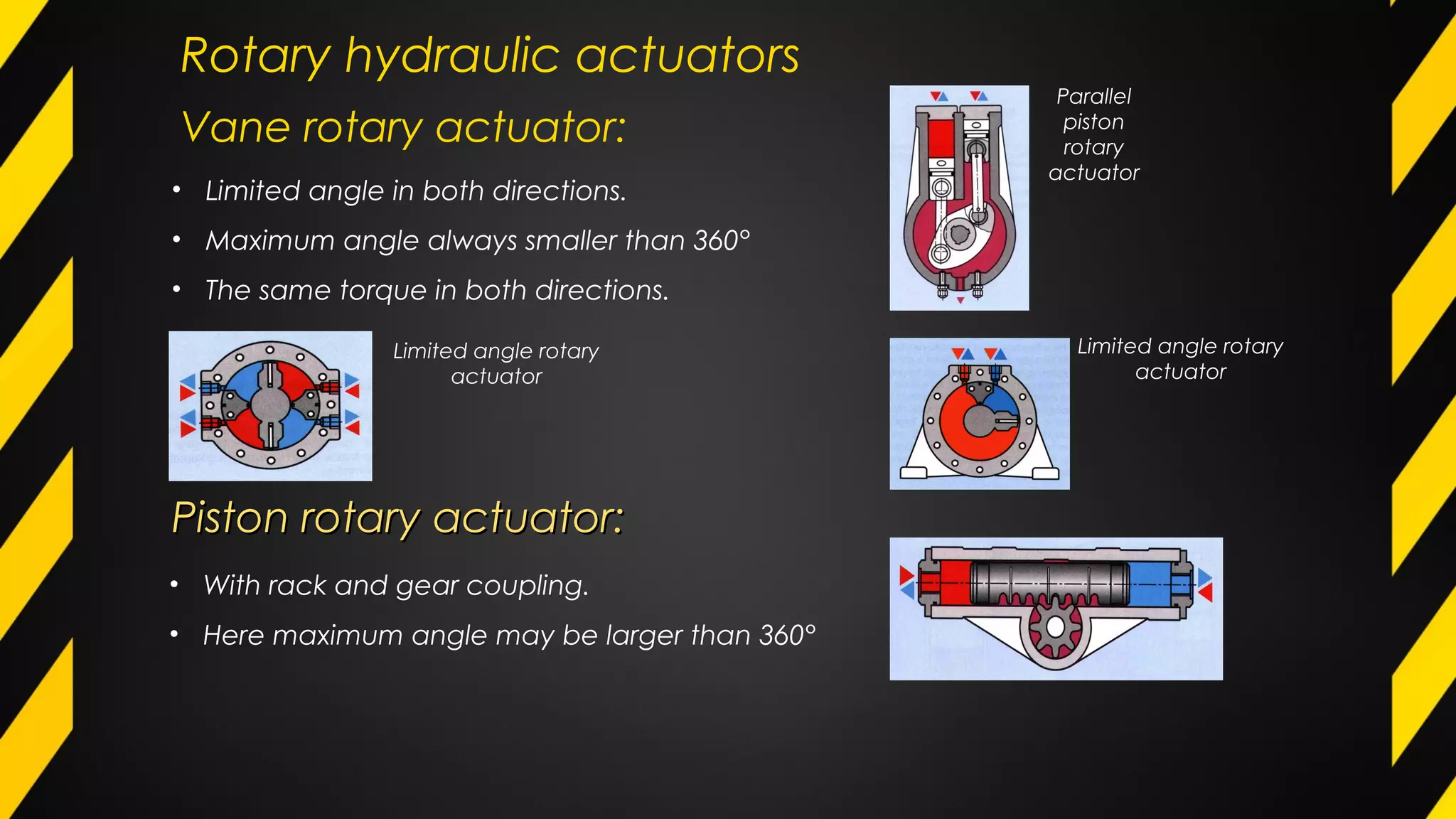
Rotary hydraulic actuators
Vane rotary actuator:
• Limited angle in both directions.
• Maximum angle always smaller than 360°
• The same torque in both directions.
Piston rotary actuator:Piston rotary actuator:
• With rack and gear coupling.
• Here maximum angle may be larger than 360°
Limited angle rotary
actuator
Limited angle rotary
actuator
Parallel
piston
rotary
actuator
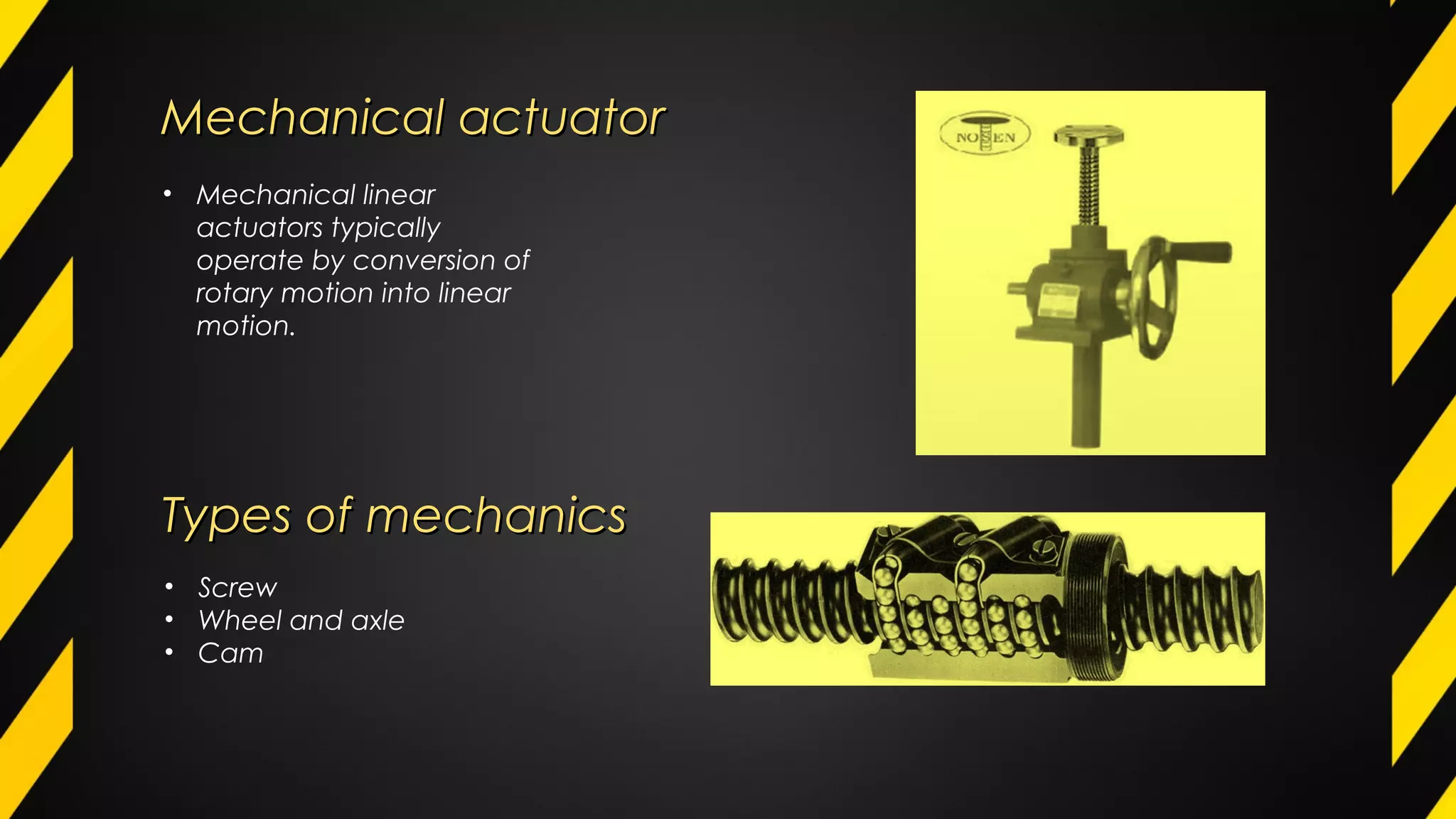
Mechanical actuatorMechanical actuator
• Mechanical linear
actuators typically
operate by conversion of
rotary motion into linear
motion.
Types of mechanicsTypes of mechanics
• Screw
• Wheel and axle
• Cam
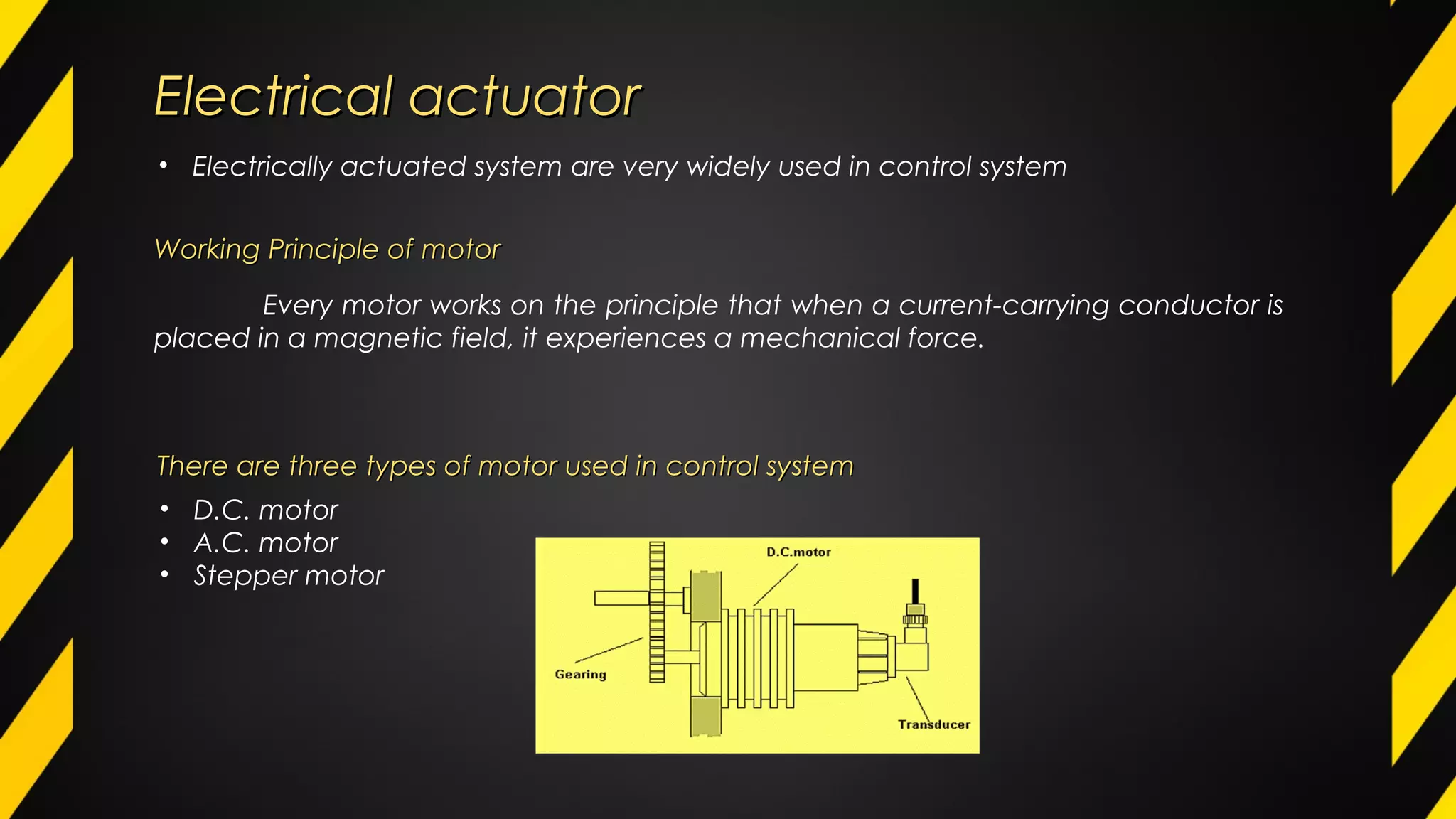
Electrical actuatorElectrical actuator
• Electrically actuated system are very widely used in control system
There are three types of motor used in control systemThere are three types of motor used in control system
• D.C. motor
• A.C. motor
• Stepper motor
Every motor works on the principle that when a current-carrying conductor is
placed in a magnetic field, it experiences a mechanical force.
Working Principle of motorWorking Principle of motor
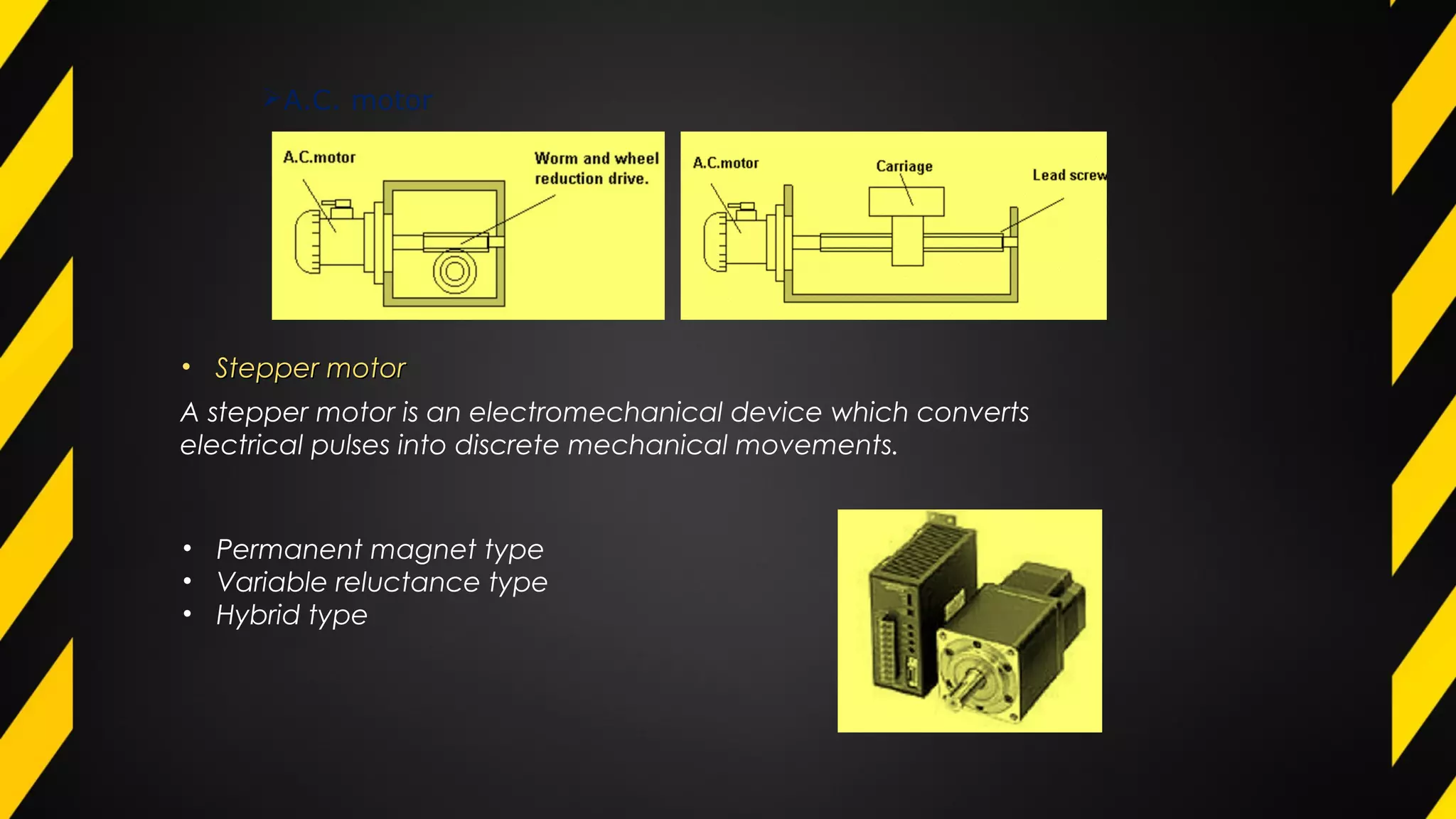
A.C. motor
• Stepper motorStepper motor
• Permanent magnet type
• Variable reluctance type
• Hybrid type
A stepper motor is an electromechanical device which converts
electrical pulses into discrete mechanical movements.
Piezoelectric actuatorsPiezoelectric actuators
• Pierre and Jacques Curie discovered the piezoelectric effect in 1880.
• The application of an electric field to a piezoelectric crystal leads to a physical
deformation of the crystal.
• Piezoelectric materials are: Quartz, Ceramics, PZT(lead zirconate titanade).
Advantages
•short response time.
•An ability to create high forces.
•A high efficiency and a high mechanical durability.
Disadvantage
•Have small strains. (0.1-.2%)
•High supply voltage needed.(60-1000V)
•Large hysteresis. (actuator doesn’t go back to exactly where it started).
ConfigurationConfiguration
• A piezo ceramic crystal is coated with silver on both sides.
• Glued to a brass, nickel alloy, or stainless steel disk.
• Brass:
• Commercial & industrial use.(not subjected to environment )
• Nickel alloy:
• Use where it subjected to environment.
• Stainless steel:
• Uses where it subjected to solvent, corrosive chemical,
• Underwater .
• Medical fields.
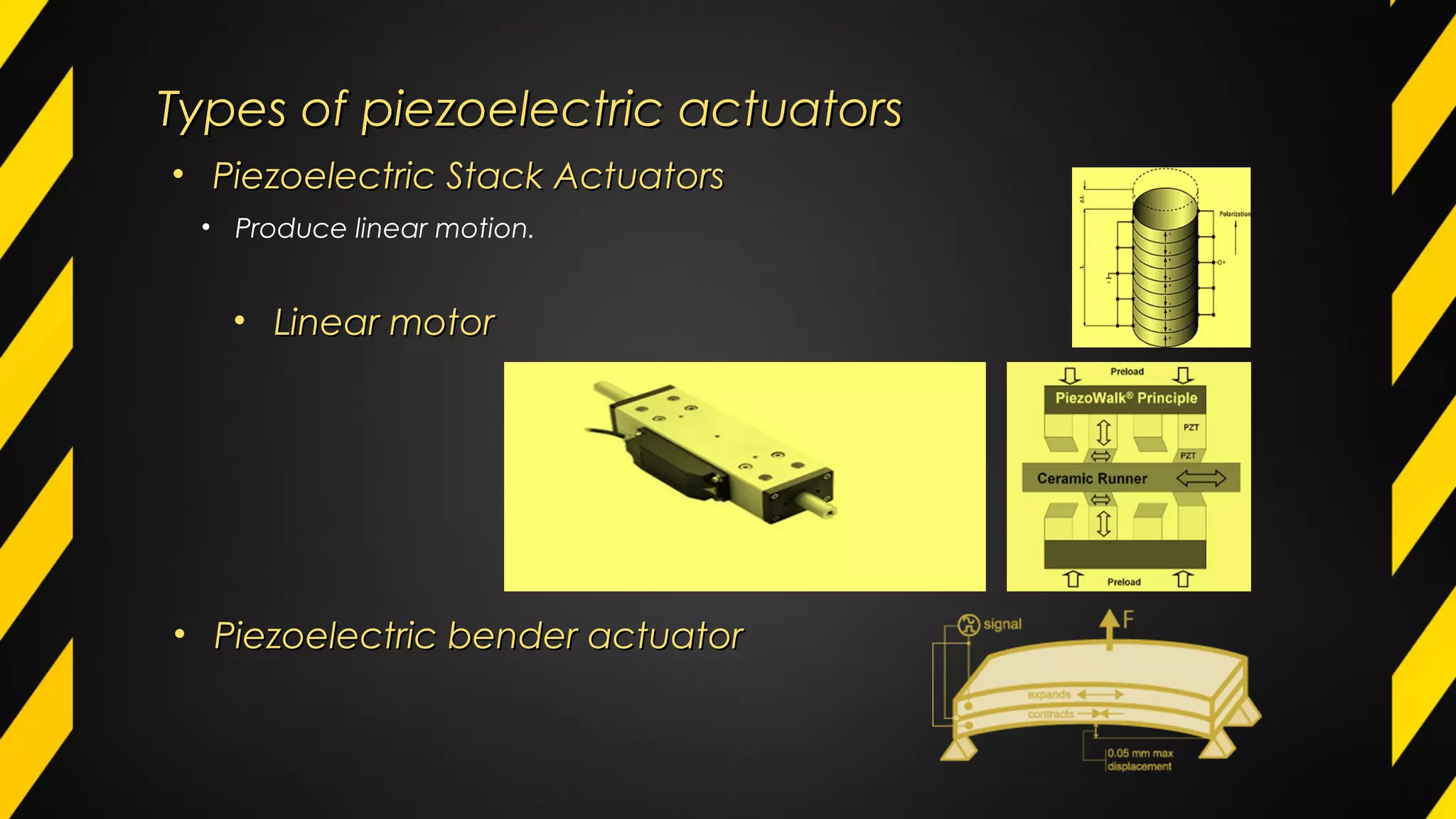
Types of piezoelectric actuatorsTypes of piezoelectric actuators
• Piezoelectric Stack ActuatorsPiezoelectric Stack Actuators
• Produce linear motion.
• Linear motorLinear motor
• Piezoelectric bender actuatorPiezoelectric bender actuator
Other type of actuatorOther type of actuator
Heaters
Used with temperature sensors And temperature controller to control the
temperature in automated molding equipment and in soldering operation.
Lights
Lights are used on almost all machines to indicate the machine state and provide
feedback to the operator.
• LED
• LCD’s
• Gas plasma display
• CRT
Sirens/Horns
Sirens or horns can be useful for unattended or dangerous machines to make
conditions well known.
Skillcruise.com

Fundamentals of an actuator

  • 1.
    Fundamentals of anactuatorFundamentals of an actuatorFundamentals of an actuatorFundamentals of an actuator
  • 2.
    What is anactuator?What is an actuator? • Actuators are devices used to produce action or motion. • Input(mainly electrical signal , air, fluids) • Electrical signal can be low power or high power. • Actuators output can be position or rate i. e. • linear displacement or velocity. • Actuation can be from few microns to few meters
  • 3.
    Actuator functional diagramActuatorfunctional diagram A Power amplification & modulation Energy conversion Control signal Actuator Output Unmodulate Energy source
  • 4.
    Types of actuators:Typesof actuators: • Hydraulic actuatorHydraulic actuator • Pneumatic actuatorPneumatic actuator • Mechanical actuatorMechanical actuator • Electrical actuatorElectrical actuator • Linear actuator: solenoid, Hydraulic/Pneumatic. • Rotary actuator: motor, Hydraulic/Pneumatic.
  • 5.
    SolenoidSolenoid • A solenoidis a coil wound into a tightly packed helix. • In physics, the term solenoid refers to a long, thin loop of wire, and wrapped around a metallic core which produces a magnetic field when an electric current is passed through it.
  • 6.
    ApplicationApplication • Pneumatic valve. •Car door openers. Solenoids controlled valvesSolenoids controlled valves Hydraulic cylinder Single pressure line
  • 7.
    Hydraulic actuator:Hydraulic actuator: •Hydraulic systems are used to control & transmit power. • A pump driven by prime mover (electric motor) creates flow of fluid Linear actuator (hydraulic cylinder) •Provides motion in straight line. •Linear displacement depends on stroke length. •Usually referred to as cylinders, rams (single acting cylinders) or jacks. Rotary actuators (Hydraulic motors) •Produces continuous rotational motion. •Pump shaft is rotated to generate flow. •A motor shaft is caused to rotate by fluid being forced into the driving chambers. Types of hydraulic actuatorTypes of hydraulic actuator
  • 8.
    Semi rotary actuatorsSemirotary actuators •Produces non-continuous rotational motion. •Limited to less than one revolution (<360°). •Used to produce oscillatory motions in mechanisms. ApplicationsApplications • Hydraulic jack. • Hydraulic brake. • Hydraulic ram. • Used as sensor. • Close loop velocity controlling. • Highly precise positioning for heavy loads.
  • 9.
    • It convertenergy formed by compressed air at high pressure into ether linear or rotary motion. • • Quickly respond in operation. Pneumatic actuatorPneumatic actuator CONSTRUCTIONAL FEATURES OF CYLINDERCONSTRUCTIONAL FEATURES OF CYLINDER
  • 10.
    Hydraulic & pneumaticactuators Single acting:Single acting: work can be done only in one direction Piston Double actingDouble acting piston:piston: Piston rod on both sides Plunger Work is done in both directions Telescopic Telescopic Tandem
  • 11.
    • Non cushionedcylinders are suitable for full stroke working at slow speed. • Higher speeds with external cushions. Double acting cylinder with & without cushioningDouble acting cylinder with & without cushioning
  • 12.
    Rotary hydraulic actuators Vanerotary actuator: • Limited angle in both directions. • Maximum angle always smaller than 360° • The same torque in both directions. Piston rotary actuator:Piston rotary actuator: • With rack and gear coupling. • Here maximum angle may be larger than 360° Limited angle rotary actuator Limited angle rotary actuator Parallel piston rotary actuator
  • 13.
    Mechanical actuatorMechanical actuator •Mechanical linear actuators typically operate by conversion of rotary motion into linear motion. Types of mechanicsTypes of mechanics • Screw • Wheel and axle • Cam
  • 14.
    Electrical actuatorElectrical actuator •Electrically actuated system are very widely used in control system There are three types of motor used in control systemThere are three types of motor used in control system • D.C. motor • A.C. motor • Stepper motor Every motor works on the principle that when a current-carrying conductor is placed in a magnetic field, it experiences a mechanical force. Working Principle of motorWorking Principle of motor
  • 15.
    A.C. motor • SteppermotorStepper motor • Permanent magnet type • Variable reluctance type • Hybrid type A stepper motor is an electromechanical device which converts electrical pulses into discrete mechanical movements.
  • 16.
    Piezoelectric actuatorsPiezoelectric actuators •Pierre and Jacques Curie discovered the piezoelectric effect in 1880. • The application of an electric field to a piezoelectric crystal leads to a physical deformation of the crystal. • Piezoelectric materials are: Quartz, Ceramics, PZT(lead zirconate titanade). Advantages •short response time. •An ability to create high forces. •A high efficiency and a high mechanical durability. Disadvantage •Have small strains. (0.1-.2%) •High supply voltage needed.(60-1000V) •Large hysteresis. (actuator doesn’t go back to exactly where it started).
  • 17.
    ConfigurationConfiguration • A piezoceramic crystal is coated with silver on both sides. • Glued to a brass, nickel alloy, or stainless steel disk. • Brass: • Commercial & industrial use.(not subjected to environment ) • Nickel alloy: • Use where it subjected to environment. • Stainless steel: • Uses where it subjected to solvent, corrosive chemical, • Underwater . • Medical fields.
  • 18.
    Types of piezoelectricactuatorsTypes of piezoelectric actuators • Piezoelectric Stack ActuatorsPiezoelectric Stack Actuators • Produce linear motion. • Linear motorLinear motor • Piezoelectric bender actuatorPiezoelectric bender actuator
  • 19.
    Other type ofactuatorOther type of actuator Heaters Used with temperature sensors And temperature controller to control the temperature in automated molding equipment and in soldering operation. Lights Lights are used on almost all machines to indicate the machine state and provide feedback to the operator. • LED • LCD’s • Gas plasma display • CRT Sirens/Horns Sirens or horns can be useful for unattended or dangerous machines to make conditions well known.
  • 20.