Types of Wood Joints

   Prepared by: Lim, Mary Wynne Ann S.
                   BSED – TLE3W1
Dowel Joint
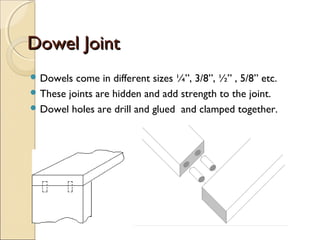
 Dowels  come in different sizes ¼”, 3/8”, ½” , 5/8” etc.
 These joints are hidden and add strength to the joint.
 Dowel holes are drill and glued and clamped together.
Dado
•   Dado's are typically used in making book shelves,
    they support the shelf without the benefit of any
    additional fasteners, any glue or hardware simply
    holds the shelf in place.
•   Dados may be made with a dado blade on a table
    saw
Rabbet Joint
This type of joint is made by using the
 dado blade.
Each side of wood is cut to a specific
 length, then glued or brad nailed to make a
 stronger joint.
Lap Joint
A  lap joint is when two piece are cut on a
 dado and glued or nail together to create a
 stronger joint.
Dovetail Joints
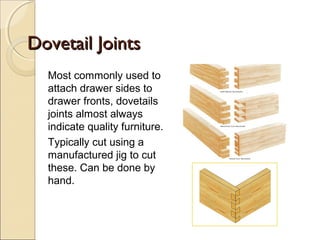
  Most commonly used to
  attach drawer sides to
  drawer fronts, dovetails
  joints almost always
  indicate quality furniture.
  Typically cut using a
  manufactured jig to cut
  these. Can be done by
  hand.
Mortise and Tenon
•   The mortise and tenon joint is one of the
    strongest wood joints.
•   Mortise and tenon joint is normally formed by cutting
    a square tongue (the tenon) on the end of one piece
    of wood and an equal size square hole or slot (the
    mortise) in another.
Mitre with Wood Spline
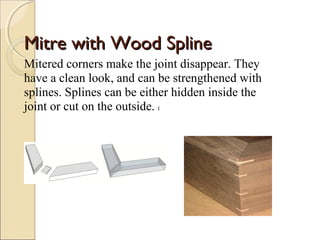
Mitered corners make the joint disappear. They
have a clean look, and can be strengthened with
splines. Splines can be either hidden inside the
joint or cut on the outside. I
Tongue and Groove
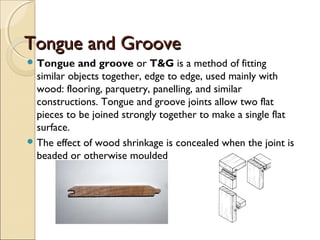
 Tongue    and groove or T&G is a method of fitting
  similar objects together, edge to edge, used mainly with
  wood: flooring, parquetry, panelling, and similar
  constructions. Tongue and groove joints allow two flat
  pieces to be joined strongly together to make a single flat
  surface.
 The effect of wood shrinkage is concealed when the joint is
  beaded or otherwise moulded
Types of-wood-joints

Types of-wood-joints

  • 1.
    Types of WoodJoints Prepared by: Lim, Mary Wynne Ann S. BSED – TLE3W1
  • 3.
    Dowel Joint  Dowels come in different sizes ¼”, 3/8”, ½” , 5/8” etc.  These joints are hidden and add strength to the joint.  Dowel holes are drill and glued and clamped together.
  • 4.
    Dado • Dado's are typically used in making book shelves, they support the shelf without the benefit of any additional fasteners, any glue or hardware simply holds the shelf in place. • Dados may be made with a dado blade on a table saw
  • 5.
    Rabbet Joint This typeof joint is made by using the dado blade. Each side of wood is cut to a specific length, then glued or brad nailed to make a stronger joint.
  • 6.
    Lap Joint A lap joint is when two piece are cut on a dado and glued or nail together to create a stronger joint.
  • 7.
    Dovetail Joints Most commonly used to attach drawer sides to drawer fronts, dovetails joints almost always indicate quality furniture. Typically cut using a manufactured jig to cut these. Can be done by hand.
  • 8.
    Mortise and Tenon • The mortise and tenon joint is one of the strongest wood joints. • Mortise and tenon joint is normally formed by cutting a square tongue (the tenon) on the end of one piece of wood and an equal size square hole or slot (the mortise) in another.
  • 9.
    Mitre with WoodSpline Mitered corners make the joint disappear. They have a clean look, and can be strengthened with splines. Splines can be either hidden inside the joint or cut on the outside. I
  • 10.
    Tongue and Groove Tongue and groove or T&G is a method of fitting similar objects together, edge to edge, used mainly with wood: flooring, parquetry, panelling, and similar constructions. Tongue and groove joints allow two flat pieces to be joined strongly together to make a single flat surface.  The effect of wood shrinkage is concealed when the joint is beaded or otherwise moulded