INDUSTRIAL TECHNOLOGY-
BUILDING AND FURNITURE
DESIGN
FURNITURE TECHNOLOGY
FEATURES OF FURNITURE TECHNOLOGY
LESSON OBJECTIVE
At the end of this lesson students will be able to
differentiate between the different features of
furniture technology over the 16th, 17th and 19th to
21st Century.
Students are required to take notes throughout the lesson
QUESTION?
What do you think are the different styles/features
of furniture design?
WHAT IS FURNITURE ?
Furniture are objects of applied arts intended for mobile and
permanent furnishing of residential interiors. Among other things, it
serves for storage, work, eating, sitting, lying down, sleeping and
relaxing. Furniture can be used individually, in suites or sets.
WHAT ARE THE DIFFERENT TYPES OF FURNITURE
FEATURES?
Furniture belongs to the group of objects of applied arts, and many of
them have similar structural, technological, functional, operational and
aesthetic features.
Main Groups of Furniture
• Furniture According to Their Purpose
• Furniture According to Their Functionality
• Furniture According to Their Form and Construction
THIS LESSON WILL FOCUS ON FURNITURE
ACCORDING TO THEIR FORM AND CONSTRUCTION
What do you think are some of the different
features/styles related to furniture form and
construction?
DIFFERENT TYPES
OF FURNITURE FEATURES/STYLES
16th Century:
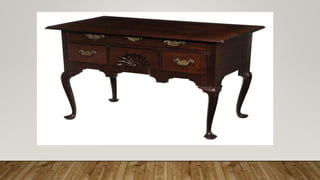
Queen Anne: Furniture crafted in the Queen Anne style dates from the 1720s to
approximately 1750 in England, although the ruler it is named after died in 1714. In the
United States production ran longer, right up to 1800 or so. Marking a shift toward
elegance and refinement in American furniture manufactureing, Queen Anne style pieces
were the first to incorporate the curving cabriole leg. Most pieces, even pedestal accent
tables and bed frames, featured a cabriole-shaped leg even if on a shorter scale than those
used on chairs and tables.
DIFFERENT TYPES
OF FURNITURE FEATURES/STYLES CONT.
16th Century:
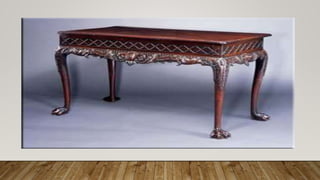
Georgian: This furniture style was during the reign of George I,
George II, George III in Great Britain. The most important change that
occurred in the furniture in Georgian style was the replacement
of walnut, by mahogany. The legs are elaborately carved terminating
in a pad or ball-and-claw foot.
DIFFERENT TYPES
OF FURNITURE FEATURES/STYLES CONT.
17th Century:
Victorian: Throughout history Queen Victoria identified herself with the
middle class. Therefore the furniture of this period was made for an ever-
increasing middle class population. The early part of this period saw machines
beginning to replace hand labor, the beginning of the industrial age.
This period created a large gap between the designer and the craftsmen. The
factories had changed, the designers no longer had direct contact with the
customer.
DIFFERENT TYPES
OF FURNITURE FEATURES/STYLES
17th Century:
Victorian: The demand for furniture was high, the factories were manufacturing at a
fast pace, and a frantic rush for the designers to keep ahead of each other created poor
quality design.
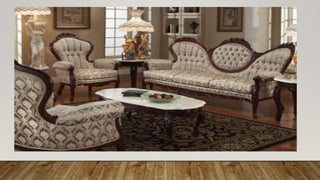
Features of Victorian Furniture
• Cumbersome furniture, dust catching carving.
• Buttoned upholstery – armchairs frequently with low arms scrolled at the front.
• Balloon back chairs and spoon back.
• Thonet’s steam bent chair.
DIFFERENT TYPES
OF FURNITURE FEATURES/STYLES CONT.
19 – 21st Century (Contemporary):
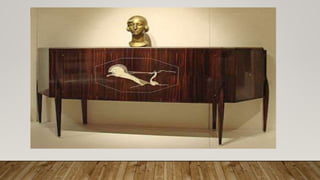
Art deco: was an art and design style popular in the 1920s and 1930s, began in
Paris as a result of a large decorative arts exhibition in 1925. It quickly spread all
over the world where it found use in fine art, architecture, fashion design and
decorative arts. Art Deco works featured new materials like chrome, Bakelite (a
type of plastic), chrome and plate glass, as well as costly materials like ivory,
mahogany and dark lacquered surfaces. Lacquering was a process that coated
materials like wood with many layers of resins to create hard shiny surfaces.
DIFFERENT TYPES
OF FURNITURE FEATURES/STYLES CONT.
19 – 21st Century (Contemporary):
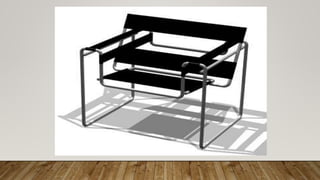
Bauhaus: The Bauhaus was a design school Germany created in 1919 and shut
down in 1933. The forms in the Bauhaus furniture are frequently simple and
light without decorative additive just following the needs of the consumer.
Used are: steel, glass, bent wood, leathers and plastic. The most attentive
colors are: generally black, white, brown, grey and chromium.
DIFFERENT TYPES
OF FURNITURE FEATURES/STYLES CONT.
19 – 21st Century (Contemporary):
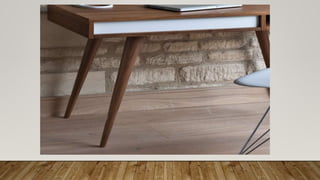
Tapered and Carved legs and components:
Tapered: One of the defining features of mid-Century furniture is the wooden tapered
legs that were so common for the furniture designs of their time. However, this style
dates back much further… this has been a practice of furniture makers since ancient
times. Tapering is a gradual thinning in thickness as legs get closer to the floor, often
round in shape which creates a very elegant, yet strong design that can support the
furniture whilst keeping the view clear underneath the furniture.
DIFFERENT TYPES
OF FURNITURE FEATURES/STYLES CONT.
19 – 21st Century (Contemporary):
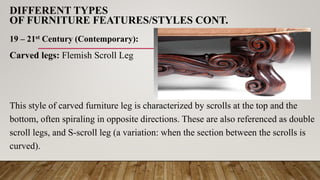
Carved legs: Flemish Scroll Leg
This style of carved furniture leg is characterized by scrolls at the top and the
bottom, often spiraling in opposite directions. These are also referenced as double
scroll legs, and S-scroll leg (a variation: when the section between the scrolls is
curved).
DIFFERENT TYPES
OF FURNITURE FEATURES/STYLES CONT.
19 – 21st Century (Contemporary):
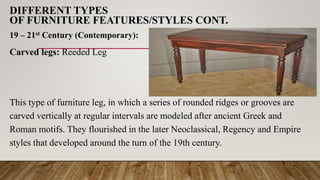
Carved legs: Reeded Leg
This type of furniture leg, in which a series of rounded ridges or grooves are
carved vertically at regular intervals are modeled after ancient Greek and
Roman motifs. They flourished in the later Neoclassical, Regency and Empire
styles that developed around the turn of the 19th century.
DIFFERENT TYPES
OF FURNITURE FEATURES/STYLES CONT.
19 – 21st Century (Contemporary):
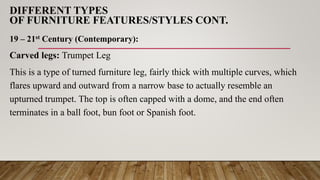
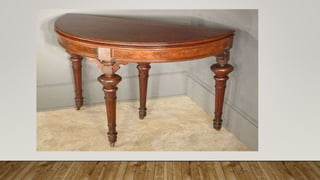
Carved legs: Trumpet Leg
This is a type of turned furniture leg, fairly thick with multiple curves, which
flares upward and outward from a narrow base to actually resemble an
upturned trumpet. The top is often capped with a dome, and the end often
terminates in a ball foot, bun foot or Spanish foot.
QUESTIONS?
What furniture features/styles were prominent in the 16th and 17th
century?
What is the purposes of their being different features and styles of
furniture design?
RECAP/QUESTIONS ASKED BY STUDENTS
EVALUATION
Students are asked to accurately list and describe at least four of the
different styles/features of Furniture Technology relating to its form
and construction.
Notes acquired during the lesson can be used.

Furniture Design

  • 1.
    INDUSTRIAL TECHNOLOGY- BUILDING ANDFURNITURE DESIGN FURNITURE TECHNOLOGY FEATURES OF FURNITURE TECHNOLOGY
  • 2.
    LESSON OBJECTIVE At theend of this lesson students will be able to differentiate between the different features of furniture technology over the 16th, 17th and 19th to 21st Century. Students are required to take notes throughout the lesson
  • 3.
    QUESTION? What do youthink are the different styles/features of furniture design?
  • 4.
    WHAT IS FURNITURE? Furniture are objects of applied arts intended for mobile and permanent furnishing of residential interiors. Among other things, it serves for storage, work, eating, sitting, lying down, sleeping and relaxing. Furniture can be used individually, in suites or sets.
  • 5.
    WHAT ARE THEDIFFERENT TYPES OF FURNITURE FEATURES? Furniture belongs to the group of objects of applied arts, and many of them have similar structural, technological, functional, operational and aesthetic features. Main Groups of Furniture • Furniture According to Their Purpose • Furniture According to Their Functionality • Furniture According to Their Form and Construction
  • 6.
    THIS LESSON WILLFOCUS ON FURNITURE ACCORDING TO THEIR FORM AND CONSTRUCTION What do you think are some of the different features/styles related to furniture form and construction?
  • 7.
    DIFFERENT TYPES OF FURNITUREFEATURES/STYLES 16th Century: Queen Anne: Furniture crafted in the Queen Anne style dates from the 1720s to approximately 1750 in England, although the ruler it is named after died in 1714. In the United States production ran longer, right up to 1800 or so. Marking a shift toward elegance and refinement in American furniture manufactureing, Queen Anne style pieces were the first to incorporate the curving cabriole leg. Most pieces, even pedestal accent tables and bed frames, featured a cabriole-shaped leg even if on a shorter scale than those used on chairs and tables.
  • 9.
    DIFFERENT TYPES OF FURNITUREFEATURES/STYLES CONT. 16th Century: Georgian: This furniture style was during the reign of George I, George II, George III in Great Britain. The most important change that occurred in the furniture in Georgian style was the replacement of walnut, by mahogany. The legs are elaborately carved terminating in a pad or ball-and-claw foot.
  • 11.
    DIFFERENT TYPES OF FURNITUREFEATURES/STYLES CONT. 17th Century: Victorian: Throughout history Queen Victoria identified herself with the middle class. Therefore the furniture of this period was made for an ever- increasing middle class population. The early part of this period saw machines beginning to replace hand labor, the beginning of the industrial age. This period created a large gap between the designer and the craftsmen. The factories had changed, the designers no longer had direct contact with the customer.
  • 12.
    DIFFERENT TYPES OF FURNITUREFEATURES/STYLES 17th Century: Victorian: The demand for furniture was high, the factories were manufacturing at a fast pace, and a frantic rush for the designers to keep ahead of each other created poor quality design. Features of Victorian Furniture • Cumbersome furniture, dust catching carving. • Buttoned upholstery – armchairs frequently with low arms scrolled at the front. • Balloon back chairs and spoon back. • Thonet’s steam bent chair.
  • 14.
    DIFFERENT TYPES OF FURNITUREFEATURES/STYLES CONT. 19 – 21st Century (Contemporary): Art deco: was an art and design style popular in the 1920s and 1930s, began in Paris as a result of a large decorative arts exhibition in 1925. It quickly spread all over the world where it found use in fine art, architecture, fashion design and decorative arts. Art Deco works featured new materials like chrome, Bakelite (a type of plastic), chrome and plate glass, as well as costly materials like ivory, mahogany and dark lacquered surfaces. Lacquering was a process that coated materials like wood with many layers of resins to create hard shiny surfaces.
  • 16.
    DIFFERENT TYPES OF FURNITUREFEATURES/STYLES CONT. 19 – 21st Century (Contemporary): Bauhaus: The Bauhaus was a design school Germany created in 1919 and shut down in 1933. The forms in the Bauhaus furniture are frequently simple and light without decorative additive just following the needs of the consumer. Used are: steel, glass, bent wood, leathers and plastic. The most attentive colors are: generally black, white, brown, grey and chromium.
  • 18.
    DIFFERENT TYPES OF FURNITUREFEATURES/STYLES CONT. 19 – 21st Century (Contemporary): Tapered and Carved legs and components: Tapered: One of the defining features of mid-Century furniture is the wooden tapered legs that were so common for the furniture designs of their time. However, this style dates back much further… this has been a practice of furniture makers since ancient times. Tapering is a gradual thinning in thickness as legs get closer to the floor, often round in shape which creates a very elegant, yet strong design that can support the furniture whilst keeping the view clear underneath the furniture.
  • 20.
    DIFFERENT TYPES OF FURNITUREFEATURES/STYLES CONT. 19 – 21st Century (Contemporary): Carved legs: Flemish Scroll Leg This style of carved furniture leg is characterized by scrolls at the top and the bottom, often spiraling in opposite directions. These are also referenced as double scroll legs, and S-scroll leg (a variation: when the section between the scrolls is curved).
  • 21.
    DIFFERENT TYPES OF FURNITUREFEATURES/STYLES CONT. 19 – 21st Century (Contemporary): Carved legs: Reeded Leg This type of furniture leg, in which a series of rounded ridges or grooves are carved vertically at regular intervals are modeled after ancient Greek and Roman motifs. They flourished in the later Neoclassical, Regency and Empire styles that developed around the turn of the 19th century.
  • 22.
    DIFFERENT TYPES OF FURNITUREFEATURES/STYLES CONT. 19 – 21st Century (Contemporary): Carved legs: Trumpet Leg This is a type of turned furniture leg, fairly thick with multiple curves, which flares upward and outward from a narrow base to actually resemble an upturned trumpet. The top is often capped with a dome, and the end often terminates in a ball foot, bun foot or Spanish foot.
  • 24.
    QUESTIONS? What furniture features/styleswere prominent in the 16th and 17th century? What is the purposes of their being different features and styles of furniture design?
  • 25.
  • 26.
    EVALUATION Students are askedto accurately list and describe at least four of the different styles/features of Furniture Technology relating to its form and construction. Notes acquired during the lesson can be used.