WORKING CAPITAL MANAGEMENT
Dr. Mohamed Kutty Kakkakunnan
Associate Professor
P.G. Dept. of Commerce
NAM College Kallikkandy
Kannur - Kerala – India
CONCEPTS OF WORKING CAPITAL
A. Gross Working Capital
Total investment in current assets
B. Net Working Capital
Difference between current assets and current
liabilities (Current Assets - Current Liabilities)
Positive Working Capital And Negative Working Capital
(Positive when CA>CL and negative when CA<CL)
Two concepts have equal significance
Gross working capital – adequacy / inadequacy of working
capital
Net working capital – liquidity and sources of funds or mix
of funds for financing working capital (short term sources
and long term sources)
COMPONENTS OF WORKING CAPITAL
Current Assets And Current Liabilities
Kinds of working capital
a. Permanent or fixed working capital
Business is a continuous process and thus, to carry on its
operations continuously and smoothly it require minimum
investment in current assets. This minimum investment in CA.
The minimum amount of working capital (CA) required to
carry on business during the dullest period.
b. Variable or fluctuating or seasonal or temporary
Working capital required to meet the varying or changing
production and business conditions or to meet seasonal
demand of customers.
Sources of funds for working capital
a. Fixed working capital
b. Variable working capital
Both concepts have equal importance
Fixed working capital = long term sources
Variable working capital = short term sources
Depends upon the financial policy and risk
perspective of management
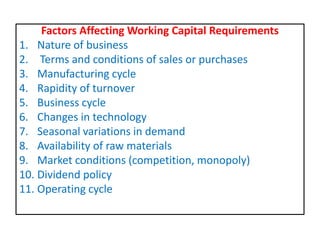
Factors Affecting Working Capital Requirements
1. Nature of business
2. Terms and conditions of sales or purchases
3. Manufacturing cycle
4. Rapidity of turnover
5. Business cycle
6. Changes in technology
7. Seasonal variations in demand
8. Availability of raw materials
9. Market conditions (competition, monopoly)
10. Dividend policy
11. Operating cycle
O P E R AT I N G C Y C L E
Gross working capital – amount invested in currents
assets (meaning and definition)
Assets that can be converted into cash within a short
span of time (within an operating cycle)
The period required to convert cash into cash (conversion
period)
Trading concern: Cash → inventories →debtors →cash
Manufacturing concerns
Cash → raw materials → WIP → Finished goods →
debtors/receivables → cash
Working capital requirements depends upon operating
cycle – the longer, the more working capital
Depends upon the briskness or speed with which the
business if carried on
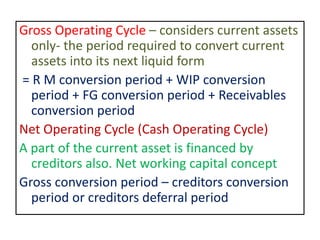
Gross Operating Cycle – considers current assets
only- the period required to convert current
assets into its next liquid form
= R M conversion period + WIP conversion
period + FG conversion period + Receivables
conversion period
Net Operating Cycle (Cash Operating Cycle)
A part of the current asset is financed by
creditors also. Net working capital concept
Gross conversion period – creditors conversion
period or creditors deferral period
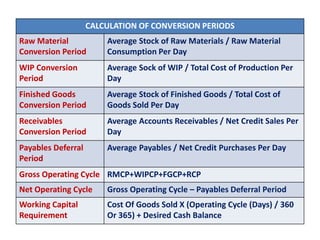
CALCULATION OF CONVERSION PERIODS
Raw Material
Conversion Period
Average Stock of Raw Materials / Raw Material
Consumption Per Day
WIP Conversion
Period
Average Sock of WIP / Total Cost of Production Per
Day
Finished Goods
Conversion Period
Average Stock of Finished Goods / Total Cost of
Goods Sold Per Day
Receivables
Conversion Period
Average Accounts Receivables / Net Credit Sales Per
Day
Payables Deferral
Period
Average Payables / Net Credit Purchases Per Day
Gross Operating Cycle RMCP+WIPCP+FGCP+RCP
Net Operating Cycle Gross Operating Cycle – Payables Deferral Period
Working Capital
Requirement
Cost Of Goods Sold X (Operating Cycle (Days) / 360
Or 365) + Desired Cash Balance
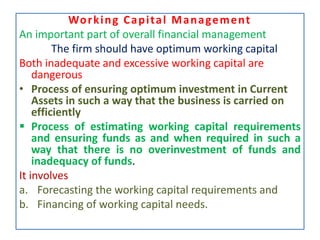
Working Capital Management
An important part of overall financial management
The firm should have optimum working capital
Both inadequate and excessive working capital are
dangerous
• Process of ensuring optimum investment in Current
Assets in such a way that the business is carried on
efficiently
 Process of estimating working capital requirements
and ensuring funds as and when required in such a
way that there is no overinvestment of funds and
inadequacy of funds.
It involves
a. Forecasting the working capital requirements and
b. Financing of working capital needs.
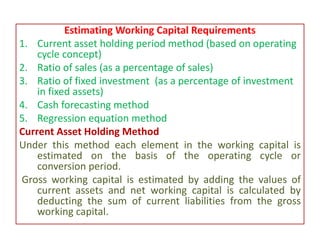
Estimating Working Capital Requirements
1. Current asset holding period method (based on operating
cycle concept)
2. Ratio of sales (as a percentage of sales)
3. Ratio of fixed investment (as a percentage of investment
in fixed assets)
4. Cash forecasting method
5. Regression equation method
Current Asset Holding Method
Under this method each element in the working capital is
estimated on the basis of the operating cycle or
conversion period.
Gross working capital is estimated by adding the values of
current assets and net working capital is calculated by
deducting the sum of current liabilities from the gross
working capital.
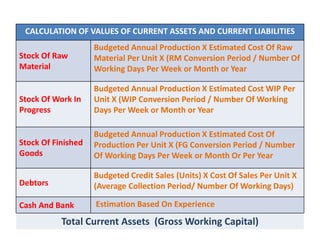
CALCULATION OF VALUES OF CURRENT ASSETS AND CURRENT LIABILITIES
Stock Of Raw
Material
Budgeted Annual Production X Estimated Cost Of Raw
Material Per Unit X (RM Conversion Period / Number Of
Working Days Per Week or Month or Year
Stock Of Work In
Progress
Budgeted Annual Production X Estimated Cost WIP Per
Unit X (WIP Conversion Period / Number Of Working
Days Per Week or Month or Year
Stock Of Finished
Goods
Budgeted Annual Production X Estimated Cost Of
Production Per Unit X (FG Conversion Period / Number
Of Working Days Per Week or Month Or Per Year
Debtors
Budgeted Credit Sales (Units) X Cost Of Sales Per Unit X
(Average Collection Period/ Number Of Working Days)
Cash And Bank Estimation Based On Experience
Total Current Assets (Gross Working Capital)
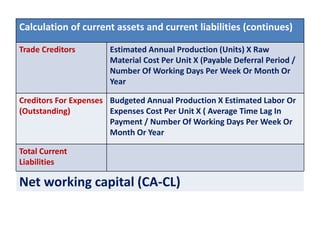
Calculation of current assets and current liabilities (continues)
Trade Creditors Estimated Annual Production (Units) X Raw
Material Cost Per Unit X (Payable Deferral Period /
Number Of Working Days Per Week Or Month Or
Year
Creditors For Expenses
(Outstanding)
Budgeted Annual Production X Estimated Labor Or
Expenses Cost Per Unit X ( Average Time Lag In
Payment / Number Of Working Days Per Week Or
Month Or Year
Total Current
Liabilities
Net working capital (CA-CL)
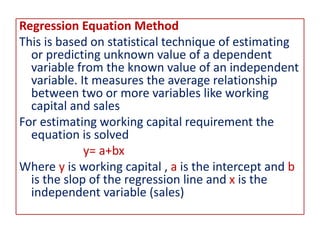
Regression Equation Method
This is based on statistical technique of estimating
or predicting unknown value of a dependent
variable from the known value of an independent
variable. It measures the average relationship
between two or more variables like working
capital and sales
For estimating working capital requirement the
equation is solved
y= a+bx
Where y is working capital , a is the intercept and b
is the slop of the regression line and x is the
independent variable (sales)
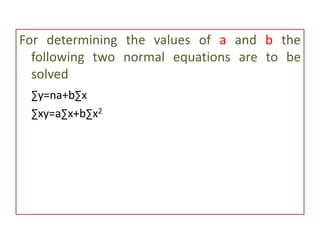
For determining the values of a and b the
following two normal equations are to be
solved
∑y=na+b∑x
∑xy=a∑x+b∑x2
Policies of Financing Current Assets
Sources of funds
1. Long term financing
2. Short term financing
3. Spontaneous financing (the automatic sources
of short-term funds arising in the normal course
of business. Trade suppliers, outstanding
expenses and other current liabilities constitute
spontaneous financing. A firm is expected to
utilize this source to the fullest level)
The mix or proportion of these sources depend
upon the financial policy followed by the
management
Three policies / approaches
1. Matching approach
Permanent working capital – long term sources
Temporary working capital – short term sources
2. Conservative approach
A part of the variable working capital
requirement is met out of long term sources
3. Aggressive approach
A part of the permanent working capital is met
out of short term sources
Note: Liquidity v/s Profitability consideration

Working capital management

  • 1.
    WORKING CAPITAL MANAGEMENT Dr.Mohamed Kutty Kakkakunnan Associate Professor P.G. Dept. of Commerce NAM College Kallikkandy Kannur - Kerala – India
  • 2.
    CONCEPTS OF WORKINGCAPITAL A. Gross Working Capital Total investment in current assets B. Net Working Capital Difference between current assets and current liabilities (Current Assets - Current Liabilities) Positive Working Capital And Negative Working Capital (Positive when CA>CL and negative when CA<CL) Two concepts have equal significance Gross working capital – adequacy / inadequacy of working capital Net working capital – liquidity and sources of funds or mix of funds for financing working capital (short term sources and long term sources)
  • 3.
    COMPONENTS OF WORKINGCAPITAL Current Assets And Current Liabilities Kinds of working capital a. Permanent or fixed working capital Business is a continuous process and thus, to carry on its operations continuously and smoothly it require minimum investment in current assets. This minimum investment in CA. The minimum amount of working capital (CA) required to carry on business during the dullest period. b. Variable or fluctuating or seasonal or temporary Working capital required to meet the varying or changing production and business conditions or to meet seasonal demand of customers.
  • 4.
    Sources of fundsfor working capital a. Fixed working capital b. Variable working capital Both concepts have equal importance Fixed working capital = long term sources Variable working capital = short term sources Depends upon the financial policy and risk perspective of management
  • 5.
    Factors Affecting WorkingCapital Requirements 1. Nature of business 2. Terms and conditions of sales or purchases 3. Manufacturing cycle 4. Rapidity of turnover 5. Business cycle 6. Changes in technology 7. Seasonal variations in demand 8. Availability of raw materials 9. Market conditions (competition, monopoly) 10. Dividend policy 11. Operating cycle
  • 6.
    O P ER AT I N G C Y C L E Gross working capital – amount invested in currents assets (meaning and definition) Assets that can be converted into cash within a short span of time (within an operating cycle) The period required to convert cash into cash (conversion period) Trading concern: Cash → inventories →debtors →cash Manufacturing concerns Cash → raw materials → WIP → Finished goods → debtors/receivables → cash Working capital requirements depends upon operating cycle – the longer, the more working capital Depends upon the briskness or speed with which the business if carried on
  • 7.
    Gross Operating Cycle– considers current assets only- the period required to convert current assets into its next liquid form = R M conversion period + WIP conversion period + FG conversion period + Receivables conversion period Net Operating Cycle (Cash Operating Cycle) A part of the current asset is financed by creditors also. Net working capital concept Gross conversion period – creditors conversion period or creditors deferral period
  • 8.
    CALCULATION OF CONVERSIONPERIODS Raw Material Conversion Period Average Stock of Raw Materials / Raw Material Consumption Per Day WIP Conversion Period Average Sock of WIP / Total Cost of Production Per Day Finished Goods Conversion Period Average Stock of Finished Goods / Total Cost of Goods Sold Per Day Receivables Conversion Period Average Accounts Receivables / Net Credit Sales Per Day Payables Deferral Period Average Payables / Net Credit Purchases Per Day Gross Operating Cycle RMCP+WIPCP+FGCP+RCP Net Operating Cycle Gross Operating Cycle – Payables Deferral Period Working Capital Requirement Cost Of Goods Sold X (Operating Cycle (Days) / 360 Or 365) + Desired Cash Balance
  • 9.
    Working Capital Management Animportant part of overall financial management The firm should have optimum working capital Both inadequate and excessive working capital are dangerous • Process of ensuring optimum investment in Current Assets in such a way that the business is carried on efficiently  Process of estimating working capital requirements and ensuring funds as and when required in such a way that there is no overinvestment of funds and inadequacy of funds. It involves a. Forecasting the working capital requirements and b. Financing of working capital needs.
  • 10.
    Estimating Working CapitalRequirements 1. Current asset holding period method (based on operating cycle concept) 2. Ratio of sales (as a percentage of sales) 3. Ratio of fixed investment (as a percentage of investment in fixed assets) 4. Cash forecasting method 5. Regression equation method Current Asset Holding Method Under this method each element in the working capital is estimated on the basis of the operating cycle or conversion period. Gross working capital is estimated by adding the values of current assets and net working capital is calculated by deducting the sum of current liabilities from the gross working capital.
  • 11.
    CALCULATION OF VALUESOF CURRENT ASSETS AND CURRENT LIABILITIES Stock Of Raw Material Budgeted Annual Production X Estimated Cost Of Raw Material Per Unit X (RM Conversion Period / Number Of Working Days Per Week or Month or Year Stock Of Work In Progress Budgeted Annual Production X Estimated Cost WIP Per Unit X (WIP Conversion Period / Number Of Working Days Per Week or Month or Year Stock Of Finished Goods Budgeted Annual Production X Estimated Cost Of Production Per Unit X (FG Conversion Period / Number Of Working Days Per Week or Month Or Per Year Debtors Budgeted Credit Sales (Units) X Cost Of Sales Per Unit X (Average Collection Period/ Number Of Working Days) Cash And Bank Estimation Based On Experience Total Current Assets (Gross Working Capital)
  • 12.
    Calculation of currentassets and current liabilities (continues) Trade Creditors Estimated Annual Production (Units) X Raw Material Cost Per Unit X (Payable Deferral Period / Number Of Working Days Per Week Or Month Or Year Creditors For Expenses (Outstanding) Budgeted Annual Production X Estimated Labor Or Expenses Cost Per Unit X ( Average Time Lag In Payment / Number Of Working Days Per Week Or Month Or Year Total Current Liabilities Net working capital (CA-CL)
  • 13.
    Regression Equation Method Thisis based on statistical technique of estimating or predicting unknown value of a dependent variable from the known value of an independent variable. It measures the average relationship between two or more variables like working capital and sales For estimating working capital requirement the equation is solved y= a+bx Where y is working capital , a is the intercept and b is the slop of the regression line and x is the independent variable (sales)
  • 14.
    For determining thevalues of a and b the following two normal equations are to be solved ∑y=na+b∑x ∑xy=a∑x+b∑x2
  • 15.
    Policies of FinancingCurrent Assets Sources of funds 1. Long term financing 2. Short term financing 3. Spontaneous financing (the automatic sources of short-term funds arising in the normal course of business. Trade suppliers, outstanding expenses and other current liabilities constitute spontaneous financing. A firm is expected to utilize this source to the fullest level) The mix or proportion of these sources depend upon the financial policy followed by the management
  • 16.
    Three policies /approaches 1. Matching approach Permanent working capital – long term sources Temporary working capital – short term sources 2. Conservative approach A part of the variable working capital requirement is met out of long term sources 3. Aggressive approach A part of the permanent working capital is met out of short term sources Note: Liquidity v/s Profitability consideration