WORKING CAPITAL Prepared By  : -  PARAG VORA     MANISH  AGHASIYA    MILAN DAVE
CONTENTS Introduction. Concept of Working Capital Types of Working Capital Working Capital cycle Working Capital needs of a business Nature and Importance of Working Capital Working Capital management concepts Management of Working Capital Measures of Working Capital management Efficiency Objectives of Working Capital management
Analysis of Liquidity position Methods for estimating Working Capital requirement Conclusion
INTRODUCTION
WHAT IS WORKING CAPITAL? Working capital is the difference between  current assets  and  current liabilities . Working capital is how much in liquid assets that a company has on hand. Working capital is needed to pay for planned and unexpected expenses, meet the short-term obligations of the business, and to build the business.
CONCEPT OF  WORKING CAPITAL   The core of the Working capital concept has been subjected to considerable change over the years. A few years  ago the concept was viewed as a measure of the debtor’s ability to meet his obligation in case of liquidation. The prime concern was with whether or not the current assets were immediately realizable and available to pay debts in case of liquidation. The concept of  WCM was first evolved by  KARL MARX  but it was something different , they used the word  variable Capital  means outlays for payrolls advanced to workers before the goods they worked on were complete.
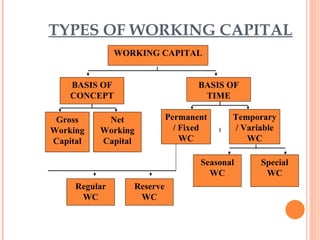
TYPES OF WORKING CAPITAL WORKING CAPITAL BASIS OF CONCEPT BASIS OF TIME Gross Working Capital Net Working Capital Permanent / Fixed WC Temporary / Variable WC Regular WC Reserve WC Special WC Seasonal WC
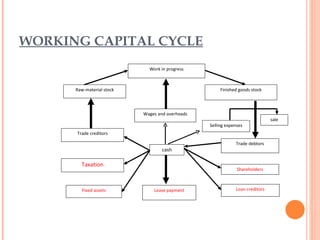
WORKING CAPITAL CYCLE The Working Capital Cycle can be defined as: The period of time which Elapses between the point at which cash begins to be expended on the production of a product and the collection of cash from a customer. The diagram  below  illustrates the Working Capital Cycle for a manufacturing firm.
WORKING CAPITAL CYCLE Work in progress Raw-material stock Finished goods stock Wages and overheads Trade creditors Taxation sale Trade debtors Shareholders cash Fixed   assets Loan   creditors Lease   payment Selling expenses
Thank You
REQUIREMENTS OF WORKING CAPITAL IN BUSINESS
Business with a lot of cash sales & few  credit sales should have minimal trade debtors. Supermarkets are good examples  of such business.  Business that exists to trade in completed  products will only have finished goods in  stock. Compare this with manufacturers  who will also have to maintain stocks of  raw-material & work-in-progress.
Some finished goods, notably foodstuffs,  have to be sold within a limited period.  Larger companies may be able to use their  bargaining strength as customers to  obtain more favorable, extended credit  terms from suppliers. By contrast, smaller  companies, particularly those that have  recently started trading may be required  to pay their suppliers immediately.
Some businesses will receive their money  at certain times of year, although they may  incur expenses throughout the year at a  fairly consistent level. This is often known  as “SEASONALITY” of cash flow.
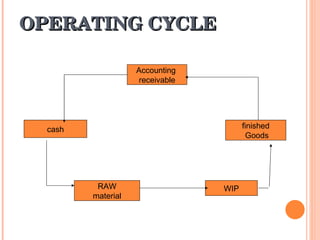
OPERATING CYCLE Accounting  receivable finished Goods WIP RAW material cash
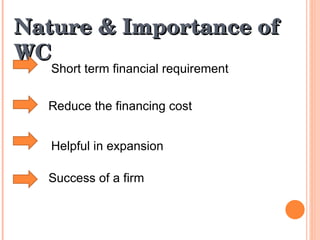
Nature & Importance of  WC Short term financial requirement Reduce the financing cost Helpful in expansion Success of a firm
Working capital management  (WCM)
Management of the WC
MEASUREMENT OF WORKINGCAPITAL REQUIREMENT
The form & amount of working capital  componenets vary overthe operating cycle. Working capital efficiency can be measured in terms of “DAYS OF WORKING CAPITAL (DWC)”  DWC value is based on amount of each of equally weighted receivable, inventory & payable accounts.  THE MEASUREMENT OF WORKING CAPITAL EFFICIENCY IS AS UNDER
The DWC represents the time period between purchase of material on account from the supplier untill the sell of finished goods.  Thus it reflects the firm’s profitability to finance it’s core operations with vendor credit.  The firm’s profitability is measured using(IA) approach.
Another profitability measure is (IS) approach. To measure the liquidity of the firm the cash conversion efficiency (CCE)  & current ratio are used.  The CCE is the cash flow generated from operating activities related to sales.
OBJECTIVES OF WORKING CAPITAL MANAGEMENT
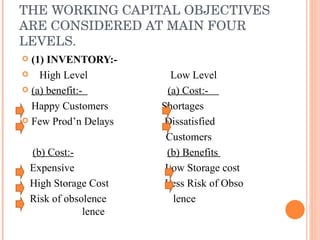
THE WORKING CAPITAL OBJECTIVES ARE CONSIDERED AT MAIN FOUR LEVELS. (1) INVENTORY:-   High Level  Low Level  (a) benefit:-  (a) Cost:-  Happy Customers  Shortages  Few Prod’n Delays  Dissatisfied  Customers  (b) Cost:-   (b) Benefits  Expensive  Low Storage cost  High Storage Cost  Less Risk of Obso  Risk of obsolence  lence  lence
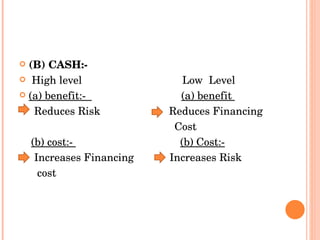
(B) CASH:-  High level   Low  Level  (a) benefit:-  (a) benefit  Reduces Risk  Reduces Financing  Cost  (b) cost:-  (b) Cost:- Increases Financing  Increases Risk  cost
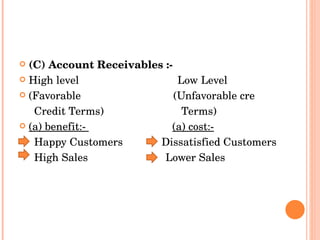
(C) Account Receivables :-  High level  Low Level  (Favorable  (Unfavorable cre Credit Terms)  Terms)  (a) benefit:-  (a) cost:-   Happy Customers  Dissatisfied Customers  High Sales  Lower Sales
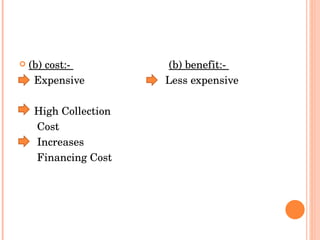
(b) cost:-  (b) benefit:-  Expensive  Less expensive  High Collection Cost  Increases  Financing Cost
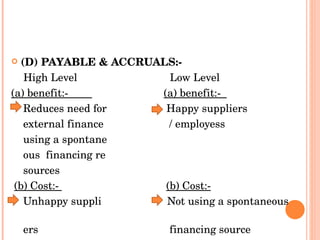
(D) PAYABLE & ACCRUALS:-   High Level  Low Level  (a) benefit:-  (a) benefit:-  Reduces need for  Happy suppliers  external finance  / employess using a spontane  ous  financing re sources  (b) Cost:-  (b) Cost:-   Unhappy suppli  Not using a spontaneous  ers  financing source
(1)- LIQUIDITY:- It reflects the firm’s ability to meet it’s short term obligations using those assets which are most readily converted into cash.  Assets that may be converted into cash in a shorter period of time are referred as liquid assets. ANALYSIS OF LIQUIDITY POSITION
Current assets are often referred to as  working capital, since they represents resources needed for day to day operations of the firm’s long term capital investments. Current assets are used to satisfy short term obligation or current liability.
(2)- The Operating Cycle:-   The operating cycle is the duration from the time cash is invested into goods & services to the time the investment produces cash. It includes four phases which are as under.
(A)- Purchase of raw-material & produces goods, investing in inventory.  (B)- Sell goods,  generating sales, which may or may not be in cash. (C)- Extent credit, creating a/c receivable. (D)- Collects a/c receivable, generating cash. FOUR PHASES OF OPERATING CYCLE
(3)- Liquidity Ratio:- Liquidity ratio or Solvency ratio include the, (A) Current Ratio:- (B) Quick Ratio:- (C) Net Working Capital:-
The current ratio compares current assets to current liability. It also gives an idea of a company’s ability  to meet day to day payment obligation. Generally higher ratio is better. (A) CURRENT RATIO
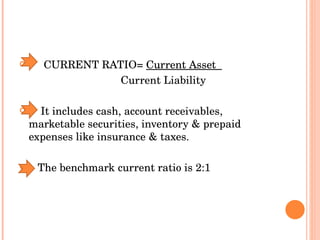
CURRENT RATIO=  Current Asset  Current Liability It includes cash, account receivables, marketable securities, inventory & prepaid expenses like insurance & taxes.  The benchmark current ratio is 2:1
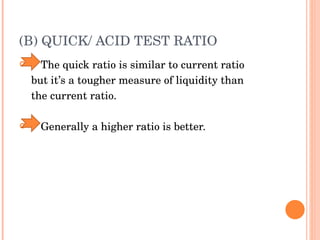
The quick ratio is similar to current ratio  but it’s a tougher measure of liquidity than the current ratio. Generally a higher ratio is better. (B) QUICK/ ACID TEST RATIO
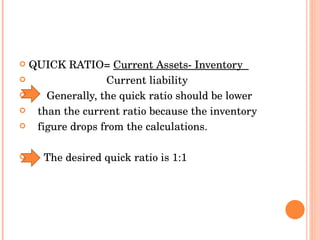
QUICK RATIO=  Current Assets- Inventory  Current liability  Generally, the quick ratio should be lower than the current ratio because the inventory figure drops from the calculations. The desired quick ratio is 1:1
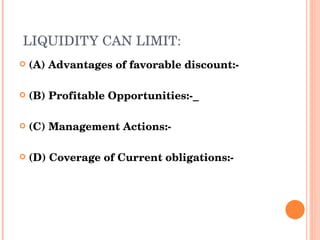
(A) Advantages of favorable discount:-  (B) Profitable Opportunities:-   (C) Management Actions:- (D) Coverage of Current obligations:- LIQUIDITY CAN LIMIT:
(A) Lower Profitability:-  (B) Restricted Opportunities:- (C) Loss Of Owner Control:-  (D) Loss Of Capital Investment:- (E) Insolvency & Bankruptcy:- SEVERE LIQUIDITY OFTEN PROCEEDS
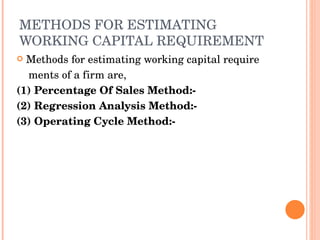
METHODS FOR ESTIMATING WORKING CAPITAL REQUIREMENT Methods for estimating working capital require  ments of a firm are,  (1) Percentage Of Sales Method:-  (2) Regression Analysis Method:-  (3) Operating Cycle Method:-
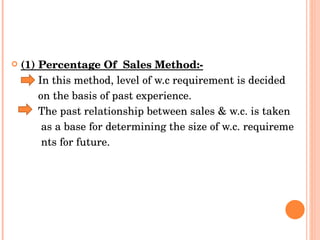
(1) Percentage Of  Sales Method:-   In this method, level of w.c requirement is decided  on the basis of past experience.  The past relationship between sales & w.c. is taken  as a base for determining the size of w.c. requireme nts for future.
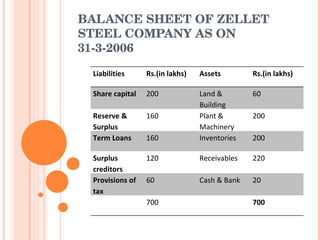
BALANCE SHEET OF ZELLET STEEL COMPANY AS ON 31-3-2006 Liabilities Rs.(in lakhs) Assets Rs.(in lakhs) Share capital 200 Land & Building 60 Reserve & Surplus 160 Plant & Machinery 200 Term Loans 160 Inventories 200 Surplus creditors 120 Receivables 220 Provisions of tax  60 Cash & Bank 20 700 700
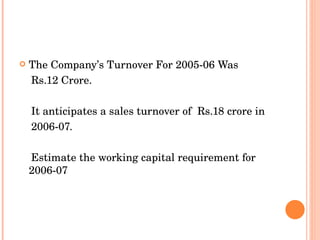
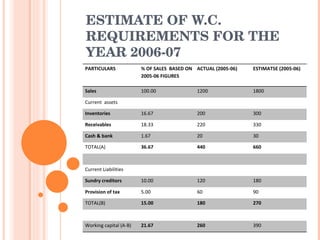
The Company’s Turnover For 2005-06 Was  Rs.12 Crore. It anticipates a sales turnover of  Rs.18 crore in  2006-07.  Estimate the working capital requirement for 2006-07
ESTIMATE OF W.C. REQUIREMENTS FOR THE YEAR 2006-07 PARTICULARS % OF SALES  BASED ON 2005-06 FIGURES ACTUAL (2005-06) ESTIMATSE (2005-06) Sales 100.00 1200 1800 Current  assets Inventories 16.67 200 300 Receivables 18.33 220 330 Cash & bank 1.67 20 30 TOTAL(A) 36.67 440 660 Current Liabilities Sundry creditors 10.00 120 180 Provision of tax 5.00 60 90 TOTAL(B) 15.00 180 270 Working capital (A-B) 21.67 260 390
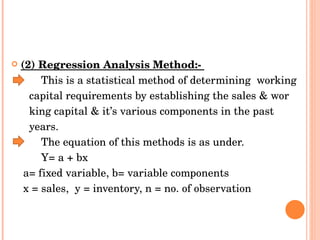
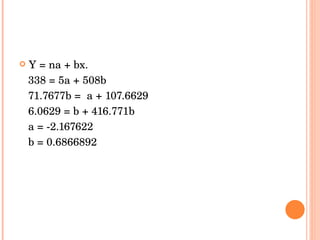
(2) Regression Analysis Method:-  This is a statistical method of determining  working  capital requirements by establishing the sales & wor  king capital & it’s various components in the past  years.  The equation of this methods is as under.  Y= a + bx  a= fixed variable, b= variable components  x = sales,  y = inventory, n = no. of observation
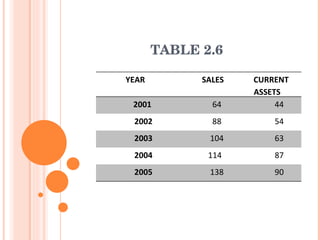
TABLE 2.6 YEAR  SALES  CURRENT  ASSETS 2001  64 44 2002 88 54 2003 104 63 2004 114  87 2005 138 90
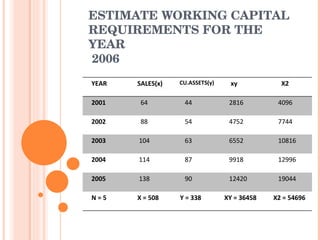
ESTIMATE WORKING CAPITAL  REQUIREMENTS FOR THE YEAR  2006 YEAR SALES(x)  CU.ASSETS(y) xy X2 2001 64 44  2816 4096 2002 88 54 4752 7744 2003 104 63 6552 10816 2004 114 87 9918 12996 2005 138  90 12420 19044 N = 5 X = 508  Y = 338 XY = 36458 X2 = 54696
Y = na + bx. 338 = 5a + 508b  71.7677b =  a + 107.6629  6.0629 = b + 416.771b  a = -2.167622  b = 0.6866892
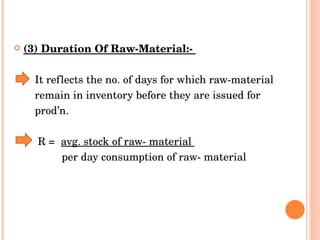
(3) Duration Of Raw-Material:-  It reflects the no. of days for which raw-material  remain in inventory before they are issued for  prod’n.  R =  avg. stock of raw- material  per day consumption of raw- material
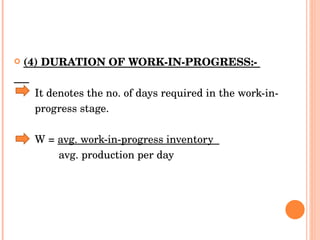
(4) DURATION OF WORK-IN-PROGRESS:-  It denotes the no. of days required in the work-in- progress stage. W =  avg. work-in-progress inventory  avg. production per day
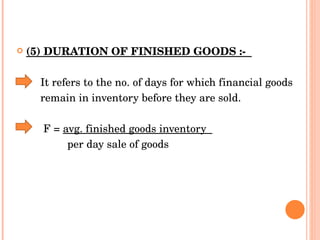
(5) DURATION OF FINISHED GOODS :-  It refers to the no. of days for which financial goods  remain in inventory before they are sold.  F =  avg. finished goods inventory  per day sale of goods
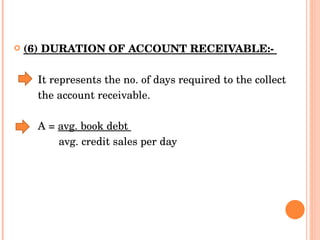
(6) DURATION OF ACCOUNT RECEIVABLE:-  It represents the no. of days required to the collect  the account receivable.  A =  avg. book debt  avg. credit sales per day
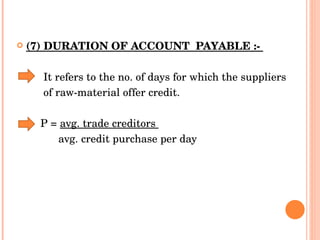
(7) DURATION OF ACCOUNT  PAYABLE :-  It refers to the no. of days for which the suppliers  of raw-material offer credit.  P =  avg. trade creditors  avg. credit purchase per day
Any Questions

working capital

  • 1.
    WORKING CAPITAL PreparedBy : - PARAG VORA MANISH AGHASIYA MILAN DAVE
  • 2.
    CONTENTS Introduction. Conceptof Working Capital Types of Working Capital Working Capital cycle Working Capital needs of a business Nature and Importance of Working Capital Working Capital management concepts Management of Working Capital Measures of Working Capital management Efficiency Objectives of Working Capital management
  • 3.
    Analysis of Liquidityposition Methods for estimating Working Capital requirement Conclusion
  • 4.
  • 5.
    WHAT IS WORKINGCAPITAL? Working capital is the difference between current assets and current liabilities . Working capital is how much in liquid assets that a company has on hand. Working capital is needed to pay for planned and unexpected expenses, meet the short-term obligations of the business, and to build the business.
  • 6.
    CONCEPT OF WORKING CAPITAL The core of the Working capital concept has been subjected to considerable change over the years. A few years ago the concept was viewed as a measure of the debtor’s ability to meet his obligation in case of liquidation. The prime concern was with whether or not the current assets were immediately realizable and available to pay debts in case of liquidation. The concept of WCM was first evolved by KARL MARX but it was something different , they used the word variable Capital means outlays for payrolls advanced to workers before the goods they worked on were complete.
  • 7.
    TYPES OF WORKINGCAPITAL WORKING CAPITAL BASIS OF CONCEPT BASIS OF TIME Gross Working Capital Net Working Capital Permanent / Fixed WC Temporary / Variable WC Regular WC Reserve WC Special WC Seasonal WC
  • 8.
    WORKING CAPITAL CYCLEThe Working Capital Cycle can be defined as: The period of time which Elapses between the point at which cash begins to be expended on the production of a product and the collection of cash from a customer. The diagram below illustrates the Working Capital Cycle for a manufacturing firm.
  • 9.
    WORKING CAPITAL CYCLEWork in progress Raw-material stock Finished goods stock Wages and overheads Trade creditors Taxation sale Trade debtors Shareholders cash Fixed assets Loan creditors Lease payment Selling expenses
  • 10.
  • 11.
    REQUIREMENTS OF WORKINGCAPITAL IN BUSINESS
  • 12.
    Business with alot of cash sales & few credit sales should have minimal trade debtors. Supermarkets are good examples of such business. Business that exists to trade in completed products will only have finished goods in stock. Compare this with manufacturers who will also have to maintain stocks of raw-material & work-in-progress.
  • 13.
    Some finished goods,notably foodstuffs, have to be sold within a limited period. Larger companies may be able to use their bargaining strength as customers to obtain more favorable, extended credit terms from suppliers. By contrast, smaller companies, particularly those that have recently started trading may be required to pay their suppliers immediately.
  • 14.
    Some businesses willreceive their money at certain times of year, although they may incur expenses throughout the year at a fairly consistent level. This is often known as “SEASONALITY” of cash flow.
  • 15.
    OPERATING CYCLE Accounting receivable finished Goods WIP RAW material cash
  • 16.
    Nature & Importanceof WC Short term financial requirement Reduce the financing cost Helpful in expansion Success of a firm
  • 17.
  • 18.
  • 19.
  • 20.
    The form &amount of working capital componenets vary overthe operating cycle. Working capital efficiency can be measured in terms of “DAYS OF WORKING CAPITAL (DWC)” DWC value is based on amount of each of equally weighted receivable, inventory & payable accounts. THE MEASUREMENT OF WORKING CAPITAL EFFICIENCY IS AS UNDER
  • 21.
    The DWC representsthe time period between purchase of material on account from the supplier untill the sell of finished goods. Thus it reflects the firm’s profitability to finance it’s core operations with vendor credit. The firm’s profitability is measured using(IA) approach.
  • 22.
    Another profitability measureis (IS) approach. To measure the liquidity of the firm the cash conversion efficiency (CCE) & current ratio are used. The CCE is the cash flow generated from operating activities related to sales.
  • 23.
    OBJECTIVES OF WORKINGCAPITAL MANAGEMENT
  • 24.
    THE WORKING CAPITALOBJECTIVES ARE CONSIDERED AT MAIN FOUR LEVELS. (1) INVENTORY:- High Level Low Level (a) benefit:- (a) Cost:- Happy Customers Shortages Few Prod’n Delays Dissatisfied Customers (b) Cost:- (b) Benefits Expensive Low Storage cost High Storage Cost Less Risk of Obso Risk of obsolence lence lence
  • 25.
    (B) CASH:- High level Low Level (a) benefit:- (a) benefit Reduces Risk Reduces Financing Cost (b) cost:- (b) Cost:- Increases Financing Increases Risk cost
  • 26.
    (C) Account Receivables:- High level Low Level (Favorable (Unfavorable cre Credit Terms) Terms) (a) benefit:- (a) cost:- Happy Customers Dissatisfied Customers High Sales Lower Sales
  • 27.
    (b) cost:- (b) benefit:- Expensive Less expensive High Collection Cost Increases Financing Cost
  • 28.
    (D) PAYABLE &ACCRUALS:- High Level Low Level (a) benefit:- (a) benefit:- Reduces need for Happy suppliers external finance / employess using a spontane ous financing re sources (b) Cost:- (b) Cost:- Unhappy suppli Not using a spontaneous ers financing source
  • 29.
    (1)- LIQUIDITY:- Itreflects the firm’s ability to meet it’s short term obligations using those assets which are most readily converted into cash. Assets that may be converted into cash in a shorter period of time are referred as liquid assets. ANALYSIS OF LIQUIDITY POSITION
  • 30.
    Current assets areoften referred to as working capital, since they represents resources needed for day to day operations of the firm’s long term capital investments. Current assets are used to satisfy short term obligation or current liability.
  • 31.
    (2)- The OperatingCycle:- The operating cycle is the duration from the time cash is invested into goods & services to the time the investment produces cash. It includes four phases which are as under.
  • 32.
    (A)- Purchase ofraw-material & produces goods, investing in inventory. (B)- Sell goods, generating sales, which may or may not be in cash. (C)- Extent credit, creating a/c receivable. (D)- Collects a/c receivable, generating cash. FOUR PHASES OF OPERATING CYCLE
  • 33.
    (3)- Liquidity Ratio:-Liquidity ratio or Solvency ratio include the, (A) Current Ratio:- (B) Quick Ratio:- (C) Net Working Capital:-
  • 34.
    The current ratiocompares current assets to current liability. It also gives an idea of a company’s ability to meet day to day payment obligation. Generally higher ratio is better. (A) CURRENT RATIO
  • 35.
    CURRENT RATIO= Current Asset Current Liability It includes cash, account receivables, marketable securities, inventory & prepaid expenses like insurance & taxes. The benchmark current ratio is 2:1
  • 36.
    The quick ratiois similar to current ratio but it’s a tougher measure of liquidity than the current ratio. Generally a higher ratio is better. (B) QUICK/ ACID TEST RATIO
  • 37.
    QUICK RATIO= Current Assets- Inventory Current liability Generally, the quick ratio should be lower than the current ratio because the inventory figure drops from the calculations. The desired quick ratio is 1:1
  • 38.
    (A) Advantages offavorable discount:- (B) Profitable Opportunities:- (C) Management Actions:- (D) Coverage of Current obligations:- LIQUIDITY CAN LIMIT:
  • 39.
    (A) Lower Profitability:- (B) Restricted Opportunities:- (C) Loss Of Owner Control:- (D) Loss Of Capital Investment:- (E) Insolvency & Bankruptcy:- SEVERE LIQUIDITY OFTEN PROCEEDS
  • 40.
    METHODS FOR ESTIMATINGWORKING CAPITAL REQUIREMENT Methods for estimating working capital require ments of a firm are, (1) Percentage Of Sales Method:- (2) Regression Analysis Method:- (3) Operating Cycle Method:-
  • 41.
    (1) Percentage Of Sales Method:- In this method, level of w.c requirement is decided on the basis of past experience. The past relationship between sales & w.c. is taken as a base for determining the size of w.c. requireme nts for future.
  • 42.
    BALANCE SHEET OFZELLET STEEL COMPANY AS ON 31-3-2006 Liabilities Rs.(in lakhs) Assets Rs.(in lakhs) Share capital 200 Land & Building 60 Reserve & Surplus 160 Plant & Machinery 200 Term Loans 160 Inventories 200 Surplus creditors 120 Receivables 220 Provisions of tax 60 Cash & Bank 20 700 700
  • 43.
    The Company’s TurnoverFor 2005-06 Was Rs.12 Crore. It anticipates a sales turnover of Rs.18 crore in 2006-07. Estimate the working capital requirement for 2006-07
  • 44.
    ESTIMATE OF W.C.REQUIREMENTS FOR THE YEAR 2006-07 PARTICULARS % OF SALES BASED ON 2005-06 FIGURES ACTUAL (2005-06) ESTIMATSE (2005-06) Sales 100.00 1200 1800 Current assets Inventories 16.67 200 300 Receivables 18.33 220 330 Cash & bank 1.67 20 30 TOTAL(A) 36.67 440 660 Current Liabilities Sundry creditors 10.00 120 180 Provision of tax 5.00 60 90 TOTAL(B) 15.00 180 270 Working capital (A-B) 21.67 260 390
  • 45.
    (2) Regression AnalysisMethod:- This is a statistical method of determining working capital requirements by establishing the sales & wor king capital & it’s various components in the past years. The equation of this methods is as under. Y= a + bx a= fixed variable, b= variable components x = sales, y = inventory, n = no. of observation
  • 46.
    TABLE 2.6 YEAR SALES CURRENT ASSETS 2001 64 44 2002 88 54 2003 104 63 2004 114 87 2005 138 90
  • 47.
    ESTIMATE WORKING CAPITAL REQUIREMENTS FOR THE YEAR 2006 YEAR SALES(x) CU.ASSETS(y) xy X2 2001 64 44 2816 4096 2002 88 54 4752 7744 2003 104 63 6552 10816 2004 114 87 9918 12996 2005 138 90 12420 19044 N = 5 X = 508 Y = 338 XY = 36458 X2 = 54696
  • 48.
    Y = na+ bx. 338 = 5a + 508b 71.7677b = a + 107.6629 6.0629 = b + 416.771b a = -2.167622 b = 0.6866892
  • 49.
    (3) Duration OfRaw-Material:- It reflects the no. of days for which raw-material remain in inventory before they are issued for prod’n. R = avg. stock of raw- material per day consumption of raw- material
  • 50.
    (4) DURATION OFWORK-IN-PROGRESS:- It denotes the no. of days required in the work-in- progress stage. W = avg. work-in-progress inventory avg. production per day
  • 51.
    (5) DURATION OFFINISHED GOODS :- It refers to the no. of days for which financial goods remain in inventory before they are sold. F = avg. finished goods inventory per day sale of goods
  • 52.
    (6) DURATION OFACCOUNT RECEIVABLE:- It represents the no. of days required to the collect the account receivable. A = avg. book debt avg. credit sales per day
  • 53.
    (7) DURATION OFACCOUNT PAYABLE :- It refers to the no. of days for which the suppliers of raw-material offer credit. P = avg. trade creditors avg. credit purchase per day
  • 54.

Editor's Notes

  • #17 Helpful in expansion Success of a firm
  • #18 Working capital management (WCM)
  • #19 Management of the WC