Working Capital Management |Prof. Pallavi Rahul Gedamkar
P a g e 1 | 17
Chapter 4- WORKING CAPITAL MANAGEMENT
4.1 Introduction to Working Capital Management
4.2 Operating Cycle
4.3 Calculation of working capital
INTRODUCTION
It has been often observed that the shortage of working capital leads to the failure of a business. The
proper management of working capital may bring about the success of a business firm. The management
of working capital includes the management of current assets and current liabilities. A number of
companies for the past few years have been finding it difficult to solve the increasing problems of
adopting seriously the management of working capital. A firm may exist without making profits but
cannot survive without liquidity. The function of working capital management in an organization is
similar that of the heart in a human body. Also it is an important function of financial management. The
financial manager must determine the satisfactory level of working capital funds and also the optimum
mix of current assets and current liabilities. He must ensure that the appropriate sources of funds are used
to finance working capital and should also see that short term obligation of the business are met well in
time.
Working capital management is a business process that helps companies make effective use of their
current assets and optimize cash flow. It’s oriented around ensuring short-term financial obligations and
expenses can be met, while also contributing towards longer-term business objectives. The goal of
working capital management is to maximize operational efficiency.
By improving the way they manage working capital, companies can free up cash that would otherwise
be trapped on their balance sheets. As a result, they may be able to reduce the need for external borrowing,
fuel growth, fund mergers or acquisitions, or invest in R&D.
Working capital is essential to the health of every business and improving your working capital position
can provide a boost to the operational efficiency of a business, but managing it effectively is something
of a balancing act.
Companies need to have enough cash available to cover both planned and unexpected costs, while also
making the best use of the funds available to fuel growth. This is achieved by the effective management
of accounts payable, accounts receivable, inventory, and cash.
DEFINITION OF WORKING CAPITAL
1. Gerestenburg defines, “Circulating capital means current assets of a company that are changed
in the ordinary course of business from one form to another, as for example, from cash to
inventories, inventories to receivables, receivables into cash”.
2. Shubin defines, “Working capital is the amount of funds necessary to cover the cost of operating
the enterprise.”
3. Weston and Brigham defines, “Working capital refers to a firm’s investment in short term assets
– cash, short term securities accounts receivables and inventories.”
Working Capital Management |Prof. Pallavi Rahul Gedamkar
P a g e 2 | 17
4. Hoagland defines, “Working capital is descriptive of that capital which is not fixed. But the more
common use of the working capital is to consider it as the difference between the book value of
current assets and the current liabilities.”
5. Mead, Malott and Field defines, “Working capital means current assets.”
6. Bonneville defines, “Any acquisition of funds which increases the current assets, and which
increases the working capital for they are one and the same.”
7. J.S. Mill defines, “The sum of the current assets is the working capital of business.”
From the above definitions, it is clear that working capital is a going concern, is a revolving fund. It
consists of cash receipts, from sales which are to cover the cost of operation.
CONCEPT OF WORKING CAPITAL MANAGEMENT
There are two concepts of working capital viz .quantitative and qualitative. Some people also define the
two concepts as gross concept and net concept.
According to quantitative concept, the amount of working capital refers to ‘total of current assets’.
Current assets are considered to be gross working capital in this concept. The qualitative concept gives
an idea regarding source of financing capital.
According to qualitative concept the amount of working capital refers to “excess of current assets over
current liabilities.” L.J. Guthmann defined working capital as “the portion of a firm’s current assets
which are financed from long–term funds.” The excess of current assets over current liabilities is termed
as ‘Net working capital’. In this concept “Net working capital” represents the amount of current assets
which would remain if all current liabilities were paid.
Both the concepts of working capital have their own points of importance. “If the objectives is to measure
the size and extent to which current assets are being used, ‘Gross concept’ is useful; whereas in evaluating
the liquidity position of an undertaking ‘Net concept’ becomes pertinent and preferable. It is necessary
to understand the meaning of current assets and current liabilities for learning the meaning of working
capital, which is explained below:
1. Current assets – It is rightly observed that “Current assets have a short life span. These type of
assets are engaged in current operation of a business and normally used for short– term operations
of the firm during an accounting period i.e. within twelve months. The two important characteristics
of such assets are,
(i) short life span, and
(ii) swift transformation into other form of assets. Cash balance may be held idle for a week or
two; account receivable may have a life span of 30 to 60 days, and inventories may be held
for 30 to 100 days.
CA examples are Cash in hand, cash at bank, sundry debtors, bills receivables, short term
investments, inventories, marketable securities, prepaid expenses, accrued incomes etc.
2. Current liabilities – The firm creates a Current Liability towards creditors (sellers) from whom it
has purchased raw materials on credit. This liability is also known as accounts payable and shown
in the balance sheet till the payment has been made to the creditors. The claims or obligations which
are normally expected to mature for payment within an accounting cycle (1 year) are known as
current liabilities. These can be defined as “those liabilities where liquidation is reasonably
Working Capital Management |Prof. Pallavi Rahul Gedamkar
P a g e 3 | 17
expected to require the use of existing resources properly classifiable as current assets, or the
creation of other current assets, or the creation of other current liabilities.”
CL examples are Sundry creditors, bills payable, outstanding expenses, accrued expenses, short
term advances and deposits, dividends payable, bank overdraft etc.
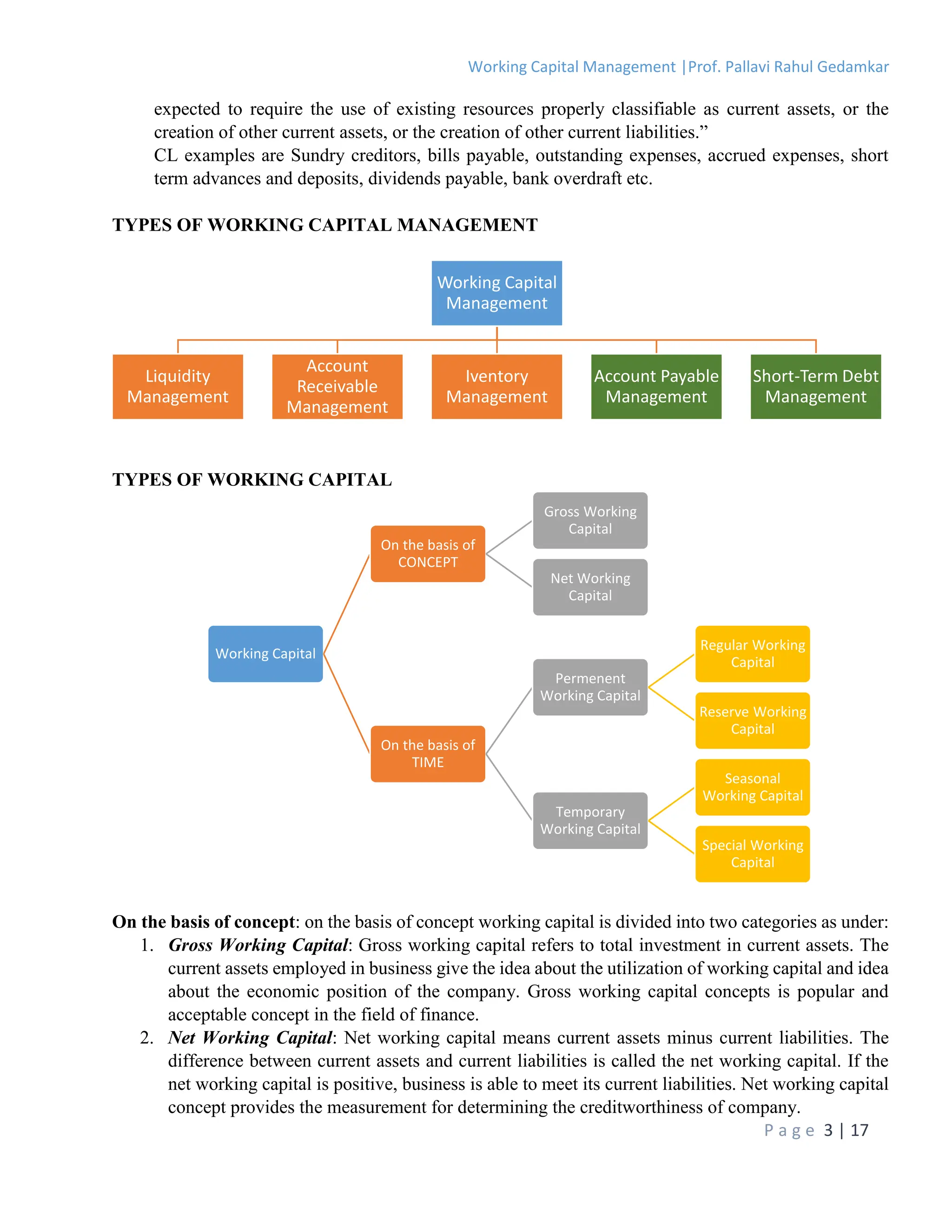
TYPES OF WORKING CAPITAL MANAGEMENT
TYPES OF WORKING CAPITAL
On the basis of concept: on the basis of concept working capital is divided into two categories as under:
1. Gross Working Capital: Gross working capital refers to total investment in current assets. The
current assets employed in business give the idea about the utilization of working capital and idea
about the economic position of the company. Gross working capital concepts is popular and
acceptable concept in the field of finance.
2. Net Working Capital: Net working capital means current assets minus current liabilities. The
difference between current assets and current liabilities is called the net working capital. If the
net working capital is positive, business is able to meet its current liabilities. Net working capital
concept provides the measurement for determining the creditworthiness of company.
Working Capital
Management
Liquidity
Management
Account
Receivable
Management
Iventory
Management
Account Payable
Management
Short-Term Debt
Management
Working Capital
On the basis of
CONCEPT
Gross Working
Capital
Net Working
Capital
On the basis of
TIME
Permenent
Working Capital
Regular Working
Capital
Reserve Working
Capital
Temporary
Working Capital
Seasonal
Working Capital
Special Working
Capital
Working Capital Management |Prof. Pallavi Rahul Gedamkar
P a g e 4 | 17
On the basis of time: The requirements of working capital are continuous. More working capital is
required in a particular season or the peck period of business activity.
1. Permanent working capital: This type of working capital is known as Fixed Working Capital.
Permanent working capital means the part of working capital which is permanently locked up in
the current assets to carry out the business smoothly. The minimum amount of current assets
which is required to conduct the business smoothly during the year is called permanent working
capital. For example, investments required to maintain the minimum stock of raw materials or to
cash balance. The amount of permanent working capital depends upon the size and growth of
company. Fixed working capital can further be divided into two categories as under:
i. Regular Working capital: Minimum amount of working capital required to keep the
primary circulation. Some amount of cash is necessary for the payment of wages, salaries
etc.
ii. Reserve Margin Working capital: Additional working capital may also be required for
contingencies that may arise any time. The reserve working capital is the excess of capital
over the needs of the regular working capital is kept aside as reserve for contingencies,
such as strike, business depression etc.
2. Variable or Temporary Working Capital: The term variable working capital refers that the level
of working capital is temporary and fluctuating. Variable working capital may change from one
assets to another and changes with the increase or decrease in the volume of business. The variable
working capital may also be subdivided into following two sub-groups.
i. Seasonal Variable Working capital: Seasonal working capital is the additional amount
which is required during the active business seasons of the year. Raw materials like raw-
cotton or jute or sugarcane are purchased in particular season. The industry has to borrow
funds for short period. It is particularly suited to a business of a seasonal nature. In short,
seasonal working capital is required to meet the seasonal liquidity of the business.
ii. Special variable working capital: Additional working capital may also be needed to
provide additional current assets to meet the unexpected events or special operations such
as extensive marketing campaigns or carrying of special job etc.
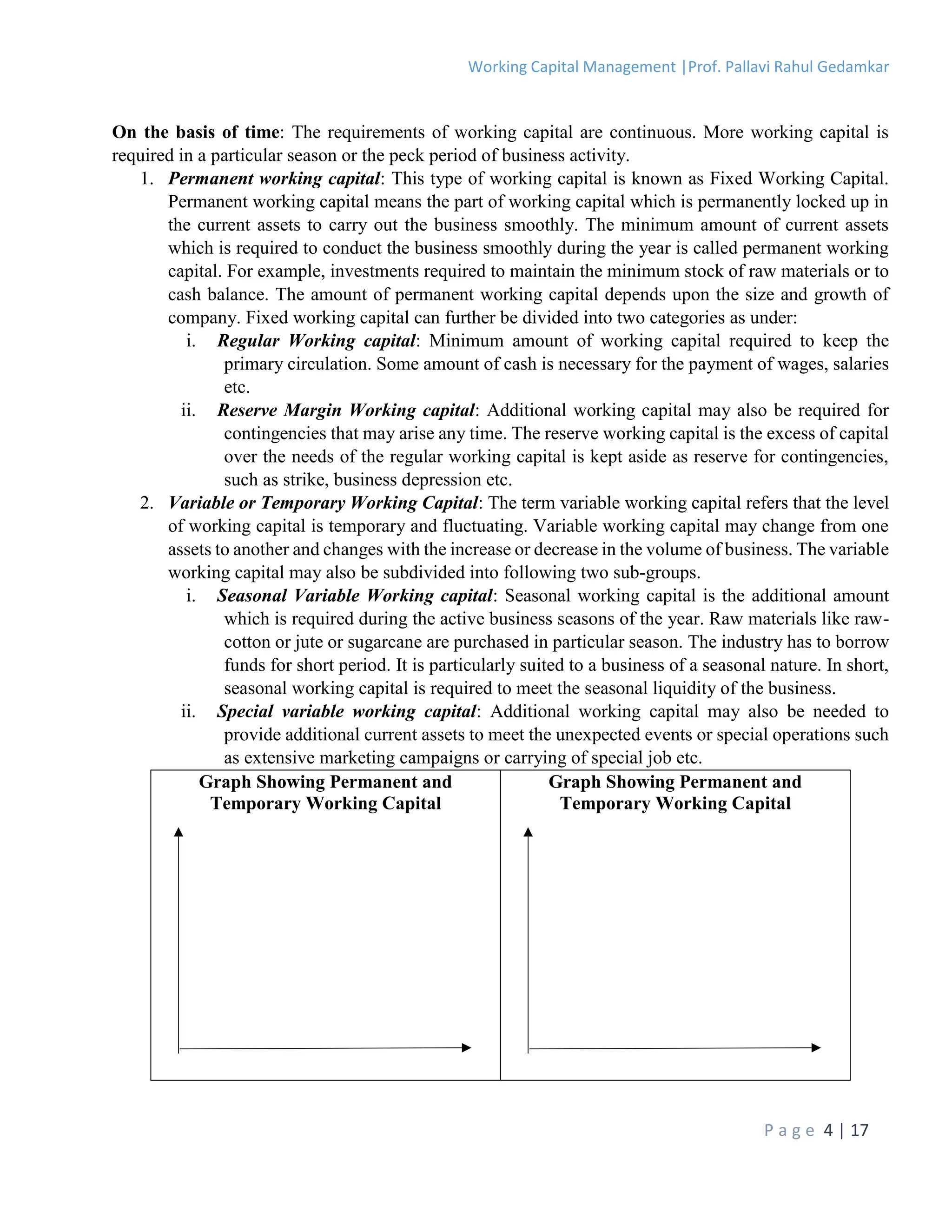
Graph Showing Permanent and
Temporary Working Capital
Graph Showing Permanent and
Temporary Working Capital
Working Capital Management |Prof. Pallavi Rahul Gedamkar
P a g e 5 | 17
FACTORS DETERMINING WORKING CAPITAL
The working capital requirements of an enterprise depend on a variety of factors. These factors affect
different enterprises differently and vary from time to time. The following factor determine the amount
of working capital:
OPERATING CYCLE
The duration of time required to complete the sequence of events right from purchase of raw material /
goods for cash to the realization of sales in cash is called the operating cycle, working capital cycle or
cash cycle.
The Operating Cycle tracks the number of days between the initial date of inventory purchase and the
receipt of cash payment from customer credit purchases.
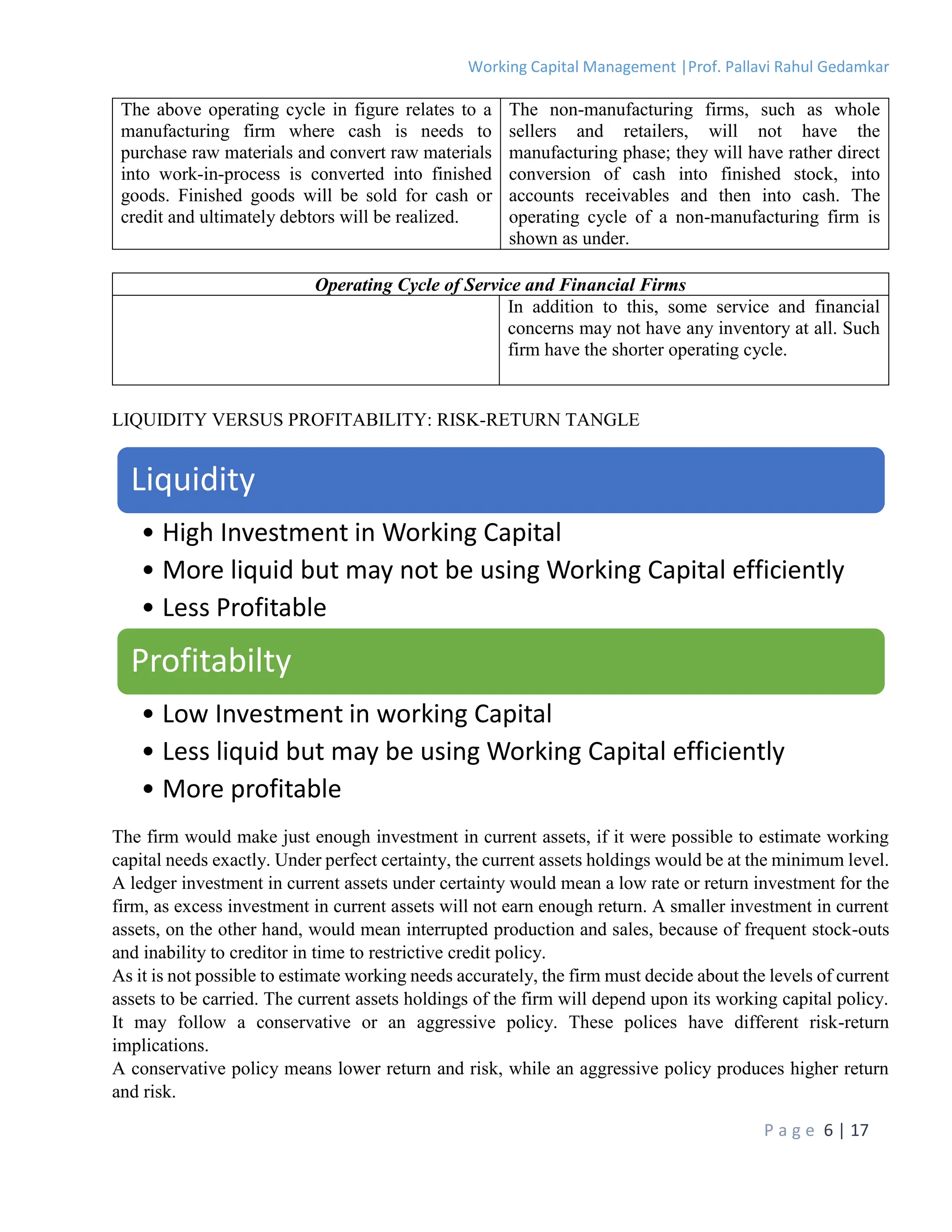
Operating Cycle of Manufacturing Cycle Operating Cycle of Non-Manufacturing Firm
Nature of Business
Size of Business
Demand of Creditors
Cash Requirement
Time
Volume of Sales
Term of Purchase and Sale
Business Cycle
Production Cycle
Liquidity and Profitability
Seasonal Fluctuation
Working Capital Management |Prof. Pallavi Rahul Gedamkar
P a g e 6 | 17
The above operating cycle in figure relates to a
manufacturing firm where cash is needs to
purchase raw materials and convert raw materials
into work-in-process is converted into finished
goods. Finished goods will be sold for cash or
credit and ultimately debtors will be realized.
The non-manufacturing firms, such as whole
sellers and retailers, will not have the
manufacturing phase; they will have rather direct
conversion of cash into finished stock, into
accounts receivables and then into cash. The
operating cycle of a non-manufacturing firm is
shown as under.
Operating Cycle of Service and Financial Firms
In addition to this, some service and financial
concerns may not have any inventory at all. Such
firm have the shorter operating cycle.
LIQUIDITY VERSUS PROFITABILITY: RISK-RETURN TANGLE
The firm would make just enough investment in current assets, if it were possible to estimate working
capital needs exactly. Under perfect certainty, the current assets holdings would be at the minimum level.
A ledger investment in current assets under certainty would mean a low rate or return investment for the
firm, as excess investment in current assets will not earn enough return. A smaller investment in current
assets, on the other hand, would mean interrupted production and sales, because of frequent stock-outs
and inability to creditor in time to restrictive credit policy.
As it is not possible to estimate working needs accurately, the firm must decide about the levels of current
assets to be carried. The current assets holdings of the firm will depend upon its working capital policy.
It may follow a conservative or an aggressive policy. These polices have different risk-return
implications.
A conservative policy means lower return and risk, while an aggressive policy produces higher return
and risk.
Liquidity
• High Investment in Working Capital
• More liquid but may not be using Working Capital efficiently
• Less Profitable
Profitabilty
• Low Investment in working Capital
• Less liquid but may be using Working Capital efficiently
• More profitable
Working Capital Management |Prof. Pallavi Rahul Gedamkar
P a g e 7 | 17
The two important aims of the working capital management are: profitability and solvency.
Solvency, used in the technical sense, refers to the firm’s continuous ability to meet maturing obligations.
Lenders and creditors expected prompt settlement of their claims as and when due. To ensure solvency,
the firm maintains a relatively large investment in current assets holdings. If the firm maintains a
relatively large investment in current assets, it will have no difficulty in paying the claims of the creditors
when they become due and will be able to fill all sales orders and ensure smooth production. Thus, a
liquid firm has less risk of insolvency; that is, it will hardly experiences a cash shortage or stock-outs.
However, there is a cost associated with maintaining a sound liquidity position.
A considerable amount of the firm’s funds will be tied up in current assets. And to the extent this
investment is idle, the firm’s profitability will suffer.
To have high profitability, the firm may sacrifice solvency and maintain a relatively low level of current
assets. When the firm does so, its profitability will improve as less funds are tied up in idle current assets,
but its solvency would be threatened and would be exposed to greater risk of cash shortage and stock-
outs.
Therefore, the firm should balance the profitability solvency tangle by minimizing the total cost of
liquidity and cost of illiquidity.
The Cost Trade-off: A different way of looking into the risk-return trade of is in terms of the cost of
maintaining a particular level of current assets. There are two different kinds of costs involved.
First there is the cost of liquidity. If the firm carries too much liquidity, the firm’s rate of return will be
low. Funds tied up in idle cash and excess inventory earn nothing, and receivables levels that are too
large also reduce the firm’s profitability. Thus, the cost of liquidity increases with the level of current
assets.
There is the cost of liquidity, which is the cost of having too little invested in current assets. If the firm
carries too little cash, it may not be able to pay bills promptly at they mature. This may force the firm to
borrow at high rates of interest. This will also adversely affect the creditworthiness of the firm and it will
face difficulties in obtaining funds in future. This all may force the firm into insolvency.
If the firm’s inventory level too low, sales may be lost and customers may shift to competitors. Also, low
level of book debts may be due to tight credit policy, which would impair sales further. Thus, the low
level of current assets involves cost which increases as this level falls.
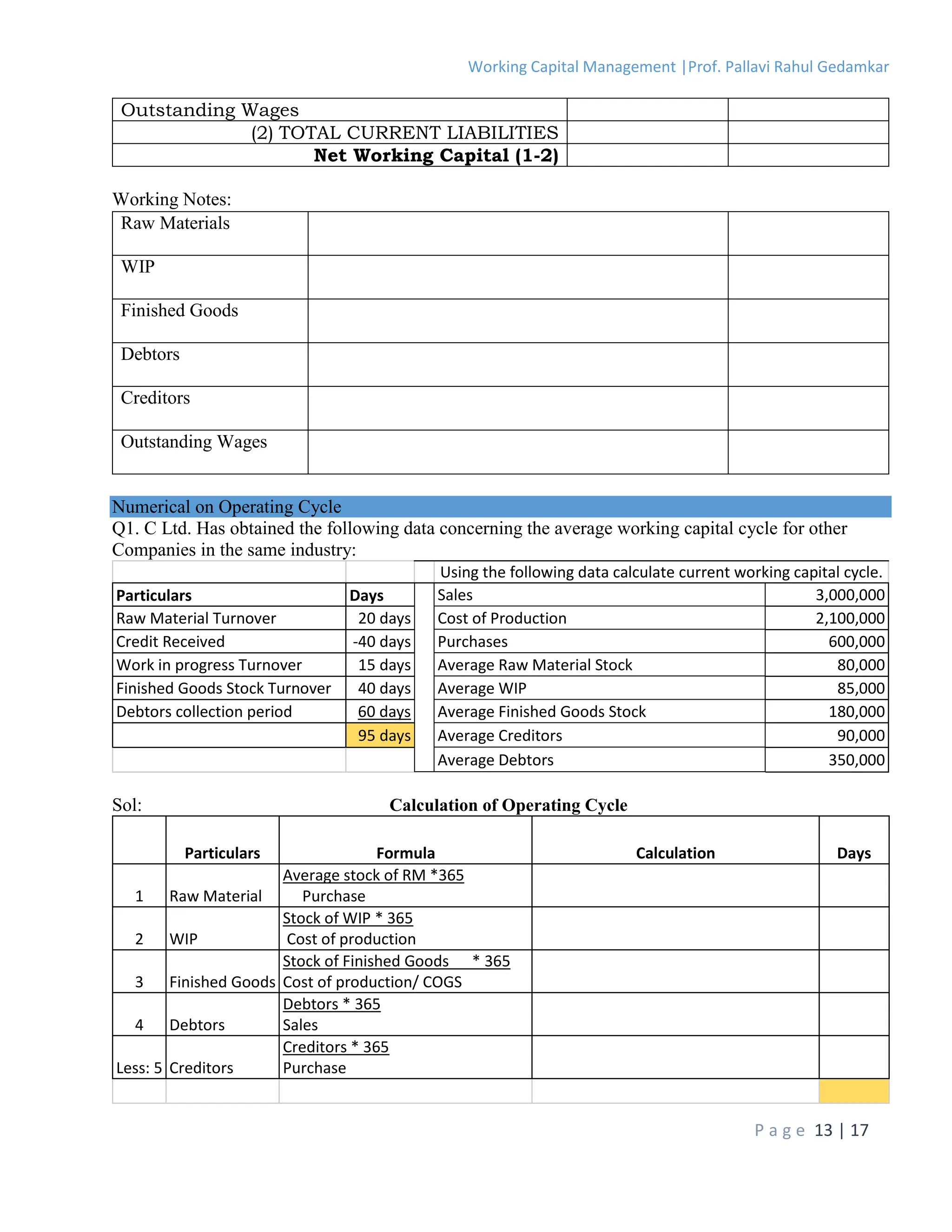
Numerical on Working Capital Calculation
Q1. The Board of Directors of XYZ Engineering Co. Pvt. Ltd. Request you to prepare a statement
showing the Working Capital Requirements for a level of activity of 1,56,000 units of production. The
following information is available for your consideration:
Particulars Per Unit (INR)
a. Raw Materials 90
b. Direct Labour 40
c. Overheads 75
TOTAL COST 205
Profit 60
SELLING PRICE P.U 265
i. Raw materials are in stock on an average one month.
Working Capital Management |Prof. Pallavi Rahul Gedamkar
P a g e 8 | 17
ii. Materials are in process 50% complete on an average 2 weeks.
iii. Finished goods are in stock on an average one month.
iv. Credit allowed by suppliers one month.
v. Time lag in payment from debtors 2 months.
vi. Lag in payment of wages in 1.5 weeks.
vii. Lag in payment of overheads one month. 20% of the output is sold against cash. Cash in
hand and bank is expected Rs 60,000.
Assume that production is carried on evenly throughout the year, wages and overheads accrue similarly
and a time period of 4 weeks is equivalent to 1 month.
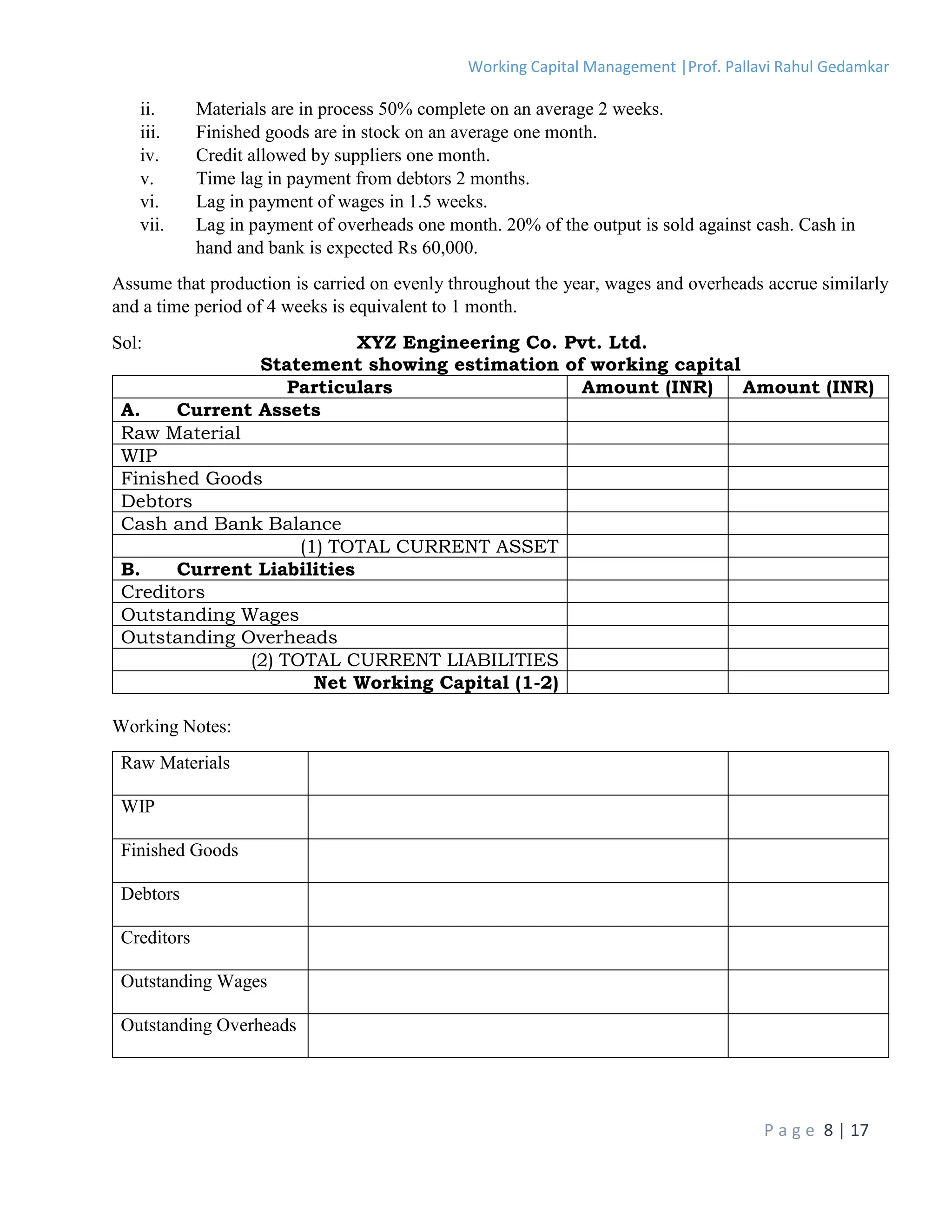
Sol: XYZ Engineering Co. Pvt. Ltd.
Statement showing estimation of working capital
Particulars Amount (INR) Amount (INR)
A. Current Assets
Raw Material
WIP
Finished Goods
Debtors
Cash and Bank Balance
(1) TOTAL CURRENT ASSET
B. Current Liabilities
Creditors
Outstanding Wages
Outstanding Overheads
(2) TOTAL CURRENT LIABILITIES
Net Working Capital (1-2)
Working Notes:
Raw Materials
WIP
Finished Goods
Debtors
Creditors
Outstanding Wages
Outstanding Overheads
Working Capital Management |Prof. Pallavi Rahul Gedamkar
P a g e 9 | 17
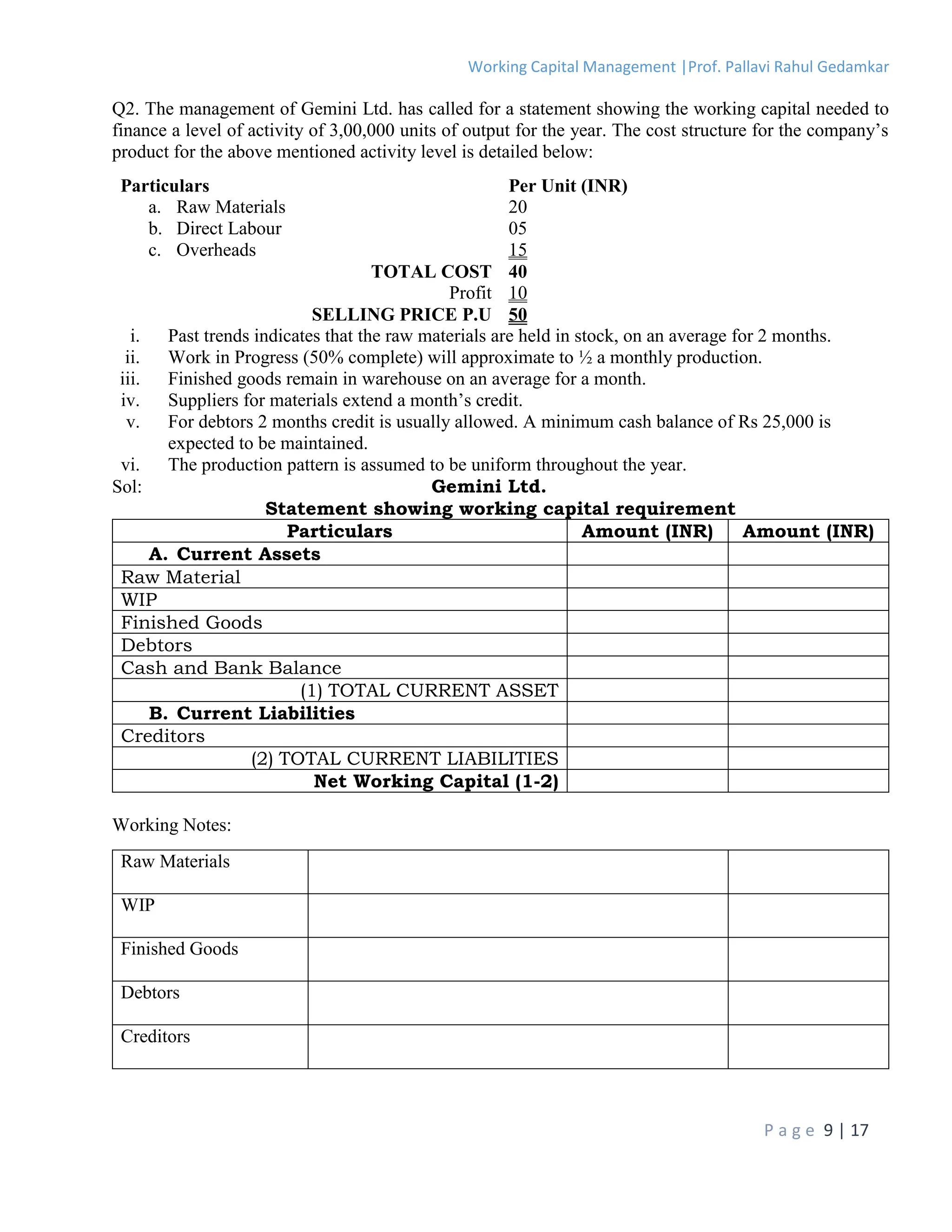
Q2. The management of Gemini Ltd. has called for a statement showing the working capital needed to
finance a level of activity of 3,00,000 units of output for the year. The cost structure for the company’s
product for the above mentioned activity level is detailed below:
Particulars Per Unit (INR)
a. Raw Materials 20
b. Direct Labour 05
c. Overheads 15
TOTAL COST 40
Profit 10
SELLING PRICE P.U 50
i. Past trends indicates that the raw materials are held in stock, on an average for 2 months.
ii. Work in Progress (50% complete) will approximate to ½ a monthly production.
iii. Finished goods remain in warehouse on an average for a month.
iv. Suppliers for materials extend a month’s credit.
v. For debtors 2 months credit is usually allowed. A minimum cash balance of Rs 25,000 is
expected to be maintained.
vi. The production pattern is assumed to be uniform throughout the year.
Sol: Gemini Ltd.
Statement showing working capital requirement
Particulars Amount (INR) Amount (INR)
A. Current Assets
Raw Material
WIP
Finished Goods
Debtors
Cash and Bank Balance
(1) TOTAL CURRENT ASSET
B. Current Liabilities
Creditors
(2) TOTAL CURRENT LIABILITIES
Net Working Capital (1-2)
Working Notes:
Raw Materials
WIP
Finished Goods
Debtors
Creditors
Working Capital Management |Prof. Pallavi Rahul Gedamkar
P a g e 10 | 17
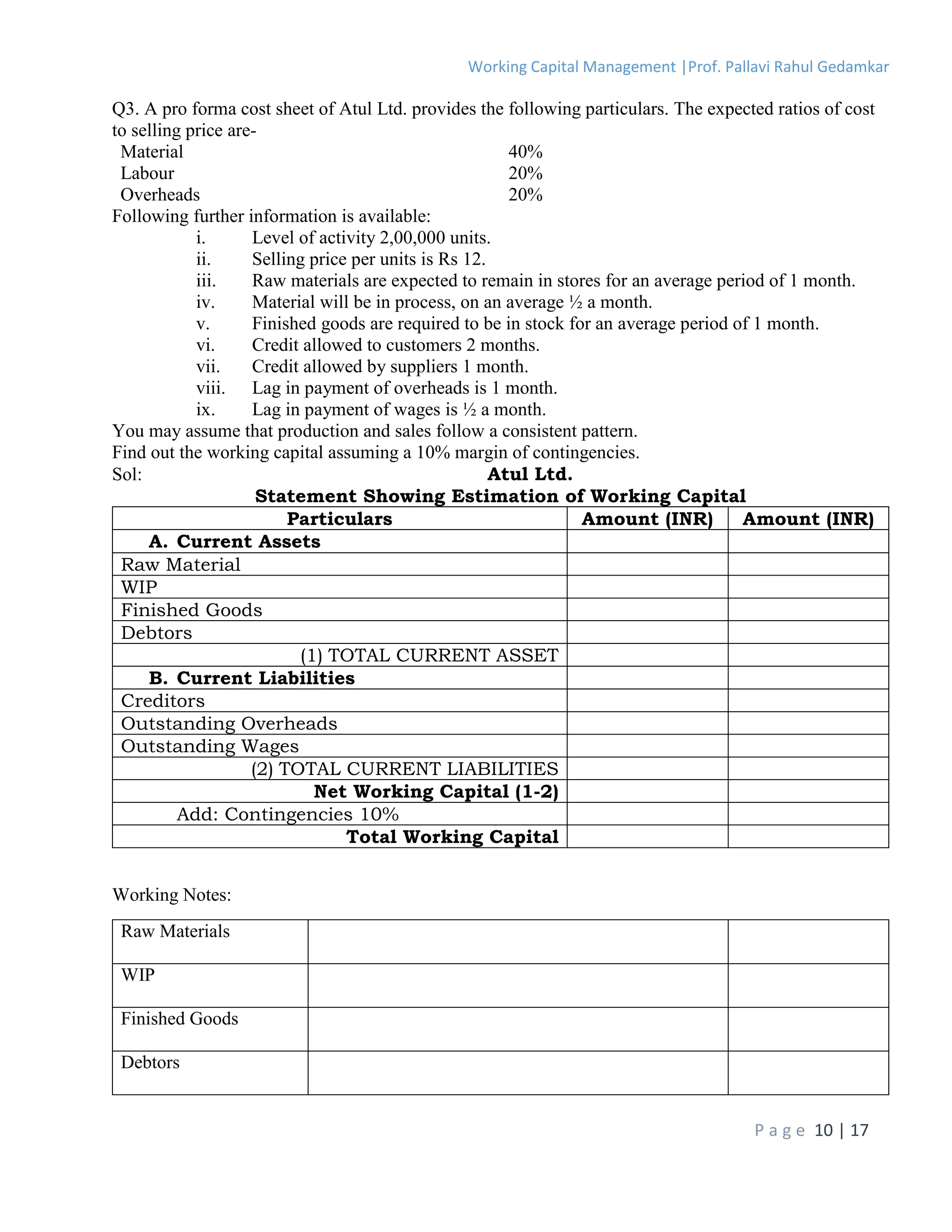
Q3. A pro forma cost sheet of Atul Ltd. provides the following particulars. The expected ratios of cost
to selling price are-
Material 40%
Labour 20%
Overheads 20%
Following further information is available:
i. Level of activity 2,00,000 units.
ii. Selling price per units is Rs 12.
iii. Raw materials are expected to remain in stores for an average period of 1 month.
iv. Material will be in process, on an average ½ a month.
v. Finished goods are required to be in stock for an average period of 1 month.
vi. Credit allowed to customers 2 months.
vii. Credit allowed by suppliers 1 month.
viii. Lag in payment of overheads is 1 month.
ix. Lag in payment of wages is ½ a month.
You may assume that production and sales follow a consistent pattern.
Find out the working capital assuming a 10% margin of contingencies.
Sol: Atul Ltd.
Statement Showing Estimation of Working Capital
Particulars Amount (INR) Amount (INR)
A. Current Assets
Raw Material
WIP
Finished Goods
Debtors
(1) TOTAL CURRENT ASSET
B. Current Liabilities
Creditors
Outstanding Overheads
Outstanding Wages
(2) TOTAL CURRENT LIABILITIES
Net Working Capital (1-2)
Add: Contingencies 10%
Total Working Capital
Working Notes:
Raw Materials
WIP
Finished Goods
Debtors
Working Capital Management |Prof. Pallavi Rahul Gedamkar
P a g e 11 | 17
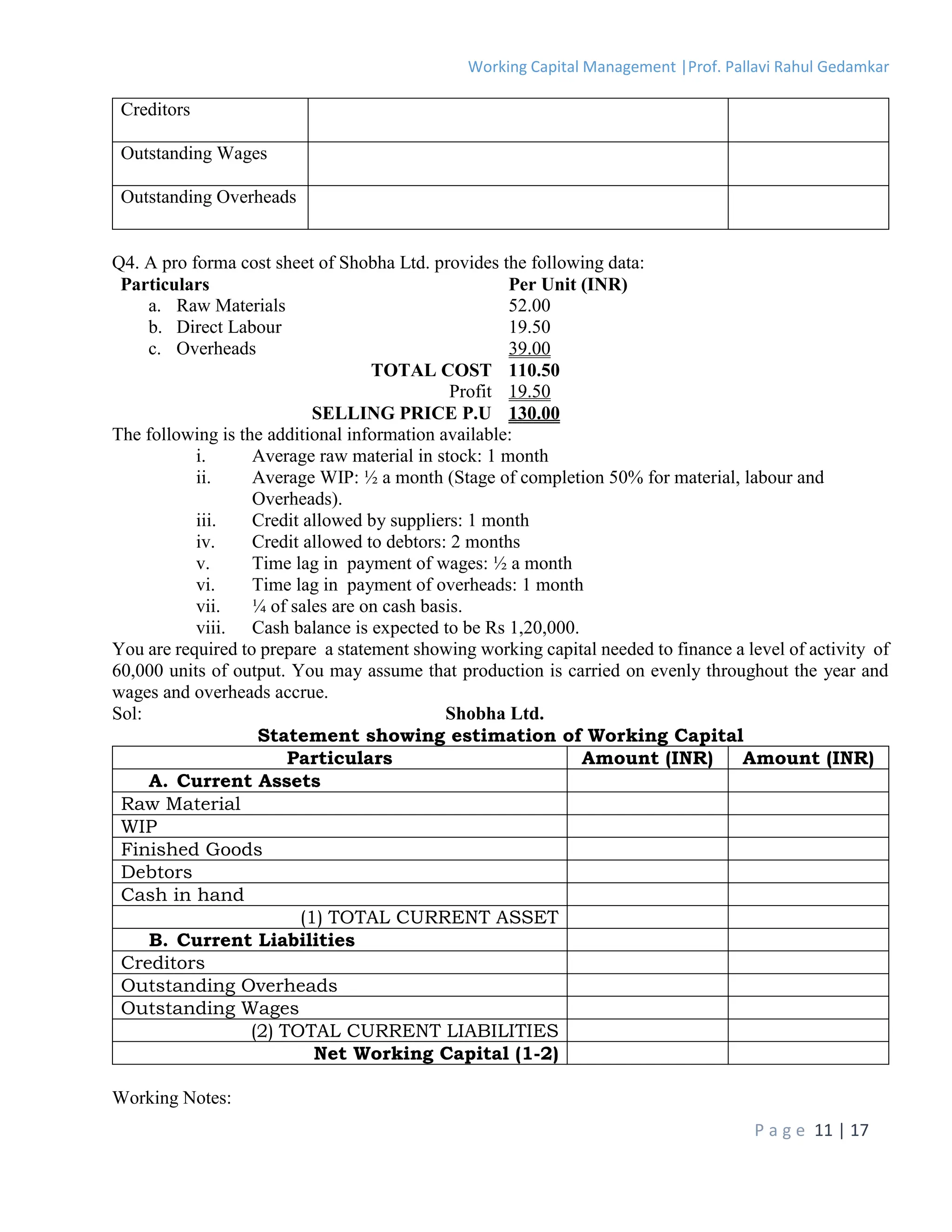
Creditors
Outstanding Wages
Outstanding Overheads
Q4. A pro forma cost sheet of Shobha Ltd. provides the following data:
Particulars Per Unit (INR)
a. Raw Materials 52.00
b. Direct Labour 19.50
c. Overheads 39.00
TOTAL COST 110.50
Profit 19.50
SELLING PRICE P.U 130.00
The following is the additional information available:
i. Average raw material in stock: 1 month
ii. Average WIP: ½ a month (Stage of completion 50% for material, labour and
Overheads).
iii. Credit allowed by suppliers: 1 month
iv. Credit allowed to debtors: 2 months
v. Time lag in payment of wages: ½ a month
vi. Time lag in payment of overheads: 1 month
vii. ¼ of sales are on cash basis.
viii. Cash balance is expected to be Rs 1,20,000.
You are required to prepare a statement showing working capital needed to finance a level of activity of
60,000 units of output. You may assume that production is carried on evenly throughout the year and
wages and overheads accrue.
Sol: Shobha Ltd.
Statement showing estimation of Working Capital
Particulars Amount (INR) Amount (INR)
A. Current Assets
Raw Material
WIP
Finished Goods
Debtors
Cash in hand
(1) TOTAL CURRENT ASSET
B. Current Liabilities
Creditors
Outstanding Overheads
Outstanding Wages
(2) TOTAL CURRENT LIABILITIES
Net Working Capital (1-2)
Working Notes:
Working Capital Management |Prof. Pallavi Rahul Gedamkar
P a g e 12 | 17
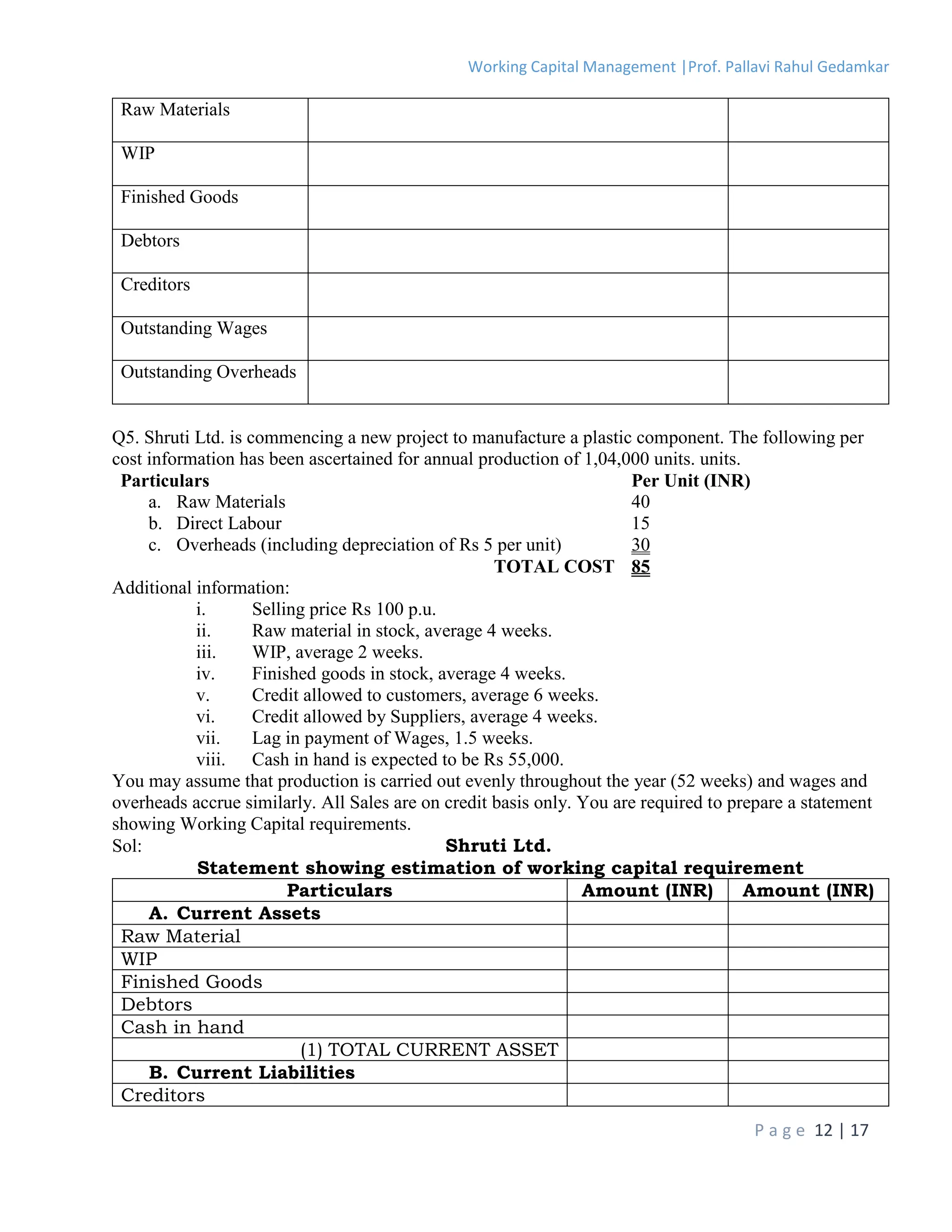
Raw Materials
WIP
Finished Goods
Debtors
Creditors
Outstanding Wages
Outstanding Overheads
Q5. Shruti Ltd. is commencing a new project to manufacture a plastic component. The following per
cost information has been ascertained for annual production of 1,04,000 units. units.
Particulars Per Unit (INR)
a. Raw Materials 40
b. Direct Labour 15
c. Overheads (including depreciation of Rs 5 per unit) 30
TOTAL COST 85
Additional information:
i. Selling price Rs 100 p.u.
ii. Raw material in stock, average 4 weeks.
iii. WIP, average 2 weeks.
iv. Finished goods in stock, average 4 weeks.
v. Credit allowed to customers, average 6 weeks.
vi. Credit allowed by Suppliers, average 4 weeks.
vii. Lag in payment of Wages, 1.5 weeks.
viii. Cash in hand is expected to be Rs 55,000.
You may assume that production is carried out evenly throughout the year (52 weeks) and wages and
overheads accrue similarly. All Sales are on credit basis only. You are required to prepare a statement
showing Working Capital requirements.
Sol: Shruti Ltd.
Statement showing estimation of working capital requirement
Particulars Amount (INR) Amount (INR)
A. Current Assets
Raw Material
WIP
Finished Goods
Debtors
Cash in hand
(1) TOTAL CURRENT ASSET
B. Current Liabilities
Creditors
Working Capital Management |Prof. Pallavi Rahul Gedamkar
P a g e 13 | 17
Outstanding Wages
(2) TOTAL CURRENT LIABILITIES
Net Working Capital (1-2)
Working Notes:
Raw Materials
WIP
Finished Goods
Debtors
Creditors
Outstanding Wages
Numerical on Operating Cycle
Q1. C Ltd. Has obtained the following data concerning the average working capital cycle for other
Companies in the same industry:
Using the following data calculate current working capital cycle.
Particulars Days Sales 3,000,000
Raw Material Turnover 20 days Cost of Production 2,100,000
Credit Received -40 days Purchases 600,000
Work in progress Turnover 15 days Average Raw Material Stock 80,000
Finished Goods Stock Turnover 40 days Average WIP 85,000
Debtors collection period 60 days Average Finished Goods Stock 180,000
95 days Average Creditors 90,000
Average Debtors 350,000
Sol: Calculation of Operating Cycle
Particulars Formula Calculation Days
1 Raw Material
Average stock of RM *365
Purchase
2 WIP
Stock of WIP * 365
Cost of production
3 Finished Goods
Stock of Finished Goods * 365
Cost of production/ COGS
4 Debtors
Debtors * 365
Sales
Less: 5 Creditors
Creditors * 365
Purchase
Working Capital Management |Prof. Pallavi Rahul Gedamkar
P a g e 14 | 17
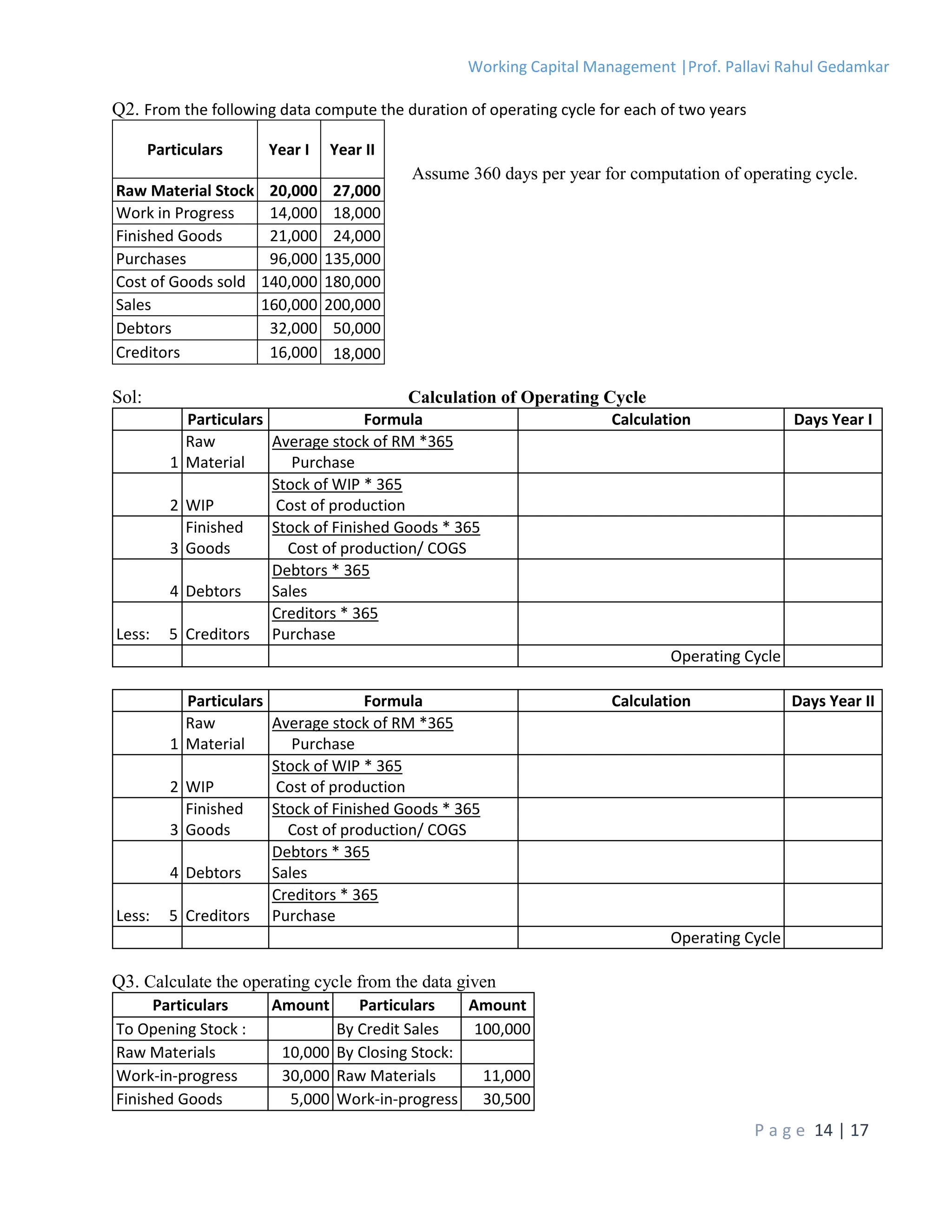
Q2. From the following data compute the duration of operating cycle for each of two years
Sol: Calculation of Operating Cycle
Particulars Formula Calculation Days Year I
1
Raw
Material
Average stock of RM *365
Purchase
2 WIP
Stock of WIP * 365
Cost of production
3
Finished
Goods
Stock of Finished Goods * 365
Cost of production/ COGS
4 Debtors
Debtors * 365
Sales
Less: 5 Creditors
Creditors * 365
Purchase
Operating Cycle
Particulars Formula Calculation Days Year II
1
Raw
Material
Average stock of RM *365
Purchase
2 WIP
Stock of WIP * 365
Cost of production
3
Finished
Goods
Stock of Finished Goods * 365
Cost of production/ COGS
4 Debtors
Debtors * 365
Sales
Less: 5 Creditors
Creditors * 365
Purchase
Operating Cycle
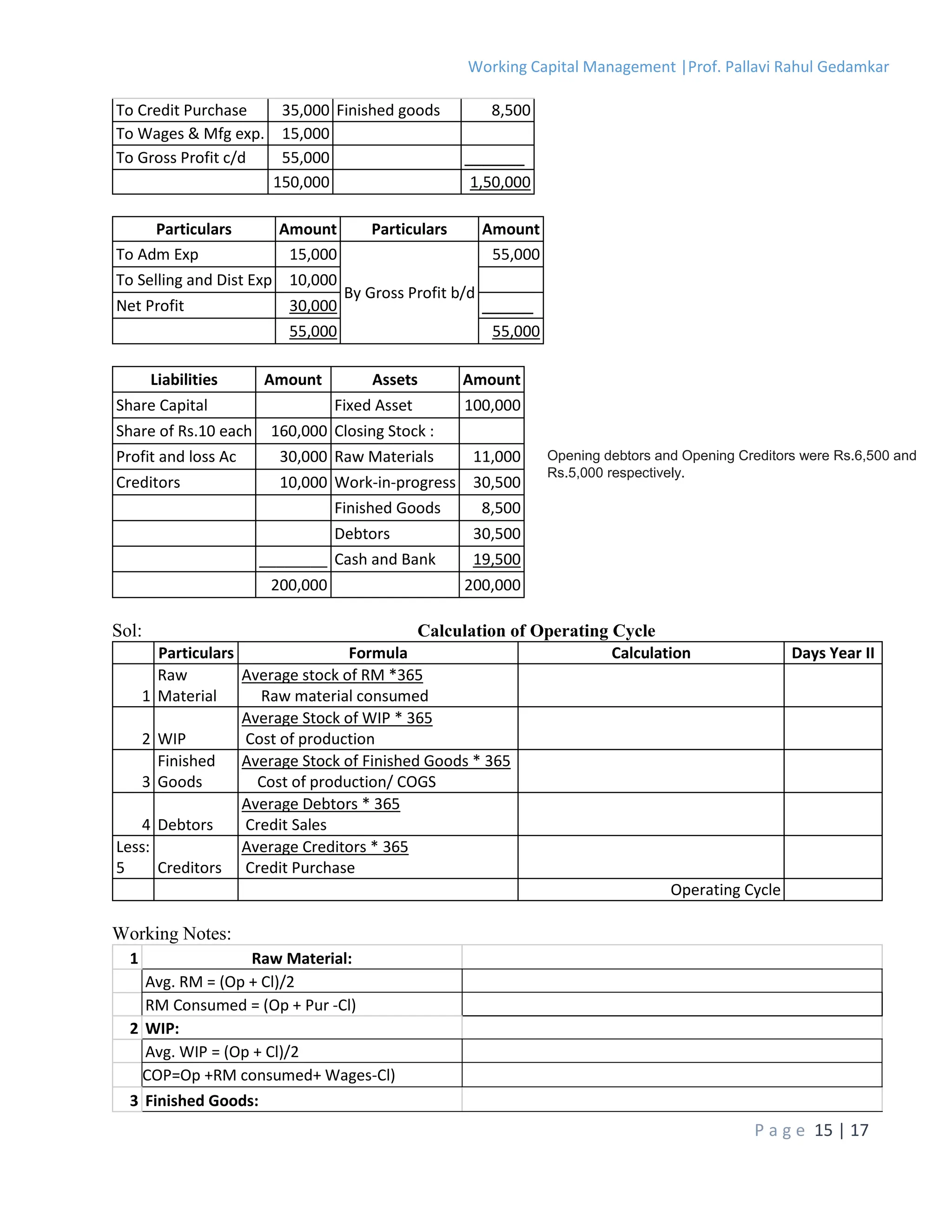
Q3. Calculate the operating cycle from the data given
Particulars Amount Particulars Amount
To Opening Stock : By Credit Sales 100,000
Raw Materials 10,000 By Closing Stock:
Work-in-progress 30,000 Raw Materials 11,000
Finished Goods 5,000 Work-in-progress 30,500
Particulars Year I Year II
Raw Material Stock 20,000 27,000
Work in Progress 14,000 18,000
Finished Goods 21,000 24,000
Purchases 96,000 135,000
Cost of Goods sold 140,000 180,000
Sales 160,000 200,000
Debtors 32,000 50,000
Creditors 16,000 18,000
Assume 360 days per year for computation of operating cycle.
Working Capital Management |Prof. Pallavi Rahul Gedamkar
P a g e 15 | 17
To Credit Purchase 35,000 Finished goods 8,500
To Wages & Mfg exp. 15,000
To Gross Profit c/d 55,000 _______
150,000 1,50,000
Particulars Amount Particulars Amount
To Adm Exp 15,000
By Gross Profit b/d
55,000
To Selling and Dist Exp 10,000
Net Profit 30,000 ______
55,000 55,000
Liabilities Amount Assets Amount
Share Capital Fixed Asset 100,000
Share of Rs.10 each 160,000 Closing Stock :
Profit and loss Ac 30,000 Raw Materials 11,000
Creditors 10,000 Work-in-progress 30,500
Finished Goods 8,500
Debtors 30,500
________ Cash and Bank 19,500
200,000 200,000
Sol: Calculation of Operating Cycle
Particulars Formula Calculation Days Year II
1
Raw
Material
Average stock of RM *365
Raw material consumed
2 WIP
Average Stock of WIP * 365
Cost of production
3
Finished
Goods
Average Stock of Finished Goods * 365
Cost of production/ COGS
4 Debtors
Average Debtors * 365
Credit Sales
Less:
5 Creditors
Average Creditors * 365
Credit Purchase
Operating Cycle
Working Notes:
1 Raw Material:
Avg. RM = (Op + Cl)/2
RM Consumed = (Op + Pur -Cl)
2 WIP:
Avg. WIP = (Op + Cl)/2
COP=Op +RM consumed+ Wages-Cl)
3 Finished Goods:
Opening debtors and Opening Creditors were Rs.6,500 and
Rs.5,000 respectively.
Working Capital Management |Prof. Pallavi Rahul Gedamkar
P a g e 16 | 17
Avg. FG = (Op + Cl)/2
COGS = Op + COP + Adm Exps - Cl)
4 Debtors:
Avg. Drs = (Op + Cl)/2
5 Creditors:
Avg. Crs = (Op + Cl)/2
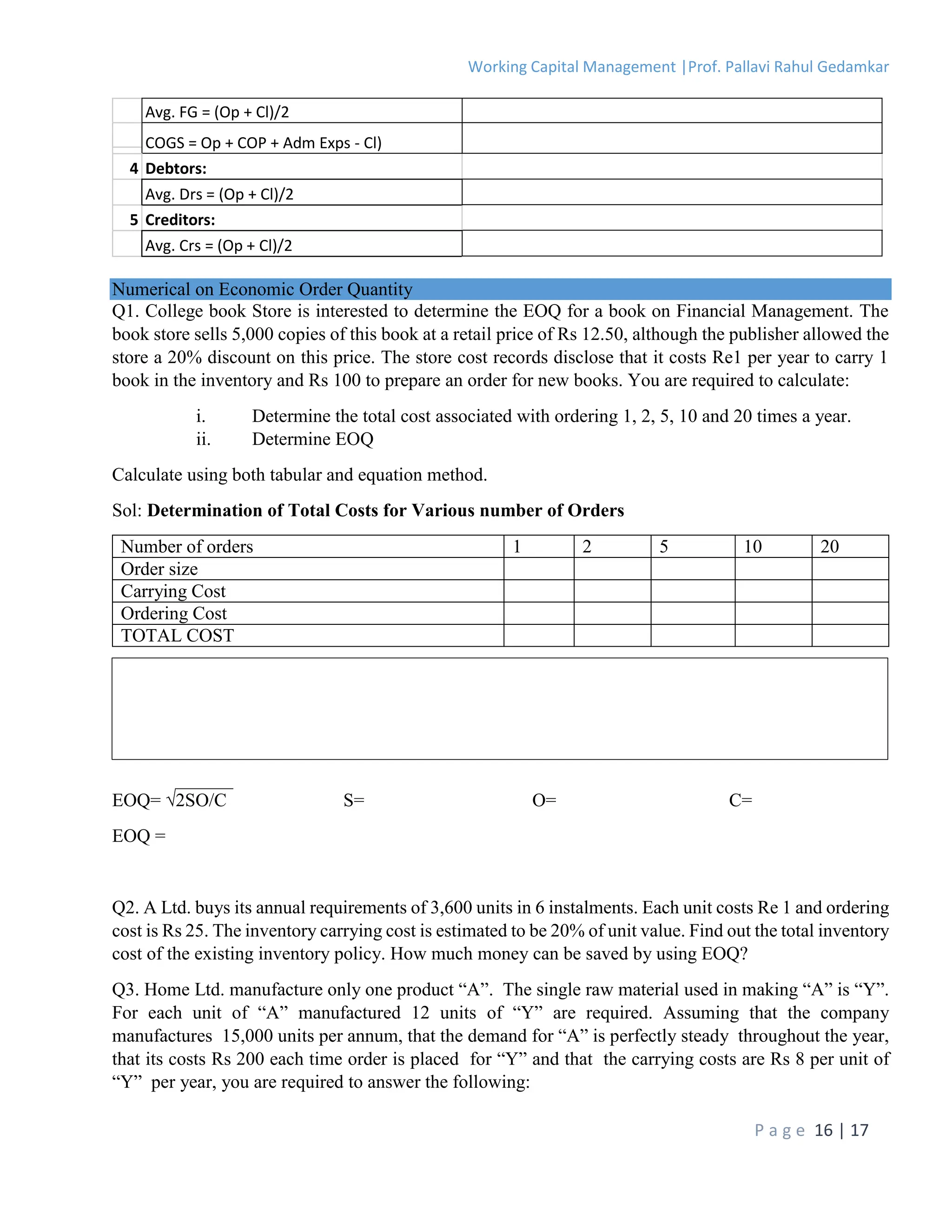
Numerical on Economic Order Quantity
Q1. College book Store is interested to determine the EOQ for a book on Financial Management. The
book store sells 5,000 copies of this book at a retail price of Rs 12.50, although the publisher allowed the
store a 20% discount on this price. The store cost records disclose that it costs Re1 per year to carry 1
book in the inventory and Rs 100 to prepare an order for new books. You are required to calculate:
i. Determine the total cost associated with ordering 1, 2, 5, 10 and 20 times a year.
ii. Determine EOQ
Calculate using both tabular and equation method.
Sol: Determination of Total Costs for Various number of Orders
Number of orders 1 2 5 10 20
Order size
Carrying Cost
Ordering Cost
TOTAL COST
EOQ= √2SO/C S= O= C=
EOQ =
Q2. A Ltd. buys its annual requirements of 3,600 units in 6 instalments. Each unit costs Re 1 and ordering
cost is Rs 25. The inventory carrying cost is estimated to be 20% of unit value. Find out the total inventory
cost of the existing inventory policy. How much money can be saved by using EOQ?
Q3. Home Ltd. manufacture only one product “A”. The single raw material used in making “A” is “Y”.
For each unit of “A” manufactured 12 units of “Y” are required. Assuming that the company
manufactures 15,000 units per annum, that the demand for “A” is perfectly steady throughout the year,
that its costs Rs 200 each time order is placed for “Y” and that the carrying costs are Rs 8 per unit of
“Y” per year, you are required to answer the following:
Working Capital Management |Prof. Pallavi Rahul Gedamkar
P a g e 17 | 17
i. What is EOQ of Y?
ii. What are total costs of inventory for the quantity?
iii. How many times per year would inventory be ordered?
Q4. You are given the following information regarding the inventory handling in XYZ Ltd.:
Annual Usage 300 units
Cost price per unit Rs 100
Ordering Costs Rs 30 per order
Carrying Costs 20% of the value of inventory
Calculate EOQ.
Q5. A manufacturer of refrigerator buys 3,200 units of certain component from a supplier. His annual
usage is 3,200 units. The cost of placing an order is Rs 100 and the cost of carrying 1 unit for a year
is Rs 16. Calculate EOQ.

Working Capital Management- Notes Plus Numericals

  • 1.
    Working Capital Management|Prof. Pallavi Rahul Gedamkar P a g e 1 | 17 Chapter 4- WORKING CAPITAL MANAGEMENT 4.1 Introduction to Working Capital Management 4.2 Operating Cycle 4.3 Calculation of working capital INTRODUCTION It has been often observed that the shortage of working capital leads to the failure of a business. The proper management of working capital may bring about the success of a business firm. The management of working capital includes the management of current assets and current liabilities. A number of companies for the past few years have been finding it difficult to solve the increasing problems of adopting seriously the management of working capital. A firm may exist without making profits but cannot survive without liquidity. The function of working capital management in an organization is similar that of the heart in a human body. Also it is an important function of financial management. The financial manager must determine the satisfactory level of working capital funds and also the optimum mix of current assets and current liabilities. He must ensure that the appropriate sources of funds are used to finance working capital and should also see that short term obligation of the business are met well in time. Working capital management is a business process that helps companies make effective use of their current assets and optimize cash flow. It’s oriented around ensuring short-term financial obligations and expenses can be met, while also contributing towards longer-term business objectives. The goal of working capital management is to maximize operational efficiency. By improving the way they manage working capital, companies can free up cash that would otherwise be trapped on their balance sheets. As a result, they may be able to reduce the need for external borrowing, fuel growth, fund mergers or acquisitions, or invest in R&D. Working capital is essential to the health of every business and improving your working capital position can provide a boost to the operational efficiency of a business, but managing it effectively is something of a balancing act. Companies need to have enough cash available to cover both planned and unexpected costs, while also making the best use of the funds available to fuel growth. This is achieved by the effective management of accounts payable, accounts receivable, inventory, and cash. DEFINITION OF WORKING CAPITAL 1. Gerestenburg defines, “Circulating capital means current assets of a company that are changed in the ordinary course of business from one form to another, as for example, from cash to inventories, inventories to receivables, receivables into cash”. 2. Shubin defines, “Working capital is the amount of funds necessary to cover the cost of operating the enterprise.” 3. Weston and Brigham defines, “Working capital refers to a firm’s investment in short term assets – cash, short term securities accounts receivables and inventories.”
  • 2.
    Working Capital Management|Prof. Pallavi Rahul Gedamkar P a g e 2 | 17 4. Hoagland defines, “Working capital is descriptive of that capital which is not fixed. But the more common use of the working capital is to consider it as the difference between the book value of current assets and the current liabilities.” 5. Mead, Malott and Field defines, “Working capital means current assets.” 6. Bonneville defines, “Any acquisition of funds which increases the current assets, and which increases the working capital for they are one and the same.” 7. J.S. Mill defines, “The sum of the current assets is the working capital of business.” From the above definitions, it is clear that working capital is a going concern, is a revolving fund. It consists of cash receipts, from sales which are to cover the cost of operation. CONCEPT OF WORKING CAPITAL MANAGEMENT There are two concepts of working capital viz .quantitative and qualitative. Some people also define the two concepts as gross concept and net concept. According to quantitative concept, the amount of working capital refers to ‘total of current assets’. Current assets are considered to be gross working capital in this concept. The qualitative concept gives an idea regarding source of financing capital. According to qualitative concept the amount of working capital refers to “excess of current assets over current liabilities.” L.J. Guthmann defined working capital as “the portion of a firm’s current assets which are financed from long–term funds.” The excess of current assets over current liabilities is termed as ‘Net working capital’. In this concept “Net working capital” represents the amount of current assets which would remain if all current liabilities were paid. Both the concepts of working capital have their own points of importance. “If the objectives is to measure the size and extent to which current assets are being used, ‘Gross concept’ is useful; whereas in evaluating the liquidity position of an undertaking ‘Net concept’ becomes pertinent and preferable. It is necessary to understand the meaning of current assets and current liabilities for learning the meaning of working capital, which is explained below: 1. Current assets – It is rightly observed that “Current assets have a short life span. These type of assets are engaged in current operation of a business and normally used for short– term operations of the firm during an accounting period i.e. within twelve months. The two important characteristics of such assets are, (i) short life span, and (ii) swift transformation into other form of assets. Cash balance may be held idle for a week or two; account receivable may have a life span of 30 to 60 days, and inventories may be held for 30 to 100 days. CA examples are Cash in hand, cash at bank, sundry debtors, bills receivables, short term investments, inventories, marketable securities, prepaid expenses, accrued incomes etc. 2. Current liabilities – The firm creates a Current Liability towards creditors (sellers) from whom it has purchased raw materials on credit. This liability is also known as accounts payable and shown in the balance sheet till the payment has been made to the creditors. The claims or obligations which are normally expected to mature for payment within an accounting cycle (1 year) are known as current liabilities. These can be defined as “those liabilities where liquidation is reasonably
  • 3.
    Working Capital Management|Prof. Pallavi Rahul Gedamkar P a g e 3 | 17 expected to require the use of existing resources properly classifiable as current assets, or the creation of other current assets, or the creation of other current liabilities.” CL examples are Sundry creditors, bills payable, outstanding expenses, accrued expenses, short term advances and deposits, dividends payable, bank overdraft etc. TYPES OF WORKING CAPITAL MANAGEMENT TYPES OF WORKING CAPITAL On the basis of concept: on the basis of concept working capital is divided into two categories as under: 1. Gross Working Capital: Gross working capital refers to total investment in current assets. The current assets employed in business give the idea about the utilization of working capital and idea about the economic position of the company. Gross working capital concepts is popular and acceptable concept in the field of finance. 2. Net Working Capital: Net working capital means current assets minus current liabilities. The difference between current assets and current liabilities is called the net working capital. If the net working capital is positive, business is able to meet its current liabilities. Net working capital concept provides the measurement for determining the creditworthiness of company. Working Capital Management Liquidity Management Account Receivable Management Iventory Management Account Payable Management Short-Term Debt Management Working Capital On the basis of CONCEPT Gross Working Capital Net Working Capital On the basis of TIME Permenent Working Capital Regular Working Capital Reserve Working Capital Temporary Working Capital Seasonal Working Capital Special Working Capital
  • 4.
    Working Capital Management|Prof. Pallavi Rahul Gedamkar P a g e 4 | 17 On the basis of time: The requirements of working capital are continuous. More working capital is required in a particular season or the peck period of business activity. 1. Permanent working capital: This type of working capital is known as Fixed Working Capital. Permanent working capital means the part of working capital which is permanently locked up in the current assets to carry out the business smoothly. The minimum amount of current assets which is required to conduct the business smoothly during the year is called permanent working capital. For example, investments required to maintain the minimum stock of raw materials or to cash balance. The amount of permanent working capital depends upon the size and growth of company. Fixed working capital can further be divided into two categories as under: i. Regular Working capital: Minimum amount of working capital required to keep the primary circulation. Some amount of cash is necessary for the payment of wages, salaries etc. ii. Reserve Margin Working capital: Additional working capital may also be required for contingencies that may arise any time. The reserve working capital is the excess of capital over the needs of the regular working capital is kept aside as reserve for contingencies, such as strike, business depression etc. 2. Variable or Temporary Working Capital: The term variable working capital refers that the level of working capital is temporary and fluctuating. Variable working capital may change from one assets to another and changes with the increase or decrease in the volume of business. The variable working capital may also be subdivided into following two sub-groups. i. Seasonal Variable Working capital: Seasonal working capital is the additional amount which is required during the active business seasons of the year. Raw materials like raw- cotton or jute or sugarcane are purchased in particular season. The industry has to borrow funds for short period. It is particularly suited to a business of a seasonal nature. In short, seasonal working capital is required to meet the seasonal liquidity of the business. ii. Special variable working capital: Additional working capital may also be needed to provide additional current assets to meet the unexpected events or special operations such as extensive marketing campaigns or carrying of special job etc. Graph Showing Permanent and Temporary Working Capital Graph Showing Permanent and Temporary Working Capital
  • 5.
    Working Capital Management|Prof. Pallavi Rahul Gedamkar P a g e 5 | 17 FACTORS DETERMINING WORKING CAPITAL The working capital requirements of an enterprise depend on a variety of factors. These factors affect different enterprises differently and vary from time to time. The following factor determine the amount of working capital: OPERATING CYCLE The duration of time required to complete the sequence of events right from purchase of raw material / goods for cash to the realization of sales in cash is called the operating cycle, working capital cycle or cash cycle. The Operating Cycle tracks the number of days between the initial date of inventory purchase and the receipt of cash payment from customer credit purchases. Operating Cycle of Manufacturing Cycle Operating Cycle of Non-Manufacturing Firm Nature of Business Size of Business Demand of Creditors Cash Requirement Time Volume of Sales Term of Purchase and Sale Business Cycle Production Cycle Liquidity and Profitability Seasonal Fluctuation
  • 6.
    Working Capital Management|Prof. Pallavi Rahul Gedamkar P a g e 6 | 17 The above operating cycle in figure relates to a manufacturing firm where cash is needs to purchase raw materials and convert raw materials into work-in-process is converted into finished goods. Finished goods will be sold for cash or credit and ultimately debtors will be realized. The non-manufacturing firms, such as whole sellers and retailers, will not have the manufacturing phase; they will have rather direct conversion of cash into finished stock, into accounts receivables and then into cash. The operating cycle of a non-manufacturing firm is shown as under. Operating Cycle of Service and Financial Firms In addition to this, some service and financial concerns may not have any inventory at all. Such firm have the shorter operating cycle. LIQUIDITY VERSUS PROFITABILITY: RISK-RETURN TANGLE The firm would make just enough investment in current assets, if it were possible to estimate working capital needs exactly. Under perfect certainty, the current assets holdings would be at the minimum level. A ledger investment in current assets under certainty would mean a low rate or return investment for the firm, as excess investment in current assets will not earn enough return. A smaller investment in current assets, on the other hand, would mean interrupted production and sales, because of frequent stock-outs and inability to creditor in time to restrictive credit policy. As it is not possible to estimate working needs accurately, the firm must decide about the levels of current assets to be carried. The current assets holdings of the firm will depend upon its working capital policy. It may follow a conservative or an aggressive policy. These polices have different risk-return implications. A conservative policy means lower return and risk, while an aggressive policy produces higher return and risk. Liquidity • High Investment in Working Capital • More liquid but may not be using Working Capital efficiently • Less Profitable Profitabilty • Low Investment in working Capital • Less liquid but may be using Working Capital efficiently • More profitable
  • 7.
    Working Capital Management|Prof. Pallavi Rahul Gedamkar P a g e 7 | 17 The two important aims of the working capital management are: profitability and solvency. Solvency, used in the technical sense, refers to the firm’s continuous ability to meet maturing obligations. Lenders and creditors expected prompt settlement of their claims as and when due. To ensure solvency, the firm maintains a relatively large investment in current assets holdings. If the firm maintains a relatively large investment in current assets, it will have no difficulty in paying the claims of the creditors when they become due and will be able to fill all sales orders and ensure smooth production. Thus, a liquid firm has less risk of insolvency; that is, it will hardly experiences a cash shortage or stock-outs. However, there is a cost associated with maintaining a sound liquidity position. A considerable amount of the firm’s funds will be tied up in current assets. And to the extent this investment is idle, the firm’s profitability will suffer. To have high profitability, the firm may sacrifice solvency and maintain a relatively low level of current assets. When the firm does so, its profitability will improve as less funds are tied up in idle current assets, but its solvency would be threatened and would be exposed to greater risk of cash shortage and stock- outs. Therefore, the firm should balance the profitability solvency tangle by minimizing the total cost of liquidity and cost of illiquidity. The Cost Trade-off: A different way of looking into the risk-return trade of is in terms of the cost of maintaining a particular level of current assets. There are two different kinds of costs involved. First there is the cost of liquidity. If the firm carries too much liquidity, the firm’s rate of return will be low. Funds tied up in idle cash and excess inventory earn nothing, and receivables levels that are too large also reduce the firm’s profitability. Thus, the cost of liquidity increases with the level of current assets. There is the cost of liquidity, which is the cost of having too little invested in current assets. If the firm carries too little cash, it may not be able to pay bills promptly at they mature. This may force the firm to borrow at high rates of interest. This will also adversely affect the creditworthiness of the firm and it will face difficulties in obtaining funds in future. This all may force the firm into insolvency. If the firm’s inventory level too low, sales may be lost and customers may shift to competitors. Also, low level of book debts may be due to tight credit policy, which would impair sales further. Thus, the low level of current assets involves cost which increases as this level falls. Numerical on Working Capital Calculation Q1. The Board of Directors of XYZ Engineering Co. Pvt. Ltd. Request you to prepare a statement showing the Working Capital Requirements for a level of activity of 1,56,000 units of production. The following information is available for your consideration: Particulars Per Unit (INR) a. Raw Materials 90 b. Direct Labour 40 c. Overheads 75 TOTAL COST 205 Profit 60 SELLING PRICE P.U 265 i. Raw materials are in stock on an average one month.
  • 8.
    Working Capital Management|Prof. Pallavi Rahul Gedamkar P a g e 8 | 17 ii. Materials are in process 50% complete on an average 2 weeks. iii. Finished goods are in stock on an average one month. iv. Credit allowed by suppliers one month. v. Time lag in payment from debtors 2 months. vi. Lag in payment of wages in 1.5 weeks. vii. Lag in payment of overheads one month. 20% of the output is sold against cash. Cash in hand and bank is expected Rs 60,000. Assume that production is carried on evenly throughout the year, wages and overheads accrue similarly and a time period of 4 weeks is equivalent to 1 month. Sol: XYZ Engineering Co. Pvt. Ltd. Statement showing estimation of working capital Particulars Amount (INR) Amount (INR) A. Current Assets Raw Material WIP Finished Goods Debtors Cash and Bank Balance (1) TOTAL CURRENT ASSET B. Current Liabilities Creditors Outstanding Wages Outstanding Overheads (2) TOTAL CURRENT LIABILITIES Net Working Capital (1-2) Working Notes: Raw Materials WIP Finished Goods Debtors Creditors Outstanding Wages Outstanding Overheads
  • 9.
    Working Capital Management|Prof. Pallavi Rahul Gedamkar P a g e 9 | 17 Q2. The management of Gemini Ltd. has called for a statement showing the working capital needed to finance a level of activity of 3,00,000 units of output for the year. The cost structure for the company’s product for the above mentioned activity level is detailed below: Particulars Per Unit (INR) a. Raw Materials 20 b. Direct Labour 05 c. Overheads 15 TOTAL COST 40 Profit 10 SELLING PRICE P.U 50 i. Past trends indicates that the raw materials are held in stock, on an average for 2 months. ii. Work in Progress (50% complete) will approximate to ½ a monthly production. iii. Finished goods remain in warehouse on an average for a month. iv. Suppliers for materials extend a month’s credit. v. For debtors 2 months credit is usually allowed. A minimum cash balance of Rs 25,000 is expected to be maintained. vi. The production pattern is assumed to be uniform throughout the year. Sol: Gemini Ltd. Statement showing working capital requirement Particulars Amount (INR) Amount (INR) A. Current Assets Raw Material WIP Finished Goods Debtors Cash and Bank Balance (1) TOTAL CURRENT ASSET B. Current Liabilities Creditors (2) TOTAL CURRENT LIABILITIES Net Working Capital (1-2) Working Notes: Raw Materials WIP Finished Goods Debtors Creditors
  • 10.
    Working Capital Management|Prof. Pallavi Rahul Gedamkar P a g e 10 | 17 Q3. A pro forma cost sheet of Atul Ltd. provides the following particulars. The expected ratios of cost to selling price are- Material 40% Labour 20% Overheads 20% Following further information is available: i. Level of activity 2,00,000 units. ii. Selling price per units is Rs 12. iii. Raw materials are expected to remain in stores for an average period of 1 month. iv. Material will be in process, on an average ½ a month. v. Finished goods are required to be in stock for an average period of 1 month. vi. Credit allowed to customers 2 months. vii. Credit allowed by suppliers 1 month. viii. Lag in payment of overheads is 1 month. ix. Lag in payment of wages is ½ a month. You may assume that production and sales follow a consistent pattern. Find out the working capital assuming a 10% margin of contingencies. Sol: Atul Ltd. Statement Showing Estimation of Working Capital Particulars Amount (INR) Amount (INR) A. Current Assets Raw Material WIP Finished Goods Debtors (1) TOTAL CURRENT ASSET B. Current Liabilities Creditors Outstanding Overheads Outstanding Wages (2) TOTAL CURRENT LIABILITIES Net Working Capital (1-2) Add: Contingencies 10% Total Working Capital Working Notes: Raw Materials WIP Finished Goods Debtors
  • 11.
    Working Capital Management|Prof. Pallavi Rahul Gedamkar P a g e 11 | 17 Creditors Outstanding Wages Outstanding Overheads Q4. A pro forma cost sheet of Shobha Ltd. provides the following data: Particulars Per Unit (INR) a. Raw Materials 52.00 b. Direct Labour 19.50 c. Overheads 39.00 TOTAL COST 110.50 Profit 19.50 SELLING PRICE P.U 130.00 The following is the additional information available: i. Average raw material in stock: 1 month ii. Average WIP: ½ a month (Stage of completion 50% for material, labour and Overheads). iii. Credit allowed by suppliers: 1 month iv. Credit allowed to debtors: 2 months v. Time lag in payment of wages: ½ a month vi. Time lag in payment of overheads: 1 month vii. ¼ of sales are on cash basis. viii. Cash balance is expected to be Rs 1,20,000. You are required to prepare a statement showing working capital needed to finance a level of activity of 60,000 units of output. You may assume that production is carried on evenly throughout the year and wages and overheads accrue. Sol: Shobha Ltd. Statement showing estimation of Working Capital Particulars Amount (INR) Amount (INR) A. Current Assets Raw Material WIP Finished Goods Debtors Cash in hand (1) TOTAL CURRENT ASSET B. Current Liabilities Creditors Outstanding Overheads Outstanding Wages (2) TOTAL CURRENT LIABILITIES Net Working Capital (1-2) Working Notes:
  • 12.
    Working Capital Management|Prof. Pallavi Rahul Gedamkar P a g e 12 | 17 Raw Materials WIP Finished Goods Debtors Creditors Outstanding Wages Outstanding Overheads Q5. Shruti Ltd. is commencing a new project to manufacture a plastic component. The following per cost information has been ascertained for annual production of 1,04,000 units. units. Particulars Per Unit (INR) a. Raw Materials 40 b. Direct Labour 15 c. Overheads (including depreciation of Rs 5 per unit) 30 TOTAL COST 85 Additional information: i. Selling price Rs 100 p.u. ii. Raw material in stock, average 4 weeks. iii. WIP, average 2 weeks. iv. Finished goods in stock, average 4 weeks. v. Credit allowed to customers, average 6 weeks. vi. Credit allowed by Suppliers, average 4 weeks. vii. Lag in payment of Wages, 1.5 weeks. viii. Cash in hand is expected to be Rs 55,000. You may assume that production is carried out evenly throughout the year (52 weeks) and wages and overheads accrue similarly. All Sales are on credit basis only. You are required to prepare a statement showing Working Capital requirements. Sol: Shruti Ltd. Statement showing estimation of working capital requirement Particulars Amount (INR) Amount (INR) A. Current Assets Raw Material WIP Finished Goods Debtors Cash in hand (1) TOTAL CURRENT ASSET B. Current Liabilities Creditors
  • 13.
    Working Capital Management|Prof. Pallavi Rahul Gedamkar P a g e 13 | 17 Outstanding Wages (2) TOTAL CURRENT LIABILITIES Net Working Capital (1-2) Working Notes: Raw Materials WIP Finished Goods Debtors Creditors Outstanding Wages Numerical on Operating Cycle Q1. C Ltd. Has obtained the following data concerning the average working capital cycle for other Companies in the same industry: Using the following data calculate current working capital cycle. Particulars Days Sales 3,000,000 Raw Material Turnover 20 days Cost of Production 2,100,000 Credit Received -40 days Purchases 600,000 Work in progress Turnover 15 days Average Raw Material Stock 80,000 Finished Goods Stock Turnover 40 days Average WIP 85,000 Debtors collection period 60 days Average Finished Goods Stock 180,000 95 days Average Creditors 90,000 Average Debtors 350,000 Sol: Calculation of Operating Cycle Particulars Formula Calculation Days 1 Raw Material Average stock of RM *365 Purchase 2 WIP Stock of WIP * 365 Cost of production 3 Finished Goods Stock of Finished Goods * 365 Cost of production/ COGS 4 Debtors Debtors * 365 Sales Less: 5 Creditors Creditors * 365 Purchase
  • 14.
    Working Capital Management|Prof. Pallavi Rahul Gedamkar P a g e 14 | 17 Q2. From the following data compute the duration of operating cycle for each of two years Sol: Calculation of Operating Cycle Particulars Formula Calculation Days Year I 1 Raw Material Average stock of RM *365 Purchase 2 WIP Stock of WIP * 365 Cost of production 3 Finished Goods Stock of Finished Goods * 365 Cost of production/ COGS 4 Debtors Debtors * 365 Sales Less: 5 Creditors Creditors * 365 Purchase Operating Cycle Particulars Formula Calculation Days Year II 1 Raw Material Average stock of RM *365 Purchase 2 WIP Stock of WIP * 365 Cost of production 3 Finished Goods Stock of Finished Goods * 365 Cost of production/ COGS 4 Debtors Debtors * 365 Sales Less: 5 Creditors Creditors * 365 Purchase Operating Cycle Q3. Calculate the operating cycle from the data given Particulars Amount Particulars Amount To Opening Stock : By Credit Sales 100,000 Raw Materials 10,000 By Closing Stock: Work-in-progress 30,000 Raw Materials 11,000 Finished Goods 5,000 Work-in-progress 30,500 Particulars Year I Year II Raw Material Stock 20,000 27,000 Work in Progress 14,000 18,000 Finished Goods 21,000 24,000 Purchases 96,000 135,000 Cost of Goods sold 140,000 180,000 Sales 160,000 200,000 Debtors 32,000 50,000 Creditors 16,000 18,000 Assume 360 days per year for computation of operating cycle.
  • 15.
    Working Capital Management|Prof. Pallavi Rahul Gedamkar P a g e 15 | 17 To Credit Purchase 35,000 Finished goods 8,500 To Wages & Mfg exp. 15,000 To Gross Profit c/d 55,000 _______ 150,000 1,50,000 Particulars Amount Particulars Amount To Adm Exp 15,000 By Gross Profit b/d 55,000 To Selling and Dist Exp 10,000 Net Profit 30,000 ______ 55,000 55,000 Liabilities Amount Assets Amount Share Capital Fixed Asset 100,000 Share of Rs.10 each 160,000 Closing Stock : Profit and loss Ac 30,000 Raw Materials 11,000 Creditors 10,000 Work-in-progress 30,500 Finished Goods 8,500 Debtors 30,500 ________ Cash and Bank 19,500 200,000 200,000 Sol: Calculation of Operating Cycle Particulars Formula Calculation Days Year II 1 Raw Material Average stock of RM *365 Raw material consumed 2 WIP Average Stock of WIP * 365 Cost of production 3 Finished Goods Average Stock of Finished Goods * 365 Cost of production/ COGS 4 Debtors Average Debtors * 365 Credit Sales Less: 5 Creditors Average Creditors * 365 Credit Purchase Operating Cycle Working Notes: 1 Raw Material: Avg. RM = (Op + Cl)/2 RM Consumed = (Op + Pur -Cl) 2 WIP: Avg. WIP = (Op + Cl)/2 COP=Op +RM consumed+ Wages-Cl) 3 Finished Goods: Opening debtors and Opening Creditors were Rs.6,500 and Rs.5,000 respectively.
  • 16.
    Working Capital Management|Prof. Pallavi Rahul Gedamkar P a g e 16 | 17 Avg. FG = (Op + Cl)/2 COGS = Op + COP + Adm Exps - Cl) 4 Debtors: Avg. Drs = (Op + Cl)/2 5 Creditors: Avg. Crs = (Op + Cl)/2 Numerical on Economic Order Quantity Q1. College book Store is interested to determine the EOQ for a book on Financial Management. The book store sells 5,000 copies of this book at a retail price of Rs 12.50, although the publisher allowed the store a 20% discount on this price. The store cost records disclose that it costs Re1 per year to carry 1 book in the inventory and Rs 100 to prepare an order for new books. You are required to calculate: i. Determine the total cost associated with ordering 1, 2, 5, 10 and 20 times a year. ii. Determine EOQ Calculate using both tabular and equation method. Sol: Determination of Total Costs for Various number of Orders Number of orders 1 2 5 10 20 Order size Carrying Cost Ordering Cost TOTAL COST EOQ= √2SO/C S= O= C= EOQ = Q2. A Ltd. buys its annual requirements of 3,600 units in 6 instalments. Each unit costs Re 1 and ordering cost is Rs 25. The inventory carrying cost is estimated to be 20% of unit value. Find out the total inventory cost of the existing inventory policy. How much money can be saved by using EOQ? Q3. Home Ltd. manufacture only one product “A”. The single raw material used in making “A” is “Y”. For each unit of “A” manufactured 12 units of “Y” are required. Assuming that the company manufactures 15,000 units per annum, that the demand for “A” is perfectly steady throughout the year, that its costs Rs 200 each time order is placed for “Y” and that the carrying costs are Rs 8 per unit of “Y” per year, you are required to answer the following:
  • 17.
    Working Capital Management|Prof. Pallavi Rahul Gedamkar P a g e 17 | 17 i. What is EOQ of Y? ii. What are total costs of inventory for the quantity? iii. How many times per year would inventory be ordered? Q4. You are given the following information regarding the inventory handling in XYZ Ltd.: Annual Usage 300 units Cost price per unit Rs 100 Ordering Costs Rs 30 per order Carrying Costs 20% of the value of inventory Calculate EOQ. Q5. A manufacturer of refrigerator buys 3,200 units of certain component from a supplier. His annual usage is 3,200 units. The cost of placing an order is Rs 100 and the cost of carrying 1 unit for a year is Rs 16. Calculate EOQ.