WORKING CAPITAL MANAGEMENT PRESENTED BY: NAZIA NAJ
DEFINITION Working capital refers to that part of the firm’s capital, which is required for financing short-term or current assets such as cash marketable securities, debtors and inventories.  It is also known as revolving or circulating capital or short-term capital.
Objectives of working capital   •  For the purchase of raw materials, components and spares. •  To pay wages and salaries. •  To incur day to day expenses and overhead costs such as fuel, power, and  office expenses etc. •  To provide credit facilities to customers etc.
NEED FOR WORKING CAPITAL Quick payments to suppliers Cash discount Easy availabilities of bank loans Increase in the productivity of fixed assets Meeting unseen contingencies
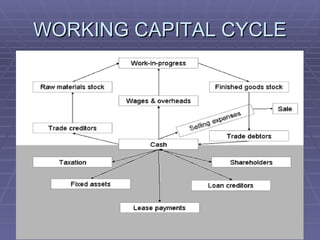
WORKING CAPITAL CYCLE
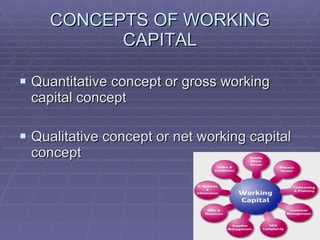
CONCEPTS OF WORKING CAPITAL Quantitative concept or gross working capital concept Qualitative concept or net working capital concept
COMPONENTS Current Assets These are those assets which change  their form within a short period of time, generally within one year. It includes-: Debtors, B/R, Cash & Bank balance, Prepaid expenses etc.
Cont…. Current Liabilities These are those liabilities which are payable within a short period of time, generally within one year. It includes- Creditors, B/P, Bank o/d, Short term loan, Proposed dividend etc.
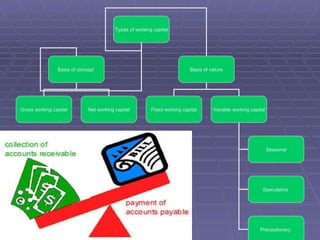
Types of working capital Basis of concept  Basis of nature Gross working capital Net working capital Fixed working capital Variable working capital Seasonal Precautionary  Speculative
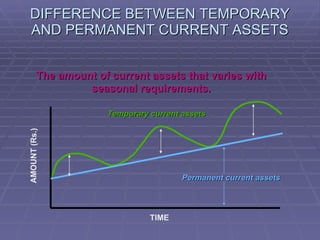
DIFFERENCE BETWEEN TEMPORARY AND PERMANENT CURRENT ASSETS Permanent current assets TIME AMOUNT (Rs.) Temporary current assets The amount of current assets that varies with seasonal requirements.
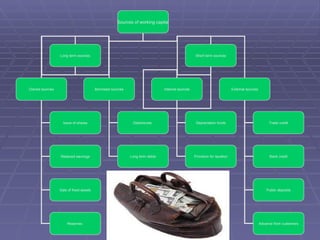
Sources of working capital Long term sources Short term sources Owned sources Borrowed sources Internal sources External sources Issue of shares Retained earnings Reserves  Sale of fixed assets Debentures  Long term debts Depreciation funds Provision for taxation Trade credit Advance from customers Public deposits Bank credit
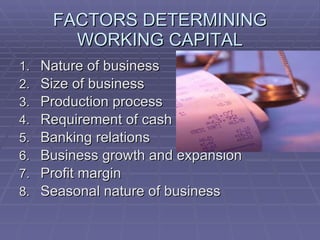
FACTORS DETERMINING WORKING CAPITAL Nature of business Size of business Production process Requirement of cash Banking relations Business growth and expansion Profit margin Seasonal nature of business
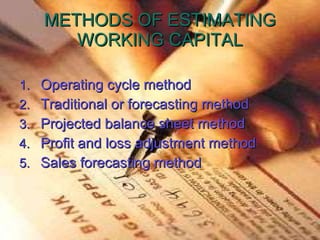
METHODS OF ESTIMATING WORKING CAPITAL Operating cycle method Traditional or forecasting method Projected balance sheet method Profit and loss adjustment method Sales forecasting method
Advantages of working capital  •  It helps the business concern in maintaining the goodwill. •  It can arrange loans from banks and others on easy and favorable terms. •  It enables a concern to face business crisis in emergencies such as depression. •  It creates an environment of security, confidence, and over all efficiency in a business. •  It helps in maintaining solvency of the business.
Disadvantages of working capital  •  Rate of return on investments also fall with the shortage of working capital. •  Excess working capital may result into over all inefficiency in organization. •  Excess working capital means idle funds which earn no profits. •  Inadequate working capital can not pay its short term liabilities in time.
 

Working Capital Management

  • 1.
    WORKING CAPITAL MANAGEMENTPRESENTED BY: NAZIA NAJ
  • 2.
    DEFINITION Working capitalrefers to that part of the firm’s capital, which is required for financing short-term or current assets such as cash marketable securities, debtors and inventories. It is also known as revolving or circulating capital or short-term capital.
  • 3.
    Objectives of workingcapital • For the purchase of raw materials, components and spares. • To pay wages and salaries. • To incur day to day expenses and overhead costs such as fuel, power, and office expenses etc. • To provide credit facilities to customers etc.
  • 4.
    NEED FOR WORKINGCAPITAL Quick payments to suppliers Cash discount Easy availabilities of bank loans Increase in the productivity of fixed assets Meeting unseen contingencies
  • 5.
  • 6.
    CONCEPTS OF WORKINGCAPITAL Quantitative concept or gross working capital concept Qualitative concept or net working capital concept
  • 7.
    COMPONENTS Current AssetsThese are those assets which change their form within a short period of time, generally within one year. It includes-: Debtors, B/R, Cash & Bank balance, Prepaid expenses etc.
  • 8.
    Cont…. Current LiabilitiesThese are those liabilities which are payable within a short period of time, generally within one year. It includes- Creditors, B/P, Bank o/d, Short term loan, Proposed dividend etc.
  • 9.
    Types of workingcapital Basis of concept Basis of nature Gross working capital Net working capital Fixed working capital Variable working capital Seasonal Precautionary Speculative
  • 10.
    DIFFERENCE BETWEEN TEMPORARYAND PERMANENT CURRENT ASSETS Permanent current assets TIME AMOUNT (Rs.) Temporary current assets The amount of current assets that varies with seasonal requirements.
  • 11.
    Sources of workingcapital Long term sources Short term sources Owned sources Borrowed sources Internal sources External sources Issue of shares Retained earnings Reserves Sale of fixed assets Debentures Long term debts Depreciation funds Provision for taxation Trade credit Advance from customers Public deposits Bank credit
  • 12.
    FACTORS DETERMINING WORKINGCAPITAL Nature of business Size of business Production process Requirement of cash Banking relations Business growth and expansion Profit margin Seasonal nature of business
  • 13.
    METHODS OF ESTIMATINGWORKING CAPITAL Operating cycle method Traditional or forecasting method Projected balance sheet method Profit and loss adjustment method Sales forecasting method
  • 14.
    Advantages of workingcapital • It helps the business concern in maintaining the goodwill. • It can arrange loans from banks and others on easy and favorable terms. • It enables a concern to face business crisis in emergencies such as depression. • It creates an environment of security, confidence, and over all efficiency in a business. • It helps in maintaining solvency of the business.
  • 15.
    Disadvantages of workingcapital • Rate of return on investments also fall with the shortage of working capital. • Excess working capital may result into over all inefficiency in organization. • Excess working capital means idle funds which earn no profits. • Inadequate working capital can not pay its short term liabilities in time.
  • 16.