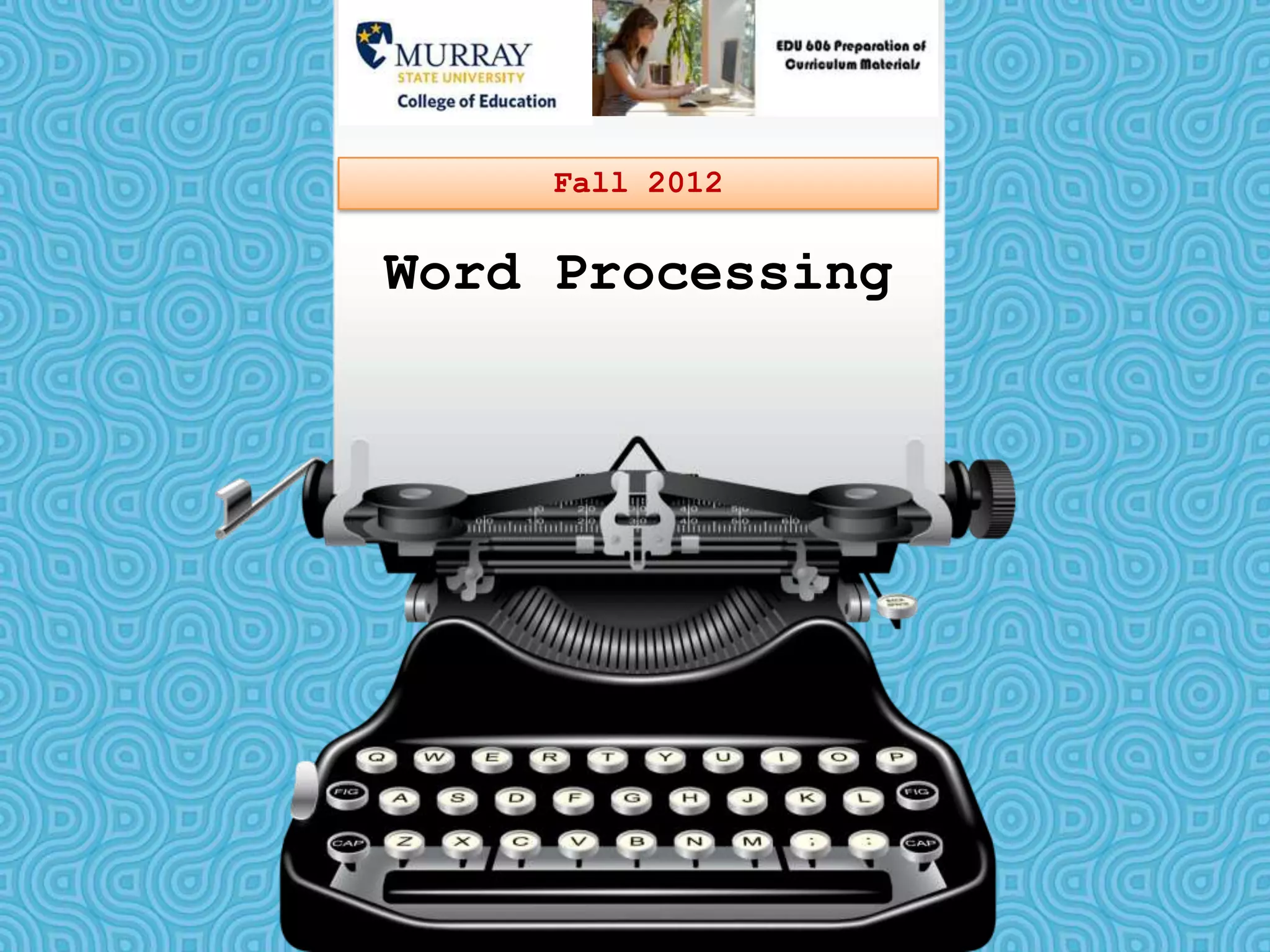
Fall 2012


Word Processing
2


          Word Processing?
• What is Word Processing Anyway?
   – Word Processing: Word Processing is the
     use of computers to prepare documents.
   – A word processor generally refers to a
     WYSIWYG ("What You See Is What You Get")
     system where the formatting takes place
     while you enter your text; no further
     processing is needed prior to sending
     your work to a printer. Word and
     WordPerfect and other similar personal
     computer packages are examples of word
     processors.
3


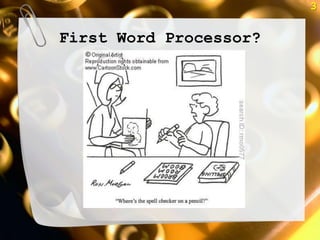
First Word Processor?
4

     The first mechanical word
             processor
• The typewriter
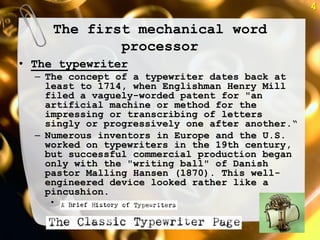
  – The concept of a typewriter dates back at
    least to 1714, when Englishman Henry Mill
    filed a vaguely-worded patent for "an
    artificial machine or method for the
    impressing or transcribing of letters
    singly or progressively one after another.―
  – Numerous inventors in Europe and the U.S.
    worked on typewriters in the 19th century,
    but successful commercial production began
    only with the "writing ball" of Danish
    pastor Malling Hansen (1870). This well-
    engineered device looked rather like a
    pincushion.
    •
5


            Why the QWERTY?
• ...the Universal User Interface....
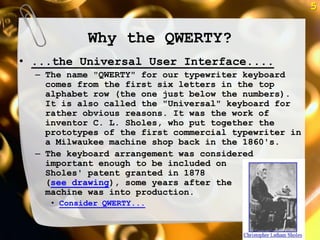
  – The name "QWERTY" for our typewriter keyboard
    comes from the first six letters in the top
    alphabet row (the one just below the numbers).
    It is also called the "Universal" keyboard for
    rather obvious reasons. It was the work of
    inventor C. L. Sholes, who put together the
    prototypes of the first commercial typewriter in
    a Milwaukee machine shop back in the 1860's.
  – The keyboard arrangement was considered
    important enough to be included on
    Sholes' patent granted in 1878
    (see drawing), some years after the
    machine was into production.
     • Consider QWERTY...
6


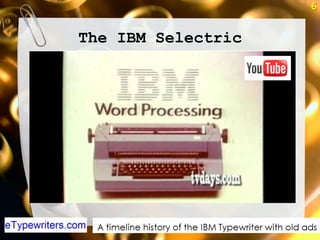
The IBM Selectric
7

 But when were they called
      word processors? See Wikipedia
                           the original

                                    article on Word
• Term coined by IBM                  Processor!
   – The term word processing
     was invented by IBM in the late 1960s.
     By 1971 it was recognized by the New
     York Times as a "buzz word". A 1971
     Times article referred to "the brave new
     world of Word Processing or W/P. That's
     International Business Machines talk...
     I.B.M. introduced W/P about five years
     ago for its Magnetic Selectric
     typewriter and other electronic razzle-
     dazzle.―
     • History of Word Processors


         See also:
8


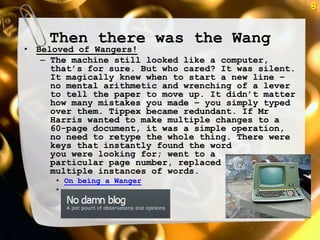
    Then there was the Wang
• Beloved of Wangers!
   – The machine still looked like a computer,
     that‘s for sure. But who cared? It was silent.
     It magically knew when to start a new line –
     no mental arithmetic and wrenching of a lever
     to tell the paper to move up. It didn‘t matter
     how many mistakes you made – you simply typed
     over them. Tippex became redundant. If Mr
     Harris wanted to make multiple changes to a
     60-page document, it was a simple operation,
     no need to retype the whole thing. There were
     keys that instantly found the word
     you were looking for; went to a
     particular page number, replaced
     multiple instances of words.
      • On being a Wanger
      •
9
10

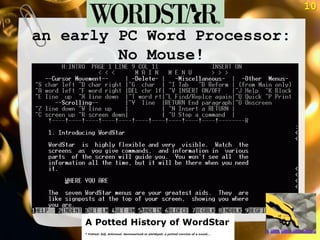
an early PC Word Processor:
         No Mouse!
11
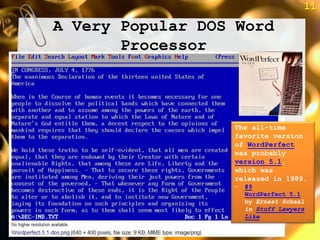
A Very Popular DOS Word
       Processor


                  The all-time
                  favorite version
                  of WordPerfect
                  was probably
                  version 5.1,
                  which was
                  released in 1989.
                  −   #9
                      WordPerfect 5.1
                      by Ernest Schaal
                      in Stuff Lawyers
                      Like
12

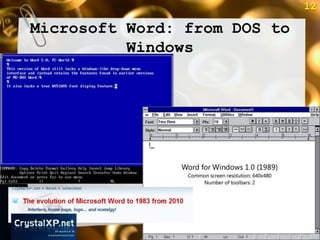
Microsoft Word: from DOS to
          Windows
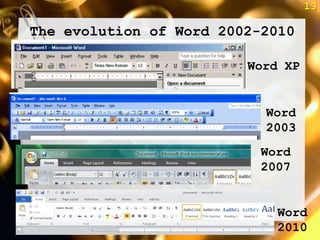
13

The evolution of Word 2002-2010

                         Word XP


                           Word
                           2003
                           Word
                           2007


                             Word
                             2010
14

More on the evolution of Word
 and the changes in Word 2007

• The Why of the New UI (Part 1)
• Ye Olde Museum Of Office Past (Why
  the UI, Part 2)
   – See MSDN Blogs > Jensen Harris: An
     Office User Interface Blog
15


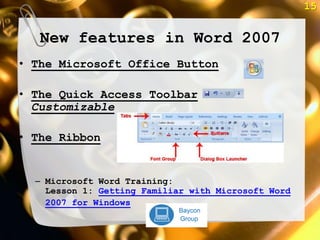
   New features in Word 2007
• The Microsoft Office Button

• The Quick Access Toolbar
  Customizable

• The Ribbon


  – Microsoft Word Training:
    Lesson 1: Getting Familiar with Microsoft Word
    2007 for Windows
16


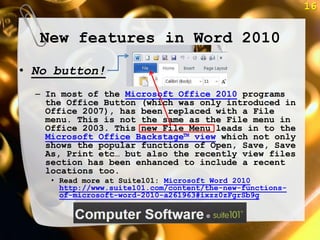
  New features in Word 2010
• No button!
  – In most of the Microsoft Office 2010 programs
    the Office Button (which was only introduced in
    Office 2007), has been replaced with a File
    menu. This is not the same as the File menu in
    Office 2003. This new File Menu leads in to the
    Microsoft Office Backstage™ view which not only
    shows the popular functions of Open, Save, Save
    As, Print etc… but also the recently view files
    section has been enhanced to include a recent
    locations too.
     • Read more at Suite101: Microsoft Word 2010
       http://www.suite101.com/content/the-new-functions-
       of-microsoft-word-2010-a261963#ixzz0zFgrSb9g
17


 Changes in File Extensions
• From .doc to .docx
  – The standard file extension for Microsoft Word 2003
    is .doc. When Microsoft launched Office 2007, users
    found that documents produced in Word would by
    default save with a new extension known as .docx.
    Documents can still be saved in the previous version
    format of .doc by clicking ―Word 97-2003 Document‖
    from the Save As menu. Whilst the change did not
    pose considerable harm to documents, if users were
    sending their work electronically, they had to
    anticipate whether the recipient was able to open it
    in the new format.
    Read more at Suite101: PC File Extensions Explained:
    Keeping up to Speed with the Different Document
    Saving Formats http://www.suite101.com/content/pc-
    file-extensions-explained-a214044#ixzz0zFjh3Zs3
18


 Office 2013 is almost here!

• Word 2013 Preview
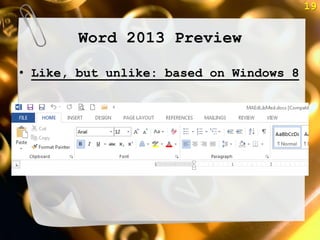
  – First, the interface. Word 2013 draws heavily
    from the visual language of Metro—that means
    most of the Windows chrome has been sandblasted
    off the interface. The ribbon bars are still
    there, though you can hide them if you don‘t
    want to see them, especially if you‘re on a
    touch device. You can get away with hiding much
    of the Word interface because of contextual
    menus.
     • First look: Word 2013
       by Sean Gallagher - July 16 2012, 2:00pm CDT
19


        Word 2013 Preview

• Like, but unlike: based on Windows 8
20


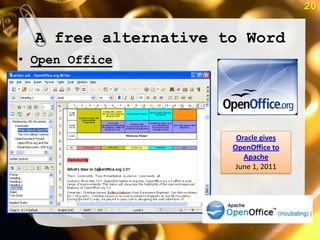
  A free alternative to Word
• Open Office


                       Oracle gives
                      OpenOffice to
                         Apache
                       June 1, 2011
21


Word processing in the clouds

• What Is 'Cloud Computing'?
  – "Cloud Computing" is a somewhat nebulous
    word to describe users "renting" or
    borrowing online software instead of
    actually purchasing and installing it on
    their own computers.
  – All of the processing work and file saving
    will be done "in the cloud" of the
    Internet, and the users will plug into that
    cloud every day to do their computer work.

  – See also
    ―Software via the Internet:
   Microsoft in ‗Cloud‘ Computing‖
22


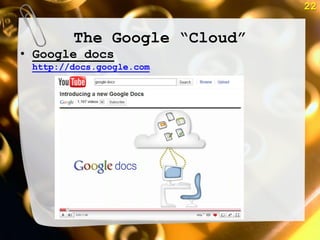
        The Google ―Cloud‖
• Google docs
 http://docs.google.com
23


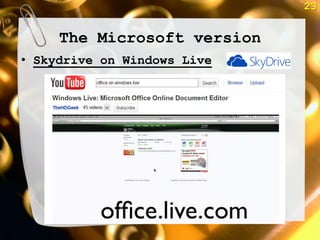
     The Microsoft version
• Skydrive on Windows Live
24

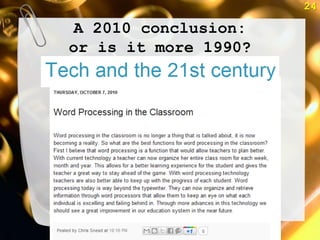
 A 2010 conclusion:
or is it more 1990?

Word Processing

  • 1.
  • 2.
    2 Word Processing? • What is Word Processing Anyway? – Word Processing: Word Processing is the use of computers to prepare documents. – A word processor generally refers to a WYSIWYG ("What You See Is What You Get") system where the formatting takes place while you enter your text; no further processing is needed prior to sending your work to a printer. Word and WordPerfect and other similar personal computer packages are examples of word processors.
  • 3.
  • 4.
    4 The first mechanical word processor • The typewriter – The concept of a typewriter dates back at least to 1714, when Englishman Henry Mill filed a vaguely-worded patent for "an artificial machine or method for the impressing or transcribing of letters singly or progressively one after another.― – Numerous inventors in Europe and the U.S. worked on typewriters in the 19th century, but successful commercial production began only with the "writing ball" of Danish pastor Malling Hansen (1870). This well- engineered device looked rather like a pincushion. •
  • 5.
    5 Why the QWERTY? • ...the Universal User Interface.... – The name "QWERTY" for our typewriter keyboard comes from the first six letters in the top alphabet row (the one just below the numbers). It is also called the "Universal" keyboard for rather obvious reasons. It was the work of inventor C. L. Sholes, who put together the prototypes of the first commercial typewriter in a Milwaukee machine shop back in the 1860's. – The keyboard arrangement was considered important enough to be included on Sholes' patent granted in 1878 (see drawing), some years after the machine was into production. • Consider QWERTY...
  • 6.
  • 7.
    7 But whenwere they called word processors? See Wikipedia the original article on Word • Term coined by IBM Processor! – The term word processing was invented by IBM in the late 1960s. By 1971 it was recognized by the New York Times as a "buzz word". A 1971 Times article referred to "the brave new world of Word Processing or W/P. That's International Business Machines talk... I.B.M. introduced W/P about five years ago for its Magnetic Selectric typewriter and other electronic razzle- dazzle.― • History of Word Processors See also:
  • 8.
    8 Then there was the Wang • Beloved of Wangers! – The machine still looked like a computer, that‘s for sure. But who cared? It was silent. It magically knew when to start a new line – no mental arithmetic and wrenching of a lever to tell the paper to move up. It didn‘t matter how many mistakes you made – you simply typed over them. Tippex became redundant. If Mr Harris wanted to make multiple changes to a 60-page document, it was a simple operation, no need to retype the whole thing. There were keys that instantly found the word you were looking for; went to a particular page number, replaced multiple instances of words. • On being a Wanger •
  • 9.
  • 10.
    10 an early PCWord Processor: No Mouse!
  • 11.
    11 A Very PopularDOS Word Processor The all-time favorite version of WordPerfect was probably version 5.1, which was released in 1989. − #9 WordPerfect 5.1 by Ernest Schaal in Stuff Lawyers Like
  • 12.
  • 13.
    13 The evolution ofWord 2002-2010 Word XP Word 2003 Word 2007 Word 2010
  • 14.
    14 More on theevolution of Word and the changes in Word 2007 • The Why of the New UI (Part 1) • Ye Olde Museum Of Office Past (Why the UI, Part 2) – See MSDN Blogs > Jensen Harris: An Office User Interface Blog
  • 15.
    15 New features in Word 2007 • The Microsoft Office Button • The Quick Access Toolbar Customizable • The Ribbon – Microsoft Word Training: Lesson 1: Getting Familiar with Microsoft Word 2007 for Windows
  • 16.
    16 Newfeatures in Word 2010 • No button! – In most of the Microsoft Office 2010 programs the Office Button (which was only introduced in Office 2007), has been replaced with a File menu. This is not the same as the File menu in Office 2003. This new File Menu leads in to the Microsoft Office Backstage™ view which not only shows the popular functions of Open, Save, Save As, Print etc… but also the recently view files section has been enhanced to include a recent locations too. • Read more at Suite101: Microsoft Word 2010 http://www.suite101.com/content/the-new-functions- of-microsoft-word-2010-a261963#ixzz0zFgrSb9g
  • 17.
    17 Changes inFile Extensions • From .doc to .docx – The standard file extension for Microsoft Word 2003 is .doc. When Microsoft launched Office 2007, users found that documents produced in Word would by default save with a new extension known as .docx. Documents can still be saved in the previous version format of .doc by clicking ―Word 97-2003 Document‖ from the Save As menu. Whilst the change did not pose considerable harm to documents, if users were sending their work electronically, they had to anticipate whether the recipient was able to open it in the new format. Read more at Suite101: PC File Extensions Explained: Keeping up to Speed with the Different Document Saving Formats http://www.suite101.com/content/pc- file-extensions-explained-a214044#ixzz0zFjh3Zs3
  • 18.
    18 Office 2013is almost here! • Word 2013 Preview – First, the interface. Word 2013 draws heavily from the visual language of Metro—that means most of the Windows chrome has been sandblasted off the interface. The ribbon bars are still there, though you can hide them if you don‘t want to see them, especially if you‘re on a touch device. You can get away with hiding much of the Word interface because of contextual menus. • First look: Word 2013 by Sean Gallagher - July 16 2012, 2:00pm CDT
  • 19.
    19 Word 2013 Preview • Like, but unlike: based on Windows 8
  • 20.
    20 Afree alternative to Word • Open Office Oracle gives OpenOffice to Apache June 1, 2011
  • 21.
    21 Word processing inthe clouds • What Is 'Cloud Computing'? – "Cloud Computing" is a somewhat nebulous word to describe users "renting" or borrowing online software instead of actually purchasing and installing it on their own computers. – All of the processing work and file saving will be done "in the cloud" of the Internet, and the users will plug into that cloud every day to do their computer work. – See also ―Software via the Internet: Microsoft in ‗Cloud‘ Computing‖
  • 22.
    22 The Google ―Cloud‖ • Google docs http://docs.google.com
  • 23.
    23 The Microsoft version • Skydrive on Windows Live
  • 24.
    24 A 2010conclusion: or is it more 1990?