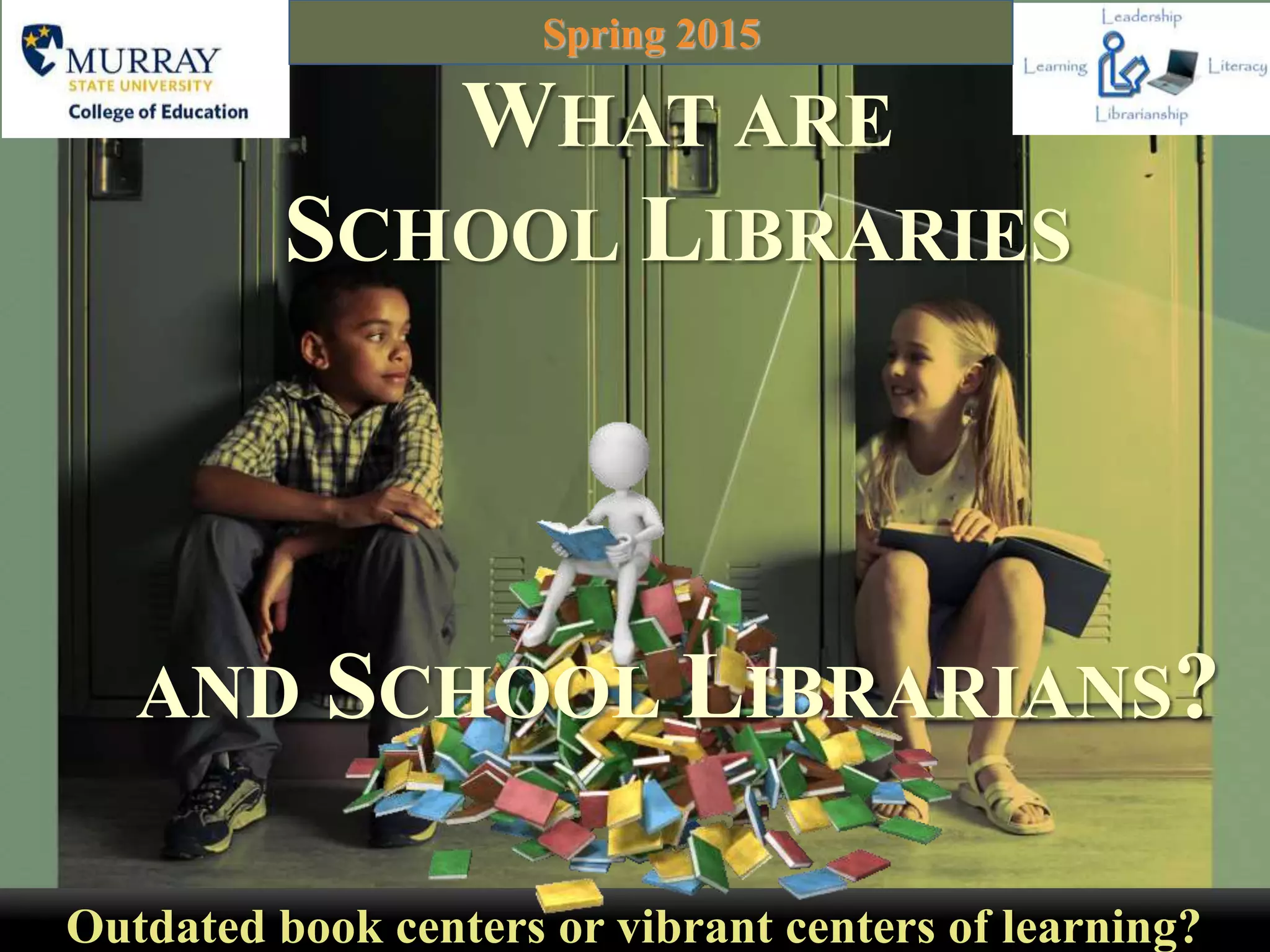
Outdated book centers or vibrant centers of learning?
Spring 2015
WHAT ARE
SCHOOL LIBRARIES
AND SCHOOL LIBRARIANS?
2
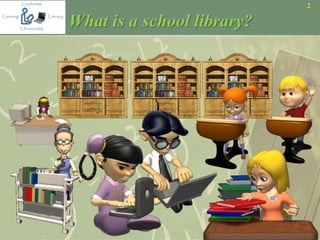
What is a school library?
3
Frank Zappa on libraries
From the liner notes to his first
album, Freak Out! (1966)
HUNGRY FREAKS, DADDY was written for Carl
Orestes Franzoni. He is freaky down to his toe nails.
Some day he will live next door to you and your lawn
will die. Drop out of school before your mind rots from
exposure to our mediocre educational system. Forget
about the Senior Prom and go to the library and educate
yourself if you’ve got any guts. Some of you like Pep
rallies and plastic robots who tell you what to read.
Forget I mentioned it. This song has no message. Rise
for the flag salute. [Emphasis added]
• Comments on the song “Hungry Freaks, Daddy” reproduced on website
Information is Not Knowledge
4
History of School Libraries
Not very well known!
Although the American public school library is
one of this nation’s most ubiquitous educational
institutions, we know very little about its history.
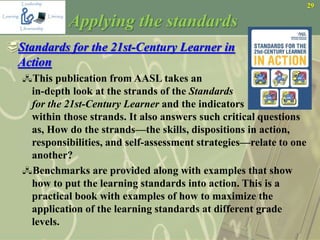
• First sentence of:
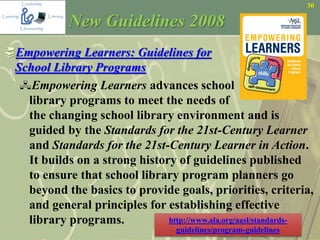
5
Vintage ads for school libraries
6
Roles of the school library in history
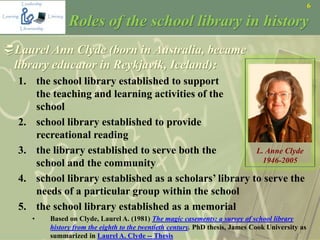
Laurel Ann Clyde (born in Australia, became
library educator in Reykjavik, Iceland):
1. the school library established to support
the teaching and learning activities of the
school
2. school library established to provide
recreational reading
3. the library established to serve both the
school and the community
4. school library established as a scholars’ library to serve the
needs of a particular group within the school
5. the school library established as a memorial
• Based on Clyde, Laurel A. (1981) The magic casements: a survey of school library
history from the eighth to the twentieth century. PhD thesis, James Cook University as
summarized in Laurel A. Clyde -- Thesis
L. Anne Clyde
1946-2005
7
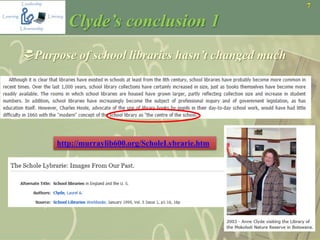
Clyde’s conclusion 1
Purpose of school libraries hasn’t changed much
http://murraylib600.org/ScholeLybrarie.htm
8
The library as center of the school?
http://heartoftheschool.edublogs.org/
http://stephanieharvey.com/home
9
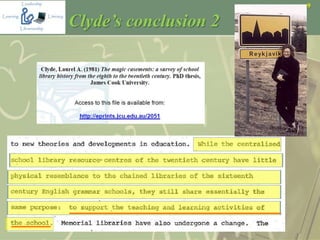
Clyde’s conclusion 2
10
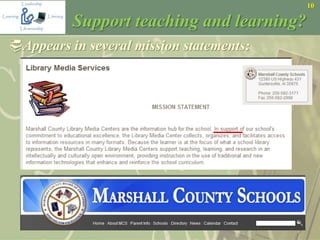
Support teaching and learning?
Appears in several mission statements:
11
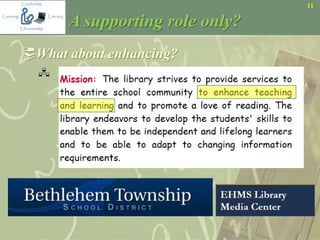
A supporting role only?
What about enhancing?

12
The Instructional Role of the Media Specialist
Has it changed much?
It is evident from an analysis of two data sources
that an evolution in the instructional role of the
library media specialist did occur from 1950 to
1984. A clear pattern of progressive development
of the instructional role has persisted in the
standards and the literature. The changes in the
library media specialist’s role from study hall
monitor to curriculum designer can certainly be
termed substantive.
• Craver, K. (1986, Summer). The Changing Instructional Role of the High School Library
Media Specialist, 1950–84: A Survey of Professional Literature, Standards, and Research
Studies. School Library Media Quarterly, 14, 4: 183-91. Also available in print in The
emerging school library media program. Libraries Unlimited, 1988
13
1945 Benchmark
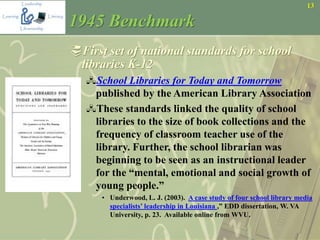
First set of national standards for school
libraries K-12
School Libraries for Today and Tomorrow
published by the American Library Association
These standards linked the quality of school
libraries to the size of book collections and the
frequency of classroom teacher use of the
library. Further, the school librarian was
beginning to be seen as an instructional leader
for the “mental, emotional and social growth of
young people.”
• Underwood, L. J. (2003). A case study of four school library media
specialists’ leadership in Louisiana ,” EDD dissertation, W. VA
University, p. 23. Available online from WVU.
14
Tracing the evolution
The Fifties
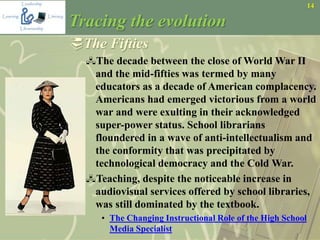
The decade between the close of World War II
and the mid-fifties was termed by many
educators as a decade of American complacency.
Americans had emerged victorious from a world
war and were exulting in their acknowledged
super-power status. School librarians
floundered in a wave of anti-intellectualism and
the conformity that was precipitated by
technological democracy and the Cold War.
Teaching, despite the noticeable increase in
audiovisual services offered by school libraries,
was still dominated by the textbook.
• The Changing Instructional Role of the High School
Media Specialist
15
The advent of the space age
1957
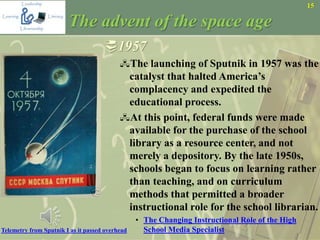
The launching of Sputnik in 1957 was the
catalyst that halted America’s
complacency and expedited the
educational process.
At this point, federal funds were made
available for the purchase of the school
library as a resource center, and not
merely a depository. By the late 1950s,
schools began to focus on learning rather
than teaching, and on curriculum
methods that permitted a broader
instructional role for the school librarian.
• The Changing Instructional Role of the High
School Media SpecialistTelemetry from Sputnik I as it passed overhead
16
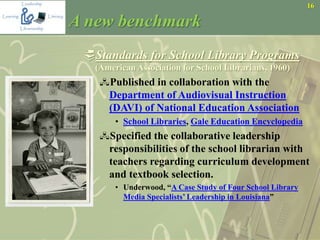
A new benchmark
Standards for School Library Programs
(American Association for School Librarians, 1960)
Published in collaboration with the
Department of Audiovisual Instruction
(DAVI) of National Education Association
• School Libraries, Gale Education Encyclopedia
Specified the collaborative leadership
responsibilities of the school librarian with
teachers regarding curriculum development
and textbook selection.
• Underwood, “A Case Study of Four School Library
Media Specialists’ Leadership in Louisiana”
17
The decade of ferment
The Sixties
In school library development and education in
general, the 1960s can be described as a decade
of ferment. “rhetoric and ideas abounded as to
what education would do to solve a number of
pressing social issues—from integrating the
schools racially to promoting a love of reading
among the disadvantaged or disinterested.”
The school’s new emphasis on “diversified
learning materials—both printed and
nonprinted—for all subjects and levels of
ability” finally brought to school librarians the
opportunity for [a] greater instructional role.
• The Changing Instructional Role of the High School
Media Specialist
18
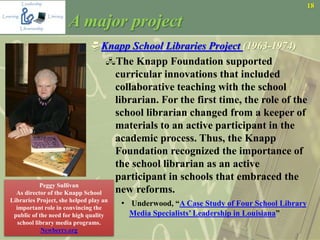
A major project
Knapp School Libraries Project (1963-1974)
The Knapp Foundation supported
curricular innovations that included
collaborative teaching with the school
librarian. For the first time, the role of the
school librarian changed from a keeper of
materials to an active participant in the
academic process. Thus, the Knapp
Foundation recognized the importance of
the school librarian as an active
participant in schools that embraced the
new reforms.
• Underwood, “A Case Study of Four School Library
Media Specialists’ Leadership in Louisiana”
Peggy Sullivan
As director of the Knapp School
Libraries Project, she helped play an
important role in convincing the
public of the need for high quality
school library media programs.
Newberry.org
19
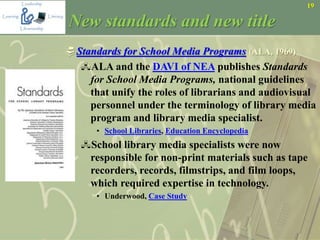
New standards and new title
Standards for School Media Programs (ALA, 1969)
ALA and the DAVI of NEA publishes Standards
for School Media Programs, national guidelines
that unify the roles of librarians and audiovisual
personnel under the terminology of library media
program and library media specialist.
• School Libraries, Education Encyclopedia
School library media specialists were now
responsible for non-print materials such as tape
recorders, records, filmstrips, and film loops,
which required expertise in technology.
• Underwood, Case Study
20
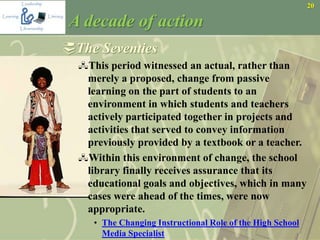
A decade of action
The Seventies
This period witnessed an actual, rather than
merely a proposed, change from passive
learning on the part of students to an
environment in which students and teachers
actively participated together in projects and
activities that served to convey information
previously provided by a textbook or a teacher.
Within this environment of change, the school
library finally receives assurance that its
educational goals and objectives, which in many
cases were ahead of the times, were now
appropriate.
• The Changing Instructional Role of the High School
Media Specialist
21
New standards again
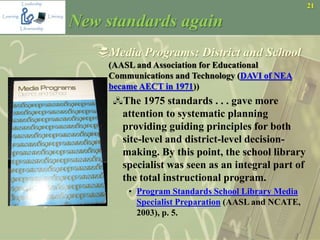
Media Programs: District and School
(AASL and Association for Educational
Communications and Technology (DAVI of NEA
became AECT in 1971))
The 1975 standards . . . gave more
attention to systematic planning
providing guiding principles for both
site-level and district-level decision-
making. By this point, the school library
specialist was seen as an integral part of
the total instructional program.
• Program Standards School Library Media
Specialist Preparation (AASL and NCATE,
2003), p. 5.
22
A mercurial environment
The Eighties
While the instructional role of the school
library media specialist from 1980 to 1984
could be characterized as a period of
adjustment concerning the implementation of
instructional design activities, the introduction
of computers presented library media
specialists with a new set of problems.
There is evidence that more systematic
approaches were being followed for instruction
and that library media specialists were being
urged to consider their educational role within
the framework of the total program.
• The Changing Instructional Role of the High School
Media Specialist
23
Response to A Nation at Risk (1983)
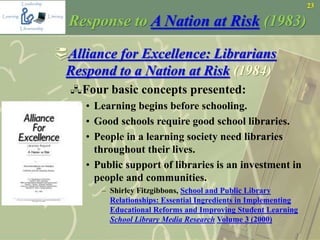
Alliance for Excellence: Librarians
Respond to a Nation at Risk (1984)
Four basic concepts presented:
• Learning begins before schooling.
• Good schools require good school libraries.
• People in a learning society need libraries
throughout their lives.
• Public support of libraries is an investment in
people and communities.
– Shirley Fitzgibbons, School and Public Library
Relationships: Essential Ingredients in Implementing
Educational Reforms and Improving Student Learning
School Library Media Research Volume 3 (2000)
24
The Information Power Era
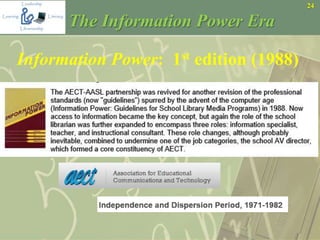
Information Power: 1st edition (1988)
25
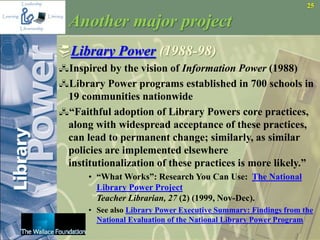
Another major project
Library Power (1988-98)
Inspired by the vision of Information Power (1988)
Library Power programs established in 700 schools in
19 communities nationwide
“Faithful adoption of Library Powers core practices,
along with widespread acceptance of these practices,
can lead to permanent change; similarly, as similar
policies are implemented elsewhere
institutionalization of these practices is more likely.”
• “What Works”: Research You Can Use: The National
Library Power Project
Teacher Librarian, 27 (2) (1999, Nov-Dec).
• See also Library Power Executive Summary: Findings from the
National Evaluation of the National Library Power Program
26
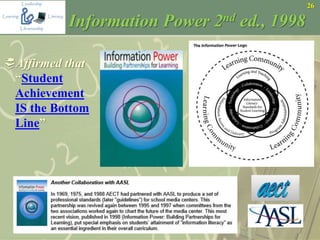
Affirmed that
“Student
Achievement
IS the Bottom
Line”
Information Power 2nd ed., 1998
27
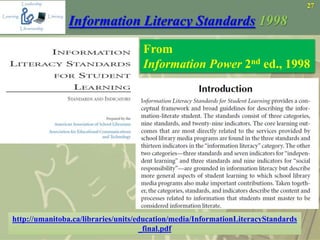
Information Literacy Standards 1998
http://umanitoba.ca/libraries/units/education/media/InformationLiteracyStandards
_final.pdf
From
Information Power 2nd ed., 1998
28
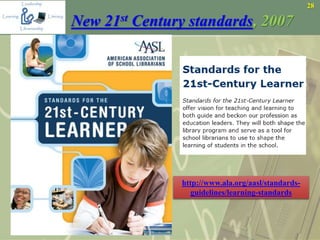
New 21st Century standards, 2007
http://www.ala.org/aasl/standards-
guidelines/learning-standards
29
Applying the standards
Standards for the 21st-Century Learner in
Action
This publication from AASL takes an
in-depth look at the strands of the Standards
for the 21st-Century Learner and the indicators
within those strands. It also answers such critical questions
as, How do the strands—the skills, dispositions in action,
responsibilities, and self-assessment strategies—relate to one
another?
Benchmarks are provided along with examples that show
how to put the learning standards into action. This is a
practical book with examples of how to maximize the
application of the learning standards at different grade
levels.
30
Empowering Learners: Guidelines for
School Library Programs
Empowering Learners advances school
library programs to meet the needs of
the changing school library environment and is
guided by the Standards for the 21st-Century Learner
and Standards for the 21st-Century Learner in Action.
It builds on a strong history of guidelines published
to ensure that school library program planners go
beyond the basics to provide goals, priorities, criteria,
and general principles for establishing effective
library programs.
New Guidelines 2008
http://www.ala.org/aasl/standards-
guidelines/program-guidelines
31
32
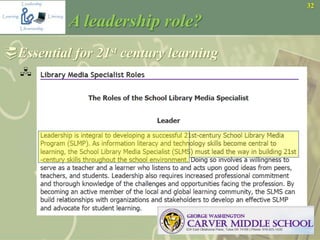
A leadership role?
Essential for 21st century learning

33
Leadership in AASL guidelines
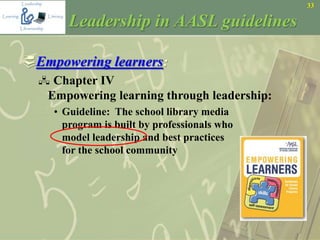
Empowering learners:
 Chapter IV
Empowering learning through leadership:
• Guideline: The school library media
program is built by professionals who
model leadership and best practices
for the school community
34
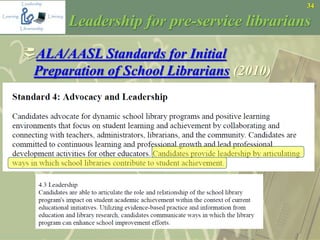
Leadership for pre-service librarians
ALA/AASL Standards for Initial
Preparation of School Librarians (2010)

35
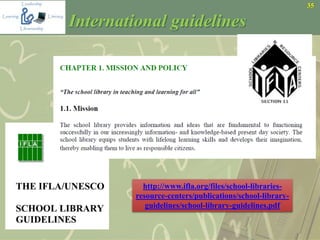
International guidelines
http://www.ifla.org/files/school-libraries-
resource-centers/publications/school-library-
guidelines/school-library-guidelines.pdf
36
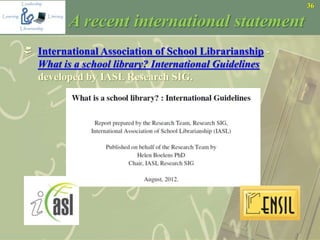
A recent international statement
 International Association of School Librarianship -
What is a school library? International Guidelines
developed by IASL Research SIG.
37
An international initiative
School Library Proclamation: A Library
for Every School (2010) [115Kb 4 pages]
Also on Facebook!
http://www.facebook.com/EnsilEurope#!/ALibraryInEverySchool
38
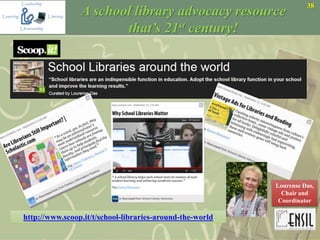
A school library advocacy resource
that’s 21st century!
http://www.scoop.it/t/school-libraries-around-the-world
Lourense Das,
Chair and
Coordinator
39
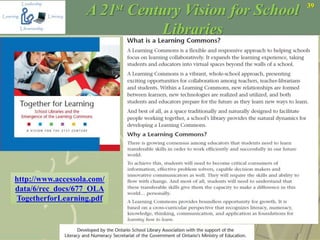
A 21st Century Vision for School
Libraries
http://www.accessola.com/
data/6/rec_docs/677_OLA
TogetherforLearning.pdf
40
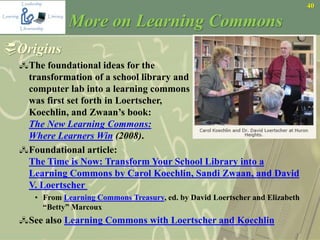
More on Learning Commons
Origins
The foundational ideas for the
transformation of a school library and
computer lab into a learning commons
was first set forth in Loertscher,
Koechlin, and Zwaan’s book:
The New Learning Commons:
Where Learners Win (2008).
Foundational article:
The Time is Now: Transform Your School Library into a
Learning Commons by Carol Koechlin, Sandi Zwaan, and David
V. Loertscher
• From Learning Commons Treasury, ed. by David Loertscher and Elizabeth
“Betty” Marcoux
See also Learning Commons with Loertscher and Koechlin
41
Do school librarians make a difference?
One of the Latest Studies:
A full-time school librarian makes a critical
difference in boosting student achievement
This study [from Pennsylvania] adds to the evidence
that all K–12 students need and deserve quality school
library programs with full-time certified staff. Students
are more likely to succeed when they have library
programs that are well staffed, well funded,
technologically well equipped, well stocked, and more
accessible. And, the neediest learners may benefit the
most from trained librarians and quality library
programs.
• By Debra E. Kachel and Keith Curry Lance on March 7, 2013
42
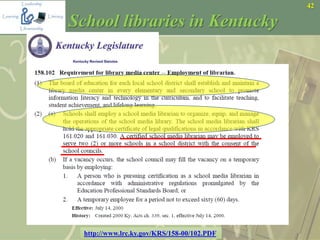
School libraries in Kentucky
http://www.lrc.ky.gov/KRS/158-00/102.PDF
43
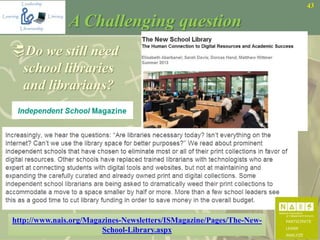
A Challenging question
Do we still need
school libraries
and librarians?
http://www.nais.org/Magazines-Newsletters/ISMagazine/Pages/The-New-
School-Library.aspx
44
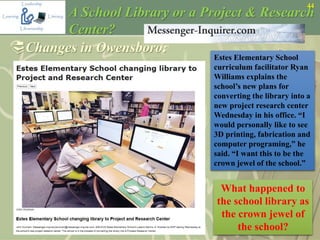
A School Library or a Project & Research
Center?
Changes in Owensboro:
Estes Elementary School
curriculum facilitator Ryan
Williams explains the
school’s new plans for
converting the library into a
new project research center
Wednesday in his office. “I
would personally like to see
3D printing, fabrication and
computer programing,” he
said. “I want this to be the
crown jewel of the school.”
What happened to
the school library as
the crown jewel of
the school?
45
4646
http://www.slideshare.net/
SarahNewbutt/the-school-
librarian
47
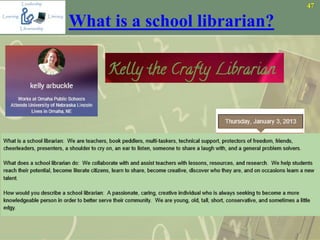
What is a school librarian?
48
Essential reading
Joyce Valenza’s Manifesto
Manifesto for
21st Century School
Librarians
Joyce Valenza has basically compiled a list of all
the possible activity you could be expected to
create/ initiate/ manage and support, as a TL.
[Teacher Librarian]
. . . she says that the library is “not a grocery
store, but a kitchen!”, meaning that, rather then
being just a place to come and get stuff
(i.e. information), it is a place where people
come to collaborate and create.
Educators
That Rock!:
Joyce
Valenza
49
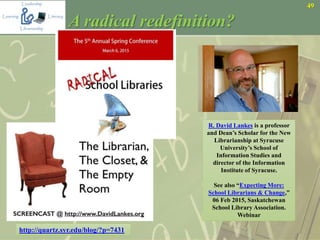
A radical redefinition?
R. David Lankes is a professor
and Dean’s Scholar for the New
Librarianship at Syracuse
University’s School of
Information Studies and
director of the Information
Institute of Syracuse.
See also “Expecting More:
School Librarians & Change,”
06 Feb 2015, Saskatchewan
School Library Association.
Webinar
http://quartz.syr.edu/blog/?p=7431
50
Expecting More: School Librarians & Change
R. David Lankes
51
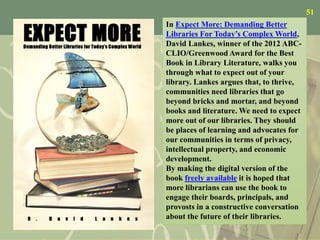
In Expect More: Demanding Better
Libraries For Today’s Complex World,
David Lankes, winner of the 2012 ABC-
CLIO/Greenwood Award for the Best
Book in Library Literature, walks you
through what to expect out of your
library. Lankes argues that, to thrive,
communities need libraries that go
beyond bricks and mortar, and beyond
books and literature. We need to expect
more out of our libraries. They should
be places of learning and advocates for
our communities in terms of privacy,
intellectual property, and economic
development.
By making the digital version of the
book freely available it is hoped that
more librarians can use the book to
engage their boards, principals, and
provosts in a constructive conversation
about the future of their libraries.

What are School Libraries and School Librarians?

  • 1.
    Outdated book centersor vibrant centers of learning? Spring 2015 WHAT ARE SCHOOL LIBRARIES AND SCHOOL LIBRARIANS?
  • 2.
    2 What is aschool library?
  • 3.
    3 Frank Zappa onlibraries From the liner notes to his first album, Freak Out! (1966) HUNGRY FREAKS, DADDY was written for Carl Orestes Franzoni. He is freaky down to his toe nails. Some day he will live next door to you and your lawn will die. Drop out of school before your mind rots from exposure to our mediocre educational system. Forget about the Senior Prom and go to the library and educate yourself if you’ve got any guts. Some of you like Pep rallies and plastic robots who tell you what to read. Forget I mentioned it. This song has no message. Rise for the flag salute. [Emphasis added] • Comments on the song “Hungry Freaks, Daddy” reproduced on website Information is Not Knowledge
  • 4.
    4 History of SchoolLibraries Not very well known! Although the American public school library is one of this nation’s most ubiquitous educational institutions, we know very little about its history. • First sentence of:
  • 5.
    5 Vintage ads forschool libraries
  • 6.
    6 Roles of theschool library in history Laurel Ann Clyde (born in Australia, became library educator in Reykjavik, Iceland): 1. the school library established to support the teaching and learning activities of the school 2. school library established to provide recreational reading 3. the library established to serve both the school and the community 4. school library established as a scholars’ library to serve the needs of a particular group within the school 5. the school library established as a memorial • Based on Clyde, Laurel A. (1981) The magic casements: a survey of school library history from the eighth to the twentieth century. PhD thesis, James Cook University as summarized in Laurel A. Clyde -- Thesis L. Anne Clyde 1946-2005
  • 7.
    7 Clyde’s conclusion 1 Purposeof school libraries hasn’t changed much http://murraylib600.org/ScholeLybrarie.htm
  • 8.
    8 The library ascenter of the school? http://heartoftheschool.edublogs.org/ http://stephanieharvey.com/home
  • 9.
  • 10.
    10 Support teaching andlearning? Appears in several mission statements:
  • 11.
    11 A supporting roleonly? What about enhancing? 
  • 12.
    12 The Instructional Roleof the Media Specialist Has it changed much? It is evident from an analysis of two data sources that an evolution in the instructional role of the library media specialist did occur from 1950 to 1984. A clear pattern of progressive development of the instructional role has persisted in the standards and the literature. The changes in the library media specialist’s role from study hall monitor to curriculum designer can certainly be termed substantive. • Craver, K. (1986, Summer). The Changing Instructional Role of the High School Library Media Specialist, 1950–84: A Survey of Professional Literature, Standards, and Research Studies. School Library Media Quarterly, 14, 4: 183-91. Also available in print in The emerging school library media program. Libraries Unlimited, 1988
  • 13.
    13 1945 Benchmark First setof national standards for school libraries K-12 School Libraries for Today and Tomorrow published by the American Library Association These standards linked the quality of school libraries to the size of book collections and the frequency of classroom teacher use of the library. Further, the school librarian was beginning to be seen as an instructional leader for the “mental, emotional and social growth of young people.” • Underwood, L. J. (2003). A case study of four school library media specialists’ leadership in Louisiana ,” EDD dissertation, W. VA University, p. 23. Available online from WVU.
  • 14.
    14 Tracing the evolution TheFifties The decade between the close of World War II and the mid-fifties was termed by many educators as a decade of American complacency. Americans had emerged victorious from a world war and were exulting in their acknowledged super-power status. School librarians floundered in a wave of anti-intellectualism and the conformity that was precipitated by technological democracy and the Cold War. Teaching, despite the noticeable increase in audiovisual services offered by school libraries, was still dominated by the textbook. • The Changing Instructional Role of the High School Media Specialist
  • 15.
    15 The advent ofthe space age 1957 The launching of Sputnik in 1957 was the catalyst that halted America’s complacency and expedited the educational process. At this point, federal funds were made available for the purchase of the school library as a resource center, and not merely a depository. By the late 1950s, schools began to focus on learning rather than teaching, and on curriculum methods that permitted a broader instructional role for the school librarian. • The Changing Instructional Role of the High School Media SpecialistTelemetry from Sputnik I as it passed overhead
  • 16.
    16 A new benchmark Standardsfor School Library Programs (American Association for School Librarians, 1960) Published in collaboration with the Department of Audiovisual Instruction (DAVI) of National Education Association • School Libraries, Gale Education Encyclopedia Specified the collaborative leadership responsibilities of the school librarian with teachers regarding curriculum development and textbook selection. • Underwood, “A Case Study of Four School Library Media Specialists’ Leadership in Louisiana”
  • 17.
    17 The decade offerment The Sixties In school library development and education in general, the 1960s can be described as a decade of ferment. “rhetoric and ideas abounded as to what education would do to solve a number of pressing social issues—from integrating the schools racially to promoting a love of reading among the disadvantaged or disinterested.” The school’s new emphasis on “diversified learning materials—both printed and nonprinted—for all subjects and levels of ability” finally brought to school librarians the opportunity for [a] greater instructional role. • The Changing Instructional Role of the High School Media Specialist
  • 18.
    18 A major project KnappSchool Libraries Project (1963-1974) The Knapp Foundation supported curricular innovations that included collaborative teaching with the school librarian. For the first time, the role of the school librarian changed from a keeper of materials to an active participant in the academic process. Thus, the Knapp Foundation recognized the importance of the school librarian as an active participant in schools that embraced the new reforms. • Underwood, “A Case Study of Four School Library Media Specialists’ Leadership in Louisiana” Peggy Sullivan As director of the Knapp School Libraries Project, she helped play an important role in convincing the public of the need for high quality school library media programs. Newberry.org
  • 19.
    19 New standards andnew title Standards for School Media Programs (ALA, 1969) ALA and the DAVI of NEA publishes Standards for School Media Programs, national guidelines that unify the roles of librarians and audiovisual personnel under the terminology of library media program and library media specialist. • School Libraries, Education Encyclopedia School library media specialists were now responsible for non-print materials such as tape recorders, records, filmstrips, and film loops, which required expertise in technology. • Underwood, Case Study
  • 20.
    20 A decade ofaction The Seventies This period witnessed an actual, rather than merely a proposed, change from passive learning on the part of students to an environment in which students and teachers actively participated together in projects and activities that served to convey information previously provided by a textbook or a teacher. Within this environment of change, the school library finally receives assurance that its educational goals and objectives, which in many cases were ahead of the times, were now appropriate. • The Changing Instructional Role of the High School Media Specialist
  • 21.
    21 New standards again MediaPrograms: District and School (AASL and Association for Educational Communications and Technology (DAVI of NEA became AECT in 1971)) The 1975 standards . . . gave more attention to systematic planning providing guiding principles for both site-level and district-level decision- making. By this point, the school library specialist was seen as an integral part of the total instructional program. • Program Standards School Library Media Specialist Preparation (AASL and NCATE, 2003), p. 5.
  • 22.
    22 A mercurial environment TheEighties While the instructional role of the school library media specialist from 1980 to 1984 could be characterized as a period of adjustment concerning the implementation of instructional design activities, the introduction of computers presented library media specialists with a new set of problems. There is evidence that more systematic approaches were being followed for instruction and that library media specialists were being urged to consider their educational role within the framework of the total program. • The Changing Instructional Role of the High School Media Specialist
  • 23.
    23 Response to ANation at Risk (1983) Alliance for Excellence: Librarians Respond to a Nation at Risk (1984) Four basic concepts presented: • Learning begins before schooling. • Good schools require good school libraries. • People in a learning society need libraries throughout their lives. • Public support of libraries is an investment in people and communities. – Shirley Fitzgibbons, School and Public Library Relationships: Essential Ingredients in Implementing Educational Reforms and Improving Student Learning School Library Media Research Volume 3 (2000)
  • 24.
    24 The Information PowerEra Information Power: 1st edition (1988)
  • 25.
    25 Another major project LibraryPower (1988-98) Inspired by the vision of Information Power (1988) Library Power programs established in 700 schools in 19 communities nationwide “Faithful adoption of Library Powers core practices, along with widespread acceptance of these practices, can lead to permanent change; similarly, as similar policies are implemented elsewhere institutionalization of these practices is more likely.” • “What Works”: Research You Can Use: The National Library Power Project Teacher Librarian, 27 (2) (1999, Nov-Dec). • See also Library Power Executive Summary: Findings from the National Evaluation of the National Library Power Program
  • 26.
    26 Affirmed that “Student Achievement IS theBottom Line” Information Power 2nd ed., 1998
  • 27.
    27 Information Literacy Standards1998 http://umanitoba.ca/libraries/units/education/media/InformationLiteracyStandards _final.pdf From Information Power 2nd ed., 1998
  • 28.
    28 New 21st Centurystandards, 2007 http://www.ala.org/aasl/standards- guidelines/learning-standards
  • 29.
    29 Applying the standards Standardsfor the 21st-Century Learner in Action This publication from AASL takes an in-depth look at the strands of the Standards for the 21st-Century Learner and the indicators within those strands. It also answers such critical questions as, How do the strands—the skills, dispositions in action, responsibilities, and self-assessment strategies—relate to one another? Benchmarks are provided along with examples that show how to put the learning standards into action. This is a practical book with examples of how to maximize the application of the learning standards at different grade levels.
  • 30.
    30 Empowering Learners: Guidelinesfor School Library Programs Empowering Learners advances school library programs to meet the needs of the changing school library environment and is guided by the Standards for the 21st-Century Learner and Standards for the 21st-Century Learner in Action. It builds on a strong history of guidelines published to ensure that school library program planners go beyond the basics to provide goals, priorities, criteria, and general principles for establishing effective library programs. New Guidelines 2008 http://www.ala.org/aasl/standards- guidelines/program-guidelines
  • 31.
  • 32.
    32 A leadership role? Essentialfor 21st century learning 
  • 33.
    33 Leadership in AASLguidelines Empowering learners:  Chapter IV Empowering learning through leadership: • Guideline: The school library media program is built by professionals who model leadership and best practices for the school community
  • 34.
    34 Leadership for pre-servicelibrarians ALA/AASL Standards for Initial Preparation of School Librarians (2010) 
  • 35.
  • 36.
    36 A recent internationalstatement  International Association of School Librarianship - What is a school library? International Guidelines developed by IASL Research SIG.
  • 37.
    37 An international initiative SchoolLibrary Proclamation: A Library for Every School (2010) [115Kb 4 pages] Also on Facebook! http://www.facebook.com/EnsilEurope#!/ALibraryInEverySchool
  • 38.
    38 A school libraryadvocacy resource that’s 21st century! http://www.scoop.it/t/school-libraries-around-the-world Lourense Das, Chair and Coordinator
  • 39.
    39 A 21st CenturyVision for School Libraries http://www.accessola.com/ data/6/rec_docs/677_OLA TogetherforLearning.pdf
  • 40.
    40 More on LearningCommons Origins The foundational ideas for the transformation of a school library and computer lab into a learning commons was first set forth in Loertscher, Koechlin, and Zwaan’s book: The New Learning Commons: Where Learners Win (2008). Foundational article: The Time is Now: Transform Your School Library into a Learning Commons by Carol Koechlin, Sandi Zwaan, and David V. Loertscher • From Learning Commons Treasury, ed. by David Loertscher and Elizabeth “Betty” Marcoux See also Learning Commons with Loertscher and Koechlin
  • 41.
    41 Do school librariansmake a difference? One of the Latest Studies: A full-time school librarian makes a critical difference in boosting student achievement This study [from Pennsylvania] adds to the evidence that all K–12 students need and deserve quality school library programs with full-time certified staff. Students are more likely to succeed when they have library programs that are well staffed, well funded, technologically well equipped, well stocked, and more accessible. And, the neediest learners may benefit the most from trained librarians and quality library programs. • By Debra E. Kachel and Keith Curry Lance on March 7, 2013
  • 42.
    42 School libraries inKentucky http://www.lrc.ky.gov/KRS/158-00/102.PDF
  • 43.
    43 A Challenging question Dowe still need school libraries and librarians? http://www.nais.org/Magazines-Newsletters/ISMagazine/Pages/The-New- School-Library.aspx
  • 44.
    44 A School Libraryor a Project & Research Center? Changes in Owensboro: Estes Elementary School curriculum facilitator Ryan Williams explains the school’s new plans for converting the library into a new project research center Wednesday in his office. “I would personally like to see 3D printing, fabrication and computer programing,” he said. “I want this to be the crown jewel of the school.” What happened to the school library as the crown jewel of the school?
  • 45.
  • 46.
  • 47.
    47 What is aschool librarian?
  • 48.
    48 Essential reading Joyce Valenza’sManifesto Manifesto for 21st Century School Librarians Joyce Valenza has basically compiled a list of all the possible activity you could be expected to create/ initiate/ manage and support, as a TL. [Teacher Librarian] . . . she says that the library is “not a grocery store, but a kitchen!”, meaning that, rather then being just a place to come and get stuff (i.e. information), it is a place where people come to collaborate and create. Educators That Rock!: Joyce Valenza
  • 49.
    49 A radical redefinition? R.David Lankes is a professor and Dean’s Scholar for the New Librarianship at Syracuse University’s School of Information Studies and director of the Information Institute of Syracuse. See also “Expecting More: School Librarians & Change,” 06 Feb 2015, Saskatchewan School Library Association. Webinar http://quartz.syr.edu/blog/?p=7431
  • 50.
    50 Expecting More: SchoolLibrarians & Change R. David Lankes
  • 51.
    51 In Expect More:Demanding Better Libraries For Today’s Complex World, David Lankes, winner of the 2012 ABC- CLIO/Greenwood Award for the Best Book in Library Literature, walks you through what to expect out of your library. Lankes argues that, to thrive, communities need libraries that go beyond bricks and mortar, and beyond books and literature. We need to expect more out of our libraries. They should be places of learning and advocates for our communities in terms of privacy, intellectual property, and economic development. By making the digital version of the book freely available it is hoped that more librarians can use the book to engage their boards, principals, and provosts in a constructive conversation about the future of their libraries.