Wireless Sensor Networks
1
Outline
• Introduction
• Wireless Sensor Networks Applications
• Factors Influencing Sensor Network Design
• Sensor Node Components
• Sensor Networks Communication Architecture
• Sensor Network Protocols
• Sensor Networks Operating Systems
• Sensor Networks Simulators
• Conclusion
2
Introduction
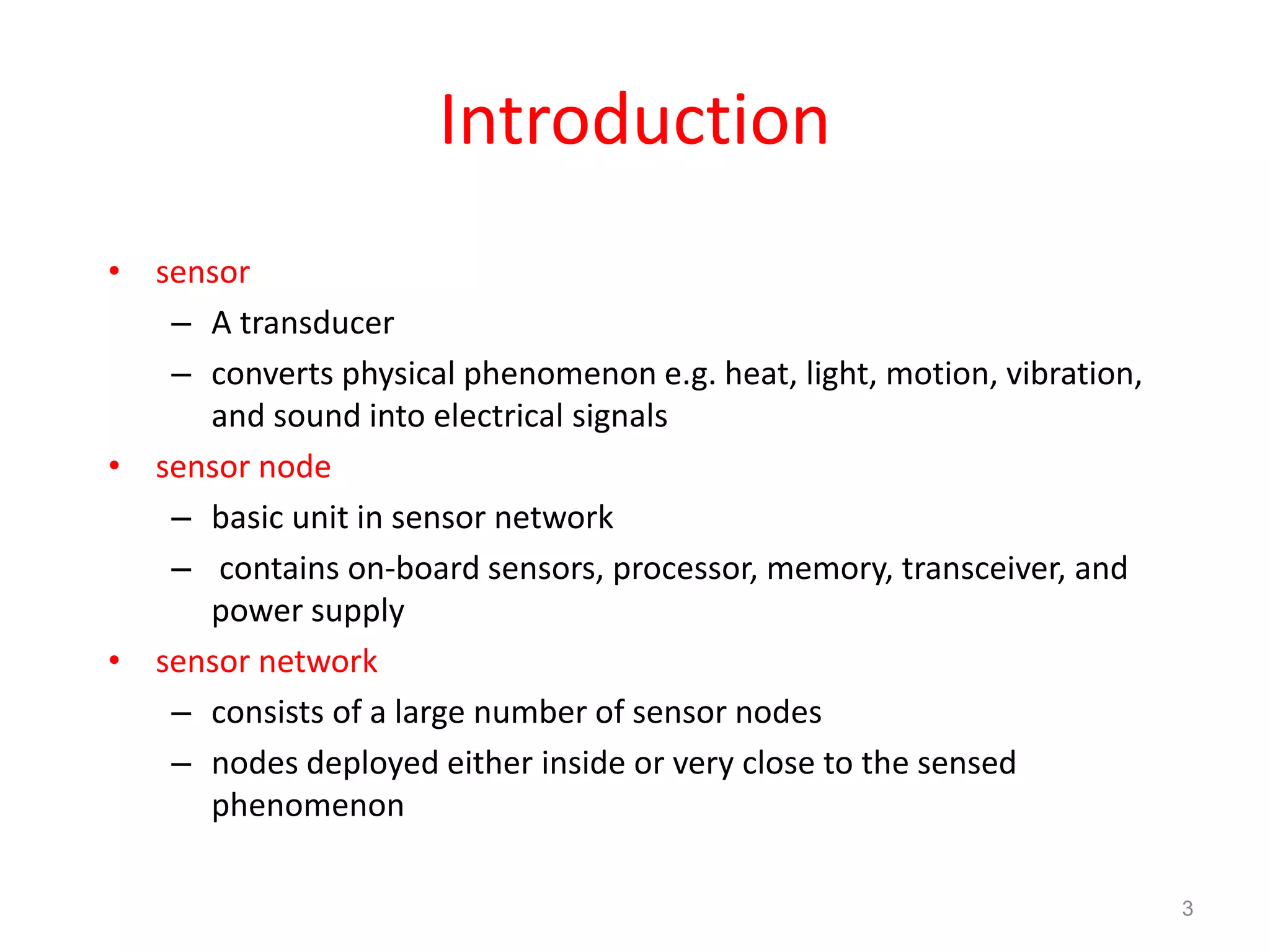
• sensor
– A transducer
– converts physical phenomenon e.g. heat, light, motion, vibration,
and sound into electrical signals
• sensor node
– basic unit in sensor network
– contains on-board sensors, processor, memory, transceiver, and
power supply
• sensor network
– consists of a large number of sensor nodes
– nodes deployed either inside or very close to the sensed
phenomenon
3
Wireless Sensor Networks Applications
Military Applications
• Monitoring friendly forces, equipment, and ammunition
• Battlefield surveillance
• Reconnaissance of opposing forces and terrain
• Targeting
• Battle damage assessment
• Nuclear, biological, and chemical attack detection
4
Wireless Sensor Networks Applications
Environmental Applications
• Forest fire detection
• Bio-complexity mapping of environment
• Flood detection
• Precision Agriculture
• Air and water pollution
5
Wireless Sensor Networks Applications
Health Applications
• Telemonitoring of human physiological data.
• Tracking and monitoring doctors and patients inside a hospital.
• Drug administration in hospitals
6
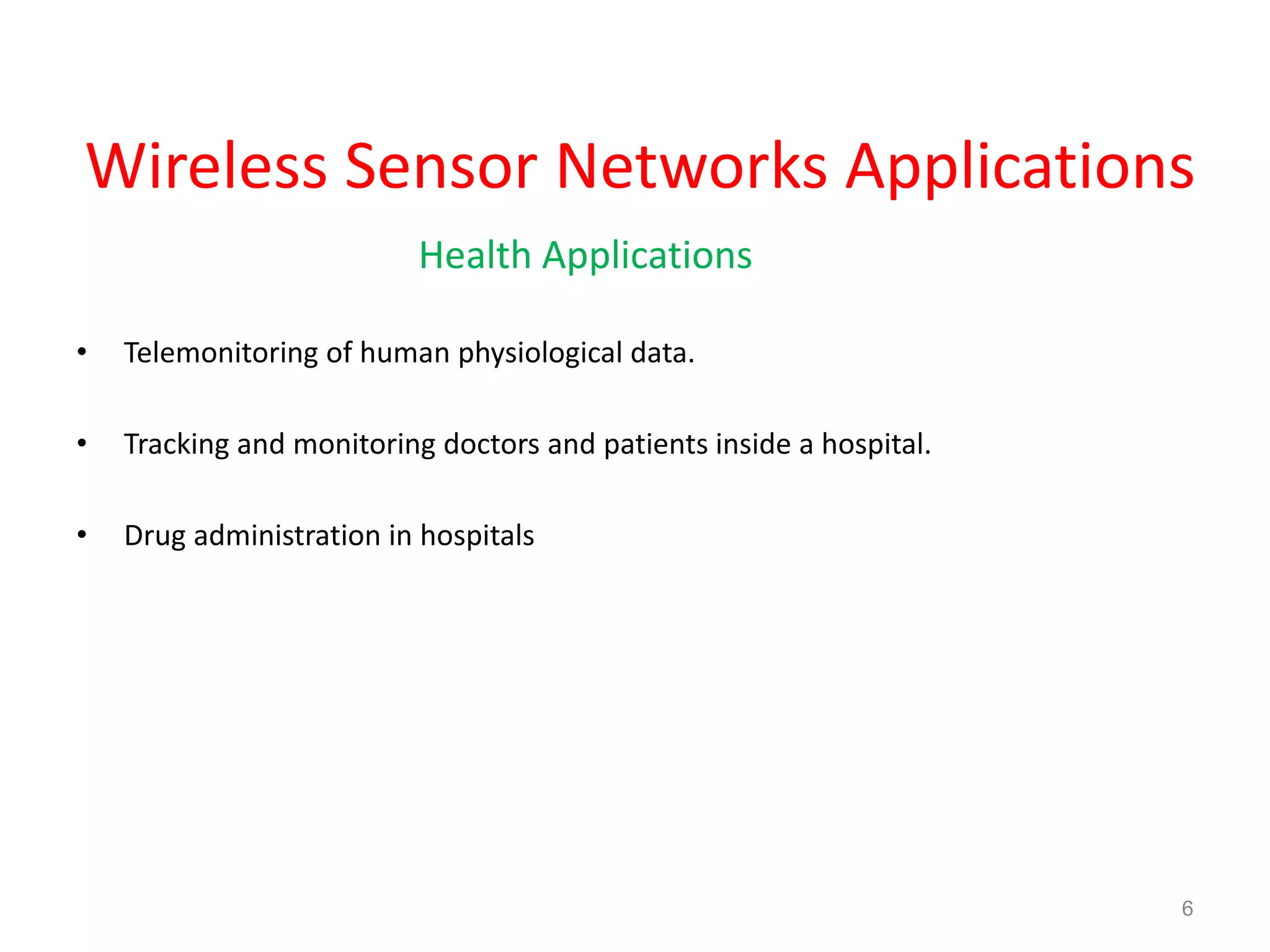
Wireless Sensor Networks Applications
Home and Office Applications
• Home and office automation
• Smart environment
7
Wireless Sensor Networks Applications
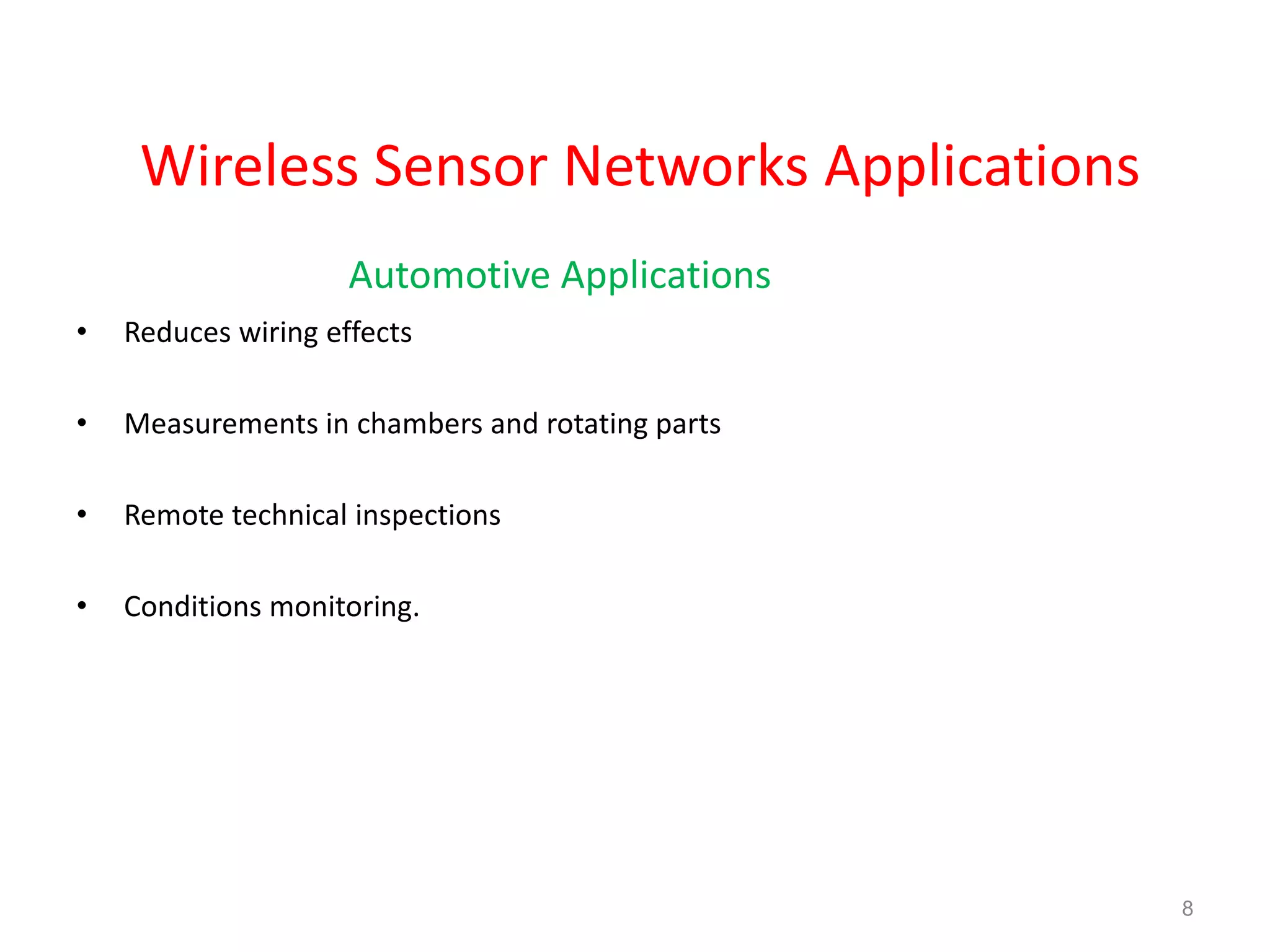
Automotive Applications
• Reduces wiring effects
• Measurements in chambers and rotating parts
• Remote technical inspections
• Conditions monitoring.
8
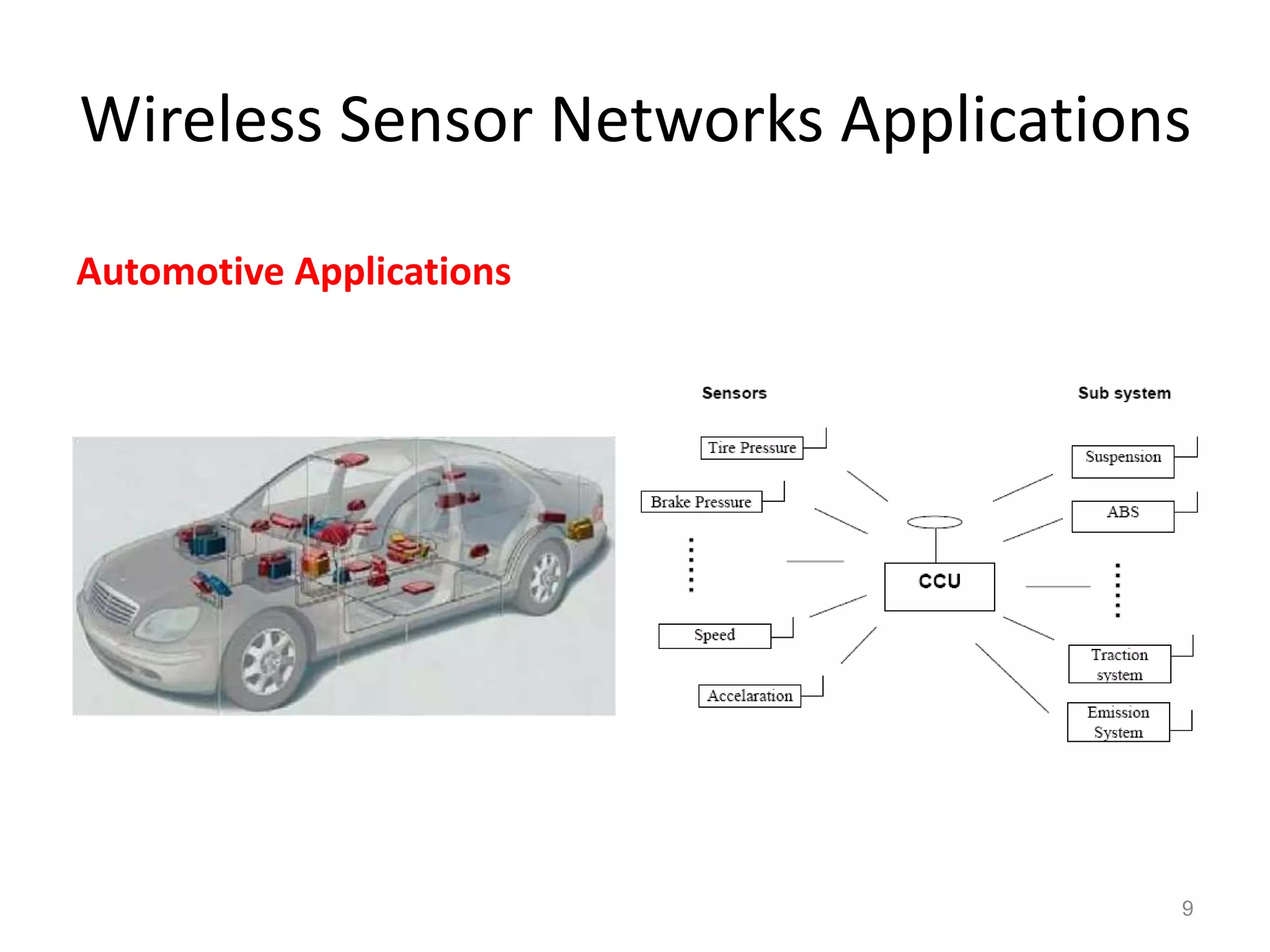
Wireless Sensor Networks Applications
Automotive Applications
9
Wireless Sensor Networks Applications
Other Commercial Applications
• Environmental control in office buildings (estimated energy savings $55 billion per
year!)
• Interactive museums
• Detecting and monitoring car thefts
• Managing inventory control
• Vehicle tracking and detection
10
Factors Influencing WSN Design
• Fault tolerance
• Scalability
• Production costs
• Hardware constraints
• Sensor network topology
• Environment
• Transmission media
• Power Consumption
– Sensing
– Communication
– Data processing
11
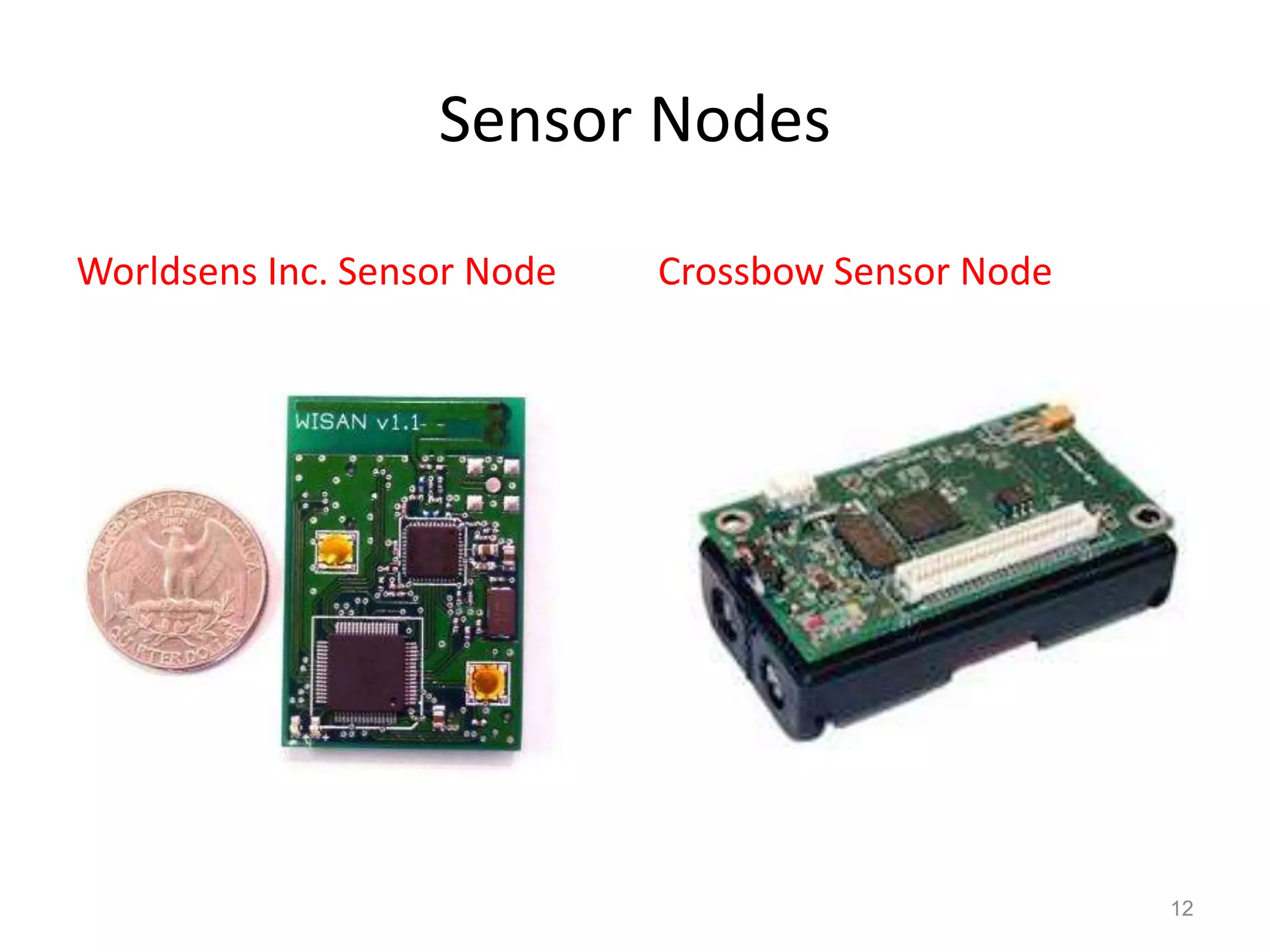
Sensor Nodes
Worldsens Inc. Sensor Node Crossbow Sensor Node
12
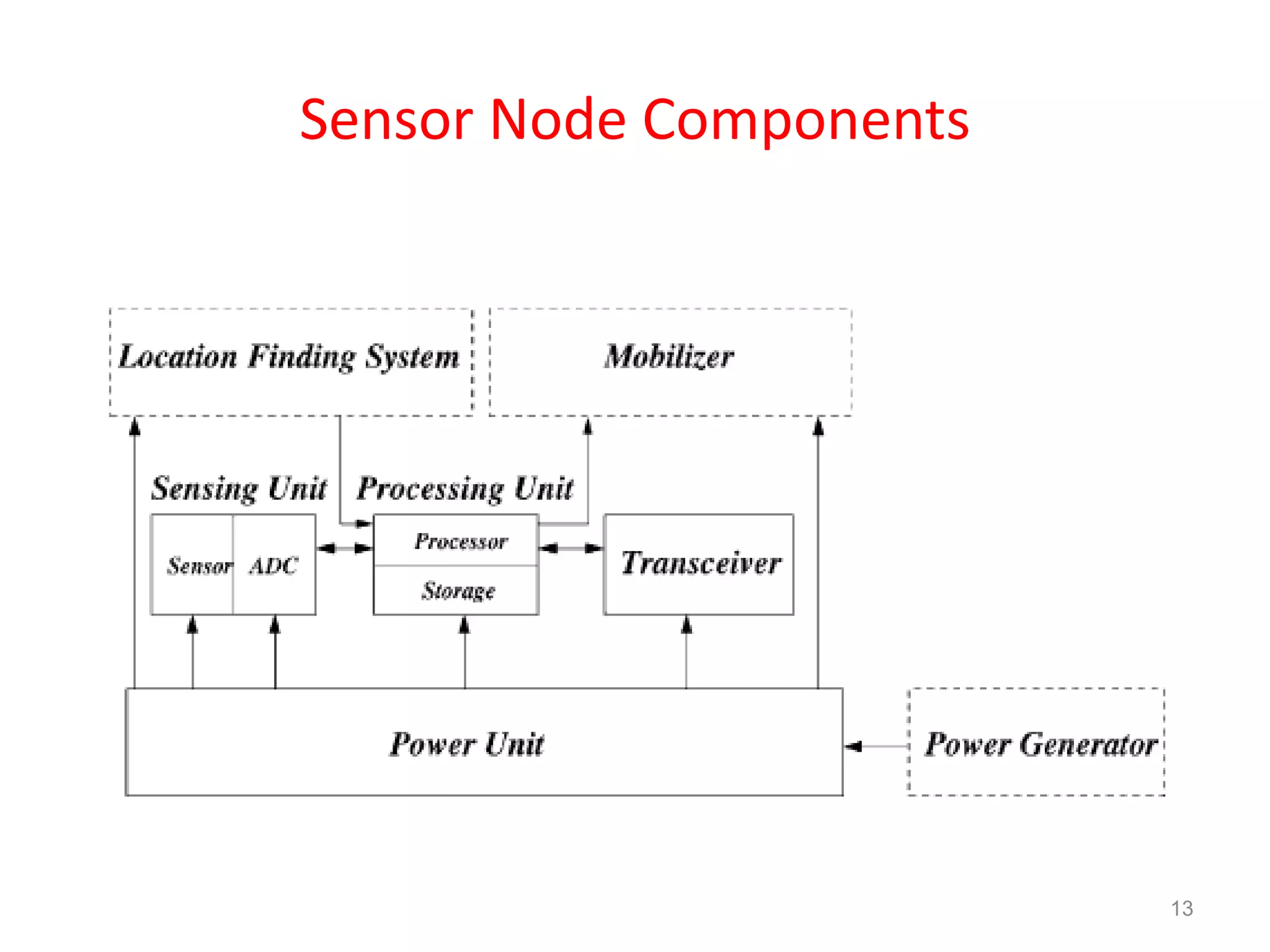
Sensor Node Components
13
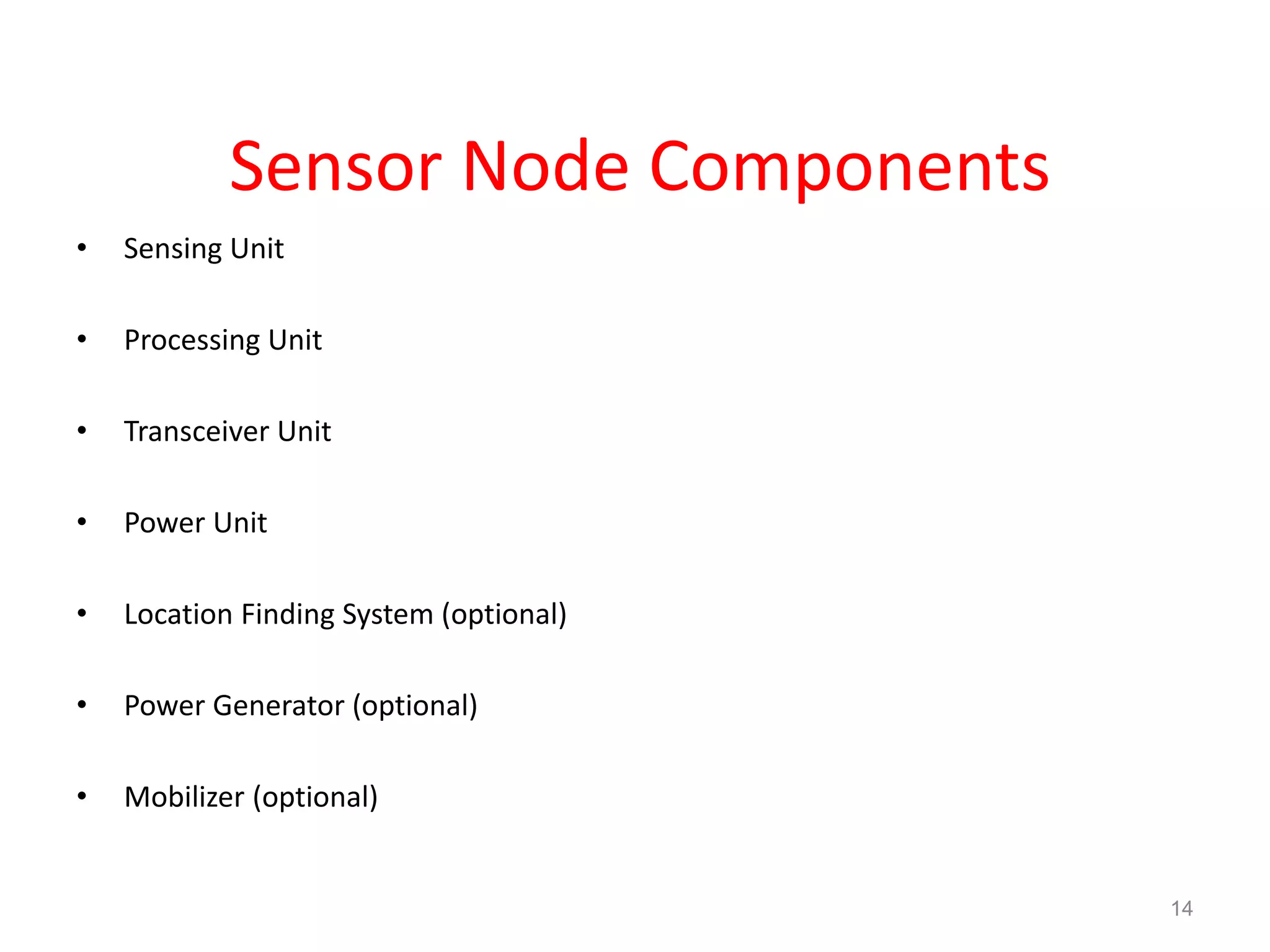
Sensor Node Components
• Sensing Unit
• Processing Unit
• Transceiver Unit
• Power Unit
• Location Finding System (optional)
• Power Generator (optional)
• Mobilizer (optional)
14
WSN Communication Architecture
15
WSN Protocol Stack
16
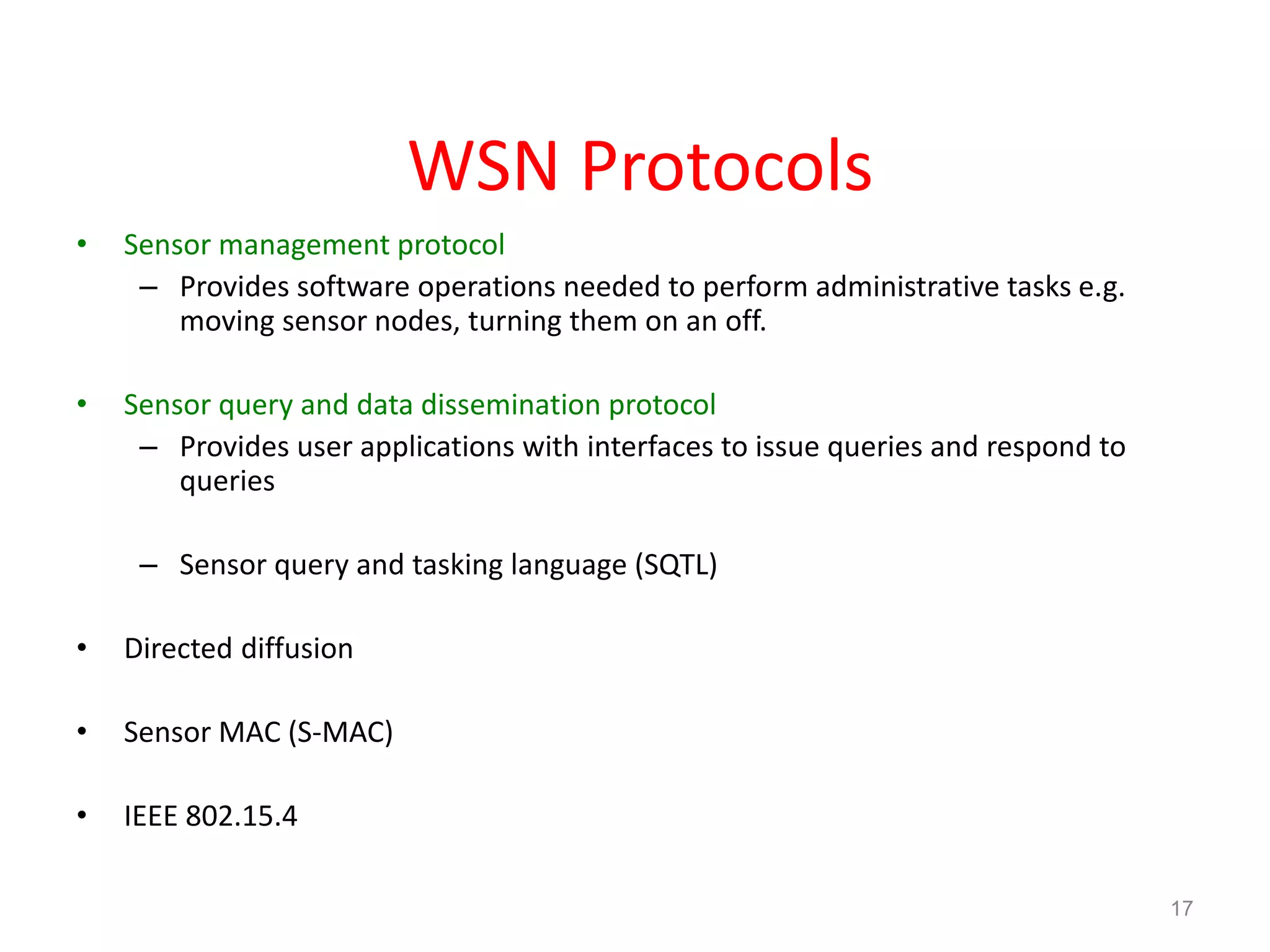
WSN Protocols
• Sensor management protocol
– Provides software operations needed to perform administrative tasks e.g.
moving sensor nodes, turning them on an off.
• Sensor query and data dissemination protocol
– Provides user applications with interfaces to issue queries and respond to
queries
– Sensor query and tasking language (SQTL)
• Directed diffusion
• Sensor MAC (S-MAC)
• IEEE 802.15.4
17
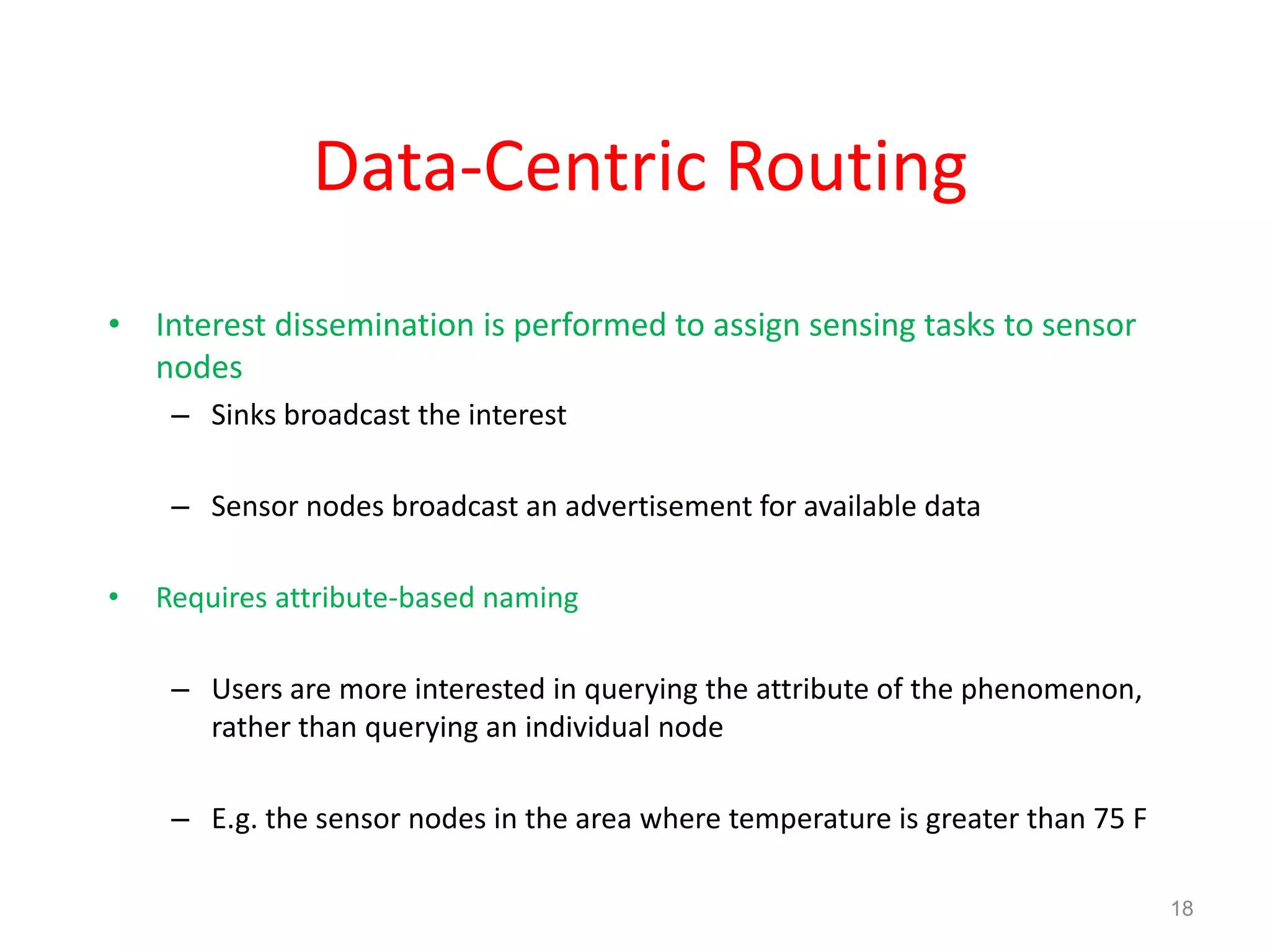
Data-Centric Routing
• Interest dissemination is performed to assign sensing tasks to sensor
nodes
– Sinks broadcast the interest
– Sensor nodes broadcast an advertisement for available data
• Requires attribute-based naming
– Users are more interested in querying the attribute of the phenomenon,
rather than querying an individual node
– E.g. the sensor nodes in the area where temperature is greater than 75 F
18
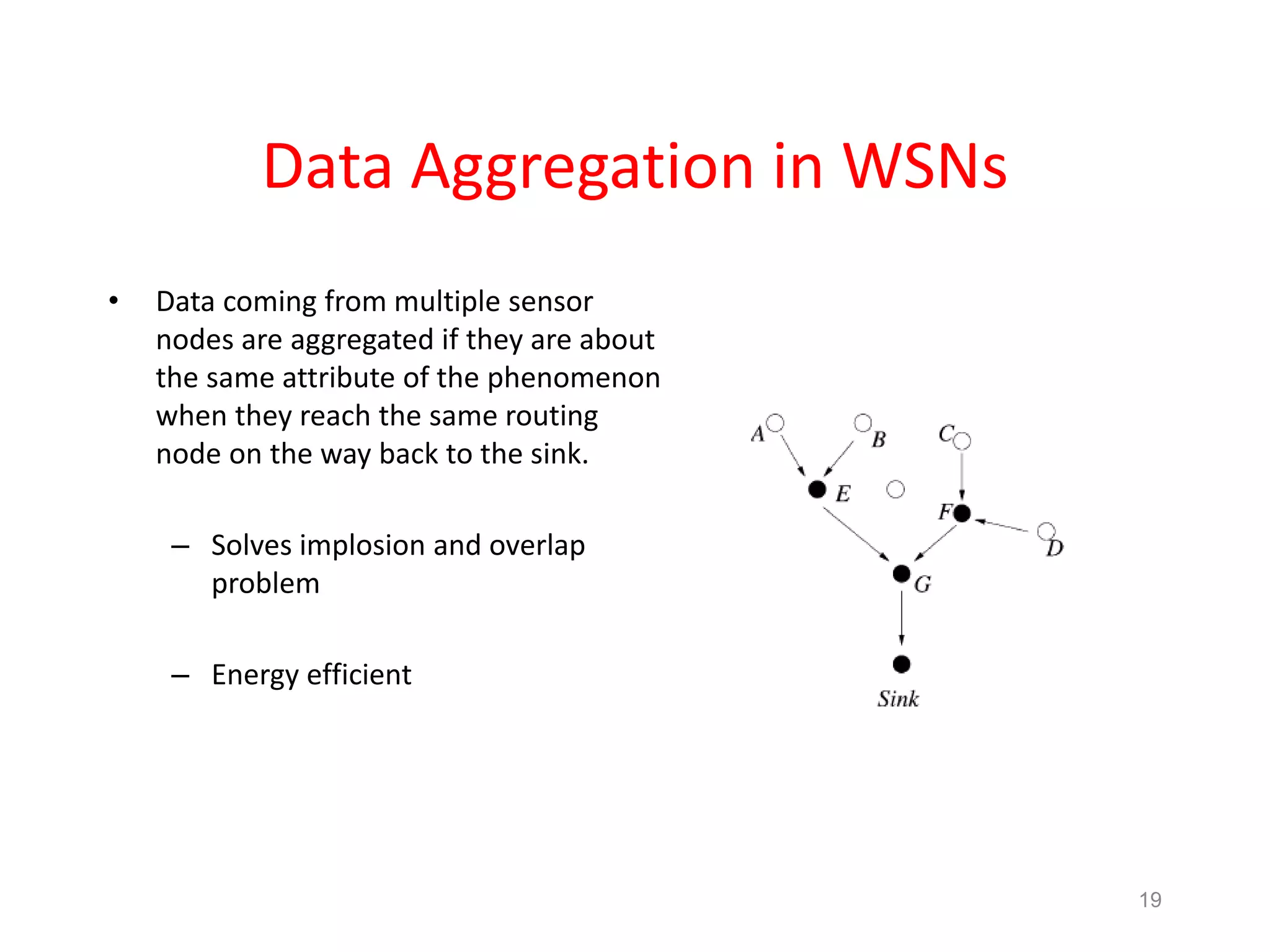
Data Aggregation in WSNs
• Data coming from multiple sensor
nodes are aggregated if they are about
the same attribute of the phenomenon
when they reach the same routing
node on the way back to the sink.
– Solves implosion and overlap
problem
– Energy efficient
19
WSN Operating Systems
• TinyOS
• Contiki
• MANTIS
• Btnut
• SOS
• Nano-RK
20
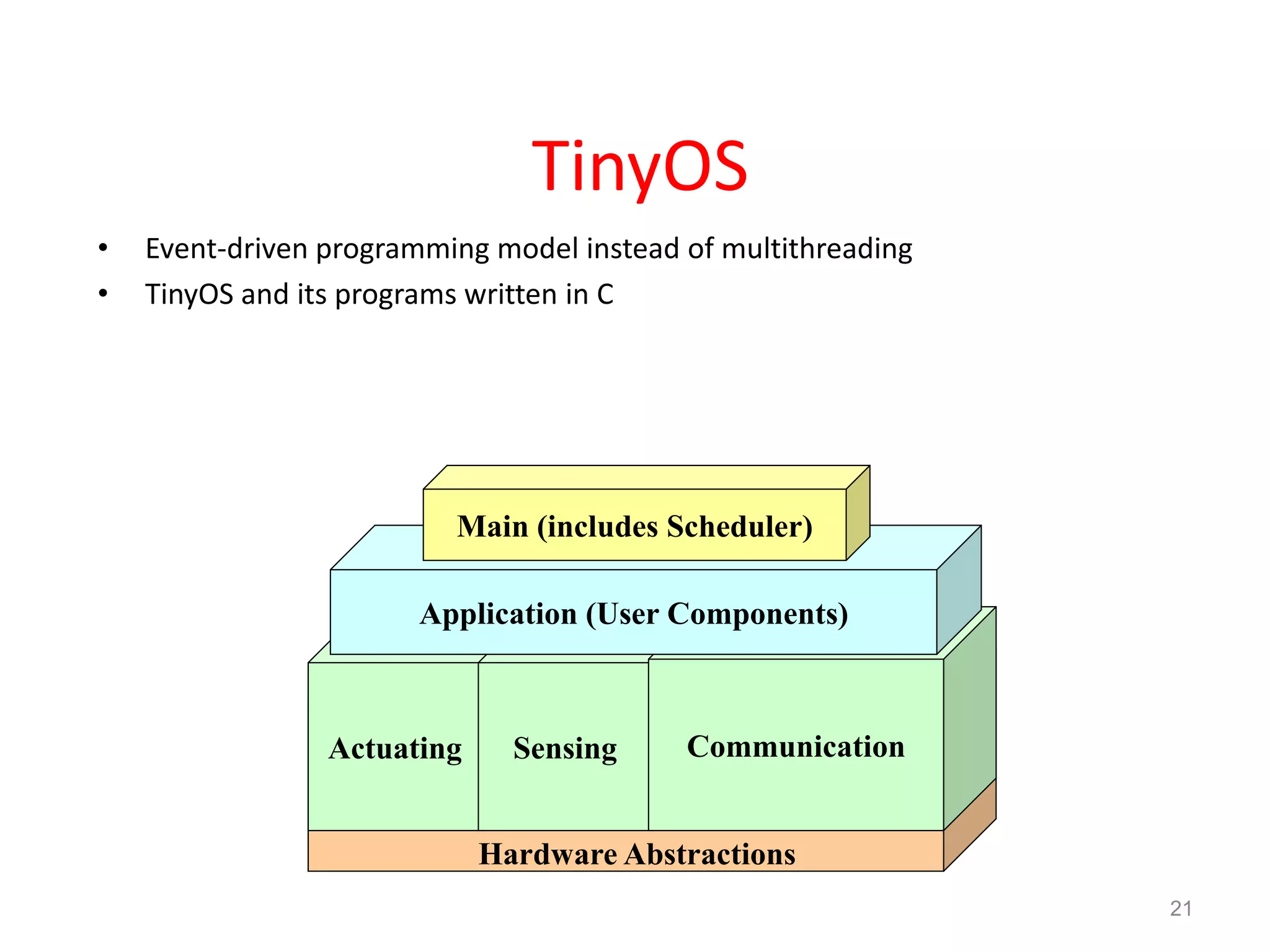
TinyOS
• Event-driven programming model instead of multithreading
• TinyOS and its programs written in C
21
Communication
Actuating Sensing Communication
Application (User Components)
Main (includes Scheduler)
Hardware Abstractions
TinyOS Charactersitics
• Small memory footprint
– non-preemptable FIFO task scheduling.
• Power Efficient
– Puts microcontroller to sleep
– Puts radio to sleep
• Concurrency-Intensive Operations
– Event-driven architecture
– Efficient Interrupts and event handling
22
MICA Sensor Mote
23
MICA Mote Specifications
• 4 MHz ATMEGA103L Microprocessor
• 128 KB of Flash Program Memory
• 4KB RAM
• 10 bit Analog to Digital Converter (ADC)
• 3 Hardware Timers
• Serial Peripheral Interface (SPI) bus
• External UART
• A coprocessor AT90LS2343 (to handle wireless reprogramming)
• DS2401 silicon serial number (provides unique ID to nodes)
• RF Monolithics TR1000 transceiver
• External 4Mbit Atmel AT45DB041B Serial Flash Chip (for persistent data
storage)
• Maxim1678 DC-DC Converter (provides a constant 3.0 V supply)
24
Smart Dust Mote Specifications
• 4 MHz Atmel AVR 8535 Microprocessor
• 8 KB Instruction Flash Memory
• 512 Bytes RAM
• 512 Bytes EEPROM
• Total Stored Energy approx. 1 Joule
• TinyOS Operating System (OS) with 3500 bytes
OS code space and 4500 bytes available code
space
25
WSN Development Platforms
• Crossbow
• Dust Networks
• Sensoria Corporation
• Ember Corporation
• Worldsens
26
WSN Simulators
• NS-2
• GloMoSim
• OPNET
• SensorSim
• J-Sim
• OMNeT++
• Sidh
• SENS
27
Conclusion
• WSNs possible today due to technological advancement in various domains.
• Envisioned to become an essential part of our lives.
• Design Constraints need to be satisfied for realization of sensor networks.
• Tremendous research efforts being made in different layers of WSNs protocol
stack.
28

Wireless sensor networks

  • 1.
  • 2.
    Outline • Introduction • WirelessSensor Networks Applications • Factors Influencing Sensor Network Design • Sensor Node Components • Sensor Networks Communication Architecture • Sensor Network Protocols • Sensor Networks Operating Systems • Sensor Networks Simulators • Conclusion 2
  • 3.
    Introduction • sensor – Atransducer – converts physical phenomenon e.g. heat, light, motion, vibration, and sound into electrical signals • sensor node – basic unit in sensor network – contains on-board sensors, processor, memory, transceiver, and power supply • sensor network – consists of a large number of sensor nodes – nodes deployed either inside or very close to the sensed phenomenon 3
  • 4.
    Wireless Sensor NetworksApplications Military Applications • Monitoring friendly forces, equipment, and ammunition • Battlefield surveillance • Reconnaissance of opposing forces and terrain • Targeting • Battle damage assessment • Nuclear, biological, and chemical attack detection 4
  • 5.
    Wireless Sensor NetworksApplications Environmental Applications • Forest fire detection • Bio-complexity mapping of environment • Flood detection • Precision Agriculture • Air and water pollution 5
  • 6.
    Wireless Sensor NetworksApplications Health Applications • Telemonitoring of human physiological data. • Tracking and monitoring doctors and patients inside a hospital. • Drug administration in hospitals 6
  • 7.
    Wireless Sensor NetworksApplications Home and Office Applications • Home and office automation • Smart environment 7
  • 8.
    Wireless Sensor NetworksApplications Automotive Applications • Reduces wiring effects • Measurements in chambers and rotating parts • Remote technical inspections • Conditions monitoring. 8
  • 9.
    Wireless Sensor NetworksApplications Automotive Applications 9
  • 10.
    Wireless Sensor NetworksApplications Other Commercial Applications • Environmental control in office buildings (estimated energy savings $55 billion per year!) • Interactive museums • Detecting and monitoring car thefts • Managing inventory control • Vehicle tracking and detection 10
  • 11.
    Factors Influencing WSNDesign • Fault tolerance • Scalability • Production costs • Hardware constraints • Sensor network topology • Environment • Transmission media • Power Consumption – Sensing – Communication – Data processing 11
  • 12.
    Sensor Nodes Worldsens Inc.Sensor Node Crossbow Sensor Node 12
  • 13.
  • 14.
    Sensor Node Components •Sensing Unit • Processing Unit • Transceiver Unit • Power Unit • Location Finding System (optional) • Power Generator (optional) • Mobilizer (optional) 14
  • 15.
  • 16.
  • 17.
    WSN Protocols • Sensormanagement protocol – Provides software operations needed to perform administrative tasks e.g. moving sensor nodes, turning them on an off. • Sensor query and data dissemination protocol – Provides user applications with interfaces to issue queries and respond to queries – Sensor query and tasking language (SQTL) • Directed diffusion • Sensor MAC (S-MAC) • IEEE 802.15.4 17
  • 18.
    Data-Centric Routing • Interestdissemination is performed to assign sensing tasks to sensor nodes – Sinks broadcast the interest – Sensor nodes broadcast an advertisement for available data • Requires attribute-based naming – Users are more interested in querying the attribute of the phenomenon, rather than querying an individual node – E.g. the sensor nodes in the area where temperature is greater than 75 F 18
  • 19.
    Data Aggregation inWSNs • Data coming from multiple sensor nodes are aggregated if they are about the same attribute of the phenomenon when they reach the same routing node on the way back to the sink. – Solves implosion and overlap problem – Energy efficient 19
  • 20.
    WSN Operating Systems •TinyOS • Contiki • MANTIS • Btnut • SOS • Nano-RK 20
  • 21.
    TinyOS • Event-driven programmingmodel instead of multithreading • TinyOS and its programs written in C 21 Communication Actuating Sensing Communication Application (User Components) Main (includes Scheduler) Hardware Abstractions
  • 22.
    TinyOS Charactersitics • Smallmemory footprint – non-preemptable FIFO task scheduling. • Power Efficient – Puts microcontroller to sleep – Puts radio to sleep • Concurrency-Intensive Operations – Event-driven architecture – Efficient Interrupts and event handling 22
  • 23.
  • 24.
    MICA Mote Specifications •4 MHz ATMEGA103L Microprocessor • 128 KB of Flash Program Memory • 4KB RAM • 10 bit Analog to Digital Converter (ADC) • 3 Hardware Timers • Serial Peripheral Interface (SPI) bus • External UART • A coprocessor AT90LS2343 (to handle wireless reprogramming) • DS2401 silicon serial number (provides unique ID to nodes) • RF Monolithics TR1000 transceiver • External 4Mbit Atmel AT45DB041B Serial Flash Chip (for persistent data storage) • Maxim1678 DC-DC Converter (provides a constant 3.0 V supply) 24
  • 25.
    Smart Dust MoteSpecifications • 4 MHz Atmel AVR 8535 Microprocessor • 8 KB Instruction Flash Memory • 512 Bytes RAM • 512 Bytes EEPROM • Total Stored Energy approx. 1 Joule • TinyOS Operating System (OS) with 3500 bytes OS code space and 4500 bytes available code space 25
  • 26.
    WSN Development Platforms •Crossbow • Dust Networks • Sensoria Corporation • Ember Corporation • Worldsens 26
  • 27.
    WSN Simulators • NS-2 •GloMoSim • OPNET • SensorSim • J-Sim • OMNeT++ • Sidh • SENS 27
  • 28.
    Conclusion • WSNs possibletoday due to technological advancement in various domains. • Envisioned to become an essential part of our lives. • Design Constraints need to be satisfied for realization of sensor networks. • Tremendous research efforts being made in different layers of WSNs protocol stack. 28