CALCUTTA INSTITUTE OF ENGINEERING AND MANAGEMENT,
KOLKATA, BATCH 2009-2013, C.S.E DEPARTMENT, DURING 4rth
YEAR 2012


WIRELESS SENSOR
 NETWORK - A Survey
                                       by
                                       RAMESH VERMA
                                       ANIL KUMAR
                                       PRAVIND KUMAR
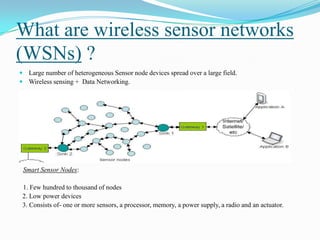
What are wireless sensor networks
(WSNs) ?
 Large number of heterogeneous Sensor node devices spread over a large field.
 Wireless sensing + Data Networking.


 Smart Sensor Nodes:

 1. Few hundred to thousand of nodes
 2. Low power devices
 3. Consists of- one or more sensors, a processor, memory, a power supply, a radio and an actuator.
ENERGY REQUIREMENTS FOR NODES

 Can harvest energy during the idle time .


 Sensor nodes can efficiently convert environmental
 energy to its electrical energy.

 Self powered circuitry of nodes.
NETWORK CONSTRAINTS FOR WSN
 Denser node deployment.

 Battery powered sensor nodes.

 Self configurable.

 Data redundancy.

 Application specific.

 Frequent topology change.
NETWORK DESIGN OBJECTIVES
 Low power consuming nodes are required.

 Scalability – network protocol design should be scalable to
  different network sizes.

 Can deliver data over noisy ,error prone, time varying
  wireless channel.

 Efficient use of bandwidth.

 Fault tolerancnce
ROUTING PROTOCOLS IN WSN
  Responsible for maintaining routes in the network
Types:
1. Location based protocols
2. Data-centric protocols
3. Hierarchical based protocols
4. Mobility based protocols
5. Multi-path based protocols
6. QOS based protocols
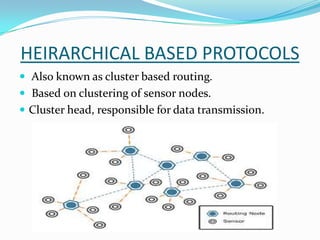
HEIRARCHICAL BASED PROTOCOLS
 Also known as cluster based routing.
 Based on clustering of sensor nodes.
 Cluster head, responsible for data transmission.
LEACH PROTOCOL
 Low energy adaptive clustering hierarchy.
 Clustering task is rotated among nodes.
 Its operation is divided into two rounds
      1. Setup phase: organize network into clusters
      2. Steady state phase: data aggregation,
         compression and transmission to the sink.
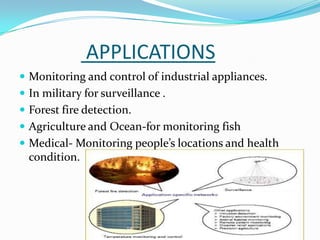
APPLICATIONS
 Monitoring and control of industrial appliances.
 In military for surveillance .
 Forest fire detection.
 Agriculture and Ocean-for monitoring fish
 Medical- Monitoring people’s locations and health
  condition.
SCOPE OF FUTURE RESEARCH
 To exploit redundancy
 To employ more efficient technique for fault
  tolerance.
 To maximize the life time of sensor nodes.
 To provide efficient energy harvesting techniques.
 To provide more secure way of data transmission
FUTURE SCOPE
CONCLUSION

The ultimate objective behind the routing protocol is
to keep the sensor operating for as far as possible,
thus extending the network lifetime.
REFERENCES
 S.K. Singh, M.P. Singh, and D.K. Singh, “A survey of
 Energy-Efficient Hierarchical Cluster-base Routing in
 Wireless Sensor Networks”

 M. J. Handy, M. Haase, D. Timmermann” A survey on
 low energy adaptive clustering hierarchy with
 deterministic cluster-head section”

 Jamal N. Al-Karaki and Ahmed E. Kamal,” Routing
 techniques in wireless sensor networks: A survey”
THANK YOU!

Wireless sensor network

  • 1.
    CALCUTTA INSTITUTE OFENGINEERING AND MANAGEMENT, KOLKATA, BATCH 2009-2013, C.S.E DEPARTMENT, DURING 4rth YEAR 2012 WIRELESS SENSOR NETWORK - A Survey by RAMESH VERMA ANIL KUMAR PRAVIND KUMAR
  • 2.
    What are wirelesssensor networks (WSNs) ?  Large number of heterogeneous Sensor node devices spread over a large field.  Wireless sensing + Data Networking. Smart Sensor Nodes: 1. Few hundred to thousand of nodes 2. Low power devices 3. Consists of- one or more sensors, a processor, memory, a power supply, a radio and an actuator.
  • 3.
    ENERGY REQUIREMENTS FORNODES  Can harvest energy during the idle time .  Sensor nodes can efficiently convert environmental energy to its electrical energy.  Self powered circuitry of nodes.
  • 4.
    NETWORK CONSTRAINTS FORWSN  Denser node deployment.  Battery powered sensor nodes.  Self configurable.  Data redundancy.  Application specific.  Frequent topology change.
  • 5.
    NETWORK DESIGN OBJECTIVES Low power consuming nodes are required.  Scalability – network protocol design should be scalable to different network sizes.  Can deliver data over noisy ,error prone, time varying wireless channel.  Efficient use of bandwidth.  Fault tolerancnce
  • 6.
    ROUTING PROTOCOLS INWSN Responsible for maintaining routes in the network Types: 1. Location based protocols 2. Data-centric protocols 3. Hierarchical based protocols 4. Mobility based protocols 5. Multi-path based protocols 6. QOS based protocols
  • 7.
    HEIRARCHICAL BASED PROTOCOLS Also known as cluster based routing.  Based on clustering of sensor nodes.  Cluster head, responsible for data transmission.
  • 8.
    LEACH PROTOCOL  Lowenergy adaptive clustering hierarchy.  Clustering task is rotated among nodes.  Its operation is divided into two rounds 1. Setup phase: organize network into clusters 2. Steady state phase: data aggregation, compression and transmission to the sink.
  • 9.
    APPLICATIONS  Monitoring andcontrol of industrial appliances.  In military for surveillance .  Forest fire detection.  Agriculture and Ocean-for monitoring fish  Medical- Monitoring people’s locations and health condition.
  • 10.
    SCOPE OF FUTURERESEARCH  To exploit redundancy  To employ more efficient technique for fault tolerance.  To maximize the life time of sensor nodes.  To provide efficient energy harvesting techniques.  To provide more secure way of data transmission
  • 11.
  • 12.
    CONCLUSION The ultimate objectivebehind the routing protocol is to keep the sensor operating for as far as possible, thus extending the network lifetime.
  • 13.
    REFERENCES  S.K. Singh,M.P. Singh, and D.K. Singh, “A survey of Energy-Efficient Hierarchical Cluster-base Routing in Wireless Sensor Networks”  M. J. Handy, M. Haase, D. Timmermann” A survey on low energy adaptive clustering hierarchy with deterministic cluster-head section”  Jamal N. Al-Karaki and Ahmed E. Kamal,” Routing techniques in wireless sensor networks: A survey”
  • 14.