OVERVIEW OF WIRELESS
SENSOR NETWORKS
Unit- I
Introduction
 sensor
 A transducer
 converts physical phenomenon e.g. heat, light, motion, vibration, and
sound into electrical signals
 sensor node
 basic unit in sensor network
 contains on-board sensors, processor, memory, transceiver, and power
supply
 sensor network
 consists of a large number of sensor nodes
 nodes deployed either inside or very close to the sensed phenomenon
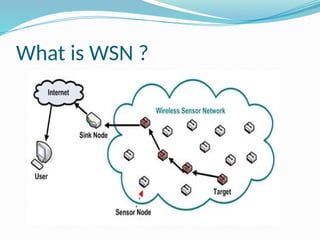
What is WSN ?
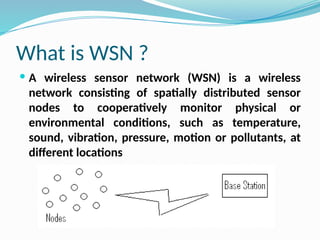
 A wireless sensor network (WSN) is a wireless
network consisting of spatially distributed sensor
nodes to cooperatively monitor physical or
environmental conditions, such as temperature,
sound, vibration, pressure, motion or pollutants, at
different locations
What is WSN ?
 Wireless Sensor Networks are networks that consists
of sensors which are distributed in an ad hoc
manner.
 These sensors work with each other to sense some
physical phenomenon and then the information
gathered is processed to get relevant results.
 These nodes have to collaborate to fulfill their tasks
they use wireless communication to enable this
collaboration.
 Wireless sensor networks consists of protocols and
algorithms with self-organizing capabilities.
What is WSN ?
WSN- syllabus
UNIT-I
Overview of Wireless Sensor Networks: Applications, Unique constraints
and Challenges, Characteristic Requirements and mechanisms;
Advantages of Sensor Networks, Collaborative processing and Key
definitions, Difference between Mobile Ad-hoc and Sensor Networks,
Classification, Enabling technologies.
UNIT-II
Architectures: Single Node Architecture - Hardware Components, Energy
Consumption of Sensor Nodes- Operating states with different Power
Consumption, Energy consumption of Transceiver, Micro controller;
Memory; Dynamic Voltage Scaling, Relation between Computation and
Communication, commercially available sensor nodes; Network
Architecture - Sensor Network Scenarios, Optimization Goals and Figures
of Merit, Gateway Concepts.
UNIT-III
Networking Sensors: Wireless channel and Communication
fundamentals, Physical Layer and Transceiver design considerations in
WSNs; MAC Protocols for Wireless Sensor Networks, Low Duty Cycle
protocols and Wakeup concepts- S-MAC, The IEEE 802.15.4 MAC protocol,
Wakeup Radio Concepts; Routing Protocols- Energy efficient routing,
WSN- syllabus
UNIT – IV
Infrastructure Establishment: Topology Control, Clustering, Time
Synchronization, Localization & Positioning, Sensor Tasking & Control-
Task driven sensing, Role of sensor nodes & utilities, Information based
sensor tasking.
UNIT – V
Sensor Network Platforms and Tools: Operating Systems for Wireless
Sensor Networks, Sensor Node Hardware – Berkeley Motes,
Programming Challenges, Node-level software platforms – network
simulator-NS-2, Node-level Simulators, State-centric programming.
TEXT BOOKS
1. Feng Zhao & Leonidas J. Guibas, “Wireless Sensor Networks- An
Information Processing Approach", Elsevier, 2007.
2. Holger Karl & Andreas Willig, “Protocols and Architectures for Wireless
Sensor Networks”, John Wiley & Sons, 2005
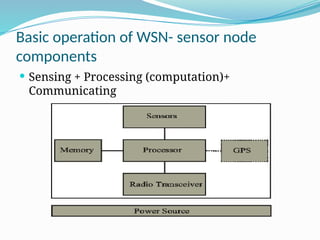
Basic operation of WSN- sensor node
components
 Sensing + Processing (computation)+
Communicating
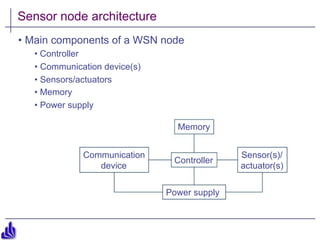
Sensor node architecture
• Main components of a WSN node
• Controller
• Communication device(s)
• Sensors/actuators
• Memory
• Power supply
Memory
Communication
device
Controller
Power supply
Sensor(s)/
actuator(s)
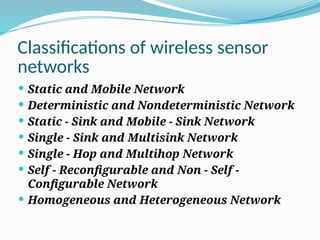
Classifications of wireless sensor
networks
 Static and Mobile Network
 Deterministic and Nondeterministic Network
 Static - Sink and Mobile - Sink Network
 Single - Sink and Multisink Network
 Single - Hop and Multihop Network
 Self - Reconfigurable and Non - Self -
Configurable Network
 Homogeneous and Heterogeneous Network
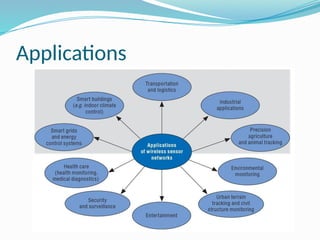
Applications
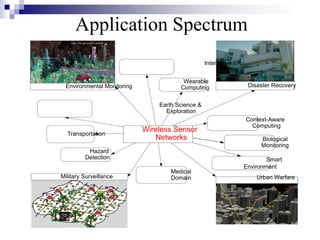
Application Spectrum
Interactive VR
Game
Environmental Monitoring
Wearable
Computing Disaster Recovery
Earth Science &
Exploration
Context-Aware
Transportation
Hazard
Detection
Military Surveillance
Wireless Sensor
Networks
Medical
Domain
Computing
Biological
Monitoring
Smart
Environment
Urban Warfare
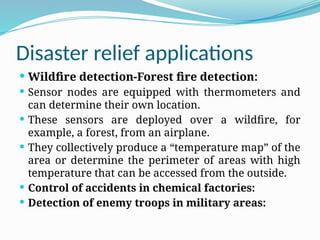
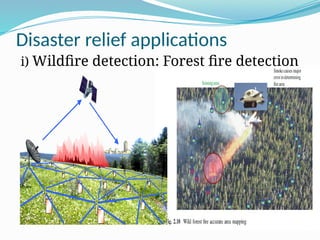
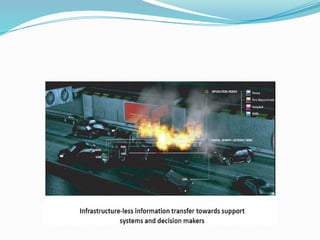
Disaster relief applications
 Wildfire detection-Forest fire detection:
 Sensor nodes are equipped with thermometers and
can determine their own location.
 These sensors are deployed over a wildfire, for
example, a forest, from an airplane.
 They collectively produce a “temperature map” of the
area or determine the perimeter of areas with high
temperature that can be accessed from the outside.
 Control of accidents in chemical factories:
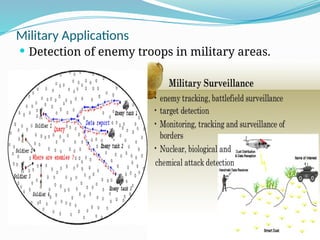
 Detection of enemy troops in military areas:
Disaster relief applications
i) Wildfire detection: Forest fire detection
Military Applications
 Detection of enemy troops in military areas.
Environment control and biodiversity
mapping
 WSNs can be used to control the environment, for
example, with respect to chemical pollutants –
a possible application is garbage dump sites.
 Another example is the surveillance of the marine
ground floor; an understanding of its erosion
processes is important for the construction of
offshore wind farms.
 Closely related to environmental control is the use of
WSNs to gain an understanding of the number of
plant and animal species that live in a given habitat
(biodiversity mapping).
Intelligent buildings
 Efficient HVAC usage: A better, real-time, high-resolution monitoring
of temperature, airflow, humidity, and other physical parameters in a
building by means of a WSN can considerably increase the comfort
level of inhabitants and reduce the energy consumption.
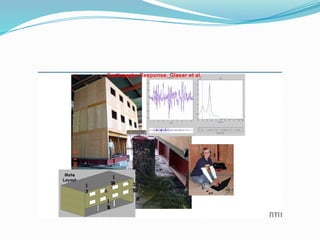
 Sensing seismic events: sensor nodes can be used to monitor
mechanical stress levels of buildings in seismically active zones. By
measuring mechanical parameters like the bending load of girders, it
is possible to quickly ascertain via a WSN whether it is still safe to
enter a given building after an earthquake or whether the building is
on the brink of collapse – a considerable advantage for rescue
personnel.
 detecting people enclosed in a collapsed building and communicating
such information to a rescue team.
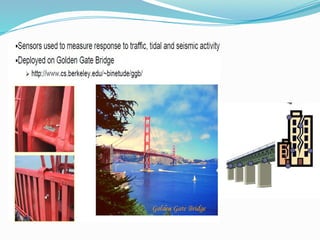
 Intelligent bridges:
Facility management
 Keyless entry applications where people wear
badges that allow a WSN to check which person
is allowed to enter which areas of a larger
company site
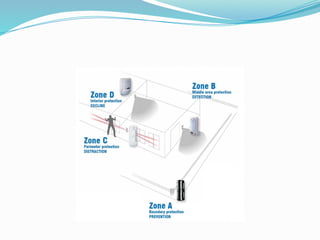
 Detection of intruders, for example of vehicles
that pass a street outside of normal business
hours. A wide area WSN could track such a
vehicle’s position and alert security personnel.
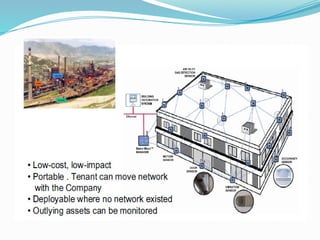
 WSN could be used in a chemical plant to scan
for leaking chemicals.
Machine surveillance and preventive
maintenance
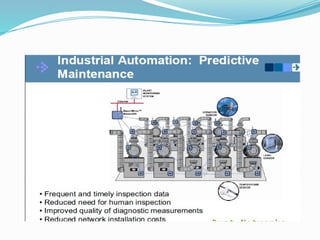
 Machine surveillance: One idea is to fix sensor nodes
to difficult to- reach areas of machinery where they
can detect vibration patterns that indicate the need for
maintenance. Examples for such machinery could be
robotics or the axles of trains.
 Industrial monitoring
Precision agriculture
 Applying WSN to agriculture allows precise
irrigation and fertilizing by placing humidity/soil
composition sensors into the fields.
 Similarly, pest control can profit from a high-
resolution surveillance of farm land.
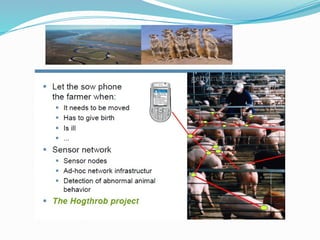
 livestock breeding can benefit from attaching a
sensor to each pig or cow, which controls the
health status of the animal (by checking body
temperature, step counting, or similar means) and
raises alarms if given thresholds are exceeded.
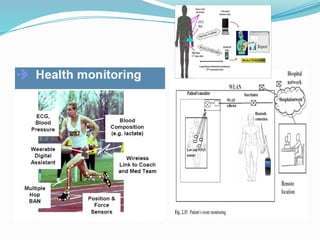
Medicine and health care
 postoperative and intensive care, where sensors
are directly attached to patients.
 long-term surveillance of (typically elderly)
patients and to automatic drug administration
(embedding sensors into drug packaging, raising
alarms when applied to the wrong patient.
 patient and doctor tracking systems within
hospitals can be literally life saving.
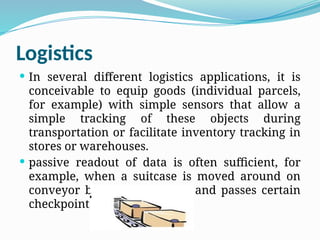
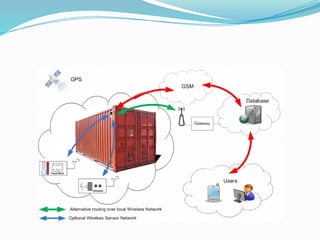
Logistics
 In several different logistics applications, it is
conceivable to equip goods (individual parcels,
for example) with simple sensors that allow a
simple tracking of these objects during
transportation or facilitate inventory tracking in
stores or warehouses.
 passive readout of data is often sufficient, for
example, when a suitcase is moved around on
conveyor belts in an airport and passes certain
checkpoints
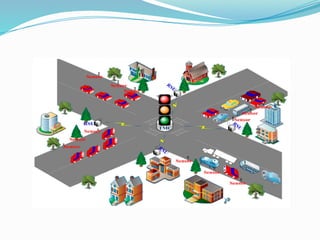
Telematics
 “intelligent roadside”- traffic control: sensors
embedded in the streets or roadsides can gather
information about traffic conditions at a much
finer grained resolution than what is possible
today
 They could also interact with the cars to
exchange danger warnings about road
conditions or traffic jams ahead.
other applications
 airplane wings and support for smart spaces
 applications in waste water treatment plants
 instrumentation of semiconductor processing chambers
and wind tunnels
 “smart kindergartens” where toys interact with children
 the detection of floods
 Interactive museums
 monitoring a bird habitat on a remote island
 implanting sensors into the human body (for glucose
monitoring or as retina prosthesis)
Types of applications
Event detection:
 Sensor nodes should report to the sink(s) once they have
detected the occurrence of a specified event.
 e.g. A temperature threshold is exceeded- simple event
 e.g. A temperature gradient becomes too steep
Periodic measurements:
 Sensors can be tasked with periodically reporting
measured values.
 Often, these reports can be triggered by a detected event;
the reporting period is application dependent.
 e.g: health monitoring of patient in medical applications
Function approximation and edge detection:
 The way a physical value like temperature changes
from one place to another can be regarded as a
function of location.
 A WSN can be used to approximate this unknown
function
 e.g : to find the isothermal points in a forest fire
application to detect the border of the actual fire. –
finding “edges”
Tracking: the source of an event can be mobile.
The WSN can be used to report updates on event’s
source position to sink node and then the estimates
about speed & direction are calculated.
Eg: an intruder(mobile) in surveillance
Design Challenges
 Heterogeneity
 The devices deployed maybe of various types
and need to collaborate with each other.
 Distributed Processing
 The algorithms need to be centralized as the
processing is carried out on different nodes.
 Low Bandwidth Communication
 The data should be transferred efficiently
between sensors
39
Introduction to Wireless Sensor Networks
Continued..
 Large Scale Coordination
 Large number of sensors need to coordinate with
each other to produce required results.
 Utilization of Sensors
 The sensors should be utilized in a ways that
produce the maximum performance and use less
energy.
 Real Time Computation
 The computation should be done quickly as new
data is always being generated.
40
Introduction to Wireless Sensor Networks
Operational Challenges of Wireless Sensor Networks
 Energy Efficiency- limited battery power
 Limited storage and computation
 Low bandwidth and high error rates
 Errors are common
 Wireless communication
 Noisy measurements
 Node failure are expected
 Scalability to a large number of sensor nodes
 Survivability in harsh environments
 Experiments are time- and space-intensive
 Operate in self-configured mode (no infrastructure
network support)
41
Introduction to Wireless Sensor Networks
Deployment options for wireless sensor
networks
 Well planned fixed deployment of sensor nodes
E.g.. In machinery maintenance applications
 Random deployment of sensor nodes by
dropping large number of sensor nodes from an
aircraft over a forest
E.g.. In forest fire detection
 Sensor nodes can be mobile themselves
E.g.. In logistics applications, tracking
applications
Characteristic requirements for WSN
 Type of service of WSN
Not simply moving bits like another network
Rather: provide answers or meaningful information(not just numbers)
Issues like geographic scoping are natural requirements, absent
from other networks
 Quality of service-type of network service
Traditional QoS metrics(bandwidth,delay) do not apply
Still, service of WSN must be “good”: Right answers at the right
time. Reliable detection of events is important. eg.temp. map
 Fault tolerance
Be robust against node failure (running out of energy, physical
destruction, …)
 Lifetime
The network should fulfill its task as long as possible - definition
depends on application
The lifetime of a network also has direct trade-offs against
quality of service
Characteristic requirements for WSNs
 Scalability
Support large number of
nodes
 Wide range of densities
Vast or small number of nodes per unit area, change of
no.of nodes is application-dependent- should adapt to such changes
 Programmability
Re-programming of nodes in the field might be necessary,
programming must be changeable during operation when new tasks become important
 Maintainability
WSN has to adapt to changes(failing nodes, new tasks),
self-monitoring, adapt operation
It has to monitor its own health and status to change operational
parameters or to choose different trade-offs.
Required mechanisms to meet
requirements
 Multi-hop wireless communication
 Energy-efficient operation
Both for communication and computation, sensing,
actuating
 Auto-configuration
Manual configuration just not an option
 Collaboration & in-network processing
Nodes in the network collaborate towards a joint goal
Pre-processing data in network (as opposed to at the
edge) can greatly improve efficiency
Required mechanisms to meet
requirements
 Data centric networking
Focusing network design on data, not on
node identifies (id-centric networking)
To improve efficiency
 Locality
Do things locally (on node or among nearby
neighbors) as far as possible
 Exploit tradeoffs
E.g., between invested energy and accuracy
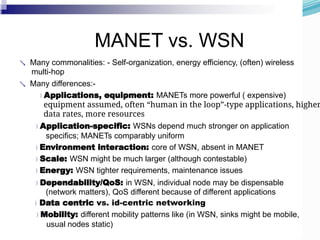
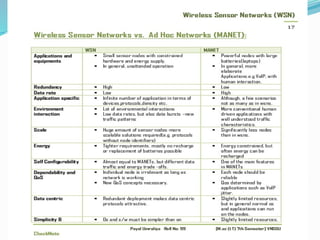
MANET vs. WSN
 Many commonalities: - Self-organization, energy efficiency, (often) wireless
multi-hop
 Many differences:-
Applications, equipment: MANETs more powerful ( expensive)
equipment assumed, often “human in the loop”-type applications, higher
data rates, more resources
Application-specific: WSNs depend much stronger on application
specifics; MANETs comparably uniform
Environment interaction: core of WSN, absent in MANET
Scale: WSN might be much larger (although contestable)
Energy: WSN tighter requirements, maintenance issues
Dependability/QoS: in WSN, individual node may be dispensable
(network matters), QoS different because of different applications
Data centric vs. id-centric networking
Mobility: different mobility patterns like (in WSN, sinks might be mobile,
usual nodes static)
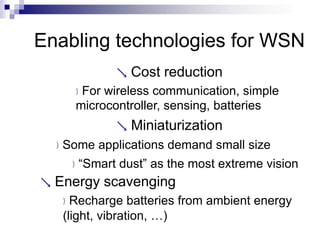
Enabling technologies for WSN
 Cost reduction
For wireless communication, simple
microcontroller, sensing, batteries
 Miniaturization
Some applications demand small size
“Smart dust” as the most extreme vision
 Energy scavenging
Recharge batteries from ambient energy
(light, vibration, …)
Advantages of sensor networks
Networked sensing offers unique advantages over
traditional centralized approaches:
Dense networks of distributed communicating
sensors can improve signal-to-noise ratio (SNR) by
reducing average distances from sensor to source of
signal, or target.
 Increased energy efficiency in communications is
enabled by the multi-hop topology of the network .
Moreover, additional relevant information from other
sensors can be aggregated during this multihop
transmission through in-network processing [104].
But perhaps the greatest advantages of networked
sensing are in improved robustness and scalability.
A decentralized sensing system is inherently more
robust against individual sensor node or link failures,
Advantages of sensor networks
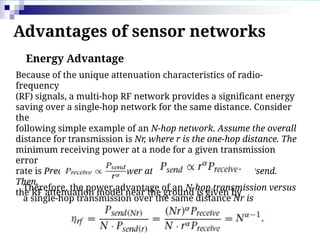
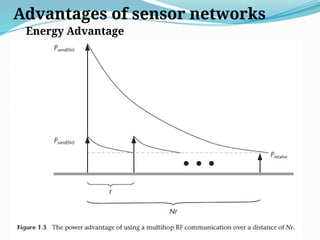
Energy Advantage
Because of the unique attenuation characteristics of radio-
frequency
(RF) signals, a multi-hop RF network provides a significant energy
saving over a single-hop network for the same distance. Consider
the
following simple example of an N-hop network. Assume the overall
distance for transmission is Nr, where r is the one-hop distance. The
minimum receiving power at a node for a given transmission
error
rate is Preceive, and the power at a transmission node is Psend.
Then,
the RF attenuation model near the ground is given by
Therefore, the power advantage of an N-hop transmission versus
a single-hop transmission over the same distance Nr is
Advantages of sensor networks
Energy Advantage
Advantages of sensor networks
Detection Advantage
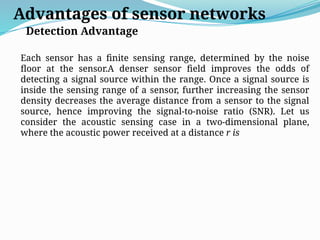
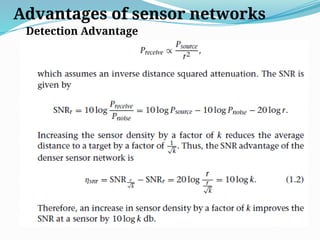
Each sensor has a finite sensing range, determined by the noise
floor at the sensor.A denser sensor field improves the odds of
detecting a signal source within the range. Once a signal source is
inside the sensing range of a sensor, further increasing the sensor
density decreases the average distance from a sensor to the signal
source, hence improving the signal-to-noise ratio (SNR). Let us
consider the acoustic sensing case in a two-dimensional plane,
where the acoustic power received at a distance r is
Advantages of sensor networks
Detection Advantage
Collaborative Processing
Collaborative Processing :
Sensors cooperatively processing data from multiple
sources in order to serve a high-level task. This
typically requires communication among a set of
nodes.
Collaborative processing in wireless sensor networks
(WSNs) refers to the cooperative effort of multiple
sensor nodes to perform data processing tasks
collectively. Instead of each node working
independently, collaborative processing enables the
nodes to collaborate, share data, and collectively make
decisions to achieve more efficient and accurate
results.
Collaborative Processing
Collaborative processing in WSNs is essential for
several reasons, such as:
Reducing energy consumption: By distributing
processing tasks among nodes, energy consumption
can be optimized, extending the network's lifetime.
Improving accuracy: Collaborative data fusion can
enhance data accuracy by aggregating information
from multiple sources.
Coping with node failures: If some nodes fail,
collaboration allows the network to continue
functioning and compensates for the loss of data from
the failed nodes.
Key Definitions of Sensor Networks
Sensor: A transducer that converts a physical
phenomenon such as heat, light, sound, or motion into
electrical or other signals that may be further
manipulated by other apparatus.
Sensor node: A basic unit in a sensor network, with on-
board sensors, processor, memory, wireless modem,
and power supply. It is often abbreviated as node.
When a node has only a single sensor on board, the
node is sometimes also referred to as a sensor, creating
some confusion.
Network topology: A connectivity graph where nodes
are sensor nodes and edges are communication links.
In a wireless network, the link represents a one-hop
connection, and the neighbors of a node are those
Key Definitions of Sensor Networks
• Routing: The process of determining a network path
from a packet source node to its destination.
• Date-centric: Approaches that name, route, or access
a piece of data via properties, such as physical location,
that are external to a communication network. This is
to be contrasted with address centric approaches
which use logical properties of nodes related to the
network structure.
• Geographic routing: Routing of data based on
geographical attributes such as locations or regions.
This is an example of date-centric networking.
In-network: A style of processing in which the data is
processed and combined near where the data is
generated.
Key Definitions of Sensor Networks
• Collaborative processing: Sensors cooperatively processing
data from multiple sources in order to serve a high-level task. This
typically requires communication among a set of nodes.
• State: A snapshot about a physical environment (e.g., the number
of signal sources, their locations or spatial extent, speed of
movement), or a snapshot of the system itself (e.g.,the network
state).
• Uncertainty: A condition of the information caused by noise in
sensor measurements, or lack of knowledge in models. The
uncertainty affects the system’s ability to estimate the state
accurately and must be carefully modeled. Because of the
ubiquity of uncertainty in the data, many sensor network
estimation problems are cast in a statistical framework. For
example, one may use a covariance matrix to characterize the
uncertainty in a Gaussian-like process or more general
probability distributions for non-Gaussian processes.
Key Definitions of Sensor Networks
• Task: Either high-level system tasks which may include sensing,
communication, processing, and resource allocation, or
application tasks which may include detection, classification,
localization, or tracking.
• Detection: The process of discovering the existence of a physical
phenomenon. A threshold-based detector may flag a detection
whenever the signature of a physical phenomenon is determined
to be significant enough compared with the threshold.
• Classification: The assignment of class labels to a set of physical
phenomena being observed.
• Localization and tracking: The estimation of the state of a
physical entity such as a physical phenomenon or a sensor node
from a set of measurements. Tracking produces a series of
estimates over time.
• Value of information or information utility: A mapping of
data to a scalar number, in the context of the overall system task
and knowledge. For example, information utility of a piece of
sensor data may be characterized by its relevance to an
estimation task at hand and computed by a mutual information
Key Definitions of Sensor Networks
• Resource: Resources include sensors, communication links,
processors,
on-board memory, and node energy reserves. Resource allocation
assigns resources to tasks, typically optimizing some performance
objective.
• Sensor tasking: The assignment of sensors to a particular task and
the control of sensor state (e.g., on/off, pan/tilt) for accomplishing
the task.
• Node services: Services such as time synchronization and node
localization that enable applications to discover properties of a
node and the nodes to organize themselves into a useful network.
• Data storage: Sensor information is stored, indexed, and
accessed by applications. Storage may be local to the node where
the data is generated, load-balanced across a network, or
anchored at a few points (warehouses).
• Embedded operating system (OS): The run-time system support
for sensor network applications. An embedded OS typically
provides an abstraction of system resources and a set of utilities.
Key Definitions of Sensor Networks
• System performance goal: The abstract characterization of
system properties. Examples include scalability, robustness,
and network
longevity, each of which may be measured by a set of
evaluation
metrics.
• Evaluation metric: A measurable quantity that describes how
well
the system is performing on some absolute scale. Examples
include packet loss (system), network dwell time (system), track
loss (application), false alarm rate (application), probability of
correct association (application), location error (application), or
processing latency (application/system). An evaluation method
is a process for comparing the value of applying the metrics on
an experimental system with that of some other benchmark
system.

Configuring a wireless LAN There are thr

  • 1.
  • 2.
    Introduction  sensor  Atransducer  converts physical phenomenon e.g. heat, light, motion, vibration, and sound into electrical signals  sensor node  basic unit in sensor network  contains on-board sensors, processor, memory, transceiver, and power supply  sensor network  consists of a large number of sensor nodes  nodes deployed either inside or very close to the sensed phenomenon
  • 3.
    What is WSN?  A wireless sensor network (WSN) is a wireless network consisting of spatially distributed sensor nodes to cooperatively monitor physical or environmental conditions, such as temperature, sound, vibration, pressure, motion or pollutants, at different locations
  • 4.
    What is WSN?  Wireless Sensor Networks are networks that consists of sensors which are distributed in an ad hoc manner.  These sensors work with each other to sense some physical phenomenon and then the information gathered is processed to get relevant results.  These nodes have to collaborate to fulfill their tasks they use wireless communication to enable this collaboration.  Wireless sensor networks consists of protocols and algorithms with self-organizing capabilities.
  • 5.
  • 6.
    WSN- syllabus UNIT-I Overview ofWireless Sensor Networks: Applications, Unique constraints and Challenges, Characteristic Requirements and mechanisms; Advantages of Sensor Networks, Collaborative processing and Key definitions, Difference between Mobile Ad-hoc and Sensor Networks, Classification, Enabling technologies. UNIT-II Architectures: Single Node Architecture - Hardware Components, Energy Consumption of Sensor Nodes- Operating states with different Power Consumption, Energy consumption of Transceiver, Micro controller; Memory; Dynamic Voltage Scaling, Relation between Computation and Communication, commercially available sensor nodes; Network Architecture - Sensor Network Scenarios, Optimization Goals and Figures of Merit, Gateway Concepts. UNIT-III Networking Sensors: Wireless channel and Communication fundamentals, Physical Layer and Transceiver design considerations in WSNs; MAC Protocols for Wireless Sensor Networks, Low Duty Cycle protocols and Wakeup concepts- S-MAC, The IEEE 802.15.4 MAC protocol, Wakeup Radio Concepts; Routing Protocols- Energy efficient routing,
  • 7.
    WSN- syllabus UNIT –IV Infrastructure Establishment: Topology Control, Clustering, Time Synchronization, Localization & Positioning, Sensor Tasking & Control- Task driven sensing, Role of sensor nodes & utilities, Information based sensor tasking. UNIT – V Sensor Network Platforms and Tools: Operating Systems for Wireless Sensor Networks, Sensor Node Hardware – Berkeley Motes, Programming Challenges, Node-level software platforms – network simulator-NS-2, Node-level Simulators, State-centric programming. TEXT BOOKS 1. Feng Zhao & Leonidas J. Guibas, “Wireless Sensor Networks- An Information Processing Approach", Elsevier, 2007. 2. Holger Karl & Andreas Willig, “Protocols and Architectures for Wireless Sensor Networks”, John Wiley & Sons, 2005
  • 8.
    Basic operation ofWSN- sensor node components  Sensing + Processing (computation)+ Communicating
  • 9.
    Sensor node architecture •Main components of a WSN node • Controller • Communication device(s) • Sensors/actuators • Memory • Power supply Memory Communication device Controller Power supply Sensor(s)/ actuator(s)
  • 10.
    Classifications of wirelesssensor networks  Static and Mobile Network  Deterministic and Nondeterministic Network  Static - Sink and Mobile - Sink Network  Single - Sink and Multisink Network  Single - Hop and Multihop Network  Self - Reconfigurable and Non - Self - Configurable Network  Homogeneous and Heterogeneous Network
  • 11.
  • 12.
    Application Spectrum Interactive VR Game EnvironmentalMonitoring Wearable Computing Disaster Recovery Earth Science & Exploration Context-Aware Transportation Hazard Detection Military Surveillance Wireless Sensor Networks Medical Domain Computing Biological Monitoring Smart Environment Urban Warfare
  • 13.
    Disaster relief applications Wildfire detection-Forest fire detection:  Sensor nodes are equipped with thermometers and can determine their own location.  These sensors are deployed over a wildfire, for example, a forest, from an airplane.  They collectively produce a “temperature map” of the area or determine the perimeter of areas with high temperature that can be accessed from the outside.  Control of accidents in chemical factories:  Detection of enemy troops in military areas:
  • 14.
    Disaster relief applications i)Wildfire detection: Forest fire detection
  • 15.
    Military Applications  Detectionof enemy troops in military areas.
  • 16.
    Environment control andbiodiversity mapping  WSNs can be used to control the environment, for example, with respect to chemical pollutants – a possible application is garbage dump sites.  Another example is the surveillance of the marine ground floor; an understanding of its erosion processes is important for the construction of offshore wind farms.  Closely related to environmental control is the use of WSNs to gain an understanding of the number of plant and animal species that live in a given habitat (biodiversity mapping).
  • 18.
    Intelligent buildings  EfficientHVAC usage: A better, real-time, high-resolution monitoring of temperature, airflow, humidity, and other physical parameters in a building by means of a WSN can considerably increase the comfort level of inhabitants and reduce the energy consumption.  Sensing seismic events: sensor nodes can be used to monitor mechanical stress levels of buildings in seismically active zones. By measuring mechanical parameters like the bending load of girders, it is possible to quickly ascertain via a WSN whether it is still safe to enter a given building after an earthquake or whether the building is on the brink of collapse – a considerable advantage for rescue personnel.  detecting people enclosed in a collapsed building and communicating such information to a rescue team.  Intelligent bridges:
  • 21.
    Facility management  Keylessentry applications where people wear badges that allow a WSN to check which person is allowed to enter which areas of a larger company site  Detection of intruders, for example of vehicles that pass a street outside of normal business hours. A wide area WSN could track such a vehicle’s position and alert security personnel.  WSN could be used in a chemical plant to scan for leaking chemicals.
  • 24.
    Machine surveillance andpreventive maintenance  Machine surveillance: One idea is to fix sensor nodes to difficult to- reach areas of machinery where they can detect vibration patterns that indicate the need for maintenance. Examples for such machinery could be robotics or the axles of trains.  Industrial monitoring
  • 26.
    Precision agriculture  ApplyingWSN to agriculture allows precise irrigation and fertilizing by placing humidity/soil composition sensors into the fields.  Similarly, pest control can profit from a high- resolution surveillance of farm land.  livestock breeding can benefit from attaching a sensor to each pig or cow, which controls the health status of the animal (by checking body temperature, step counting, or similar means) and raises alarms if given thresholds are exceeded.
  • 29.
    Medicine and healthcare  postoperative and intensive care, where sensors are directly attached to patients.  long-term surveillance of (typically elderly) patients and to automatic drug administration (embedding sensors into drug packaging, raising alarms when applied to the wrong patient.  patient and doctor tracking systems within hospitals can be literally life saving.
  • 31.
    Logistics  In severaldifferent logistics applications, it is conceivable to equip goods (individual parcels, for example) with simple sensors that allow a simple tracking of these objects during transportation or facilitate inventory tracking in stores or warehouses.  passive readout of data is often sufficient, for example, when a suitcase is moved around on conveyor belts in an airport and passes certain checkpoints
  • 33.
    Telematics  “intelligent roadside”-traffic control: sensors embedded in the streets or roadsides can gather information about traffic conditions at a much finer grained resolution than what is possible today  They could also interact with the cars to exchange danger warnings about road conditions or traffic jams ahead.
  • 36.
    other applications  airplanewings and support for smart spaces  applications in waste water treatment plants  instrumentation of semiconductor processing chambers and wind tunnels  “smart kindergartens” where toys interact with children  the detection of floods  Interactive museums  monitoring a bird habitat on a remote island  implanting sensors into the human body (for glucose monitoring or as retina prosthesis)
  • 37.
    Types of applications Eventdetection:  Sensor nodes should report to the sink(s) once they have detected the occurrence of a specified event.  e.g. A temperature threshold is exceeded- simple event  e.g. A temperature gradient becomes too steep Periodic measurements:  Sensors can be tasked with periodically reporting measured values.  Often, these reports can be triggered by a detected event; the reporting period is application dependent.  e.g: health monitoring of patient in medical applications
  • 38.
    Function approximation andedge detection:  The way a physical value like temperature changes from one place to another can be regarded as a function of location.  A WSN can be used to approximate this unknown function  e.g : to find the isothermal points in a forest fire application to detect the border of the actual fire. – finding “edges” Tracking: the source of an event can be mobile. The WSN can be used to report updates on event’s source position to sink node and then the estimates about speed & direction are calculated. Eg: an intruder(mobile) in surveillance
  • 39.
    Design Challenges  Heterogeneity The devices deployed maybe of various types and need to collaborate with each other.  Distributed Processing  The algorithms need to be centralized as the processing is carried out on different nodes.  Low Bandwidth Communication  The data should be transferred efficiently between sensors 39 Introduction to Wireless Sensor Networks
  • 40.
    Continued..  Large ScaleCoordination  Large number of sensors need to coordinate with each other to produce required results.  Utilization of Sensors  The sensors should be utilized in a ways that produce the maximum performance and use less energy.  Real Time Computation  The computation should be done quickly as new data is always being generated. 40 Introduction to Wireless Sensor Networks
  • 41.
    Operational Challenges ofWireless Sensor Networks  Energy Efficiency- limited battery power  Limited storage and computation  Low bandwidth and high error rates  Errors are common  Wireless communication  Noisy measurements  Node failure are expected  Scalability to a large number of sensor nodes  Survivability in harsh environments  Experiments are time- and space-intensive  Operate in self-configured mode (no infrastructure network support) 41 Introduction to Wireless Sensor Networks
  • 42.
    Deployment options forwireless sensor networks  Well planned fixed deployment of sensor nodes E.g.. In machinery maintenance applications  Random deployment of sensor nodes by dropping large number of sensor nodes from an aircraft over a forest E.g.. In forest fire detection  Sensor nodes can be mobile themselves E.g.. In logistics applications, tracking applications
  • 43.
    Characteristic requirements forWSN  Type of service of WSN Not simply moving bits like another network Rather: provide answers or meaningful information(not just numbers) Issues like geographic scoping are natural requirements, absent from other networks  Quality of service-type of network service Traditional QoS metrics(bandwidth,delay) do not apply Still, service of WSN must be “good”: Right answers at the right time. Reliable detection of events is important. eg.temp. map  Fault tolerance Be robust against node failure (running out of energy, physical destruction, …)  Lifetime The network should fulfill its task as long as possible - definition depends on application The lifetime of a network also has direct trade-offs against quality of service
  • 44.
    Characteristic requirements forWSNs  Scalability Support large number of nodes  Wide range of densities Vast or small number of nodes per unit area, change of no.of nodes is application-dependent- should adapt to such changes  Programmability Re-programming of nodes in the field might be necessary, programming must be changeable during operation when new tasks become important  Maintainability WSN has to adapt to changes(failing nodes, new tasks), self-monitoring, adapt operation It has to monitor its own health and status to change operational parameters or to choose different trade-offs.
  • 45.
    Required mechanisms tomeet requirements  Multi-hop wireless communication  Energy-efficient operation Both for communication and computation, sensing, actuating  Auto-configuration Manual configuration just not an option  Collaboration & in-network processing Nodes in the network collaborate towards a joint goal Pre-processing data in network (as opposed to at the edge) can greatly improve efficiency
  • 46.
    Required mechanisms tomeet requirements  Data centric networking Focusing network design on data, not on node identifies (id-centric networking) To improve efficiency  Locality Do things locally (on node or among nearby neighbors) as far as possible  Exploit tradeoffs E.g., between invested energy and accuracy
  • 47.
    MANET vs. WSN Many commonalities: - Self-organization, energy efficiency, (often) wireless multi-hop  Many differences:- Applications, equipment: MANETs more powerful ( expensive) equipment assumed, often “human in the loop”-type applications, higher data rates, more resources Application-specific: WSNs depend much stronger on application specifics; MANETs comparably uniform Environment interaction: core of WSN, absent in MANET Scale: WSN might be much larger (although contestable) Energy: WSN tighter requirements, maintenance issues Dependability/QoS: in WSN, individual node may be dispensable (network matters), QoS different because of different applications Data centric vs. id-centric networking Mobility: different mobility patterns like (in WSN, sinks might be mobile, usual nodes static)
  • 49.
    Enabling technologies forWSN  Cost reduction For wireless communication, simple microcontroller, sensing, batteries  Miniaturization Some applications demand small size “Smart dust” as the most extreme vision  Energy scavenging Recharge batteries from ambient energy (light, vibration, …)
  • 50.
    Advantages of sensornetworks Networked sensing offers unique advantages over traditional centralized approaches: Dense networks of distributed communicating sensors can improve signal-to-noise ratio (SNR) by reducing average distances from sensor to source of signal, or target.  Increased energy efficiency in communications is enabled by the multi-hop topology of the network . Moreover, additional relevant information from other sensors can be aggregated during this multihop transmission through in-network processing [104]. But perhaps the greatest advantages of networked sensing are in improved robustness and scalability. A decentralized sensing system is inherently more robust against individual sensor node or link failures,
  • 51.
    Advantages of sensornetworks Energy Advantage Because of the unique attenuation characteristics of radio- frequency (RF) signals, a multi-hop RF network provides a significant energy saving over a single-hop network for the same distance. Consider the following simple example of an N-hop network. Assume the overall distance for transmission is Nr, where r is the one-hop distance. The minimum receiving power at a node for a given transmission error rate is Preceive, and the power at a transmission node is Psend. Then, the RF attenuation model near the ground is given by Therefore, the power advantage of an N-hop transmission versus a single-hop transmission over the same distance Nr is
  • 52.
    Advantages of sensornetworks Energy Advantage
  • 53.
    Advantages of sensornetworks Detection Advantage Each sensor has a finite sensing range, determined by the noise floor at the sensor.A denser sensor field improves the odds of detecting a signal source within the range. Once a signal source is inside the sensing range of a sensor, further increasing the sensor density decreases the average distance from a sensor to the signal source, hence improving the signal-to-noise ratio (SNR). Let us consider the acoustic sensing case in a two-dimensional plane, where the acoustic power received at a distance r is
  • 54.
    Advantages of sensornetworks Detection Advantage
  • 55.
    Collaborative Processing Collaborative Processing: Sensors cooperatively processing data from multiple sources in order to serve a high-level task. This typically requires communication among a set of nodes. Collaborative processing in wireless sensor networks (WSNs) refers to the cooperative effort of multiple sensor nodes to perform data processing tasks collectively. Instead of each node working independently, collaborative processing enables the nodes to collaborate, share data, and collectively make decisions to achieve more efficient and accurate results.
  • 56.
    Collaborative Processing Collaborative processingin WSNs is essential for several reasons, such as: Reducing energy consumption: By distributing processing tasks among nodes, energy consumption can be optimized, extending the network's lifetime. Improving accuracy: Collaborative data fusion can enhance data accuracy by aggregating information from multiple sources. Coping with node failures: If some nodes fail, collaboration allows the network to continue functioning and compensates for the loss of data from the failed nodes.
  • 57.
    Key Definitions ofSensor Networks Sensor: A transducer that converts a physical phenomenon such as heat, light, sound, or motion into electrical or other signals that may be further manipulated by other apparatus. Sensor node: A basic unit in a sensor network, with on- board sensors, processor, memory, wireless modem, and power supply. It is often abbreviated as node. When a node has only a single sensor on board, the node is sometimes also referred to as a sensor, creating some confusion. Network topology: A connectivity graph where nodes are sensor nodes and edges are communication links. In a wireless network, the link represents a one-hop connection, and the neighbors of a node are those
  • 58.
    Key Definitions ofSensor Networks • Routing: The process of determining a network path from a packet source node to its destination. • Date-centric: Approaches that name, route, or access a piece of data via properties, such as physical location, that are external to a communication network. This is to be contrasted with address centric approaches which use logical properties of nodes related to the network structure. • Geographic routing: Routing of data based on geographical attributes such as locations or regions. This is an example of date-centric networking. In-network: A style of processing in which the data is processed and combined near where the data is generated.
  • 59.
    Key Definitions ofSensor Networks • Collaborative processing: Sensors cooperatively processing data from multiple sources in order to serve a high-level task. This typically requires communication among a set of nodes. • State: A snapshot about a physical environment (e.g., the number of signal sources, their locations or spatial extent, speed of movement), or a snapshot of the system itself (e.g.,the network state). • Uncertainty: A condition of the information caused by noise in sensor measurements, or lack of knowledge in models. The uncertainty affects the system’s ability to estimate the state accurately and must be carefully modeled. Because of the ubiquity of uncertainty in the data, many sensor network estimation problems are cast in a statistical framework. For example, one may use a covariance matrix to characterize the uncertainty in a Gaussian-like process or more general probability distributions for non-Gaussian processes.
  • 60.
    Key Definitions ofSensor Networks • Task: Either high-level system tasks which may include sensing, communication, processing, and resource allocation, or application tasks which may include detection, classification, localization, or tracking. • Detection: The process of discovering the existence of a physical phenomenon. A threshold-based detector may flag a detection whenever the signature of a physical phenomenon is determined to be significant enough compared with the threshold. • Classification: The assignment of class labels to a set of physical phenomena being observed. • Localization and tracking: The estimation of the state of a physical entity such as a physical phenomenon or a sensor node from a set of measurements. Tracking produces a series of estimates over time. • Value of information or information utility: A mapping of data to a scalar number, in the context of the overall system task and knowledge. For example, information utility of a piece of sensor data may be characterized by its relevance to an estimation task at hand and computed by a mutual information
  • 61.
    Key Definitions ofSensor Networks • Resource: Resources include sensors, communication links, processors, on-board memory, and node energy reserves. Resource allocation assigns resources to tasks, typically optimizing some performance objective. • Sensor tasking: The assignment of sensors to a particular task and the control of sensor state (e.g., on/off, pan/tilt) for accomplishing the task. • Node services: Services such as time synchronization and node localization that enable applications to discover properties of a node and the nodes to organize themselves into a useful network. • Data storage: Sensor information is stored, indexed, and accessed by applications. Storage may be local to the node where the data is generated, load-balanced across a network, or anchored at a few points (warehouses). • Embedded operating system (OS): The run-time system support for sensor network applications. An embedded OS typically provides an abstraction of system resources and a set of utilities.
  • 62.
    Key Definitions ofSensor Networks • System performance goal: The abstract characterization of system properties. Examples include scalability, robustness, and network longevity, each of which may be measured by a set of evaluation metrics. • Evaluation metric: A measurable quantity that describes how well the system is performing on some absolute scale. Examples include packet loss (system), network dwell time (system), track loss (application), false alarm rate (application), probability of correct association (application), location error (application), or processing latency (application/system). An evaluation method is a process for comparing the value of applying the metrics on an experimental system with that of some other benchmark system.

Editor's Notes

  • #16 Thoreau website university of Chicago- Sensor network to map and predict pollution, effluents in Godavari