






BY:
JOHNSAIDA.NOORBASHA
ECE
VVIT.

WIRELESS SENSOR
NETWORKS
•Introduction
•Wireless Sensor Networks Applications
•Factors Influencing Sensor Network Design
•Characteristics
•Advantages
•Disadvantages
•Conclusion
Contents:
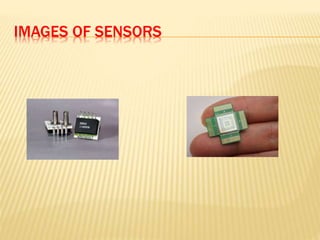
IMAGES OF SENSORS
Introduction
sensor
 A transducer
 converts physical phenomenon e.g. heat, light, motion,
vibration, and sound into electrical signals
sensor node
 basic unit in sensor network
 contains on-board sensors, processor, memory,
transceiver, and power supply
sensor network
 consists of a large number of sensor nodes
 nodes deployed either inside or very close to the sensed
phenomenon
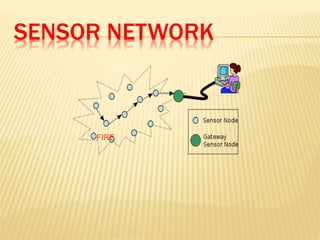
SENSOR NETWORK
FIRE
Wireless Sensor Networks Applications
Military Applications
 Monitoring friendly forces, equipment, and
ammunition
 Battlefield surveillance
 Reconnaissance of opposing forces and terrain
 Targeting
 Battle damage assessment
 Nuclear, biological, and chemical attack
detection
Environmental Applications
 Forest fire detection
 Bio-complexity mapping of environment
 Flood detection
 Precision Agriculture
 Air and water pollution
Health Applications
 Medical applications are of two types:
 1:wearable->used on body surface of a human
or just at close proximity of the user.
 2:implanted-> The implantable medical
devices are those that are inserted inside
human body.
 Telemonitoring of human physiological data
 Tracking and monitoring doctors and patients
inside a hospital
 Drug administration in hospitals
Home and Office Applications
 Home and office automation
 Smart environment
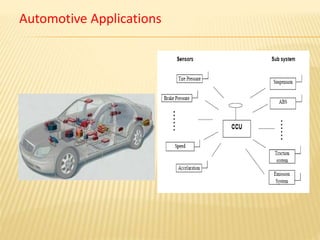
Automotive Applications
 Reduces wiring effects
 Measurements in chambers and rotating parts
 Remote technical inspections
 Conditions monitoring e.g. at a bearing
Automotive Applications
Other Commercial Applications
 Environmental control in office buildings
(estimated energy savings $55 billion per
year!)
 Interactive museums
 Detecting and monitoring car thefts
 Managing inventory control
 Vehicle tracking and detection
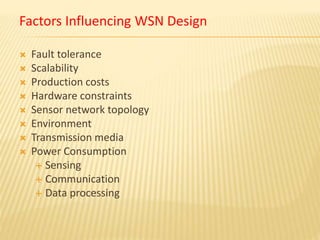
Factors Influencing WSN Design
 Fault tolerance
 Scalability
 Production costs
 Hardware constraints
 Sensor network topology
 Environment
 Transmission media
 Power Consumption
 Sensing
 Communication
 Data processing
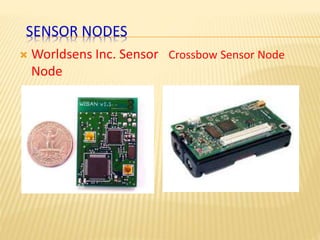
SENSOR NODES
 Worldsens Inc. Sensor
Node
Crossbow Sensor Node
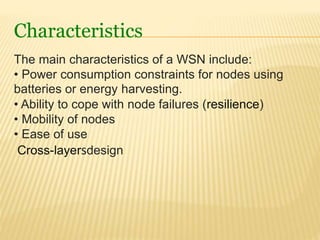
Characteristics
The main characteristics of a WSN include:
• Power consumption constraints for nodes using
batteries or energy harvesting.
• Ability to cope with node failures (resilience)
• Mobility of nodes
• Ease of use
Cross-layersdesign
ADVANTAGES
 Sensors networks allow a system to be
extended from one with basic functions to
one that can receive and act on data about
the environment it operates in.
 Sensors such as PIR detectors are relatively
cheap if using wired versions.
DISADVANTAGES
 Users need to decide carefully if they wish to
be monitored 24 hours a day by a computer
system.
 A Sensor Network may require a lot of
additional wiring to be installed around the
house to allow sensors to work - unless the
sensors used are wireless.
CONCLUSION
 WSNs possible today due to technological
advancement in various domains
 Envisioned to become an essential part of our
lives
 Design Constraints need to be satisfied for
realization of sensor networks
 Tremendous research efforts being made in
different layers of WSNs protocol stack
Wireless Sensor Networks

Wireless Sensor Networks

  • 1.
  • 2.
    •Introduction •Wireless Sensor NetworksApplications •Factors Influencing Sensor Network Design •Characteristics •Advantages •Disadvantages •Conclusion Contents:
  • 3.
  • 4.
    Introduction sensor  A transducer converts physical phenomenon e.g. heat, light, motion, vibration, and sound into electrical signals sensor node  basic unit in sensor network  contains on-board sensors, processor, memory, transceiver, and power supply sensor network  consists of a large number of sensor nodes  nodes deployed either inside or very close to the sensed phenomenon
  • 5.
  • 6.
    Wireless Sensor NetworksApplications Military Applications  Monitoring friendly forces, equipment, and ammunition  Battlefield surveillance  Reconnaissance of opposing forces and terrain  Targeting  Battle damage assessment  Nuclear, biological, and chemical attack detection
  • 7.
    Environmental Applications  Forestfire detection  Bio-complexity mapping of environment  Flood detection  Precision Agriculture  Air and water pollution
  • 8.
    Health Applications  Medicalapplications are of two types:  1:wearable->used on body surface of a human or just at close proximity of the user.  2:implanted-> The implantable medical devices are those that are inserted inside human body.  Telemonitoring of human physiological data  Tracking and monitoring doctors and patients inside a hospital  Drug administration in hospitals
  • 10.
    Home and OfficeApplications  Home and office automation  Smart environment
  • 11.
    Automotive Applications  Reduceswiring effects  Measurements in chambers and rotating parts  Remote technical inspections  Conditions monitoring e.g. at a bearing
  • 12.
  • 13.
    Other Commercial Applications Environmental control in office buildings (estimated energy savings $55 billion per year!)  Interactive museums  Detecting and monitoring car thefts  Managing inventory control  Vehicle tracking and detection
  • 14.
    Factors Influencing WSNDesign  Fault tolerance  Scalability  Production costs  Hardware constraints  Sensor network topology  Environment  Transmission media  Power Consumption  Sensing  Communication  Data processing
  • 15.
    SENSOR NODES  WorldsensInc. Sensor Node Crossbow Sensor Node
  • 16.
    Characteristics The main characteristicsof a WSN include: • Power consumption constraints for nodes using batteries or energy harvesting. • Ability to cope with node failures (resilience) • Mobility of nodes • Ease of use Cross-layersdesign
  • 17.
    ADVANTAGES  Sensors networksallow a system to be extended from one with basic functions to one that can receive and act on data about the environment it operates in.  Sensors such as PIR detectors are relatively cheap if using wired versions.
  • 18.
    DISADVANTAGES  Users needto decide carefully if they wish to be monitored 24 hours a day by a computer system.  A Sensor Network may require a lot of additional wiring to be installed around the house to allow sensors to work - unless the sensors used are wireless.
  • 19.
    CONCLUSION  WSNs possibletoday due to technological advancement in various domains  Envisioned to become an essential part of our lives  Design Constraints need to be satisfied for realization of sensor networks  Tremendous research efforts being made in different layers of WSNs protocol stack