Government Polytechnic, Pune 
An Autonomous Institute of Government of Maharashtra 
SEMINAR PRESENTATION ON 
WIRELESS SENSOR NETWORKS 
Presented By: 
Ganesh S. Khadsan 
1206103 
Guided By: 
Prof. Mrs N. R. Wagh 
1
PRESENTATION FLOW 
INTRODUCTION 
WSN ARCHITECTURE 
NETWORKING TOPOLOGIES 
ADVANTAGES & 
DISADVANTAGES 
APPLICATIONS 
FUTURE WORK 
CONCLUSION 
2
Introduction 
Wireless Sensor Networks(WSN) 
•WSN are used to collect data from the 
environment. 
•They consists of large number of sensor nodes and 
one or more Base Stations. 
•The nodes in the network are connected via 
Wireless communication channels. 
•Each node has capability to sense data, process the 
data and send it to rest of the nodes or to Base 
Station. 
•These networks are limited by the node battery 
lifetime. 
3
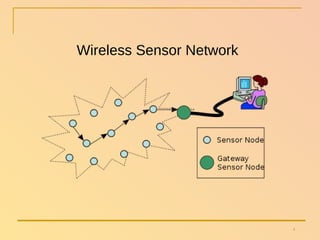
Wireless Sensor Network 
4
Definition 
•Wireless Sensor Network (WSN) consists of 
spatially distributed autonomous sensors to 
cooperatively monitor physical or 
environmental conditions, such as 
temperature, sound, vibration, pressure, 
motion or pollutants. 
5
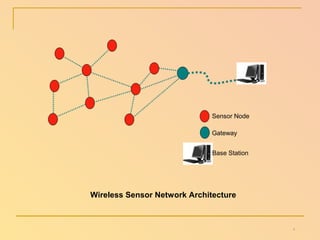
Sensor Node 
Gateway 
Base Station 
Wireless Sensor Network Architecture 
6
Sensors 
A Sensor is an electronic device that 
measures a physical quantity and 
converts it into a signal which can be 
read by an observer or by an instrument. 
7
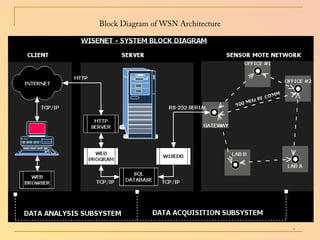
Architecture of WSN 
The entire system can be described as consist 
as two subsystems depending upon the 
operation performed by the entire system, 
such as:- 
Data Acquisition. 
Data Analysis. 
8
Block Diagram of WSN Architecture 
9
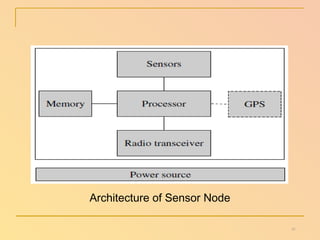
Architecture of Sensor Node 
10
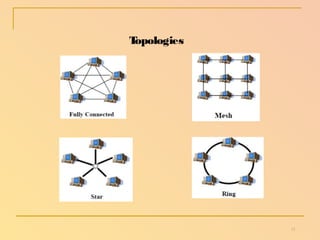
Networking Topology 
• A communication network is composed of 
nodes, each of which has computing power 
and can transmit and receive messages over 
communication links. 
• The basic network topologies are 
1.Fully connected Topology 
2.Mesh Topology 
3.Star Topology 
4.Ring Topology 
11
Topologies 
12
 Advantages 
 It can accommodate new devices at any time. 
 Its flexible to go through physical partitions. 
 It can be accessed through a centralized 
monitor. 
 It avoid lot of wiring. 
 WSN’s can be applied on large scale and in 
various fields. 
13 
Pros and Cons of WSN
 Disadvantages 
 It is very easy for hackers to hack it as we 
can't control propagation of waves. 
 Comparatively low speed of communications. 
 Gets distracted by various elements like Blue-tooth. 
 Still costly at large. 
14
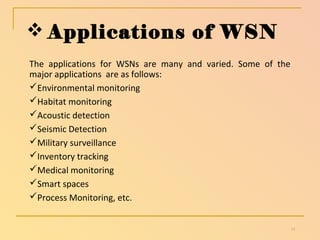
Applications of WSN 
The applications for WSNs are many and varied. Some of the 
major applications are as follows: 
Environmental monitoring 
Habitat monitoring 
Acoustic detection 
Seismic Detection 
Military surveillance 
Inventory tracking 
Medical monitoring 
Smart spaces 
Process Monitoring, etc. 
15
Future Scope 
Wireless sensor network has the potential to 
trigger the next revolution in computing. While its 
applications and potential benefits can spread 
far and beyond, and could finally break the 
barrier between physical and digital worlds to 
allow disappearance of computation. 
16
Conclusion 
• The emergence of wireless sensor networks 
can finally bridge the gap between physical and 
digital worlds, with the effect as if to establish 
nervous system for the physical world. 
• It also allows measurement and monitoring in 
the way that is much closer to the phenomenon 
than ever before, resulting in continuous and 
high fidelity of data collected. 
17
18

Wireless Sensor Network

  • 1.
    Government Polytechnic, Pune An Autonomous Institute of Government of Maharashtra SEMINAR PRESENTATION ON WIRELESS SENSOR NETWORKS Presented By: Ganesh S. Khadsan 1206103 Guided By: Prof. Mrs N. R. Wagh 1
  • 2.
    PRESENTATION FLOW INTRODUCTION WSN ARCHITECTURE NETWORKING TOPOLOGIES ADVANTAGES & DISADVANTAGES APPLICATIONS FUTURE WORK CONCLUSION 2
  • 3.
    Introduction Wireless SensorNetworks(WSN) •WSN are used to collect data from the environment. •They consists of large number of sensor nodes and one or more Base Stations. •The nodes in the network are connected via Wireless communication channels. •Each node has capability to sense data, process the data and send it to rest of the nodes or to Base Station. •These networks are limited by the node battery lifetime. 3
  • 4.
  • 5.
    Definition •Wireless SensorNetwork (WSN) consists of spatially distributed autonomous sensors to cooperatively monitor physical or environmental conditions, such as temperature, sound, vibration, pressure, motion or pollutants. 5
  • 6.
    Sensor Node Gateway Base Station Wireless Sensor Network Architecture 6
  • 7.
    Sensors A Sensoris an electronic device that measures a physical quantity and converts it into a signal which can be read by an observer or by an instrument. 7
  • 8.
    Architecture of WSN The entire system can be described as consist as two subsystems depending upon the operation performed by the entire system, such as:- Data Acquisition. Data Analysis. 8
  • 9.
    Block Diagram ofWSN Architecture 9
  • 10.
  • 11.
    Networking Topology •A communication network is composed of nodes, each of which has computing power and can transmit and receive messages over communication links. • The basic network topologies are 1.Fully connected Topology 2.Mesh Topology 3.Star Topology 4.Ring Topology 11
  • 12.
  • 13.
     Advantages It can accommodate new devices at any time.  Its flexible to go through physical partitions.  It can be accessed through a centralized monitor.  It avoid lot of wiring.  WSN’s can be applied on large scale and in various fields. 13 Pros and Cons of WSN
  • 14.
     Disadvantages It is very easy for hackers to hack it as we can't control propagation of waves.  Comparatively low speed of communications.  Gets distracted by various elements like Blue-tooth.  Still costly at large. 14
  • 15.
    Applications of WSN The applications for WSNs are many and varied. Some of the major applications are as follows: Environmental monitoring Habitat monitoring Acoustic detection Seismic Detection Military surveillance Inventory tracking Medical monitoring Smart spaces Process Monitoring, etc. 15
  • 16.
    Future Scope Wirelesssensor network has the potential to trigger the next revolution in computing. While its applications and potential benefits can spread far and beyond, and could finally break the barrier between physical and digital worlds to allow disappearance of computation. 16
  • 17.
    Conclusion • Theemergence of wireless sensor networks can finally bridge the gap between physical and digital worlds, with the effect as if to establish nervous system for the physical world. • It also allows measurement and monitoring in the way that is much closer to the phenomenon than ever before, resulting in continuous and high fidelity of data collected. 17
  • 18.