1
Wireless Sensor Networks
Dhara Shah
Outline
 Overview
– Definition
 Factors influencing WSN design
 Features of WSN
– Distinguished features from other MAN
 WSN Protocol Stack
 Data Handling
 Media access control schemes
 Architecture for a Wireless Sensor Network
 Applications
Overview
 A Wireless Sensor Network (WSN) consists of base
stations and a number of wireless sensors (nodes).
 sensor
– A transducer
– Converts physical phenomenon e.g. heat, light, motion, vibration, and sound into
electrical signals
 sensor node
– Basic unit in sensor network
– Contains on-board sensors, processor, memory, transceiver, and power supply
 sensor network
– Consists of a large number of sensor nodes
– Nodes deployed either inside or very close to the sensed phenomenon
Definition
 “A wireless sensor network (WSN) is a wireless
network consisting of spatially distributed
autonomous devices using sensors to cooperatively
monitor physical or environmental conditions, such as
temperature, sound, vibration, pressure, motion or
pollutants, at different locations.”
- Wikipedia
4
2
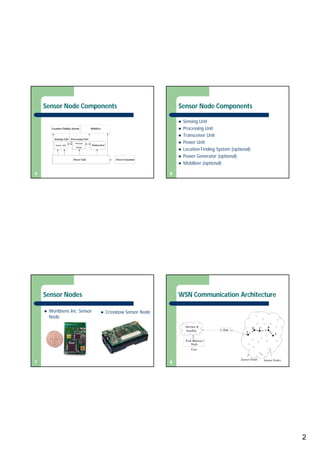
Sensor Node Components
5
Sensor Node Components
 Sensing Unit
 Processing Unit
 Transceiver Unit
 Power Unit
 Location Finding System (optional)
 Power Generator (optional)
 Mobilizer (optional)
6
Sensor Nodes
7
 Worldsens Inc. Sensor
Node
 Crossbow Sensor Node
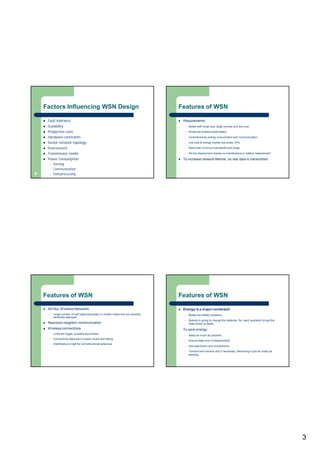
WSN Communication Architecture
8
3
Factors Influencing WSN Design
 Fault tolerance
 Scalability
 Production costs
 Hardware constraints
 Sensor network topology
 Environment
 Transmission media
 Power Consumption
– Sensing
– Communication
– Data processing9
Features of WSN
 Requirements
– Nodes with small size, large number and low cost
– Small size implies small battery
– Constrained by energy consumption and communication
– Low cost & energy implies low power CPU
– Radio with minimum bandwidth and range
– Ad-hoc deployment implies no maintenance or battery replacement
 To increase network lifetime, no raw data is transmitted
Features of WSN
 Ad Hoc Wireless Networks
– Large number of self-organizing static or mobile nodes that are possibly
randomly deployed
 Near(est)-neighbor communication
 Wireless connections
– Links are fragile, possibly asymmetric
– Connectivity depends on power levels and fading
– Interference is high for omnidirectional antennas
Features of WSN
 Energy is a major constraint
– Nodes are battery-powered
– Nobody is going to change the batteries. So, each operation brings the
node closer to death.
To save energy:
– Sleep as much as possible.
– Acquire data only if indispensable.
– Use data fusion and compression.
– Transmit and receive only if necessary. Receiving is just as costly as
sending.
4
Features of WSN
 Scalability and Reliability
– Self-configure and robust to topology changes (e.g., death of a node)
– Maintain connectivity: Base Station should reach all nodes
– Ensure coverage
 Maintenance
– Reprogramming is the only practical kind of maintenance.
– It is highly desirable to reprogram wirelessly.
Features of WSN
 Data Collection
– Centralized data collection puts extra burden on nodes close to the base
station. Clever routing can alleviate that problem
– Clustering: data from groups of nodes are fused before being transmitted,
so that fewer transmissions are needed
– Often getting measurements from a particular area is more important than
getting data from each node
– Security and authenticity should be guaranteed. However, the CPUs on the
sensing nodes cannot handle fancy encryption schemes.
Features of WSN
 Power Supply
– AA batteries power the vast majority of existing platforms. They dominate
the node size.
– Alkaline batteries offer a high energy density at a cheap price. The
discharge curve is far from flat, though.
– Lithium coin cells are more compact and boast a flat discharge curve.
Rechargeable batteries: Who does the recharging?
– Solar cells are an option for some applications.
– Fuel cells may be an alternative in the future.
– Energy scavenging techniques are a hot research topic
Features of WSN
 Radio
– Commercially-available chips
– Available bands: 433 and 916MHz, 2.4GHz ISM bands
– Typical transmit power: 0dBm.
– Narrowband (FSK) or Spread Spectrum communication. DS-SS (e.g.,
ZigBee) or FH-SS (e.g., Bluetooth)
– Relatively low rates (<100 kbps) save power
– Sensitivity: as low as -110dBm
5
Features of WSN
 CPU
– The Microcontroller Unit (MCU) is the primary choice for in-node processing.
– Power consumption is the key metric in MCU selection.
– The MCU should be able to sleep whenever possible, like the radio.
– Memory requirements depend on the application
– ATmega128L and MSP430 are popular choices
 Sensors
– The power efficiency of the sensors is
also crucial, as well as their duty cycle.
– MEMS techniques allow miniaturization.
Distinguishing features of WSN
 WSNs are ad hoc networks
– wireless nodes that self-organize into an infrastructure less network
BUT, in contrast to other ad hoc networks:
 Sensing and data processing are essential
 WSNs have many more nodes and are more densely deployed
 Hardware must be cheap; nodes are more prone to failures
 WSNs operate under very strict energy constraints
 WSN nodes are typically static
 The communication scheme is many-to-one (data collected at a
base station) rather than peer-to-peer
WSN Protocol Stack
19
WSN Protocol Stack
 Sensor management protocol
– Provides software operations needed to perform administrative
tasks e.g. moving sensor nodes, turning them on an off
 Sensor query and data dissemination protocol
– Provides user applications with interfaces to issue queries and
respond to queries
– Sensor query and tasking language (SQTL)
 Directed diffusion
 Sensor MAC (S-MAC)
 IEEE 802.15.4
20
6
Data Handling : Data-Centric Routing
 Interest distribution is performed to assign
sensing tasks to sensor nodes
– Sinks broadcast the interest
– Sensor nodes broadcast an advertisement for available
data
 Requires attribute-based naming
– Users are more interested in querying the attribute of the
phenomenon, rather than querying an individual node
– E.g. the sensor nodes in the area where temperature is
greater than 75 °F
21
Data handling: Data Aggregation
 Data coming from multiple sensor
nodes are aggregated if they are
about the same attribute of the
phenomenon when they reach the
same routing node on the way back
to the sink
– Solves implosion and overlap problem
– Energy efficient
22
Data Handling: Data-dissemination
Conventional Methods
 Direct communication with the base station
– Sensor nodes communicate with the base station directly.
– Energy consuming.
 Multi-hop Scheme
– Transmit through some other intermediate nodes.
– Energy consuming.
Low Energy Adaptive Clustering
Hierarchy (LEACH)
 Designed for sensor networks where an end-user wants to
remotely monitor the environment.
 Where the data from the individual nodes must be sent to a
central base station, often located far from the sensor network.
 Desirable properties for protocols on these networks:
– Use 100’s – 1000’s of nodes
– Maximize system lifetime
– Maximize network coverage
– Use uniform, battery operated nodes
 The use of distributed cluster formation and local processing
– Reduce global communication along with randomized rotation
– Cluster-heads allows LEACH to achieve the desired properties while being
energy-efficient.
Data-dissemination Schemes (Cont.)
7
Clustering Hierarchy
Data-dissemination Schemes (Cont.)
Media Access Control (MAC) Scheme
Two categories of MAC schemes for wireless networks
 Contention-based schemes
– Designed for minimum delay and maximum throughput.
– Require transceivers to monitor the channel at all times.
 Reservation-based or schedule-based schemes
– Detect the neighboring radios before allocating collision-free
channel to a link.
– TDMA —a natural choice for sensor networks.
MAC Scheme (Cont.)
TDMA-based solutions
 The self-organizing “super frame” algorithm
– Super frame = TDMA period + BOOTUP period + unused
bandwidth
– Performs well only under the specific conditions.
 Power Aware Clustered TDMA (PACT)
– Divide the TDMA structure into control slot and data slot.
– Hard to maintain the cluster when there are mobile nodes.
MAC Scheme (Cont.)
Other solutions
 Sensor-MAC (SMAC)
– Nodes periodically sleep.
– A node sleeps during transmission period of other
nodes.
– Not suitable for time-critical applications.
8
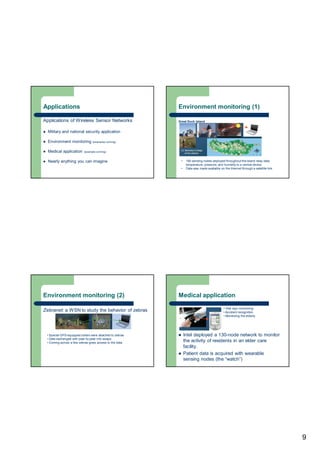
Architecture for a WSN
Special addressing requirement
 Local unique addresses
 Data-centric
 Example: Each node has an unique number.
Attribute-based naming architecture
 Data is named by one or more attributes.
 Example: Each node is distinguished by an
attribute – GPS sensors are practical for this.
Architecture for a WSN (cont.)
An address-free architecture (AFA)
 Advantage
– Randomly select probabilistically unique identifier for each
transaction.
– Spatial locality.
– Temporal locality.
 Drawback
– Not applicable when static addressing of nodes is needed.
– Identifier conflict.
WSN Operating Systems
 TinyOS
 Contiki
 MANTIS
 BTnut
 SOS
 Nano-RK
31
Overview (Cont.)
Wireless Sensor Node: Components
9
Applications
Applications of Wireless Sensor Networks
 Military and national security application
 Environment monitoring (examples coming)
 Medical application (example coming)
 Nearly anything you can imagine
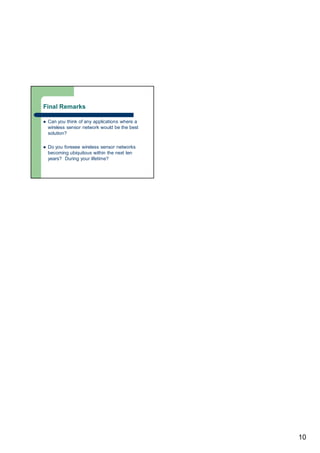
Environment monitoring (1)
Great Duck Island
• 150 sensing nodes deployed throughout the island relay data
temperature, pressure, and humidity to a central device.
• Data was made available on the Internet through a satellite link.
Environment monitoring (2)
Zebranet: a WSN to study the behavior of zebras
• Special GPS-equipped collars were attached to zebras
• Data exchanged with peer-to-peer info swaps
• Coming across a few zebras gives access to the data
Medical application
 Intel deployed a 130-node network to monitor
the activity of residents in an elder care
facility.
 Patient data is acquired with wearable
sensing nodes (the “watch”)
• Vital sign monitoring
• Accident recognition
• Monitoring the elderly
10
Final Remarks
 Can you think of any applications where a
wireless sensor network would be the best
solution?
 Do you foresee wireless sensor networks
becoming ubiquitous within the next ten
years? During your lifetime?

Wireless sensor networks dcs

  • 1.
    1 Wireless Sensor Networks DharaShah Outline  Overview – Definition  Factors influencing WSN design  Features of WSN – Distinguished features from other MAN  WSN Protocol Stack  Data Handling  Media access control schemes  Architecture for a Wireless Sensor Network  Applications Overview  A Wireless Sensor Network (WSN) consists of base stations and a number of wireless sensors (nodes).  sensor – A transducer – Converts physical phenomenon e.g. heat, light, motion, vibration, and sound into electrical signals  sensor node – Basic unit in sensor network – Contains on-board sensors, processor, memory, transceiver, and power supply  sensor network – Consists of a large number of sensor nodes – Nodes deployed either inside or very close to the sensed phenomenon Definition  “A wireless sensor network (WSN) is a wireless network consisting of spatially distributed autonomous devices using sensors to cooperatively monitor physical or environmental conditions, such as temperature, sound, vibration, pressure, motion or pollutants, at different locations.” - Wikipedia 4
  • 2.
    2 Sensor Node Components 5 SensorNode Components  Sensing Unit  Processing Unit  Transceiver Unit  Power Unit  Location Finding System (optional)  Power Generator (optional)  Mobilizer (optional) 6 Sensor Nodes 7  Worldsens Inc. Sensor Node  Crossbow Sensor Node WSN Communication Architecture 8
  • 3.
    3 Factors Influencing WSNDesign  Fault tolerance  Scalability  Production costs  Hardware constraints  Sensor network topology  Environment  Transmission media  Power Consumption – Sensing – Communication – Data processing9 Features of WSN  Requirements – Nodes with small size, large number and low cost – Small size implies small battery – Constrained by energy consumption and communication – Low cost & energy implies low power CPU – Radio with minimum bandwidth and range – Ad-hoc deployment implies no maintenance or battery replacement  To increase network lifetime, no raw data is transmitted Features of WSN  Ad Hoc Wireless Networks – Large number of self-organizing static or mobile nodes that are possibly randomly deployed  Near(est)-neighbor communication  Wireless connections – Links are fragile, possibly asymmetric – Connectivity depends on power levels and fading – Interference is high for omnidirectional antennas Features of WSN  Energy is a major constraint – Nodes are battery-powered – Nobody is going to change the batteries. So, each operation brings the node closer to death. To save energy: – Sleep as much as possible. – Acquire data only if indispensable. – Use data fusion and compression. – Transmit and receive only if necessary. Receiving is just as costly as sending.
  • 4.
    4 Features of WSN Scalability and Reliability – Self-configure and robust to topology changes (e.g., death of a node) – Maintain connectivity: Base Station should reach all nodes – Ensure coverage  Maintenance – Reprogramming is the only practical kind of maintenance. – It is highly desirable to reprogram wirelessly. Features of WSN  Data Collection – Centralized data collection puts extra burden on nodes close to the base station. Clever routing can alleviate that problem – Clustering: data from groups of nodes are fused before being transmitted, so that fewer transmissions are needed – Often getting measurements from a particular area is more important than getting data from each node – Security and authenticity should be guaranteed. However, the CPUs on the sensing nodes cannot handle fancy encryption schemes. Features of WSN  Power Supply – AA batteries power the vast majority of existing platforms. They dominate the node size. – Alkaline batteries offer a high energy density at a cheap price. The discharge curve is far from flat, though. – Lithium coin cells are more compact and boast a flat discharge curve. Rechargeable batteries: Who does the recharging? – Solar cells are an option for some applications. – Fuel cells may be an alternative in the future. – Energy scavenging techniques are a hot research topic Features of WSN  Radio – Commercially-available chips – Available bands: 433 and 916MHz, 2.4GHz ISM bands – Typical transmit power: 0dBm. – Narrowband (FSK) or Spread Spectrum communication. DS-SS (e.g., ZigBee) or FH-SS (e.g., Bluetooth) – Relatively low rates (<100 kbps) save power – Sensitivity: as low as -110dBm
  • 5.
    5 Features of WSN CPU – The Microcontroller Unit (MCU) is the primary choice for in-node processing. – Power consumption is the key metric in MCU selection. – The MCU should be able to sleep whenever possible, like the radio. – Memory requirements depend on the application – ATmega128L and MSP430 are popular choices  Sensors – The power efficiency of the sensors is also crucial, as well as their duty cycle. – MEMS techniques allow miniaturization. Distinguishing features of WSN  WSNs are ad hoc networks – wireless nodes that self-organize into an infrastructure less network BUT, in contrast to other ad hoc networks:  Sensing and data processing are essential  WSNs have many more nodes and are more densely deployed  Hardware must be cheap; nodes are more prone to failures  WSNs operate under very strict energy constraints  WSN nodes are typically static  The communication scheme is many-to-one (data collected at a base station) rather than peer-to-peer WSN Protocol Stack 19 WSN Protocol Stack  Sensor management protocol – Provides software operations needed to perform administrative tasks e.g. moving sensor nodes, turning them on an off  Sensor query and data dissemination protocol – Provides user applications with interfaces to issue queries and respond to queries – Sensor query and tasking language (SQTL)  Directed diffusion  Sensor MAC (S-MAC)  IEEE 802.15.4 20
  • 6.
    6 Data Handling :Data-Centric Routing  Interest distribution is performed to assign sensing tasks to sensor nodes – Sinks broadcast the interest – Sensor nodes broadcast an advertisement for available data  Requires attribute-based naming – Users are more interested in querying the attribute of the phenomenon, rather than querying an individual node – E.g. the sensor nodes in the area where temperature is greater than 75 °F 21 Data handling: Data Aggregation  Data coming from multiple sensor nodes are aggregated if they are about the same attribute of the phenomenon when they reach the same routing node on the way back to the sink – Solves implosion and overlap problem – Energy efficient 22 Data Handling: Data-dissemination Conventional Methods  Direct communication with the base station – Sensor nodes communicate with the base station directly. – Energy consuming.  Multi-hop Scheme – Transmit through some other intermediate nodes. – Energy consuming. Low Energy Adaptive Clustering Hierarchy (LEACH)  Designed for sensor networks where an end-user wants to remotely monitor the environment.  Where the data from the individual nodes must be sent to a central base station, often located far from the sensor network.  Desirable properties for protocols on these networks: – Use 100’s – 1000’s of nodes – Maximize system lifetime – Maximize network coverage – Use uniform, battery operated nodes  The use of distributed cluster formation and local processing – Reduce global communication along with randomized rotation – Cluster-heads allows LEACH to achieve the desired properties while being energy-efficient. Data-dissemination Schemes (Cont.)
  • 7.
    7 Clustering Hierarchy Data-dissemination Schemes(Cont.) Media Access Control (MAC) Scheme Two categories of MAC schemes for wireless networks  Contention-based schemes – Designed for minimum delay and maximum throughput. – Require transceivers to monitor the channel at all times.  Reservation-based or schedule-based schemes – Detect the neighboring radios before allocating collision-free channel to a link. – TDMA —a natural choice for sensor networks. MAC Scheme (Cont.) TDMA-based solutions  The self-organizing “super frame” algorithm – Super frame = TDMA period + BOOTUP period + unused bandwidth – Performs well only under the specific conditions.  Power Aware Clustered TDMA (PACT) – Divide the TDMA structure into control slot and data slot. – Hard to maintain the cluster when there are mobile nodes. MAC Scheme (Cont.) Other solutions  Sensor-MAC (SMAC) – Nodes periodically sleep. – A node sleeps during transmission period of other nodes. – Not suitable for time-critical applications.
  • 8.
    8 Architecture for aWSN Special addressing requirement  Local unique addresses  Data-centric  Example: Each node has an unique number. Attribute-based naming architecture  Data is named by one or more attributes.  Example: Each node is distinguished by an attribute – GPS sensors are practical for this. Architecture for a WSN (cont.) An address-free architecture (AFA)  Advantage – Randomly select probabilistically unique identifier for each transaction. – Spatial locality. – Temporal locality.  Drawback – Not applicable when static addressing of nodes is needed. – Identifier conflict. WSN Operating Systems  TinyOS  Contiki  MANTIS  BTnut  SOS  Nano-RK 31 Overview (Cont.) Wireless Sensor Node: Components
  • 9.
    9 Applications Applications of WirelessSensor Networks  Military and national security application  Environment monitoring (examples coming)  Medical application (example coming)  Nearly anything you can imagine Environment monitoring (1) Great Duck Island • 150 sensing nodes deployed throughout the island relay data temperature, pressure, and humidity to a central device. • Data was made available on the Internet through a satellite link. Environment monitoring (2) Zebranet: a WSN to study the behavior of zebras • Special GPS-equipped collars were attached to zebras • Data exchanged with peer-to-peer info swaps • Coming across a few zebras gives access to the data Medical application  Intel deployed a 130-node network to monitor the activity of residents in an elder care facility.  Patient data is acquired with wearable sensing nodes (the “watch”) • Vital sign monitoring • Accident recognition • Monitoring the elderly
  • 10.
    10 Final Remarks  Canyou think of any applications where a wireless sensor network would be the best solution?  Do you foresee wireless sensor networks becoming ubiquitous within the next ten years? During your lifetime?