PRESENTATION
SUBMITTED TO:
Dr.Rashmi
SUBMITTED BY:
LALIT SHARMA
MBA 2nd SHIFT
DIV –A 3rd Sem
02521303917
WIRELESS SENSOR NETWORKS:
A STUDY
CONTENTS
• Introduction
• Architecture of WSN
• WSN Node
• Architecture of sensor node
• Characteristics
• Applications
• Operational Challenges
• Advantages
• Disadvantages
• Future
• Conclusion
INTRODUCTION
• Wireless sensor network (WSN) refers to a group of spatially dispersed and
dedicated sensors for monitoring and recording the physical conditions of the
environment and organizing the collected data at a central location.
• WSNs measure environmental conditions like temperature, sound, pollution levels,
humidity, wind, and so on.
• A collection of sensing devices that can communicate wirelessly.
• Even though wireless sensors has limited resources in memory, computation power,
bandwidth, and energy.
• With small physical size. It Can be embedded in the physical environment.
• Self-organizing multi-hop ad-doc networks
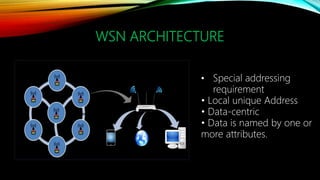
WSN ARCHITECTURE
• Special addressing
requirement
• Local unique Address
• Data-centric
• Data is named by one or
more attributes.
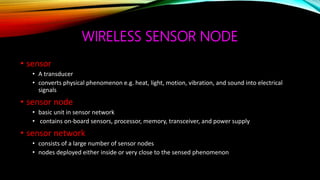
WIRELESS SENSOR NODE
• sensor
• A transducer
• converts physical phenomenon e.g. heat, light, motion, vibration, and sound into electrical
signals
• sensor node
• basic unit in sensor network
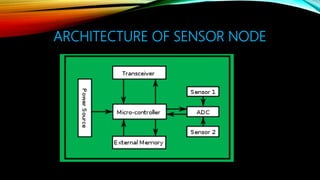
• contains on-board sensors, processor, memory, transceiver, and power supply
• sensor network
• consists of a large number of sensor nodes
• nodes deployed either inside or very close to the sensed phenomenon
ARCHITECTURE OF SENSOR NODE
WIRELESS SENSOR NETWORKS
APPLICATIONS
Military Applications
• Monitoring friendly forces, equipment, and ammunition
• Battlefield surveillance
• Reconnaissance of opposing forces and terrain
• Targeting
• Battle damage assessment
• Nuclear, biological, and chemical attack detection
10
Environmental Applications
• Forest fire detection
• Bio-complexity mapping of environment
• Flood detection
• Precision Agriculture
• Air and water pollution
11
Health Applications
• Telemonitoring of human physiological data
• Tracking and monitoring doctors and patients inside a hospital
• Drug administration in hospitals
12
Home and Office Applications
• Home and office automation
• Smart environment
13
Automotive Applications
• Reduces wiring effects
• Measurements in chambers and rotating parts
• Remote technical inspections
• Conditions monitoring e.g. at a bearing
14
Automotive Applications
15
Other Commercial Applications
• Environmental control in office buildings (estimated energy savings $55
billion per year!)
• Interactive museums
• Detecting and monitoring car thefts
• Managing inventory control
• Vehicle tracking and detection
16
CHARACTERISTICS
• Power consumption constraints for nodes using batteries or energy harvesting
• Ability to cope with node failures (resilience)
• Mobility of nodes
• Heterogeneity of nodes
• Scalability to large scale of deployment
• Ability to withstand harsh environmental conditions
• Ease of use
• Cross-layer design
FACTORS INFLUENCING WSN DESIGN
• Fault tolerance
• Scalability
• Production costs
• Hardware constraints
• Sensor network topology
• Environment
• Transmission media
• Power Consumption
• Sensing
• Communication
• Data processing
18
ADVANTAGES
 It avoids a lot of wiring .
 It can accommodate new devices at any time .
It's flexible to go through physical partitions .
 It can be accessed through a centralized monito
DISADVANTAGE
 Lower speed compared to wired network.
 Less secure because hacker's laptop can act as Access Point. If you connected to
their laptop, they'll read all your information (username, password.. etc).
More complex to configure than wired network.
Gets distracted by various elements like Blue-tooth .
Still Costly at large.
It does not make sensing quantities in buildings easier.
It does not reduce costs for installation of sensors.
It does not allow us to do more than can be done with a wired system
OPERATIONAL CHALLENGES OF WIRELESS
SENSOR NETWORKS
• Energy Efficiency
• Limited storage and computation
• Low bandwidth and high error rates
• Errors are common – Wireless communication – Noisy measurements – Node
failure are expected
• Scalability to a large number of sensor nodes
• Survivability in harsh environments
• Experiments are time- and space-intensive
FUTURE OF WSN SMART HOME / SMART
OFFICE
• Sensors controlling appliances and electrical devices in the house.
• Better lighting and heating in office buildings.
• The Pentagon building has used sensors extensively.
CONCLUSION
• WSNs possible today due to technological advancement in various
domains
• Envisioned to become an essential part of our lives
• Design Constraints need to be satisfied for realization of sensor networks
• Tremendous research efforts being made in different layers of WSNs
protocol stack
23
Wireless sensor networks

Wireless sensor networks

  • 2.
    PRESENTATION SUBMITTED TO: Dr.Rashmi SUBMITTED BY: LALITSHARMA MBA 2nd SHIFT DIV –A 3rd Sem 02521303917
  • 3.
  • 4.
    CONTENTS • Introduction • Architectureof WSN • WSN Node • Architecture of sensor node • Characteristics • Applications • Operational Challenges • Advantages • Disadvantages • Future • Conclusion
  • 5.
    INTRODUCTION • Wireless sensornetwork (WSN) refers to a group of spatially dispersed and dedicated sensors for monitoring and recording the physical conditions of the environment and organizing the collected data at a central location. • WSNs measure environmental conditions like temperature, sound, pollution levels, humidity, wind, and so on. • A collection of sensing devices that can communicate wirelessly.
  • 6.
    • Even thoughwireless sensors has limited resources in memory, computation power, bandwidth, and energy. • With small physical size. It Can be embedded in the physical environment. • Self-organizing multi-hop ad-doc networks
  • 7.
    WSN ARCHITECTURE • Specialaddressing requirement • Local unique Address • Data-centric • Data is named by one or more attributes.
  • 8.
    WIRELESS SENSOR NODE •sensor • A transducer • converts physical phenomenon e.g. heat, light, motion, vibration, and sound into electrical signals • sensor node • basic unit in sensor network • contains on-board sensors, processor, memory, transceiver, and power supply • sensor network • consists of a large number of sensor nodes • nodes deployed either inside or very close to the sensed phenomenon
  • 9.
  • 10.
    WIRELESS SENSOR NETWORKS APPLICATIONS MilitaryApplications • Monitoring friendly forces, equipment, and ammunition • Battlefield surveillance • Reconnaissance of opposing forces and terrain • Targeting • Battle damage assessment • Nuclear, biological, and chemical attack detection 10
  • 11.
    Environmental Applications • Forestfire detection • Bio-complexity mapping of environment • Flood detection • Precision Agriculture • Air and water pollution 11
  • 12.
    Health Applications • Telemonitoringof human physiological data • Tracking and monitoring doctors and patients inside a hospital • Drug administration in hospitals 12
  • 13.
    Home and OfficeApplications • Home and office automation • Smart environment 13
  • 14.
    Automotive Applications • Reduceswiring effects • Measurements in chambers and rotating parts • Remote technical inspections • Conditions monitoring e.g. at a bearing 14
  • 15.
  • 16.
    Other Commercial Applications •Environmental control in office buildings (estimated energy savings $55 billion per year!) • Interactive museums • Detecting and monitoring car thefts • Managing inventory control • Vehicle tracking and detection 16
  • 17.
    CHARACTERISTICS • Power consumptionconstraints for nodes using batteries or energy harvesting • Ability to cope with node failures (resilience) • Mobility of nodes • Heterogeneity of nodes • Scalability to large scale of deployment • Ability to withstand harsh environmental conditions • Ease of use • Cross-layer design
  • 18.
    FACTORS INFLUENCING WSNDESIGN • Fault tolerance • Scalability • Production costs • Hardware constraints • Sensor network topology • Environment • Transmission media • Power Consumption • Sensing • Communication • Data processing 18
  • 19.
    ADVANTAGES  It avoidsa lot of wiring .  It can accommodate new devices at any time . It's flexible to go through physical partitions .  It can be accessed through a centralized monito
  • 20.
    DISADVANTAGE  Lower speedcompared to wired network.  Less secure because hacker's laptop can act as Access Point. If you connected to their laptop, they'll read all your information (username, password.. etc). More complex to configure than wired network. Gets distracted by various elements like Blue-tooth . Still Costly at large. It does not make sensing quantities in buildings easier. It does not reduce costs for installation of sensors. It does not allow us to do more than can be done with a wired system
  • 21.
    OPERATIONAL CHALLENGES OFWIRELESS SENSOR NETWORKS • Energy Efficiency • Limited storage and computation • Low bandwidth and high error rates • Errors are common – Wireless communication – Noisy measurements – Node failure are expected • Scalability to a large number of sensor nodes • Survivability in harsh environments • Experiments are time- and space-intensive
  • 22.
    FUTURE OF WSNSMART HOME / SMART OFFICE • Sensors controlling appliances and electrical devices in the house. • Better lighting and heating in office buildings. • The Pentagon building has used sensors extensively.
  • 23.
    CONCLUSION • WSNs possibletoday due to technological advancement in various domains • Envisioned to become an essential part of our lives • Design Constraints need to be satisfied for realization of sensor networks • Tremendous research efforts being made in different layers of WSNs protocol stack 23