By:- Mustahid Ali
Presentational Outline
 Definition of WLL
 Two important issue
 Capacity and Efficiency
 The Future Technologies
 Wireless Standards
 Disadvantages of WLL
 Scope of WLL
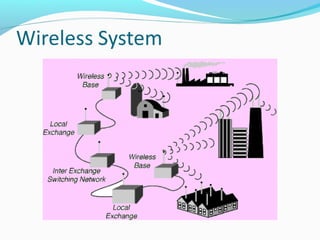
What is WLL ?
“In telephone network, a Wireless Local Loop is a
generic term for an access system that uses a
wireless link to connect subscriber to their local
exchange in place of conventional copper cable.
Using a wireless link shortens the construction
period and also reduces installation and operating
cost.”
Difference between WLL and mobile system
.
Mobile system
- connect people on the move
- universal coverage
- moderate voice quality
- Traffic per subscriber is supposed to be not
very high.


Difference between WLL and
mobile System
Wireless in Local Loop
- Serve subscribers at homes or offices.
-Voice quality must be high.
-Long conversation facility
-High Traffic support.
Efficiency Consideration
Depends on use and reuse of spectrum which is
governed by the following :







channel pay load
signaling overhead
modulation efficiency
cell-radius
choice of multiple access
interference reduction techniques
Channel Pay Load
 Higher bit rate pay load large frequency resources
 Voice Communication required lower bit rate voice

codec
Signaling Overhead
 Used in setting up, monitoring and tearing down of a

call
 Carried out between subscriber and base stations
 More sophisticated system more signaling
requirement
 It is an overhead
Modulation Efficiency
 Direct bearing on efficient use of spectrum
 QAM, QPSK, MSK techniques are used
 Efficient techniques are expensive
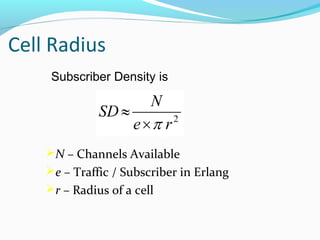
Cell Radius
Subscriber Density is

N – Channels Available
e – Traffic / Subscriber in Erlang
r – Radius of a cell
FTDMA
- Frequency signal is divided into frequency channels
- Channels are assigned to users on demand
- Used for both analog and digital signals

TDMA
- Careers used for transmission of multiple time
multiplexed channels
- provided batter reuse factor for digital signal
CDMA
- Each bit is uniquely coded
- Receiver use decoder to separate data
- Interference is very small

MC-TDMA
- Use dynamic channel selection
- Frame is divide into time slots
Sectorization
Voice Activity Detection
Frequency Hopping
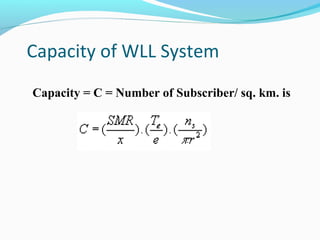
Capacity of WLL System
Capacity = C = Number of Subscriber/ sq. km. is
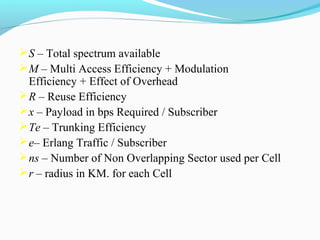
 S – Total spectrum available
 M – Multi Access Efficiency + Modulation

Efficiency + Effect of Overhead
 R – Reuse Efficiency
 x – Payload in bps Required / Subscriber
 Te – Trunking Efficiency
 e– Erlang Traffic / Subscriber
 ns – Number of Non Overlapping Sector used per Cell
 r – radius in KM. for each Cell


Space-Time processing
- Smart Antenna Technology
- Transmit Diversity Schemes

 Turbo Codes
 Multi User Detection
Wireless Standards
 First Generation Standards
-Promised Wide – Scale Mobile communication
-AMPS(USA), NTT (Japan), NMT (Europe)

 Second Generation Standards
-Marked as late eighties and early nineties
-Technology used TDMA,GSM
-Wireless Standards Used AMPS,IS-95,DECT

 Third Generation Standards

-DECT Evaluation towards third Generation
Disadvantages
 Relatively new technology
 Network capacity needs improvement
 Has yet to be fully implemented to maximize

utilization and economy
Developed vs. Developing
 Developed: Wire line service
 Firmly established, cellular penetration is relatively

high
 Incumbent operator would use it to install 2nd, 3rd lines,
coverage to rural areas
 2nd or 3rd competitive operator deploy it for fast & cost
effective deployment
 Quick way to establish market presence
 cellular complement to their offerings
Developed vs. Developing
 Developing
Quick & easy to deploy in countries with little copper line
service, so as to accommodate people on enormous
waiting lists for basic service
Low maintenance costs
Allows more competition in provider market
Potential
 Without the need to have a physical link in the last

mile, WLL offers us a variety of applications that will
further enhance our capability to communicate and
transfer information
Potential
 Suitable for the deployment of communication

facilities in provinces where tele-density is low and
geographical terrain is unsuitable for the setting-up of
infrastructure
Abbreviation Used
FDMA - Frequency Division Multiple Access
TDMA – Time Division Multiple Access
CDMA – Code Division Multiple Access
MC-TDMA – Multi Career TDMA
QAM – Quadrature Amplitude Modulation
QPSK - Quadrature Phase Shift Keying
MSK – Minimum Shift Keying
AMPS – Advance Mobile Phone Service
GSM – Global Service Mobile communication
DECT – Digital European Cordless Telephone
THANK
YOU

Wireless in local loop

  • 1.
  • 2.
    Presentational Outline  Definitionof WLL  Two important issue  Capacity and Efficiency  The Future Technologies  Wireless Standards  Disadvantages of WLL  Scope of WLL
  • 3.
    What is WLL? “In telephone network, a Wireless Local Loop is a generic term for an access system that uses a wireless link to connect subscriber to their local exchange in place of conventional copper cable. Using a wireless link shortens the construction period and also reduces installation and operating cost.”
  • 5.
    Difference between WLLand mobile system . Mobile system - connect people on the move - universal coverage - moderate voice quality - Traffic per subscriber is supposed to be not very high. 
  • 6.
    Difference between WLLand mobile System Wireless in Local Loop - Serve subscribers at homes or offices. -Voice quality must be high. -Long conversation facility -High Traffic support.
  • 7.
    Efficiency Consideration Depends onuse and reuse of spectrum which is governed by the following :       channel pay load signaling overhead modulation efficiency cell-radius choice of multiple access interference reduction techniques
  • 8.
    Channel Pay Load Higher bit rate pay load large frequency resources  Voice Communication required lower bit rate voice codec
  • 9.
    Signaling Overhead  Usedin setting up, monitoring and tearing down of a call  Carried out between subscriber and base stations  More sophisticated system more signaling requirement  It is an overhead
  • 10.
    Modulation Efficiency  Directbearing on efficient use of spectrum  QAM, QPSK, MSK techniques are used  Efficient techniques are expensive
  • 11.
    Cell Radius Subscriber Densityis N – Channels Available e – Traffic / Subscriber in Erlang r – Radius of a cell
  • 12.
    FTDMA - Frequency signalis divided into frequency channels - Channels are assigned to users on demand - Used for both analog and digital signals TDMA - Careers used for transmission of multiple time multiplexed channels - provided batter reuse factor for digital signal
  • 13.
    CDMA - Each bitis uniquely coded - Receiver use decoder to separate data - Interference is very small MC-TDMA - Use dynamic channel selection - Frame is divide into time slots
  • 14.
  • 15.
    Capacity of WLLSystem Capacity = C = Number of Subscriber/ sq. km. is
  • 16.
     S –Total spectrum available  M – Multi Access Efficiency + Modulation Efficiency + Effect of Overhead  R – Reuse Efficiency  x – Payload in bps Required / Subscriber  Te – Trunking Efficiency  e– Erlang Traffic / Subscriber  ns – Number of Non Overlapping Sector used per Cell  r – radius in KM. for each Cell
  • 17.
     Space-Time processing - SmartAntenna Technology - Transmit Diversity Schemes  Turbo Codes  Multi User Detection
  • 18.
    Wireless Standards  FirstGeneration Standards -Promised Wide – Scale Mobile communication -AMPS(USA), NTT (Japan), NMT (Europe)  Second Generation Standards -Marked as late eighties and early nineties -Technology used TDMA,GSM -Wireless Standards Used AMPS,IS-95,DECT  Third Generation Standards -DECT Evaluation towards third Generation
  • 19.
    Disadvantages  Relatively newtechnology  Network capacity needs improvement  Has yet to be fully implemented to maximize utilization and economy
  • 20.
    Developed vs. Developing Developed: Wire line service  Firmly established, cellular penetration is relatively high  Incumbent operator would use it to install 2nd, 3rd lines, coverage to rural areas  2nd or 3rd competitive operator deploy it for fast & cost effective deployment  Quick way to establish market presence  cellular complement to their offerings
  • 21.
    Developed vs. Developing Developing Quick & easy to deploy in countries with little copper line service, so as to accommodate people on enormous waiting lists for basic service Low maintenance costs Allows more competition in provider market
  • 22.
    Potential  Without theneed to have a physical link in the last mile, WLL offers us a variety of applications that will further enhance our capability to communicate and transfer information
  • 23.
    Potential  Suitable forthe deployment of communication facilities in provinces where tele-density is low and geographical terrain is unsuitable for the setting-up of infrastructure
  • 24.
    Abbreviation Used FDMA -Frequency Division Multiple Access TDMA – Time Division Multiple Access CDMA – Code Division Multiple Access MC-TDMA – Multi Career TDMA QAM – Quadrature Amplitude Modulation QPSK - Quadrature Phase Shift Keying MSK – Minimum Shift Keying AMPS – Advance Mobile Phone Service GSM – Global Service Mobile communication DECT – Digital European Cordless Telephone
  • 25.