Mrs.G.Gnana Priya
Assistant Professor(Sr.Gr.)/ECE
Ramco Institute of Technology
Introduction to
Cognitive Radios
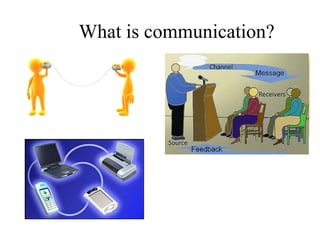
What is communication?
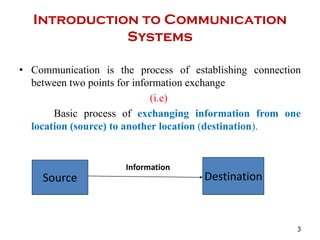
• Communication is the process of establishing connection
between two points for information exchange
(i.e)
Basic process of exchanging information from one
location (source) to another location (destination).
3
Introduction to Communication
Systems
Source Destination
Information
4
Elements of a Communication
System
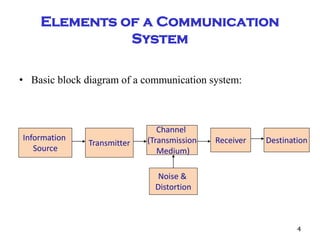
• Basic block diagram of a communication system:
Information
Source
Transmitter
Channel
(Transmission
Medium)
Noise &
Distortion
Receiver Destination
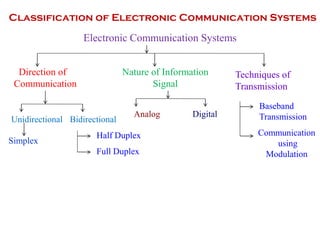
Electronic Communication Systems
Direction of
Communication
Nature of Information
Signal
Half Duplex
Full Duplex
Analog Digital
Unidirectional Bidirectional
Simplex
Techniques of
Transmission
Baseband
Transmission
Communication
using
Modulation
Classification of Electronic Communication Systems
Advantages and disadvantages of wireless
communication
• Advantages:
– Mobility
– A wireless communication network is a solution in areas
where cables are impossible to install (e.g. hazardous
areas, long distances etc.)
– Easier to maintain
• Disadvantages:
– Has security vulnerabilities
– Unlike wired comm., wireless comm. is influenced by
physical obstructions, climatic conditions, interference
from other wireless devices
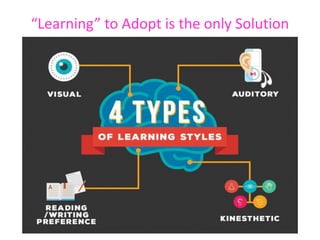
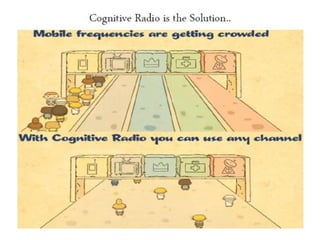
“Learning” to Adopt is the only Solution
Introduction
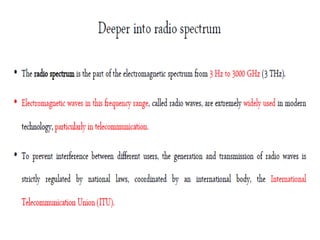
The radio spectrum is divided into licensed and unlicensed
frequencies.
• The licensed spectrum is for the exclusive use of
designated users. For instance, it includes the UHF/VHF
TV frequency bands.
• The unlicensed spectrum can be freely accessed by any
user, following certain rules (e.g., not exceeding a
defined limit for transmission power). It includes, for
instance, the ISM (Industrial, Scientific and Medical)
and U-NII (Unlicensed National Information
Infrastructure) frequency bands. ISM is shared by
technologies such as IEEE 802.11 for wireless local area
networks (WLANs), Bluetooth.
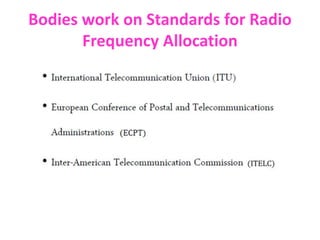
Bodies work on Standards for Radio
Frequency Allocation
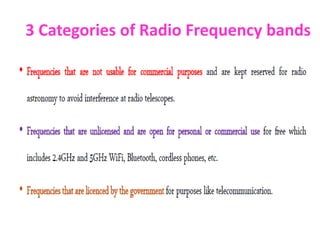
3 Categories of Radio Frequency bands
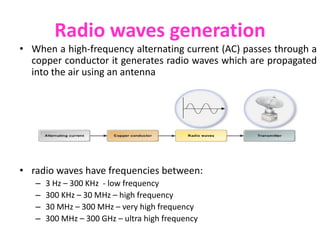
Radio waves generation
• When a high-frequency alternating current (AC) passes through a
copper conductor it generates radio waves which are propagated
into the air using an antenna
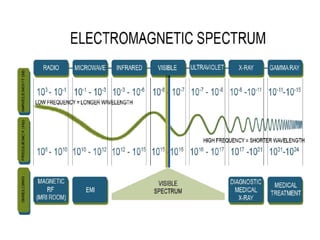
• radio waves have frequencies between:
– 3 Hz – 300 KHz - low frequency
– 300 KHz – 30 MHz – high frequency
– 30 MHz – 300 MHz – very high frequency
– 300 MHz – 300 GHz – ultra high frequency
Cognitive Radio Introduction

Cognitive Radio Introduction

  • 1.
    Mrs.G.Gnana Priya Assistant Professor(Sr.Gr.)/ECE RamcoInstitute of Technology Introduction to Cognitive Radios
  • 2.
  • 3.
    • Communication isthe process of establishing connection between two points for information exchange (i.e) Basic process of exchanging information from one location (source) to another location (destination). 3 Introduction to Communication Systems Source Destination Information
  • 4.
    4 Elements of aCommunication System • Basic block diagram of a communication system: Information Source Transmitter Channel (Transmission Medium) Noise & Distortion Receiver Destination
  • 5.
    Electronic Communication Systems Directionof Communication Nature of Information Signal Half Duplex Full Duplex Analog Digital Unidirectional Bidirectional Simplex Techniques of Transmission Baseband Transmission Communication using Modulation Classification of Electronic Communication Systems
  • 6.
    Advantages and disadvantagesof wireless communication • Advantages: – Mobility – A wireless communication network is a solution in areas where cables are impossible to install (e.g. hazardous areas, long distances etc.) – Easier to maintain • Disadvantages: – Has security vulnerabilities – Unlike wired comm., wireless comm. is influenced by physical obstructions, climatic conditions, interference from other wireless devices
  • 11.
    “Learning” to Adoptis the only Solution
  • 18.
    Introduction The radio spectrumis divided into licensed and unlicensed frequencies. • The licensed spectrum is for the exclusive use of designated users. For instance, it includes the UHF/VHF TV frequency bands. • The unlicensed spectrum can be freely accessed by any user, following certain rules (e.g., not exceeding a defined limit for transmission power). It includes, for instance, the ISM (Industrial, Scientific and Medical) and U-NII (Unlicensed National Information Infrastructure) frequency bands. ISM is shared by technologies such as IEEE 802.11 for wireless local area networks (WLANs), Bluetooth.
  • 21.
    Bodies work onStandards for Radio Frequency Allocation
  • 22.
    3 Categories ofRadio Frequency bands
  • 23.
    Radio waves generation •When a high-frequency alternating current (AC) passes through a copper conductor it generates radio waves which are propagated into the air using an antenna • radio waves have frequencies between: – 3 Hz – 300 KHz - low frequency – 300 KHz – 30 MHz – high frequency – 30 MHz – 300 MHz – very high frequency – 300 MHz – 300 GHz – ultra high frequency