Enabling Deployments through Standards & Certification Margaret LaBrecque  WiMAX President ma [email_address]
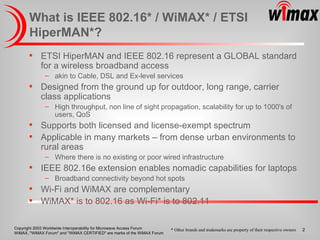
What is IEEE 802.16* / WiMAX* / ETSI HiperMAN*? ETSI HiperMAN and IEEE 802.16 represent a GLOBAL standard for a wireless broadband access akin to Cable, DSL and Ex-level services Designed from the ground up for outdoor, long range, carrier class applications High throughput, non line of sight propagation, scalability for up to 1000's of users, QoS Supports both licensed and license-exempt spectrum Applicable in many markets – from dense urban environments to rural areas Where there is no existing or poor wired infrastructure IEEE 802.16e extension enables nomadic capabilities for laptops Broadband connectivity beyond hot spots Wi-Fi and WiMAX are complementary WiMAX* is to 802.16 as Wi-Fi* is to 802.11 * Other brands and trademarks are property of their respective owners
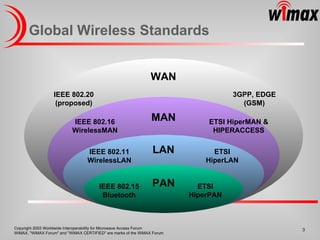
Global Wireless Standards IEEE 802.15 Bluetooth WAN MAN LAN PAN ETSI HiperPAN IEEE 802.11 WirelessLAN ETSI HiperLAN IEEE 802.16 WirelessMAN ETSI HiperMAN & HIPERACCESS IEEE 802.20 (proposed) 3GPP, EDGE (GSM)
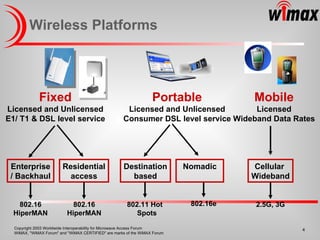
Wireless Platforms Fixed Licensed and Unlicensed E1/ T1 & DSL level service Portable Licensed and Unlicensed Consumer DSL level service Mobile Licensed Wideband Data Rates 802.16 HiperMAN Enterprise / Backhaul 802.16 HiperMAN Residential access Nomadic Cellular  Wideband 2.5G, 3G Destination based 802.11 Hot Spots 802.16e
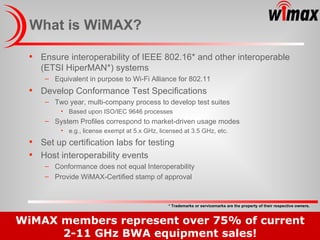
What is WiMAX? Ensure interoperability of IEEE 802.16* and other interoperable (ETSI HiperMAN*) systems Equivalent in purpose to Wi-Fi Alliance for 802.11 Develop Conformance Test Specifications Two year, multi-company process to develop test suites Based upon ISO/IEC 9646 processes System Profiles correspond to market-driven usage modes e.g., license exempt at 5.x GHz, licensed at 3.5 GHz, etc. Set up certification labs for testing Host interoperability events Conformance does not equal Interoperability Provide WiMAX-Certified stamp of approval * Trademarks or servicemarks are the property of their respective owners. WiMAX members represent over 75% of current 2-11 GHz BWA equipment sales!
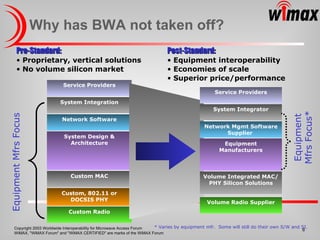
Why has BWA not taken off?  Pre-Standard: Proprietary, vertical solutions No volume silicon market Service Providers System Design & Architecture Custom MAC Custom Radio Custom, 802.11 or DOCSIS PHY Network Software System Integration Equipment Mfrs Focus Post-Standard: Equipment interoperability Economies of scale Superior price/performance Service Providers Equipment Manufacturers Volume Integrated MAC/PHY Silicon Solutions Volume Radio Supplier Network Mgmt Software Supplier  System Integrator Equipment Mfrs Focus* * Varies by equipment mfr.  Some will still do their own S/W and SI.
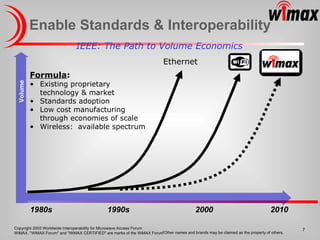
Enable Standards & Interoperability 1980s 1990s 2000 Volume Ethernet 2010 Formula : Existing proprietary technology & market Standards adoption Low cost manufacturing through economies of scale Wireless:  available spectrum IEEE: The Path to Volume Economics *Other names and brands may be claimed as the property of others.
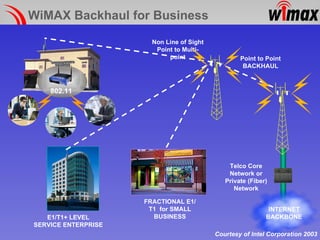
WiMAX Backhaul for Business Point to Point BACKHAUL INTERNET BACKBONE Telco Core Network or Private (Fiber) Network Non Line of Sight Point to Multi-point FRACTIONAL E1/T1  for SMALL BUSINESS 802.11 E1/T1+ LEVEL SERVICE ENTERPRISE Courtesy of Intel Corporation 2003
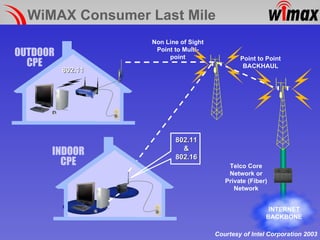
WiMAX Consumer Last Mile INTERNET BACKBONE Telco Core Network or Private (Fiber) Network Non Line of Sight Point to Multi-point OUTDOOR CPE INDOOR CPE 802.11 Point to Point BACKHAUL Courtesy of Intel Corporation 2003 802.11 & 802.16
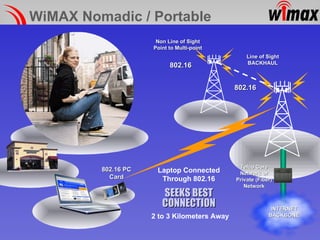
WiMAX Nomadic / Portable INTERNET BACKBONE Telco Core Network or Private (Fiber) Network Non Line of Sight Point to Multi-point 802.16 802.16 SEEKS BEST CONNECTION Laptop Connected Through 802.16 2 to 3 Kilometers Away Line of Sight BACKHAUL 802.16 PC Card
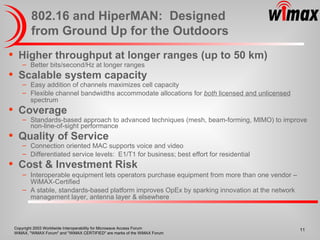
802.16 and HiperMAN:  Designed from Ground Up for the Outdoors Higher throughput at longer ranges (up to 50 km) Better bits/second/Hz at longer ranges  Scalable system capacity Easy addition of channels maximizes cell capacity Flexible channel bandwidths accommodate allocations for  both  licensed and unlicensed  spectrum Coverage Standards-based approach to advanced techniques (mesh, beam-forming, MIMO) to improve non-line-of-sight performance Quality of Service Connection oriented MAC supports voice and video Differentiated service levels:  E1/T1 for business; best effort for residential Cost & Investment Risk Interoperable equipment lets operators purchase equipment from more than one vendor – WiMAX-Certified A stable, standards-based platform improves OpEx by sparking innovation at the network management layer, antenna layer & elsewhere
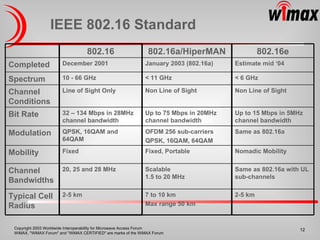
IEEE 802.16 Standard 2-5 km Same as 802.16a with UL sub-channels Nomadic Mobility Same as 802.16a Up to 15 Mbps in 5MHz channel bandwidth Non Line of Sight < 6 GHz Estimate mid ‘04 802.16e Fixed, Portable Fixed Mobility Non Line of Sight Line of Sight Only Channel Conditions < 11 GHz 10 - 66 GHz Spectrum January 2003 (802.16a) December 2001 Completed 7 to 10 km Max range 50 km 2-5 km Typical Cell Radius Scalable 1.5 to 20 MHz 20, 25 and 28 MHz  Channel Bandwidths OFDM 256 sub-carriers QPSK, 16QAM, 64QAM QPSK, 16QAM and 64QAM Modulation Up to 75 Mbps in 20MHz channel bandwidth 32 – 134 Mbps in 28MHz channel bandwidth Bit Rate 802.16a/HiperMAN 802.16
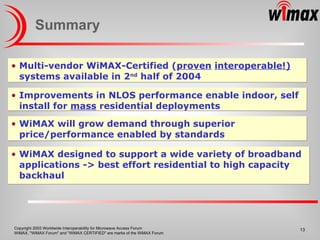
Summary Improvements in NLOS performance enable indoor, self install for  mass  residential deployments Multi-vendor WiMAX-Certified ( proven   interoperable!)  systems available in 2 nd  half of 2004 WiMAX will grow demand through superior price/performance enabled by standards WiMAX designed to support a wide variety of broadband applications -> best effort residential to high capacity backhaul
Wireless Broadband Everywhere www.wimaxforum.org

Wi Max Updated

  • 1.
    Enabling Deployments throughStandards & Certification Margaret LaBrecque WiMAX President ma [email_address]
  • 2.
    What is IEEE802.16* / WiMAX* / ETSI HiperMAN*? ETSI HiperMAN and IEEE 802.16 represent a GLOBAL standard for a wireless broadband access akin to Cable, DSL and Ex-level services Designed from the ground up for outdoor, long range, carrier class applications High throughput, non line of sight propagation, scalability for up to 1000's of users, QoS Supports both licensed and license-exempt spectrum Applicable in many markets – from dense urban environments to rural areas Where there is no existing or poor wired infrastructure IEEE 802.16e extension enables nomadic capabilities for laptops Broadband connectivity beyond hot spots Wi-Fi and WiMAX are complementary WiMAX* is to 802.16 as Wi-Fi* is to 802.11 * Other brands and trademarks are property of their respective owners
  • 3.
    Global Wireless StandardsIEEE 802.15 Bluetooth WAN MAN LAN PAN ETSI HiperPAN IEEE 802.11 WirelessLAN ETSI HiperLAN IEEE 802.16 WirelessMAN ETSI HiperMAN & HIPERACCESS IEEE 802.20 (proposed) 3GPP, EDGE (GSM)
  • 4.
    Wireless Platforms FixedLicensed and Unlicensed E1/ T1 & DSL level service Portable Licensed and Unlicensed Consumer DSL level service Mobile Licensed Wideband Data Rates 802.16 HiperMAN Enterprise / Backhaul 802.16 HiperMAN Residential access Nomadic Cellular Wideband 2.5G, 3G Destination based 802.11 Hot Spots 802.16e
  • 5.
    What is WiMAX?Ensure interoperability of IEEE 802.16* and other interoperable (ETSI HiperMAN*) systems Equivalent in purpose to Wi-Fi Alliance for 802.11 Develop Conformance Test Specifications Two year, multi-company process to develop test suites Based upon ISO/IEC 9646 processes System Profiles correspond to market-driven usage modes e.g., license exempt at 5.x GHz, licensed at 3.5 GHz, etc. Set up certification labs for testing Host interoperability events Conformance does not equal Interoperability Provide WiMAX-Certified stamp of approval * Trademarks or servicemarks are the property of their respective owners. WiMAX members represent over 75% of current 2-11 GHz BWA equipment sales!
  • 6.
    Why has BWAnot taken off? Pre-Standard: Proprietary, vertical solutions No volume silicon market Service Providers System Design & Architecture Custom MAC Custom Radio Custom, 802.11 or DOCSIS PHY Network Software System Integration Equipment Mfrs Focus Post-Standard: Equipment interoperability Economies of scale Superior price/performance Service Providers Equipment Manufacturers Volume Integrated MAC/PHY Silicon Solutions Volume Radio Supplier Network Mgmt Software Supplier System Integrator Equipment Mfrs Focus* * Varies by equipment mfr. Some will still do their own S/W and SI.
  • 7.
    Enable Standards &Interoperability 1980s 1990s 2000 Volume Ethernet 2010 Formula : Existing proprietary technology & market Standards adoption Low cost manufacturing through economies of scale Wireless: available spectrum IEEE: The Path to Volume Economics *Other names and brands may be claimed as the property of others.
  • 8.
    WiMAX Backhaul forBusiness Point to Point BACKHAUL INTERNET BACKBONE Telco Core Network or Private (Fiber) Network Non Line of Sight Point to Multi-point FRACTIONAL E1/T1 for SMALL BUSINESS 802.11 E1/T1+ LEVEL SERVICE ENTERPRISE Courtesy of Intel Corporation 2003
  • 9.
    WiMAX Consumer LastMile INTERNET BACKBONE Telco Core Network or Private (Fiber) Network Non Line of Sight Point to Multi-point OUTDOOR CPE INDOOR CPE 802.11 Point to Point BACKHAUL Courtesy of Intel Corporation 2003 802.11 & 802.16
  • 10.
    WiMAX Nomadic /Portable INTERNET BACKBONE Telco Core Network or Private (Fiber) Network Non Line of Sight Point to Multi-point 802.16 802.16 SEEKS BEST CONNECTION Laptop Connected Through 802.16 2 to 3 Kilometers Away Line of Sight BACKHAUL 802.16 PC Card
  • 11.
    802.16 and HiperMAN: Designed from Ground Up for the Outdoors Higher throughput at longer ranges (up to 50 km) Better bits/second/Hz at longer ranges Scalable system capacity Easy addition of channels maximizes cell capacity Flexible channel bandwidths accommodate allocations for both licensed and unlicensed spectrum Coverage Standards-based approach to advanced techniques (mesh, beam-forming, MIMO) to improve non-line-of-sight performance Quality of Service Connection oriented MAC supports voice and video Differentiated service levels: E1/T1 for business; best effort for residential Cost & Investment Risk Interoperable equipment lets operators purchase equipment from more than one vendor – WiMAX-Certified A stable, standards-based platform improves OpEx by sparking innovation at the network management layer, antenna layer & elsewhere
  • 12.
    IEEE 802.16 Standard2-5 km Same as 802.16a with UL sub-channels Nomadic Mobility Same as 802.16a Up to 15 Mbps in 5MHz channel bandwidth Non Line of Sight < 6 GHz Estimate mid ‘04 802.16e Fixed, Portable Fixed Mobility Non Line of Sight Line of Sight Only Channel Conditions < 11 GHz 10 - 66 GHz Spectrum January 2003 (802.16a) December 2001 Completed 7 to 10 km Max range 50 km 2-5 km Typical Cell Radius Scalable 1.5 to 20 MHz 20, 25 and 28 MHz Channel Bandwidths OFDM 256 sub-carriers QPSK, 16QAM, 64QAM QPSK, 16QAM and 64QAM Modulation Up to 75 Mbps in 20MHz channel bandwidth 32 – 134 Mbps in 28MHz channel bandwidth Bit Rate 802.16a/HiperMAN 802.16
  • 13.
    Summary Improvements inNLOS performance enable indoor, self install for mass residential deployments Multi-vendor WiMAX-Certified ( proven interoperable!) systems available in 2 nd half of 2004 WiMAX will grow demand through superior price/performance enabled by standards WiMAX designed to support a wide variety of broadband applications -> best effort residential to high capacity backhaul
  • 14.