RAMSHEEDA.K
11bcs1121
Guided by: Mr.SREEKESH NAMBOODIRI
Department of
Computer Science and Engineering
MES COLLEGE OF ENGINEERING
Kuttippuram
January 20, 2015
1
Outline:
 Objective
 Introduction
 Existing system
 Proposed system
 3-tier Architecture
 Data Flow Diagram
 System Requirements
 Security Requirements
 Applications
 Comparison with other networks
 Advantages and disadvantages
 Future Scope
 Conclusion
 References 2
Objective:
“ To implement Ubiquitous and affordable
healthcare”
3
Introduction:
WBAN is a RF based wireless networking
technology.
Integration of intelligent, miniaturized, low power
sensor node.
Classified into two:
 Wearable WBAN
 Implantable WBAN
Utilizes wireless sensor nodes
patients health condition can be monitored anytime
and anywhere
4
cont’d..
Continuously monitor the health conditions of
patients.
 Prevention and early risk detection.
 Sharing the information with care seekers and
physicians.
 Provides greater mobility and flexibility to patients
Alarming the person who wears it.
Auto medication in case of emergency.
5
What is BAN…???
Definition by IEEE 802.15.6:
“A communication standard optimized for low power devices for their
operation on, in or around the human body (but not limited to humans)
to serve a variety of applications including medical, consumer
electronics or personal entertainment and other.”
6
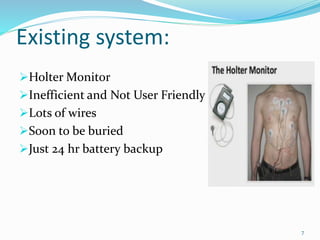
Existing system:
7
Holter Monitor
Inefficient and Not User Friendly
Lots of wires
Soon to be buried
Just 24 hr battery backup
Proposed system:
Easily accessible
Saves a lot of time.
Close-loop bio-feedback:
If high sugar-level, a device triggers an insulin pump to
inject a dose of insulin (artificial pancreas)
Reduction in hospital stays
Managing ILLNESS for managing WELLNESS by
focusing on prevention and early detection.
8
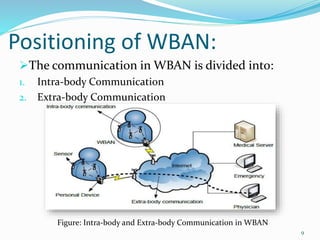
Positioning of WBAN:
The communication in WBAN is divided into:
1. Intra-body Communication
2. Extra-body Communication
9
Figure: Intra-body and Extra-body Communication in WBAN
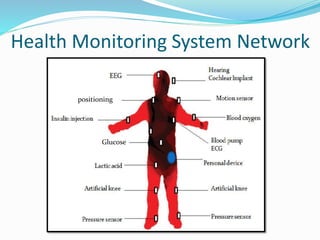
Health Monitoring System Network
positioning
Glucose
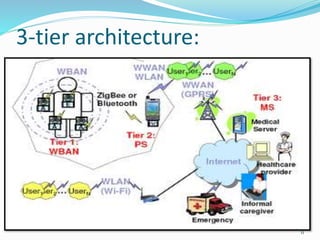
3-tier architecture:
11
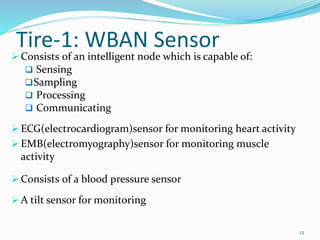
Tire-1: WBAN Sensor
 Consists of an intelligent node which is capable of:
 Sensing
Sampling
 Processing
 Communicating
 ECG(electrocardiogram)sensor for monitoring heart activity
 EMB(electromyography)sensor for monitoring muscle
activity
 Consists of a blood pressure sensor
 A tilt sensor for monitoring
12
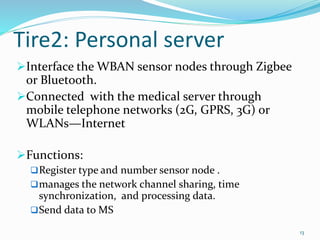
Tire2: Personal server
Interface the WBAN sensor nodes through Zigbee
or Bluetooth.
Connected with the medical server through
mobile telephone networks (2G, GPRS, 3G) or
WLANs—Internet
Functions:
Register type and number sensor node .
manages the network channel sharing, time
synchronization, and processing data.
Send data to MS
13
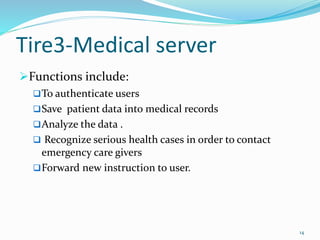
Tire3-Medical server
Functions include:
To authenticate users
Save patient data into medical records
Analyze the data .
 Recognize serious health cases in order to contact
emergency care givers
Forward new instruction to user.
14
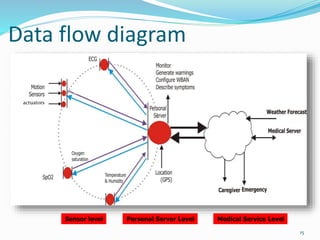
Data flow diagram
15
Sensor level Personal Server Level Medical Service Level
actuators
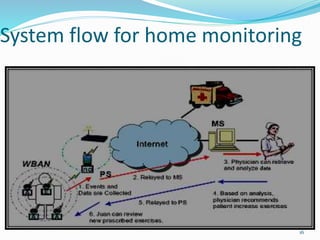
System flow for home monitoring
16
MAC protocols for WBAN
Low power consuming
Accurate
Less latency
Good performance on varying traffic load
Popular protocols for WBAN are:
TMAC:
 Duty-cycling protocol
 Active time
 Duty cycle changes according to the information
traffic load of the network
 Handle varying load with low power consumption
17
 SMAC
 Similar to TMAC but with fixed duty cycle
 Not efficient in handling continuously varying data rates
 ZigBee MAC
Two schemes:
 CSMA/CA :Gives average performance
 TDMA: Reduces the power consumption up to a great extent
 Baseline MAC
Uses CSMA/CA scheme
The performance is not average in the case of energy
Throughput is average.
18
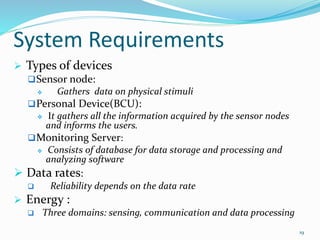
System Requirements
 Types of devices
Sensor node:
 Gathers data on physical stimuli
Personal Device(BCU):
 It gathers all the information acquired by the sensor nodes
and informs the users.
Monitoring Server:
 Consists of database for data storage and processing and
analyzing software
 Data rates:
 Reliability depends on the data rate
 Energy :
 Three domains: sensing, communication and data processing
19
Security requirements
 Data storage security requirements:
 Confidentiality
 Integrity assurance
 Dependability
 Data access security requirements:
 Access control
 Accountability
 Non-repudiation
 Other security requirements:
 Authentication
 Availability
20
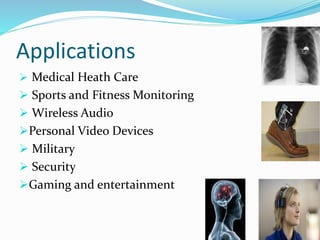
Applications
 Medical Heath Care
 Sports and Fitness Monitoring
 Wireless Audio
Personal Video Devices
 Military
 Security
Gaming and entertainment
21
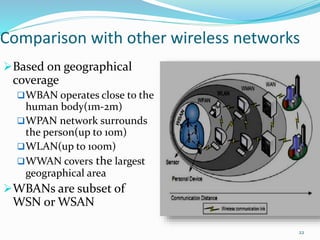
Comparison with other wireless networks
Based on geographical
coverage
WBAN operates close to the
human body(1m-2m)
WPAN network surrounds
the person(up to 10m)
WLAN(up to 100m)
WWAN covers the largest
geographical area
WBANs are subset of
WSN or WSAN
22
Advantages and disadvantages
Adavantages
 Used for the detection of chronic diseases
 Used in military for security purposes
 Assists the communication between individual and
machine
Disadvantages
 Wired network-restriction between the body movement
 Interference of the multi devices that share the channel.
 Lack of integration-sensors
23
Conclusion
Benefits to patients,medical personnel and society
 Continuous monitoring is possible
 Early detection of possible problems.
Improving the Quality of Life
Collected the pulse rate, temperature and the
location of the patients
24
Reference
[1] Samaneh Movassaghi, Mehran Abolhasan, Justin Lipman,David Smith, and
Abbas Jamalipour, “Wireless Body Area Networks: A Survey” , IEEE
Communications surveys & tutorials,vol.16, No.3, Third Quarter,2014
[2] Aashima Arya Naveen Bilandi, “ A Review: Wireless Body Area Networks for
Health Care”, International Journal of Innovative Research in Computer and
Communication Engineering, Vol.2, Issue 4, April 2014
[3] Prathamesh Dinkar, Abhishek Gulavani, Sourabh Ketkale, Pratik Kadam,and
Sheetal Dabhade, “Remote Health Monitoring using Wireless Body Area
Network ”, International Journal of Engineering and Advanced Technology
(IJEAT) ISSN: 2249 – 8958, Vol.2, Issue-4, April 2013
[4] Garth V. Crosby, Tirthankar Ghosh, Renita Murimi and Craig A. Chin,
“Wireless Body Area Networks for Healthcare: A Survey ”, International Journal
of Ad hoc, Sensor & Ubiquitous Computing (IJASUC) ,Vol.3,No.3 June 2012
25
[5] Changhong Wang, Qiang Wang, and Shunzhong Shi, “A Distributed Wireless
Body Area Network for Medical Supervision”, IEEE International, May 2012
[6] Javed Ahmadand Fareeha Zafar,”Review of Body Area Network Technology &
Wireless Medical Monitoring”,International Journal of Information and
Communication Technology Research ,Volume 2 No. 2, February 2012
[7] Latre, Benoit, Bart Braem, Ingrid Moerman, Chris Blondia, and Piet
Demeester. “A survey on wireless body area networks,” Wireless Networks, vol.
17, 2010
[8] Sana ULLAH,Pervez KHAN,Niamat ULLAH,Shahnaz SALEE and Henry
HIGGINSandKyung Sup KWAK, “A Review of Wireless Body Area Networks for
Medical Applications ”, Int. J. Communications, Network and System
Sciences,Vol.2,november 2009
[9] Pervez Khan, Md.Asdaque Hussain and Kyung Sup Kwak “Medical
Applications of Wireless Body Area Networks ”, International Journal of Digital
Content Technology and its Applications Vol.3, September 2009
26
Thank you

27

wireless body area networks(WBAN)

  • 1.
    RAMSHEEDA.K 11bcs1121 Guided by: Mr.SREEKESHNAMBOODIRI Department of Computer Science and Engineering MES COLLEGE OF ENGINEERING Kuttippuram January 20, 2015 1
  • 2.
    Outline:  Objective  Introduction Existing system  Proposed system  3-tier Architecture  Data Flow Diagram  System Requirements  Security Requirements  Applications  Comparison with other networks  Advantages and disadvantages  Future Scope  Conclusion  References 2
  • 3.
    Objective: “ To implementUbiquitous and affordable healthcare” 3
  • 4.
    Introduction: WBAN is aRF based wireless networking technology. Integration of intelligent, miniaturized, low power sensor node. Classified into two:  Wearable WBAN  Implantable WBAN Utilizes wireless sensor nodes patients health condition can be monitored anytime and anywhere 4
  • 5.
    cont’d.. Continuously monitor thehealth conditions of patients.  Prevention and early risk detection.  Sharing the information with care seekers and physicians.  Provides greater mobility and flexibility to patients Alarming the person who wears it. Auto medication in case of emergency. 5
  • 6.
    What is BAN…??? Definitionby IEEE 802.15.6: “A communication standard optimized for low power devices for their operation on, in or around the human body (but not limited to humans) to serve a variety of applications including medical, consumer electronics or personal entertainment and other.” 6
  • 7.
    Existing system: 7 Holter Monitor Inefficientand Not User Friendly Lots of wires Soon to be buried Just 24 hr battery backup
  • 8.
    Proposed system: Easily accessible Savesa lot of time. Close-loop bio-feedback: If high sugar-level, a device triggers an insulin pump to inject a dose of insulin (artificial pancreas) Reduction in hospital stays Managing ILLNESS for managing WELLNESS by focusing on prevention and early detection. 8
  • 9.
    Positioning of WBAN: Thecommunication in WBAN is divided into: 1. Intra-body Communication 2. Extra-body Communication 9 Figure: Intra-body and Extra-body Communication in WBAN
  • 10.
    Health Monitoring SystemNetwork positioning Glucose
  • 11.
  • 12.
    Tire-1: WBAN Sensor Consists of an intelligent node which is capable of:  Sensing Sampling  Processing  Communicating  ECG(electrocardiogram)sensor for monitoring heart activity  EMB(electromyography)sensor for monitoring muscle activity  Consists of a blood pressure sensor  A tilt sensor for monitoring 12
  • 13.
    Tire2: Personal server Interfacethe WBAN sensor nodes through Zigbee or Bluetooth. Connected with the medical server through mobile telephone networks (2G, GPRS, 3G) or WLANs—Internet Functions: Register type and number sensor node . manages the network channel sharing, time synchronization, and processing data. Send data to MS 13
  • 14.
    Tire3-Medical server Functions include: Toauthenticate users Save patient data into medical records Analyze the data .  Recognize serious health cases in order to contact emergency care givers Forward new instruction to user. 14
  • 15.
    Data flow diagram 15 Sensorlevel Personal Server Level Medical Service Level actuators
  • 16.
    System flow forhome monitoring 16
  • 17.
    MAC protocols forWBAN Low power consuming Accurate Less latency Good performance on varying traffic load Popular protocols for WBAN are: TMAC:  Duty-cycling protocol  Active time  Duty cycle changes according to the information traffic load of the network  Handle varying load with low power consumption 17
  • 18.
     SMAC  Similarto TMAC but with fixed duty cycle  Not efficient in handling continuously varying data rates  ZigBee MAC Two schemes:  CSMA/CA :Gives average performance  TDMA: Reduces the power consumption up to a great extent  Baseline MAC Uses CSMA/CA scheme The performance is not average in the case of energy Throughput is average. 18
  • 19.
    System Requirements  Typesof devices Sensor node:  Gathers data on physical stimuli Personal Device(BCU):  It gathers all the information acquired by the sensor nodes and informs the users. Monitoring Server:  Consists of database for data storage and processing and analyzing software  Data rates:  Reliability depends on the data rate  Energy :  Three domains: sensing, communication and data processing 19
  • 20.
    Security requirements  Datastorage security requirements:  Confidentiality  Integrity assurance  Dependability  Data access security requirements:  Access control  Accountability  Non-repudiation  Other security requirements:  Authentication  Availability 20
  • 21.
    Applications  Medical HeathCare  Sports and Fitness Monitoring  Wireless Audio Personal Video Devices  Military  Security Gaming and entertainment 21
  • 22.
    Comparison with otherwireless networks Based on geographical coverage WBAN operates close to the human body(1m-2m) WPAN network surrounds the person(up to 10m) WLAN(up to 100m) WWAN covers the largest geographical area WBANs are subset of WSN or WSAN 22
  • 23.
    Advantages and disadvantages Adavantages Used for the detection of chronic diseases  Used in military for security purposes  Assists the communication between individual and machine Disadvantages  Wired network-restriction between the body movement  Interference of the multi devices that share the channel.  Lack of integration-sensors 23
  • 24.
    Conclusion Benefits to patients,medicalpersonnel and society  Continuous monitoring is possible  Early detection of possible problems. Improving the Quality of Life Collected the pulse rate, temperature and the location of the patients 24
  • 25.
    Reference [1] Samaneh Movassaghi,Mehran Abolhasan, Justin Lipman,David Smith, and Abbas Jamalipour, “Wireless Body Area Networks: A Survey” , IEEE Communications surveys & tutorials,vol.16, No.3, Third Quarter,2014 [2] Aashima Arya Naveen Bilandi, “ A Review: Wireless Body Area Networks for Health Care”, International Journal of Innovative Research in Computer and Communication Engineering, Vol.2, Issue 4, April 2014 [3] Prathamesh Dinkar, Abhishek Gulavani, Sourabh Ketkale, Pratik Kadam,and Sheetal Dabhade, “Remote Health Monitoring using Wireless Body Area Network ”, International Journal of Engineering and Advanced Technology (IJEAT) ISSN: 2249 – 8958, Vol.2, Issue-4, April 2013 [4] Garth V. Crosby, Tirthankar Ghosh, Renita Murimi and Craig A. Chin, “Wireless Body Area Networks for Healthcare: A Survey ”, International Journal of Ad hoc, Sensor & Ubiquitous Computing (IJASUC) ,Vol.3,No.3 June 2012 25
  • 26.
    [5] Changhong Wang,Qiang Wang, and Shunzhong Shi, “A Distributed Wireless Body Area Network for Medical Supervision”, IEEE International, May 2012 [6] Javed Ahmadand Fareeha Zafar,”Review of Body Area Network Technology & Wireless Medical Monitoring”,International Journal of Information and Communication Technology Research ,Volume 2 No. 2, February 2012 [7] Latre, Benoit, Bart Braem, Ingrid Moerman, Chris Blondia, and Piet Demeester. “A survey on wireless body area networks,” Wireless Networks, vol. 17, 2010 [8] Sana ULLAH,Pervez KHAN,Niamat ULLAH,Shahnaz SALEE and Henry HIGGINSandKyung Sup KWAK, “A Review of Wireless Body Area Networks for Medical Applications ”, Int. J. Communications, Network and System Sciences,Vol.2,november 2009 [9] Pervez Khan, Md.Asdaque Hussain and Kyung Sup Kwak “Medical Applications of Wireless Body Area Networks ”, International Journal of Digital Content Technology and its Applications Vol.3, September 2009 26
  • 27.