PRESENTERDEEPAK CHANDRA PANT
ECE (4th Yr.)
10/27/2013

1
Outline1.
2.
3.
4.
5.
6.
7.
8.
9.
10.
11.

Introduction of BAN
What is BAN…???
History and Development
Architecture of BAN
Taxonomy and Requirements
Positioning of WBAN
Patient Monitoring through BAN
Applications
Challenges
Future Scope
Conclusion

10/27/2013

2
Introduction
 Increasing population and the rising costs of health care

have triggered the introduction of novel technology-driven
enhancements to current health care practices.
 Recent

advances in electronics have enabled the
development of small and intelligent (bio-) medical
sensors which can be worn on or implanted in the human
body.

 Thus introduced Wireless Body Area Network (WBAN).

10/27/2013

3
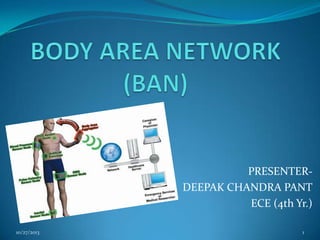
What is BAN…???
 Definition by IEEE: “A communication standard optimized for

low power devices for their operation on, in or around the
human body (but not limited to humans) to serve a variety of
applications including medical, consumer electronics or
personal entertainment and other.”
 Broad range of possible devices
 Connect everything you carry on you and with you
 Offer “Connected User” experience

10/27/2013

4
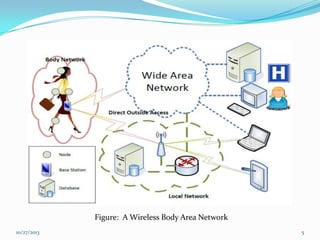
Figure: A Wireless Body Area Network
10/27/2013

5
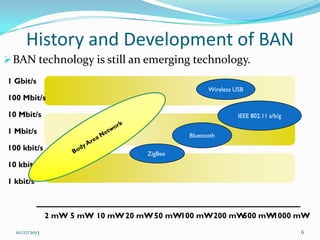
History and Development of BAN
 BAN technology is still an emerging technology.
1 Gbit/s
Wireless USB

100 Mbit/s
10 Mbit/s

IEEE 802.11 a/b/g

1 Mbit/s
100 kbit/s

Bluetooth
ZigBee

10 kbit/s
1 kbit/s

500 mW
1000 mW
2 mW 5 mW 10 mW 20 mW 50 mW100 mW200 mW
10/27/2013

6
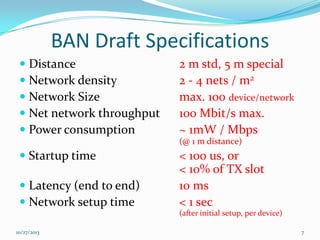
BAN Draft Specifications
 Distance
 Network density
 Network Size
 Net network throughput
 Power consumption

2 m std, 5 m special
2 - 4 nets / m2
max. 100 device/network
100 Mbit/s max.
~ 1mW / Mbps
(@ 1 m distance)

 Startup time
 Latency (end to end)
 Network setup time

< 100 us, or
< 10% of TX slot
10 ms
< 1 sec
(after initial setup, per device)

10/27/2013

7
Contd…
 Implementation module cost
 Should be comparable to Bluetooth module
 Effective sleep mode(s)
 Operates in global, license-exempt band
 Peer to peer communication, point to multi-point
 Omni-directional antennas: small, flexible
 Future proof [for 5 years?]
 Upgradeable, saleable, backwards compatibility

10/27/2013

8
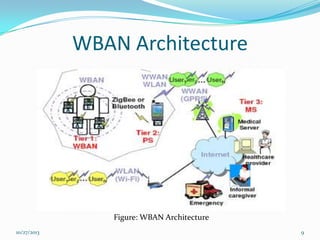
WBAN Architecture

Figure: WBAN Architecture
10/27/2013

9
Taxonomy and Requirements
1.

Types of Devices
a.
b.
c.

2.
3.
4.

5.
6.
10/27/2013

Sensor Node
Actuator Node
Personal Devices

Data Rates
Energy
Quality of Service and Reliability
Security and Privacy
Usability
10
Positioning of WBAN
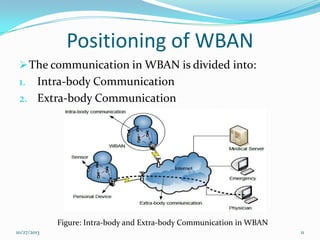
 The communication in WBAN is divided into:

Intra-body Communication
2. Extra-body Communication
1.

Figure: Intra-body and Extra-body Communication in WBAN
10/27/2013

11
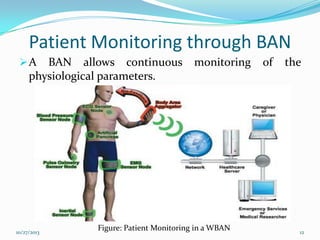
Patient Monitoring through BAN
A

BAN allows continuous
physiological parameters.

10/27/2013

monitoring

Figure: Patient Monitoring in a WBAN

of

the

12
Applications of BAN
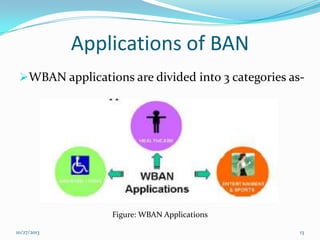
WBAN applications are divided into 3 categories as-

Figure: WBAN Applications
10/27/2013

13
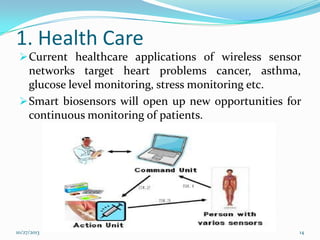
1. Health Care
 Current healthcare applications of wireless sensor

networks target heart problems cancer, asthma,
glucose level monitoring, stress monitoring etc.
 Smart biosensors will open up new opportunities for
continuous monitoring of patients.

10/27/2013

14
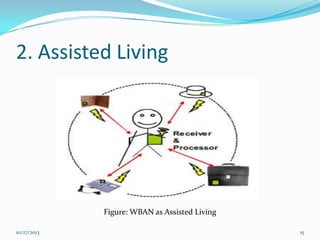
2. Assisted Living

Figure: WBAN as Assisted Living
10/27/2013

15
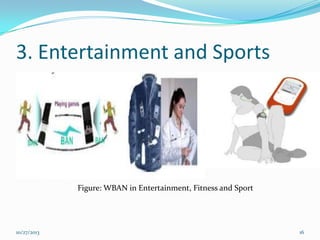
3. Entertainment and Sports

Figure: WBAN in Entertainment, Fitness and Sport

10/27/2013

16
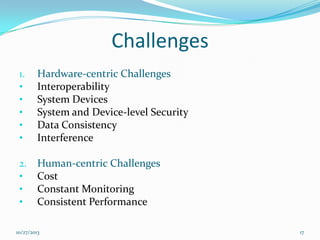
Challenges
1.
•
•
•
•
•

Hardware-centric Challenges
Interoperability
System Devices
System and Device-level Security
Data Consistency
Interference

2.
•
•
•

Human-centric Challenges
Cost
Constant Monitoring
Consistent Performance

10/27/2013

17
Advantages of BAN
 Used for detection of chronic diseases.
 Used in military for security purposes.

 Assists seamless communication between individual

and peoples.

10/27/2013

18
Future Scope
 The future market of WBAN is growing rapidly in the field

of medical as well as in the entertainment industry.
 We believe that WBAN systems will allow a dramatic shift

in the way people think about and manage their health.
 This provide more proactive preventive healthcare that will

not only improve the quality of life, but will also reduce
healthcare costs.

10/27/2013

19
Conclusion
 A WBAN is expected to be a very useful technology

with potential to offer a wide range of benefits to
patients, medical personnel and society through
continuous monitoring and early detection of possible
problems.
 The current technological evolutions will bring us

closer to a fully operational WBAN that acts as an
enabler for improving the Quality of Life.

10/27/2013

20
10/27/2013

21

Body Area Network

  • 1.
    PRESENTERDEEPAK CHANDRA PANT ECE(4th Yr.) 10/27/2013 1
  • 2.
    Outline1. 2. 3. 4. 5. 6. 7. 8. 9. 10. 11. Introduction of BAN Whatis BAN…??? History and Development Architecture of BAN Taxonomy and Requirements Positioning of WBAN Patient Monitoring through BAN Applications Challenges Future Scope Conclusion 10/27/2013 2
  • 3.
    Introduction  Increasing populationand the rising costs of health care have triggered the introduction of novel technology-driven enhancements to current health care practices.  Recent advances in electronics have enabled the development of small and intelligent (bio-) medical sensors which can be worn on or implanted in the human body.  Thus introduced Wireless Body Area Network (WBAN). 10/27/2013 3
  • 4.
    What is BAN…??? Definition by IEEE: “A communication standard optimized for low power devices for their operation on, in or around the human body (but not limited to humans) to serve a variety of applications including medical, consumer electronics or personal entertainment and other.”  Broad range of possible devices  Connect everything you carry on you and with you  Offer “Connected User” experience 10/27/2013 4
  • 5.
    Figure: A WirelessBody Area Network 10/27/2013 5
  • 6.
    History and Developmentof BAN  BAN technology is still an emerging technology. 1 Gbit/s Wireless USB 100 Mbit/s 10 Mbit/s IEEE 802.11 a/b/g 1 Mbit/s 100 kbit/s Bluetooth ZigBee 10 kbit/s 1 kbit/s 500 mW 1000 mW 2 mW 5 mW 10 mW 20 mW 50 mW100 mW200 mW 10/27/2013 6
  • 7.
    BAN Draft Specifications Distance  Network density  Network Size  Net network throughput  Power consumption 2 m std, 5 m special 2 - 4 nets / m2 max. 100 device/network 100 Mbit/s max. ~ 1mW / Mbps (@ 1 m distance)  Startup time  Latency (end to end)  Network setup time < 100 us, or < 10% of TX slot 10 ms < 1 sec (after initial setup, per device) 10/27/2013 7
  • 8.
    Contd…  Implementation modulecost  Should be comparable to Bluetooth module  Effective sleep mode(s)  Operates in global, license-exempt band  Peer to peer communication, point to multi-point  Omni-directional antennas: small, flexible  Future proof [for 5 years?]  Upgradeable, saleable, backwards compatibility 10/27/2013 8
  • 9.
    WBAN Architecture Figure: WBANArchitecture 10/27/2013 9
  • 10.
    Taxonomy and Requirements 1. Typesof Devices a. b. c. 2. 3. 4. 5. 6. 10/27/2013 Sensor Node Actuator Node Personal Devices Data Rates Energy Quality of Service and Reliability Security and Privacy Usability 10
  • 11.
    Positioning of WBAN The communication in WBAN is divided into: Intra-body Communication 2. Extra-body Communication 1. Figure: Intra-body and Extra-body Communication in WBAN 10/27/2013 11
  • 12.
    Patient Monitoring throughBAN A BAN allows continuous physiological parameters. 10/27/2013 monitoring Figure: Patient Monitoring in a WBAN of the 12
  • 13.
    Applications of BAN WBANapplications are divided into 3 categories as- Figure: WBAN Applications 10/27/2013 13
  • 14.
    1. Health Care Current healthcare applications of wireless sensor networks target heart problems cancer, asthma, glucose level monitoring, stress monitoring etc.  Smart biosensors will open up new opportunities for continuous monitoring of patients. 10/27/2013 14
  • 15.
    2. Assisted Living Figure:WBAN as Assisted Living 10/27/2013 15
  • 16.
    3. Entertainment andSports Figure: WBAN in Entertainment, Fitness and Sport 10/27/2013 16
  • 17.
    Challenges 1. • • • • • Hardware-centric Challenges Interoperability System Devices Systemand Device-level Security Data Consistency Interference 2. • • • Human-centric Challenges Cost Constant Monitoring Consistent Performance 10/27/2013 17
  • 18.
    Advantages of BAN Used for detection of chronic diseases.  Used in military for security purposes.  Assists seamless communication between individual and peoples. 10/27/2013 18
  • 19.
    Future Scope  Thefuture market of WBAN is growing rapidly in the field of medical as well as in the entertainment industry.  We believe that WBAN systems will allow a dramatic shift in the way people think about and manage their health.  This provide more proactive preventive healthcare that will not only improve the quality of life, but will also reduce healthcare costs. 10/27/2013 19
  • 20.
    Conclusion  A WBANis expected to be a very useful technology with potential to offer a wide range of benefits to patients, medical personnel and society through continuous monitoring and early detection of possible problems.  The current technological evolutions will bring us closer to a fully operational WBAN that acts as an enabler for improving the Quality of Life. 10/27/2013 20
  • 21.