Wireless Body
Area
Networks
 Introduction to WBAN
 Definition
 WBAN Architecture requirements
 WBAN Units
 WBAN Functionality
 WBAN Architecture
 WBAN Process
 Challenges
 Comparison
 Applications
 Advantages & Disadvantages
 Research Area
 Future Scope
 Conclusion
 Bibliography
CONTENTS
INTRODUCTIO
N
WBAN is a special kind of network, which is designed
and developed for Human body, to monitor, manage and
communicate different vital signs of human body like
temperature, Blood pressure, ECG etc.
These vital signs can be monitored by using different
sensor installed on clothes or on the body or even under
the skin.
DEFINITION
What is BAN…???
According to definition given by IEEE 802.15.6
“A communication standard optimized for low power
devices for their operation on, in or around the human
body to serve a variety of applications including medical,
consumer electronics or personal entertainment and other.”
WBAN ARCHITECTURE
REQUIREMENTS
Wireless Sensor
Wireless
Actuator Node
Wireless Central
Unit
Wireless Personal
Device (PD)
ARCHITECTUR
E
WBAN
BODY SENSOR UNIT
BODY CONTROL UNIT
WBAN UNITS
BODY SENSOR UNIT
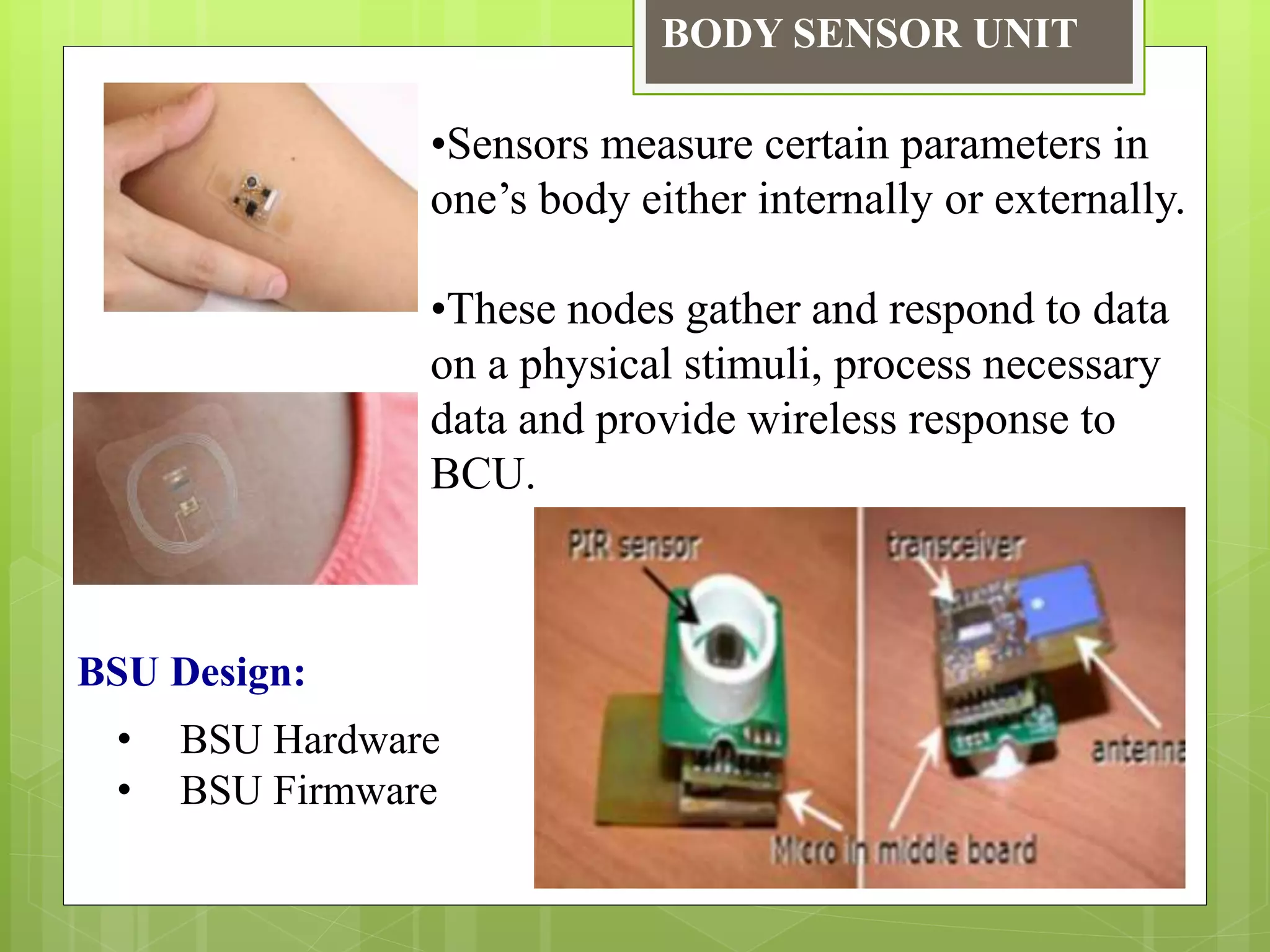
•Sensors measure certain parameters in
one’s body either internally or externally.
•These nodes gather and respond to data
on a physical stimuli, process necessary
data and provide wireless response to
BCU.
BSU Design:
• BSU Hardware
• BSU Firmware
BODY SENSOR UNIT
BSU hardware design
considerations :
1. Low power and energy consumption.
2. Scaling of major electrical
components.
3. Low cost .
4. Small volume.
Body Sensor Unit Firmware:
•Principle challenge of BCU
firmware is Wireless transmission
of motion data via Bluetooth
BODY CONTROL UNIT
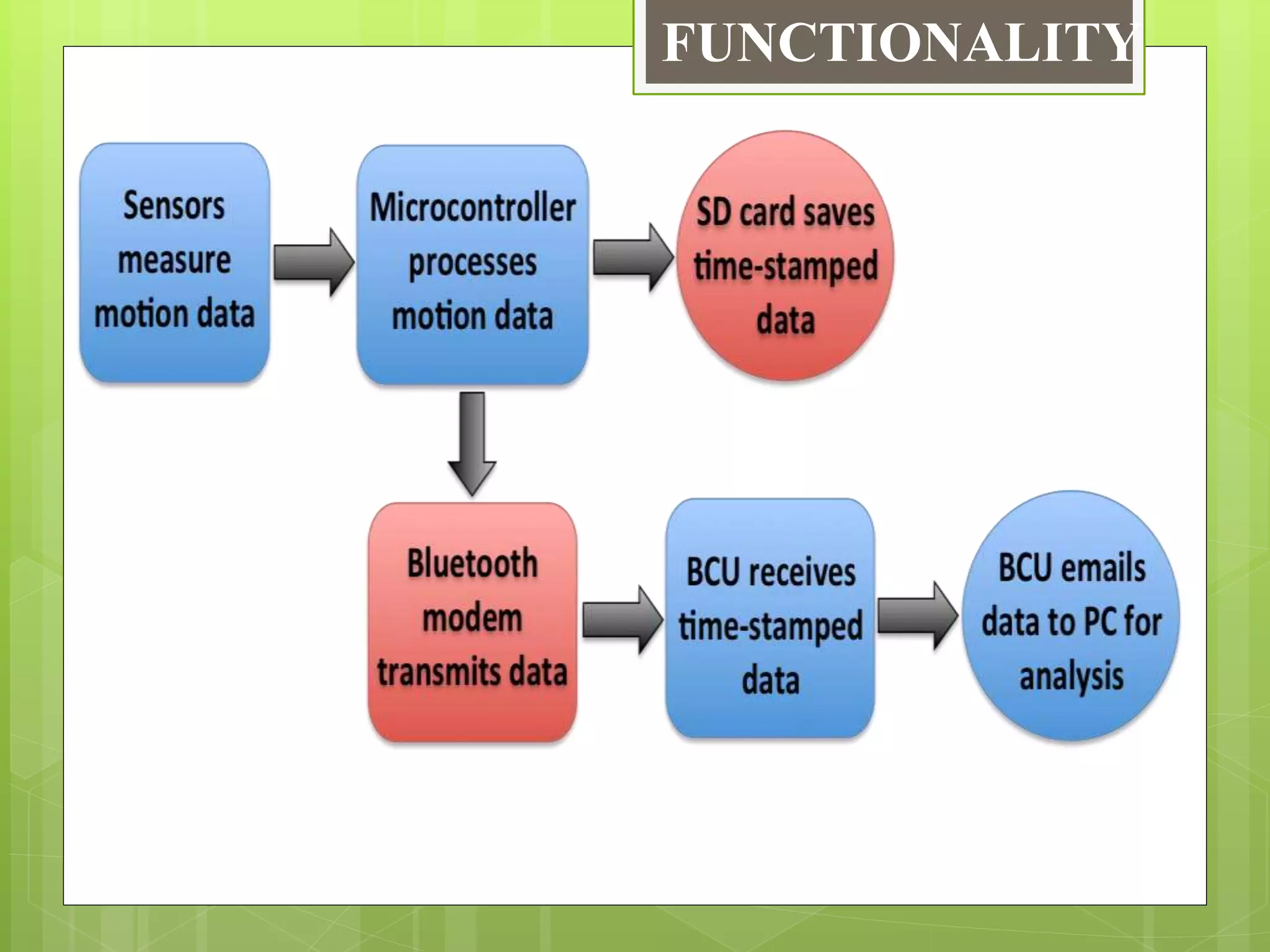
The main functions of BCU
•Implementation of additional sensors
•Receiving Data
•Saving Data
•Plotting Data
BODY CONTROL UNIT
FUNCTIONALITY
3 TIER ARCHITECTURE
3 TIER ARCHITECTURE
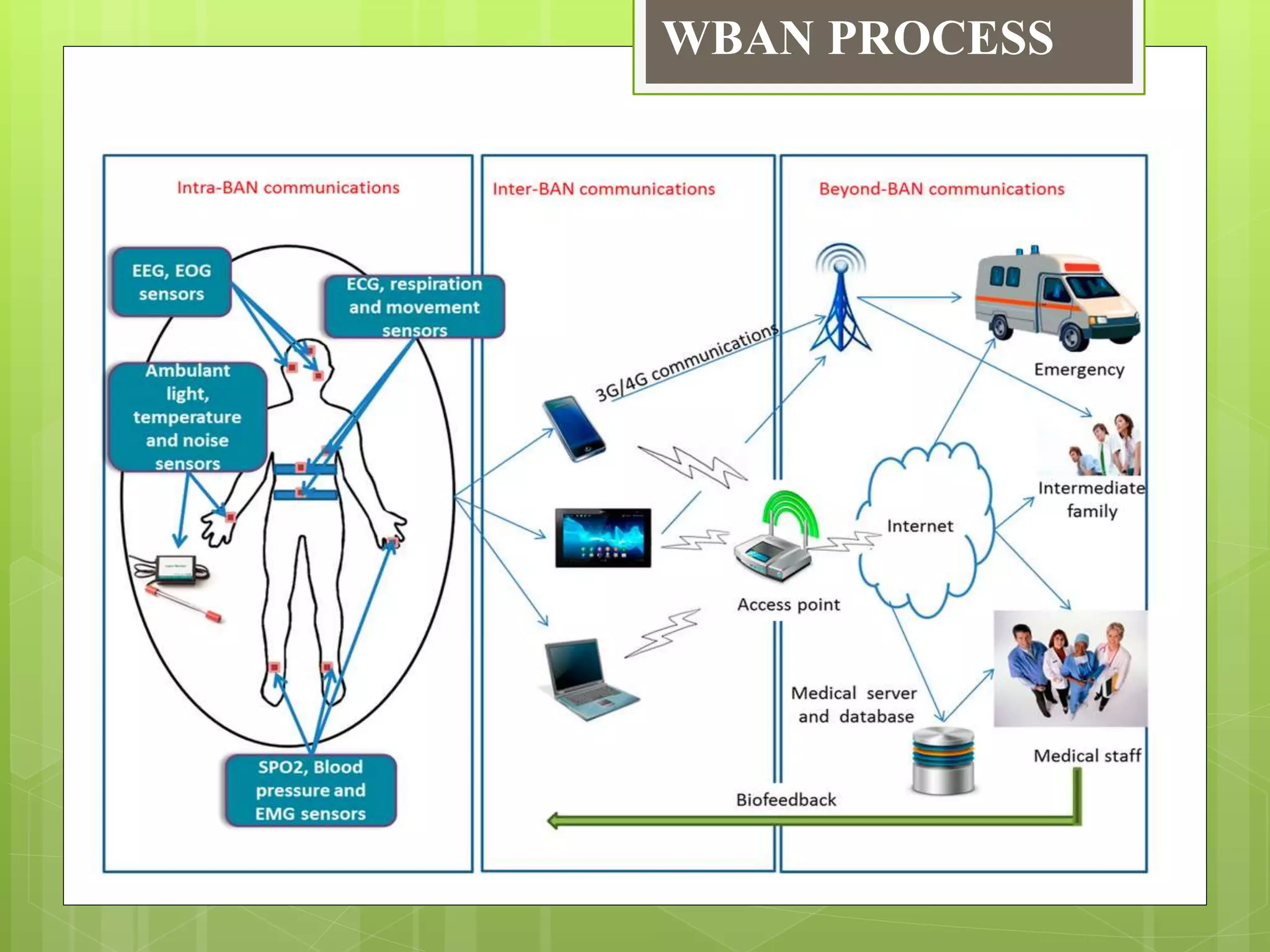
Tire-1
WBAN Sensor
Consists of an intelligent
node which is capable of:
Sensing.
Processing.
Communicating.
ECG(electrocardiogram)sen
sor for monitoring heart
activity.
Tire-2
Personal server
Interface the WBAN
Control Unit through
Zigbee or Bluetooth.
Connected with the
medical server through
mobile telephone networks
(2G, GPRS, 3G) or
WLANs—Internet.
Tire-3
Medical server
Functions include:
To authenticate users.
Save patient data into
medical records.
Analyze the data .
Recognize serious health
cases in order to contact
emergency care givers.
Forward new instruction to
user.
WBAN PROCESS
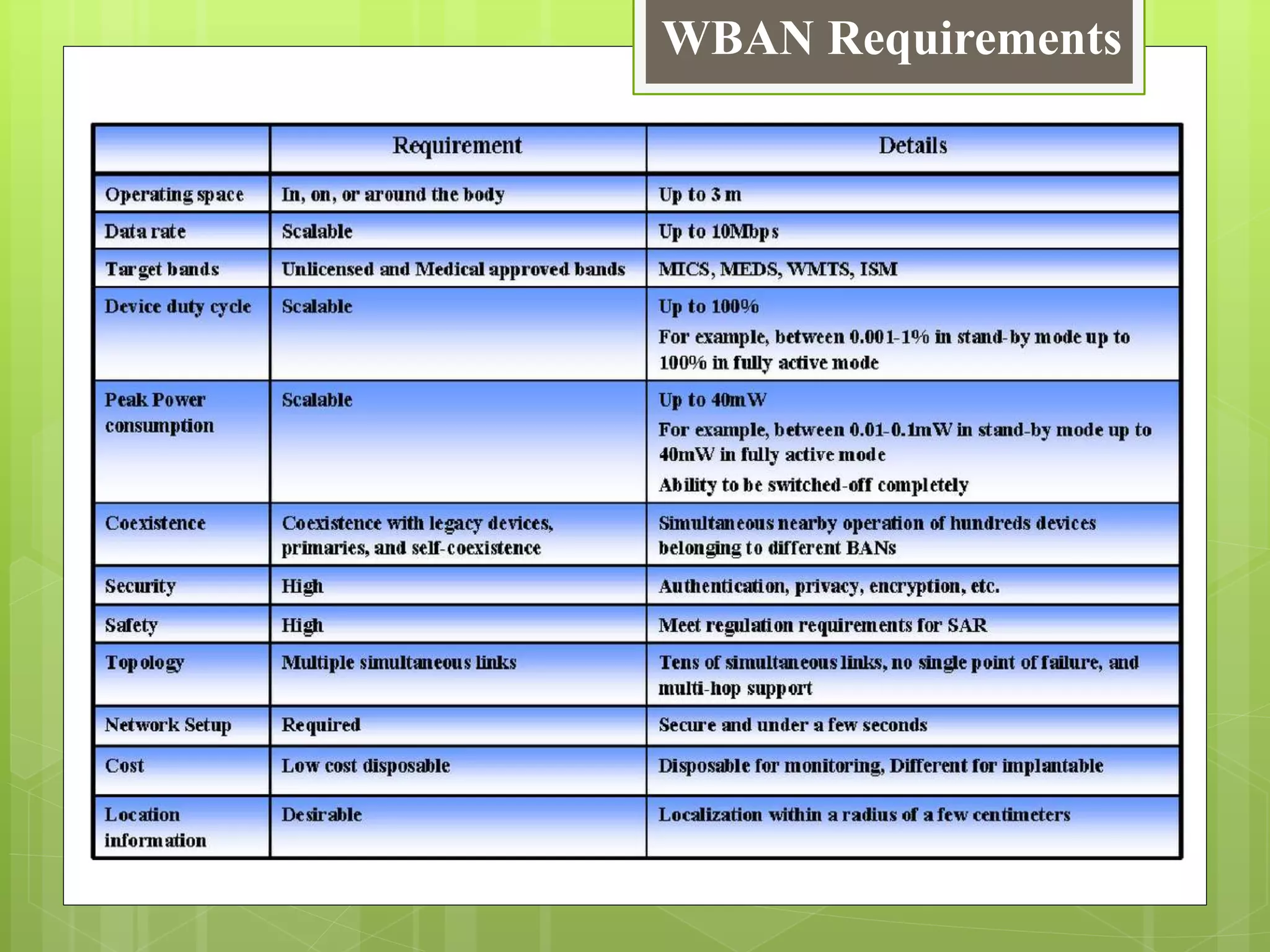
WBAN Requirements
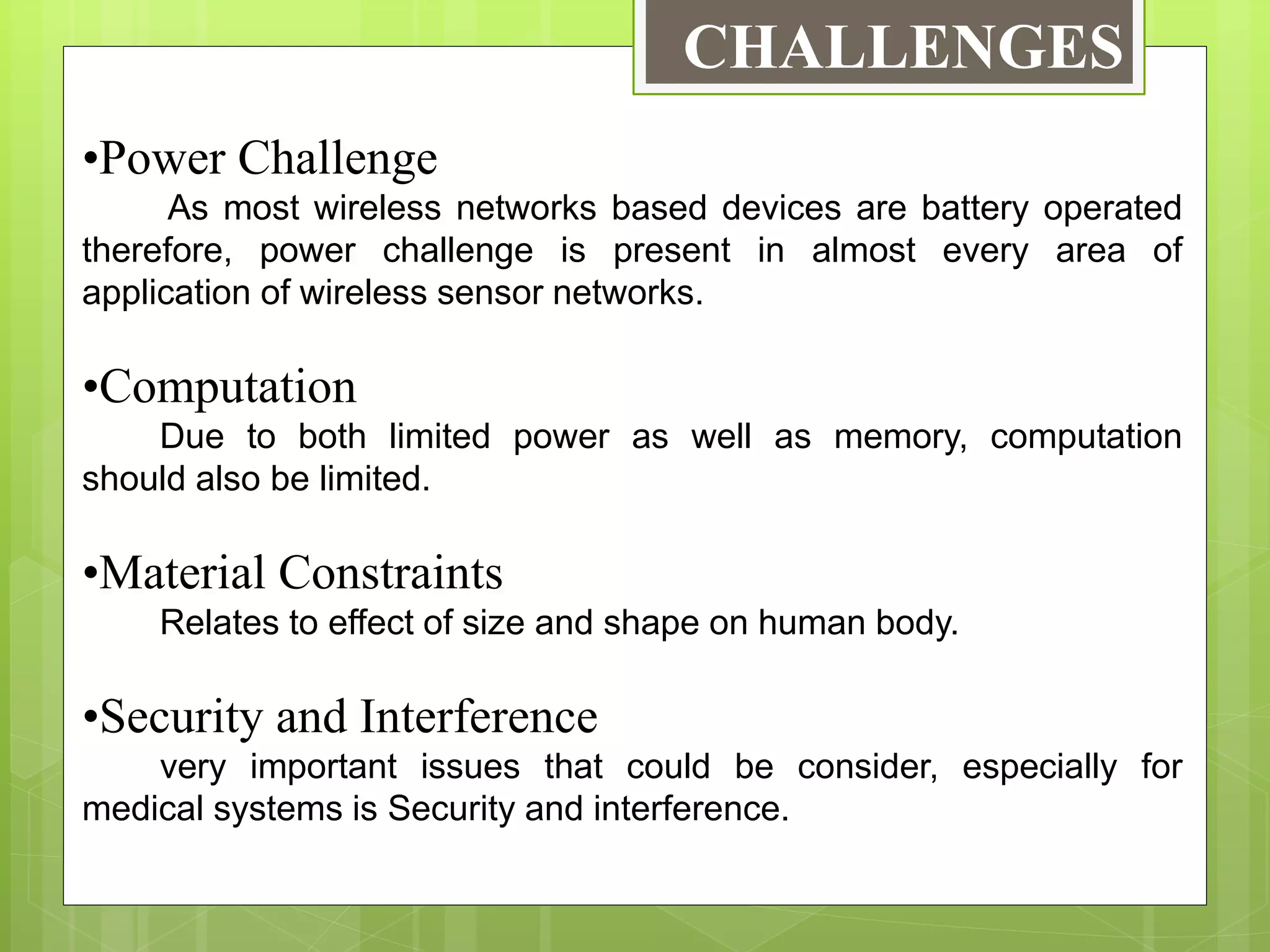
CHALLENGES
•Power Challenge
As most wireless networks based devices are battery operated
therefore, power challenge is present in almost every area of
application of wireless sensor networks.
•Computation
Due to both limited power as well as memory, computation
should also be limited.
•Material Constraints
Relates to effect of size and shape on human body.
•Security and Interference
very important issues that could be consider, especially for
medical systems is Security and interference.
COMPARISION
APPLICATIONS
Health care
Medical
Body Area
Networks
Sports
Fitness
Defence
Entertainment
ADVANTAGES &
DISADVANTAGES
Advantages :
•Used for detection of chronic diseases.
•Emergency services can be get from the doctor.
•Patient has not required to physical available to the doctor.
•Assist the communication between individual and machine
Disadvantages:
•Interface of the multi devices that share the channel
•Lack of integration-sensors
•Effect of the sensors implanted under the skin
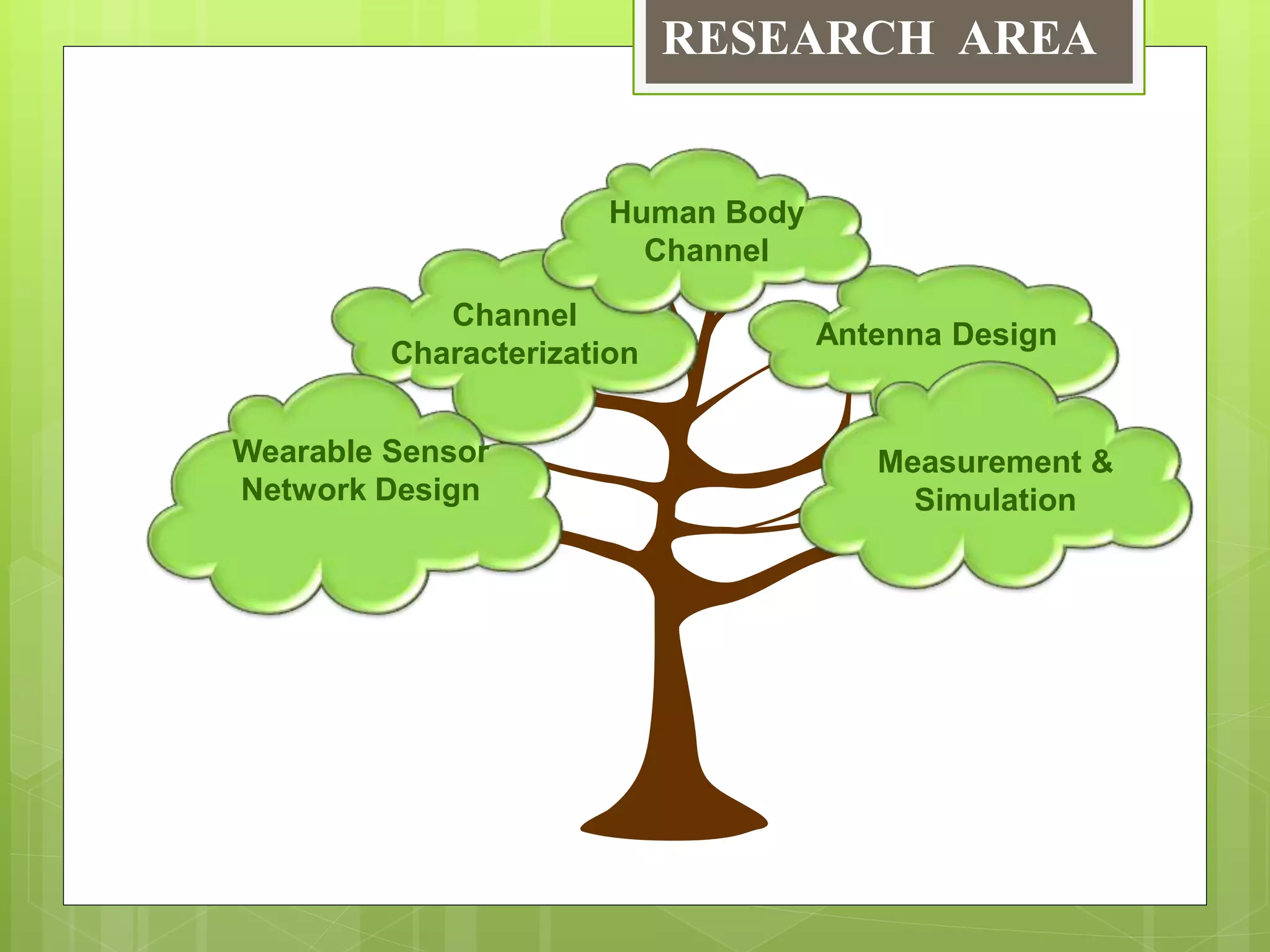
Channel
Characterization
Human Body
Channel
Measurement &
Simulation
Antenna Design
Wearable Sensor
Network Design
RESEARCH AREA
FUTURE SCOPE
•In future these features can be implemented in android platform
in a small network of low energy sensor nodes.
CONCLUSION
•The increasing use of wireless networks and the constant
miniaturization of electrical devices has empowered the
development of Wireless Body Area Networks
(WBANs).
•In these networks various sensors are attached on
clothing or on the body or even implanted under the skin.
•The wireless nature of the network and the wide variety
of sensors power numerous new, practical and innovative
applications to improve health care and the Quality of
Life.
BIBLIOGRAPHY
J.M. Kim, S.H. Park, Y.J. Han, T.M. Chung, “CHEF: CH Election Mechanism Using
Fuzzy Logic In WSNs”, In Proceedings of 10th International Conference on Advanced
Communication Technology (ICACT), Phoenix Park, Korea, pp.654-659 Vol. 1, 17-20
February 2008.
O. Zytoune, M. Aroussi, M. Rziza, D. Aboutajdine, “Stochastic Low Energy Adaptive
Clustering Hierarchy”, Journal of Computer Networks and Internet Research ICGST-
CNIR, Vol. 8, No. 1, pp.47-51, 2008.
S. Stanislava, W.B. Heinzelman, “CH Election Techniques for Coverage Preservation
in WSNs”, Elsevier, Ad Hoc Networks Journal, Vol. 7, No. 5, pp. 955-972, 2009.
C. Song, M. Liu, J. Cao, Y. Zheng et, al , “ Maximizing Network Lifetime Based on
Transmission Range Adjustment in WSNs”, Elsevier, Computer Communication
Journal, Vol. 32, No. 11, pp. 1316-1325, July 2009.
WBAN
THANK YOU

Wireless Body Area Network

  • 1.
  • 2.
     Introduction toWBAN  Definition  WBAN Architecture requirements  WBAN Units  WBAN Functionality  WBAN Architecture  WBAN Process  Challenges  Comparison  Applications  Advantages & Disadvantages  Research Area  Future Scope  Conclusion  Bibliography CONTENTS
  • 3.
    INTRODUCTIO N WBAN is aspecial kind of network, which is designed and developed for Human body, to monitor, manage and communicate different vital signs of human body like temperature, Blood pressure, ECG etc. These vital signs can be monitored by using different sensor installed on clothes or on the body or even under the skin.
  • 4.
    DEFINITION What is BAN…??? Accordingto definition given by IEEE 802.15.6 “A communication standard optimized for low power devices for their operation on, in or around the human body to serve a variety of applications including medical, consumer electronics or personal entertainment and other.”
  • 5.
    WBAN ARCHITECTURE REQUIREMENTS Wireless Sensor Wireless ActuatorNode Wireless Central Unit Wireless Personal Device (PD) ARCHITECTUR E
  • 6.
    WBAN BODY SENSOR UNIT BODYCONTROL UNIT WBAN UNITS
  • 7.
    BODY SENSOR UNIT •Sensorsmeasure certain parameters in one’s body either internally or externally. •These nodes gather and respond to data on a physical stimuli, process necessary data and provide wireless response to BCU. BSU Design: • BSU Hardware • BSU Firmware
  • 8.
    BODY SENSOR UNIT BSUhardware design considerations : 1. Low power and energy consumption. 2. Scaling of major electrical components. 3. Low cost . 4. Small volume. Body Sensor Unit Firmware: •Principle challenge of BCU firmware is Wireless transmission of motion data via Bluetooth
  • 9.
    BODY CONTROL UNIT Themain functions of BCU •Implementation of additional sensors •Receiving Data •Saving Data •Plotting Data
  • 10.
  • 11.
  • 12.
  • 13.
    3 TIER ARCHITECTURE Tire-1 WBANSensor Consists of an intelligent node which is capable of: Sensing. Processing. Communicating. ECG(electrocardiogram)sen sor for monitoring heart activity. Tire-2 Personal server Interface the WBAN Control Unit through Zigbee or Bluetooth. Connected with the medical server through mobile telephone networks (2G, GPRS, 3G) or WLANs—Internet. Tire-3 Medical server Functions include: To authenticate users. Save patient data into medical records. Analyze the data . Recognize serious health cases in order to contact emergency care givers. Forward new instruction to user.
  • 14.
  • 15.
  • 16.
    CHALLENGES •Power Challenge As mostwireless networks based devices are battery operated therefore, power challenge is present in almost every area of application of wireless sensor networks. •Computation Due to both limited power as well as memory, computation should also be limited. •Material Constraints Relates to effect of size and shape on human body. •Security and Interference very important issues that could be consider, especially for medical systems is Security and interference.
  • 17.
  • 18.
  • 19.
    ADVANTAGES & DISADVANTAGES Advantages : •Usedfor detection of chronic diseases. •Emergency services can be get from the doctor. •Patient has not required to physical available to the doctor. •Assist the communication between individual and machine Disadvantages: •Interface of the multi devices that share the channel •Lack of integration-sensors •Effect of the sensors implanted under the skin
  • 20.
    Channel Characterization Human Body Channel Measurement & Simulation AntennaDesign Wearable Sensor Network Design RESEARCH AREA
  • 21.
    FUTURE SCOPE •In futurethese features can be implemented in android platform in a small network of low energy sensor nodes.
  • 22.
    CONCLUSION •The increasing useof wireless networks and the constant miniaturization of electrical devices has empowered the development of Wireless Body Area Networks (WBANs). •In these networks various sensors are attached on clothing or on the body or even implanted under the skin. •The wireless nature of the network and the wide variety of sensors power numerous new, practical and innovative applications to improve health care and the Quality of Life.
  • 23.
    BIBLIOGRAPHY J.M. Kim, S.H.Park, Y.J. Han, T.M. Chung, “CHEF: CH Election Mechanism Using Fuzzy Logic In WSNs”, In Proceedings of 10th International Conference on Advanced Communication Technology (ICACT), Phoenix Park, Korea, pp.654-659 Vol. 1, 17-20 February 2008. O. Zytoune, M. Aroussi, M. Rziza, D. Aboutajdine, “Stochastic Low Energy Adaptive Clustering Hierarchy”, Journal of Computer Networks and Internet Research ICGST- CNIR, Vol. 8, No. 1, pp.47-51, 2008. S. Stanislava, W.B. Heinzelman, “CH Election Techniques for Coverage Preservation in WSNs”, Elsevier, Ad Hoc Networks Journal, Vol. 7, No. 5, pp. 955-972, 2009. C. Song, M. Liu, J. Cao, Y. Zheng et, al , “ Maximizing Network Lifetime Based on Transmission Range Adjustment in WSNs”, Elsevier, Computer Communication Journal, Vol. 32, No. 11, pp. 1316-1325, July 2009.
  • 24.