Intelligent Reflecting Surface (IRS)
Domain: 5G Beyond Wireless Communication Research
Dr. Varun Kumar
Domain: 5G Beyond Wireless Communication Research Dr. Varun KumarDr. Varun Kumar 1 / 12
Outlines
1 Introduction to Intelligent Reflecting Surface (IRS)
2 Existing Key Technology for Improvising the SNR
3 Need of IRS
4 Research Direction in IRS
5 References
Domain: 5G Beyond Wireless Communication Research Dr. Varun KumarDr. Varun Kumar 2 / 12
Intelligent Reflecting Surface (IRS):
Intelligent Reflecting Surface (IRS)
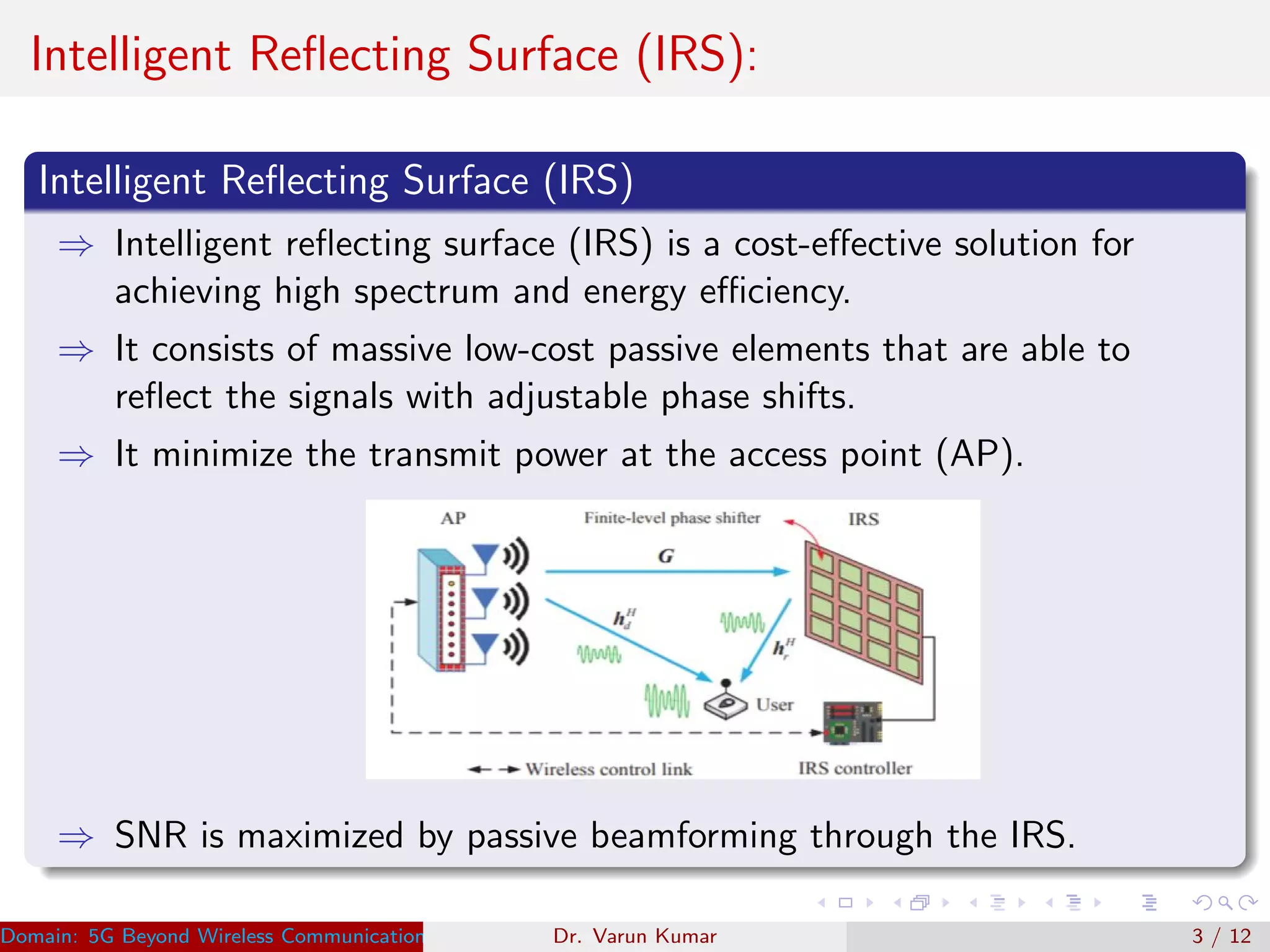
⇒ Intelligent reflecting surface (IRS) is a cost-effective solution for
achieving high spectrum and energy efficiency.
⇒ It consists of massive low-cost passive elements that are able to
reflect the signals with adjustable phase shifts.
⇒ It minimize the transmit power at the access point (AP).
⇒ SNR is maximized by passive beamforming through the IRS.
Domain: 5G Beyond Wireless Communication Research Dr. Varun KumarDr. Varun Kumar 3 / 12
Fundamentals of reflection phenomenon
⇒ When a electro-magnetic wave strike to the surface then three things
may occur at a same time
1. Refraction
2. Reflection
3. Scattering
Electrical characteristics of surface
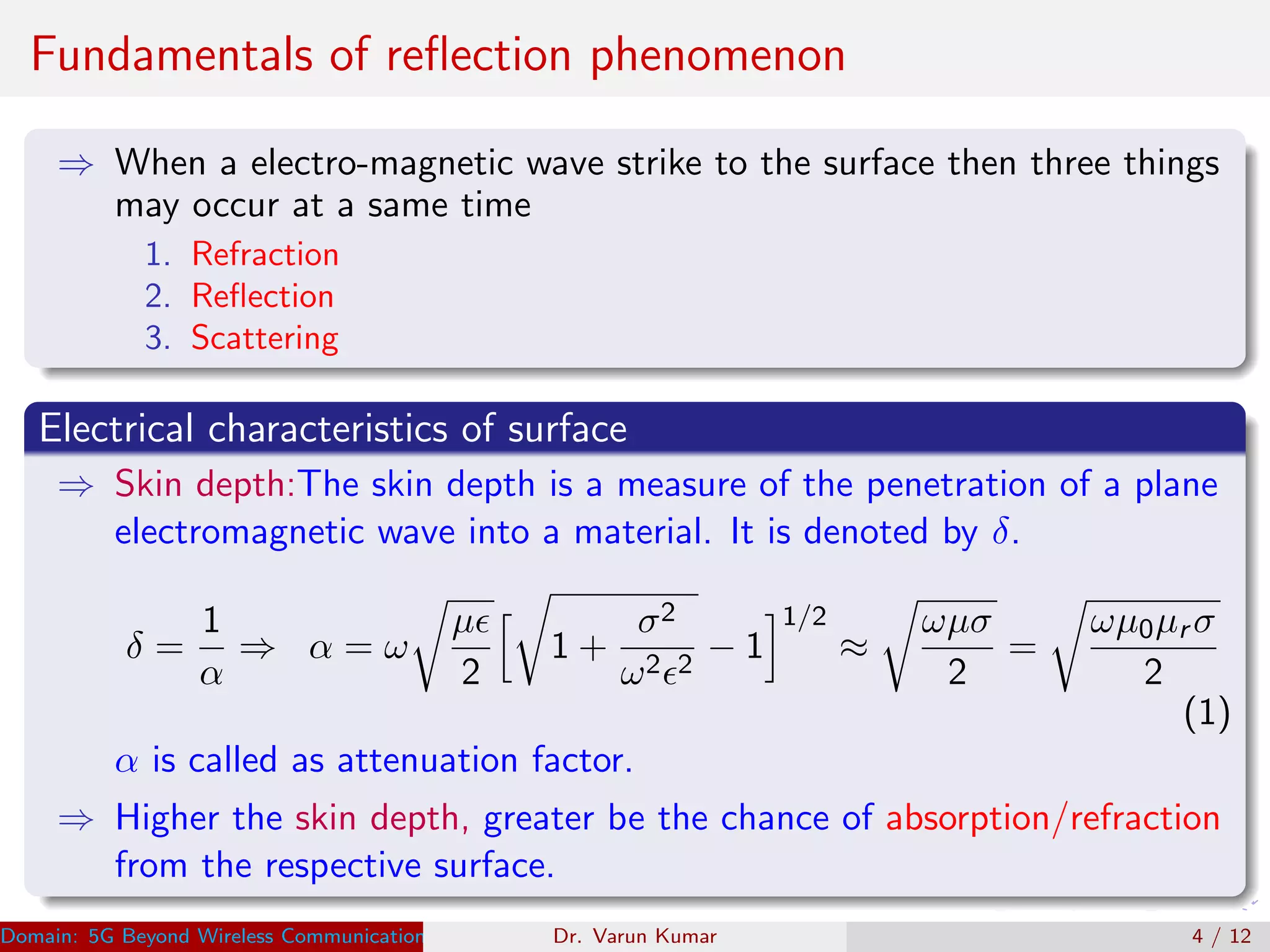
⇒ Skin depth:The skin depth is a measure of the penetration of a plane
electromagnetic wave into a material. It is denoted by δ.
δ =
1
α
⇒ α = ω
µ
2
1 +
σ2
ω2 2
− 1
1/2
≈
ωµσ
2
=
ωµ0µr σ
2
(1)
α is called as attenuation factor.
⇒ Higher the skin depth, greater be the chance of absorption/refraction
from the respective surface.
Domain: 5G Beyond Wireless Communication Research Dr. Varun KumarDr. Varun Kumar 4 / 12
Continued–
δ =
2
ωµ0µr σ
(2)
From (2), it is clear that skin depth decreases (more chance of
reflection) by
ω → Frequency of incident wave
σ → Conductivity of the surface
µr → Relative permeability
⇒ When the nature of surface is metallic then reflected wave has high
amount of energy.
⇒ For non-intelligent surface, reflection phenomena dominates, when
surface has high conductivity.
Domain: 5G Beyond Wireless Communication Research Dr. Varun KumarDr. Varun Kumar 5 / 12
Continued–
⇒ On the other side, if the nature of surface is non-metallic/di-electric
then that surface absorbs huge amount of incident energy.
⇒ If surface is not smooth then multiple reflected and refracted wave
components can be observed from that surface. → Scattering
⇒ From figure given below, reflection, refraction and scattering can be
observed through the ray tracing operation.
Note: If surface is non-intelligent and passive in nature then the angle of
incidence is equal to the angle of reflection.
Domain: 5G Beyond Wireless Communication Research Dr. Varun KumarDr. Varun Kumar 6 / 12
What is intelligent surface?
⇒ The inherent quality of IRS should be as follows
1 The nature of surface should be metallic.
2 Surface should be smooth enough, so that uni-direction of reflected
wave could be achieved.
3 Direction change ability of the reflected wave.
⇒ In communication system, the strength of reflected signal decides the
SNR quality in multi path environment.
⇒ The signal strength becomes prominent in case small IoT devices or a
mobile user.
Domain: 5G Beyond Wireless Communication Research Dr. Varun KumarDr. Varun Kumar 7 / 12
Continued–
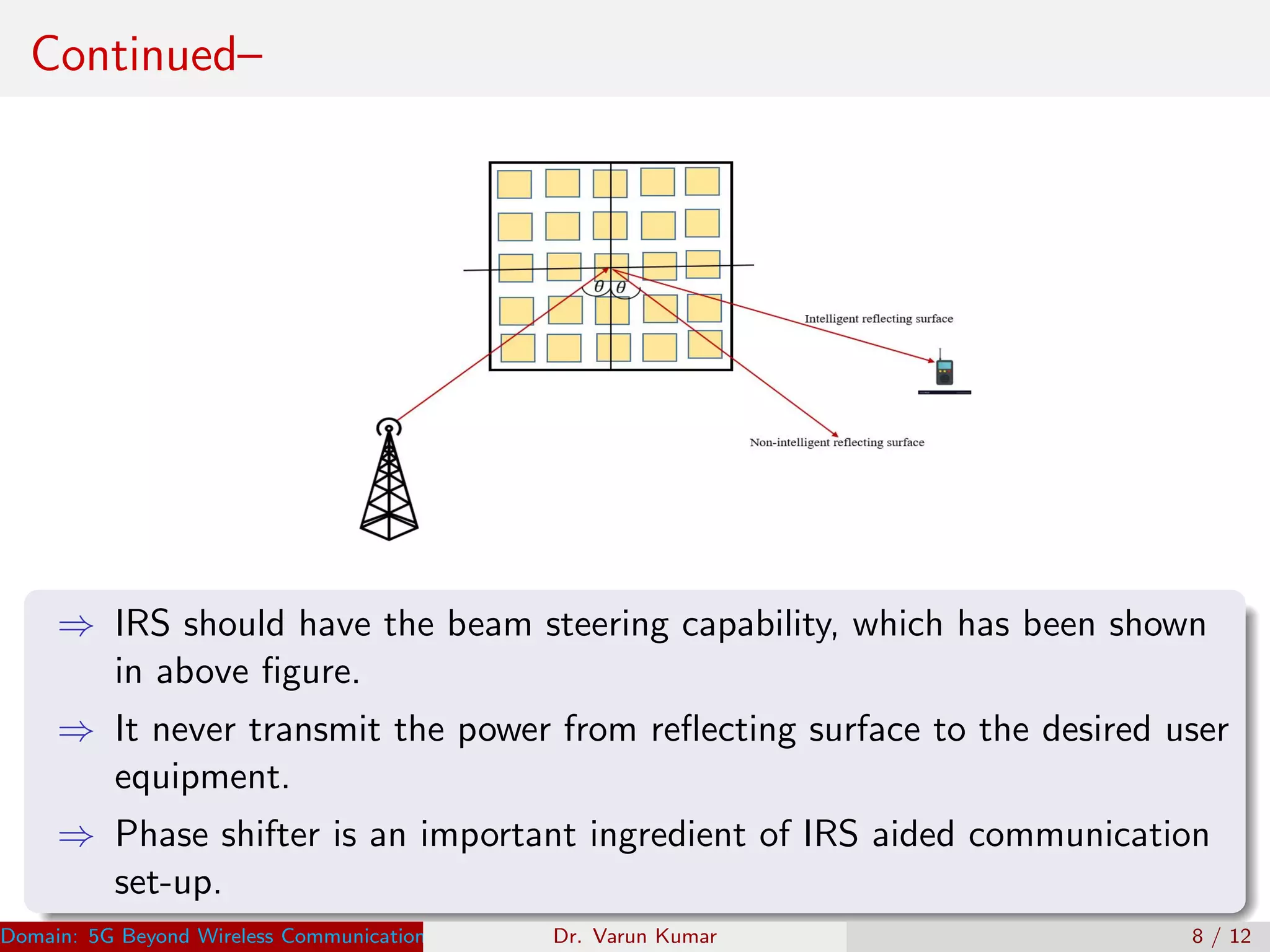
⇒ IRS should have the beam steering capability, which has been shown
in above figure.
⇒ It never transmit the power from reflecting surface to the desired user
equipment.
⇒ Phase shifter is an important ingredient of IRS aided communication
set-up.
Domain: 5G Beyond Wireless Communication Research Dr. Varun KumarDr. Varun Kumar 8 / 12
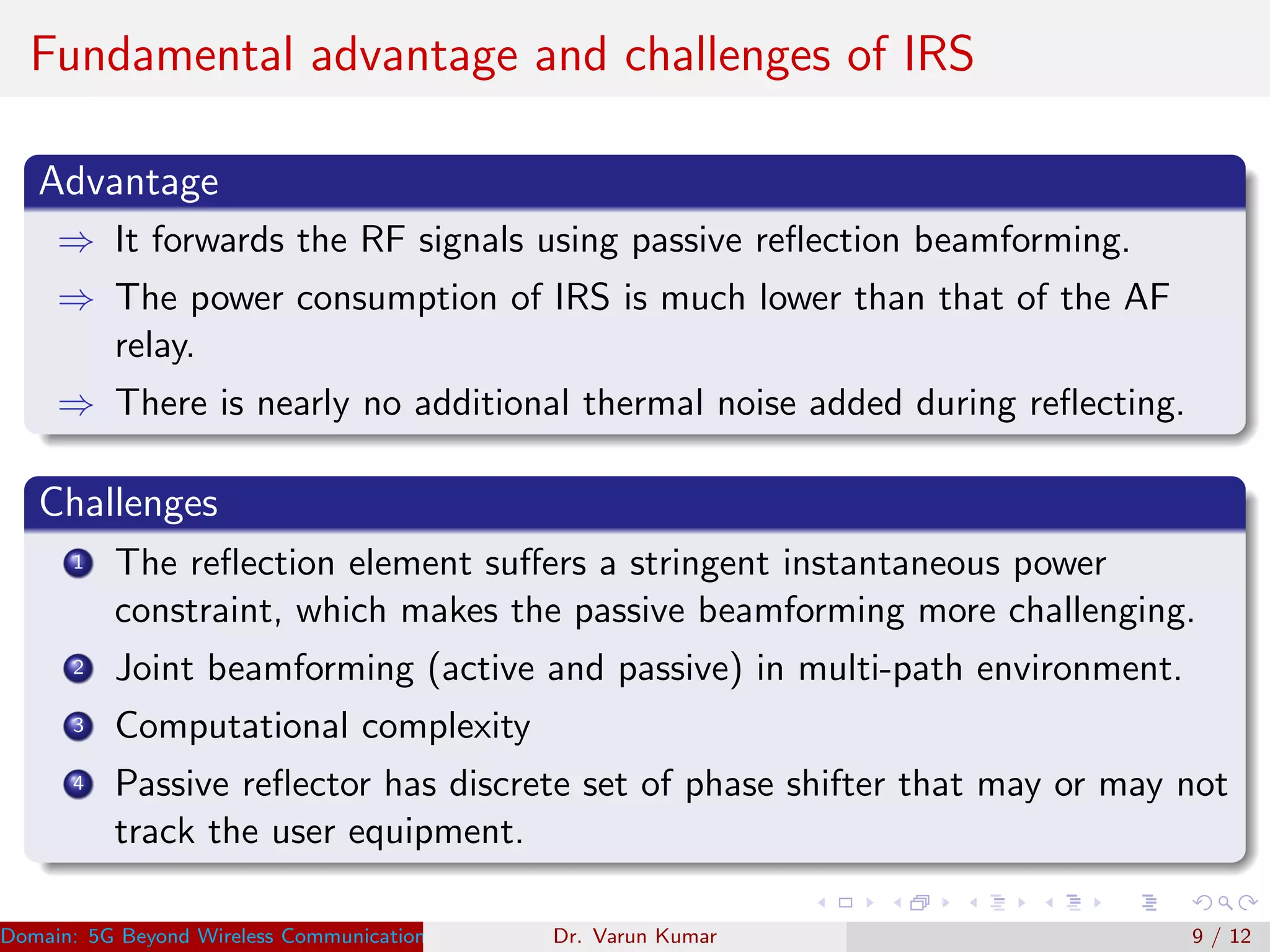
Fundamental advantage and challenges of IRS
Advantage
⇒ It forwards the RF signals using passive reflection beamforming.
⇒ The power consumption of IRS is much lower than that of the AF
relay.
⇒ There is nearly no additional thermal noise added during reflecting.
Challenges
1 The reflection element suffers a stringent instantaneous power
constraint, which makes the passive beamforming more challenging.
2 Joint beamforming (active and passive) in multi-path environment.
3 Computational complexity
4 Passive reflector has discrete set of phase shifter that may or may not
track the user equipment.
Domain: 5G Beyond Wireless Communication Research Dr. Varun KumarDr. Varun Kumar 9 / 12
Similar key technology for improvising the SNR/data rate
⇒ Massive MIMO
Large arrays of antennas are utilized to improve spectral and energy
efficiencies.
One of the important breakthrough for 5G wireless communication.
⇒ mm-Wave communication
It helps in active beamforming operation.
Very high carrier frequency of operation helps for integrating large
number of antenna elements within a fixed physical space. → Base for
massive MIMO network formation
Spatial multiplexing and beamforming enhances the data rate as well
end user received signal strength.
⇒ Back-scatter communication
It enable the low-power communications as required in the Internet of
things (IoTs) and green communications.
Domain: 5G Beyond Wireless Communication Research Dr. Varun KumarDr. Varun Kumar 10 / 12
Research direction
1 In the field of material science for making good quality reflecting
surface.
2 To develop a software based RF propagation control mechanism.
3 How to integrate the reconfigurable meta-surfaces into wireless
networks?
4 What are the ultimate performance limits of wireless networks in the
presence of reconfigurable meta-surfaces?
5 How to attain such performance limits in practice?
Domain: 5G Beyond Wireless Communication Research Dr. Varun KumarDr. Varun Kumar 11 / 12
References
M. Di Renzo, M. Debbah, D.-T. Phan-Huy, A. Zappone, M.-S. Alouini, C. Yuen,
V. Sciancalepore, G. C. Alexandropoulos, J. Hoydis, H. Gacanin et al., “Smart
radio environments empowered by reconfigurable ai meta-surfaces: An idea whose
time has come,” EURASIP Journal on Wireless Communications and Networking,
vol. 2019, no. 1, pp. 1–20, 2019.
H. Guo, Y.-C. Liang, J. Chen, and E. G. Larsson, “Weighted sum-rate optimization
for intelligent reflecting surface enhanced wireless networks,” arXiv preprint
arXiv:1905.07920, 2019.
Q. Wu and R. Zhang, “Intelligent reflecting surface enhanced wireless network via
joint active and passive beamforming,” IEEE Transactions on Wireless
Communications, vol. 18, no. 11, pp. 5394–5409, 2019.
J.-P. Niu and G. Y. Li, “An overview on backscatter communications,” 2019.
Domain: 5G Beyond Wireless Communication Research Dr. Varun KumarDr. Varun Kumar 12 / 12

Intelligent reflecting surface

  • 1.
    Intelligent Reflecting Surface(IRS) Domain: 5G Beyond Wireless Communication Research Dr. Varun Kumar Domain: 5G Beyond Wireless Communication Research Dr. Varun KumarDr. Varun Kumar 1 / 12
  • 2.
    Outlines 1 Introduction toIntelligent Reflecting Surface (IRS) 2 Existing Key Technology for Improvising the SNR 3 Need of IRS 4 Research Direction in IRS 5 References Domain: 5G Beyond Wireless Communication Research Dr. Varun KumarDr. Varun Kumar 2 / 12
  • 3.
    Intelligent Reflecting Surface(IRS): Intelligent Reflecting Surface (IRS) ⇒ Intelligent reflecting surface (IRS) is a cost-effective solution for achieving high spectrum and energy efficiency. ⇒ It consists of massive low-cost passive elements that are able to reflect the signals with adjustable phase shifts. ⇒ It minimize the transmit power at the access point (AP). ⇒ SNR is maximized by passive beamforming through the IRS. Domain: 5G Beyond Wireless Communication Research Dr. Varun KumarDr. Varun Kumar 3 / 12
  • 4.
    Fundamentals of reflectionphenomenon ⇒ When a electro-magnetic wave strike to the surface then three things may occur at a same time 1. Refraction 2. Reflection 3. Scattering Electrical characteristics of surface ⇒ Skin depth:The skin depth is a measure of the penetration of a plane electromagnetic wave into a material. It is denoted by δ. δ = 1 α ⇒ α = ω µ 2 1 + σ2 ω2 2 − 1 1/2 ≈ ωµσ 2 = ωµ0µr σ 2 (1) α is called as attenuation factor. ⇒ Higher the skin depth, greater be the chance of absorption/refraction from the respective surface. Domain: 5G Beyond Wireless Communication Research Dr. Varun KumarDr. Varun Kumar 4 / 12
  • 5.
    Continued– δ = 2 ωµ0µr σ (2) From(2), it is clear that skin depth decreases (more chance of reflection) by ω → Frequency of incident wave σ → Conductivity of the surface µr → Relative permeability ⇒ When the nature of surface is metallic then reflected wave has high amount of energy. ⇒ For non-intelligent surface, reflection phenomena dominates, when surface has high conductivity. Domain: 5G Beyond Wireless Communication Research Dr. Varun KumarDr. Varun Kumar 5 / 12
  • 6.
    Continued– ⇒ On theother side, if the nature of surface is non-metallic/di-electric then that surface absorbs huge amount of incident energy. ⇒ If surface is not smooth then multiple reflected and refracted wave components can be observed from that surface. → Scattering ⇒ From figure given below, reflection, refraction and scattering can be observed through the ray tracing operation. Note: If surface is non-intelligent and passive in nature then the angle of incidence is equal to the angle of reflection. Domain: 5G Beyond Wireless Communication Research Dr. Varun KumarDr. Varun Kumar 6 / 12
  • 7.
    What is intelligentsurface? ⇒ The inherent quality of IRS should be as follows 1 The nature of surface should be metallic. 2 Surface should be smooth enough, so that uni-direction of reflected wave could be achieved. 3 Direction change ability of the reflected wave. ⇒ In communication system, the strength of reflected signal decides the SNR quality in multi path environment. ⇒ The signal strength becomes prominent in case small IoT devices or a mobile user. Domain: 5G Beyond Wireless Communication Research Dr. Varun KumarDr. Varun Kumar 7 / 12
  • 8.
    Continued– ⇒ IRS shouldhave the beam steering capability, which has been shown in above figure. ⇒ It never transmit the power from reflecting surface to the desired user equipment. ⇒ Phase shifter is an important ingredient of IRS aided communication set-up. Domain: 5G Beyond Wireless Communication Research Dr. Varun KumarDr. Varun Kumar 8 / 12
  • 9.
    Fundamental advantage andchallenges of IRS Advantage ⇒ It forwards the RF signals using passive reflection beamforming. ⇒ The power consumption of IRS is much lower than that of the AF relay. ⇒ There is nearly no additional thermal noise added during reflecting. Challenges 1 The reflection element suffers a stringent instantaneous power constraint, which makes the passive beamforming more challenging. 2 Joint beamforming (active and passive) in multi-path environment. 3 Computational complexity 4 Passive reflector has discrete set of phase shifter that may or may not track the user equipment. Domain: 5G Beyond Wireless Communication Research Dr. Varun KumarDr. Varun Kumar 9 / 12
  • 10.
    Similar key technologyfor improvising the SNR/data rate ⇒ Massive MIMO Large arrays of antennas are utilized to improve spectral and energy efficiencies. One of the important breakthrough for 5G wireless communication. ⇒ mm-Wave communication It helps in active beamforming operation. Very high carrier frequency of operation helps for integrating large number of antenna elements within a fixed physical space. → Base for massive MIMO network formation Spatial multiplexing and beamforming enhances the data rate as well end user received signal strength. ⇒ Back-scatter communication It enable the low-power communications as required in the Internet of things (IoTs) and green communications. Domain: 5G Beyond Wireless Communication Research Dr. Varun KumarDr. Varun Kumar 10 / 12
  • 11.
    Research direction 1 Inthe field of material science for making good quality reflecting surface. 2 To develop a software based RF propagation control mechanism. 3 How to integrate the reconfigurable meta-surfaces into wireless networks? 4 What are the ultimate performance limits of wireless networks in the presence of reconfigurable meta-surfaces? 5 How to attain such performance limits in practice? Domain: 5G Beyond Wireless Communication Research Dr. Varun KumarDr. Varun Kumar 11 / 12
  • 12.
    References M. Di Renzo,M. Debbah, D.-T. Phan-Huy, A. Zappone, M.-S. Alouini, C. Yuen, V. Sciancalepore, G. C. Alexandropoulos, J. Hoydis, H. Gacanin et al., “Smart radio environments empowered by reconfigurable ai meta-surfaces: An idea whose time has come,” EURASIP Journal on Wireless Communications and Networking, vol. 2019, no. 1, pp. 1–20, 2019. H. Guo, Y.-C. Liang, J. Chen, and E. G. Larsson, “Weighted sum-rate optimization for intelligent reflecting surface enhanced wireless networks,” arXiv preprint arXiv:1905.07920, 2019. Q. Wu and R. Zhang, “Intelligent reflecting surface enhanced wireless network via joint active and passive beamforming,” IEEE Transactions on Wireless Communications, vol. 18, no. 11, pp. 5394–5409, 2019. J.-P. Niu and G. Y. Li, “An overview on backscatter communications,” 2019. Domain: 5G Beyond Wireless Communication Research Dr. Varun KumarDr. Varun Kumar 12 / 12